20 Best Retail Sales Associate Resume Examples and Templates for 2026



Store managers decide whether to call by the top third of page one; if sales numbers, shift availability, and POS experience aren't visible by then, the resume goes to the no pile.
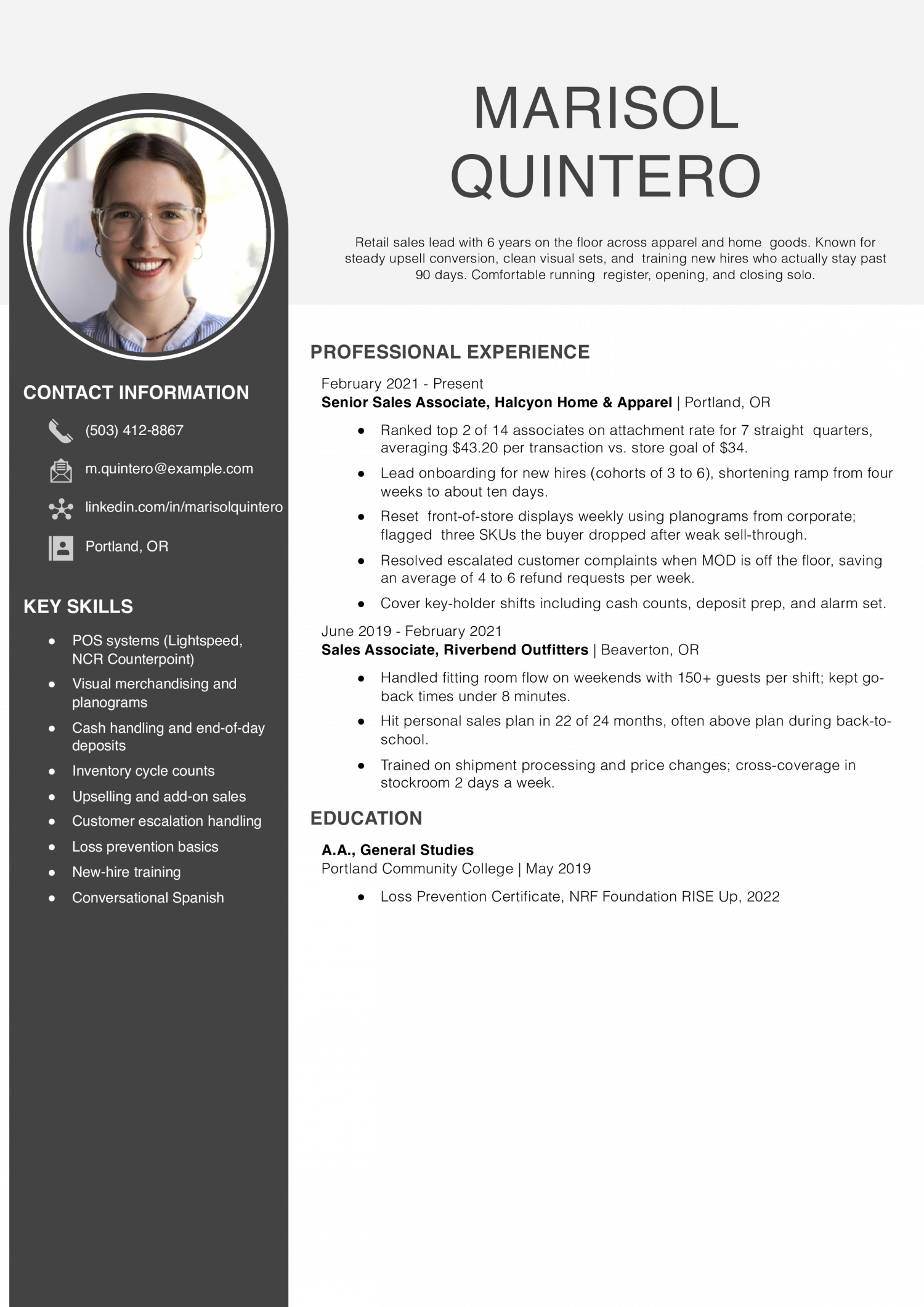
Entry level covers first-job seekers, students, and applicants moving in from food service or warehouse work. The resume needs to prove reliability, customer-facing comfort, and shift availability rather than years on a sales floor.
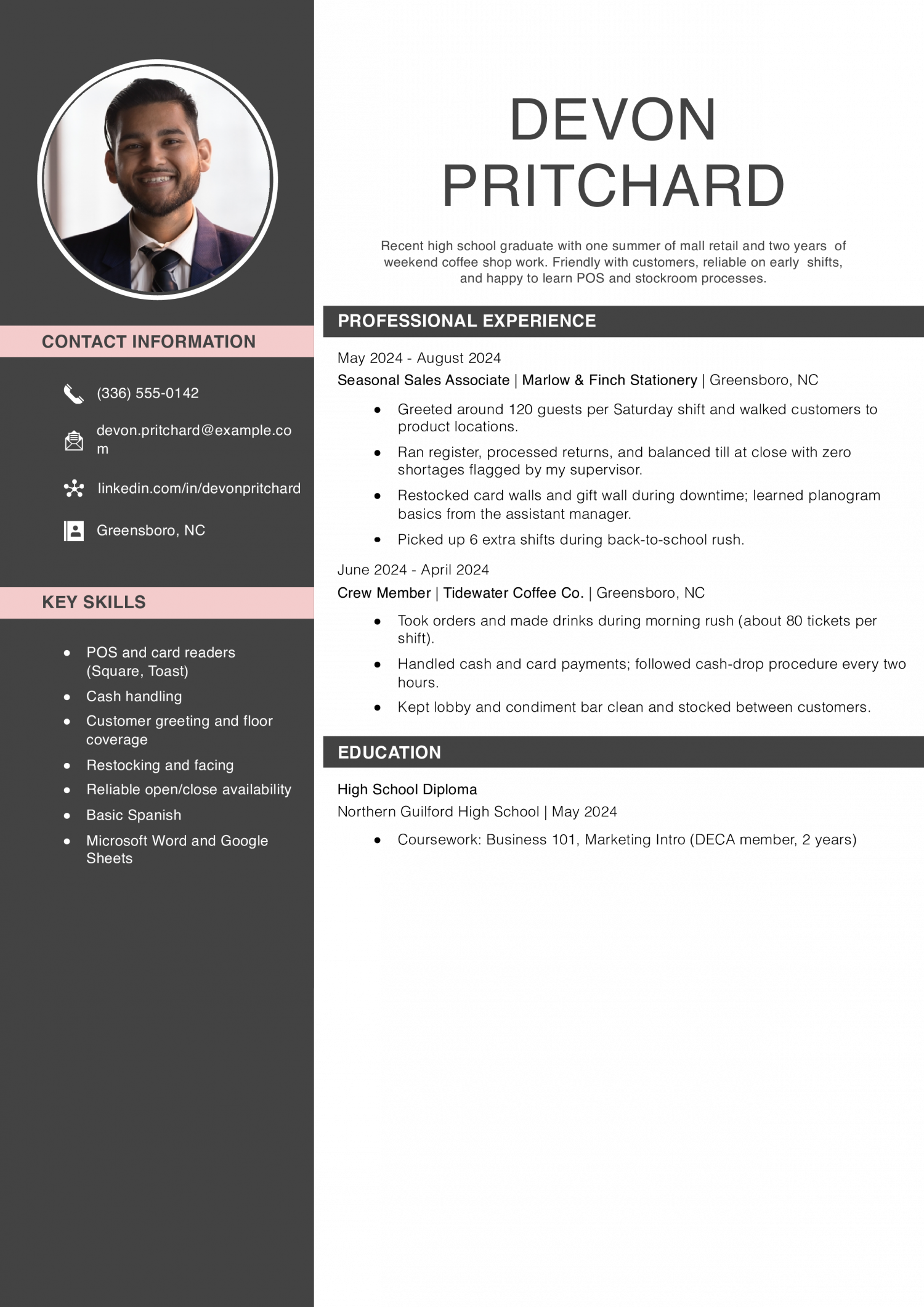
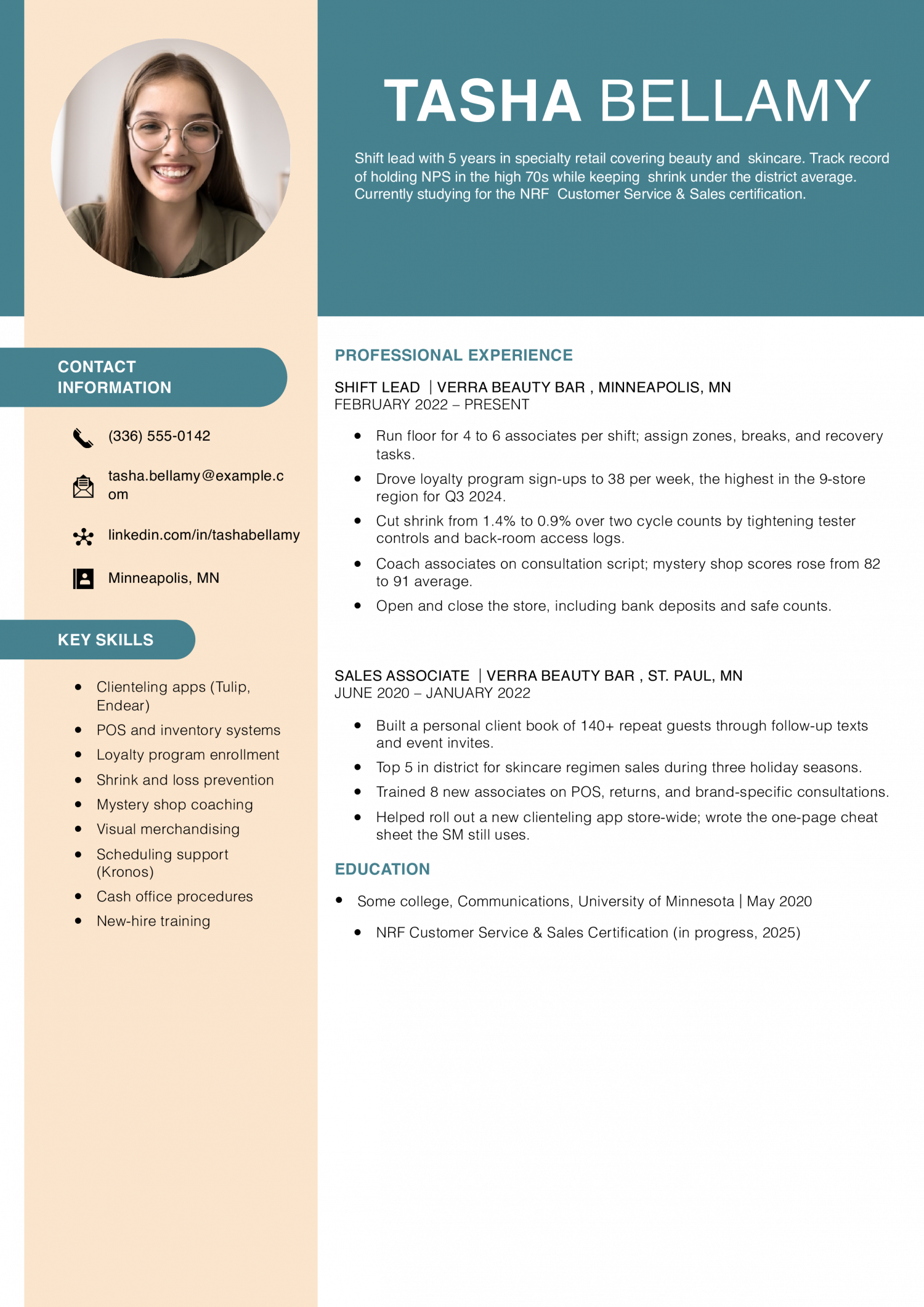
Experienced applicants have 2 to 5 years on the floor as a sales associate, cashier, or keyholder. The resume needs to prove consistent sales numbers, POS accuracy, and the trust to open, close, or handle voids.
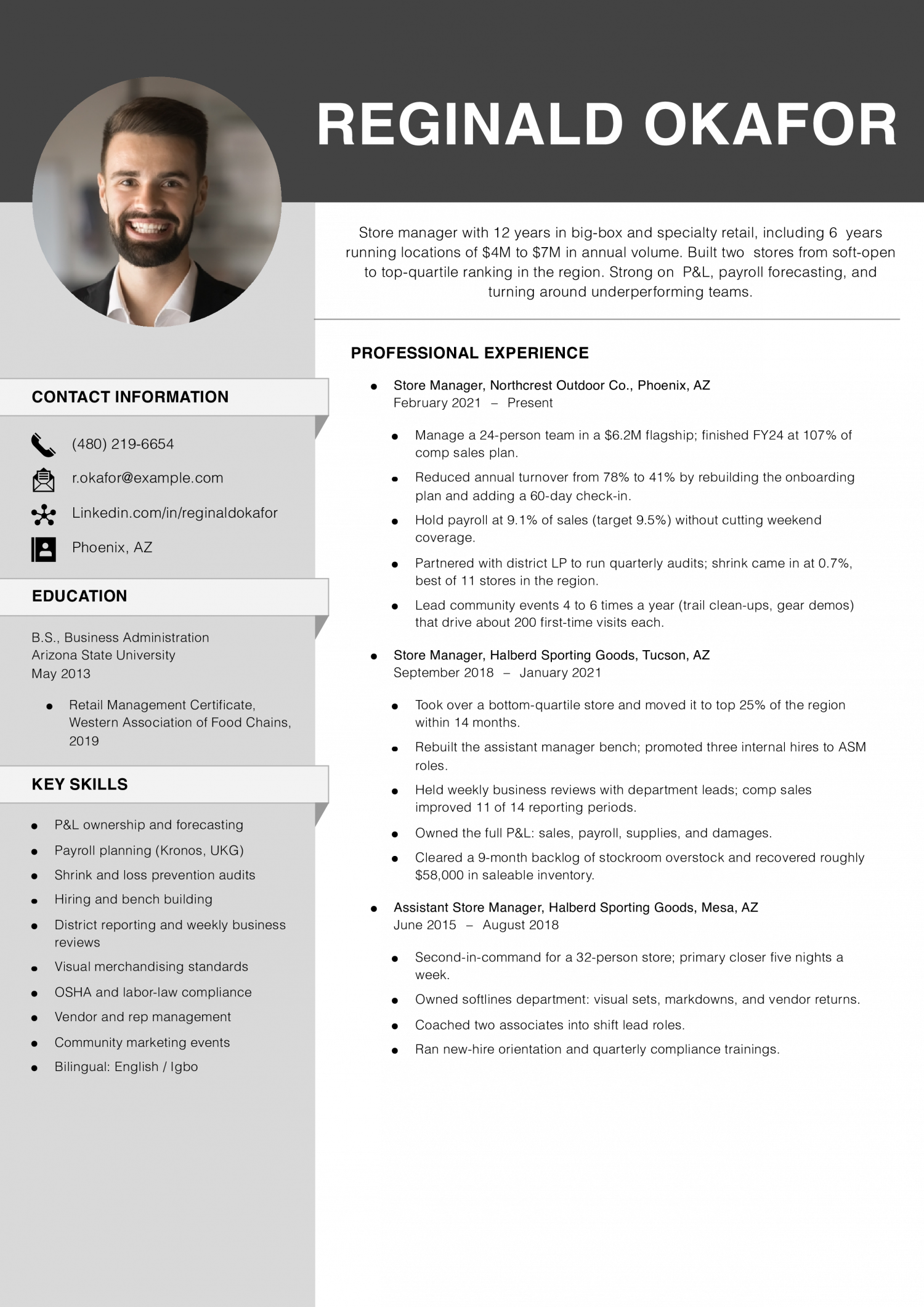
Manager covers assistant store managers, store managers, and department leads running staff and P&L. The resume needs to prove store-level revenue growth, shrink control, and the hiring and scheduling work behind those numbers.
Camille Hartwell
Nashville, TN | (615) 332-9087 | [email protected] | linkedin.com/in/camillehartwell
Retail professional with 9 years moving from seasonal cashier to assistant store manager in specialty apparel and home goods. Strong on visual merchandising, training, and inventory accuracy. Looking for a store manager role with a brand that takes both product and people seriously.
Assistant Store Manager
Pemberton & Crane Home | Nashville, TN | 2022-Present
Shift Lead
Pemberton & Crane Home | Franklin, TN | 2020-2022
Sales Associate
Avila Apparel Group | Murfreesboro, TN | 2018-2020
Cashier
Briarwood Garden Center | Murfreesboro, TN | 2017-2018
Seasonal Sales Associate
Holloway Toy Co. | Murfreesboro, TN | Nov 2016-Jan 2017
Your profile should state your years on a sales floor, the store type you’ve worked in, and the dollar volume or traffic level you’re used to.
Name the categories you’ve sold, whether apparel, electronics, beauty, or grocery, and the shift pattern you can cover.
A boutique manager reading the top of page one wants to see if you’ve handled their pace and product mix. A big-box district manager wants the store volume and headcount you’ve worked under, stated in plain numbers, not vague claims about being a team player or going the extra mile.
Retail is a numbers job, so bullets without a number tend to read as duties rather than results.
Name two or three metrics most strong resumes carry: weekly or monthly sales against goal, units per transaction, and shrink or inventory accuracy.
If you opened or closed the store, say how many shifts per week. If you ran a department, name the dollar volume. Bullets like “hit 112% of quarterly sales goal across 14 weeks” or “kept register variance under $5 across 200 shifts” do more work than “strong sales performer.”
Break your bullets into the categories store managers scan for: customer service, sales and upsell, POS and cash handling, merchandising and stock, and loss prevention.
Under customer service, name returns, complaints, and special orders you handled.
Under sales, name the conversion or attachment metrics you moved. Under POS, name the system (NCR, Lightspeed, Square, Shopify POS) and what you were trusted to do, such as voids, refunds, or end-of-day deposits. Visual merchandisers should call out planogram resets and window changeovers.
Put a short block near the top of page one listing your POS systems, any loss prevention or food handler certifications, and your shift availability.
Store managers and district managers staff against open shifts, so seeing “available nights, weekends, and holidays” early saves them a phone call.
If you carry a state alcohol-server card (TABC, TIPS, ServSafe Alcohol) or a forklift certification for stockroom work, list the certifying body and current expiration. Loss prevention coursework belongs here too, especially for keyholder roles.
If you’re entry level, keep education near the top: high school diploma, GED, or current enrollment, plus any retail-adjacent coursework or DECA experience.
For experienced applicants, education moves to the bottom and gets one line.
Add a short section for languages spoken on the floor, since bilingual associates get pulled forward in markets where the customer base demands it. Skip references, a photo, and any objective statement that opens with “seeking.” Those slots are better spent on another quantified bullet.
The retail resumes that get callbacks share a specific skill mix. The lists below come from our user-built retail resumes. Store managers and district managers scan for these patterns first, not generic customer service platitudes.
Hard skills carry more weight for keyholder and stockroom roles, while soft skills carry more weight for sales floor and service desk work. Match your bullets to the posting, and treat each soft skill as a claim that needs a quantified bullet backing it.
| Soft Skills | % of resumes with this skill |
|---|---|
| Customer Service | 71% |
| Effective Communication | 69% |
| Problem Solving | 50% |
| Adaptability | 36% |
| Teamwork | 30% |
And here are the top hard skills showing up most often.
| Hard Skills | % of resumes with this skill |
|---|---|
| Point of Sale Systems | 66% |
| Inventory Management | 58% |
| Product Knowledge | 47% |
| Cash Handling | 39% |
| Customer Relationship Management | 27% |
Based on data from thousands of retail workers’ resumes built on ResumeTemplates.com, May 2026.
Before a retail resume gets a closer read, hiring teams check for a short list of essentials.
Store managers scan the skills block for the specific POS your store runs, because training on a new system costs them a full week. Name the systems by their actual product name, not “register experience.”
Shift availability is the single most-read line on an entry-level retail resume. Place it in the header block under your name and contact info, not buried in the skills section.
Use plain language a manager can scan in a second. “Available nights, weekends, and holidays” reads faster than a grid or table.
If you have hard constraints, say so up front. Listing “available Monday through Friday after 4 p.m., all day Saturday” saves the manager a screening call and gets you on the schedule faster.
Beyond the high school diploma or GED most retail openings list as a minimum, the certifications below tell store managers and district managers which sections of the floor you can cover and how trusted you’ll be with cash, alcohol, or pallet jacks on day one. List the certifying body and current expiration date for each.
Retail salespersons make up one of the largest occupations tracked by BLS, which means the median pulls in a long tail of part-time, seasonal, and commission-only variants. The spread between a mall kiosk and a luxury floor or commission-heavy electronics counter is wide.
To position above the median on your resume, lead with the dollar volume of the store you worked in, the categories you sold, and the sales numbers you hit, not the brand name on your name tag.
| # | State | Avg. Annual |
|---|---|---|
| 1 | Washington | $38,350 |
| 2 | California | $37,800 |
| 3 | District of Columbia | $37,250 |
| 4 | New York | $37,020 |
| 5 | Colorado | $36,960 |
| 6 | Alaska | $36,940 |
| 7 | Vermont | $36,810 |
| 8 | Maine | $36,460 |
| 9 | Massachusetts | $36,320 |
| 10 | Oregon | $36,140 |
| # | State | Workers | Median |
|---|---|---|---|
| 1 | California | 352,860 | $37,250 |
| 2 | Texas | 329,520 | $30,130 |
| 3 | Florida | 325,960 | $31,950 |
| 4 | New York | 233,740 | $37,020 |
| 5 | Pennsylvania | 143,460 | $30,410 |
Resume Templates offers HR approved resume templates to help you create a professional resume in minutes. Choose from several template options and even pre-populate a resume from your profile.
Yes, for most retail openings above the seasonal level.
Boutiques and small shops will take a paper resume at the counter. Chains like Target, Best Buy, and Macy's require an online application that uploads a resume into an ATS.
Even for a holiday hire, a one-page resume with shift availability and any prior service experience moves you ahead of walk-ins.
Lead each bullet with a verb and a number. Name the store type, the product category, and what you sold or processed.
Swap "helped customers" for "served 80 customers per shift across the women's apparel floor." Swap "ran register" for "processed 200 daily transactions on Lightspeed POS with under $5 variance."
Bullets that name the tool, the volume, and the outcome read as concrete to a store manager.
Translate the work into the language of the role you want.
Customer service becomes client relations. POS accuracy becomes cash reconciliation. Visual merchandising becomes layout and brand execution.
Keep the metrics intact. A bullet about hitting 110% of sales goal reads as quota attainment to a hiring manager outside retail.
Bring a clean printed copy in a folder during a weekday mid-morning shift, between 10 a.m. and noon. Ask for the store manager by name if you can find it on the company site or LinkedIn.
Avoid weekends, holiday rushes, and the first or last hour of the day. Those windows are when managers are running the floor and won't read it.
Most chains will still send you to the online application after the handoff, so apply there the same day.
For a retail worker, an ATS-friendly template is the safest pick, because it puts your certifications and experience where a hiring manager scans first. A basic template is a solid alternative. Whichever you choose, keep the formatting clean and easy to parse: clear section headings, a standard font, and no graphics a parser can choke on.
Executive Resume Writer and Career Coach
Andrew Stoner is an executive career coach and resume writer with 17 years of experience as a hiring manager and operations leader at two Fortune 500 Financial Services companies, and as the career services director at two major university business schools.
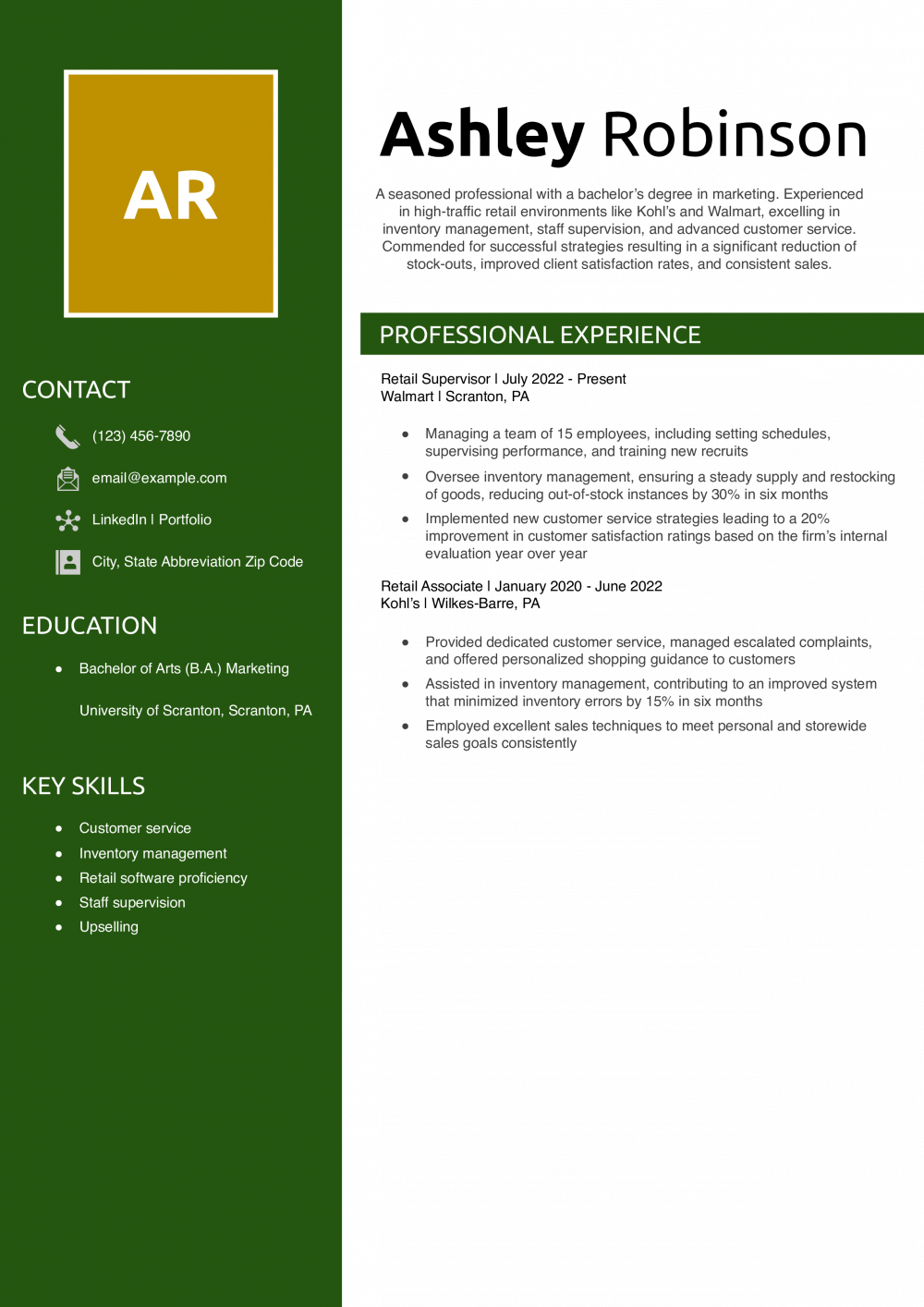
Customize this template in our builder in under 10 minutes.