Event Planner/Coordinator Resume Examples and Templates for 2026



The cook resumes that get callbacks share three things: stations worked listed in the first six lines, covers per shift on the heaviest service, and a ServSafe date a chef can read in one scan.
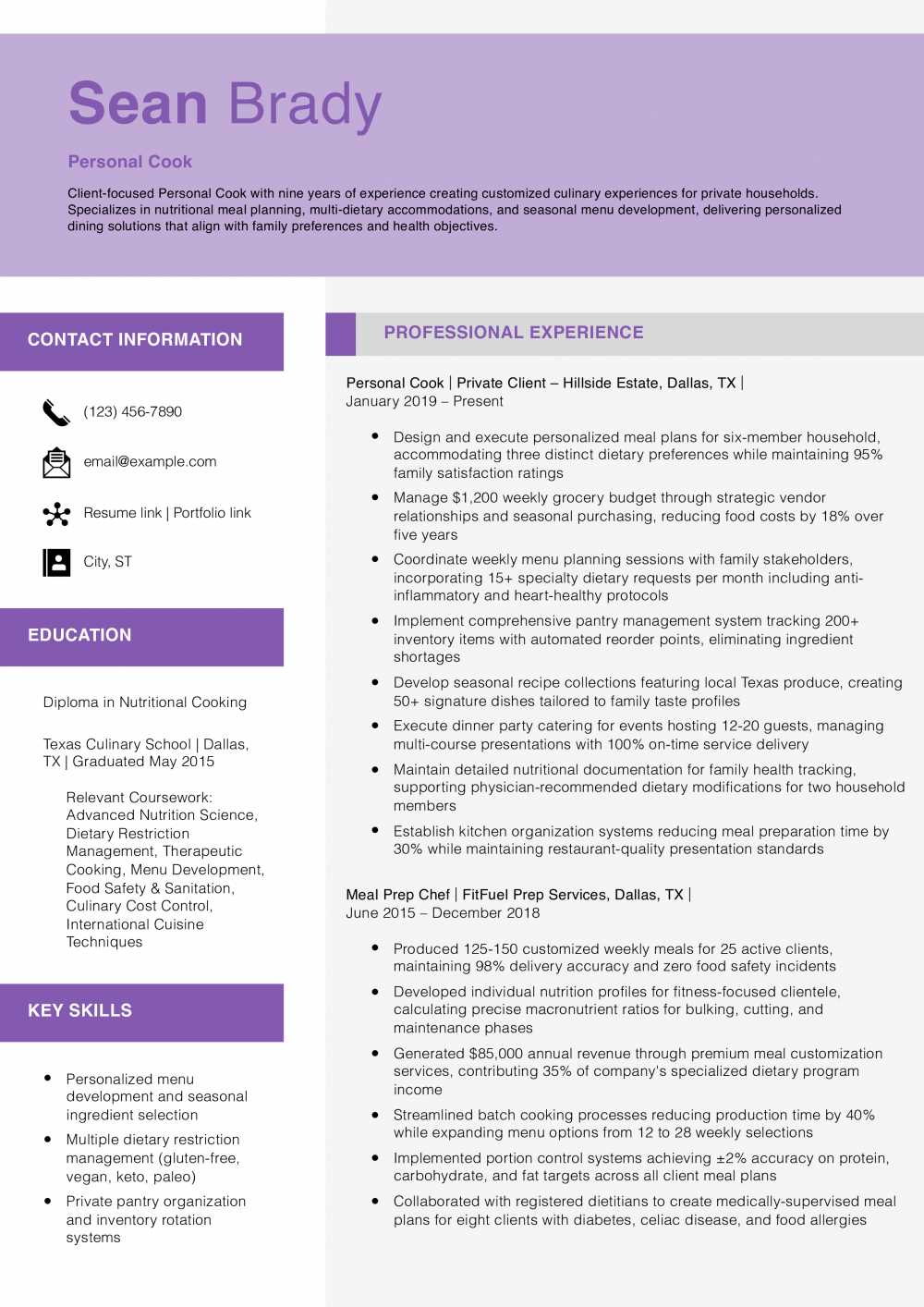
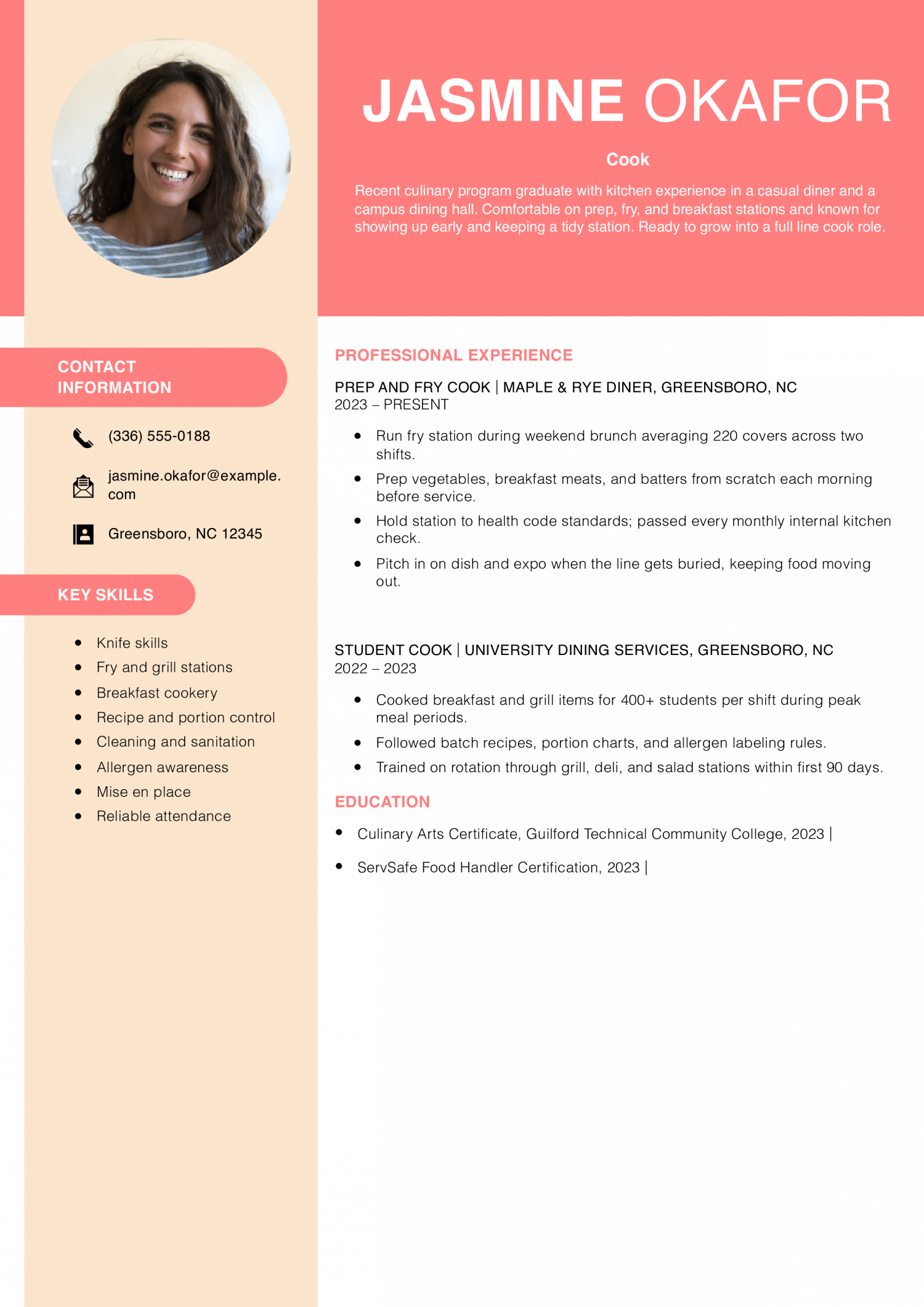
The entry-level profile covers prep cooks, fry cooks, and recent culinary school graduates with one or two kitchens on the resume. This version needs to prove food safety habits, station basics, and reliable shift coverage.
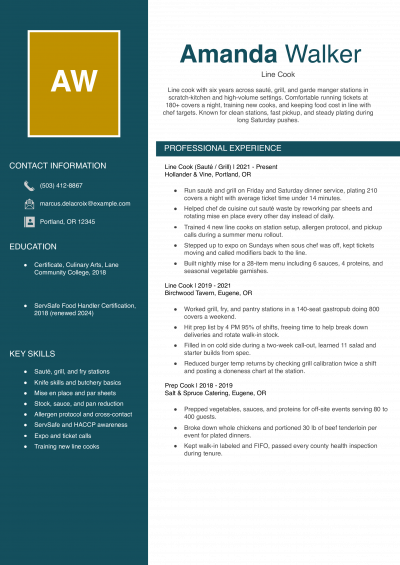
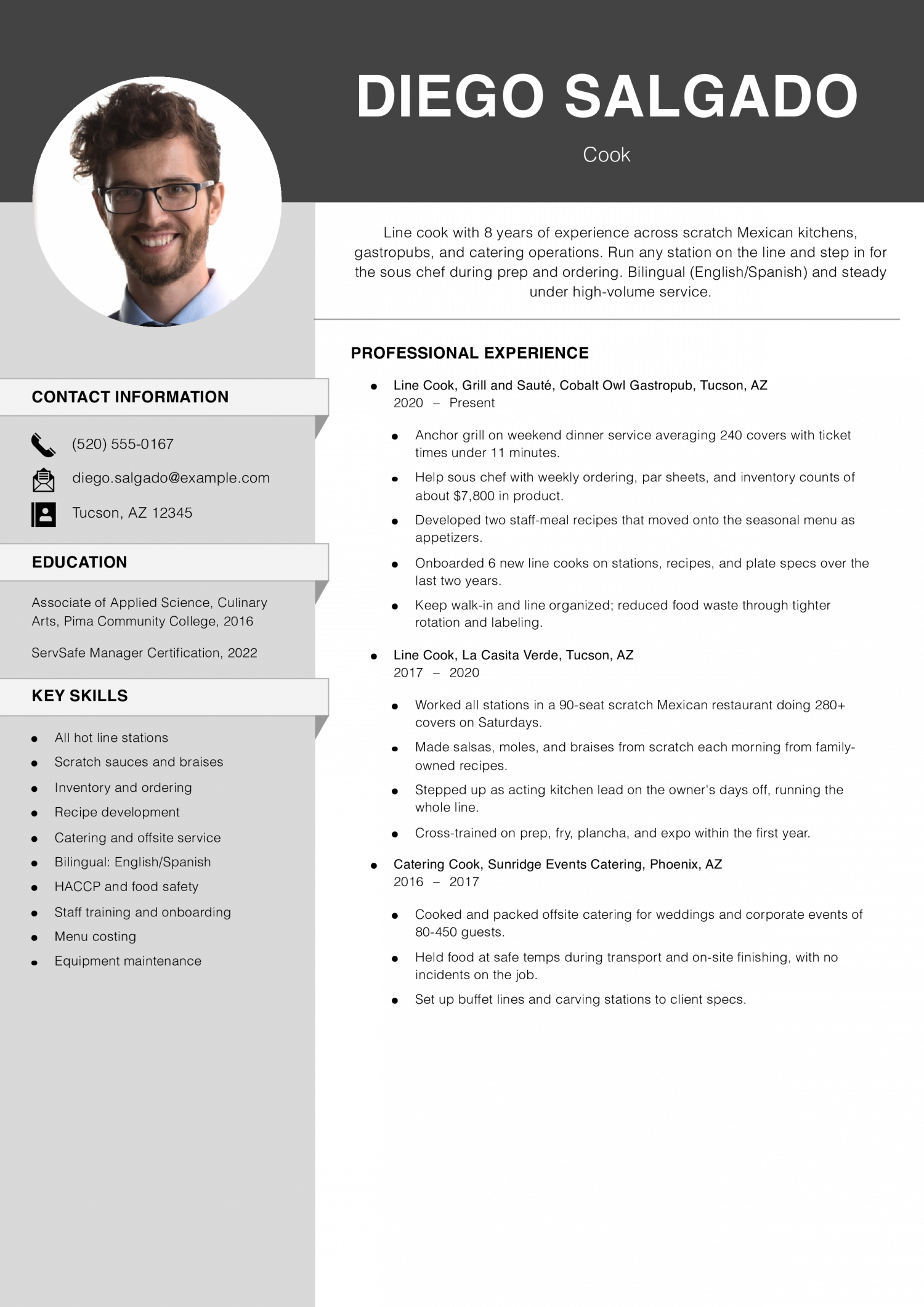
The experienced profile fits line cooks running grill, sauté, or pantry on their own across full-service or high-volume kitchens. This resume needs to prove ticket times under rush, recipe consistency, and ServSafe currency.
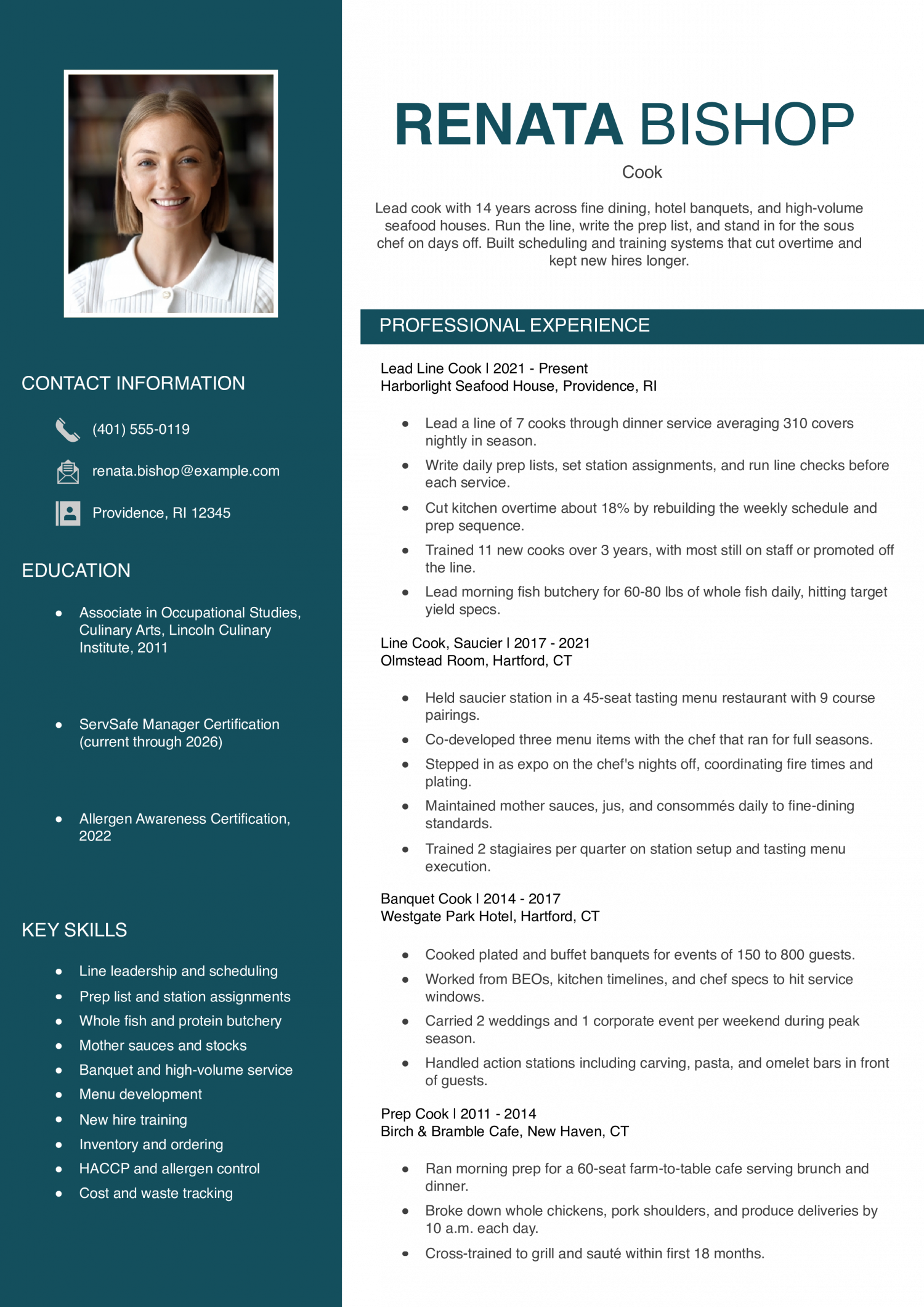
The lead cook profile covers shift leaders, sous-track cooks, and kitchen seconds who close the line and train new hires. This resume needs to prove menu execution, inventory ownership, and how you hold the line on HACCP.
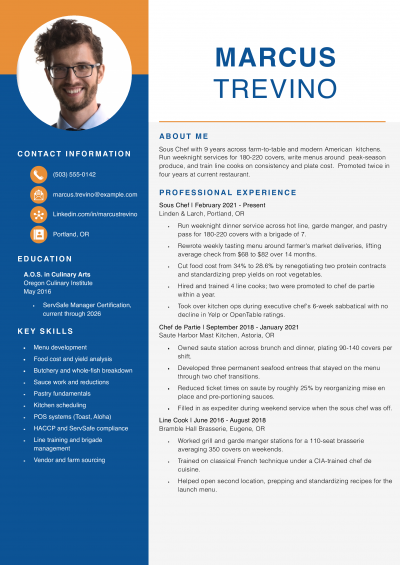
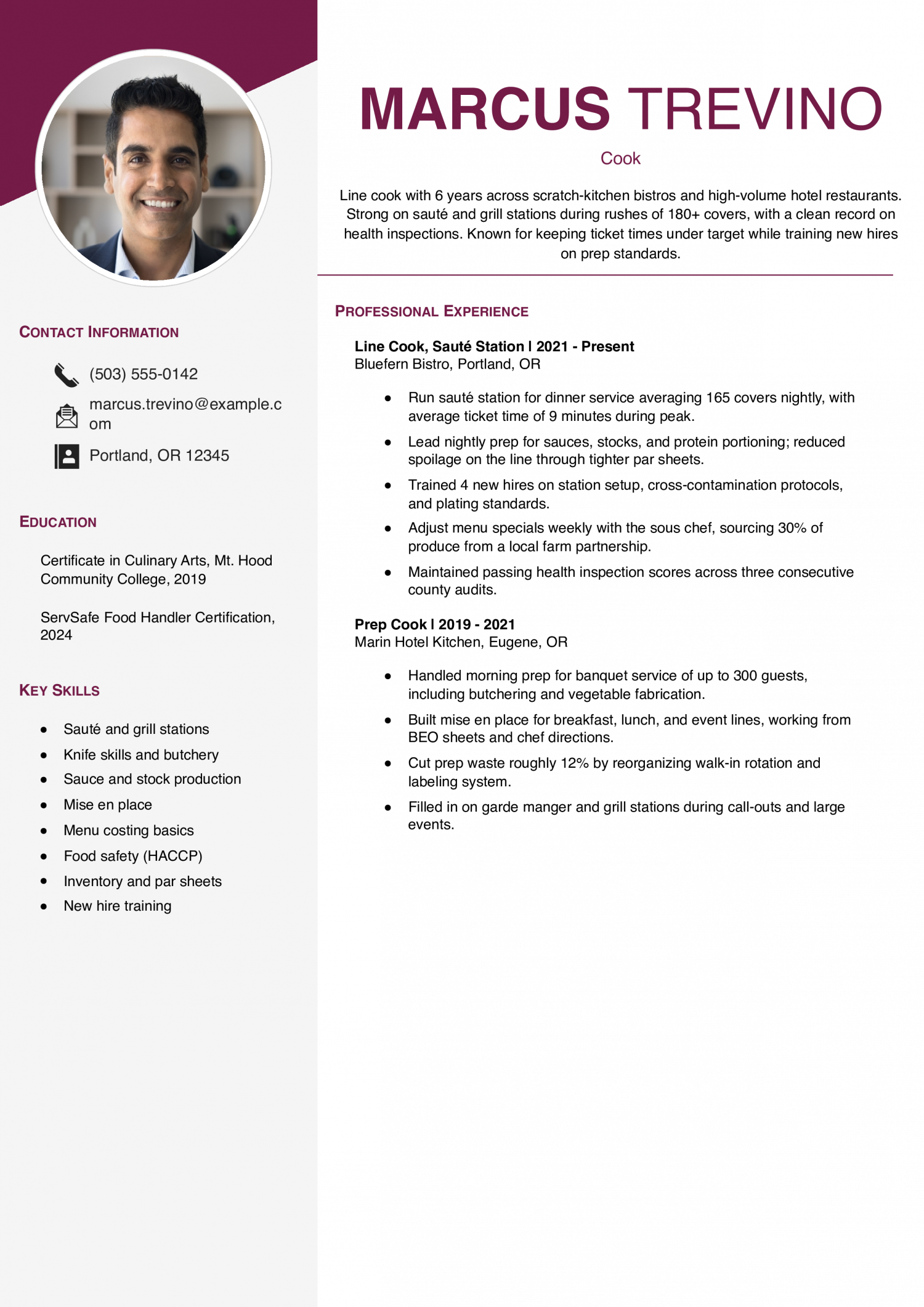
Marcus Trevino
Portland, OR | (503) 555-0142 | [email protected] | linkedin.com/in/marcustrevino
Line cook with 6 years across scratch-kitchen bistros, hotel restaurants, and catering. Strong on sauté and grill stations during rushes of 180+ covers, with a clean record on health inspections. Known for keeping ticket times under target, training new hires on prep standards, and stepping in on expo and ordering when needed.
Line Cook, Sauté Station
Bluefern Bistro | Portland, OR | 2021-Present
Prep Cook
Marin Hotel Kitchen | Eugene, OR | 2019-2021
Catering Line Cook (Part-Time)
Riverbend Catering Co. | Eugene, OR | 2020-2021
Cook, Grill Station
Cedar Plank Tavern | Salem, OR | 2018-2019
Dishwasher and Prep Helper
Hazel Street Cafe | Salem, OR | 2017-2018
Start with the stations and cuisines an executive chef cannot pull from a job title alone. A line cook role at one restaurant means wood-fired pizza; at another it means hot apps and pasta.
Put your strongest stations in the summary or top of experience: grill, sauté, fry, pantry, garde manger, expo. Name the cuisine style, too: Italian, sushi, Tex-Mex, Southern, banquet volume. Add ServSafe status on the same line if current.
This single line lets a chef route your resume to the opening they have rather than guessing.
Cook hiring runs on volume language more than dollar metrics. Use covers per shift, tickets per hour, ticket times during rush, and head counts for banquets or catering.
Strong bullets tend to read like: ran sauté for 220 covers on Friday and Saturday service, held 12-minute ticket times during peak. Prep cooks can lead with pounds prepped, batch counts, or stations supported. Where you don’t have a number, name the scope: full-service restaurant, three-meal hotel kitchen, 600-bed hospital.
Bullets without volume tend to read as duties, not proof.
Chefs read cook resumes in four buckets. Group your bullets so each one shows up.
Station execution covers the stations you ran solo and your speed on the line. Food safety and sanitation covers HACCP logs, temperature checks, allergen protocols, and station break-down. Recipe and menu work covers prep lists, recipe consistency, specials development, and plating standards.
Team and shift work covers opening or closing the kitchen, training new hires, and covering call-outs. Three to five bullets per role, drawn from these buckets, beats a long generic list every time.
Food safety credentials belong in a page-one block, not buried at the bottom. Executive chefs and kitchen managers need to confirm you can legally work the line before they call you.
List ServSafe Food Handler or Manager with the issue date, your state or county food handler card, and any allergen training. Add HACCP coursework if you’ve done it. If you have knife skills certificates, culinary school credentials, or apprenticeship hours, those go in the same block.
Currency matters; an expired ServSafe reads worse than none at all. If you also bake, see our baker resume examples for ways to present your credentials.
Kitchen hiring weighs reliability and shift fit alongside skill. Bake that into the resume rather than waiting for the trial shift.
Note open availability, weekend and holiday coverage, or specific shift preferences in a short line near contact info. Call out long tenure: three years at one restaurant beats six restaurants in three years for most chefs. If you worked through openings, closings, or a remodel, name it.
These signals tell a chef you’ll show up when the ticket printer starts going.
The cook resumes that get callbacks share a specific skill mix. The lists below come from our user-built cook resumes, so the patterns reflect what’s actually landing interviews. Executive chefs and kitchen managers scan for stations, sanitation, and pace first, not generic kitchen-passion language.
ServSafe currency and grill or sauté experience carry more weight than soft phrasing about teamwork. Match the hard skills against the posting you’re targeting, then use the soft skills as evidence to back the bullets in your experience section.
| Soft Skills | % of resumes with this skill |
|---|---|
| Teamwork | 72% |
| Communication | 61% |
| Time management | 50% |
| Working under pressure | 35% |
| Attention to detail | 31% |
And here are the top hard skills showing up most often.
| Hard Skills | % of resumes with this skill |
|---|---|
| Knife skills | 76% |
| Food safety and HACCP | 56% |
| Food preparation techniques | 48% |
| Portion control | 39% |
| Kitchen equipment operation | 31% |
Based on data from thousands of cooks’ resumes built on ResumeTemplates.com, May 2026.
The items below are what separate a cook resume from one that gets put back in the pile.
Food safety credentials are a screening gate, not a bonus. Most kitchens cannot put you on the line without a current card, so list yours in a page-one credentials block with the issue or expiration year.
Kitchen ticket systems are how orders hit your station. Naming the systems you’ve used signals you can step onto the line without a training shift to learn the screen.
Kitchen hiring weighs shift fit alongside skill. A short availability line near your contact info saves the chef a phone call and moves your resume up the stack.
Name your real availability: open availability, nights and weekends, AM prep shifts, or split shifts for banquets. If you’ve held the same shift for a year or more, that reliability is worth saying out loud.
If you’re seeking specific hours because of school or a second job, name the window you can cover rather than leaving the chef to guess. Honest availability gets you on the schedule faster than vague phrasing.
A current food handler card keeps you eligible to work the line. The certifications below are what move a cook resume from the qualified-but-typical stack into the shortlist for higher-volume or hotel and hospital kitchens. List the issuing body, level, and issue or expiration year on one line.
Cook pay clusters in unexpected places. The top-paying states tend to be tourism-driven and hospitality-heavy markets with thin year-round labor pools, not the dense restaurant metros most cooks default to. High-employment states follow population and tourism volume rather than wage strength.
If you can relocate or work seasonal contracts, your resume should foreground the cuisines, station counts, and volume figures that translate cleanly across regional kitchens.
| # | State | Avg. Annual |
|---|---|---|
| 1 | Massachusetts | $46,280 |
| 2 | District of Columbia | $45,230 |
| 3 | Washington | $44,980 |
| 4 | Maine | $44,870 |
| 5 | Hawaii | $44,710 |
| 6 | Vermont | $44,560 |
| 7 | California | $44,290 |
| 8 | New York | $39,890 |
| 9 | Colorado | $39,170 |
| 10 | New Hampshire | $39,050 |
| # | State | Avg. Annual |
|---|---|---|
| 1 | District of Columbia | $103,030 |
| 2 | New York | $101,780 |
| 3 | New Jersey | $101,340 |
| 4 | Massachusetts | $96,580 |
| 5 | California | $96,360 |
| 6 | Washington | $96,180 |
| 7 | Rhode Island | $90,040 |
| 8 | Colorado | $90,030 |
| 9 | Connecticut | $89,630 |
| 10 | Maryland | $84,890 |
| # | State | Workers | Median |
|---|---|---|---|
| 1 | California | 160,270 | $44,290 |
| 2 | Florida | 134,480 | $36,300 |
| 3 | Texas | 125,880 | $34,050 |
| 4 | New York | 62,430 | $39,890 |
| 5 | Illinois | 61,630 | $36,630 |
Resume Templates offers HR approved resume templates to help you create a professional resume in minutes. Choose from several template options and even pre-populate a resume from your profile.
Lead with the stations you can run solo: grill, sauté, fry, pantry, or expo. Add ServSafe status, HACCP familiarity, knife skills, and any cuisine specialties.
For soft skills, name speed under rush, reliability, and station cleanliness rather than generic teamwork phrasing. Mirror the exact station names from the posting so ATS filters catch them.
Open the role with the kitchen type, cuisine, and stations you ran. Then add volume: covers per shift, ticket times during peak, or banquet head counts.
Bullets should mix station execution, food safety, and recipe consistency. Avoid duty-list phrasing like 'responsible for preparing food' because it tells a chef nothing they didn't already assume.
A prep cook resume leads with volume and consistency: pounds prepped, batch counts, mise en place for how many stations, and stock rotation discipline.
A line cook resume leads with stations run solo, covers per shift, and ticket times held during service. If you've done both, separate the bullets so a chef can see which work you can step into on day one.
No. Most line cook and prep cook openings hire on stations worked, ServSafe status, and shift reliability rather than a degree.
If you do not have culinary school, lead with the kitchens you've worked in and the stations you can run.
If you do have a degree or apprenticeship hours, put them in a credentials block on page one. They tend to matter more for hotel, hospital, and fine-dining roles than for fast casual or independent restaurants.
For a cook, an ATS-friendly template is the safest pick, because it puts your certifications and experience where a hiring manager scans first. A basic template is a solid alternative. Whichever you choose, keep the formatting clean and easy to parse: clear section headings, a standard font, and no graphics a parser can choke on.
Executive Resume Writer and Career Coach
Andrew Stoner is an executive career coach and resume writer with 17 years of experience as a hiring manager and operations leader at two Fortune 500 Financial Services companies, and as the career services director at two major university business schools.