Server Resume Examples
Lead the summary with a number a floor manager scans for, not a scope sentence about your work ethic. Name covers per shift, average check size, and the POS you run. Front-of-house leads read that…
Every resume example is written and reviewed by our team of Certified Professional Resume Writers to ensure top-quality content and formatting.
Most busser roles fill fast, often within days of posting. Restaurant managers and front-of-house leads pick the person who proves speed on the floor. Your resume should show table turn times and the volume you cleared per shift.
List your ability to reset covers, restock service stations, and support servers during rushes. A ServSafe Food Handler card strengthens your application at many employers. The examples below show you how to put these details on your resume. To compare layouts before you start, browse our resume templates.
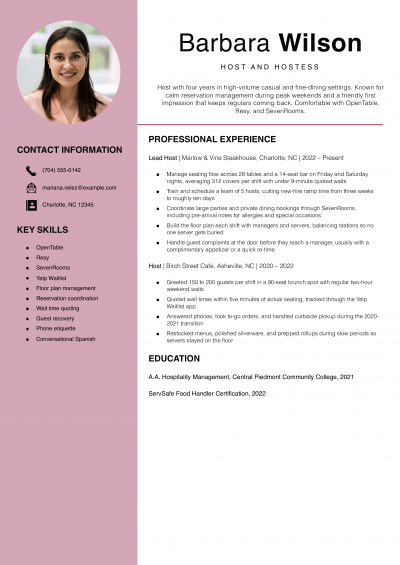
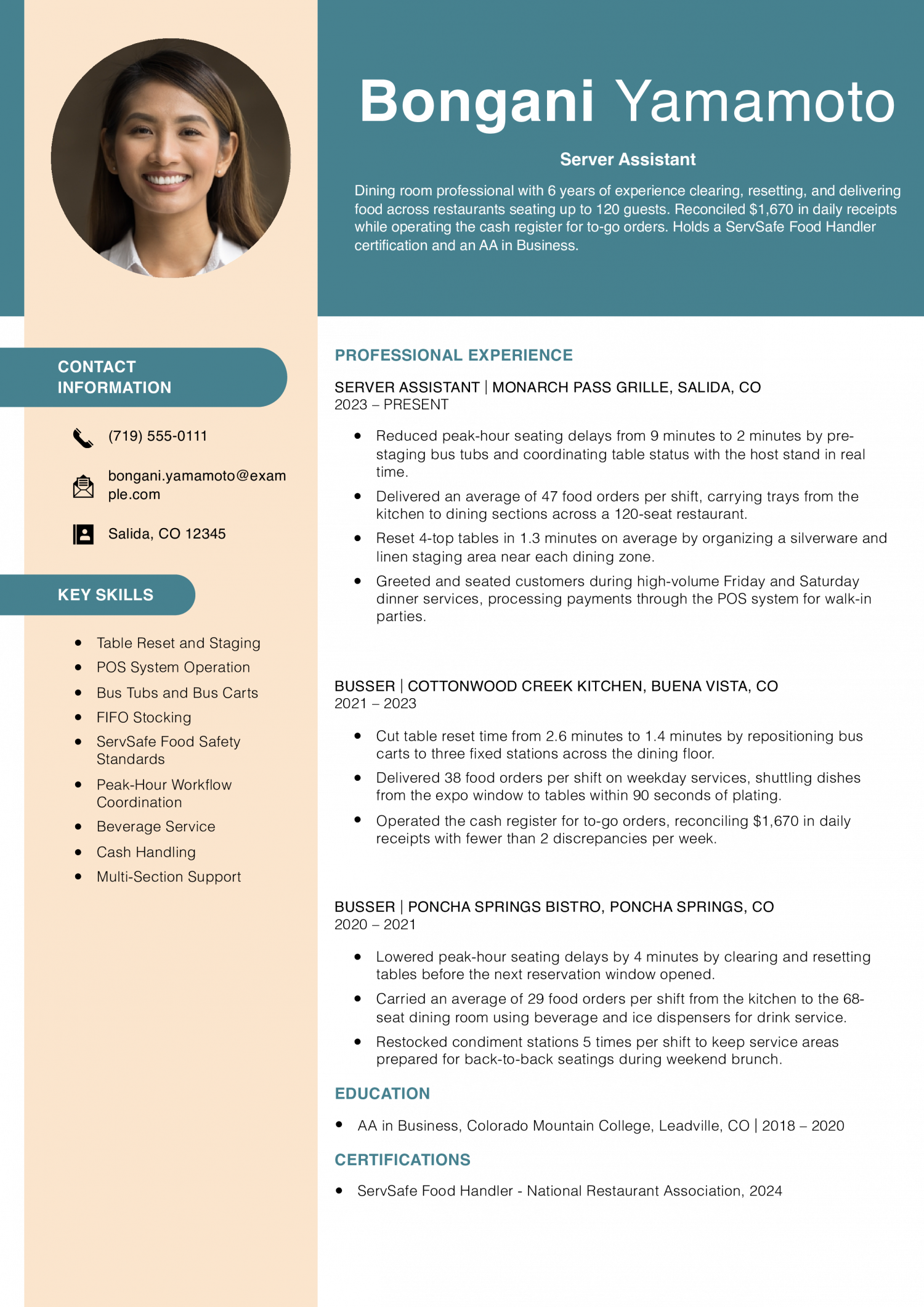
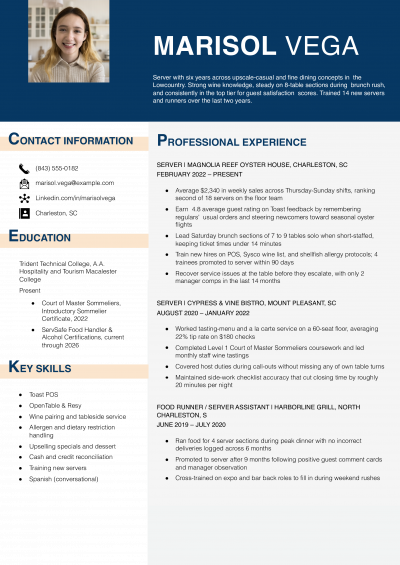
Pick this resume if you are a mid-level server assistant looking to highlight growing responsibility across multiple dining room roles. Call out the exact before-and-after reset times behind each table-turn improvement you report.
Cash-handling stands out when the daily total and error count are both visible. A manager reading the receipt figure and the weekly discrepancy count can gauge trust at a glance. If you touched a register, say the daily amount and how often it came up short.
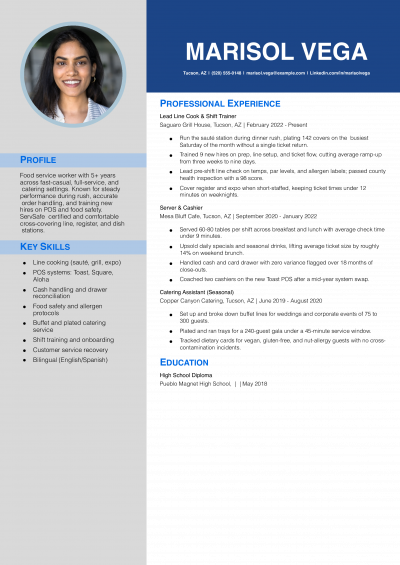
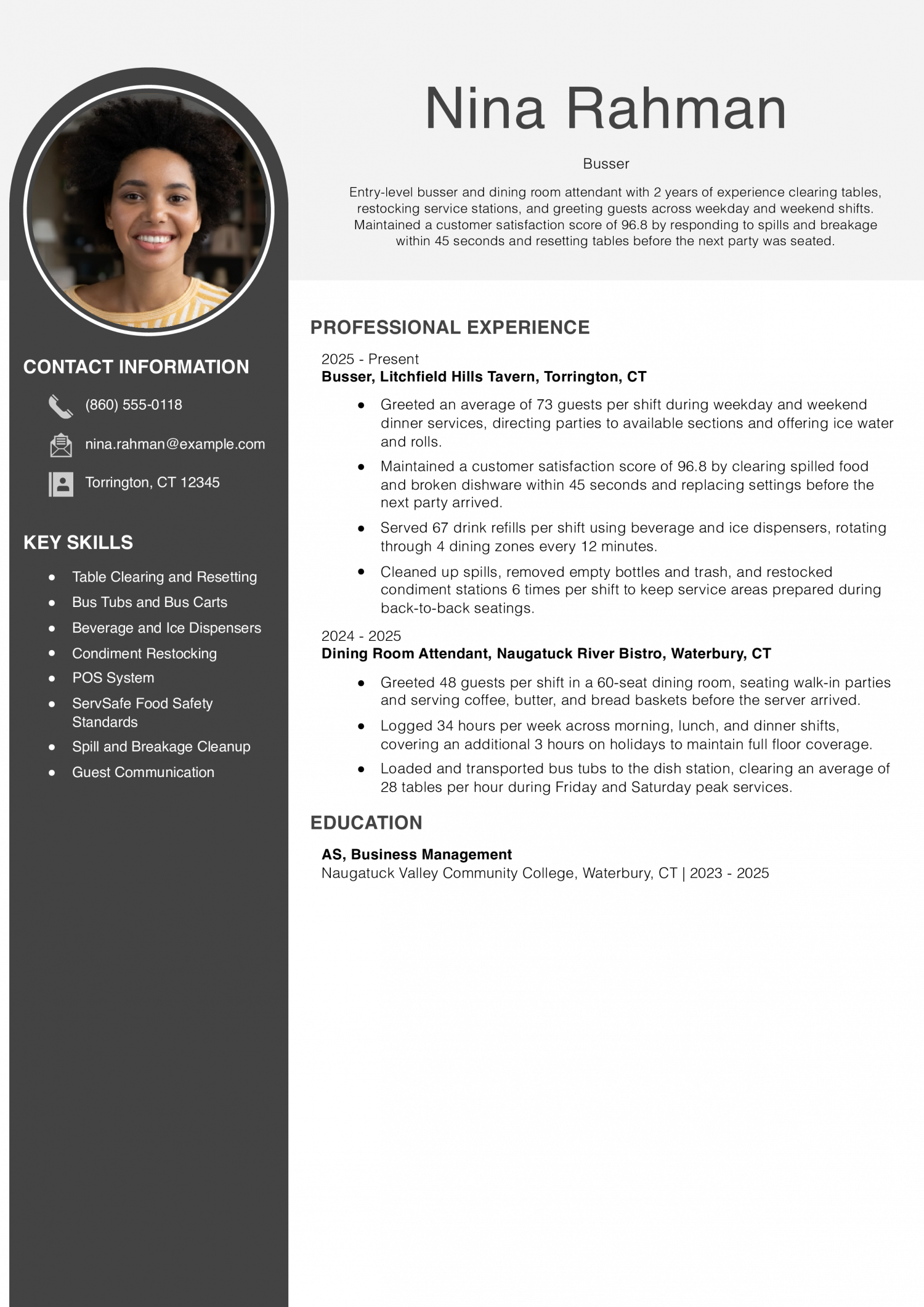
Start with this resume if you are an entry-level busser entering the restaurant industry with limited but measurable dining room experience. Choose a response-time figure, like seconds to clear a spill, to give each cleanup bullet a concrete result.
Table counts tied to peak-hour shifts show that the speed holds when it matters most. A front-of-house manager can picture the pace on a packed Friday night. Tie your own clearing numbers to the busiest service windows.
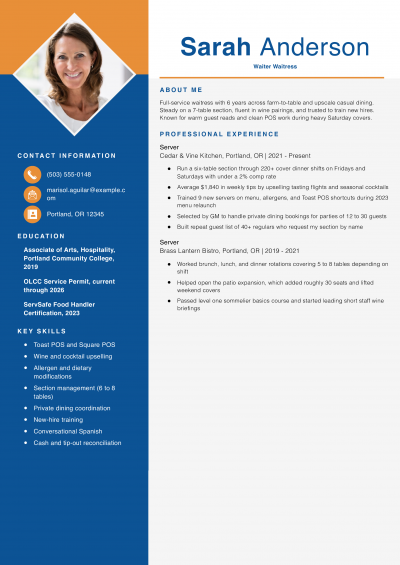
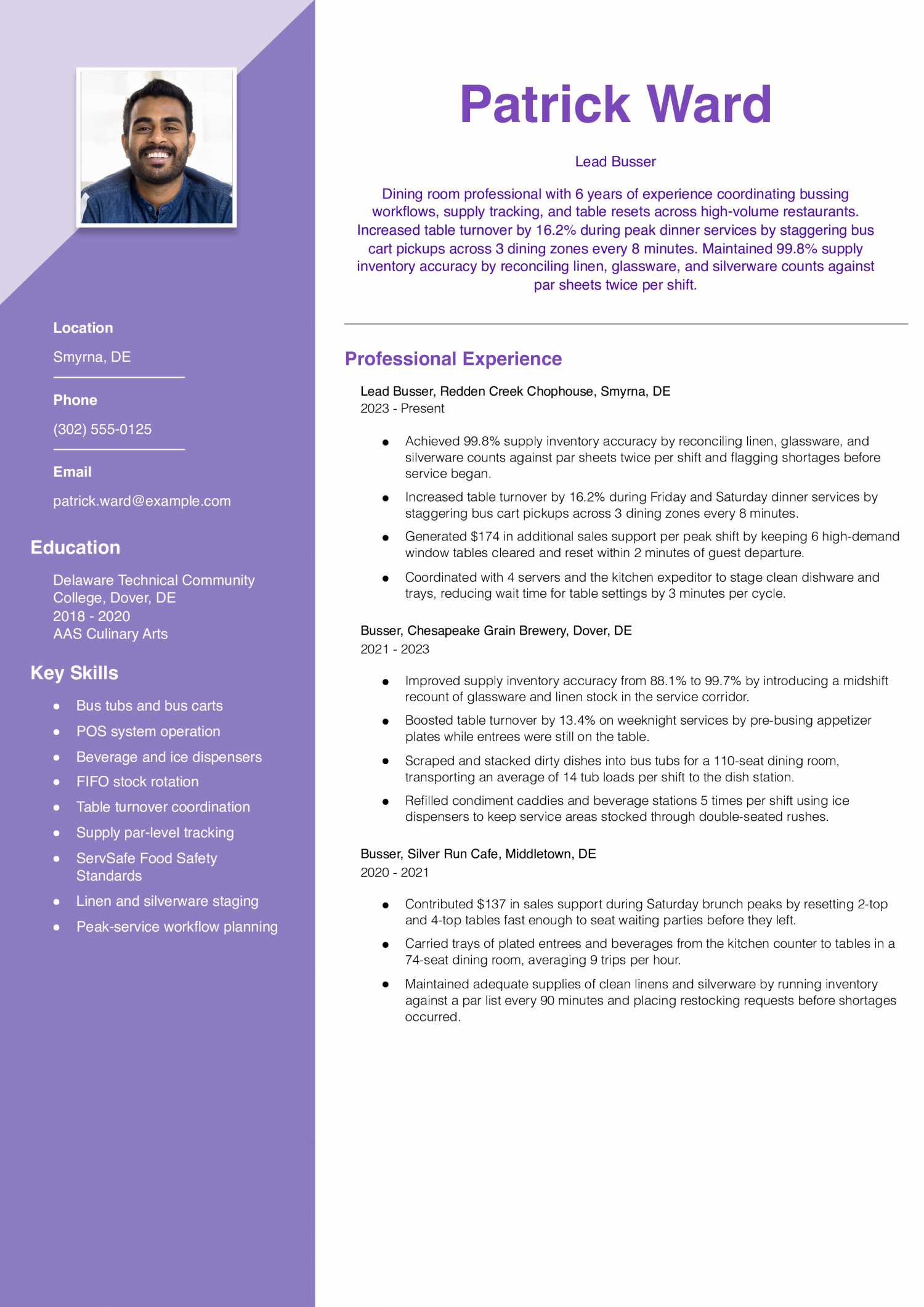
Try this resume if you are a mid-level lead busser with around six years of dining room experience stepping into a supervisory bussing role. Lead with the same move it uses: tying each inventory accuracy figure to the exact counting frequency that produced it.
Coordinating with servers and the kitchen to stage clean dishware cut the wait for fresh table settings. A floor manager reading the time saved per cycle sees that the coordination had a payoff. State who helped and how many minutes the wait shrank.
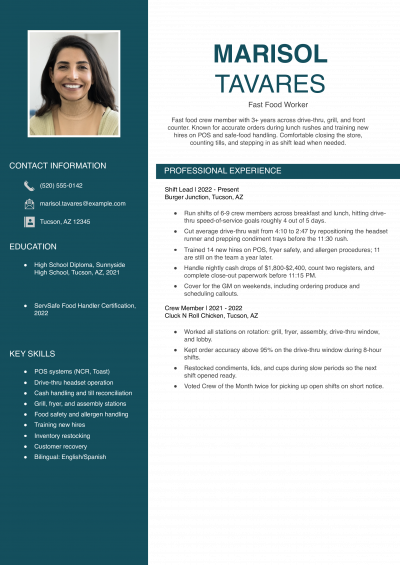
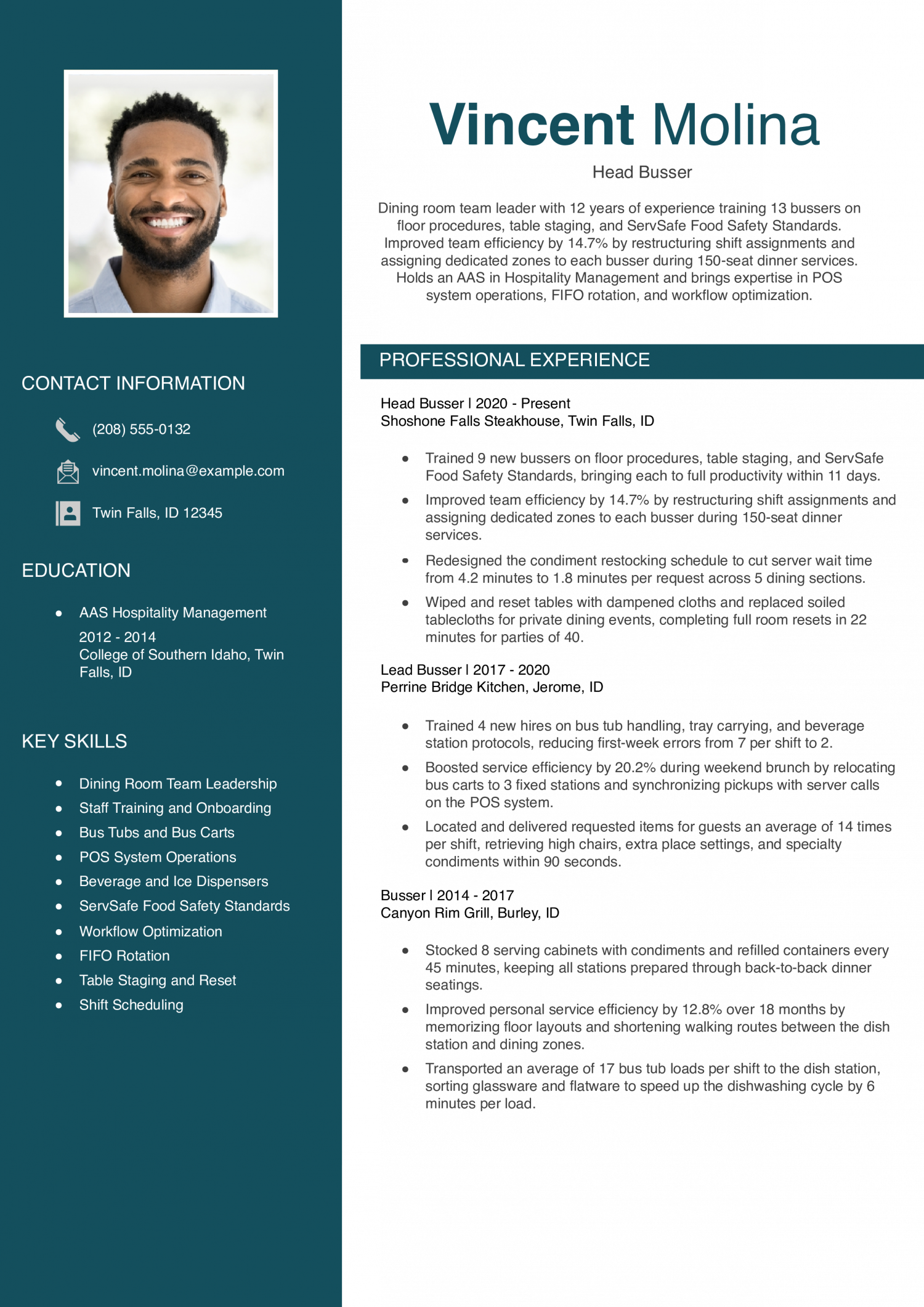
Turn to this resume if you are a senior-level head busser ready to present over a decade of dining room leadership on one page. Echo its method of crediting each efficiency gain to the specific zone or station change that produced it.
Station count and refill interval together show whether the floor stays ready through back-to-back seatings. A shift lead can picture the coverage and the pace from those two numbers alone. Say how many stations you stocked and how often you circled back.
Bringing 6 years of front-of-house experience across dining rooms seating up to 130 guests, with a consistent focus on table staging, sanitation compliance, and efficient multi-zone coordination. Skilled in POS system operations, FIFO rotation, and ServSafe Food Safety Standards, clearing up to 34 tables per hour during peak dinner rushes while maintaining side work checklists each shift.
Start with how long you have bussed tables. Name the type of restaurant where you have worked, such as fine dining or a casual chain.
State your typical cover count per shift. Mention whether you reset tables for a 50-seat patio or a 200-seat dining room. Restaurant managers and front-of-house leads scan this section in seconds.
A clear scope line tells them you fit the volume they run.
Bussing is physical, fast work. Exact dollar totals may not apply to your role. Focus on volume and speed instead.
A strong bullet names how many tables you cleared per shift.
Write something like “Cleared and reset 40 tables during a five-hour dinner service.” You might note a turnover time, such as resetting a four-top in under two minutes. A line with no number tends to blend into a list of tasks. Even a rough count of plates or bins carried per hour adds a concrete feel.
Break your duties into clear groups so the page reads fast. Start with table maintenance: clearing plates and refilling water. Next, cover side work like restocking stations and polishing silverware.
Then list sanitation tasks such as wiping surfaces.
A fourth group can cover server support, like running food. Keep each group to two or three bullet points. This layout helps restaurant managers and front-of-house leads spot the tasks they need filled.
If you hold a ServSafe Food Handler card from the National Restaurant Association, list it on page one. Create a short credentials block beneath your profile. Many job postings ask for food safety training by name.
Placing it high lets restaurant managers and front-of-house leads confirm it before reading your bullets. Include the year you earned or renewed the card. Do not list a certificate number on your resume.
A card title and its status are enough.
Most busser roles are entry-level or mid-level positions. Your education section can be brief. List your high school diploma with the year you finished.
If you are enrolled in college, note your expected graduation date.
Below education, consider a short section for availability. State whether you can work nights, weekends, or holidays. Many restaurants staff around those peak windows.
If you speak more than one language, list it here to help serve a wider range of guests.
Your busser resume should show both the hard and soft skills below.
Teamwork language decides whether the resume moves forward. Restaurant managers and front-of-house leads look for hard skills first. They confirm you can reset tables and follow sanitation steps.
Soft skills then show you can keep pace during a rush. Strong communication scores high because servers depend on you. Scan each table and circle the terms that appear in your target posting.
Use those exact words inside your bullet points. Place hard skills near the top of each bullet for the best filter match. Weave soft skills into the same bullets as proof of how you work.
A bullet that pairs both types gives your resume the strongest read.
| Soft Skills | AI-estimated % |
|---|---|
| Team collaboration | 67% |
| Customer attentiveness | 56% |
| Physical stamina | 44% |
| Quick response time | 35% |
| Positive demeanor | 29% |
And here are the top hard skills showing up most often.
| Hard Skills | AI-estimated % |
|---|---|
| Table setting | 77% |
| Station restocking | 54% |
| Dish clearing | 40% |
| Spill cleanup | 38% |
| Guest seating assistance | 31% |
Skill names and rankings come from an AI model grounded in U.S. Department of Labor occupation data for bussers, not from a count of bussers’ resumes built on ResumeTemplates.com.
Your shift availability and dining room credentials are up first.
Many restaurants require food safety training before your first shift. The ServSafe Food Handler card is the most recognized option. It is issued by the National Restaurant Association.
Bussers often enter orders or split checks at rush times. Naming the POS system you have used saves training time. Restaurant managers notice this detail right away.
Open availability is a strong selling point for bussers. Front-of-house leads fill weekend and holiday gaps first. Stating your schedule helps you stand out fast.
Tip: State Your Availability Early
Place a short line near the top of your resume. Name the days and shifts you can work. Be specific so there is no guesswork.
Beyond any food safety card your state or county may require, the credential below tells restaurant managers and front-of-house leads that you know safe handling rules. It shows you can keep a clean bus tub and avoid cross-contact risks. Many hiring leads look for this card before your first shift.
Some states ask for it by law, while others leave it up to the employer. Either way, listing it on your resume saves the house time and training cost. Add the issuing body and your current expiration date next to the credential name so a manager can verify it at a glance.
BLS data covers all Dining Room and Cafeteria Attendants and Bartender Helpers, a broader group that includes bussers. For bussers, the 10th-percentile floor and the top-decile ceiling sit about 37 percent apart on each side of the median. That gap is narrow compared to most roles.
Geography and venue type tend to separate the floor from the ceiling more than years on the job do. The national headcount is large, so openings are steady across most regions. Put the venue pace and your table-turn volume on the resume to show where you fit in that range.
| # | State | Median Annual |
|---|---|---|
| 1 | Virgin Islands | $51,760 |
| 2 | Hawaii | $51,200 |
| 3 | Washington | $41,420 |
| 4 | District of Columbia | $39,080 |
| 5 | Maine | $38,560 |
| 6 | Maryland | $37,020 |
| 7 | Oregon | $36,800 |
| 8 | Colorado | $36,790 |
| 9 | New York | $36,740 |
| 10 | Arizona | $36,500 |
| # | State | Workers | Median |
|---|---|---|---|
| 1 | California | 75,460 | $36,010 |
| 2 | Texas | 60,270 | $21,550 |
| 3 | Florida | 50,400 | $33,280 |
| 4 | New York | 41,340 | $36,740 |
| 5 | Illinois | 21,290 | $31,200 |
Resume Templates offers HR approved resume templates to help you create a professional resume in minutes. Choose from several template options and even pre-populate a resume from your profile.
Use the title the restaurant gave you, such as Busser or Dining Room Attendant. If the posting uses a different title, match it so your resume aligns with what the manager expects to read.
Lead each bullet with a verb and add a count or figure where you have one. For example, write "Cleared and reset 40-plus tables per shift during weekend dinner service." Restaurant managers and front-of-house leads look for pace and volume, so numbers carry more weight than vague task lists.
Yes, include it if the role taught skills that apply to the job you want now. Bussing builds teamwork, time management, and the ability to work under pressure. Frame each bullet around a transferable skill rather than listing the task alone.
Keep it to one page. Most busser roles are entry-level, so one page gives you enough room for a profile, your work history, and your education. Restaurant managers and front-of-house leads often review dozens of resumes at once, so a single clear page holds their attention better.
Focus on skills you have used on the job rather than soft traits you cannot prove. Good choices include table turnover speed and sanitation procedures. Add any guest-facing communication skills that the posting asks for.
Lead with a profile that highlights related strengths like physical stamina and teamwork. Below that, list any volunteer work, school events, or catering shifts where you handled setup or cleanup. Even informal experience shows restaurant managers you can handle the pace of a dining room.
Yes, send one when the posting requests it or when you apply in person. A short cover letter lets you explain your interest in that specific restaurant. Keep it to three or four paragraphs so the manager can read it in under a minute.
Pick an ATS-friendly template so your certifications and work history have their own sections. A basic template also fits this role.
Busser Resume
4.1/5 stars with 192 reviews

Executive Resume Writer and Career Coach
Andrew Stoner is an executive career coach and resume writer with 17 years of experience as a hiring manager and operations leader at two Fortune 500 Financial Services companies, and as the career services director at two major university business schools.
© 2026 Resumetemplates.com All rights reserved.