Accounts Receivable Resume Examples
Lead with a single line a controller cannot pull from your LinkedIn or a credit reference. Name the ERP you run daily, the portfolio size in dollars, and the industry vertical you collect in. A…
Every resume example is written and reviewed by our team of Certified Professional Resume Writers to ensure top-quality content and formatting.
Your recovery rate and dollars collected per hour set you apart. Collections managers and call center directors screen for proof you can reduce delinquency buckets. They want to see skip tracing results and payment plan conversions.
A strong collections representative resume leads with accounts resolved and aged balances recovered. Include your call volume and right-party contact rate. The examples below show you how to put these numbers on the page. To compare layouts before you start, browse our resume templates.
Collections managers screening resumes look for recovery rate percentages and call volume metrics on the first page, because those numbers show whether a representative can consistently convert delinquent accounts into collected revenue.
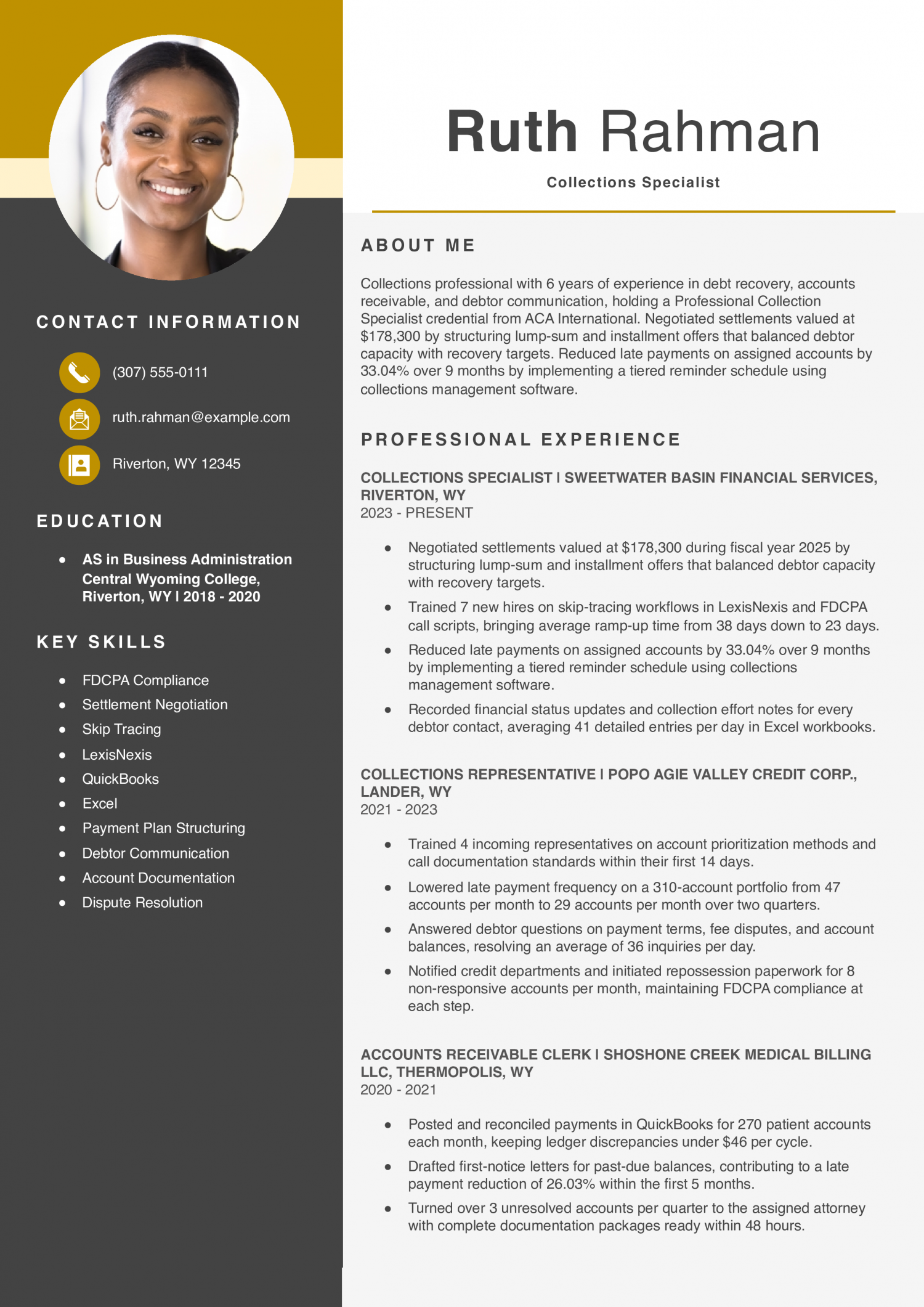
Consider this resume if you are a mid-level collections specialist with about six years spanning receivables and recovery work. Lead with training impact and ramp-up compression to show you build team capacity alongside your own production numbers.
Ramp-up time for new hires shrank because the mentoring followed a specific approach. Team leads reading that can see what the trainer did differently. Describe the training method you used and how the onboarding timeline changed for new collectors.
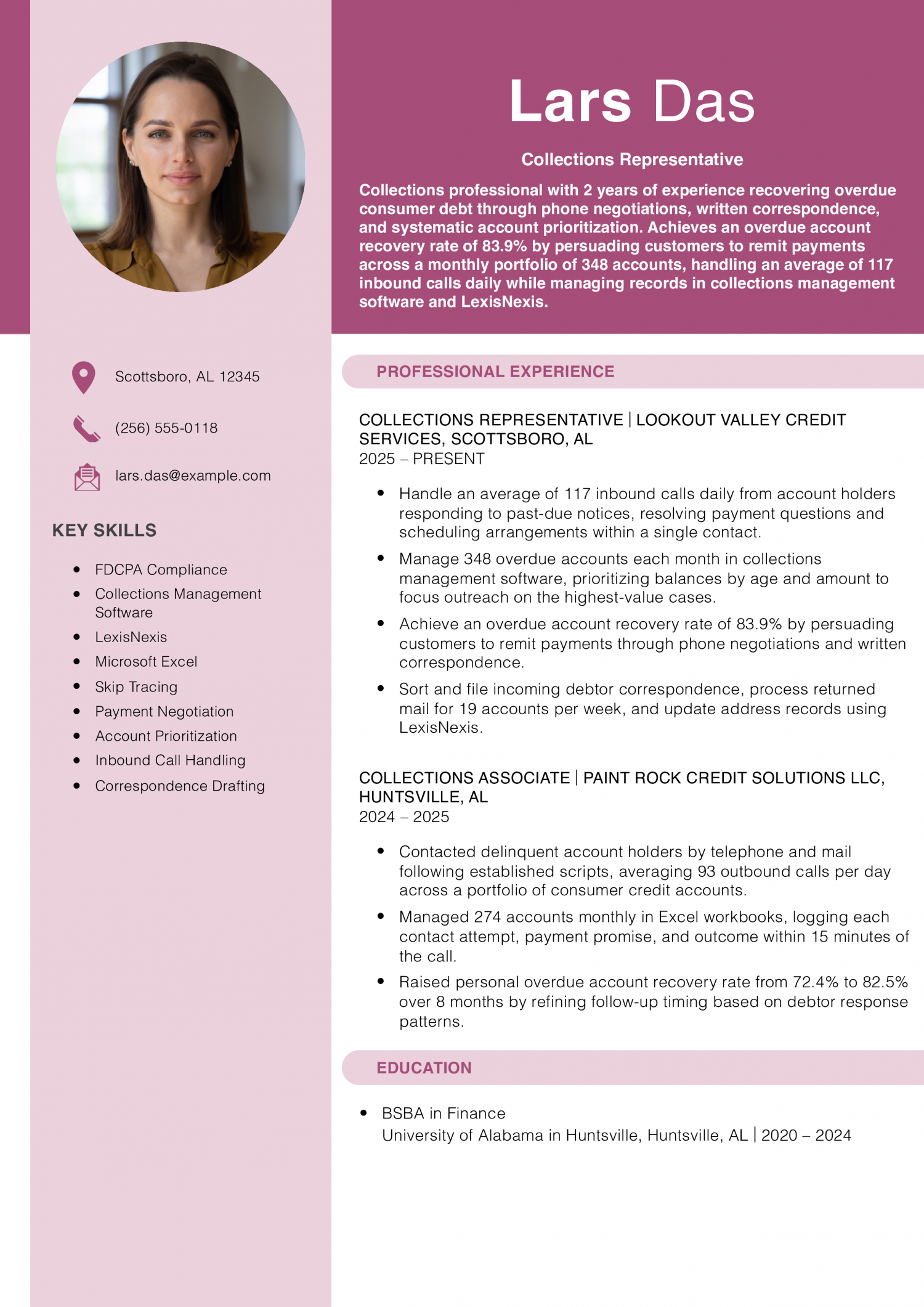
Start with this resume if you are an entry-level collections representative with about 2 years of experience moving into a higher-volume recovery role. Lead with your personal recovery rate and daily call count to prove you convert outreach into collected payments.
Recovery rates started at one level and climbed to a higher one over a set number of months. That shows a supervisor a trend, not a snapshot. Show where your performance number started, where it ended, and the time it took.
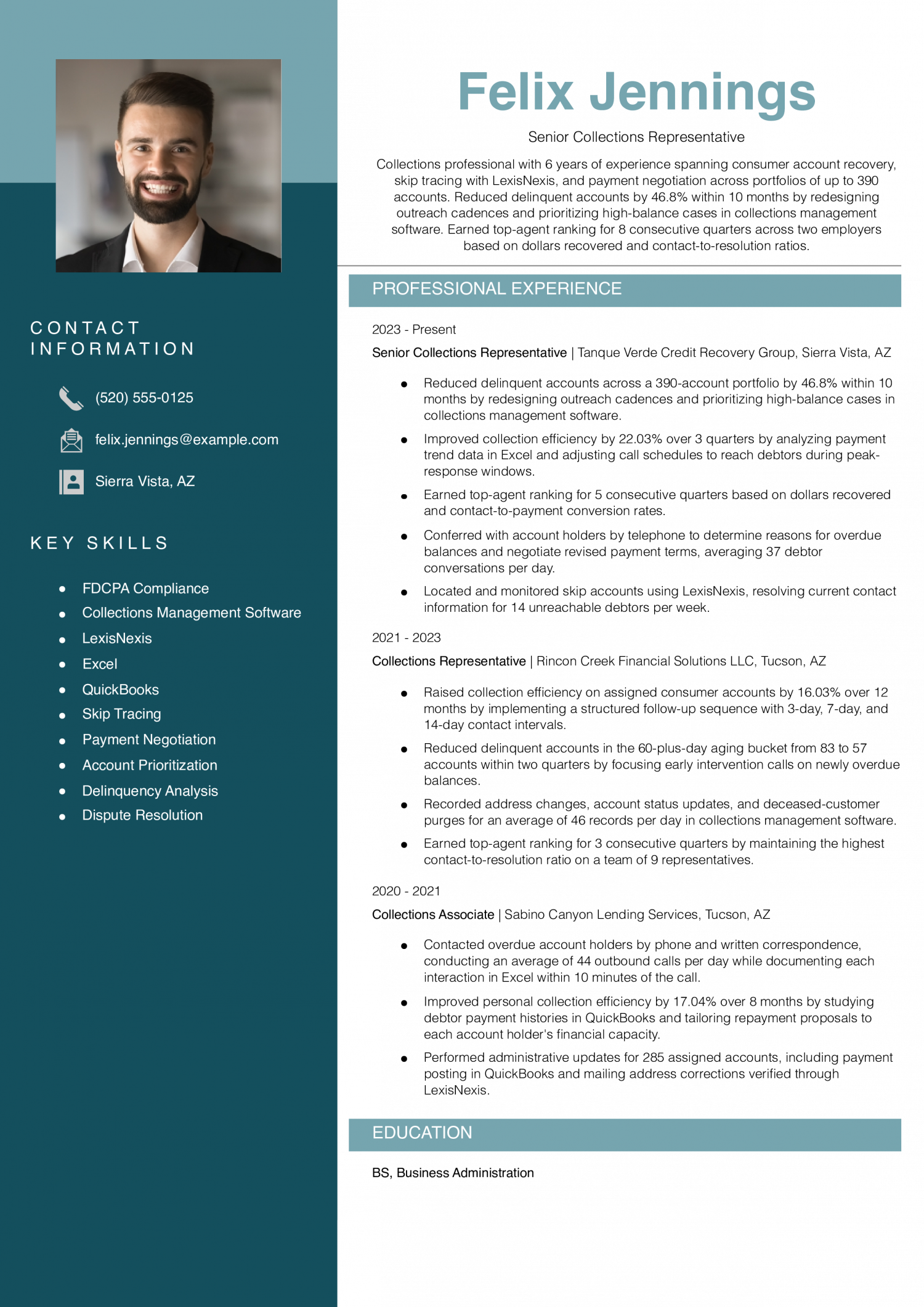
Try this resume if you are a mid-level collections representative with around six years of recovery experience looking to step into a senior role. Lead with delinquency reduction percentages and ranked performance streaks to distinguish yourself from candidates who list only call counts.
Instead of describing outreach by call volume, this resume explains the reasoning behind contact timing. Managers can see how payment trends shaped the timing of calls. Say what data you looked at and how it shaped when and how often you called.
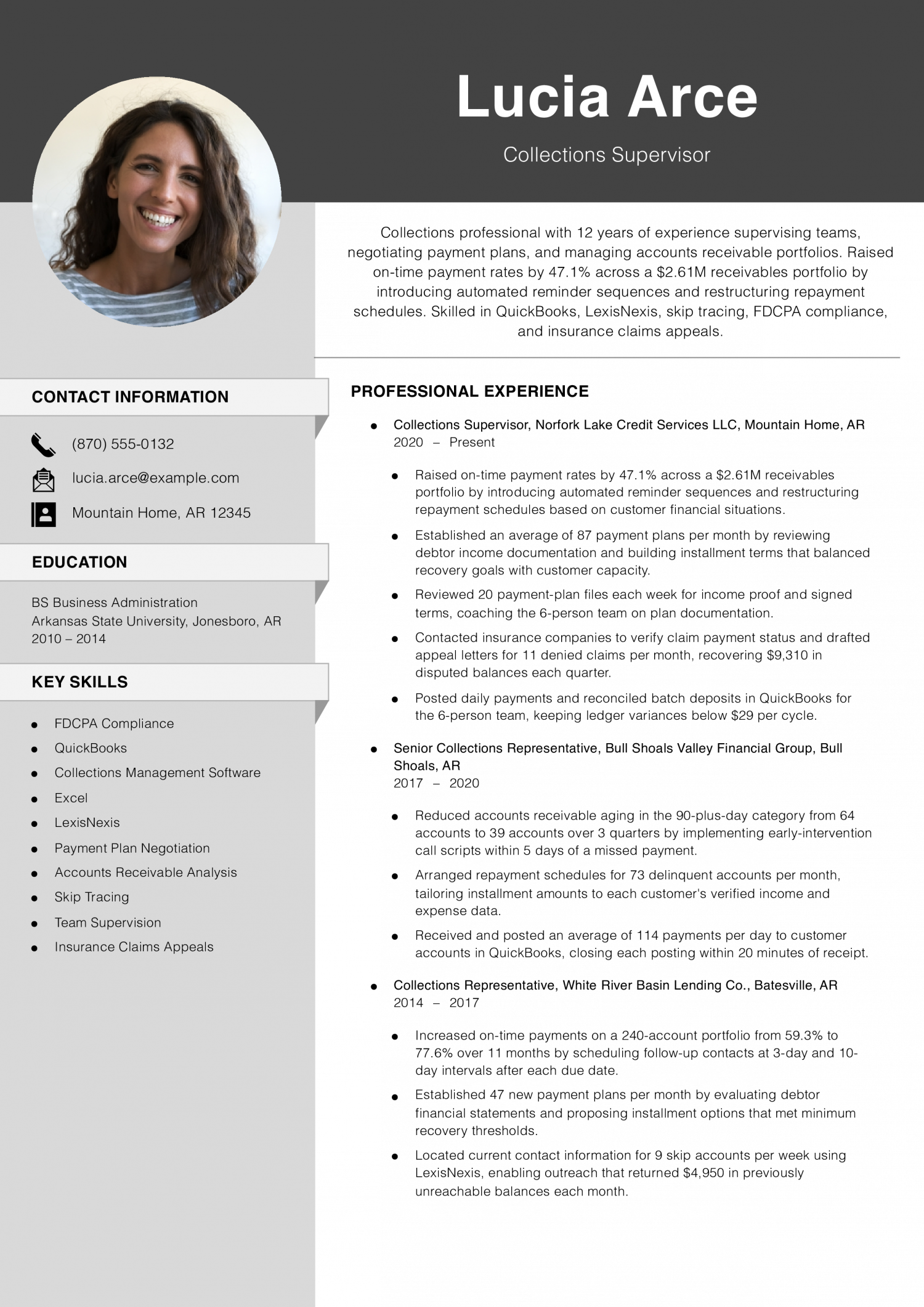
Lean on this resume if you are a senior collections supervisor with about 12 years of experience ready to lead a larger recovery operation. Lead with portfolio-level results and team oversight details to distinguish yourself from individual-contributor applicants.
Payment posting accuracy is held to a tight variance, showing control over a daily task. Finance managers see reliable reconciliation work right away. State the error range you held for your posting and how long you kept it there.
Experienced in managing over 900 active and delinquent accounts across collections management software, Excel, and QuickBooks while advising debtors on repayment strategies, credit reporting timelines, and hardship options. Recovered $6,290 in previously unreachable balances each month by querying LexisNexis and contacting neighbors during skip-tracing efforts. Skilled in FDCPA compliance, debt negotiation, small claims preparation, and credit extension analysis across 6 years of receivables and recovery work.
Start with your years in collections and the debt types you handle. Name the portfolio stage you work in most often, such as early-out or pre-charge-off.
Mention your call volume range per shift. If you focus on medical debt, auto loans, or credit card balances, say so here. Collections managers and call center directors scan this section in a few seconds.
A clear scope line helps them see your fit before they read a single bullet. Keep the profile to three or four lines. Cut vague phrases like “strong communicator” and replace them with real numbers or account types.
Give every bullet a number. Start with dollars recovered per month or quarter. Add your right-party contact rate and promise-to-pay conversion rate.
Without one, the line tends to read as a task, not a result. You can also note the size of your assigned portfolio in total accounts. State the percentage of accounts you moved to resolution.
If you cut delinquency rates, give the before and after figures. A line like “collected $185K monthly across 600 accounts” tells the reader more than “handled a large book.” Even small wins count when stated with data. Pair each action verb with at least one figure.
This habit turns a flat duty list into a results record that hiring managers trust and remember during screening.
Break your experience into task groups so each bullet has a home. Outbound contact covers skip tracing and dialer campaigns. Payment negotiation covers settlement offers and payment plan terms.
Compliance work covers call scripting rules and dispute handling. Account documentation covers notes in the system of record after each call. Grouping tasks this way keeps your resume from reading like a wall of text.
Use two or three bullets under each category in your most recent role. For older roles, one bullet per group is enough. This structure lets collections managers and call center directors spot your strengths at a glance.
List the Professional Collection Specialist credential from ACA International in a credentials block on page one. Collections managers and call center directors look for it early because it signals FDCPA knowledge. After your credentials, name the tools you use daily.
Mention your dialer platform and your primary collection software. Add any CRM or payment processing system you know. If you have worked with auto-dialers, note the brand.
Keep each tool on its own line or in a short comma-separated list. Do not bury software names at the end of a bullet. A visible tools block saves the reader from scanning every line to find your tech stack.
Place your education section after your work history. A high school diploma or associate degree is typical for this role. If you hold a bachelor’s degree, list it with the major and school name.
Add any FDCPA training courses beneath your degree. Include customer service or negotiation workshops you have finished. If you are new to collections, move your education section higher on the page.
Pair it with any call center or retail experience that shows phone skills. Volunteer roles that involved billing or donor follow-up also fit here. Close with a brief line noting your state if the role requires local residency.
Keep this section to four or five lines total.
Hard skills show you can run the daily tools of the job. Think skip tracing, payment plans, and account notes. Each one maps to a task you perform on live calls.
Swap in the exact phrasing the posting uses when you can. Soft skills carry a different weight for this role. They prove you can handle tense calls without losing the account.
Weave them into your work history bullets as proof. Bare claims like “great communicator” do not pass a screening call. Check each table against the posting you want to apply to.
Leave out any term the ad skips. Add any term it lists that you truly hold. Collections managers want proof of both types in your bullet points.
| Soft Skills | AI-estimated % |
|---|---|
| Persuasive communication | 78% |
| Empathy under pressure | 57% |
| Conflict de-escalation | 47% |
| Active listening | 39% |
| Time management | 25% |
And here are the top hard skills showing up most often.
| Hard Skills | AI-estimated % |
|---|---|
| Delinquent account recovery | 75% |
| Repayment plan negotiation | 54% |
| Collections account documentation | 49% |
| Debtor skip tracing | 40% |
| Credit contract review | 28% |
Skill names and rankings come from an AI model grounded in U.S. Department of Labor occupation data for collections representatives, not from a count of collections representatives’ resumes built on ResumeTemplates.com.
Before you send out your collections resume, check it against this list.
What collections managers and call center directors expect has shifted. Listing only manual dialer experience now looks incomplete on most postings. Naming the AI tools you use reads as current.
Note who reviewed output before any action was taken. The list below names what to add to your resume. Focus on tools you have used in live accounts.
Describe how you applied each one in a real workflow. Skip tools you only read about or saw in a demo. Honest, specific lines carry more weight than a long list.
Keep each entry tied to a measurable result.
What AI is actually changing for this role
Call prioritization: Predictive scoring models now rank accounts by likelihood to pay, replacing static aging reports.
Script guidance: Real-time speech analytics suggest negotiation prompts during live calls based on debtor tone.
Skip tracing: AI cross-references public records and data feeds to locate debtors faster than manual searches.
Compliance monitoring: Automated call audits flag potential FDCPA violations before a supervisor reviews the recording.
Payment forecasting: Machine learning models project monthly recovery totals so managers can adjust staffing and targets.
AI tools to name
How to phrase AI on your resume
Do
Skip
A clean background check and basic call center skills keep you eligible for most open roles. The certification below is what moves a Collections Representative resume past the typical stack. Collections managers and call center directors scan for it to gauge your grasp of federal rules.
They also use it to judge how well you handle disputed accounts. List the credential with the issuing body, the year earned, and its current status. Even one recognized certification signals that you invest in professional growth.
It also shows you understand the compliance standards that govern consumer debt recovery. Hiring teams at agencies and in-house departments tend to weigh this credential when comparing two otherwise equal candidates. Include it near the top of your resume so reviewers see it early.
The top-paying states for collections representatives tend to cluster in smaller markets, not the large metro areas most people expect. BLS data covers all bill and account collectors, a broader group that includes this role.
Workers at the 90th percentile out-earn those at the median by roughly 39 percent. The 10th percentile sits about 27 percent below the median. That gap signals real room to grow within the field.
If you are open to relocating, list that flexibility on your resume and note any multi-state compliance training you have completed.
| # | State | Median Annual |
|---|---|---|
| 1 | District of Columbia | $62,230 |
| 2 | Alaska | $60,810 |
| 3 | Massachusetts | $59,800 |
| 4 | California | $57,930 |
| 5 | Connecticut | $57,930 |
| 6 | Vermont | $57,630 |
| 7 | Hawaii | $53,570 |
| 8 | New Jersey | $52,510 |
| 9 | Rhode Island | $52,000 |
| 10 | Oregon | $50,880 |
| # | State | Workers | Median |
|---|---|---|---|
| 1 | Texas | 21,720 | $45,710 |
| 2 | California | 13,880 | $57,930 |
| 3 | Florida | 13,180 | $46,410 |
| 4 | New York | 8,800 | $47,170 |
| 5 | Pennsylvania | 6,680 | $46,660 |
Resume Templates offers HR approved resume templates to help you create a professional resume in minutes. Choose from several template options and even pre-populate a resume from your profile.
A strong collections representative resume leads with a brief profile, then lists work experience with quantified results. Follow that with skills, certifications, and education in separate sections. Use a clean single-column format so applicant tracking systems can read every line.
Focus on transferable skills from customer service or call center roles where you handled difficult conversations. List any coursework in finance or business communication to show your knowledge base. Note your call volume or resolution rates from prior phone-based work.
For most collections representative roles, one page is enough. Collections managers and call center directors review high volumes of resumes. A concise single page that highlights your recovery rates and call metrics stands out.
Pull keywords directly from each job posting you apply to. Common terms include skip tracing, payment arrangements, and delinquency reduction. Match the exact phrasing the posting uses so tracking software scores your resume correctly.
Yes, include dollar figures whenever your employer allows disclosure. A line like "recovered $1.2M across 350 delinquent accounts in Q3" gives collections managers a clear picture. Pair each dollar figure with the account volume or time frame for full context.
You can, but you need to add leadership details to each relevant bullet. Mention training newer representatives, running team huddles, or tracking performance dashboards. Highlight any metrics tied to coaching peers or escalating accounts on behalf of junior staff.
List the gap honestly using a brief line such as "Career break, 2022, 2023" between your other roles. If you took a relevant course or earned the PCS credential during that time, note it under the gap entry. This shows collections managers you stayed current with industry practices.
An ATS-friendly template gives your credentials and work history clear headings. A basic template works too.
Collections Representative Resume
4.4/5 stars with 176 reviews

Executive Resume Writer and Career Coach
Andrew Stoner is an executive career coach and resume writer with 17 years of experience as a hiring manager and operations leader at two Fortune 500 Financial Services companies, and as the career services director at two major university business schools.
© 2026 Resumetemplates.com All rights reserved.