4 Best Restaurant Resume Examples and Templates for 2026



Restaurant managers decide whether to call you for a trial shift by the top third of page one; if covers per shift, the reservation system, and weekend availability are not visible there, the resume gets passed over.
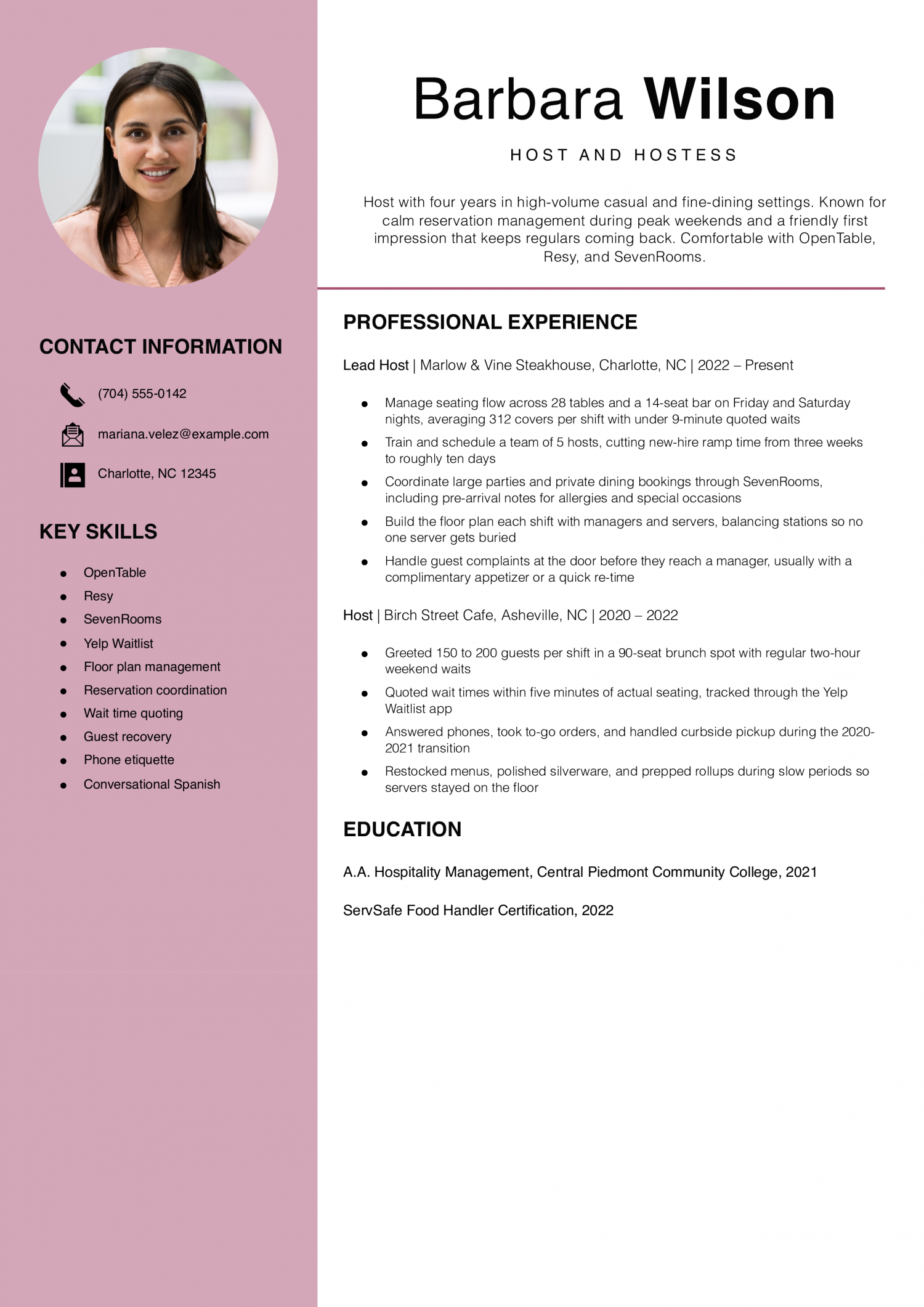
Entry-level hosts are often students or first-job applicants moving from retail or fast food. Your resume needs to prove you can stay calm during a rush, learn a POS fast, and show up on time.
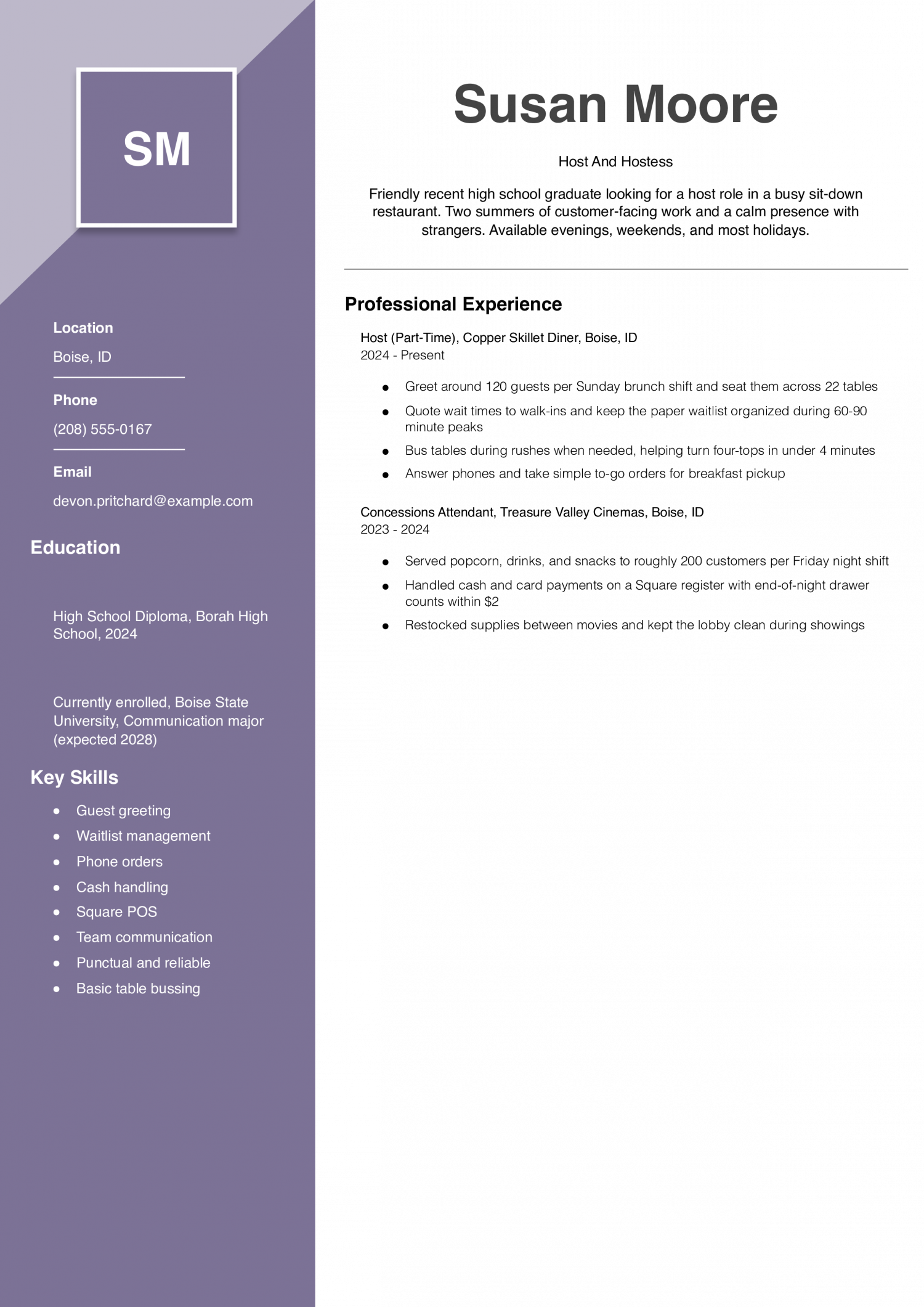
Experienced hosts run the door at high-volume rooms and train new staff. Your resume needs to prove cover counts, reservation system fluency, and how you handle VIPs, large parties, and wait time recovery.
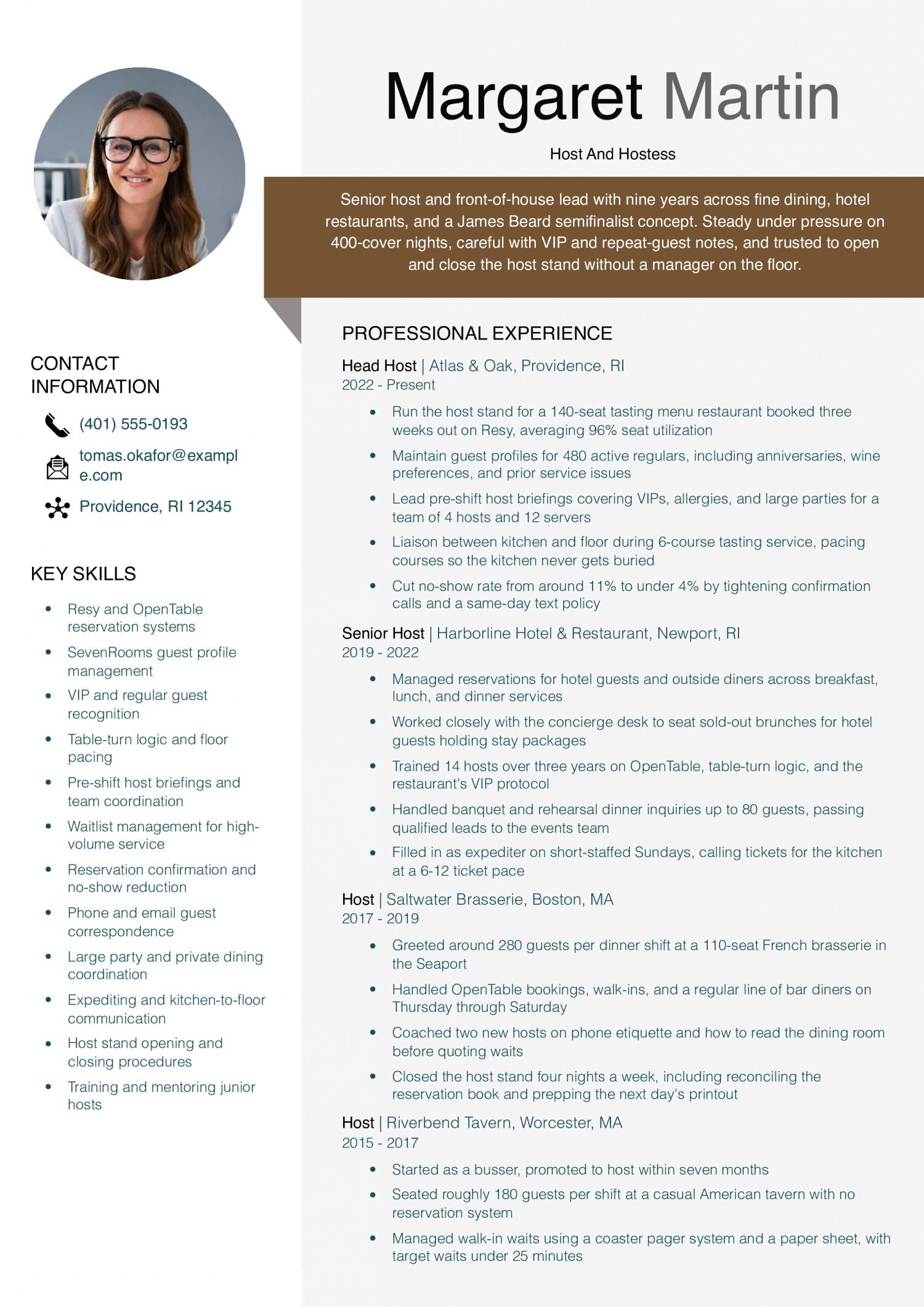
Senior host and front-of-house lead with nine years in fine dining, hotel restaurants, and a James Beard semifinalist concept. Steady under pressure on 400-cover nights, careful with VIP and repeat-guest notes, and trusted to open and close the host stand without a manager on the floor. Fluent in OpenTable, Resy, SevenRooms, and Tock, plus the unwritten rules of pacing a dining room.
Lead your summary with the number that tells a front-of-house lead how busy a room you can run. That means covers per shift, average party size, and the reservation platform you own.
A line like “Host at a 180-seat Italian concept averaging 320 covers Friday and Saturday on OpenTable” beats “friendly host with great communication skills.” Restaurant managers scan for room size and volume first, then look for the system you used to keep the wait list honest.
Hosting is a volume role, so most strong resumes name the scope a reader can picture. Use covers per shift, seat count, party sizes booked, and average wait times you held during peak.
Bullets without a number tend to read as duties. Try “Managed waitlist of up to 45 parties during Saturday dinner service, holding quoted times within 10 minutes” or “Coordinated seating for parties of 2 to 14 across 22 tables.”
Cluster your experience into three buckets a manager recognizes. First, guest flow: greeting, seating rotation, and table turn timing across servers’ sections.
Second, reservations and waitlist: OpenTable, Resy, Yelp Waitlist, or Toast TablesReady, plus phone bookings and modifications. Third, guest recovery and service support: handling complaints at the door, running drinks during a push, and prepping menus, highchairs, and to-go orders.
Food handler cards, allergen training, and any responsible alcohol service certification belong in a short credentials line near your contact info, not buried at the bottom.
Add a one-line availability block right under the summary: weekends, holidays, doubles, and reliable transportation. Restaurant managers and front-of-house leads need to see these before they invest in a phone screen, because shift coverage is half the hiring decision.
If you are in high school or college, list your school, expected graduation, and any relevant coursework like hospitality or business. GPA is optional and only helps if it is 3.5 or higher.
Add second languages with proficiency level, because bilingual hosts move faster on busy nights. Round out with one or two short prior jobs that show customer contact, cash handling, or team work, even if they are retail or camp counselor roles.
The host and hostess resumes that get callbacks share a specific skill mix. The lists below come from our user-built host and hostess resumes. Restaurant managers and front-of-house leads scan for these patterns first, not generic “people person” framing.
Hard skills prove you can run the door on night one. Soft skills back up your bullets when a manager asks how you handled a 90-minute wait. Match your skills section against the posting, then make sure each soft skill shows up as a behavior in your experience bullets.
| Soft Skills | % of resumes with this skill |
|---|---|
| Customer service | 71% |
| Communication | 51% |
| Multitasking | 41% |
| Organization | 40% |
| Composure under pressure | 27% |
And here are the top hard skills showing up most often.
| Hard Skills | % of resumes with this skill |
|---|---|
| POS systems | 69% |
| Reservation software | 68% |
| Seating chart managementg | 47% |
| Guest service standards | 35% |
| Phone and reservation handling | 31% |
Based on data from thousands of hosts’ resumes built on ResumeTemplates.com, May 2026.
These are the must-haves hiring teams look for when scanning a host and hostess resume.
Many states require a food handler card before your first shift, and rules vary by city and county. Check your state and local health department before you apply, then list the certification you hold on the top of page one.
ServSafe Food Handler: accepted in most states, valid two to three years
California Food Handler Card: required statewide for food service workers
Illinois and Texas: state-approved food handler training required
TIPS or ServSafe Alcohol: useful for any host role at a concept with a bar
Allergen training: required in Massachusetts, Michigan, and several others
Restaurants run on a small set of POS and reservation platforms. Naming the ones you have used signals you can run the book and the floor on shift one, with little training time.
Reservations and waitlist: OpenTable, Resy, Yelp Waitlist, Toast TablesReady, SevenRooms, Tock
POS systems: Toast, Square for Restaurants, Aloha, Micros, TouchBistro, Lightspeed
Communication tools: server pagers, OpenTable text alerts, in-house tablet handoffs
Phone and booking tools: third-party delivery tablets, voicemail booking, group sales email
Shift coverage is one of the top three factors a restaurant manager weighs. Hosts who hide their availability behind a generic summary get passed over for ones who put it on page one.
Add a one-line availability block right under your contact info or summary. Be honest about the shifts you can take and the ones you cannot.
If you have a hard limit like school hours or a second job, name the days you are open instead of the days you are not. Managers read the positive frame faster.
Beyond a food handler card, the certifications below tell restaurant managers and front-of-house leads how much training they can skip on your first week. List each credential with the issuing body and your current expiration date on a single line near the top of page one.
ServSafe Food Handler: Required in many states for any front-of-house role and a fast yes signal for managers who do not want to pay for training.
ServSafe Allergens: Shows you can field guest questions about gluten, nuts, and shellfish without pulling a server off the floor.
TIPS or State Responsible Alcohol Service Certification: Useful at any concept with a bar, since it lets you check IDs and field early bar questions before a server arrives.
OpenTable GuestCenter or Resy Training Badge: Free platform badges that signal you can run the book on shift one and cut your training ramp in half.
Host and hostess is one of the larger occupations BLS tracks, which means the median pulls in a long tail of part-time, student, and quick-service variants. The spread between a casual diner host and a Michelin or resort host is wide, and geography drives a big part of it.
To position above the median on paper, lead your resume with seat count, covers per shift, and the reservation system you own, not a generic “greeted guests” line.
| # | State | Avg. Annual |
|---|---|---|
| 1 | Hawaii | $43,070 |
| 2 | New York | $37,070 |
| 3 | District of Columbia | $36,950 |
| 4 | Washington | $36,500 |
| 5 | California | $35,910 |
| 6 | Colorado | $35,720 |
| 7 | Maine | $35,100 |
| 8 | Alaska | $34,800 |
| 9 | Massachusetts | $34,790 |
| 10 | New Jersey | $34,270 |
| # | State | Workers | Median |
|---|---|---|---|
| 1 | California | 42,450 | $35,910 |
| 2 | Florida | 40,540 | $29,110 |
| 3 | Texas | 37,740 | $27,000 |
| 4 | Ohio | 17,420 | $27,590 |
| 5 | New York | 17,350 | $37,070 |
Resume Templates offers HR approved resume templates to help you create a professional resume in minutes. Choose from several template options and even pre-populate a resume from your profile.
Lead with a short summary that names your availability and any customer-facing work. Add a food handler card up top if you have one, even if your state does not require it.
Then build experience bullets from retail, cashier, camp, tutoring, or volunteer roles. Frame them around guest contact, cash handling, and how you held up during a rush.
Yes. Name OpenTable, Resy, Yelp Waitlist, Toast TablesReady, or SevenRooms by their exact brand names.
Put them in your skills section and reference at least one in a bullet. Most restaurant ATS tools match the platform name, not generic phrases like "booking software."
One page. Even experienced hosts running a 200-seat room should hold to one page.
Restaurant managers spend under a minute on the first read. They look for covers, systems, and availability up top, not a second page of older retail jobs.
Add a one-line availability block right under your summary, before your experience section. Note weekends, holidays, doubles, and reliable transportation if relevant.
Shift coverage is half the hiring decision for hosts. Making it visible up top saves the manager a phone call and moves you closer to a trial shift.
For a host, an ATS-friendly template is the safest pick, because it puts your certifications and experience where a hiring manager scans first. A basic template is a solid alternative. Whichever you choose, keep the formatting clean and easy to parse: clear section headings, a standard font, and no graphics a parser can choke on.
Executive Resume Writer and Career Coach
Andrew Stoner is an executive career coach and resume writer with 17 years of experience as a hiring manager and operations leader at two Fortune 500 Financial Services companies, and as the career services director at two major university business schools.