Cook Resume Examples and Templates for 2026



Café managers decide whether to call you in for a trial shift within the first six lines of the resume; if shift availability and bar volume aren't visible by then, the page goes to the bottom of the stack.
This profile is a first-job or second-job barista moving from counter or fast-food work into coffee. Your resume needs to prove reliable attendance, cash accuracy, and that you can learn an espresso bar.
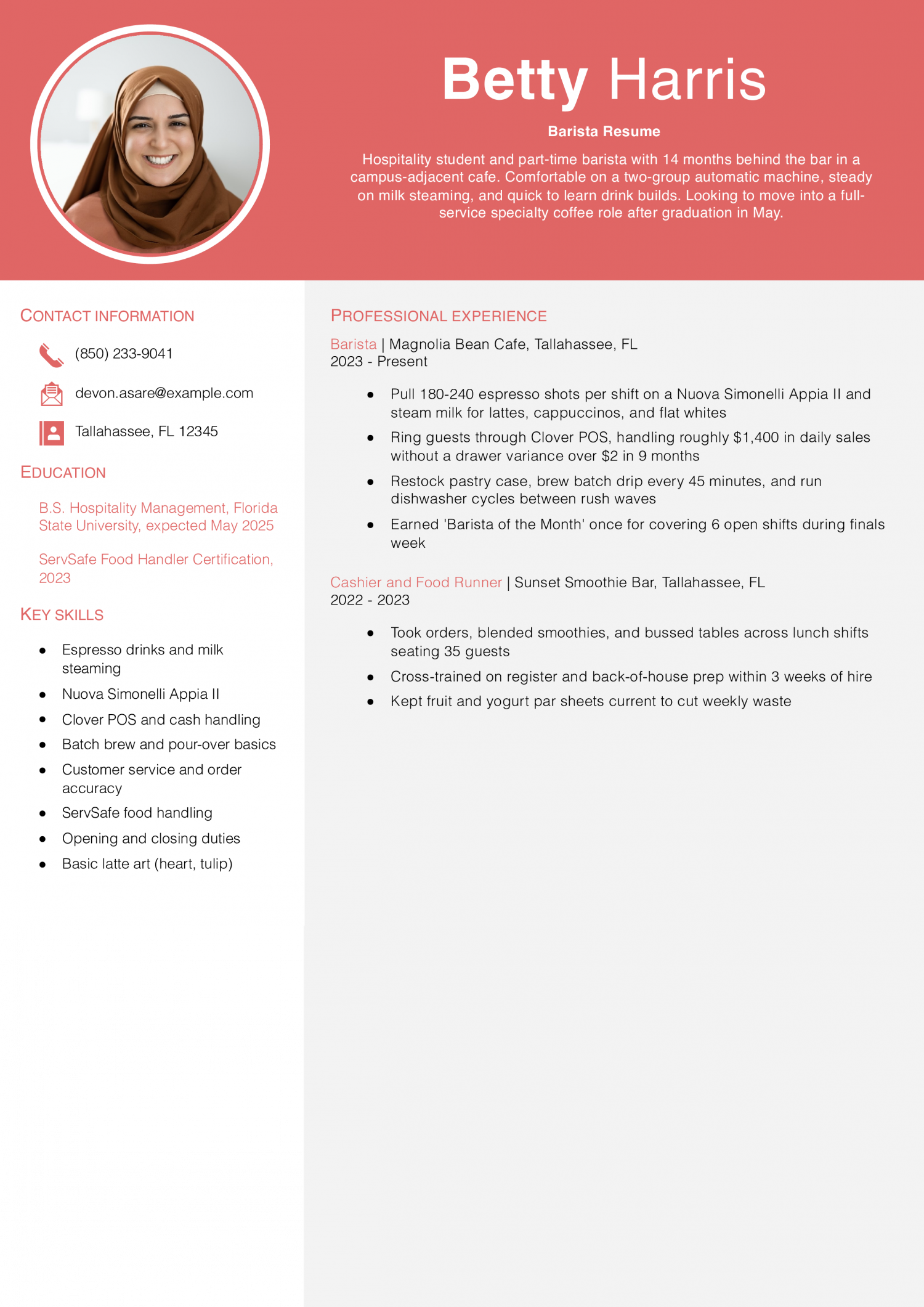
This profile is a barista with one to three years on bar, likely some lead-shift or training duties. Your resume needs to prove drink quality at volume, calibration habits, and that newer hires get up to speed on your shifts.
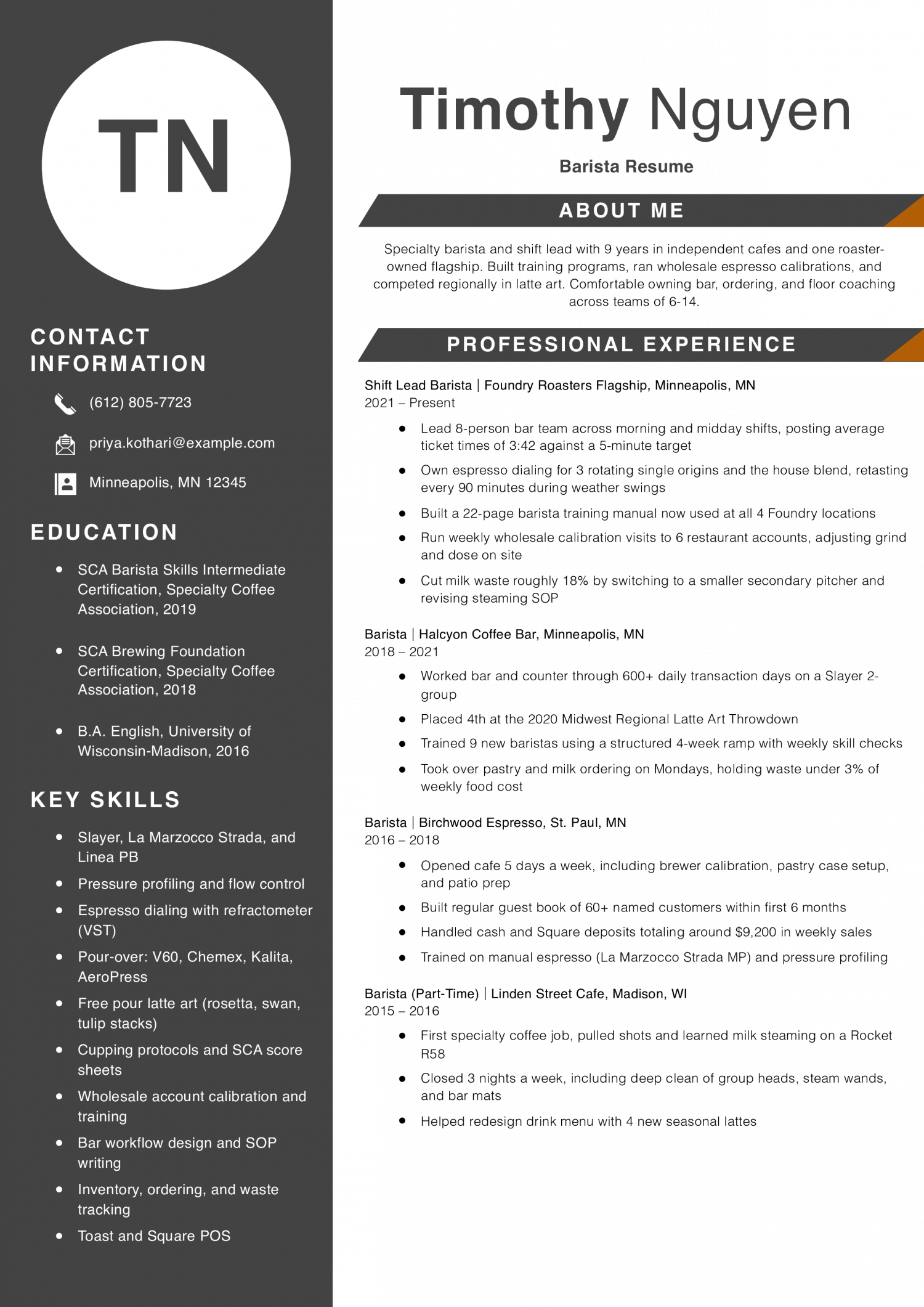
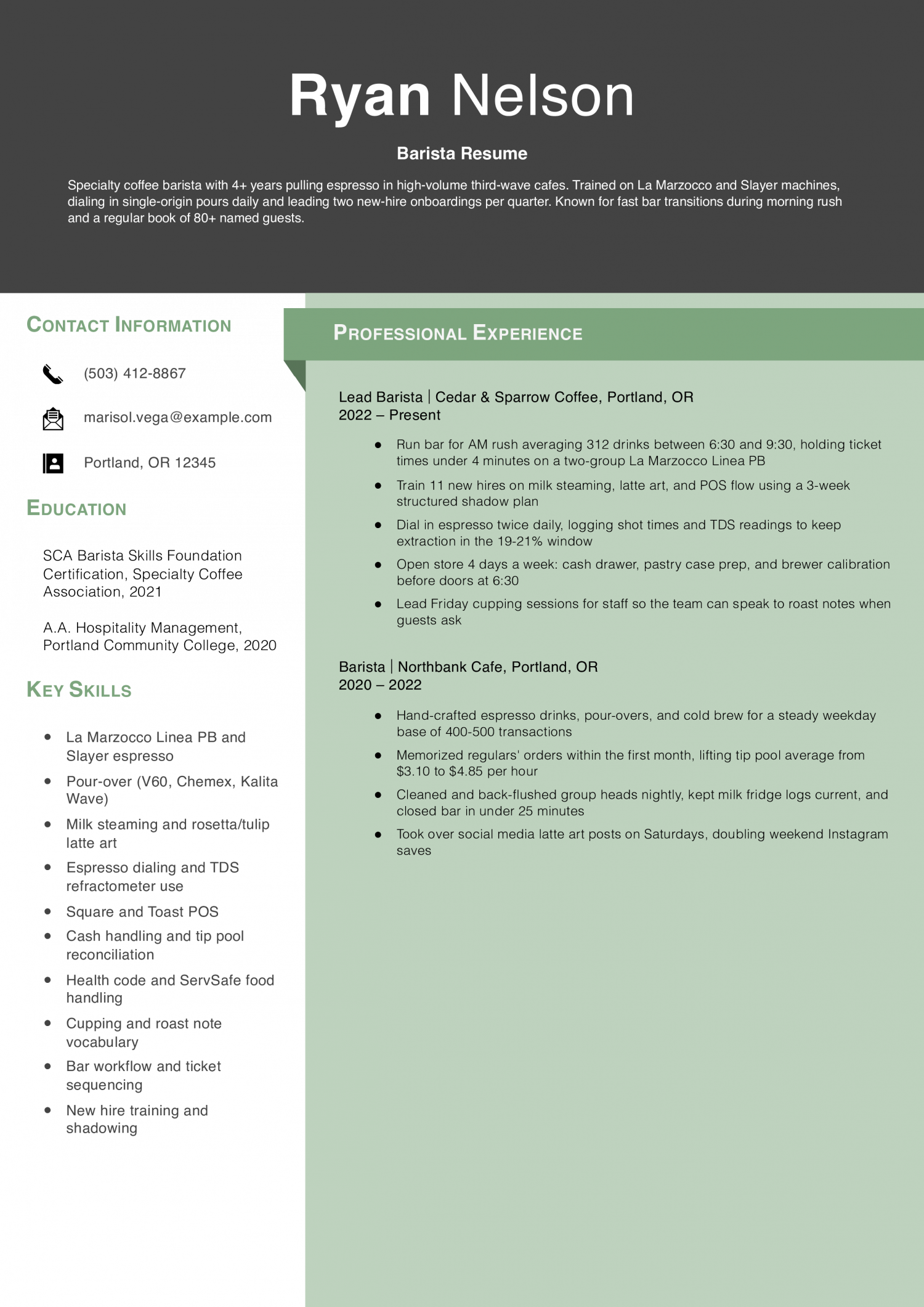
Specialty barista with 6 years across cafes, a micro-roastery tasting room, and a hotel lobby bar. Strong on espresso dialing, pour-over service, and guest education. Calm during heavy rush, intentional with training, and comfortable taking ownership of bar systems from open to close.
Lead the summary with bar volume and shift role, not a personality statement. Café managers size you up by drinks per hour, ticket times during peak, and whether you’ve run bar solo.
Name your last shop’s volume in your opening line. A strong opener reads like “Barista with two years on a 400-drinks-per-day bar, lead on weekend opens, trained four new hires on espresso calibration.” That tells a hiring lead your pace, your trust level, and your training reach inside one sentence.
Bullets without a number tend to read as duties, not wins. Café managers scan for pace and accuracy first, so pull real figures from your shifts.
Most strong barista resumes name two or three of these: average drinks per hour during peak, ticket time under five minutes, register variance held under one percent, or waste percentage on milk. If your shop didn’t track numbers, use volume signals: shop type, daily transaction count, or how many bars you ran. “Held morning rush pace at roughly 110 drinks per hour across a two-bar setup” lands harder than “prepared espresso drinks.”
Cluster bullets into three or four buckets so a 20-second skim catches the range. Use drink production, customer service and POS, calibration and maintenance, and team or training duties.
Under drink production, name the espresso machine, grinder, and milk styles you work with (La Marzocco Linea, Mahlkönig E65, free-pour latte art). Under POS and service, name the systems (Square, Toast, Clover) and cash-handling scope. Under calibration, name dialing in espresso shots, grinder adjustments, and steam wand routines.
Under team, name openings, closings, and any new-hire training you’ve owned.
Food handler card, allergen training, and barista-specific credentials go in a credentials line right under your summary. Café managers need to see these before they read your work history because health-code coverage and SCA training change who can run a bar alone.
List the credential, the issuing body, and the expiration year. Add a one-line availability block next to it: opens, closes, weekends, holidays. Shift availability is the second-biggest filter after pace, so giving the reader that signal on page one keeps your resume in the stack instead of pulled aside for follow-up questions.
Education sits at the bottom for barista resumes unless you’re a current student leaning on schedule fit. List your high school or degree, then any coffee-specific coursework like an SCA Barista Skills class or a roaster-led training.
Skip the references-available-on-request line; it wastes space hiring leads expect to ask for verbally. If you’ve worked at a recognizable specialty shop, name a lead barista or shift supervisor as a reference and confirm with them first. That single named contact tends to advance further than a generic line at the bottom.
The barista resumes that get callbacks share a specific skill mix. The lists below come from our user-built barista resumes. Café managers and shift supervisors scan for these patterns first, not generic customer-service language.
Hard skills get you past the ATS at chain employers and signal bar-readiness to independent shops. Soft skills back up the bullets that name volume and team work. Match this against the posting you’re targeting, and treat soft skills as evidence your bullets need to prove, not standalone claims.
| Soft Skills | % of resumes with this skill |
|---|---|
| Customer service | 76% |
| Teamwork | 69% |
| Attention to detail | 49% |
| Multitasking | 36% |
| Adaptability | 25% |
And here are the top hard skills showing up most often.
| Hard Skills | % of resumes with this skill |
|---|---|
| Espresso drink preparation | 77% |
| Cash handling | 70% |
| POS system operation | 44% |
| Food safety compliance | 38% |
| Coffee knowledge | 30% |
Based on data from thousands of baristas’ resumes built on ResumeTemplates.com, May 2026.
The items below are what separate a barista resume from one that gets put back in the pile.
Most states require a food handler card before you can work a bar that serves open drinks or pastries. List the credential with the issuing agency and the expiration year on page one of your resume.
State food handler card (name the state and issuing agency)
ServSafe Food Handler (where accepted)
Allergen Awareness (ServSafe Allergens or state equivalent)
Expiration year listed next to each credential
Café managers screen for the POS system their shop runs because training time drops when a new hire already knows the register flow. Name the specific systems you’ve used in your skills section and inside the relevant job bullet.
Square for Restaurants
Toast POS
Clover
Revel Systems
Lightspeed Restaurant
Starbucks Simphony / proprietary chain POS
Café hiring leads filter on availability before they read your work history. Putting a one-line availability block under your contact info answers their first question and keeps your resume in the stack.
Open shifts (4 a.m. to 7 a.m.) and weekend coverage are the hardest slots to fill at most shops. If you can work either, lead with that.
Holidays, late closes, and split shifts are also worth naming if you can cover them. Be honest about constraints; a trial shift surfaces them anyway.
A food handler card keeps you eligible. The certifications below are what move a barista resume from the qualified-but-typical stack into the shortlist for lead-bar and specialty roles. List the issuing body and expiration year next to each one.
SCA Barista Skills (Foundation, Intermediate, Professional): Specialty Coffee Association credentials signal you've trained on extraction theory and dialing in, which lead-bar roles screen for.
State Food Handler Card: Required in most states for anyone handling open food or drinks; list it with the issuing agency and expiration.
ServSafe Food Handler: Accepted as the food handler credential in many states and recognized by chain employers nationally.
Allergen Awareness Training: Useful for shops serving baked goods and milk alternatives; signals you can handle cross-contact questions at the bar.
Barista is one of the larger occupations in BLS, which means the median pulls in a long tail of part-time and quick-service variants alongside specialty roles. The spread between an entry counter shift and a lead bar at a specialty roaster is wider than the headline number suggests.
To position above the median, lead your resume with bar volume, the machines you’ve run, and any lead-shift or training scope, not a years-of-experience count.
| # | State | Avg. Annual |
|---|---|---|
| 1 | District of Columbia | $38,240 |
| 2 | California | $37,010 |
| 3 | Washington | $36,820 |
| 4 | Colorado | $35,440 |
| 5 | New York | $35,270 |
| 6 | Massachusetts | $35,060 |
| 7 | Vermont | $34,540 |
| 8 | Alaska | $34,430 |
| 9 | Oregon | $34,430 |
| 10 | Maine | $34,360 |
| # | State | Workers | Median |
|---|---|---|---|
| 1 | California | 438,950 | $37,010 |
| 2 | Texas | 410,760 | $27,000 |
| 3 | Florida | 241,010 | $27,990 |
| 4 | New York | 183,810 | $35,270 |
| 5 | Ohio | 167,650 | $28,100 |
Resume Templates offers HR approved resume templates to help you create a professional resume in minutes. Choose from several template options and even pre-populate a resume from your profile.
Skip the generic "prepared coffee drinks" line. Name the equipment, the volume, and the outcome.
A strong bullet reads: "Pulled 150-plus espresso drinks during morning rush on a two-group La Marzocco, holding ticket times under five minutes." That tells a café manager your pace, your machine, and your accuracy in one line.
Group duties under drink production, POS and cash, calibration, and team or training so the reader can scan.
Lean on volume, reliability, and scope. A first-job barista resume that names shop type, daily transactions, and shift coverage reads as experienced even at one year in.
Add any cross-training: pastry case, register close, inventory counts, or new-hire shadowing. Those signal you took on more than the basic counter role.
Yes. Starbucks scope reads in specific terms that café managers recognize.
Name the store volume tier (high-volume, drive-thru, reserve), your role (barista, shift supervisor), and any Coffee Master or Black Apron credential. Independent shops should get the shop name, the roaster they pull from, and the espresso machine model.
Both reads matter because chain hiring leads trust Starbucks pace and indie shops trust roaster-specific palate work.
Yes, in a one-line block near the top. Shift availability is the second-biggest filter after pace for café hiring.
Write it as "Availability: opens, weekends, holidays" under your summary or contact line. That answers the manager's first question before they pick up the phone and keeps your resume from getting pulled aside for follow-up.
For a barista, an ATS-friendly template is the safest pick, because it puts your certifications and experience where a hiring manager scans first. A basic template is a solid alternative. Whichever you choose, keep the formatting clean and easy to parse: clear section headings, a standard font, and no graphics a parser can choke on.
Executive Resume Writer and Career Coach
Andrew Stoner is an executive career coach and resume writer with 17 years of experience as a hiring manager and operations leader at two Fortune 500 Financial Services companies, and as the career services director at two major university business schools.
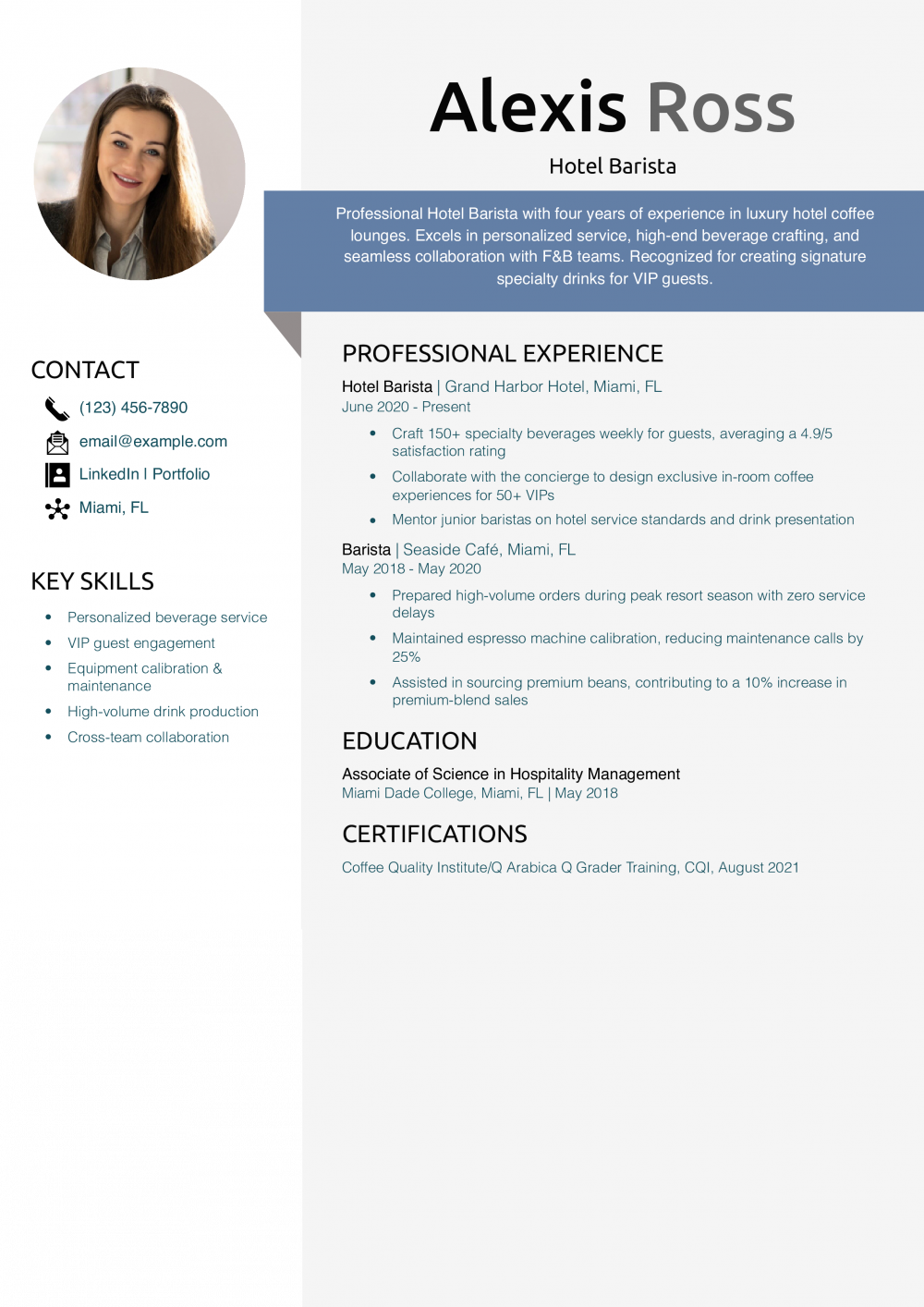
Customize this template in our builder in under 10 minutes.