Tip !

The pharmacy technician resumes that get phone screens share three things: a credentials line with PTCB and state registration up top, a prescription-volume number per shift, and named experience in Epic Willow, PioneerRx, or Rx30.

Andrew Stoner , Executive Resume Writer and Career Coach

Why this resume works

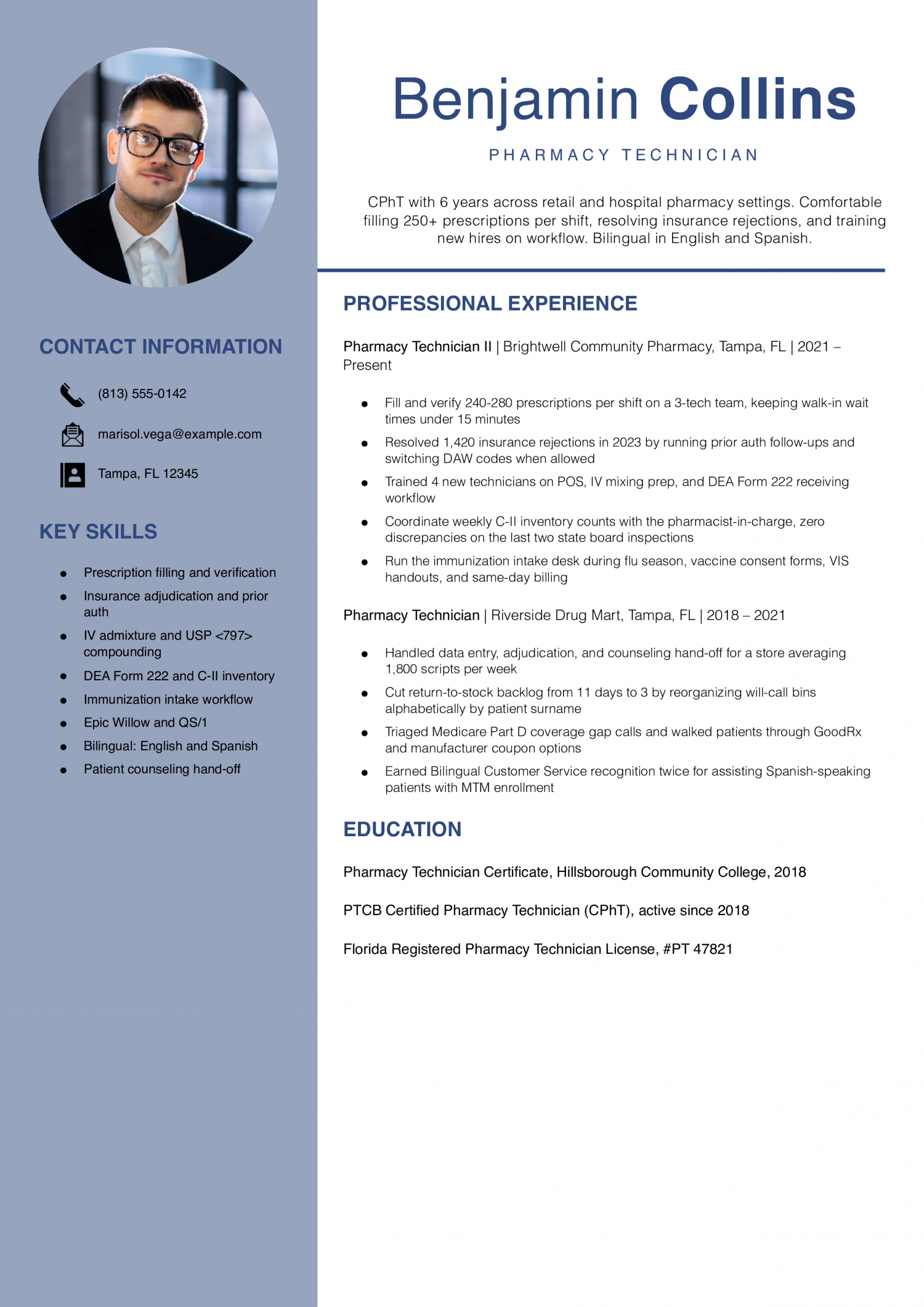
  • Real prescription volume: Saying 240-280 scripts per shift gives a hiring manager a concrete sense of the candidate’s daily pace.
  • Resolved insurance problems: The 1,420 rejections number shows she does the unglamorous billing work pharmacies most need help with.
  • Bilingual skill tied to patients: Spanish is named in context (MTM enrollment, recognition awards), not just listed as a skill.

Entry Level Example

You finished a PTCB-accredited program or a state-approved training track and need a first technician seat. The entry-level resume needs to prove certification, externship hours, and the pharmacy software you touched.

Why this resume works

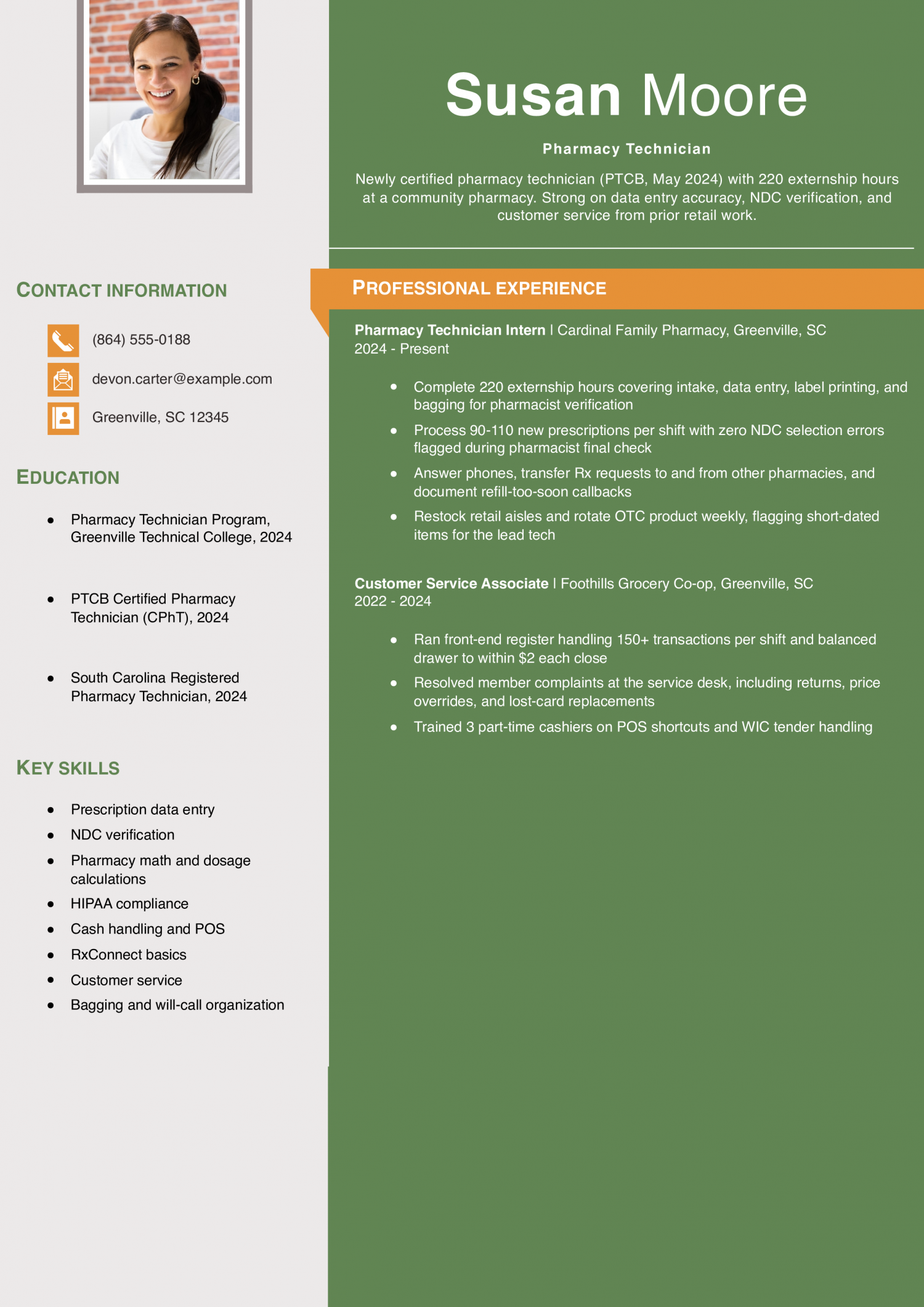
  • Names the externship hours: 220 hours is a concrete number that tells employers exactly how much hands-on time he has.
  • Uses prior retail in his favor: Cash handling and member service translate directly to a pharmacy front counter, and he frames it that way.
  • Certifications paired with dates for easy screening: PTCB and state registration are both shown with dates, which is what hiring managers screen for first.

Experienced Example

You have two to six years filling prescriptions in retail or hospital settings and want a step up in scope or pay. The experienced resume needs to prove prescription volume, accuracy rate, and insurance billing fluency.

Why this resume works

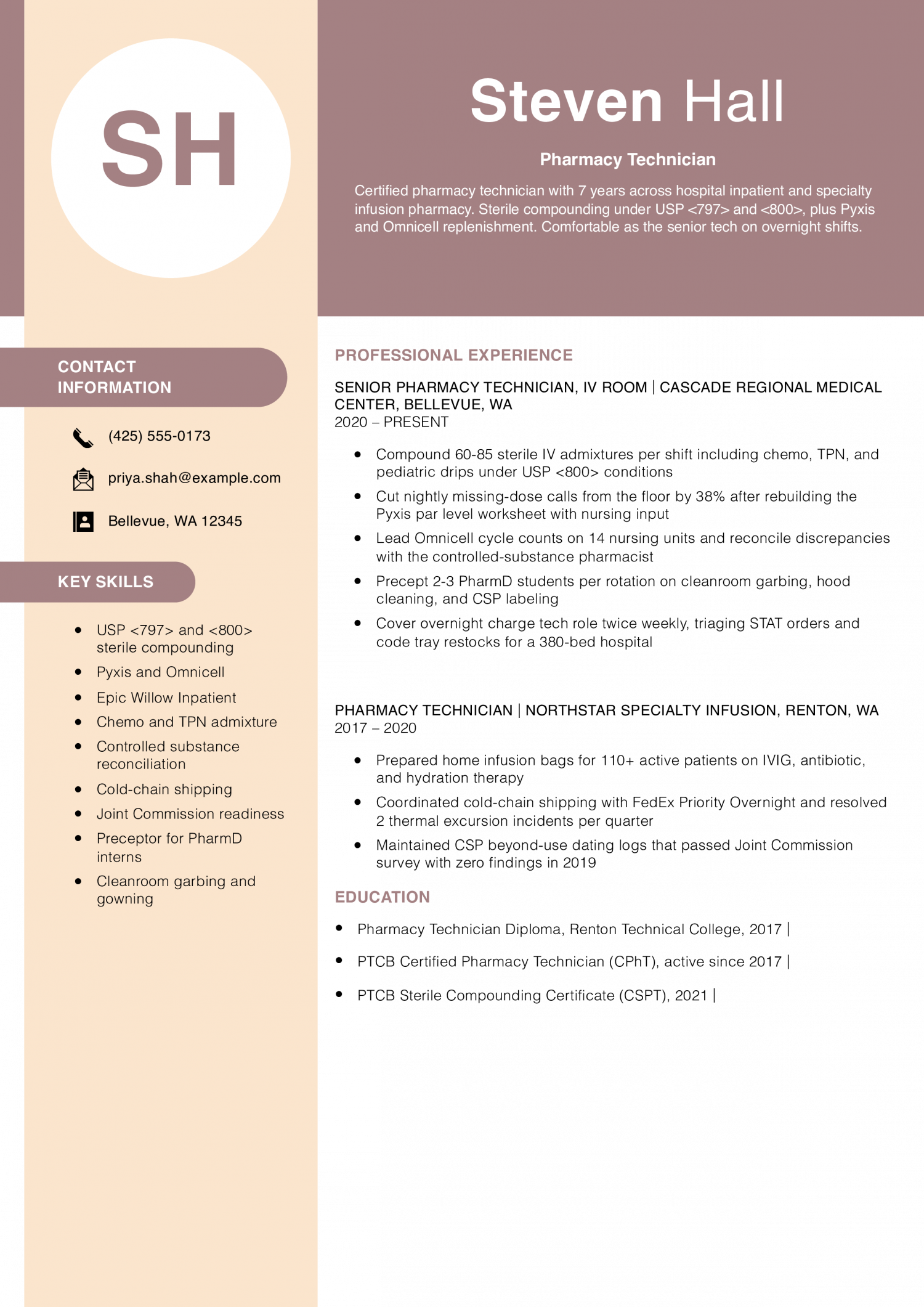
  • Sterile compounding is front and center: USP chapters and specific drugs like TPN and chemo signal she can step into an IV room on day one.
  • Cut a real problem in half: The 38% drop in missing-dose calls shows she fixes workflow issues, not just executes tasks.
  • Shows readiness for a lead role: Precepting students and running overnight charge tech work hint at readiness for a lead role next.

Lead Example

You run shifts, train new hires, or own inventory and 340B compliance for a pharmacy team. The lead resume needs to prove staff supervision, audit performance, and the systems you standardized.

Why this resume works

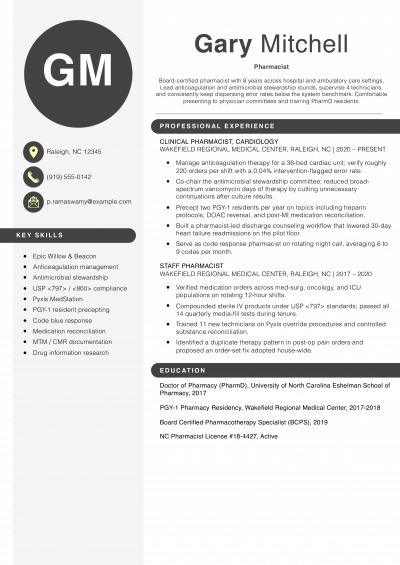
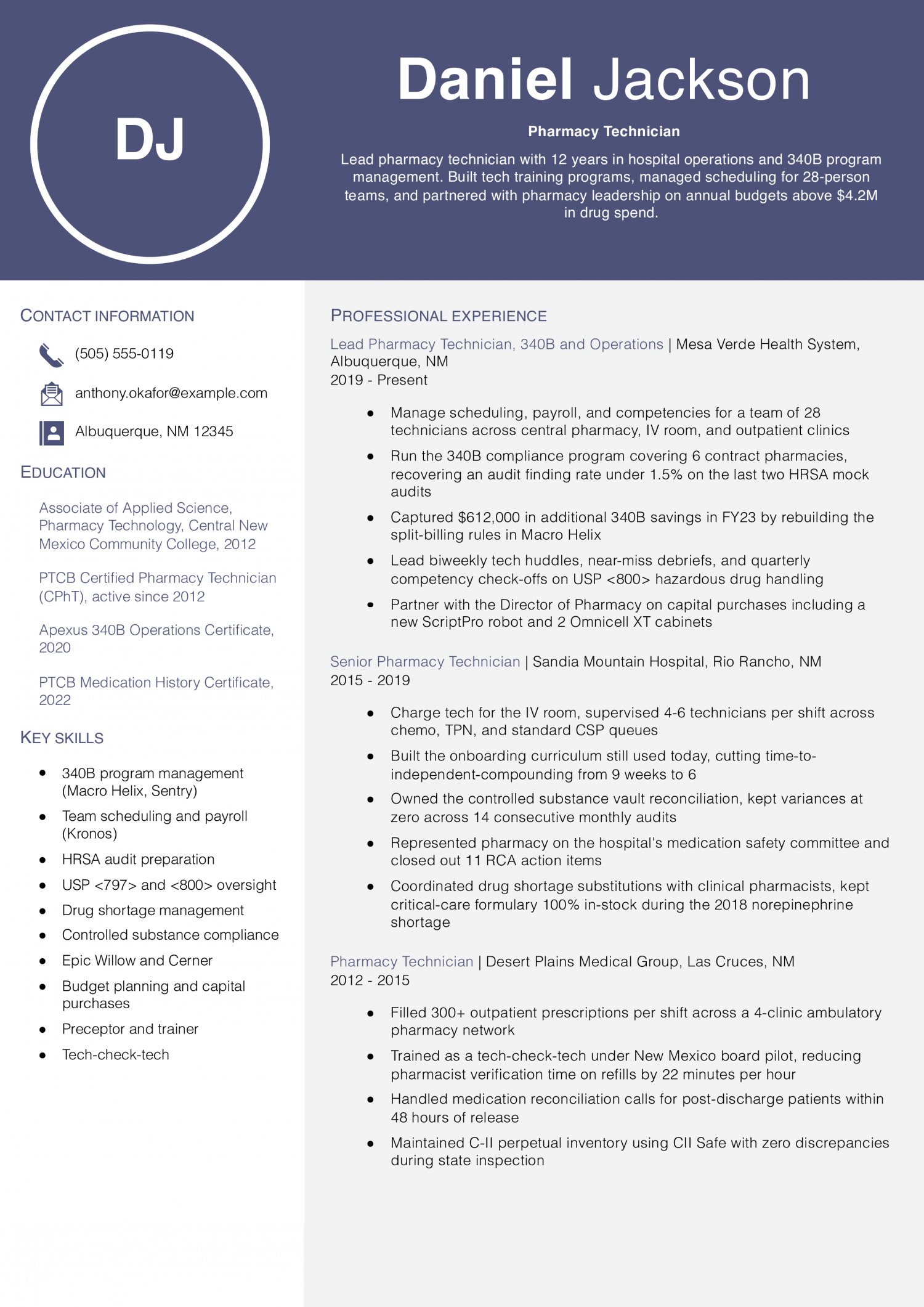
  • Real dollars saved: The $612,000 in 340B recovery is the kind of number a Director of Pharmacy will remember from the resume pile.
  • People leadership is concrete: Managing 28 techs, payroll, and competencies tells a hiring manager he runs a department, not just a shift.
  • Audit and compliance language: HRSA, Joint Commission, and USP chapters are exactly the vocabulary the job posting will use.

How to Write a Pharmacy Technician Resume

01 Open with the one thing a license lookup doesn't show

A state registration lookup tells lead pharmacists you are legal to work. It does not tell them what you can actually do on the floor.

Lead with the signal another technician likely cannot match. That could be IV admixture experience in a USP 797 cleanroom, sterile compounding hours, 340B program work, or fluency in Epic Willow plus insurance adjudication.

Bilingual patient counseling at the window counts too, especially for retail chains serving Spanish or Vietnamese populations. Put this line in your summary and echo it in your top experience bullet so the resume holds the same claim twice.

02 Quantify volume, accuracy, and wait times

Pharmacy work runs on numbers, so bullets without numbers tend to read as duties. Pharmacy managers scan for three figures first: prescriptions filled per shift, dispensing accuracy rate, and average customer wait time.

Pick metrics you can defend if asked. Strong bullets name a real range: 300 to 400 prescriptions per shift, a 99.8 percent accuracy rate over six months, or wait times trimmed from 22 to 14 minutes.

If you worked hospital inpatient, swap retail metrics for cart-fill counts, IV batch volume, and missed-dose response time. Tie one number to an outcome where you can, such as fewer rejected claims or a cleaner audit.

03 Group your work by pharmacy setting

Group bullets under four buckets so the resume reads fast. First, dispensing work: data entry, label generation, counting, pouring, and final check prep.

Second, patient and provider touchpoints: prescription intake, insurance verification, prior authorization follow-up, and OTC counseling within your scope. Third, inventory and compliance: cycle counts, expired-drug pulls, controlled substance logs, and DSCSA documentation.

Fourth, specialty work if you have it: sterile compounding under USP 797, hazardous compounding under USP 800, chemo prep, or 340B split billing. Lead pharmacists hiring for hospital roles look for that fourth bucket before anything else.

04 Put credentials and software on page one

Build a credentials block directly under your summary. List PTCB or ExCPT certification status, state board registration (state plus in good standing, no number), BLS if you have it, and any IV or sterile compounding certificates.

Add a tools line right after: Epic Willow, PioneerRx, Rx30, Liberty, QS/1, McKesson Connect, Pyxis, Omnicell, or whatever you ran. Insurance platforms count too, including Cover My Meds and ScriptPro.

Pharmacy managers verify credentials before they read bullets. Hiding PTCB at the bottom of the page costs you screens, especially for hospital and specialty roles that require active certification on day one.

05 Close with education and continuing education

Place your ASHP/ACPE-accredited training program, community college pharmacy tech program, or on-the-job training track under education. Name the program, the school, and the completion date.

If you are still sitting for the PTCE, say so with a test date. Pharmacy managers would rather see a scheduled exam than a vague claim of eligibility.

Add a short continuing education line for CE hours completed in the last cycle, especially anything in immunization, MTM support, sterile compounding, or controlled substance handling. That CE line signals you track your hours and renew on time.

ATS filters catch more pharmacy technician resumes than ever in 2026. The skills below come from our user-built pharmacy technician resumes. Named pharmacy systems and certification acronyms clear the first cut.

Patient-facing soft skills like clear counseling language decide whether the resume advances past the lead pharmacist’s read. Match this list against the posting, then use the soft skills as evidence inside your bullets, not as a separate decorative list.

Soft Skills % of resumes with this skill
Attention to detail 75%
Customer service 54%
Communication 43%
Teamwork 37%
Time management 28%

And here are the top hard skills showing up most often.

Hard Skills % of resumes with this skill
Prescription processing 74%
Insurance claims processing 55%
Dosage calculations 43%
Pharmacy software 38%
Inventory management 29%

Based on data from thousands of pharmacy technicians’ resumes built on ResumeTemplates.com, May 2026.

Must Have on a Pharmacy Technician Resume

Before a pharmacy technician resume gets a closer read, hiring teams check for a short list of essentials.

Continuing Education That Pharmacy Managers Look For

State boards set CE hour requirements on a one or two-year cycle, and lead pharmacists check that your hours match the topics on the job posting. A short continuing education line under education signals you renew on time and stay current on controlled substance and compounding rules.

Match CE topics to the posting

Pick CE that maps to the role you want, not the role you have. A retail tech aiming for a hospital seat should log sterile compounding and IV admixture hours. A tech eyeing a specialty pharmacy seat should log hours in oncology, HIV, or limited distribution drug handling.

List CE by topic and year, not by individual course title. “Sterile compounding (USP 797): 8 hours, 2025” reads cleaner than three line items for the same module.

  • Controlled substance handling and DEA recordkeeping refreshers
  • USP 797 sterile compounding and USP 800 hazardous drug handling
  • Immunization update modules where state scope allows
  • Pharmacy law updates from your state board’s approved provider list
  • Patient safety and medication error prevention coursework

Pharmacy Technology Credentials That Get You the Job

Beyond your state registration and PTCB or ExCPT, the certifications below tell lead pharmacists which settings you can step into without retraining: sterile rooms, hazardous compounding, immunization support, or specialty fills. List the certifying body and the current expiration date next to each item.

  • Certified Pharmacy Technician (CPhT) - PTCB: The default credential for retail, hospital, and mail-order roles; many states and chains require it within 12 months of hire.
  • Certified Compounded Sterile Preparation Technician (CSPT) - PTCB: Signals you can work in a USP 797 cleanroom and handle IV admixtures, which moves you to the top of hospital and infusion stacks.
  • Advanced Certified Pharmacy Technician (CPhT-Adv) - PTCB: Marks five-plus years of experience and additional assessments; useful when applying for lead technician or supervisor roles.
  • Basic Life Support (BLS) - American Heart Association: Required for most hospital pharmacy roles and many ambulatory clinic positions where techs assist with immunizations.

Allied Health Credentials Worth Adding

Pharmacy technicians who pick up allied health credentials open doors into immunization support, MTM clinics, and specialty pharmacy. List each credential with the issuing body and the expiration date, then mirror the credential name in a bullet that shows you used it.

  • Immunization administration certification (APhA-accredited) for retail chains running flu, COVID, and shingles clinics
  • Medication Therapy Management (MTM) certificate for ambulatory care and Part D outreach roles
  • Naloxone administration training where your state allows technician dispensing
  • Point-of-care testing certificate for chains offering A1c, strep, or flu testing at the counter

Latest BLS Statistics for Pharmacy Technicians

The 90th-percentile pharmacy technician out-earns the median by a wide band, which tells you the market pays for setting and specialty rather than years on a counter. Hospital, specialty, and compounding roles sit at the top; standalone retail counters anchor the bottom. Geography compounds the spread because state scope rules and metro wage floors shift the ceiling.

Lead the resume with the setting and the specialty signals (USP 797, 340B, IV admixture) that map to the band you want.

$43,460 National median annual
$44,800 National mean annual
$35,100 Entry-tier floor (10th percentile)
$59,450 Top-decile ceiling (90th percentile)
487,920 Pharmacy Technicians in the U.S.
Where you stand

Entry tier

$35,100 to $43,460 At the entry tier, lead with PTCB status or a scheduled PTCE date, your externship hours, and the pharmacy software you trained on.

Mid band

$43,460 to $59,450 At the mid band, your resume needs to show prescription volume per shift, accuracy rate, and named systems like Epic Willow or PioneerRx.

Top decile

$59,450+ At the top decile, lead with sterile or hazardous compounding hours, 340B work, lead tech duties, and audit or inspection results.

Top-paying states

# State Avg. Annual
1 Washington $56,140
2 Oregon $51,210
3 Alaska $50,440
4 California $49,640
5 Minnesota $48,560
6 Colorado $48,070
7 Arizona $47,620
8 North Dakota $47,600
9 Montana $46,980
10 Utah $46,760

Highest-employment states

# State Workers Median
1 California 45,210 $49,640
2 Texas 41,610 $43,920
3 Florida 38,950 $39,640
4 New York 26,450 $40,840
5 Illinois 22,790 $44,610
Source: U.S. Bureau of Labor Statistics, OEWS 2024 release (SOC 29-2052).
Written by professional resume writers and loved by hiring managers

Resume Templates offers HR approved resume templates to help you create a professional resume in minutes. Choose from several template options and even pre-populate a resume from your profile.

Frequently Asked Questions

How do I list my PTCB certification and state registration without exposing personal numbers?

Put a credentials block right under your summary. Write "Certified Pharmacy Technician (CPhT), PTCB, exp. 03/2027" and "Registered Pharmacy Technician, Ohio Board of Pharmacy, in good standing."

Skip the certification number and the registration number on the resume. You will enter those on the application form, and most state boards advise against publishing them publicly.

What should a pharmacy technician job description on a resume include?

Each role gets four to six bullets, not a duty dump. Open each bullet with a verb and a number: prescriptions filled per shift, accuracy rate, insurance claims processed, or wait time trimmed.

Name the pharmacy software, the patient volume, and any controlled substance handling. Save soft duties like "answered phones" for the bottom or cut them entirely.

I am moving from retail to hospital pharmacy. How do I reframe my resume?

Lead with any inpatient-adjacent work you already have. Translate retail bullets into hospital language: cart fills become unit-dose dispensing, insurance work becomes formulary lookup, OTC counseling becomes medication history support.

Add one bullet on cleanroom exposure, IV training, or USP 797 coursework even if it was a continuing education module. Apply for the CSPT credential when you have the hours to qualify.

What goes in the summary section of a pharmacy technician resume?

Three lines, no more. Line one names your credential, setting, and years ("Certified pharmacy technician with four years in high-volume retail and 18 months in hospital inpatient").

Line two names your prescription volume and accuracy rate. Line three names the software and specialty, such as Epic Willow, PioneerRx, or USP 797 sterile compounding.

Skip phrases like "detail-oriented" or "team player." Lead pharmacists scan past them and read the metrics instead.

What resume template should a pharmacy technician use?

For a pharmacy technician, an ATS-friendly template is the safest pick, because it puts your certifications and experience where a hiring manager scans first. A basic template is a solid alternative. Whichever you choose, keep the formatting clean and easy to parse: clear section headings, a standard font, and no graphics a parser can choke on.

Rate this article

Pharmacy Technician Resume

Average Rating

4.7/5 stars with 132 reviews

You have given 0 Star(s)
4.7/5 stars with 132 reviews
Andrew Stoner

Executive Resume Writer and Career Coach

Andrew Stoner is an executive career coach and resume writer with 17 years of experience as a hiring manager and operations leader at two Fortune 500 Financial Services companies, and as the career services director at two major university business schools.