20 Best Nursing Resume Examples and Templates for 2026



Nurse managers decide whether to call within the first third of page one; if active PCT or CNA certification, current BLS, and the unit type are not visible by then, the resume gets stacked under the maybe pile.
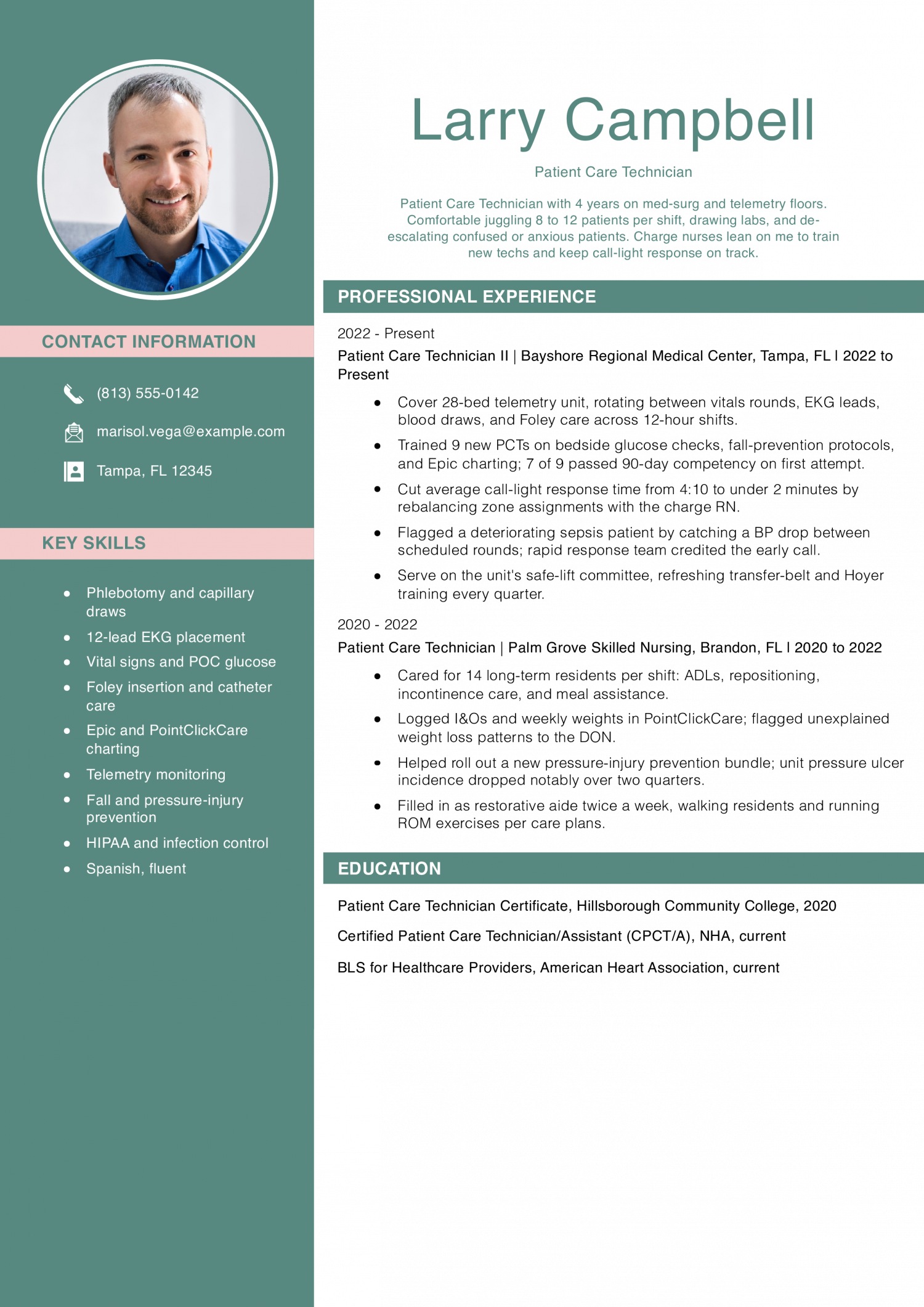
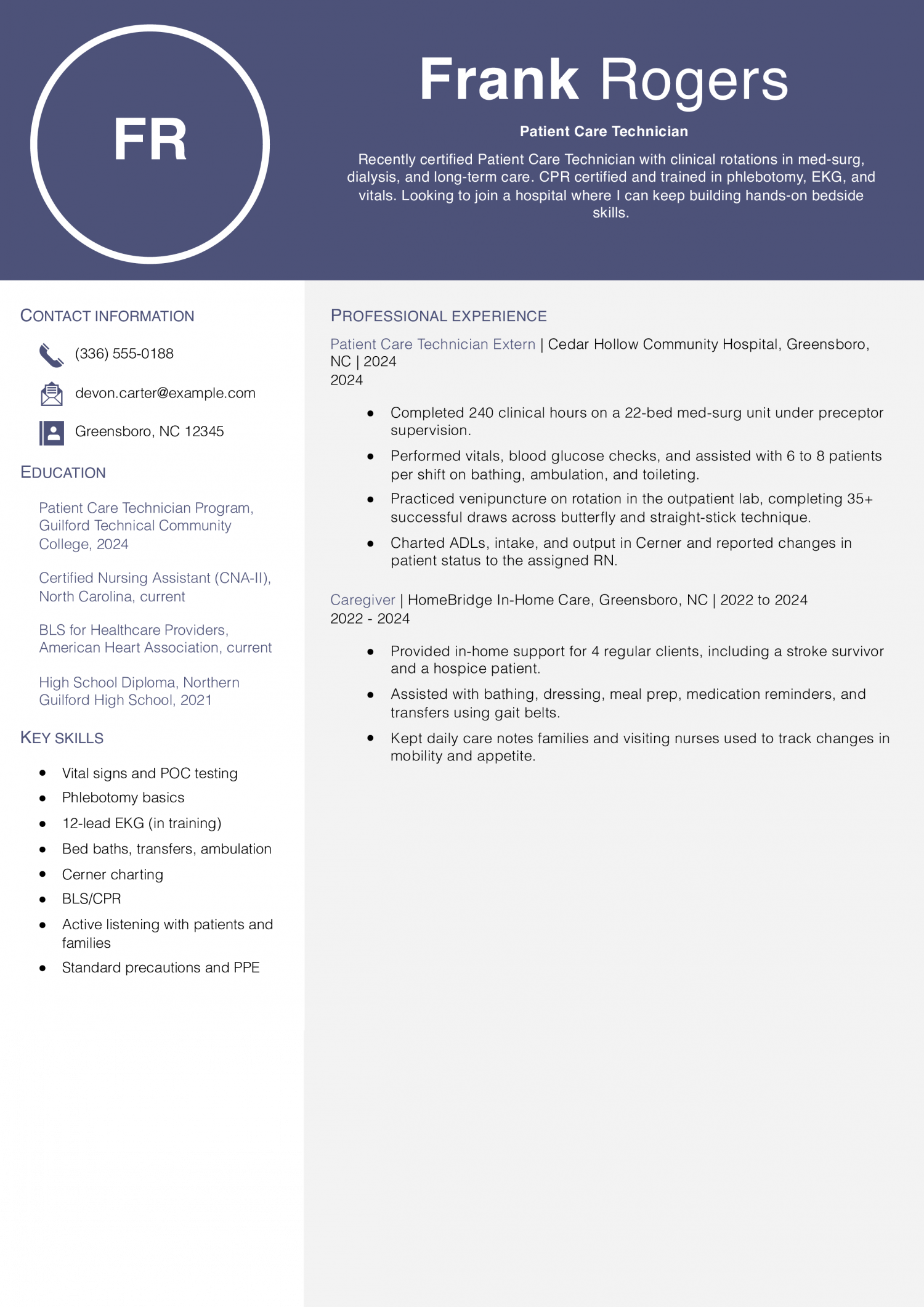
You finished a state-approved PCT or CNA program and hold current BLS, with clinicals or a first hospital role under your belt. The entry-level resume needs to prove credential currency, supervised patient care hours, and comfort with vitals, ADLs, and EHR charting.
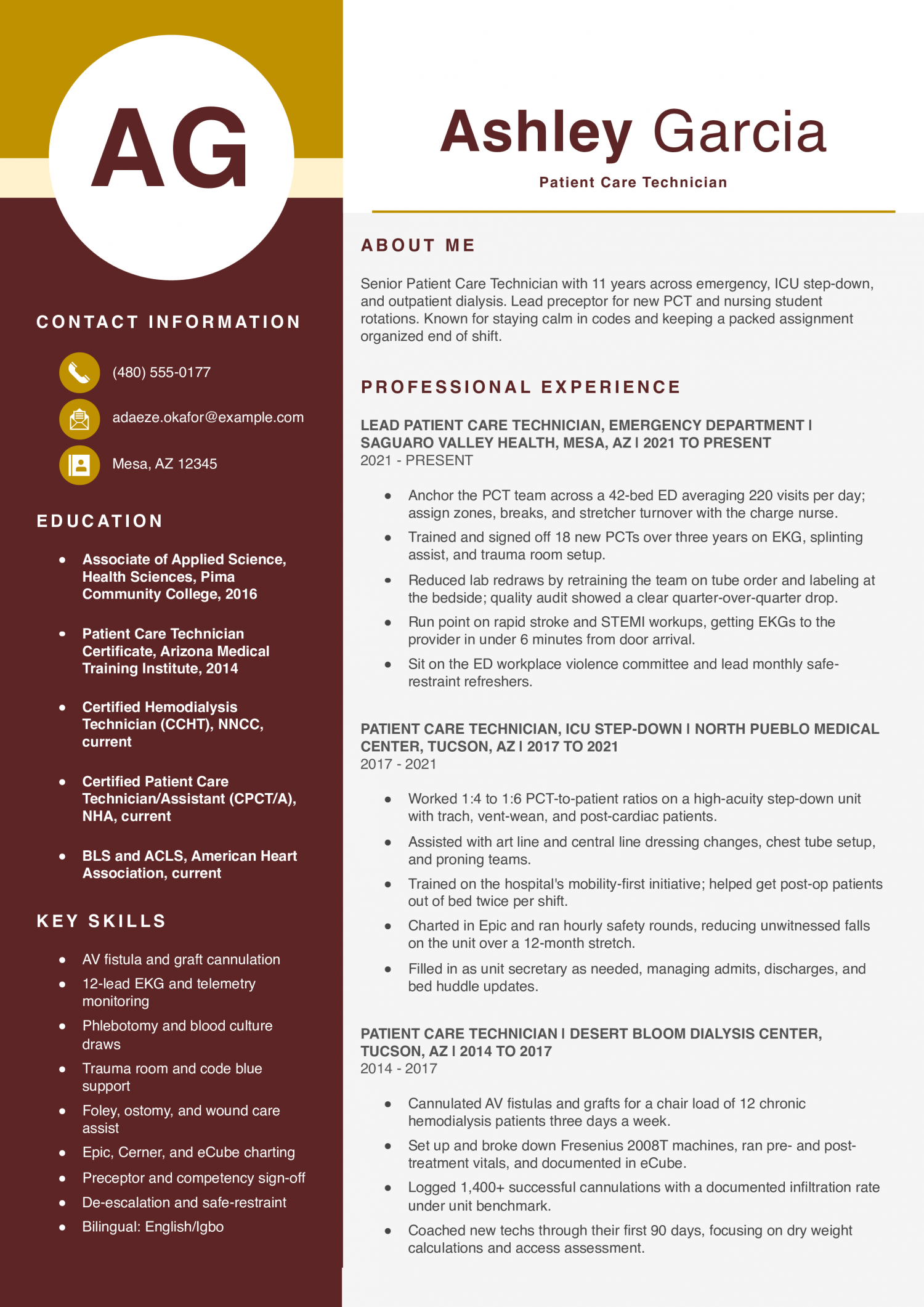
You have two or more years on the floor across med-surg, telemetry, or dialysis, with phlebotomy and EKG in your daily rotation. The experienced resume needs to show patient ratios, acuity level, and the procedures you run without an RN at your elbow.
Renata Salcedo
Columbus, OH | (614) 555-0119 | [email protected] | linkedin.com/in/renatasalcedo
Patient Care Technician with 7 years across oncology, med-surg, and outpatient infusion. Strong on central line care, neutropenic precautions, and chemo-safe handling. Preceptor to new techs and a steady voice for anxious patients and families.
Senior Patient Care Technician, Oncology
Riverbend Cancer Institute | Columbus, OH | 2022-Present
Patient Care Technician, Med-Surg
Linden Heights Hospital | Cincinnati, OH | 2019-2022
Patient Care Technician, Emergency Department
Linden Heights Hospital | Cincinnati, OH | 2018-2019
Certified Nursing Assistant
Maple Crest Senior Living | Cincinnati, OH | 2017-2018
Add a single line a nurse manager cannot pull from a CNA registry lookup. Name your unit type, your typical patient ratio, and one procedure you own.
Examples that land: telemetry PCT carrying six patients with 12-lead EKG and phlebotomy, or dialysis PCT running cannulation on a 16-chair floor. That sentence sits at the top of your summary, above the certifications block. It tells a charge nurse you fit a specific floor, not a generic care role.
Bullets without numbers tend to read as duties, not work. Most strong PCT resumes name patient ratios, procedure volume, and shift type on the bullets that matter most.
Reach for three metrics: patients per shift (six to eight on med-surg, three to four on ICU step-down), procedures performed per week (EKGs, blood draws, glucose checks), and acuity markers (telemetry, post-op, isolation). Charge nurses scan for these first because they map to the floor’s daily load. A bullet reading ‘drew labs on 25 to 30 patients per shift’ beats ‘performed phlebotomy duties’ every time.
Sort your day-to-day into four buckets so a nurse manager reads scope in seconds. The categories that travel across most PCT roles are direct patient care, diagnostic procedures, documentation, and safety.
Direct patient care covers ADLs, ambulation, vitals, and turning. Diagnostic procedures include phlebotomy, 12-lead EKG, glucose monitoring, and specimen collection. Documentation means EHR charting in Epic or Cerner, intake and output logs, and shift handoff notes.
Safety covers infection control, isolation precautions, fall prevention, and rapid response support. Two to three bullets per category gives a charge nurse a clean read on what you actually do.
Build a Certifications block under your summary on page one. List your state PCT or CNA registration with the state and good-standing status, current BLS through AHA, and any add-ons like EKG technician, phlebotomy technician, or CPCT/A from NHA.
Nurse managers and clinical supervisors need these visible early because HR cannot route the file to a hiring panel without active credentials on record. List the issuing body, state, and expiration month and year. Do not write out registration numbers on the resume; provide those on the application form when the system asks.
Your education section names the state-approved nursing assistant or PCT program, the school, and your completion date. Add clinical hours if you are within two years of graduation, since charge nurses use that to gauge bedside readiness.
If you are coming from a CNA role into a PCT seat, add one line on the bridge training you took: phlebotomy hours, EKG hours, or a hospital-sponsored PCT orientation. Career changers from EMT or medical assistant work should name the overlap (vitals, patient transport, point-of-care testing) so a recruiter sees the transfer without guessing.
ATS filters catch more patient care technician resumes than ever in 2026. The skills below come from our user-built PCT resumes. Procedure names and EHR systems clear the first cut, and bedside communication decides whether the resume advances.
Nurse managers and clinical supervisors weigh hard skills first because state regs require credentialed procedures, but soft skills break the tie between two qualified PCTs. Match the hard-skill list against your target posting word for word, and treat soft skills as evidence backing your bullet points, not standalone claims.
| Soft Skills | % of resumes with this skill |
|---|---|
| Patient communication | 73% |
| Empathy and compassion | 67% |
| Attention to detail | 47% |
| Teamwork | 35% |
| Patience | 31% |
And here are the top hard skills showing up most often.
| Hard Skills | % of resumes with this skill |
|---|---|
| Vital signs monitoring | 72% |
| Phlebotomy and blood draws | 70% |
| CPR and basic life support | 46% |
| EKG administration | 35% |
| Electronic health records | 29% |
Based on data from thousands of patient care technicians’ resumes built on ResumeTemplates.com, May 2026.
The items below are what separate a patient care technician resume from one that gets put back in the pile.
CE hours show a charge nurse you keep current between recerts. List them under a Continuing Education subheading with the provider and year.
Most states require CE hours to maintain CNA or PCT registration, and dialysis employers add their own annual training stack. Listing CE on the resume signals you handle the upkeep without HR chasing you.
Keep the list to four or five recent courses tied to the floors you want. Stale CE from five years ago crowds the section without adding signal.
Charge nurses scan for the EHR brand because onboarding to a new system eats a week of training. Name every system you have charted in, even briefly.
Never put real patient details, room numbers, or identifiable case facts on your resume. Recruiters treat any leak as a hard pass.
Describe scope with ratios, acuity, and procedure types instead of patient stories. ‘Supported six to eight post-op patients per shift on a 24-bed med-surg unit’ is specific without exposing anyone.
If you completed HIPAA training, list it under Continuing Education with the year. Do not quote policy language or name specific incidents you handled.
State PCT or CNA registration plus current BLS keeps you eligible. The certifications below are what move a PCT resume from the qualified-but-typical stack into a nurse manager’s shortlist. List the issuing body, level, and expiration month and year for each.
Allied health credentials beyond the PCT baseline tell a nurse manager which floor you can step onto without a long orientation. Group them under Certifications with the issuer and expiration date.
Patient care technician maps to the BLS nursing assistant and orderly category, one of the larger healthcare support occupations. The median pulls in a long tail of nursing-home and entry-tier roles, which means hospital-based PCT work tends to sit above the middle of the band. Geographic spread is wide because state minimum wages and union contracts move the floor.
To position above the median, lead with your unit type, patient ratios, and procedure mix, not the years you have logged.
| # | State | Avg. Annual |
|---|---|---|
| 1 | Oregon | $48,390 |
| 2 | Washington | $48,260 |
| 3 | New York | $47,390 |
| 4 | District of Columbia | $46,860 |
| 5 | California | $46,420 |
| 6 | New Hampshire | $46,050 |
| 7 | Alaska | $45,840 |
| 8 | Maine | $45,640 |
| 9 | Minnesota | $45,580 |
| 10 | Massachusetts | $45,410 |
| # | State | Workers | Median |
|---|---|---|---|
| 1 | California | 102,380 | $46,420 |
| 2 | Florida | 91,280 | $36,850 |
| 3 | Texas | 87,050 | $36,390 |
| 4 | New York | 85,310 | $47,390 |
| 5 | Pennsylvania | 65,410 | $41,110 |
Resume Templates offers HR approved resume templates to help you create a professional resume in minutes. Choose from several template options and even pre-populate a resume from your profile.
Lead with your state-approved training program, clinical rotation hours, and current BLS in a page-one credentials block.
List the procedures you performed during clinicals (vitals, ADLs, phlebotomy practice, EHR charting) as a Clinical Experience section instead of Work History.
Add any non-hospital patient-facing work like home health aide or group home shifts under a Related Experience heading so the recruiter sees patient contact without guessing.
Write a summary, not an objective. A summary names your credential, unit type or specialty interest, and one procedure or skill you own.
Example: CPCT/A with two years on med-surg, comfortable running phlebotomy on six to eight patients per shift and charting in Epic.
Objectives read as student-coded and burn space the credentials block could use.
Rename the section heading to PCT Experience if your CNA role included phlebotomy, EKG, or EHR charting.
Pull those procedures into their own bullets so the keyword scan catches PCT-coded terms.
Add bridge training like a phlebotomy course or EKG certification under Certifications with the issue date.
Duties tell a recruiter what the role was; accomplishments tell them how you ran it.
For a PCT, duties are vitals, ADLs, and charting. Accomplishments add a number or an outcome: patients per shift, procedure volume, or a preceptor role.
Aim for one accomplishment-style bullet per role, even if the rest stay duty-coded.
For a patient care technician, an ATS-friendly template is the safest pick, because it puts your certifications and experience where a hiring manager scans first. A basic template is a solid alternative. Whichever you choose, keep the formatting clean and easy to parse: clear section headings, a standard font, and no graphics a parser can choke on.
Executive Resume Writer and Career Coach
Andrew Stoner is an executive career coach and resume writer with 17 years of experience as a hiring manager and operations leader at two Fortune 500 Financial Services companies, and as the career services director at two major university business schools.
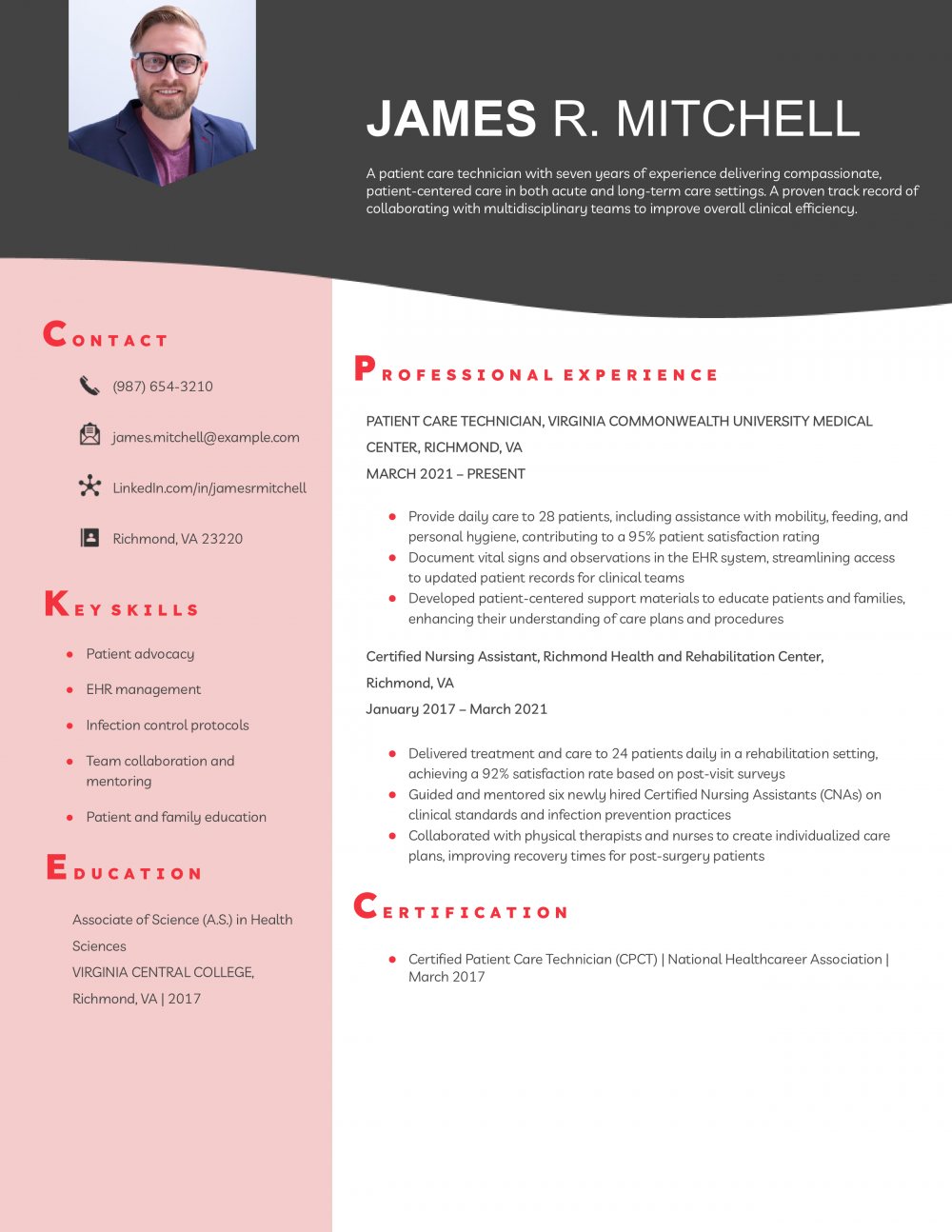
Customize this template in our builder in under 10 minutes.