
Tip !

A named stack with version numbers is what gets system administrator resumes past the recruiter screen in under 30 seconds; SLA and MTTR figures are what make them readable enough to advance to the technical phone screen.

Andrew Stoner , Executive Resume Writer and Career Coach

Why this resume works

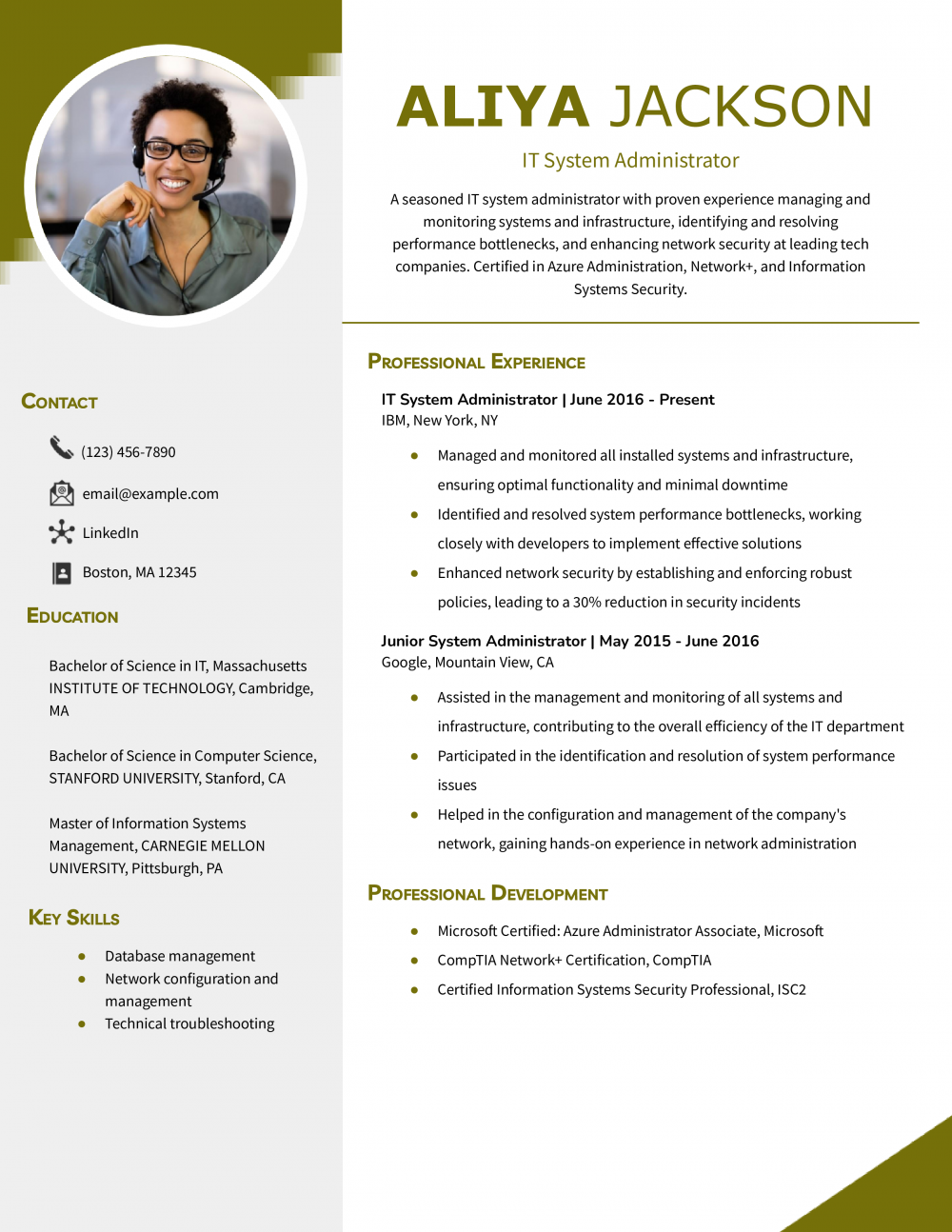
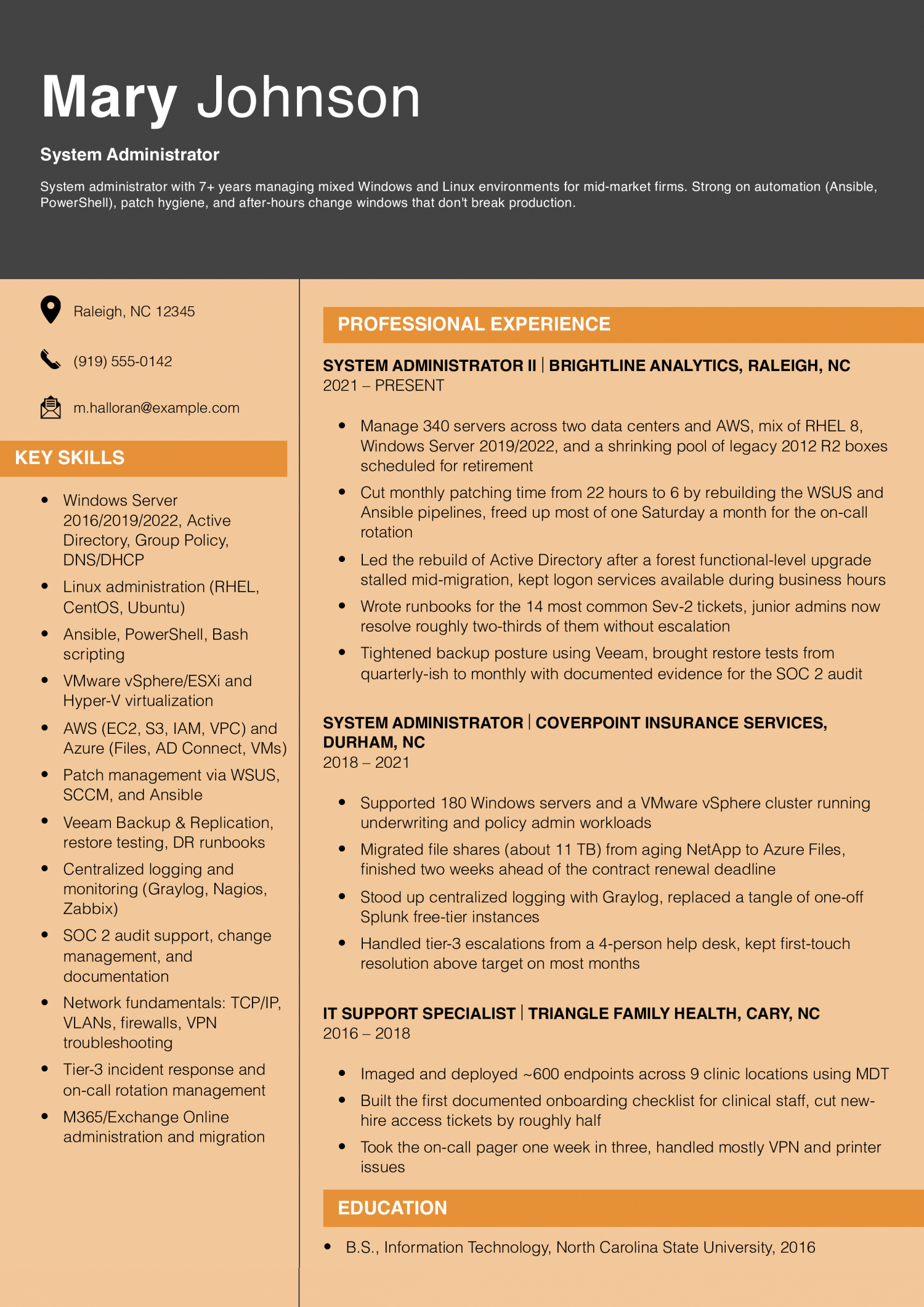
  • Real numbers on time saved: Cutting monthly patching from 22 hours to 6 is the kind of specific, believable metric a hiring manager can picture and verify in an interview.
  • Mix of platforms, not just one stack: Windows, Linux, VMware, and AWS all show up, which matches what most sysadmin job posts actually ask for.
  • Audit-ready work shows up: Mentioning SOC 2 evidence and documented restore tests signals the candidate has worked under real compliance pressure, not just lab conditions.

Junior Example

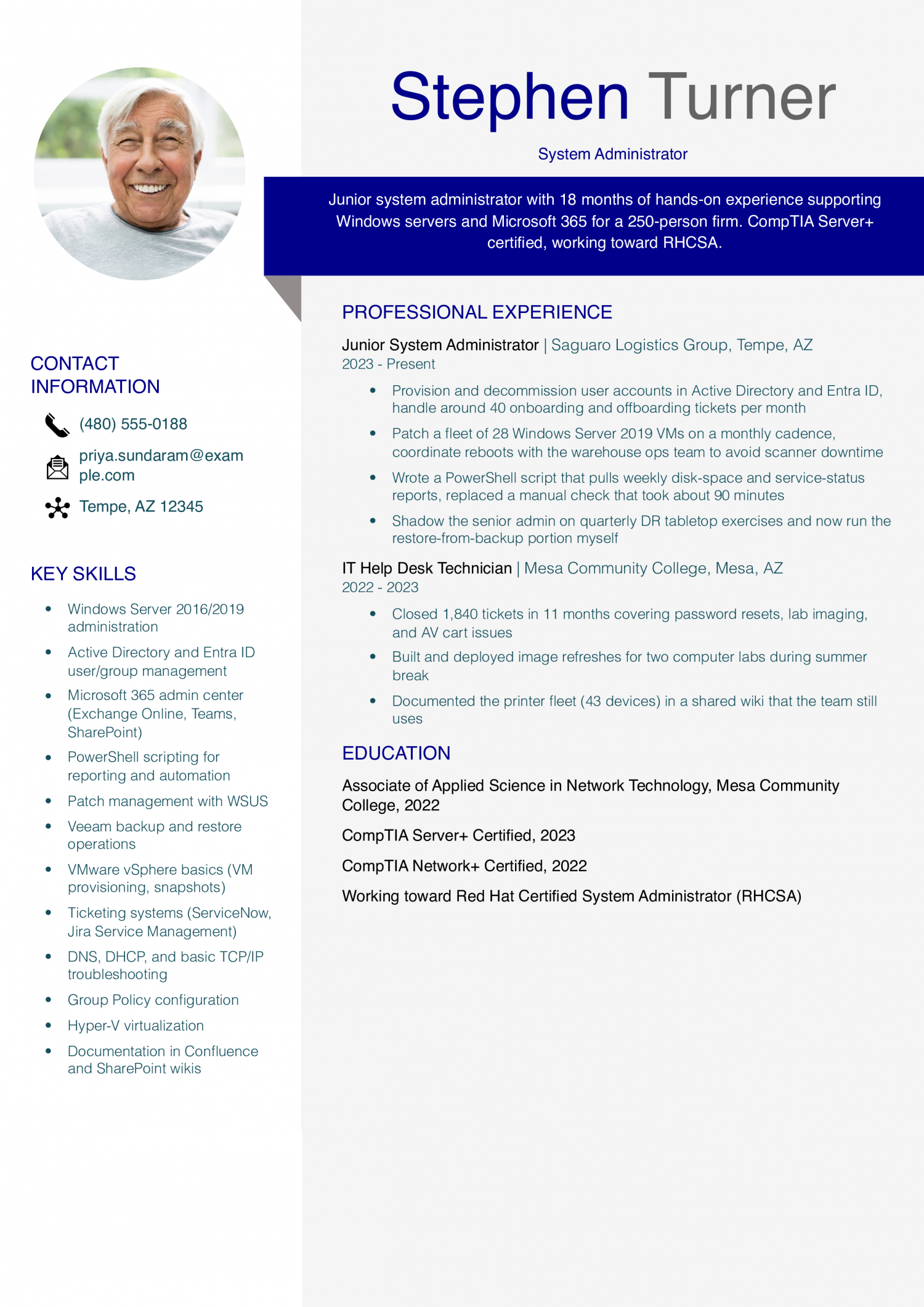
Junior system administrators are one to three years in, often promoted from help desk tier 2 or service desk lead. The resume needs to prove hands-on ticket ownership, scripting starters, and the platforms you actually touched in production.

Why this resume works

  • Owns small wins that matter: Writing a PowerShell script to replace a 90-minute manual task is exactly the level of initiative a hiring manager wants to see from a junior admin.
  • Certifications are realistic: Server+ earned and RHCSA in progress shows steady growth without overclaiming senior credentials like CISSP.
  • Help desk roots are an asset: Leading with 1,840 closed tickets and lab imaging proves the candidate has logged the troubleshooting reps that better sysadmins are built on.

Senior Example

Senior system administrators run production stacks and own incident response on call. The resume needs to prove uptime numbers, automation that cut measurable toil, and the size of the user base or server fleet you supported.

Why this resume works

  • Outage numbers tell a story: Going from 11 outages to 2 over four years is the kind of trend a director can cite when defending the hire to their own boss.
  • Saves real budget dollars: The $38K annual licensing reduction connects infrastructure work to a line item finance actually cares about.
  • Mentorship without overreach: Mentioning two mentees and a weekly office hour shows leadership instincts at a senior IC level, not a fake claim to manage a team.

Lead Example

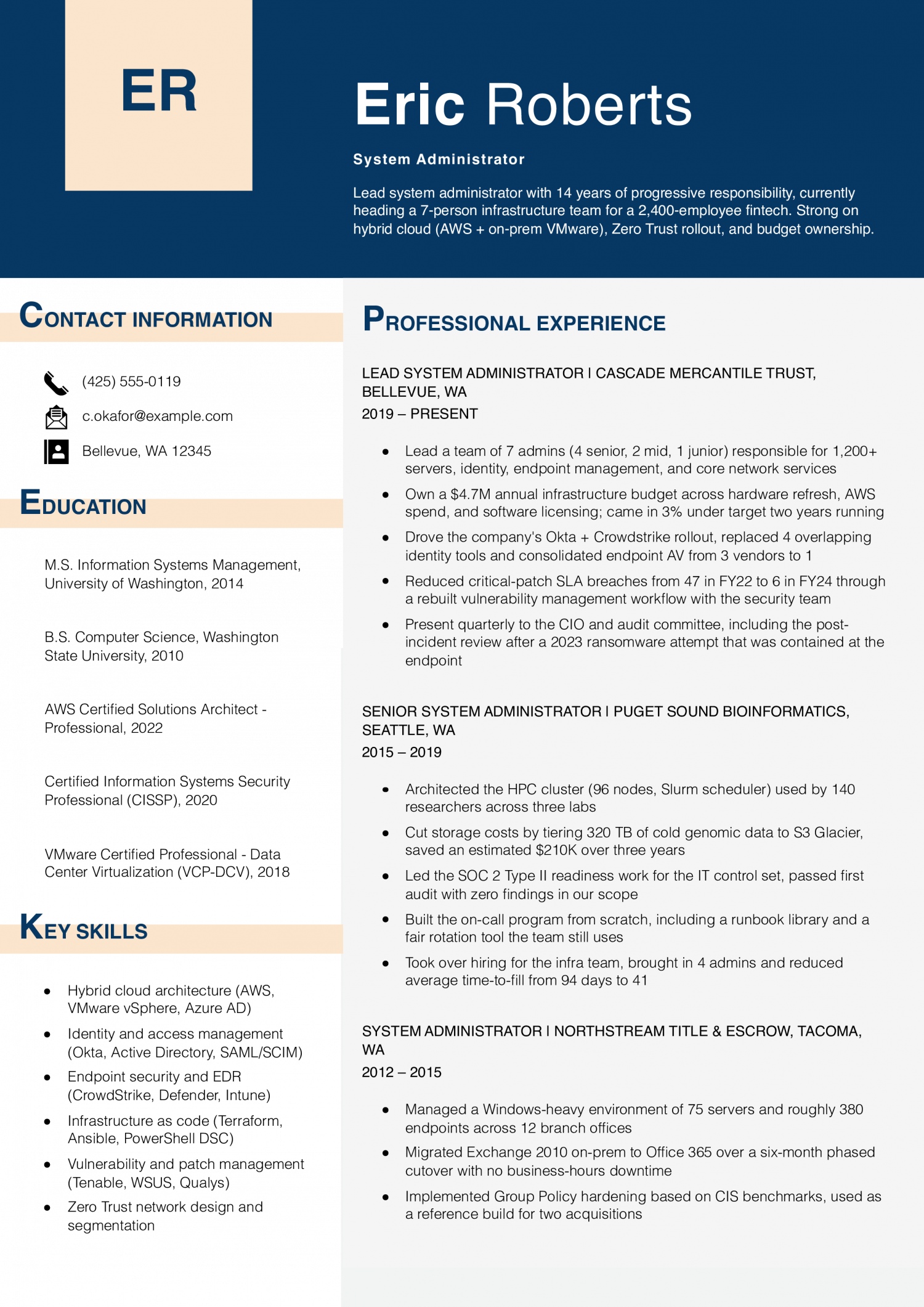
Lead system administrators set standards across a team and influence architecture decisions with infrastructure engineers. The resume needs to prove mentoring, project ownership across migrations or refreshes, and budget or vendor work tied to outcomes.

Why this resume works

  • Budget ownership is explicit: Naming a $4.7M budget and a 3% under-target result tells a CIO this candidate can be trusted with real spending authority.
  • Security results, not just security words: Going from 47 to 6 critical-patch SLA breaches in two fiscal years is the type of number an audit committee actually quotes.
  • Career path makes sense: Each role gets bigger in scope (district, then mid-market, then fintech), so the lead title at the top feels earned rather than handed out.

How to Write a System Administrator Resume

01 Open with the metric an IT manager would use to size you up

The first line of your summary should name the user count or server count you supported, your uptime figure, and your on-call rotation.

IT managers and infrastructure leads read that combination as readiness for their environment. A line like “supported 1,200 endpoints and 80 Windows Server VMs at 99.95 percent uptime on a one-in-four on-call rotation” tells them the size, the stack scale, and the operational maturity in one sentence. Skip the “seasoned IT professional” opener.

Lead with the numbers a peer admin would respect.

02 Quantify uptime, scope, and toil reduction

System administration has clear numbers attached, and strong resumes show them. Pick two or three of these for your bullets: uptime percentage, MTTR on Sev-1 incidents, server or endpoint count, ticket close rate, and hours saved through automation.

Bullets without a number tend to read as duty lists. Most strong sysadmin resumes pair the work with the result, like “cut patch deployment from 14 hours to 90 minutes by rewriting the WSUS workflow in PowerShell DSC.” Recruiters scan for these figures first when triaging a stack of 200 resumes for an opening.

03 Group bullets by category, not by job

Inside each role, cluster bullets so an IT lead can find what they need fast. Use four buckets: infrastructure and OS administration, identity and access, automation and scripting, and monitoring and incident response.

Under infrastructure, name the hypervisor, OS versions, and storage layer. Under identity, name Active Directory, Entra ID, group policy work, and any SSO or MFA rollouts. Under automation, show the language and the toil it killed.

Under monitoring, name the tool (Datadog, Zabbix, PRTG, SolarWinds) and the alert tuning or runbook work attached to it.

04 Put certifications on page one

Sysadmin hiring leans on certifications as a fast filter, so a credentials block belongs at the top of page one under your contact info, not buried under education.

List CompTIA Server+, Microsoft AZ-104 or AZ-800, Red Hat RHCSA, VMware VCP-DCV, and any AWS SysOps Administrator certs with the certifying body and the year earned. Infrastructure leads scan this block before the work history because it sets the floor for which stack you can step into. If you are mid-cert, list it as “in progress” with the target exam date.

05 Cut the help desk paragraph and the soft-skill wall

If you are three years past help desk, compress that role to two bullets covering ticket volume and the escalation path you owned. The room belongs to your sysadmin work.

Cut soft-skill clusters like “strong communicator, team player, detail-oriented” from the summary. Show those qualities through evidence in bullets: leading a migration, writing the runbook the team now uses, mentoring two junior admins. Also cut Office 365 user training and printer support from senior resumes.

Those bullets pull your title down a tier in a recruiter’s read.

IT hiring is tight in 2026. Infrastructure teams are running leaner, and the bar to clear a recruiter screen is higher than it was two years ago. The skills below come from our user-built system administrator resumes.

Hard skills like PowerShell and Active Directory carry the parse; soft skills like incident communication back the bullets that name them. Match the table against your target job posting and treat soft skills as evidence anchors, not standalone claims.

Soft Skills % of resumes with this skill
Problem-solving 74%
Technical communication 55%
Time management 45%
Adaptability 37%
Team collaboration 33%

And here are the top hard skills showing up most often.

Hard Skills % of resumes with this skill
Active Directory management 77%
Windows Server administration 50%
Linux server administration 47%
PowerShell scripting 36%
AWS cloud administration 27%

Based on data from thousands of system administrators’ resumes built on ResumeTemplates.com, May 2026.

Must Have on a System Administrator Resume

The items below are what separate a system administrator resume from one that gets put back in the pile.

Niche Keywords for ATS Checkers

IT managers and infrastructure leads expect to see the sub-stack you actually run, not a generic skills list. Pick the rows below that match your target posting and weave the exact phrases into your work history.

Niche Keywords ATS scans for
Windows administration windows server 2022, active directory, group policy, powershell
Linux administration rhel 9, ubuntu server, bash scripting, systemd
Virtualization and hypervisor vmware vsphere, hyper-v, esxi, vcenter
Cloud and hybrid azure administrator, entra id, aws sysops, hybrid identity
Backup and DR veeam backup, disaster recovery, rpo rto, immutable backups

AI Skills to Add

AI use on a system administrator resume can go three ways: lead with “AI-driven IT visionary” (which IT managers screen out), leave it off entirely (which reads as evasive in 2026), or describe the workflow as it actually runs in your shop. The third is what infrastructure leads can validate.

What AI is actually changing for this role
Ticket triage and runbook drafting

Copilot drafts first-pass runbooks and triages low-priority tickets, freeing admin time for incident work and project rollouts.

PowerShell and Bash scaffolding

Admins use Copilot or ChatGPT to draft scripts faster, then review, test in a lab, and version-control before production.

Log and alert summarization

AI features in Datadog and Sentinel cluster noisy alerts and summarize incident timelines, cutting MTTR on Sev-2 issues.

Documentation refresh cycles

Admins point Copilot at outdated wiki pages and SOPs to flag stale steps, then verify changes against the live environment.

AI tools to name
  • Microsoft Copilot for Security: Used to summarize incident timelines, query KQL faster, and draft post-incident reports for stakeholder review.
  • GitHub Copilot: Used to scaffold PowerShell, Bash, and Ansible code, then reviewed line-by-line before testing in a lab.
How to phrase AI on your resume
Do
  • Cut runbook drafting time by 40 percent using Copilot, with all output reviewed against the production change-control checklist before deployment.
  • Used GitHub Copilot to scaffold 12 PowerShell modules for AD cleanup; reviewed and tested each in a lab before pushing to prod.
Skip
  • AI-driven IT visionary leveraging next-gen automation
  • Harnessed the power of AI to revolutionize infrastructure

Tech Stack to List on a System Administrator Resume

Recruiters parse the tools section first, so name versions and pair each tool with the job it does in your environment.

  • Operating systems: Windows Server 2019/2022, RHEL 8/9, Ubuntu Server 22.04
  • Virtualization: VMware vSphere 8, Microsoft Hyper-V, Proxmox
  • Identity: Active Directory, Entra ID (Azure AD), Okta, group policy
  • Cloud: Microsoft Azure, AWS (EC2, S3, IAM), Microsoft 365
  • Automation: PowerShell 7, Bash, Ansible, Terraform basics
  • Monitoring: Datadog, Zabbix, PRTG, SolarWinds, Microsoft Sentinel
  • Backup and DR: Veeam, Azure Backup, Rubrik
  • Ticketing and ITSM: ServiceNow, Jira Service Management, Freshservice

Systems Administration Credentials That Get You the Job

Beyond a four-year IT degree or equivalent experience, the certifications below tell IT managers and infrastructure leads which stack you can step into on day one and how current you are. List the certifying body and the year earned for each item, and mark in-progress exams with a target date.

  • Microsoft Certified: Azure Administrator Associate (AZ-104): Reads as the default Microsoft cloud admin credential and signals you can run hybrid identity, networking, and storage in Azure.
  • Red Hat Certified System Administrator (RHCSA): The standard Linux sysadmin credential for RHEL shops; performance-based, so it carries weight with infrastructure leads vetting hands-on skill.
  • VMware Certified Professional - Data Center Virtualization (VCP-DCV): Signals real vSphere experience for environments still running on-prem or hybrid virtualization, which is most mid-market IT.
  • CompTIA Server+: A vendor-neutral baseline that pairs well with a Microsoft or Red Hat cert and covers hardware, storage, and disaster recovery fundamentals.

Latest BLS Statistics for System Administrators

For system administrators, the 10th-percentile floor and the top-decile ceiling sit far apart, and the spread tells you that specialization and stack depth move pay more than tenure alone. Cloud platforms (Azure, AWS), security overlap, and lead-level ownership of migrations are the levers that push admins from the middle of the band to the top.

Lead the resume with the platforms you administer at depth and the scope numbers (user count, server count, uptime) that map to the ceiling, not a generalist duty list.

$96,800 National median annual
$101,190 National mean annual
$60,320 Entry-tier floor (10th percentile)
$150,320 Top-decile ceiling (90th percentile)
318,570 System Administrators in the U.S.
Where you stand

Entry tier

$60,320 to $96,800 At the entry tier, lead with your CompTIA stack, Windows or Linux fundamentals, and the ticket volume and escalation work you owned at help desk.

Mid band

$96,800 to $150,320 At the mid band, your resume needs to show uptime numbers, the hypervisor and identity stack you run, and PowerShell or Ansible automation with hours saved.

Top decile

$150,320+ At the top decile, lead with cloud platform certs, migrations you led end-to-end, the team you mentor, and budget or vendor scope you own.

Top-paying states

# State Avg. Annual
1 District of Columbia $114,140
2 Maryland $112,080
3 California $106,620
4 Virginia $106,610
5 New Jersey $104,850
6 Massachusetts $104,730
7 New York $104,050
8 Washington $103,990
9 Colorado $103,600
10 Connecticut $102,600

Highest-employment states

# State Workers Median
1 Texas 34,640 $94,170
2 California 28,730 $106,620
3 Florida 22,280 $92,980
4 New York 19,770 $104,050
5 Ohio 15,950 $93,220
Source: U.S. Bureau of Labor Statistics, OEWS 2024 release (SOC 15-1244).
Written by professional resume writers and loved by hiring managers

Resume Templates offers HR approved resume templates to help you create a professional resume in minutes. Choose from several template options and even pre-populate a resume from your profile.

Frequently Asked Questions

What should a system administrator resume summary include?

Three things: scope, stack, and uptime. Open with the user count or server count you support, name the core platforms, and add an uptime or MTTR figure.

Skip the "seasoned IT professional" opener. Recruiters parse the summary for stack keywords first, so front-load Windows Server, Active Directory, VMware, and your scripting language.

How do I describe system administration on a resume if I am still on the help desk?

Carve out the sysadmin-adjacent work into its own bullet cluster under your current title. Name the tier 3 escalations you owned, AD account or GPO work, scripting you did, and server tasks you took on.

Add an in-progress cert (AZ-104, RHCSA, Server+) to the credentials block with a target exam date. That signals you are tracking toward the role, not just hoping for it.

Should I list my system administrator internship on a resume?

Yes, if it is your most recent IT experience or covers a stack the target job names. Title it "System Administrator Intern" and write bullets like you would for a paid role.

Name the platforms (Windows Server, Linux, VMware) and the scope (lab size, ticket volume, project scope). Drop the internship once you have two years of full-time sysadmin work behind it.

What resume format works best for a system administrator?

Reverse-chronological with a credentials block at the top of page one. Put name, contact, and a one-line headline above a certifications block, then summary, then work history.

Avoid the functional or skills-first format. IT managers want to see which employer you ran which stack at, and a functional layout hides that timeline.

Which resume template works best for a system administrator?

For a system administrator, a tech template is the safest pick, because it keeps your stack, tools, and impact easy to scan. An ATS-friendly template is a solid alternative. Whichever you choose, keep the formatting clean and easy to parse: clear section headings, a standard font, and no graphics a parser can choke on.

Rate this article

System Administrator Resume

Average Rating

4.7/5 stars with 105 reviews

You have given 0 Star(s)
4.7/5 stars with 105 reviews
Andrew Stoner

Executive Resume Writer and Career Coach

Andrew Stoner is an executive career coach and resume writer with 17 years of experience as a hiring manager and operations leader at two Fortune 500 Financial Services companies, and as the career services director at two major university business schools.