Accountant Resume Examples
Lead the summary with one line stating the close outcome and the conditions that produced it. A pattern that works: ‘Closed a four-entity consolidation in six business days on NetSuite, $180M in annual revenue, clean…
Every resume example is written and reviewed by our team of Certified Professional Resume Writers to ensure top-quality content and formatting.
Most accounting manager roles fill through proof of month-end close ownership and team oversight. Controllers and finance directors look for hard numbers: days to close, variance rates, and audit findings you resolved. A CPA or CMA credential strengthens your case at the senior level.
Your resume should lead with the ERP systems you run, such as SAP or NetSuite. Pair each tool with a measurable output like reduced close time or fewer restatements. To compare layouts before you start, browse our resume templates.
A CPA or CMA credential listed prominently is what gets accounting manager resumes past the first cut from controllers; month-end close metrics and team size are what make them readable enough to advance.
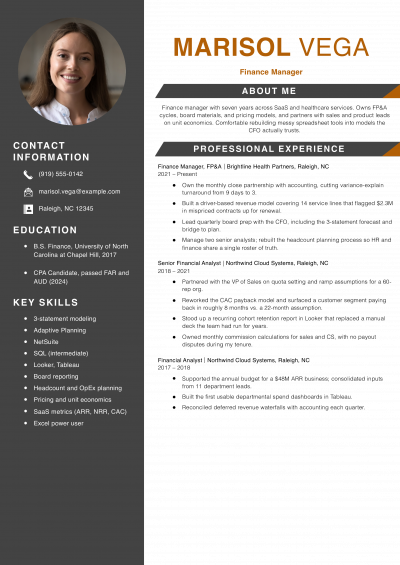
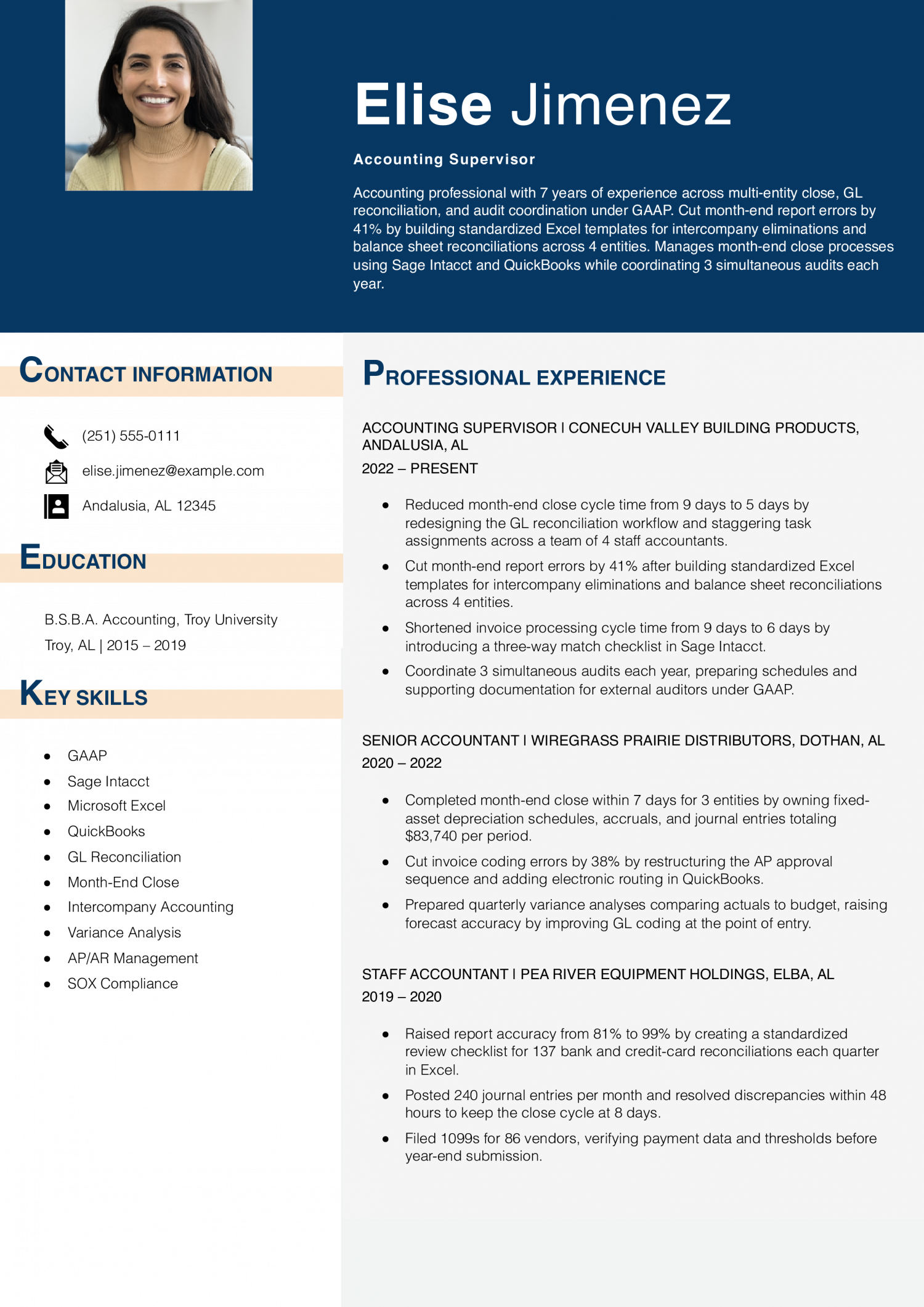
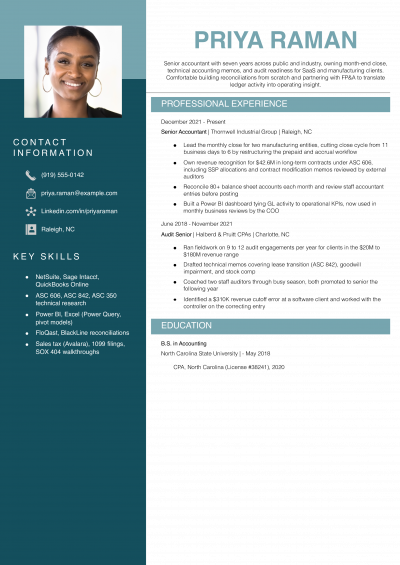
Pick this resume if you are a mid-level accountant with supervisory and multi-entity experience moving toward a stronger accounting supervisor role. Show how many days you took off the close, with the day counts before and after, rather than describing the process in general terms.
Controllers hiring an accounting supervisor look for a faster close, clean reconciliations, and a team that stays on schedule. This resume shows the close getting shorter, with the workflow change behind it and the number of staff accountants involved. On your own resume, say what you changed and how many days it saved.
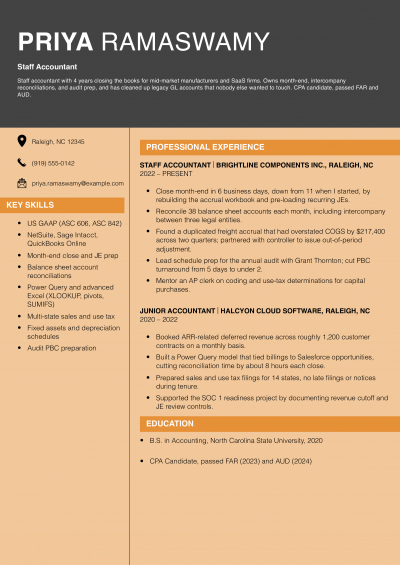
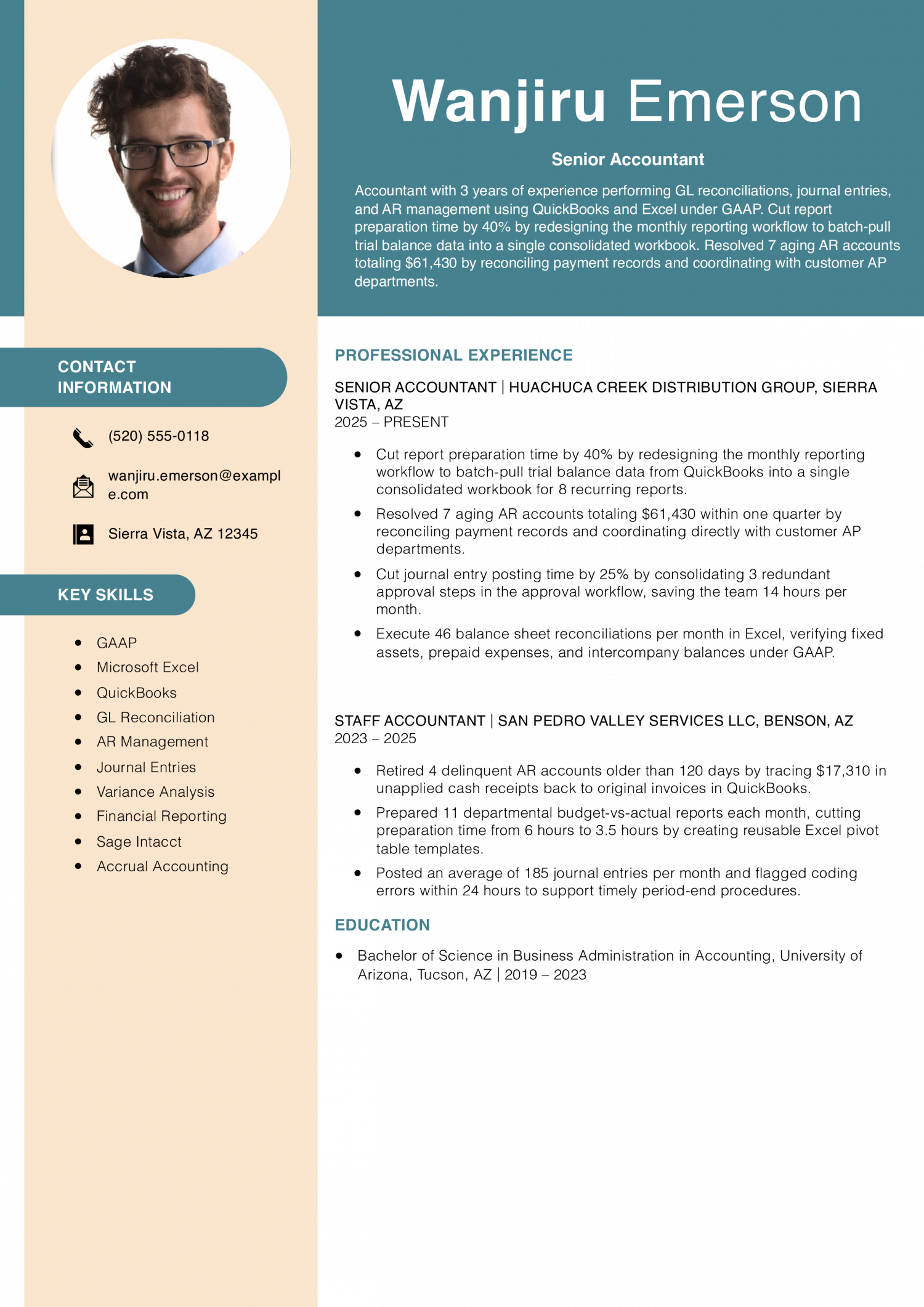
Start with this resume if you are an early-career accountant stepping into your first senior accountant role after a staff-level position. Show how much faster your reporting got after you changed the workflow, instead of restating routine month-end duties.
A first senior accountant seat goes to someone who clears old accounts and saves the team time. This resume does both by tracing unapplied cash back to the original invoices in a named system. If you resolved aging balances, write the dollar amount you recovered and the steps you took to find the mismatch.
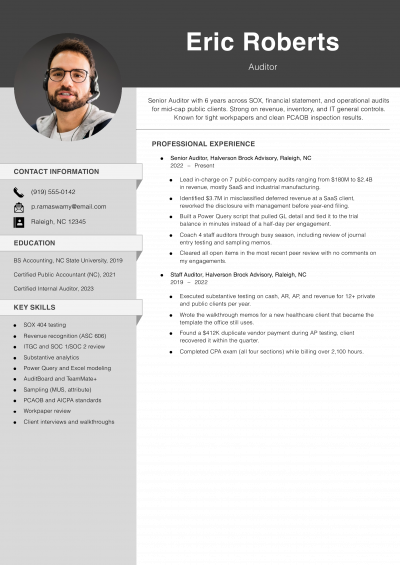
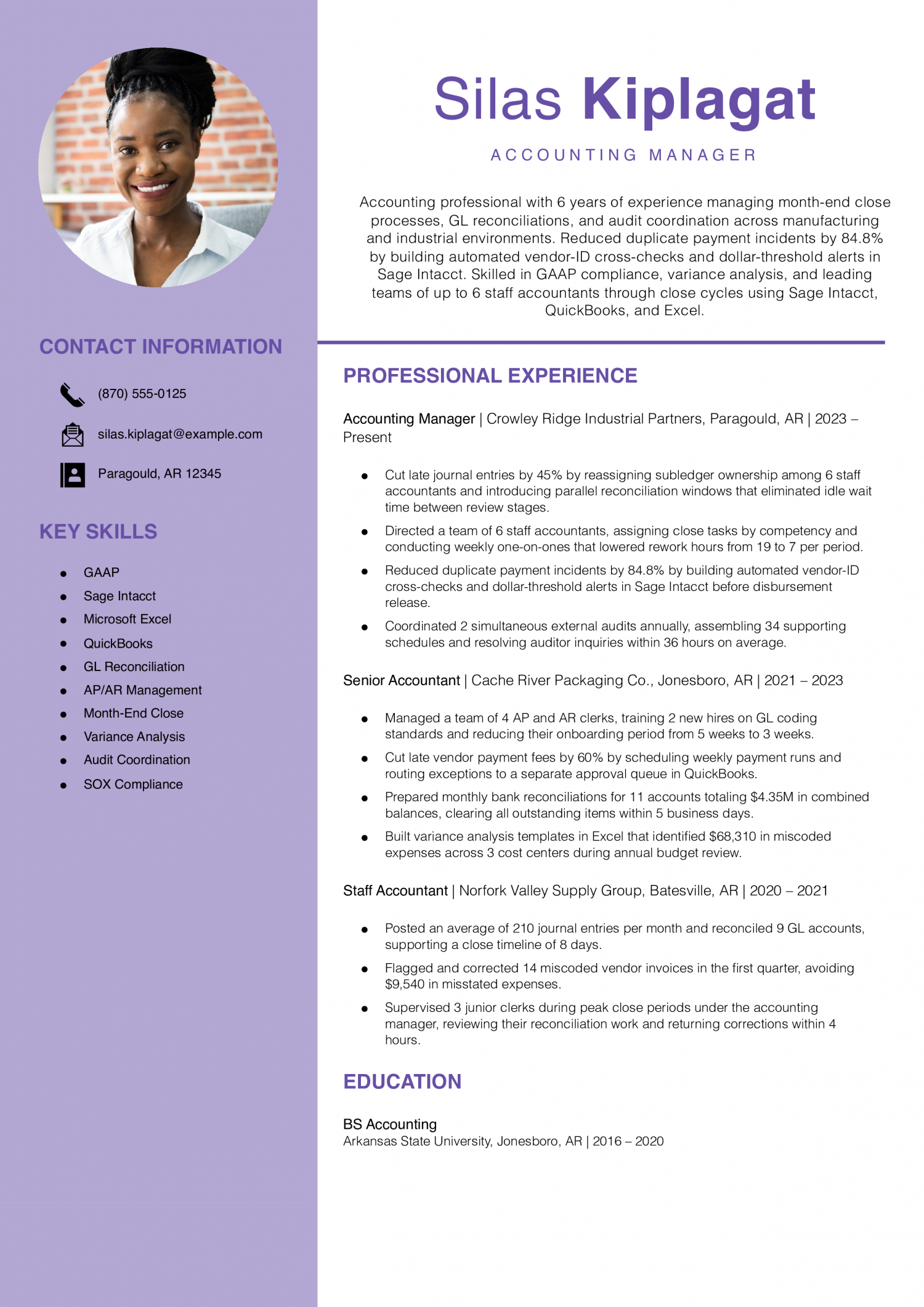
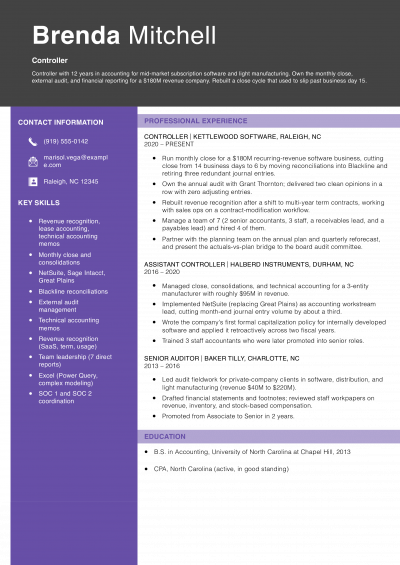
Try this resume if you are a mid-level accountant with supervisory experience moving into or growing within an accounting manager role. Lead with duplicate-payment controls and on-time journal entries to show you improve processes, not only run them.
Finance directors hiring an accounting manager look for someone who leads a team and fixes processes, not only someone who runs the close. The weekly one-on-ones here are tied to fewer rework hours, which shows leadership with a result. Describe how you manage your team, then say what changed because of it.
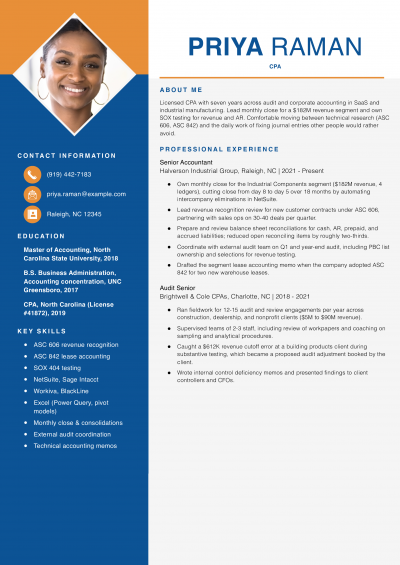
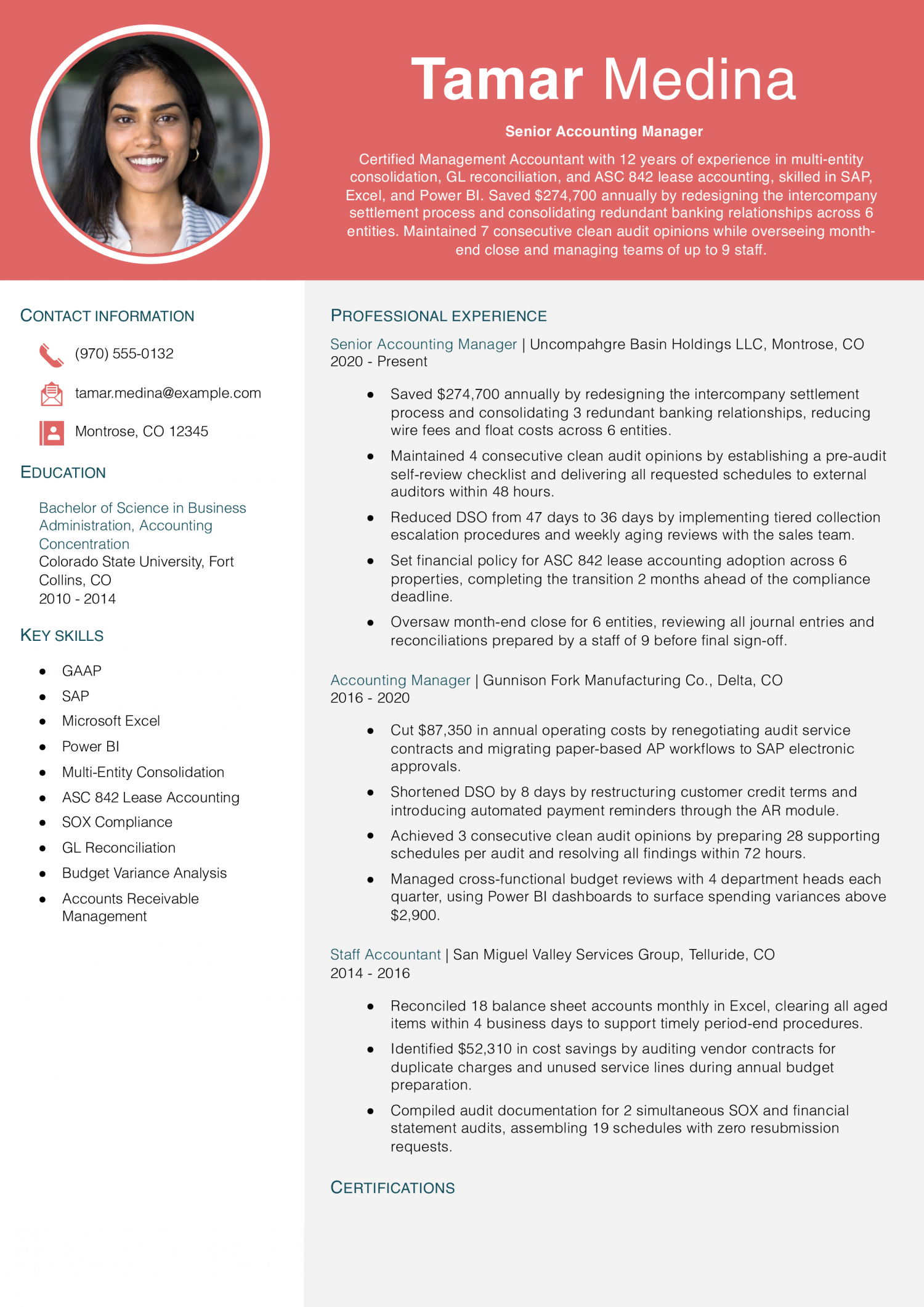
Lean on this resume if you are a senior accounting professional with over a decade of multi-entity experience targeting a senior accounting manager position. Lead with an audit-readiness record that spans consecutive roles, as this resume does across two companies.
Senior accounting roles go to people with clean audits behind them, so reviewers check how many years in a row yours came back clean. This resume lists the audit results by job and names the checklist used to prepare. Show your own run of clean audits and the steps you took to get ready.
Versatile accountant with 7 years of experience producing financial reports, preparing multi-entity tax returns, and coordinating external audits under GAAP. Reduced administrative task time by 35% by replacing manual data entry with scheduled import routines in Sage Intacct. Skilled in month-end close processes, GL reconciliation, and multi-state tax filings using Sage Intacct, QuickBooks, Excel, and Power BI.
Your profile should state your years in accounting and the team size you lead. Name the entity type you manage books for, such as multi-entity or single-site. State the revenue band or transaction volume you oversee.
Controllers and finance directors scan profiles for these scope markers first, so placing them early in your summary paragraph gives you an advantage. They want to know if your experience fits their ledger complexity. Mention your close cycle, whether monthly or quarterly.
Note the reporting framework you follow, such as GAAP or IFRS. If you report to a CFO, say so. If you present to a board, say that too.
Two or three lines should be sufficient to cover all of this information. Keep the language plain and skip vague phrases like “strategic leader.”
Start each bullet with a verb and tie it to a number. Strong metrics for this role include days-to-close benchmarks, variance percentages, and reconciliation turnaround figures. Audit adjustment counts work well too.
A bullet that says “managed month-end close” reads as a task. A bullet that says “cut close from 12 days to seven” shows a clear win. Use dollar amounts when you can, such as budget size or cost savings.
Percentage reductions in errors give reviewers a quick read on your accuracy and overall reliability. Name the period the result covers, like a quarter or fiscal year. Controllers and finance directors compare your numbers against their own benchmarks.
Two to four bullets per role is a solid target. Every bullet should carry at least one quantifiable figure to substantiate the accomplishment.
Sort your bullets under categories that match real accounting workflows so that reviewers can navigate your experience with ease. Month-end and year-end close is one natural group. Budgeting, forecasting, and variance analysis form another.
Team leadership covers staff training, reviews, and workload planning. Internal controls and audit prep deserve their own heading. Tax compliance and filing can round out the list.
This layout helps reviewers spot your depth in each area fast, and it signals that you understand how accounting departments operate.
Match the categories to the job posting when you can. If the posting stresses audit readiness, lead with that group and expand it with an extra bullet or two.
A CPA carries weight for most postings. A CMA from IMA signals cost accounting and planning depth.
A CGMA from AICPA/CIMA shows global management focus. Give each its issuer and year, and mark any that are still pending.
Controllers and finance directors often filter resumes by credential before reading further. Follow your credentials with a tools line that names your ERP systems, such as SAP, Oracle, or NetSuite.
Include Excel at an advanced level if you build models or macros. Mention reporting tools like Hyperion or Adaptive Insights.
At a senior level, early-career roles rarely need more than one line. Drop any staff accountant bullets that repeat skills you show in later jobs. Remove generic phrases like “responsible for” or “assisted with” because they dilute the impact of your accomplishments.
They waste space and weaken your tone. If a role is older than 15 years, list the title and dates only, since the relevance of that work has likely diminished. Trim your skills section to items the posting names.
A long list of soft skills without proof reads as filler. Past two pages, cut the oldest or least relevant content first.
Every line should earn its place by showing scope or a result. White space helps reviewers scan, so do not fear a shorter page.
Month-end close still matters on an accounting manager resume. Controllers and finance directors also want to see forecasting tools and cross-team leadership.
Hard skills show you can run the technical work each period. Soft skills show you can lead the team doing it. Controllers and finance directors look for budget oversight paired with clear team direction.
Scan the two tables below before you write your bullets. Pull each skill that matches your target job posting. Place hard skills in a resume skills block near the top. Show soft skills like team leadership inside your work history bullets.
Leave off any skill you cannot support with a figure. Match the phrasing in the posting so the ATS reads your terms as a hit.
| Soft Skills | AI-estimated % |
|---|---|
| Team leadership | 75% |
| Stakeholder communication | 66% |
| Detail orientation | 50% |
| Cross-department collaboration | 35% |
| Decision-making under pressure | 28% |
And here are the top hard skills showing up most often.
| Hard Skills | AI-estimated % |
|---|---|
| Budget planning | 65% |
| Financial reporting | 62% |
| General ledger oversight | 45% |
| Cash flow management | 37% |
| GAAP compliance | 32% |
Skill names and rankings come from an AI model grounded in U.S. Department of Labor occupation data for accounting managers, not from a count of accounting managers’ resumes built on ResumeTemplates.com.
For an accounting manager resume, controllers and finance directors look at budget planning and financial reporting first, so the items below back those up with detail.
Controllers and finance directors scan for terms tied to real work. Generic phrases like “financial oversight” rarely pass an ATS filter. Group your keywords by the tasks you own. Close processes belong with close terms. Tax work belongs with tax terms. Software names should match vendor spelling. Credentials like CPA or CMA need their proper form. Revenue recognition rules cite a specific standard. Add the terms that match your actual experience.
| Niche | Keywords ATS scans for |
|---|---|
| Month-End Close | journal entries, account reconciliation, close calendar |
| Financial Reporting | GAAP compliance, consolidated financial statements, variance analysis |
| ERP Systems | SAP FICO, Oracle General Ledger, NetSuite |
| Tax and Audit | ASC 740, external audit coordination, SOX controls |
| Team Leadership | staff development, accounts payable oversight, intercompany eliminations |
Controllers and finance directors know that AI touches reconciliation and forecasting workflows now. That creates a question for your resume. You can overstate your skills with vague buzzwords. You can leave AI off and explain it in the interview. Or you can name the exact tools you use and the review steps you own. The third is what controllers and finance directors can validate. Describe how you check AI output against source ledgers. Show the step where your judgment still matters. Keep each claim tied to a task they recognize. That makes the skill line credible on paper and in conversation.
AI tools flag matching errors in subledger reconciliations, but you still review and approve each adjustment entry.
Models surface unusual line items across cost centers faster, though you interpret root causes for leadership.
Machine learning can project revenue trends from historical data, yet you validate assumptions before the board sees them.
AI scripts scan for duplicate or out-of-policy entries, and you decide which ones need correction.
Controllers and finance directors scan for specific letters after your name. A CPA or CMA signals depth beyond daily bookkeeping. List credentials in a clear block near the top.
Beyond a state CPA license, the credentials below tell controllers and finance directors how deep your skills run. They show your grip on cost analysis and budgeting. A CPA license is a legal gate.
These cards go further. They mark you as someone who can lead a team through an audit or a forecast cycle. Most postings treat them as preferred, not required.
Some firms weigh one over another based on the work the team does. Add the year you earned each card and any renewal date that falls in the next 12 months so a reviewer can see your status at a glance.
The Bureau of Labor Statistics does not publish a wage code for Accounting Manager specifically. The numbers below are a proxy: the closest published match is Financial Managers (SOC 11-3031), so use them as an estimate for this role, not an exact figure.
Top earners at the 90th percentile make about 94 percent more than the median. That spread tells you the market pays a steep premium for specialized scope over general tenure.
The floor sits roughly 43 percent below the median, which means early-career pay compresses while upper-tier pay stretches. The group is large, so the upper bands are crowded. Put the size of the ledger you own on your resume, stated in dollar terms, so controllers and finance directors can place your tier at a glance.
| # | State | Median Annual |
|---|---|---|
| 1 | New York | $219,880 |
| 2 | Massachusetts | $206,760 |
| 3 | New Jersey | $199,110 |
| 4 | District of Columbia | $188,880 |
| 5 | Virginia | $185,220 |
| 6 | Colorado | $182,690 |
| 7 | Delaware | $181,580 |
| 8 | California | $180,770 |
| 9 | Washington | $174,840 |
| 10 | Connecticut | $174,830 |
| # | State | Workers | Median |
|---|---|---|---|
| 1 | California | 93,310 | $180,770 |
| 2 | New York | 80,810 | $219,880 |
| 3 | Texas | 71,870 | $164,860 |
| 4 | Illinois | 52,720 | $165,880 |
| 5 | Florida | 48,910 | $153,280 |
Resume Templates offers HR approved resume templates to help you create a professional resume in minutes. Choose from several template options and even pre-populate a resume from your profile.
Use a reverse-chronological format with clear headings for experience, education, and skills. Start with a profile section, then list each role with the company name and dates. Keep the file to one page unless you have more than ten years of progressive experience.
Focus on duties that show leadership over a team and ownership of financial reporting cycles. Strong examples include managing month-end close and supervising staff accountants. Pair each duty with a number, such as the team size you led or the budget you controlled.
Include your ERP platform experience and the size of the general ledger you managed. Controllers and finance directors look for close-cycle timelines and error-rate reductions. Also list the accounting standards you applied, such as GAAP or IFRS.
List the company once, then stack each title beneath it with its own date range and bullet points. This layout shows Controllers and finance directors that you earned greater responsibility within one organization. Highlight the shift from individual tasks to team oversight in your bullet language.
Yes, name the exact platforms you have used, such as SAP, Oracle, or NetSuite. Many job postings filter for a specific ERP, so listing yours helps your resume pass an applicant tracking system. Add your skill level or the modules you worked in to give reviewers a clearer picture.
Note the gap briefly in your experience timeline rather than trying to hide it. If you completed relevant training or freelance bookkeeping during that period, list it as its own entry. Controllers and finance directors care more about your current skills than a gap you can explain.
Yes, a two-page resume works when you have more than ten years of relevant experience to show. Keep the strongest results and most recent roles on the first page, because that is what reviewers read first. Cut older entries that duplicate skills already shown in your recent positions.
Use an ATS-friendly template for your accounting manager resume, because hiring software reads it cleanly. A basic template works too. Keep the headings plain, the font standard, and the graphics out.
Accounting Manager Resume
4.6/5 stars with 187 reviews

Executive Resume Writer and Career Coach
Andrew Stoner is an executive career coach and resume writer with 17 years of experience as a hiring manager and operations leader at two Fortune 500 Financial Services companies, and as the career services director at two major university business schools.
© 2026 Resumetemplates.com All rights reserved.