Accountant Resume Examples and Templates for 2026



Audit partners and CFOs decide whether to keep reading by the credentials line under your name; if active CPA status and the state aren't visible there, the resume slides to the maybe pile and rarely comes back.
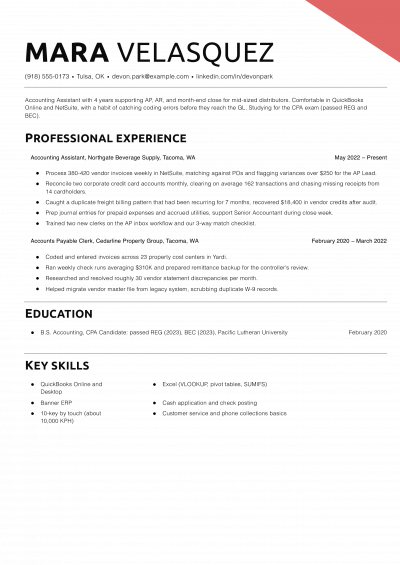
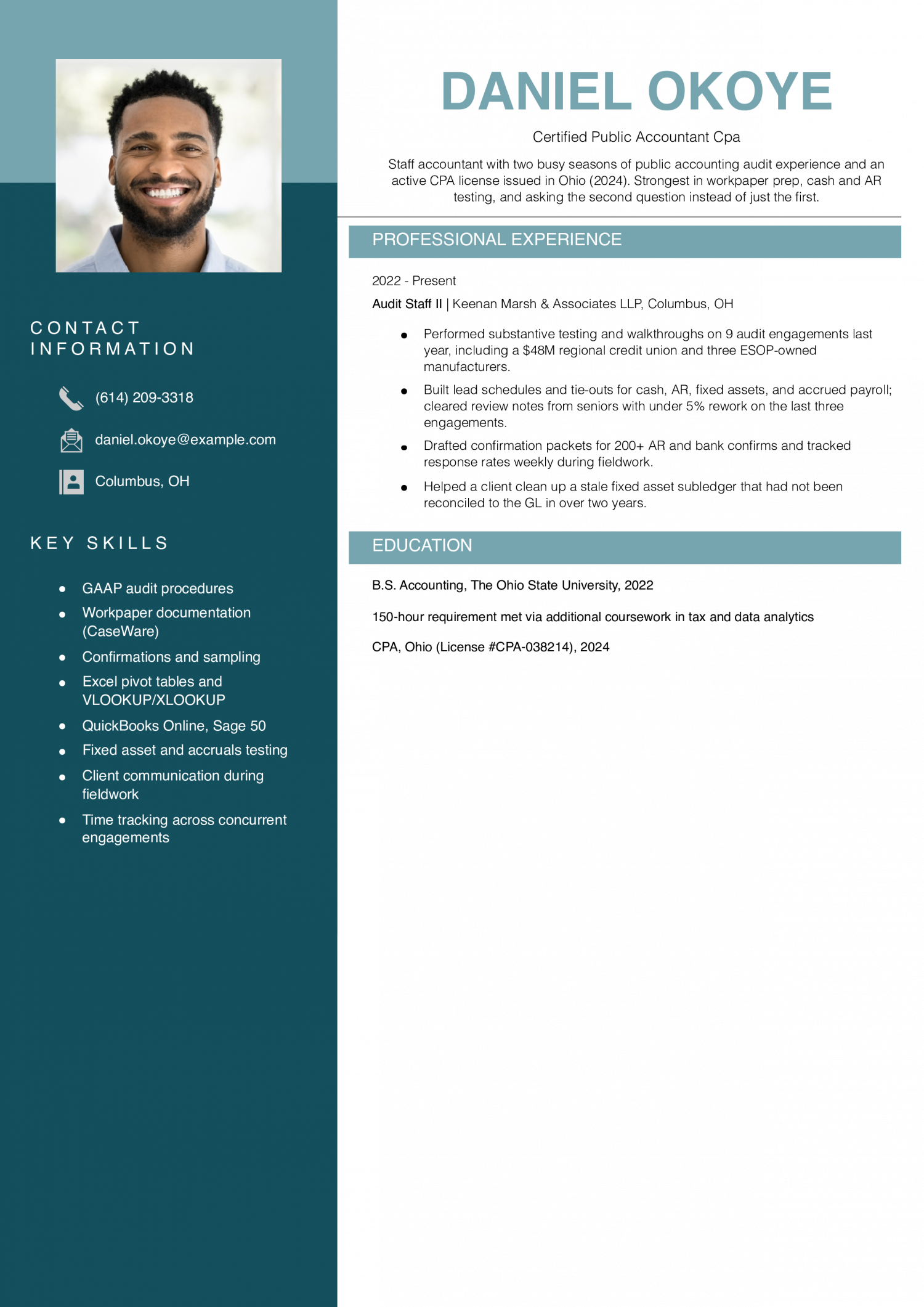
Staff CPAs are one to three years in, sitting for or freshly past the exam, and running pieces of audit or tax engagements under a senior. This resume needs to prove you can own workpapers, hit budget hours, and use the firm's tech stack without hand-holding.
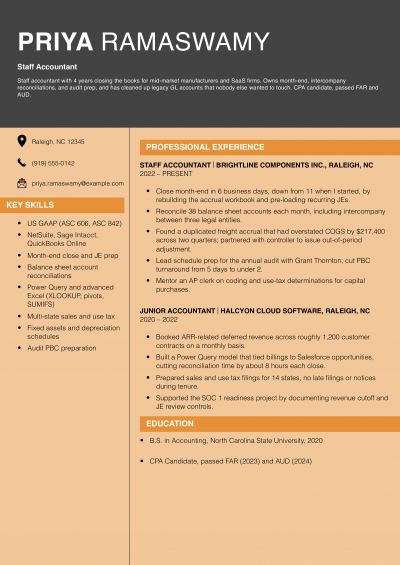
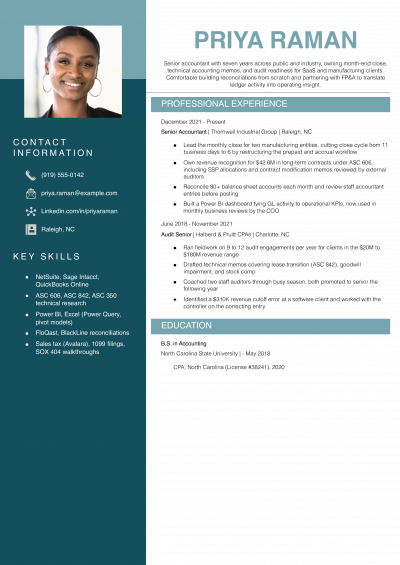
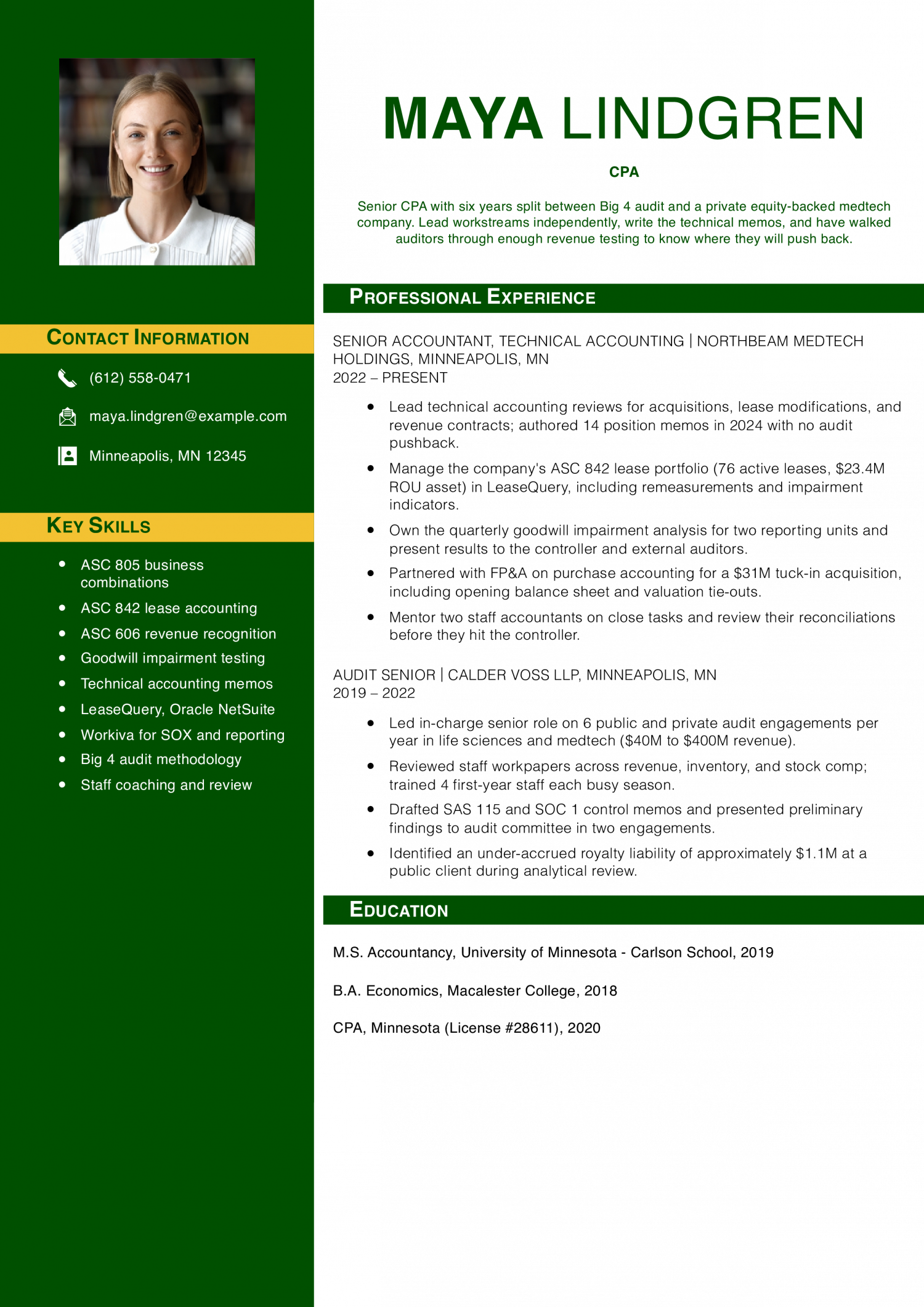
Senior CPAs run engagements day to day, review staff workpapers, and walk clients through findings. This resume needs to prove planning-to-fieldwork ownership, supervised headcount, and the GAAP or IRS code areas where you sign off without partner rework.
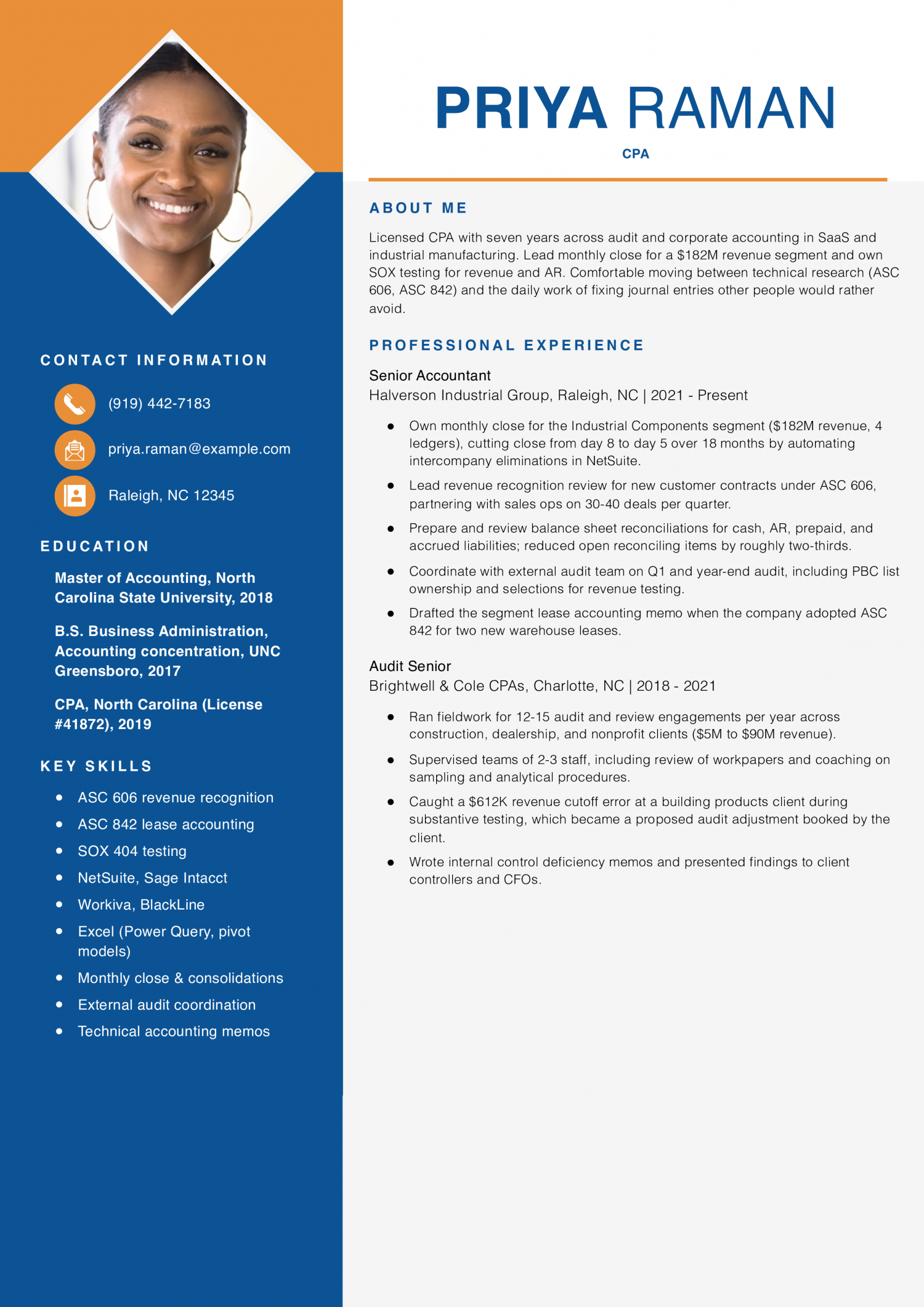
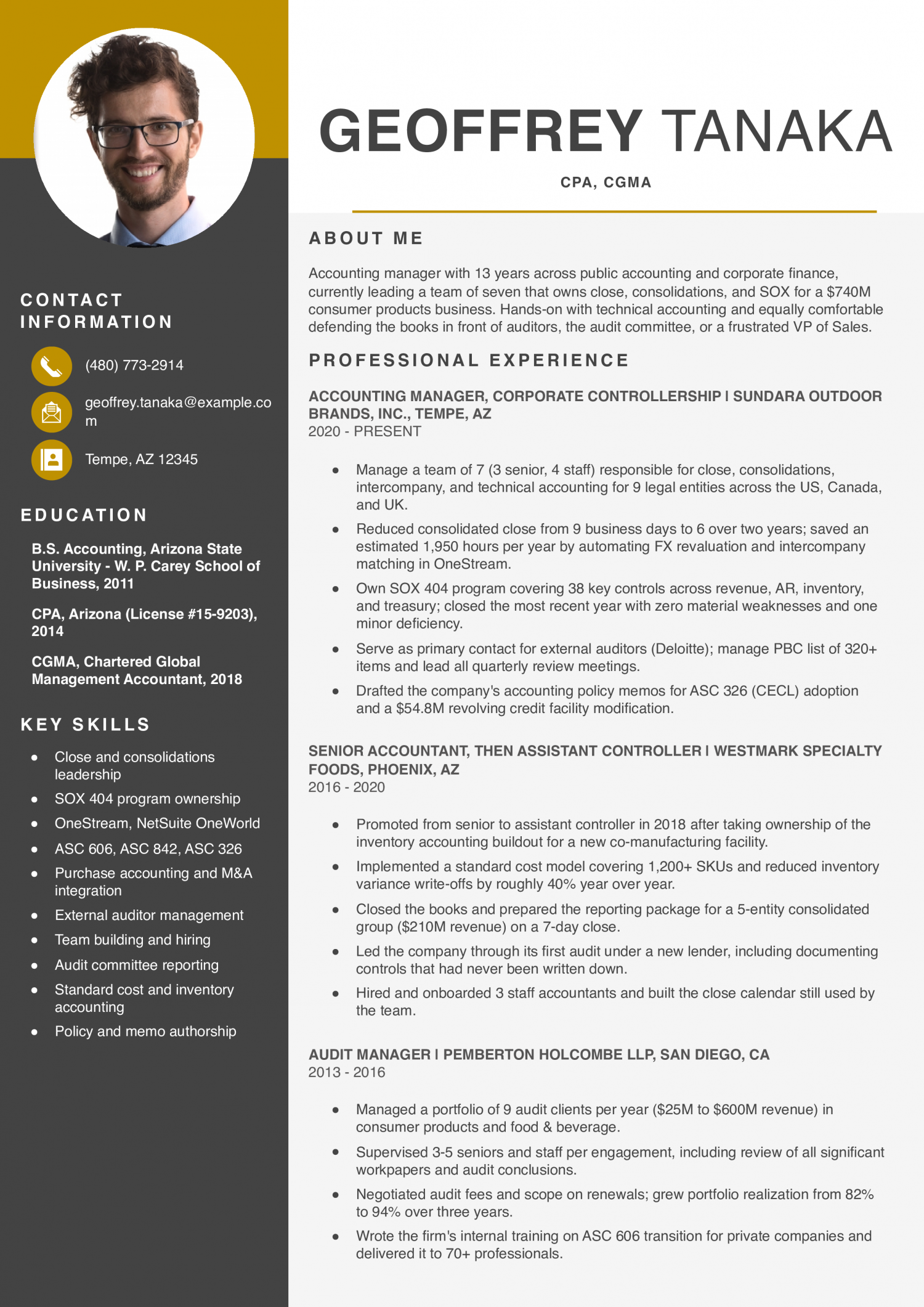
CPA Managers carry a book of clients, hit utilization and realization targets, and develop seniors into reviewers. This resume needs to prove engagement portfolio size, fee responsibility, technical reviews you led, and the staff you brought up to senior.
Helena Vasquez, CPA
Providence, RI | (401) 662-8045 | [email protected] | linkedin.com/in/helenavasquez-cpa
CPA with nine years across public accounting and corporate finance, currently a senior manager leading technical accounting and external reporting for a publicly traded insurance services company ($1.2B revenue). Strong in SEC reporting, ASC 606 and ASC 842, and the kind of cross-functional work where the controllership has to talk Legal and Sales out of a bad contract structure before the auditors see it.
Senior Manager, Technical Accounting & SEC Reporting
Arbor Ridge Insurance Services, Inc. (NYSE: ARI) | Providence, RI | 2022-Present
Manager, SEC Reporting
Linwood Capital Group | Boston, MA | 2019-2022
Audit Senior, then Audit Manager
Hartwell Greene LLP | Boston, MA | 2015-2019
Audit Staff
Hartwell Greene LLP | Boston, MA | 2014-2015
Your profile should state your years of public or industry experience, the practice area you sit in (audit, tax, advisory, or corporate accounting), and your license status.
Name the client industries you serve and the typical revenue or asset size of those engagements. A senior auditor on middle-market manufacturing reads differently from a senior on SEC tech clients, and partners want that signal in the first five lines.
If you carry a specialty (ASC 606, ASC 842, R&D credits, ESOP audits, SOC 1 work), put it in the profile. Close with the ERP or audit suite you run daily so the recruiter screen sees the tool match before scrolling.
Most strong CPA bullets carry a number tied to the work. Name the engagement count you ran per busy season, the client revenue or assets under audit, the fee size of the book, or the hours of budget you came in under.
Tax bullets read stronger with return volume and complexity (250 1040s, 40 1120s, 15 consolidated returns with state apportionment).
Bullets without a number tend to read as job descriptions. A strong bullet pairs scope (what), method (how), and result (closed two days early, cleared review with no comments, saved the client $180K in tax).
Break your experience bullets into three or four technical buckets so reviewers can scan the mix. For audit: planning and risk assessment, substantive testing, internal control work, and review or sign-off.
For tax: compliance returns, provision work (ASC 740), research and memos, and IRS or state controversy. For industry CPAs: month-end close, technical accounting memos, SOX or internal controls, and external audit support.
Name the standards behind the work (GAAP, GAAS, IFRS, IRS code sections) so the parse picks them up, and name the deliverables (10-Q footnotes, single audit reports, 5471s) so the reviewer sees the depth.
Audit partners and CFOs need three things visible above the fold: active CPA license with the state, exam status if you are a candidate, and the ERP or audit software you operate.
List the state and “license in good standing” with no license number on the resume. Add the firm-side tools you actually use: NetSuite, Workday, SAP, Oracle, QuickBooks, CCH Axcess, GoSystem, Caseware, TeamMate, Alteryx, Tableau.
Put CPE focus areas (revenue recognition, lease accounting, SOC reporting) in a one-line band under credentials so partners see your current technical reading without scrolling.
End with your accounting degree, the school, and your 150-hour status if it is not obvious from the degree. New and early-career CPAs should name the exam sections passed under the current three-core-plus-discipline structure (AUD, FAR, REG, plus BAR, ISC, or TCP).
If you are licensed in one state and applying in another, add a short line noting reciprocity in progress so the recruiter does not screen you out for state mismatch.
Skip GPA past your third year unless it cleared 3.7. Keep memberships (AICPA, state society) on a single line at the bottom.
The skills below come from certified public accountant resumes our users built on ResumeTemplates.com. Audit partners and CFOs scan dozens of resumes a week during recruiting cycles, and these are the skills that show up most often. Partners weigh hard skills first (GAAP fluency, ERP, audit suites) and use soft skills like client communication and review judgment as the tiebreaker between two technically equal seniors.
Match the hard-skill list against your target job posting and use the soft skills as evidence anchors for your bullets, not as standalone claims.
| Soft Skills | % of resumes with this skill |
|---|---|
| Attention to detail | 65% |
| Communication | 62% |
| Analytical thinking | 43% |
| Ethical judgment | 37% |
| Client relationship management | 32% |
And here are the top hard skills showing up most often.
| Hard Skills | % of resumes with this skill |
|---|---|
| Financial reporting | 72% |
| Tax preparation and compliance | 52% |
| Auditing | 42% |
| GAAP knowledge | 38% |
| Internal controls | 26% |
Based on data from thousands of CPAs’ resumes built on ResumeTemplates.com, May 2026.
Before a certified public accountant cpa resume gets a closer read, hiring teams check for a short list of essentials.
Audit partners and CFOs expect to see the technical area, the standards, and the tools named the way the posting names them. Cluster these terms into the experience bullets where the work actually happened.
| Niche | Keywords ATS scans for |
|---|---|
| Public accounting | public accounting, big four, middle market audit, engagement planning |
| Audit and assurance | GAAS, internal controls testing, SOC 1, substantive testing |
| Tax | ASC 740 tax provision, federal and state compliance, 1120 consolidated returns, IRS controversy |
| Technical accounting | ASC 606 revenue recognition, ASC 842 lease accounting, technical memos, GAAP research |
| Industry and controllership | month-end close, SOX 404, ERP implementation, financial reporting |
AI use on a CPA resume can go three ways: lead with “AI-powered auditor” (which partners screen out), leave it off entirely (which reads as out of touch on a 2026 audit team), or describe the workflow as it actually runs. The third is what audit partners and CFOs can validate.
Full-population testing through AI-assisted tools is replacing judgmental sampling on transaction-level work for many engagements.
Generative AI surfaces code sections and prior rulings faster, but the reviewer still owns the memo and the citation chain.
ERP-embedded AI matches transactions and flags anomalies, shrinking the time accountants spend on tie-out and bank rec.
Lead-sheet narratives and tickmark explanations now start as AI drafts, with the senior editing for accuracy and scope.
Audit partners and CFOs look for license status in three places: the line under your name, the credentials block on page one, and the education section. Make sure the three agree.
An active CPA license and 150 credit hours keep you eligible. The certifications below are what move a CPA resume from the qualified-but-typical stack into the shortlist for advisory, controller, and partner-track roles. List each one with the issuing body and year earned, no registration numbers.
Certified public accountant sits inside a sizable BLS occupation, so the median absorbs a long tail of bookkeeping and non-licensed accounting roles that drag the midpoint below what a licensed CPA actually earns. The spread between the 50th and 90th percentile is where industry, employer size, and specialty do the real work.
To position above the median on your resume, lead with active CPA status, the engagement scope you own, and the ERP or audit stack you run, not the years you have logged.
| # | State | Avg. Annual |
|---|---|---|
| 1 | District of Columbia | $103,030 |
| 2 | New York | $101,780 |
| 3 | New Jersey | $101,340 |
| 4 | Massachusetts | $96,580 |
| 5 | California | $96,360 |
| 6 | Washington | $96,180 |
| 7 | Rhode Island | $90,040 |
| 8 | Colorado | $90,030 |
| 9 | Connecticut | $89,630 |
| 10 | Maryland | $84,890 |
| # | State | Workers | Median |
|---|---|---|---|
| 1 | California | 173,370 | $96,360 |
| 2 | New York | 111,860 | $101,780 |
| 3 | Texas | 109,530 | $80,000 |
| 4 | Florida | 90,880 | $78,470 |
| 5 | Illinois | 54,690 | $79,300 |
Resume Templates offers HR approved resume templates to help you create a professional resume in minutes. Choose from several template options and even pre-populate a resume from your profile.
No. List the state plus "license in good standing" or the year you were licensed. State boards and the AICPA both caution against publishing the registration number on a public document.
Recruiters and partners verify your license through the state board directly. They do not need the number on your resume to start that check.
Save the number for application forms and background-check paperwork where the field is required.
Add a line under your education or credentials block: "CPA Candidate, passed AUD and FAR, scheduled for REG and BAR (Q3 2026)."
The current exam runs three core sections (AUD, FAR, REG) plus one discipline (BAR, ISC, or TCP). Name the discipline you chose so recruiters see the specialty signal.
Skip references to retired sections. Firms tracking exam progress know the current structure and screen against it.
Translate audit bullets into the language a controller reads. "Tested revenue cutoff for $400M software client" becomes evidence you can own ASC 606 in a SaaS close cycle.
Lead the profile with the industries you served and the technical memos you drafted, not the firm name. Controllers and CFOs care about what you can do on day one.
Name the ERP you used at audit clients (NetSuite, SAP, Workday) so the parse picks up the system match.
Most states have substantial equivalency under the Uniform Accountancy Act, so a CPA license in one state generally transfers with a short application.
Add one line under credentials: "Licensed CPA, [home state]; reciprocity application in progress with [target state] board." That clears the recruiter's first concern.
Check the target state board's current rules before you apply, since requirements shift and a stale reference reads worse than no reference at all.
For a CPA, a professional template is the safest pick, because it signals the polish hiring managers in this field expect. An ATS-friendly template is a solid alternative. Whichever you choose, keep the formatting clean and easy to parse: clear section headings, a standard font, and no graphics a parser can choke on.
Executive Resume Writer and Career Coach
Andrew Stoner is an executive career coach and resume writer with 17 years of experience as a hiring manager and operations leader at two Fortune 500 Financial Services companies, and as the career services director at two major university business schools.
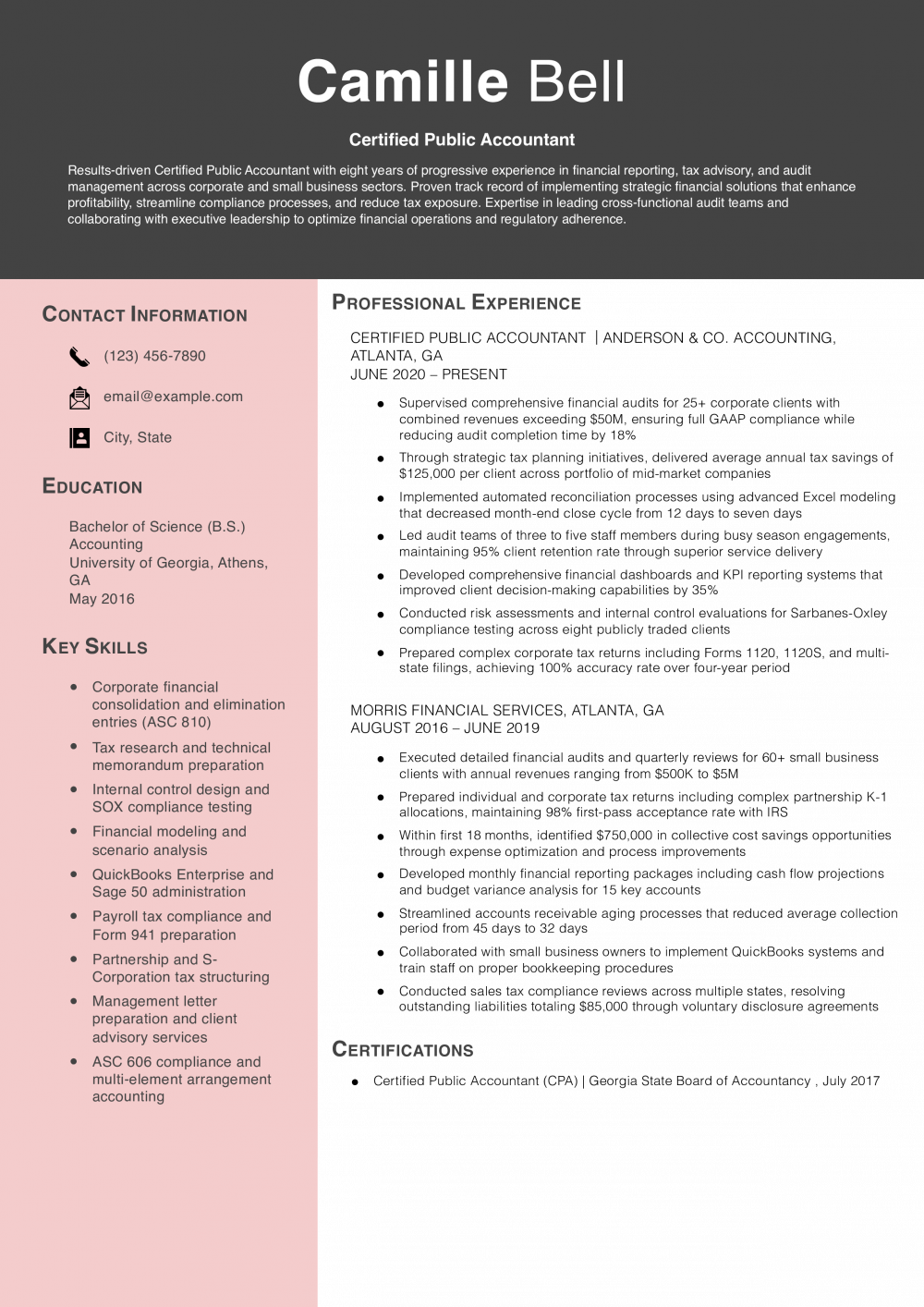
Customize this template in our builder in under 10 minutes.