Teacher Resume Examples
Your profile should state your years in the classroom, the grade band or subject you teach, and the school setting you’ve worked in (Title I, charter, magnet, independent, or rural district). Name your state license…
Every resume example is written and reviewed by our team of Certified Professional Resume Writers to ensure top-quality content and formatting.
Most art teacher roles fill through a single portfolio review and one demo lesson. Your resume has to earn that invitation. School principals and district hiring teams screen for a state teaching license with an art endorsement, studio skills across media, and proof you raised student engagement.
The strongest art teacher resumes pair curriculum design with real outcomes. Show how you built a scope and sequence, grew enrollment in elective courses, or led a student exhibition. To compare layouts before you start, browse our resume templates.
School principals decide whether to keep reading by the certification block near the top of an art teacher resume; if the state teaching license and endorsement area are not visible there, the resume moves to the reject pile.
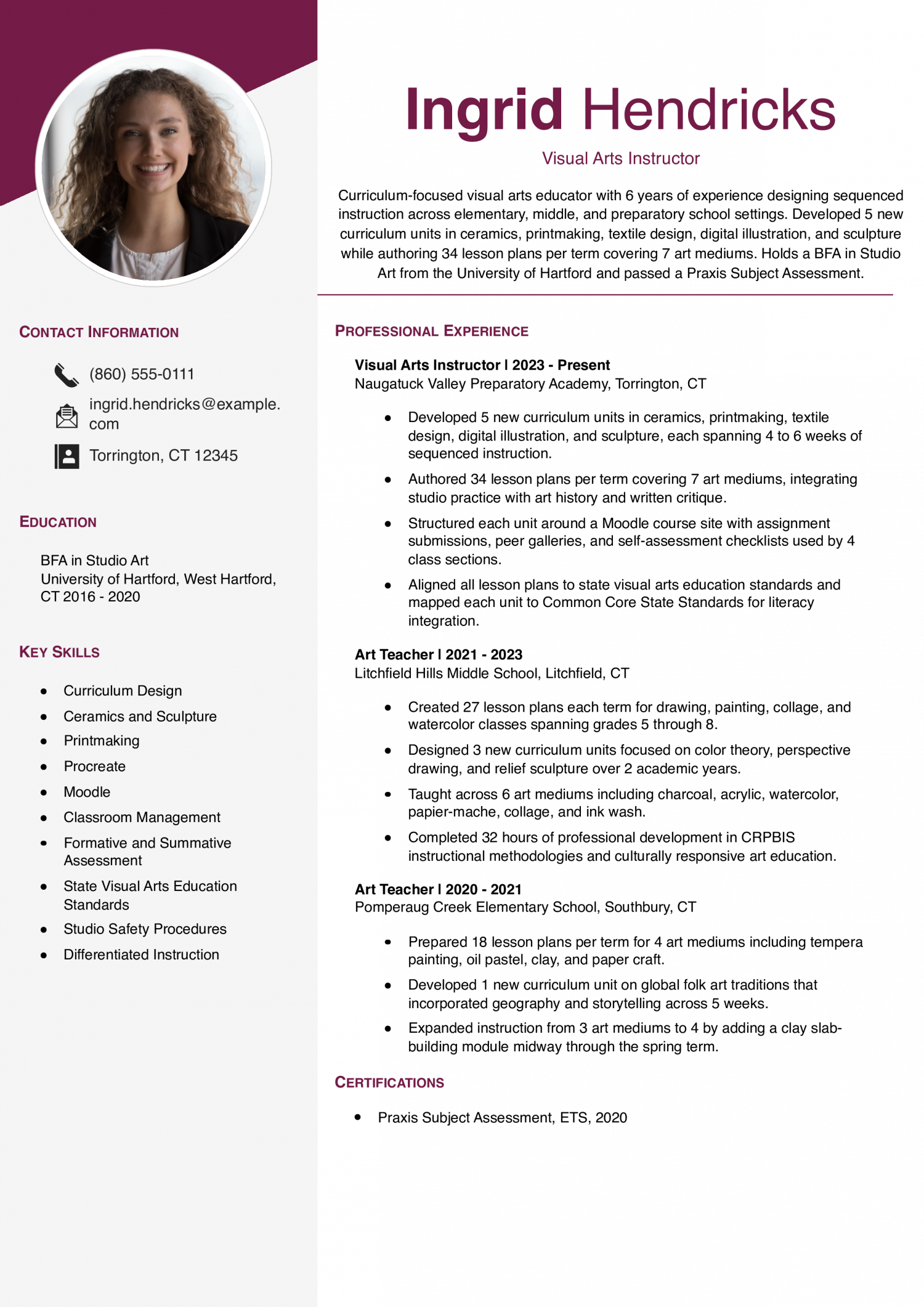
Pick this resume if you are a mid-level visual arts instructor with experience across multiple school levels and growing curriculum ownership. Lead with the number of curriculum units you built and the count of mediums you taught rather than listing artistic interests.
School principals hiring an art teacher look for a clear plan for what students will make and how you run the class. This resume names the tool, the course features students used, and how many sections took part. On your own resume, name the platform features you used and how many sections or students they reached.
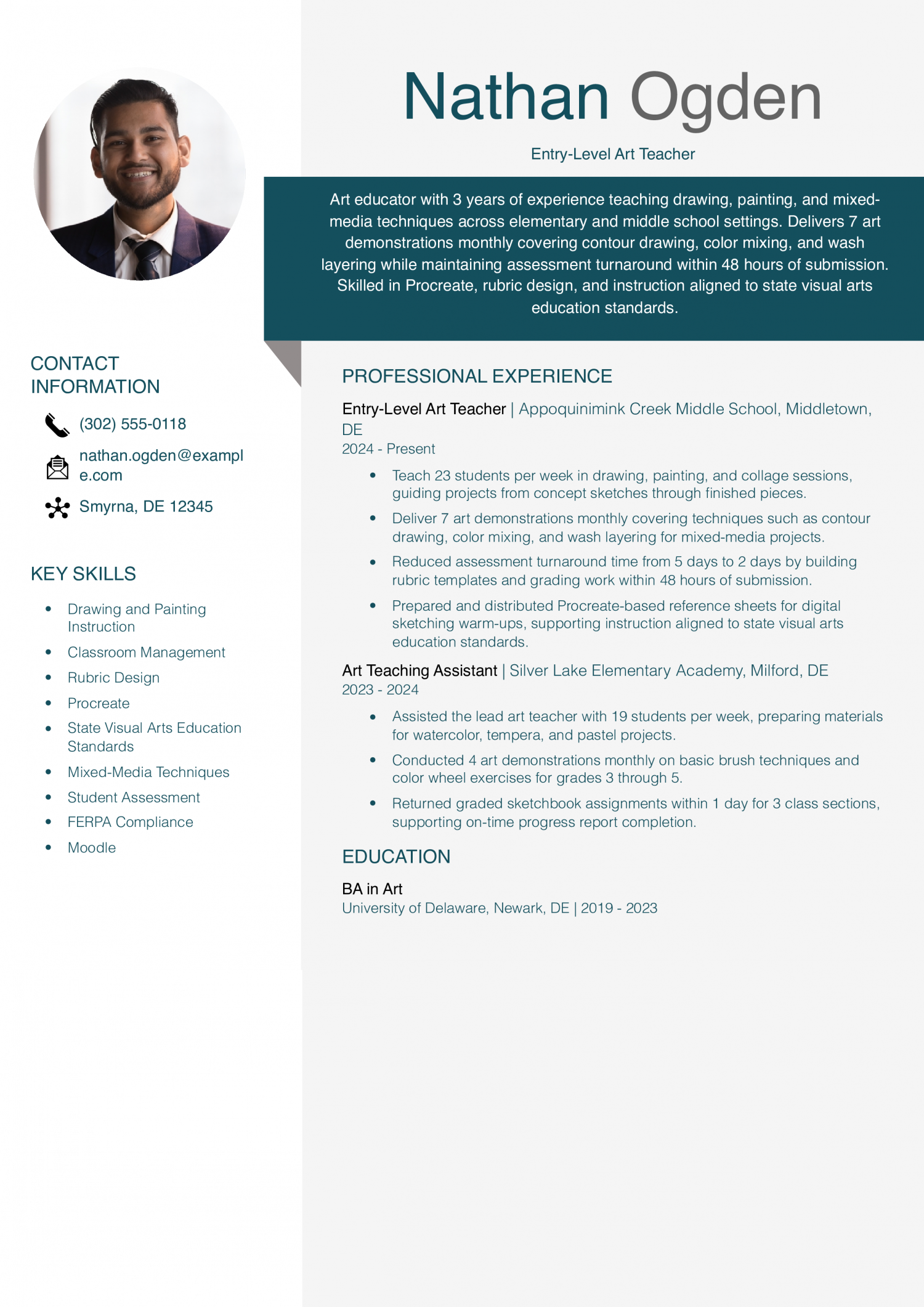
Use this resume if you are an entry-level art teacher beginning your first or second full-time classroom role. Lead with demonstration counts and grading timelines to replace vague teaching descriptions with measurable output.
Principals hiring an entry-level art teacher want to see that you can grade fairly and hand work back on time. This resume gives the old and new turnaround for grading and says rubrics made the change. On your own resume, write the days grading took before, the days it takes now, and the system that made the difference.
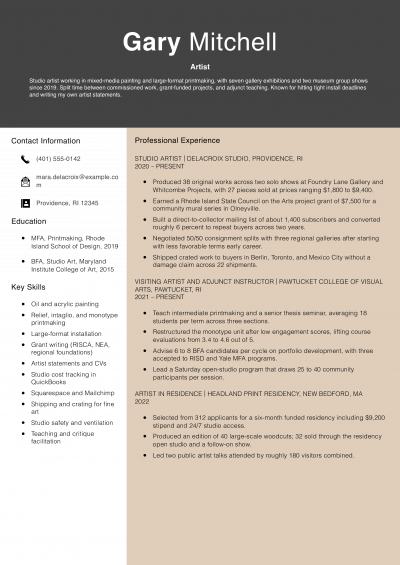
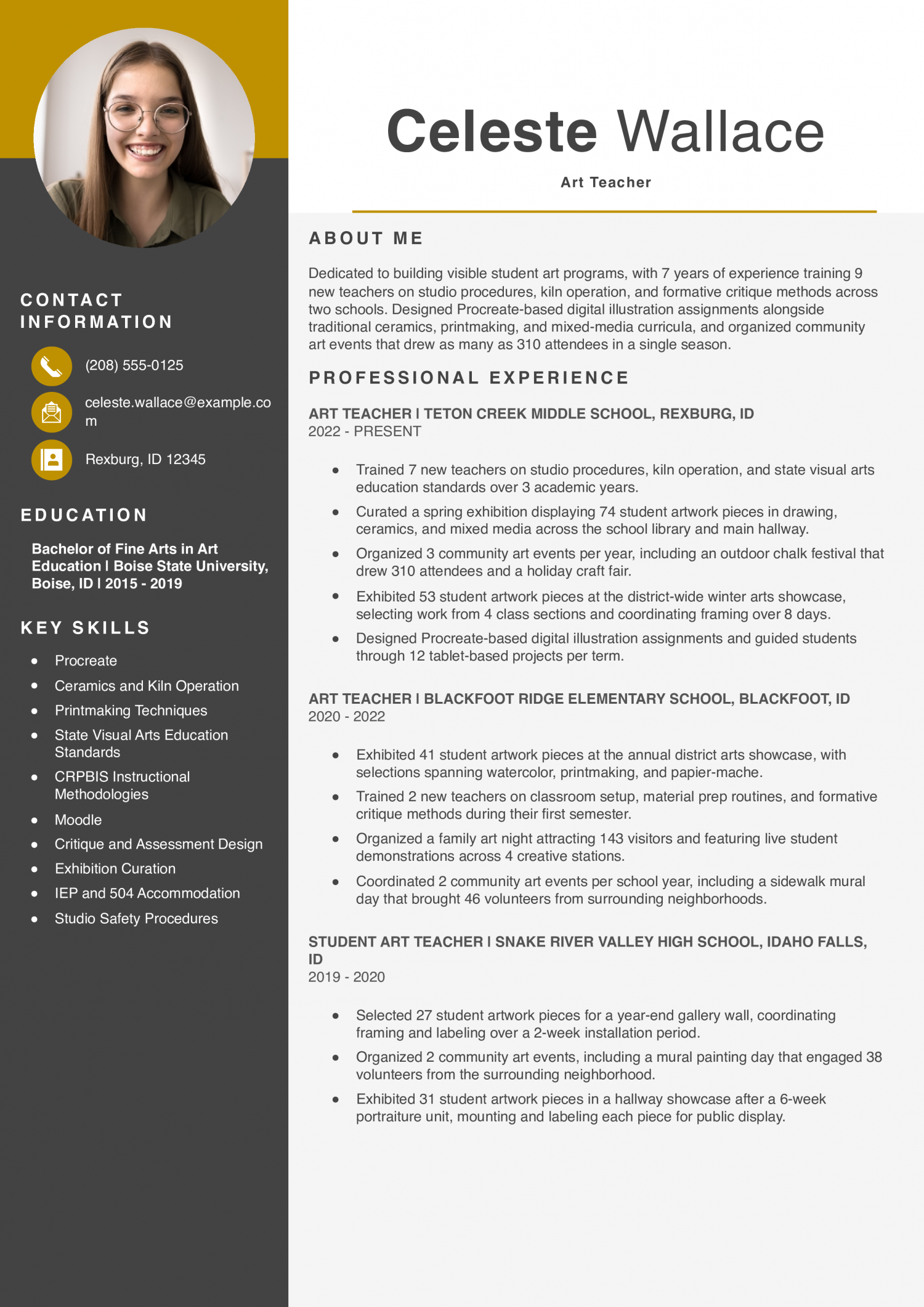
Try this resume if you are a mid-level art teacher with about seven years bridging elementary and middle school studio instruction. Lead each bullet with a concrete count of exhibited pieces, trained teachers, or event attendees rather than listing duties alone.
Art departments hiring a teacher look for someone who runs shows and community events without losing class time. This resume states how many classes gave work to an exhibition and how many days framing took. When you describe your own exhibitions, list the classes that contributed and the days you spent on setup.
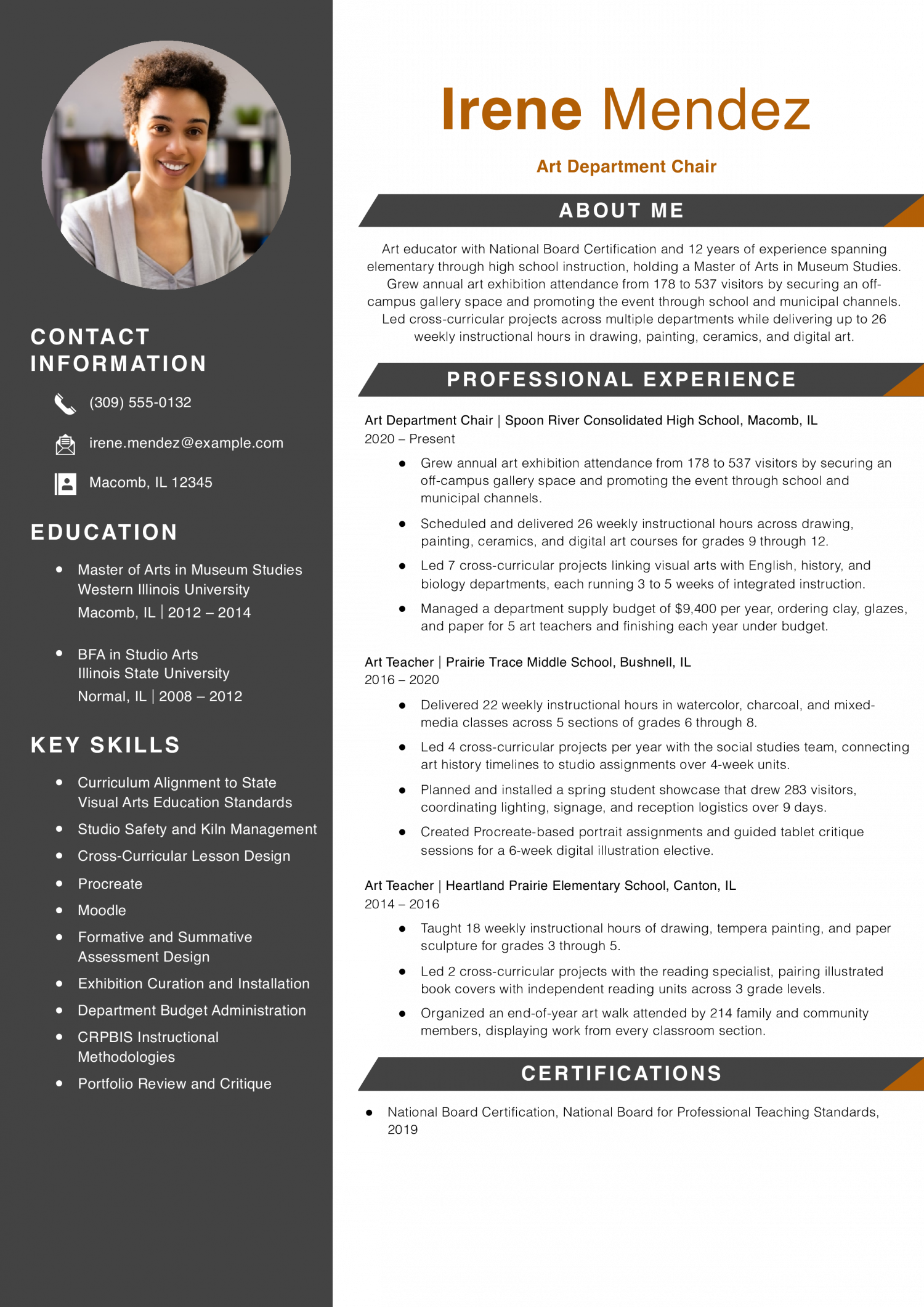
Lean on this resume if you are a senior art educator ready to step into or continue a department chair position. Lead with cross-curricular project counts and exhibition attendance figures to prove leadership beyond the studio.
Districts hiring a department chair look for a teacher who leads other teachers and brings in crowds. This resume names the budget and how many teachers it supports, plus the attendance growth from a gallery event. On your own resume, state the budget you managed, who it served, and how many people came to your events.
Experienced in raising student test scores on visual arts assessments by 14% through weekly critique journals and targeted skill drills. Over 6 years of art education experience across elementary and middle school settings, managing classroom supply budgets, conducting parent-teacher conferences across multiple grade-level sections, and designing formative and summative assessments aligned with State Visual Arts Education Standards.
School principals and district hiring teams can verify your state teaching license in minutes. They cannot see your studio specialty or your grant history that way. Open your profile with one detail they cannot look up.
That might be a ceramics kiln you built from a donor budget. It could be a bilingual classroom you run. Maybe you have a portfolio review partnership with a local college.
Name the medium, population, or program no other applicant on the shortlist is likely to share. Keep this opener to two or three lines so it reads fast. Place it at the top of page one, right above your work history.
Art teaching does not produce quarterly revenue charts. Scale still belongs in every bullet. State how many students you taught per semester and per grade band.
Note the number of art shows you organized each year. Mention the dollar value of supply grants you secured. If you raised parent attendance at a gallery night, give a percentage.
Describe how many new media you added to the curriculum. These scope details help principals compare you to other candidates who may lack measurable outcomes. A bullet that says “taught art” tells them nothing.
A bullet that says “taught 400 students across six grade levels” tells them plenty.
Organize your bullets under three to five areas so the page stays clean. Curriculum design covers lesson plans, unit maps, and standards alignment. Student assessment includes portfolio reviews and rubric creation.
Community engagement holds art shows, mural projects, and parent workshops. Classroom management covers studio safety and supply budgets. Technology integration includes digital art platforms and design software.
Pick the groups that match the posting you target, and use two to four bullets per group. This structure lets a principal scan your resume in seconds rather than hunting through a wall of text. It also shows you understand the full scope of the role, not one narrow slice.
Reorder the groups so the one most relevant to the posting appears first on the page.
Give your teaching license its own short block near the top of page one. List your State Teaching License with Art Endorsement on its own line.
If your state required a Praxis Subject Assessment, add that on the next line with the issuing body, ETS. Teachers who hold National Board Certification from NBPTS should list it above the state license. That credential signals advanced practice, and principals notice it.
Below this block, add a short tools line. Name the software you use in class, such as Adobe Creative Suite or Procreate.
If you are moving into art teaching from a studio career or design role, lead with the overlap. Client presentations translate to classroom instruction. Freelance project timelines mirror unit planning cycles.
Mention any volunteer teaching or after-school workshops you led. Even informal mentoring at a community center counts. Frame each past role around skills a school values.
A graphic designer who trained junior staff was already coaching. A muralist who managed a crew was already leading a group of learners. Name the education coursework you have finished or started.
Principals want to see that you are moving toward licensure, not waiting for it to happen on its own. One page works well when your teaching history is still short.
Many school districts run art teacher resumes through applicant tracking systems. Check the medium names below against each posting you read. Art media terms clear the first cut.
Classroom management language decides whether your resume moves forward. School principals and district hiring teams weigh hard skills and soft skills in different ways. Hard skills like curriculum design prove you can plan and teach a full art program.
Soft skills like patience show you can guide students through open-ended projects. Pull each skill from the tables that the posting also names. Then weave each soft skill into a bullet that names a measurable result.
Drop terms the posting does not list.
| Soft Skills | AI-estimated % |
|---|---|
| Student encouragement | 74% |
| Creative problem-solving | 54% |
| Parent communication | 41% |
| Classroom management | 40% |
| Adaptability to learners | 28% |
And here are the top hard skills showing up most often.
| Hard Skills | AI-estimated % |
|---|---|
| Art curriculum development | 67% |
| Studio technique instruction | 50% |
| Student portfolio assessment | 40% |
| Art history integration | 36% |
| Classroom materials management | 30% |
Skill names and rankings come from an AI model grounded in U.S. Department of Labor occupation data for art teachers, not from a count of art teachers’ resumes built on ResumeTemplates.com.
School principals and district hiring teams sort art teacher resumes by art curriculum development and studio technique instruction, which is why the items below put them where a reader finds them.
A State Teaching License with Art Endorsement is the core credential. Requirements differ by state, so check your state agency. List your license status clearly on the resume.
Many states require you to pass a Praxis Subject Assessment. ETS administers this exam, but each state sets its own cut score. Note your passing score if the posting asks for it.
Experienced teachers may hold National Board Certification. This senior credential can strengthen your resume for lead roles. Place it in a dedicated certifications section.
Art classrooms present unique management challenges every day. You lead mixed-ability groups using sharp tools and messy media. School principals want proof you can handle both.
School principals and district hiring teams scan for specialty terms. Generic words like “creative” do not carry much weight. Use the specific phrases your field relies on. Each group below covers a real part of art teaching. Studio terms show you can run a working classroom. Curriculum words prove you design units with standards. Media terms name the materials you teach students to use. Assessment words show how you measure student growth. Credential terms confirm you hold the right licenses. Match your resume language to these groups where appropriate. Pull keywords from the job posting when you can. Exact phrasing helps your resume clear automated filters.
| Niche | Keywords ATS scans for |
|---|---|
| Studio Management | kiln operation, studio safety procedures, supply inventory |
| Curriculum Design | National Core Arts Standards, scope and sequence, interdisciplinary units |
| Media Instruction | ceramics, digital photography, mixed media |
| Student Assessment | portfolio review, formative critique, rubric development |
| Credentials | State Teaching License with Art Endorsement, Praxis Subject Assessment, National Board Certification |
What school principals and district hiring teams expect on an art teacher resume has shifted. Listing only traditional media can raise questions about digital literacy. Naming the AI tools you use, and the creative judgment you apply, answers those questions. Focus on tools you have used in class. Show how you guided students through the output. Art programs vary widely by grade level and district. Pick only the tools that match your setting. Keep each line tied to a lesson or project. Describe the human step you kept in the process.
AI drafts unit outlines and standards alignments faster, but you still shape scope and sequence for your students.
Image generators create quick concept examples for class demos, though you curate and critique each one.
AI helps adapt project prompts for varied skill levels, and you review each prompt for age appropriateness.
AI can draft written critiques on student portfolios, but you revise tone and add specific art vocabulary.
Expect fingerprinting and a criminal history check before your first day. State rules on disqualifying offenses vary widely.
School principals and district hiring teams screen every classroom hire. Some states also require child abuse registry checks. Plan for this step early in your job search.
Your resume does not need to address background checks. However, gaps in employment may draw questions during screening. Be ready to explain any long breaks honestly.
The credentials below tell school principals and district hiring teams how far your training goes. They signal whether you have passed a subject test or earned a national board review. These details help sort your file from a stack of other art resumes.
A strong list can set you apart from peers who hold the same degree. Put the year you earned each credential on the same line. If a credential has a renewal cycle, add the next renewal date too.
That way a reviewer sees your status at a glance. Keep the block short and near the top of page one. Two or three lines are enough for most art teachers at the mid-career stage.
Resume Templates offers HR approved resume templates to help you create a professional resume in minutes. Choose from several template options and even pre-populate a resume from your profile.
Place your art skills in a grouped skills section, sorted by medium or discipline. For example, list ceramics and printmaking together, then digital tools on a separate line.
Back each skill up with a bullet in your experience section that shows how you taught it.
Open with your years of teaching experience, the grade levels you have covered, and one measurable result. A strong summary might note that you raised student entries in district art shows by 40 percent.
Keep the whole summary to three lines so principals can scan it in seconds.
Title the role "Long-Term Substitute Art Teacher" and list the school, district, and exact dates. Write bullets the same way you would for a permanent role, noting class sizes and media taught.
Principals view long-term assignments as real classroom proof. Give the entry the same detail you would give a full-time teaching post.
Include a summary, work experience with measurable outcomes, your degree, your state license and endorsement, and a skills section listing media and tools. Add a line for exhibitions or grants if you have them.
Tailor each section to the grade band and specific media the job posting calls for.
Lead with a summary that names your current license area and any completed coursework in art. In your experience section, highlight lessons you designed that involved visual arts, even within another subject.
List art-related workshops or college credits in a professional development section to show you are building subject-area depth.
Yes, add a link to an online portfolio near your contact information at the top of the page. Choose a clean hosting site and include five to ten pieces that reflect the media you teach.
Principals look for evidence that you practice the skills you plan to bring into the classroom.
A single page fits a teacher with under a decade in the classroom. A second page is reasonable when you have led district-wide programs or carry a long list of exhibitions.
Keep every bullet focused on outcomes so that extra length adds value rather than clutter.
A basic template is enough for many art teacher resumes, and an ATS-friendly template suits it better. Label each section with a plain heading, set the text in a standard font, and avoid graphics.
Art Teacher Resume
4.9/5 stars with 237 reviews

Executive Resume Writer and Career Coach
Andrew Stoner is an executive career coach and resume writer with 17 years of experience as a hiring manager and operations leader at two Fortune 500 Financial Services companies, and as the career services director at two major university business schools.
© 2026 Resumetemplates.com All rights reserved.