Dance Resume Examples
Add a single line a company website cannot surface: a featured role in a Balanchine work, a credit under a named choreographer, an aerial silk certification, or fluent partnering at lift weight. Put it directly…
Every resume example is written and reviewed by our team of Certified Professional Resume Writers to ensure top-quality content and formatting.
Your training in ballet, jazz, or modern technique matters. But what sets a strong dance teacher resume apart is proof you grew enrollment or raised student retention at a studio. Studio owners and dance program directors look for class size data and age groups you have taught.
List the styles you teach and any curriculum you built from scratch. Include your First Aid/CPR/AED status if you hold it. To compare layouts before you start, browse our resume templates.
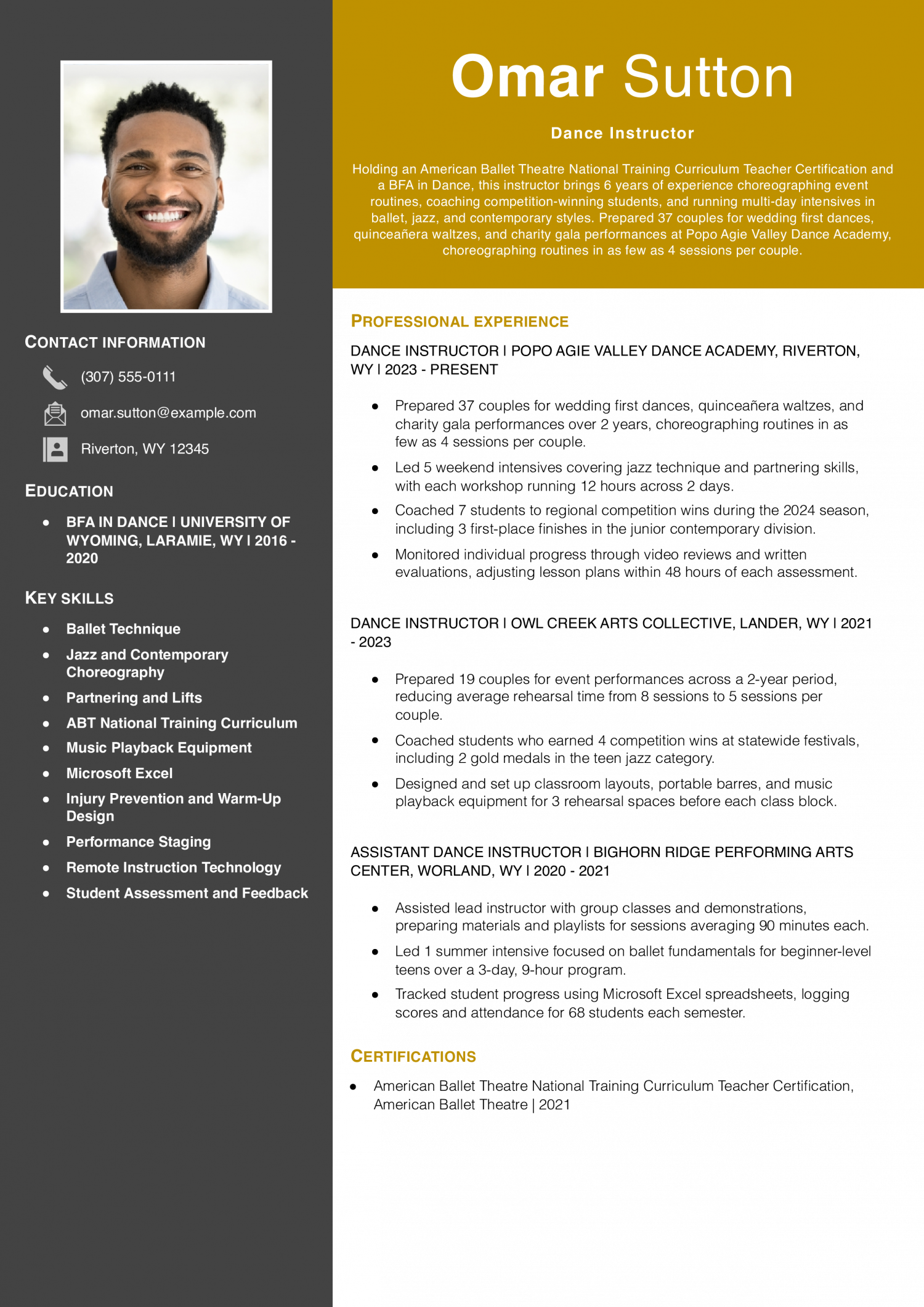
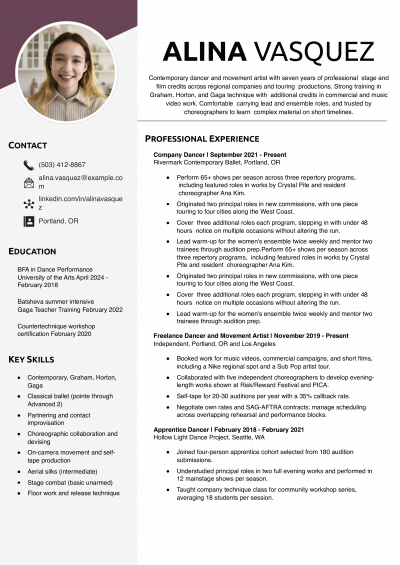
Pick this resume if you are a mid-level dance instructor with a few years of independent teaching and competition coaching under your belt. Lead with the number of students or couples you prepared and the specific outcomes those partnerships produced.
Studio owners hiring a dance instructor look for students who win, classes that fill, and a teacher who can handle events. This resume shows how many couples were prepared and how few sessions each needed, plus placements at competitions. List your own counts of students coached, the level of the contest, and what they won.
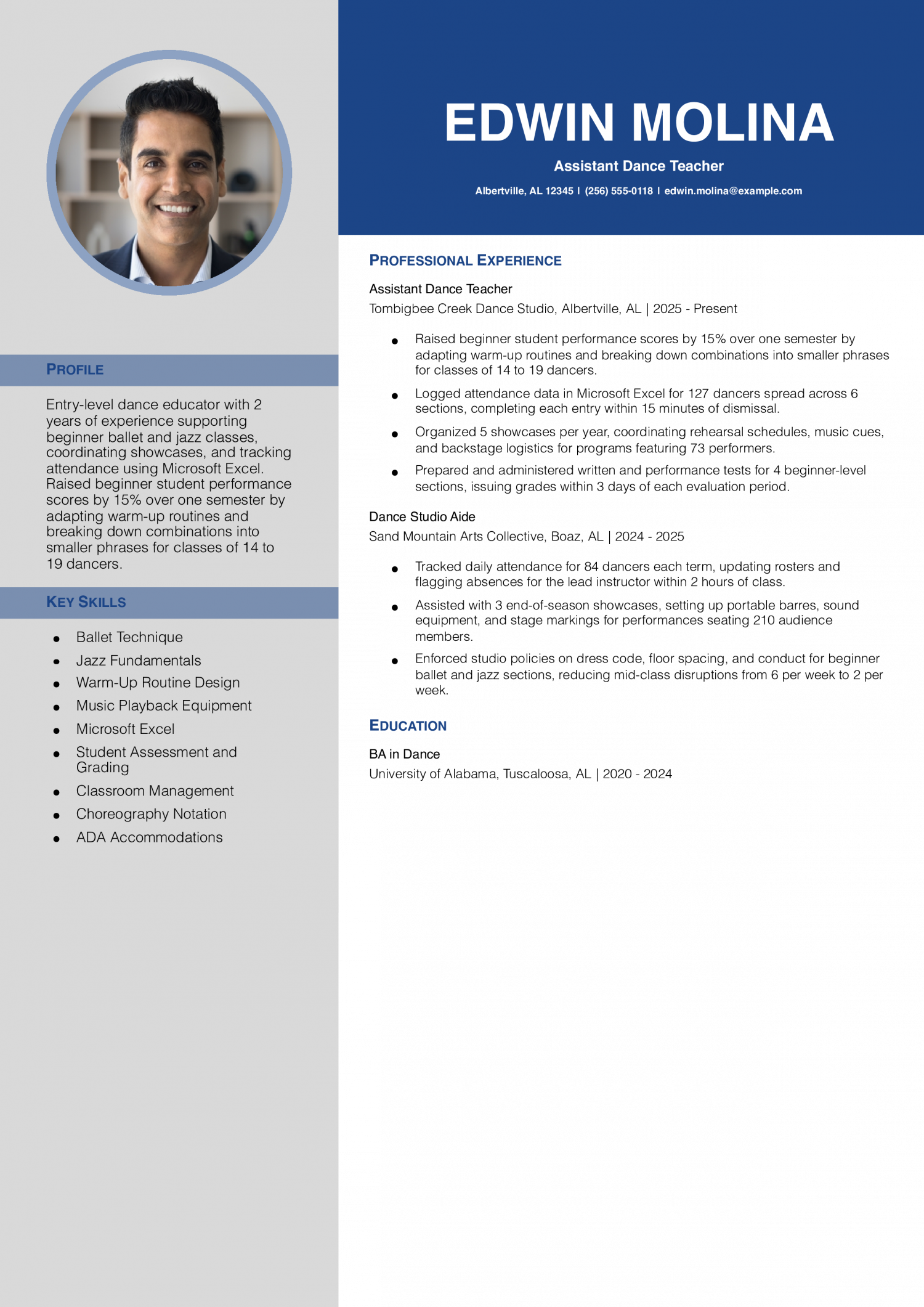
Start with this resume if you are an entry-level assistant dance teacher moving from a studio aide role into a classroom support position. Lead with before-and-after disruption counts and grading turnaround windows rather than listing dance styles alone.
An assistant teacher is hired to keep the room orderly and the records straight. This resume shows fewer mid-class disruptions, with the studio rules behind them, and attendance logged within minutes. Count disruptions before and after you stepped in, and use the same time unit, such as per week, for both.
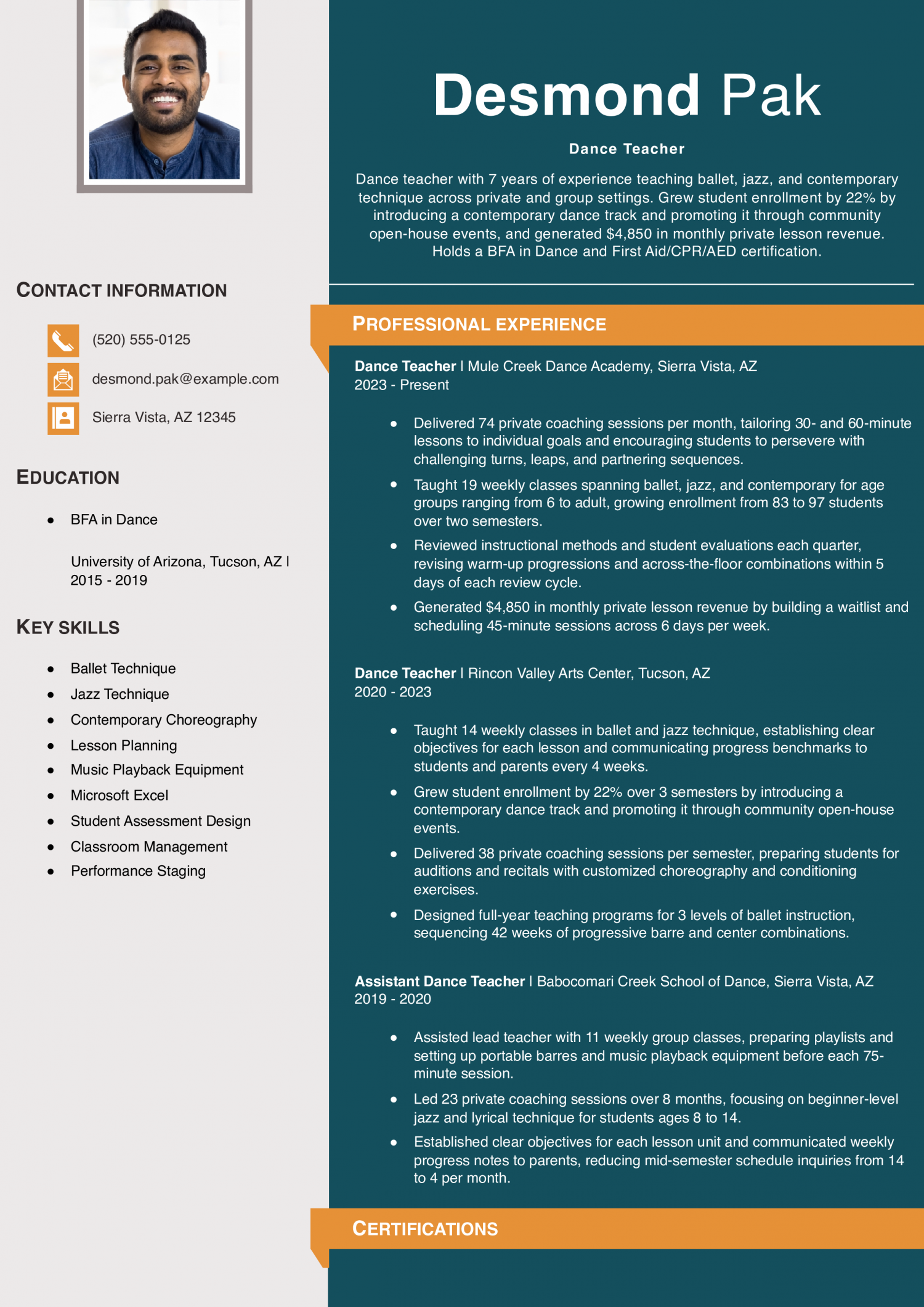
Try this resume if you are a mid-level dance teacher with a mix of group class and private coaching experience across multiple studios. Lead with enrollment growth and revenue figures tied to the scheduling and programming decisions behind them.
Owners who want full classes and private lesson income look for a teacher who plans ahead. The full-year teaching program here shows weeks of planned barre and center work, so the reader sees real planning. Give the number of weeks or sessions your program covered, and explain how each level builds on the one before.
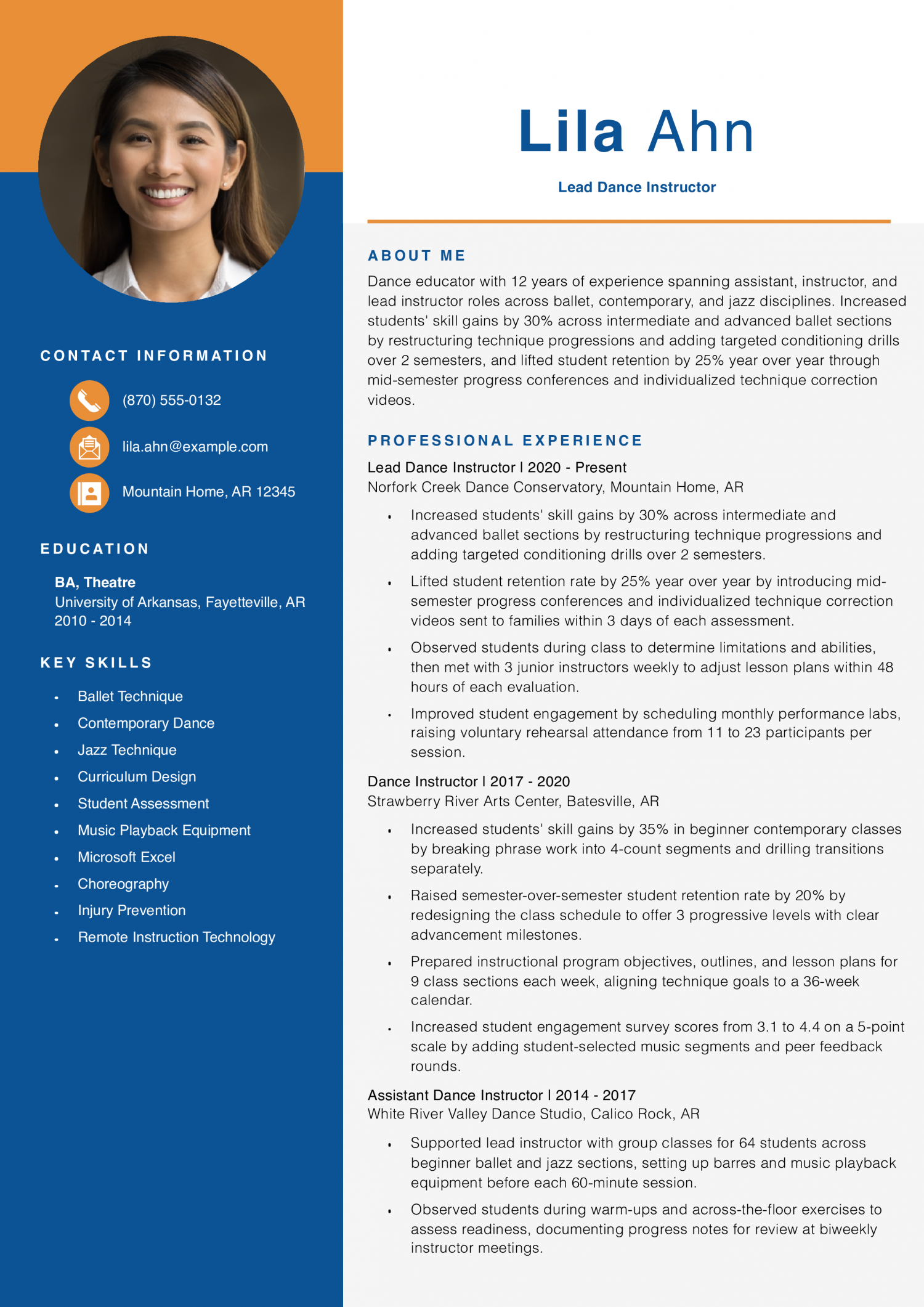
Lean on this resume if you are a senior-level lead dance instructor with over a decade of progressive teaching and mentoring experience. Lead with retention rate gains and skill improvement percentages tied to specific curriculum or assessment changes you introduced.
Directors hiring a lead instructor look for teachers who keep students coming back and who guide other teachers. This resume pairs weekly meetings with junior instructors and a quick follow-up on every evaluation. If you lead other teachers, name how often you meet and how soon you act on what you see.
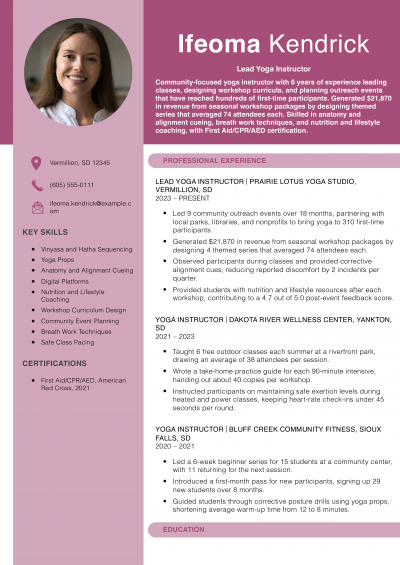
Curriculum-focused dance educator with 6 years of experience designing progressive ballet, jazz, contemporary, and lyrical programs for studios serving up to 187 students per year. Skilled in structuring multi-week lesson sequences with technique benchmarks, managing class sections of 12 to 23 dancers, and tracking student progress through Microsoft Excel. Holds a BA in Dance from the University of Colorado Boulder.
Start with your years of teaching and the styles you teach most often. Ballet and contemporary are common, but name your actual focus.
Mention the age groups you work with, such as pre-K beginners or advanced teens. Note the setting where you have taught, whether that is a private studio, a university program, or a community arts center. If you hold the American Ballet Theatre National Training Curriculum Teacher Certification, name it here.
Studio owners and dance program directors scan this block first. A clear scope line helps them see your fit in under ten seconds.
Dance teaching is hard to reduce to a single metric. Focus on scope and volume instead of raw percentages. State how many students you teach per week and how many classes you lead each term.
Note retention rates for your classes if you track them. You might write that you grew enrollment in your hip-hop program from 12 to 34 students over two semesters. Competition results also carry weight.
Mention how many students placed at regional or national events. Recital details work too: note the number of performers you choreographed and rehearsed for a spring showcase. Each bullet should pair an action verb with a concrete detail.
Link these numbers to the style you taught so the reader sees your range and your results in one line.
Organize your bullet points under each job into three or four groups. The first is instruction: lesson planning, warm-ups, technique drills, and across-the-floor combinations. The second is choreography and performance prep.
Cover recital staging, music editing, and costume coordination here. A third group covers student development. Include progress evaluations, parent conferences, and placement decisions.
A fourth group can hold administrative duties. Think class scheduling, registration tracking, and studio social media content. This structure helps studio owners and dance program directors see the full range of your work.
Label each group with a short header so the reader can scan your resume in seconds.
List the American Ballet Theatre National Training Curriculum Teacher Certification with American Ballet Theatre (ABT) as the issuing body. Add the year you earned it on the same line.
First Aid/CPR/AED from the American Red Cross belongs here too, if you hold it. If your state requires a teaching license for school-based dance roles, note it with your state and status. Below your credentials, list the tools you use.
Include music editing software and any studio management platforms you rely on. Studio owners and dance program directors need to see safety and pedagogy credentials before they read further.
Name your dance degree first, then the school and the year you finished. A BFA or BA in dance is common, but related fields like kinesiology or performing arts count too. Add intensive training programs or summer workshops that expanded your style range.
A Horton intensive or a Vaganova summer program signals depth beyond your home studio. If you are shifting from performance into teaching, lead with any student teaching or apprentice instructor hours you completed. Describe the ages and levels you taught during that period.
This framing helps studio owners and dance program directors see you as a trained teacher, not only a performer looking for a second career path. Even a short list of teaching hours can shift how they read your whole resume.
A dance teacher resume works best when it names the styles and age groups you teach.
Check the technique styles and tools below against each posting. Studio owners and dance program directors weigh hard skills first. They want proof you can teach a named style safely.
Soft skills like patience matter too, but only with evidence.
Use the posting’s own style names for hard skills. Back each soft skill with a class outcome or student metric.
| Soft Skills | AI-estimated % |
|---|---|
| Student motivation | 70% |
| Adaptive teaching style | 64% |
| Constructive feedback delivery | 49% |
| Patience with beginners | 36% |
| Parent communication | 35% |
And here are the top hard skills showing up most often.
| Hard Skills | AI-estimated % |
|---|---|
| Choreography instruction | 71% |
| Dance technique training | 65% |
| Student progress assessment | 44% |
| Lesson plan development | 35% |
| Performance preparation | 33% |
Skill names and rankings come from an AI model grounded in U.S. Department of Labor occupation data for dance teachers, not from a count of dance teachers’ resumes built on ResumeTemplates.com.
Beyond any state teaching license you hold, the credentials below tell studio owners and dance program directors how you train students and how you handle safety. These cards set you apart from other teachers who list only a degree. They show a commitment to a tested method or to keeping dancers safe.
Studio owners scan for them when they compare two resumes side by side. Program directors look for them before they schedule an audition class. Note the year you earned each card and whether it is current.
Add the renewal date if the card expires so the reviewer sees you are up to date.
The top-paying states for self-enrichment teachers, the broader BLS group that includes dance teachers, run from the District of Columbia at $66,430 down to Maryland at $51,630. Only New York appears on both the top-paying and the highest-employment lists.
Pay varies widely within this group. The 90th percentile nearly doubles the median, while the 10th percentile sits roughly a third below it.
If you are open to relocating, list that flexibility near the top of your resume and name the styles you teach.
| # | State | Median Annual |
|---|---|---|
| 1 | District of Columbia | $66,430 |
| 2 | New Hampshire | $59,880 |
| 3 | New York | $57,790 |
| 4 | Connecticut | $55,240 |
| 5 | Oregon | $53,790 |
| 6 | New Jersey | $53,780 |
| 7 | Vermont | $53,190 |
| 8 | Georgia | $52,320 |
| 9 | Hawaii | $51,960 |
| 10 | Maryland | $51,630 |
| # | State | Workers | Median |
|---|---|---|---|
| 1 | California | 60,260 | $49,570 |
| 2 | New York | 31,120 | $57,790 |
| 3 | Texas | 16,680 | $36,140 |
| 4 | Pennsylvania | 15,270 | $41,740 |
| 5 | Illinois | 15,030 | $44,230 |
Resume Templates offers HR approved resume templates to help you create a professional resume in minutes. Choose from several template options and even pre-populate a resume from your profile.
Teachers with fewer than ten years of experience usually need one page. If you have taught at multiple studios and hold several certifications, a second page is fine. Keep every line tied to the role you want.
List each position with the studio or school name, your title, and dates. Under each role, write bullet points that name styles taught and age groups served. Include a measurable result such as student retention rate or recital participation growth.
Replace the word multitasking with the specific duties you handled at the same time. You might write that you managed scheduling for 15 sections while choreographing two recitals per semester. Studio owners and dance program directors value concrete tasks over a general label.
Include both technique skills and classroom management skills. Name the dance styles you are trained in, such as ballet, jazz, or contemporary. Add skills like injury prevention, lesson planning, and student progress tracking.
Yes, if the credits are relevant to the styles you teach. List company names, productions, and roles in a section titled Performance Credits. Keep it brief so your teaching history stays the focus of the resume.
Requirements vary by employer. Some studios accept extensive training and professional performance experience in place of a degree. Schools and university programs often ask for a bachelor's degree in dance or education.
Check the posting and list the highest credential you hold.
Note any dance-related activity you did during the gap, such as freelance choreography or continued training. Place a brief note next to the dates so studio owners see the context. If you earned a new certification during that time, list it with the date to fill the timeline.
Many employers run resumes through software, so an ATS-friendly template helps your dance teacher resume get read. A basic template helps too. Give sections plain names, pick one standard font, and skip graphics.
Dance Teacher Resume
4/5 stars with 220 reviews

Executive Resume Writer and Career Coach
Andrew Stoner is an executive career coach and resume writer with 17 years of experience as a hiring manager and operations leader at two Fortune 500 Financial Services companies, and as the career services director at two major university business schools.
© 2026 Resumetemplates.com All rights reserved.