Teacher Resume Examples
Your profile should state your years in the classroom, the grade band or subject you teach, and the school setting you’ve worked in (Title I, charter, magnet, independent, or rural district). Name your state license…
Every resume example is written and reviewed by our team of Certified Professional Resume Writers to ensure top-quality content and formatting.
Your lesson plans and student progress data carry more weight than a generic teaching summary. Language program directors and school principals look for proof you raised proficiency scores across WIDA or similar benchmarks. A CELTA or CertTESOL signals training, but measurable student outcomes set your resume apart.
Show how you adapted curriculum for mixed-level classrooms. Include the enrollment sizes you managed and the languages your students spoke. To compare layouts before you start, browse our resume templates.
A visible CELTA or state teaching license is what gets ESL Teacher resumes past language program directors' credentialing screen; measurable student proficiency gains give those directors a reason to advance your resume.
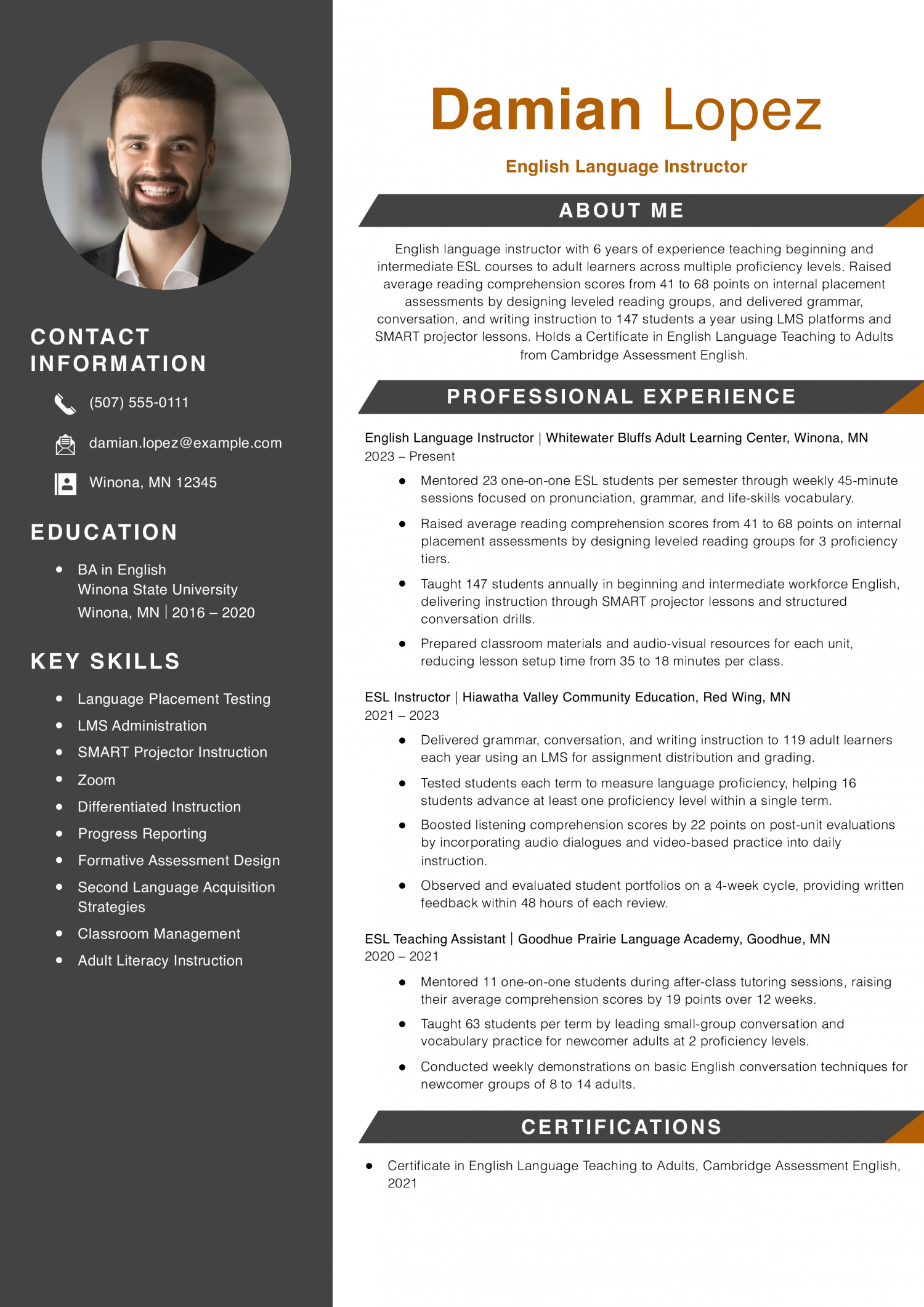
Consider this resume if you are a mid-level English language instructor with classroom and one-on-one tutoring experience across adult education programs. Put before-and-after score gains next to the specific instructional method that produced them.
Program directors hiring an ESL teacher look for a record of students moving up a level. This resume ties a testing routine to the number of learners who advanced in one term, and its reading groups to a score gain. On your own resume, follow each assessment with how many students moved up and how long it took.
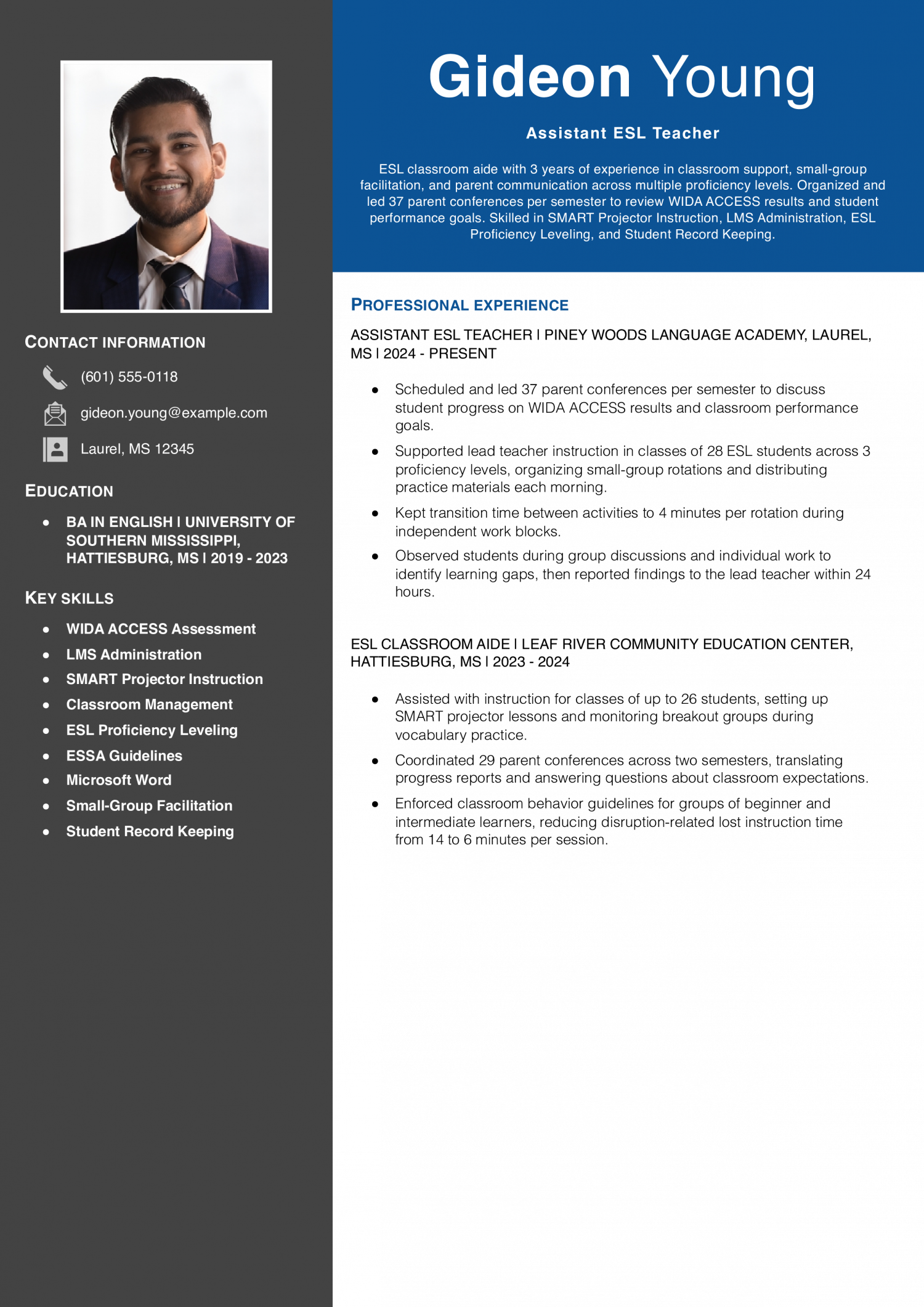
This resume suits an entry-level assistant ESL teacher stepping up from an aide job to a formal classroom support post. Lead with conference counts and transition-time data the way this candidate does to show readiness for more responsibility.
Principals hiring an assistant ESL teacher want a helper who keeps the room running and families informed. This resume counts the parent conferences held each semester and times the move between activities. Time one routine in your own classroom, and write down how many families you met with.
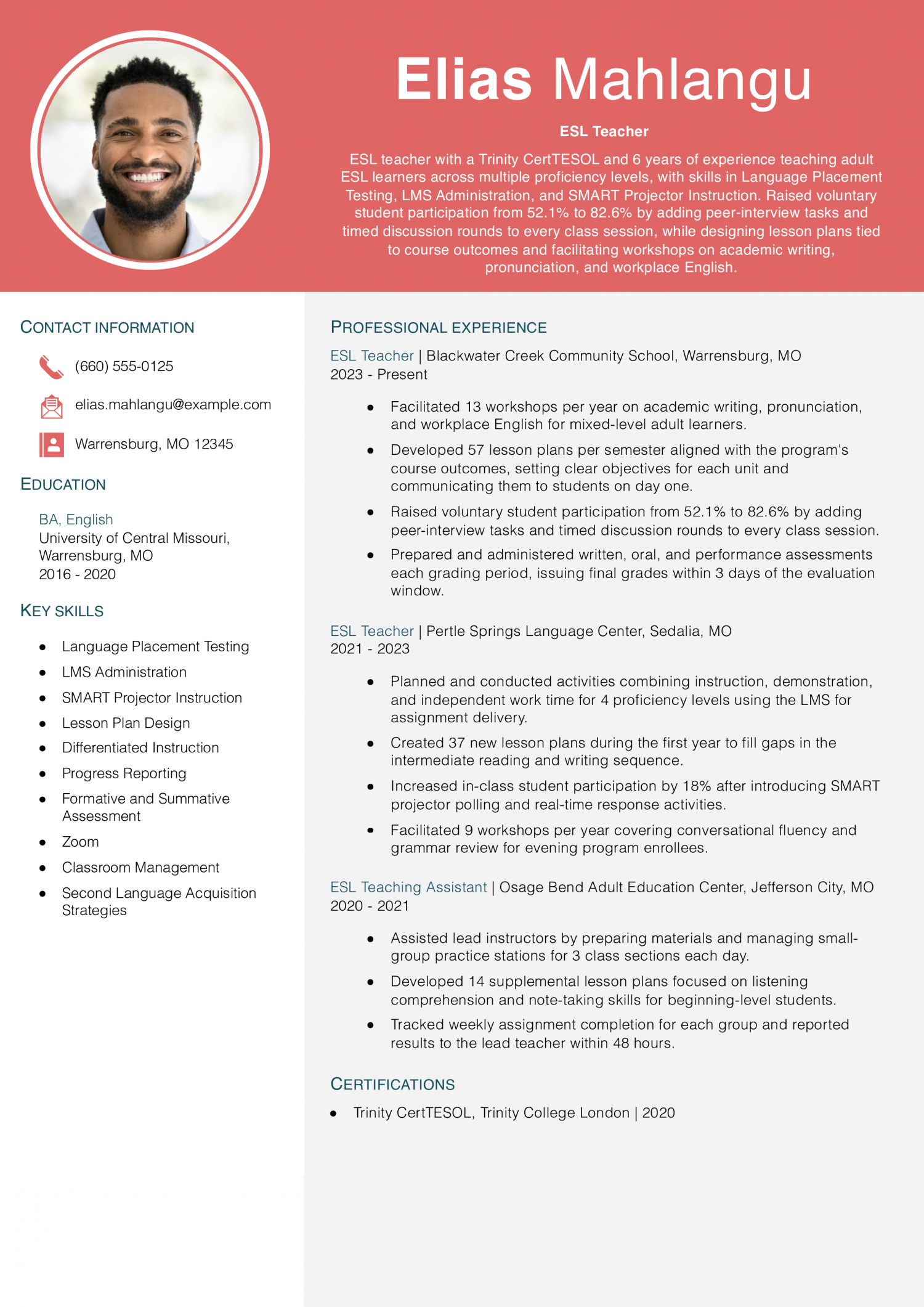
Try this resume if you are a mid-level ESL teacher with several years of classroom experience across adult education settings. Lead with participation gains tied to the specific activities you introduced, the way this candidate does throughout.
School leaders hiring an ESL teacher look for planned lessons and students who speak up. This resume gives the number of lesson plans written each semester and the rise in voluntary participation after a new activity. When you describe your planning, count your plans and say which change got students talking.
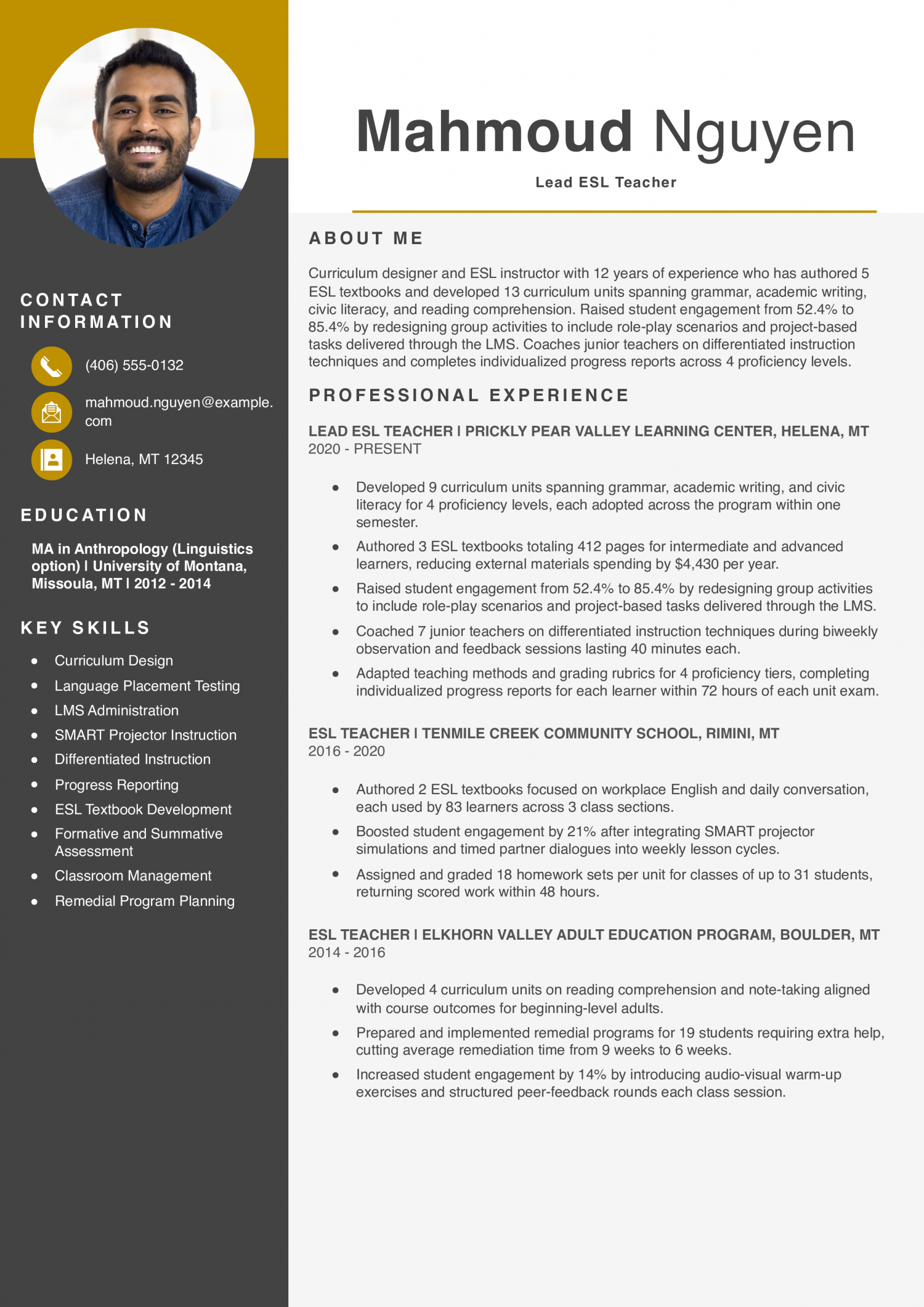
Lean on this resume if you are a senior ESL teacher who has moved into curriculum leadership and staff mentoring. Name the instructional product you built in each bullet, then the adoption or engagement result it produced.
Directors hiring a lead ESL teacher look for materials others adopt and teachers who improve under your coaching. This resume counts the textbooks and units written, the teachers coached, and how long each session ran. List what you built, who used it, and how often you met with the teachers you coached.
Raised average speaking scores by 17% on end-of-unit assessments with daily timed conversation prompts and peer-feedback rounds. Across 7 years of adult ESL instruction, built consistent classroom engagement by lifting attendance from 73.8% to 85.3% through same-day follow-up calls and makeup practice sessions. Skilled in Language Placement Testing, LMS Administration, Formative Assessment Design, and Differentiated Instruction.
The first line of your summary should name how many students you teach per term. Language program directors and school principals scan for class size and proficiency levels first. A line like “ESL teacher of 90+ adult learners across A1 to B2 levels” sets your scale fast.
Follow it with the program type you know best. Name whether you teach in a K-12 school, a community college, or a private language center. Add the age group you work with most.
These details help a reader place you in their program within seconds. A vague opener about passion for language learning gives no useful signal. Lead with the numbers and let them do the work.
ESL teaching does not produce sales figures, but it does produce measurable progress. State the number of students you moved up one proficiency band per cycle. Note your class pass rate or average score gain on a placement test.
You can also cite retention rates for your courses. If your program tracks attendance, name the percentage you held above the target. These details show your effect on a real group of learners.
Pair each bullet with the level range and term length so the reader sees context. A bullet that says “taught grammar” reads as a task. A bullet that says “raised TOEFL prep scores 14% across 22 intermediate students” reads as a result.
Sort your bullets into clear clusters so each job entry is easy to scan. Curriculum design covers lesson plans, unit maps, and material adaptation for proficiency levels. Assessment covers placement testing, rubric creation, and progress tracking.
Student support covers tutoring, parent conferences, and referrals to academic advisors. Classroom instruction covers daily lessons, conversation labs, and pronunciation drills. If you also handle program duties, add a fifth group for tasks like test coordination or textbook selection.
Two to four bullets per group is a strong range. This structure lets school principals see your full scope without reading a wall of text.
If you hold a CELTA from Cambridge Assessment English, list it on its own line. Do the same for a CertTESOL from Trinity College London.
Public school roles in many states require a state teaching license. Name the state and note that your license is in good standing.
Language program directors and school principals often filter by credential before they read your bullets. Placing these details high on the page keeps you in the stack. Below your credentials, add a line for tools like Google Classroom, Canvas, or Zoom.
Put your education near the bottom of the page, below your teaching jobs and credentials. If you hold a master’s in TESOL or applied linguistics, place it above your bachelor’s. With under eight years of teaching, a single page covers you.
For career changers, add a short section that names any tutoring or volunteer ESL work you have done. Language program directors value proven hours with real learners over a long corporate history. If you speak your students’ first language, note it with your proficiency level.
Spanish at B2, Mandarin at C1, or Arabic at conversational level all help a reader see your classroom reach. Close with any study-abroad terms or immersion experience you can name.
Lesson planning, student assessment, and sheltered instruction are the skill areas that earn ESL callbacks. Check the tools and methods below against the ones each posting names. Language program directors and school principals scan for these patterns first, not generic teaching platitudes.
Hard skills show you can run a standards-based classroom. Soft skills show you can reach learners across cultures. Both carry weight at the screening stage.
Directors want proof that you build on test data. Principals want proof that you partner with grade-level teams.
Soft skills belong in your work history bullets. A bullet that names patience should also name the outcome it produced.
| Soft Skills | AI-estimated % |
|---|---|
| Cross-cultural sensitivity | 76% |
| Student encouragement | 55% |
| Patience with learners | 44% |
| Clear verbal communication | 39% |
| Classroom adaptability | 31% |
And here are the top hard skills showing up most often.
| Hard Skills | AI-estimated % |
|---|---|
| ESL curriculum development | 79% |
| Language proficiency assessment | 61% |
| Differentiated instruction | 41% |
| Lesson plan design | 35% |
| Grammar instruction | 29% |
Skill names and rankings come from an AI model grounded in U.S. Department of Labor occupation data for ESL teachers, not from a count of ESL teachers’ resumes built on ResumeTemplates.com.
For an ESL teacher resume, language program directors and school principals look at ESL curriculum development and language proficiency assessment first, so the items below back those up with detail.
Public school ESL jobs often require a state license. Requirements vary by state and district. List your license status and any ESL endorsement.
Give your ESL endorsement its own line.
Private programs may accept a CELTA or CertTESOL instead. The CELTA is issued by Cambridge Assessment English. The CertTESOL is issued by Trinity College London.
Name the credential and the year you earned it.
ESL classrooms hold students at many proficiency levels. You must manage mixed groups every day. Show how you adapt lessons for each learner.
Language program directors and school principals scan for field-specific terms. Generic words like “teaching” or “communication” won’t stand out. Curriculum terms show you can build strong lesson plans. Assessment terms show how you use test data. Credential terms confirm you hold recognized professional training. Instructional method terms show how you run a classroom. Compliance terms matter most in public school ESL roles. Each group below covers a distinct part of practice. Match your resume language to the posting’s exact phrasing. Swap in terms that fit your target grade level. Pull from these groups to fill gaps in skills.
| Niche | Keywords ATS scans for |
|---|---|
| Curriculum Design | Scope and Sequence, Content-Based Instruction, Thematic Units |
| Language Assessment | WIDA ACCESS, Formative Language Assessment, Proficiency Benchmarks |
| Instructional Methods | Sheltered Instruction, Scaffolded Literacy, Total Physical Response |
| Credentials | CELTA, CertTESOL, State Teaching License for Public School ESL Jobs |
| Program Compliance | Reclassification Criteria, Annual Language Proficiency Testing, Parent Notification |
Language program directors and school principals question AI claims on ESL resumes. You have three paths. You could brand yourself an AI curriculum designer, which reads as hype. You could leave AI off your resume and discuss it only if asked. Or you could name the tools you use and explain how you check their output. The third is what language program directors can validate. List each tool beside the skill it supports. Then describe the human step you add. That pattern shows you use AI to save prep time, not to replace instruction. It also shows you review every AI output for accuracy.
AI drafts reading passages at a target proficiency level, but you still adjust for cultural context.
Tools generate cloze tests and vocabulary quizzes faster, though you review each item for ambiguity.
AI suggests scaffolded activities for mixed-level classes, and you choose which ones fit your learners.
Grammar checkers flag common L1 transfer errors so you can focus class time on higher-order corrections.
A state license keeps you in the door at public schools. Your other credentials set you apart. Language program directors and school principals scan them to gauge your training depth.
A strong credential shows you completed teaching practice under observation. It signals you can handle mixed-level classrooms on day one.
For each credential, name the issuing body, such as Cambridge Assessment English or Trinity College London, and the year you earned it. If a credential is still in progress, note your expected completion date so reviewers can plan ahead.
BLS tracks ESL teachers inside a broader group that includes all adult basic and secondary education instructors. A specific credential or specialty reads as clear differentiation to language program directors.
Pay spreads from about 32 percent below the median at the 10th percentile to roughly 59 percent above it at the 90th.
That spread means your resume needs to signal where you fall. List your student population size, proficiency levels taught, and the curricula you have run to give reviewers a concrete frame for your experience level.
| # | State | Median Annual |
|---|---|---|
| 1 | California | $102,030 |
| 2 | New Jersey | $81,100 |
| 3 | Delaware | $78,600 |
| 4 | New York | $78,010 |
| 5 | Minnesota | $76,800 |
| 6 | Connecticut | $72,180 |
| 7 | Washington | $69,990 |
| 8 | Louisiana | $66,870 |
| 9 | Oregon | $65,700 |
| 10 | West Virginia | $65,050 |
| # | State | Workers | Median |
|---|---|---|---|
| 1 | North Carolina | 3,720 | $51,810 |
| 2 | Florida | 3,670 | $58,920 |
| 3 | Minnesota | 2,880 | $76,800 |
| 4 | New York | 2,810 | $78,010 |
| 5 | Illinois | 1,970 | $62,370 |
Resume Templates offers HR approved resume templates to help you create a professional resume in minutes. Choose from several template options and even pre-populate a resume from your profile.
Use the title that matches the posting, such as ESL Teacher or ELD Instructor. Below the title, write bullet points that name the proficiency levels you taught. Include the number of students in your classes so the scope is clear.
List the title you held at each school, not a catchall like Traveling ESL Teacher. If you worked through a staffing agency, name the agency on one line. Then name the host school on the next so directors see where you taught.
Lead with any tutoring, volunteer teaching, or practicum hours from your certification program. Note the proficiency levels of your learners and the curriculum materials you used. Directors look for proof you can plan lessons and assess student progress, even outside a formal classroom.
Under ten years of experience in ESL teaching usually fits on one page. A second page is reasonable if you taught in multiple countries or held curriculum roles.
Yes, list every language you speak along with your proficiency level in each one. Bilingual ESL teachers often work with newcomer students who share their first language. School principals can then match your skills to the populations their school serves.
Name the assessment tool you used and the gain your students made over a set period. For example, note that students advanced one proficiency level on WIDA ACCESS within one school year. Percentages and level gains give directors a concrete picture of your teaching impact.
A two-line summary works better than an objective because it states what you bring. Mention the age group or proficiency levels you teach and one standout result. Skip the objective if the posting does not ask for one, and use the space for a strong bullet point.
If you are unsure, an ATS-friendly template is a good default for an ESL teacher resume, and a basic template is a good second choice. Simple headings, one standard font, and no graphics keep either template readable.
ESL Teacher Resume
4.8/5 stars with 177 reviews

Executive Resume Writer and Career Coach
Andrew Stoner is an executive career coach and resume writer with 17 years of experience as a hiring manager and operations leader at two Fortune 500 Financial Services companies, and as the career services director at two major university business schools.
© 2026 Resumetemplates.com All rights reserved.