Professional Resume Templates and Examples for 2025



A certified language pair and a named domain are what get translator resumes past the project-manager screen; documented throughput and CAT tool fluency are what make them readable enough to advance to a sample test.
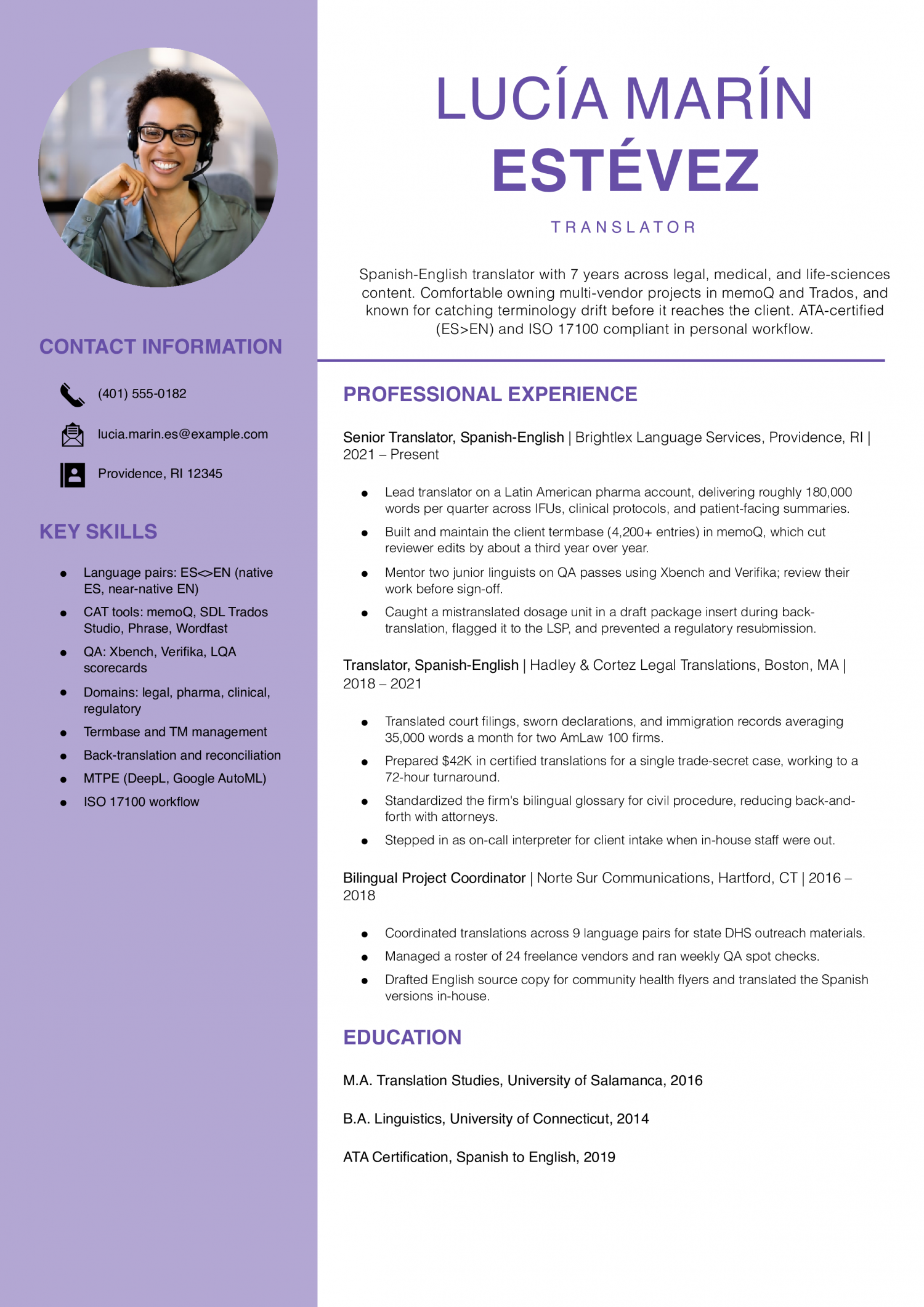
Newer translators with coursework, a degree in linguistics or a target language, and early volunteer or internship hours. The entry-level resume needs to prove language-pair fluency, any pro bono translation work, and basic CAT tool exposure.
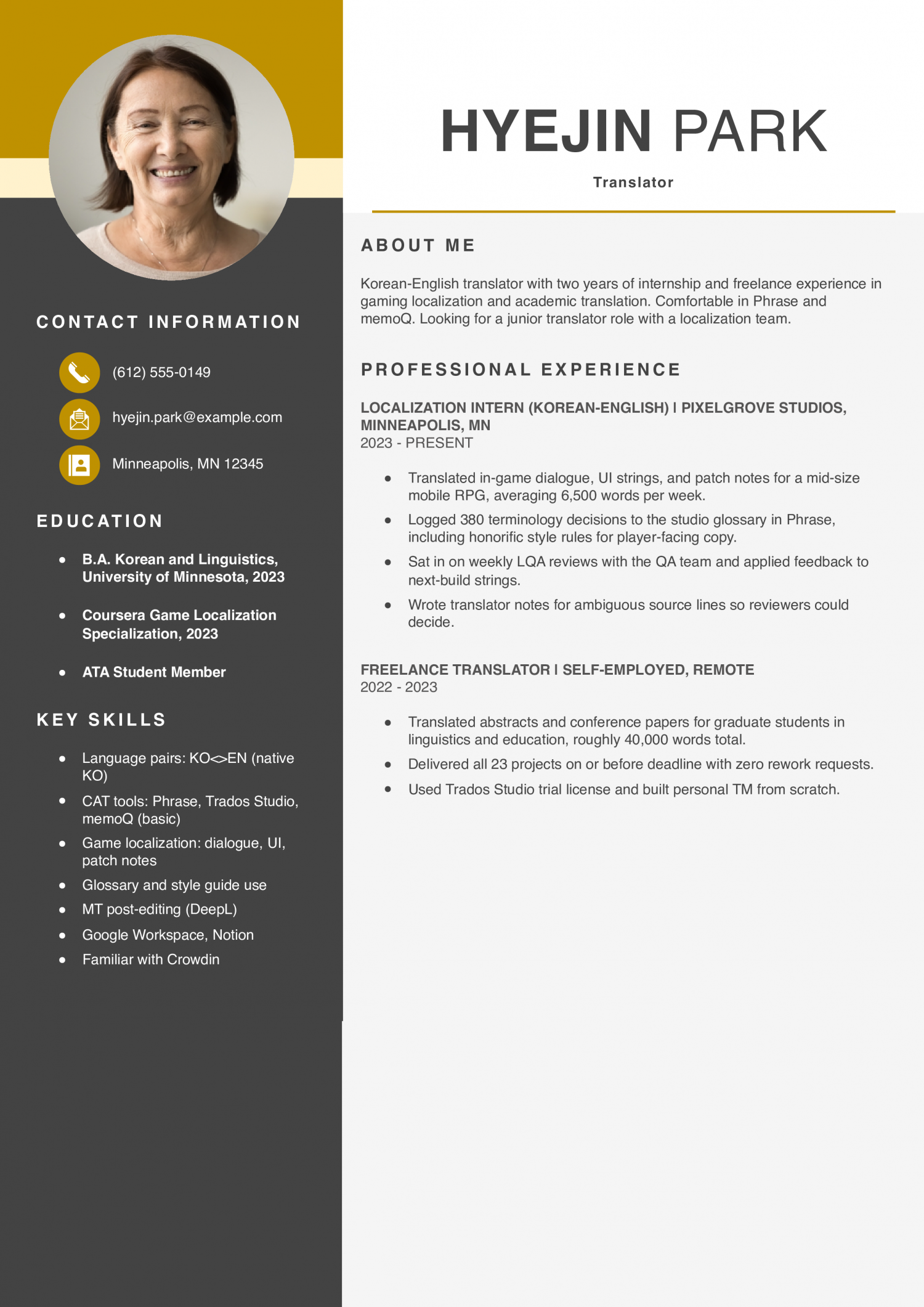
Working translators with three to seven years on paid projects, a defined subject specialty, and a repeat client base. The experienced resume needs to show certified pairs, domain depth, and weekly word throughput.
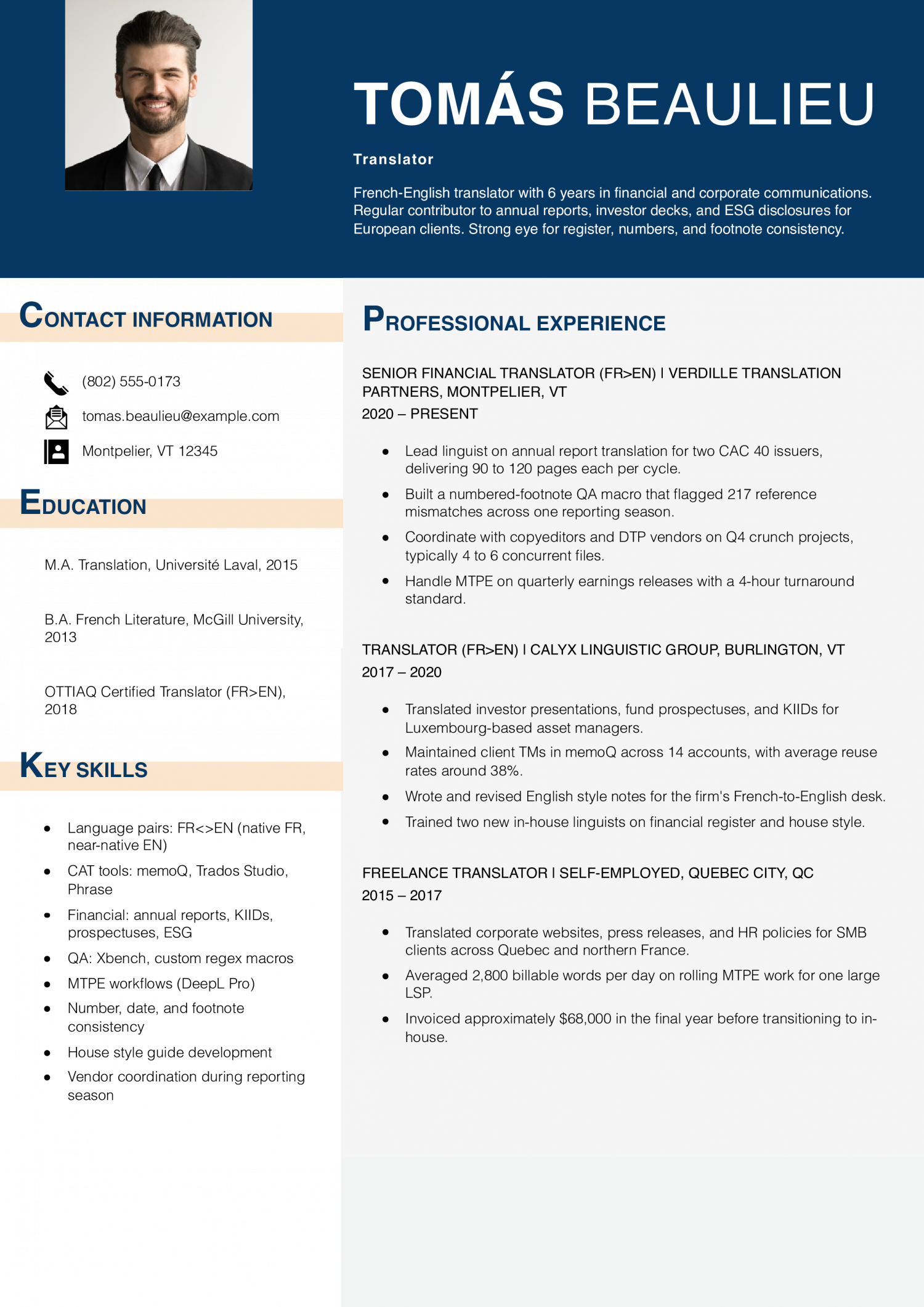
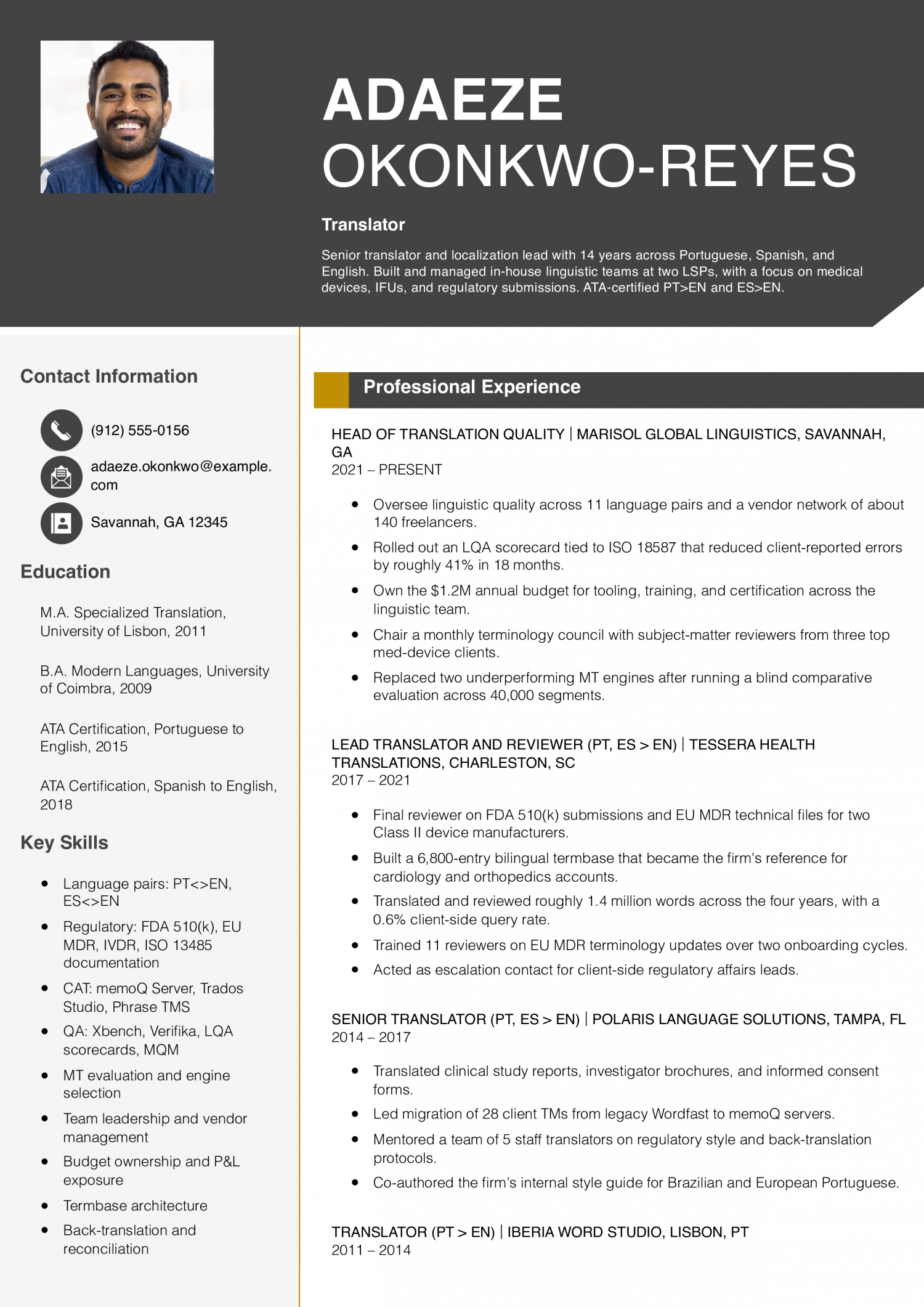
Senior translators handling complex legal, medical, or technical files, plus reviewer or LQA work for other linguists. The senior resume needs to lead with ATA or court certification, named accounts, and quality scores on large-volume projects.
Margarethe Ivanov-Schaller
Pittsburgh, PA | (412) 555-0118 | [email protected] | linkedin.com/in/margaretheivanov
German-English translator with 9 years across patent translation, technical documentation, and software localization. Combines an engineering background with formal translation training, and works comfortably across memoQ, Trados, and Phrase. ATA-certified DE>EN since 2019.
Senior Patent Translator (DE>EN)
Kernfeld IP Translations | Pittsburgh, PA | 2022-Present
Technical Translator (DE>EN)
Achterhaus Language Group | Cleveland, OH | 2019-2022
Translator (DE>EN)
Brückner Übersetzungen | Munich, DE | 2017-2019
In-House Translator
Wendler Maschinenbau GmbH | Stuttgart, DE | 2015-2017
Freelance Translator
Self-Employed | Leipzig, DE | 2014-2015
Lead the resume with one signal another translator is unlikely to match. Name the source-to-target pair, the certification body, and the domain you own.
Examples: ATA-certified English to Spanish legal translator, sworn French to English court translator, or English to Japanese pharmaceutical localizer. That single line tells a project manager which queue you belong in.
Place it directly under your name, above the summary. A generic line that reads as fluent in two languages forces the reader to hunt for the pair and pushes your resume to the bottom of the stack.
Project managers staff projects by capacity, so name the numbers they assign by. Strong translator bullets carry weekly or daily word counts, project totals, and post-edit or LQA scores.
Try patterns like 2,500 to 3,000 source words per day on legal contracts, 180,000 words delivered across 14 clinical trial protocols in 2025, or 98 percent pass rate on agency LQA reviews.
Bullets without a number tend to read as duties. Where exact counts are not handy, use scope language: high-volume patent files, multi-year court interpreting contract, or 40-plus repeat clients.
Translation work splits along predictable lines, and a project manager scans for the split that matches the posting. Group your bullets into three to five categories.
Useful buckets: legal (contracts, patents, court filings, sworn affidavits), medical (clinical trial protocols, informed consent forms, IFUs, pharma SOPs), technical (user manuals, software strings, engineering specs), marketing and transcreation (campaign copy, websites, brand guidelines), and literary or media (subtitles, screenplays, books).
Under each, name the CAT tool and QA workflow. Trados Studio with Xbench QA, memoQ with regex checks, or MemSource with TM and termbase management all signal real production fluency.
Page-one real estate goes to the credentials a project manager needs before scheduling a sample test. List ATA certification with the pair and direction, court interpreter certification with the state, and any UN, EU, or DGT roster status.
Add a Tools and Technology block beside or below the summary covering SDL Trados Studio, memoQ, MemSource or Phrase, Wordfast, Smartcat, and the QA layer (Xbench, Verifika).
Note your translation memory and terminology management experience. Project managers staffing post-edit machine translation work look for MTPE and DeepL or Google AutoML exposure listed plainly.
Education sits at the bottom for working translators. List the degree, institution, and any translation or interpreting program (MIIS, NYU, Kent State, ESIT, or equivalent).
Add a Languages block that names every working language with a CEFR level (C2, C1) or ILR rating, and mark which pairs you translate into and which you only read.
Close with continuing education: ATA conference sessions, ProZ courses, domain CE in law or medicine, and any subject-matter coursework. These tell a project manager you are still calibrating to the field you bill in.
Translation hiring is tighter in 2026. Agency rosters are running leaner as machine translation absorbs the routine tier, and the bar to clear a project manager screen is higher. The skills below come from our user-built translator resumes.
Project managers weigh hard skills (SDL Trados, ATA certification, legal or medical domain) as gating signals and read soft skills as evidence in your bullets. Match the list against the target posting, and treat soft skills as the proof points behind your throughput and quality numbers.
| Soft Skills | % of resumes with this skill |
|---|---|
| Attention to detail | 65% |
| Cultural sensitivity | 50% |
| Effective communication | 42% |
| Time management | 40% |
| Problem-solving | 25% |
And here are the top hard skills showing up most often.
| Hard Skills | % of resumes with this skill |
|---|---|
| CAT tools proficiency | 75% |
| Multilingual fluency | 64% |
| Technical translation knowledge | 45% |
| Translation memory management | 37% |
| Machine translation post-editing | 34% |
Based on data from thousands of translators’ resumes built on ResumeTemplates.com, May 2026.
These are the must-haves hiring teams look for when scanning a translator resume.
Translation agency directors and project managers expect a niche keyword block that mirrors the posting language. Group your terms by sub-specialty so the parser catches both the domain and the deliverable.
| Niche | Keywords ATS scans for |
|---|---|
| Legal translation | legal translator, contract translation, sworn translator, patent translations |
| Medical and life sciences | medical translator, clinical trial translation, informed consent translation, pharmaceutical translation |
| Software localization | software localization, l10n translator, UI string translation, locale testing |
| CAT tools and TMS | sdl trados studio, memoq, phrase tms, xbench qa |
| Interpreting and sworn work | court interpreter, medical interpreter, conference interpreter, certified translator |
AI use on a translator resume can go three ways: lead with phrases like AI-powered linguist (which project managers screen out), leave it off entirely (which reads as evasive when MTPE is now standard agency work), or describe the workflow as it actually runs. The third is what project managers can validate on a sample test.
Neural MT now produces the first pass on routine legal, technical, and corporate files, so human work shifts to post-editing and terminology control.
Pairs and domains where MT still fails (literary, transcreation, sworn legal, regulated medical) command higher rates than they did in 2022.
Termbase management, regex QA in Xbench or Verifika, and custom glossary maintenance are now expected line items, not advanced skills.
Agencies hire light and full post-editing at distinct rates, so listing MTPE separately from translation matters for matching the right requisition.
Translator portfolios live or die on confidentiality. A project manager wants samples that prove your pair and domain without exposing client NDAs, so the portfolio is curated, not exhaustive.
The default discoverability layer for agency PMs sourcing certified pairs and domains.
Secondary roster site, useful for European agencies and less-common pairs.
Holds anonymized before-and-after excerpts you control fully.
Hosts published work, conference talks, and recommendations from direct clients.
Anonymize every sample. Strip client names, case numbers, and proprietary product references before posting, and replace with a domain label (US-based pharmaceutical client, French Tier 1 supplier).
Show before-and-after pairs. A project manager wants to see the source segment next to your target, with a one-line note on the challenge (regulatory terminology, regional variant, tone shift for transcreation).
Include one MTPE sample if you take that work. Show the raw MT output, your post-edit, and a brief note on what you changed and why.
A long client list reads as scattered. Group your clients into three or four buckets that match the way project managers staff work, then put two or three named anchors under each.
The grouping pattern matters more than the count. A translator with eight clients in one domain reads stronger than one with thirty across unrelated fields.
Project managers want to know you run a business, not a hobby. A short line on your invoicing, contracting, and tax structure tells them you can onboard without friction.
Keep it factual. One line in the summary or a small Business Operations block under your freelance header is enough.
Project managers read the languages block before the work history. A vague bilingual line fails the screen, so use a calibrated scale and mark direction.
List every working language with a recognized proficiency rating, then mark which pairs you translate into. Most translators only translate into their native or dominant language.
Use CEFR (A1 through C2) or ILR (0 through 5) ratings, since project managers recognize both. Self-described fluent reads as unverifiable.
Translation agency directors and project managers read this list as a map of where your work is heading. The certifications below tell them which pair, domain, and setting you have invested in beyond a working knowledge of two languages. List the issuing body, the language pair and direction, and the year earned.
Translator is a narrow occupation in BLS, which means supply matters and a specific pair plus certification reads as differentiation rather than table stakes. Pay also spreads widely because the data pools staff agency translators, sworn court translators, hospital interpreters, and freelance localizers into one line.
To position above the median, lead your resume with the certified pair, the domain you own, and the weekly word throughput you can sustain.
| # | State | Avg. Annual |
|---|---|---|
| 1 | New York | $84,650 |
| 2 | District of Columbia | $81,140 |
| 3 | Maryland | $78,350 |
| 4 | Virginia | $74,250 |
| 5 | California | $73,510 |
| 6 | Washington | $69,620 |
| 7 | Colorado | $66,590 |
| 8 | Utah | $65,990 |
| 9 | Massachusetts | $65,490 |
| 10 | West Virginia | $63,750 |
| # | State | Workers | Median |
|---|---|---|---|
| 1 | California | 6,710 | $73,510 |
| 2 | Texas | 5,820 | $45,610 |
| 3 | Florida | 4,500 | $46,320 |
| 4 | New York | 3,650 | $84,650 |
| 5 | Virginia | 2,610 | $74,250 |
Resume Templates offers HR approved resume templates to help you create a professional resume in minutes. Choose from several template options and even pre-populate a resume from your profile.
List yourself as a freelance translator with your business name or sole proprietorship, your city, and the date range.
Under that header, group bullets by domain (legal, medical, technical) rather than by individual client. Name two or three anchor clients you have permission to cite.
Add total words translated per year and any repeat-client retention figure to make the scope readable to a project manager.
Yes, and most agency hiring expects it. Revision and LQA work are part of the standard translator workflow.
List the primary role in your headline (translator, EN-ES, legal) and add proofreading or revision as a second deliverable under your bullets.
Quantify both separately: words translated versus words revised per week. Project managers staff the two tasks at different rates and look for the split.
Name it directly. List MTPE as a service line alongside translation and revision, and note the engines you work behind (DeepL, Google, custom NMT).
Agencies hire MTPE at a different rate from full translation, so a project manager wants to see it called out.
Show throughput numbers separate from your full-translation pace, since MTPE word counts run higher per hour.
Lead with your language pair and direction, then list any pro bono work for Translators Without Borders, TED Translators, or Kiva.
Add coursework in translation theory or CAT tools, a sample portfolio link, and any volunteer interpreting hours.
Name the pairs and word counts even on unpaid work. A volunteer 50,000-word total reads as real production experience.
For a translator, a professional template is the safest pick, because it signals the polish hiring managers in this field expect. An ATS-friendly template is a solid alternative. Whichever you choose, keep the formatting clean and easy to parse: clear section headings, a standard font, and no graphics a parser can choke on.
Executive Resume Writer and Career Coach
Andrew Stoner is an executive career coach and resume writer with 17 years of experience as a hiring manager and operations leader at two Fortune 500 Financial Services companies, and as the career services director at two major university business schools.
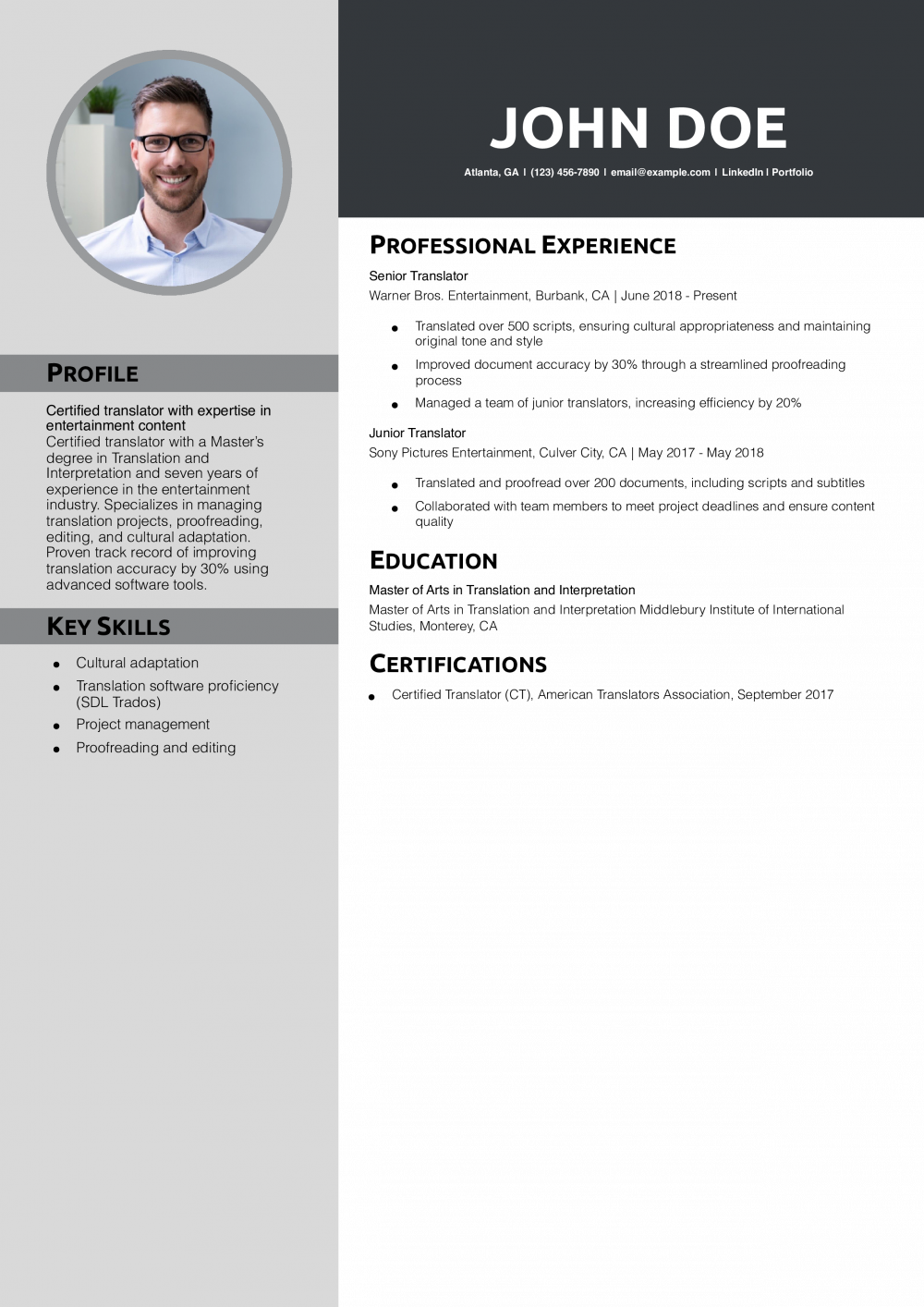
Customize this template in our builder in under 10 minutes.