![3 Best Pilot Resume Examples and Templates for [y]](/wp-content/uploads/2025/01/Senior-Level-Pilot-Resume-Examples.x400.pdf.jpeg)
3 Best Pilot Resume Examples and Templates for 2026



Base managers decide whether to advance a flight attendant resume during the first 20-second credentials scan; if the FAA certificate, aircraft types, and recurrent training dates aren't visible by then, the resume drops out of the class pool.
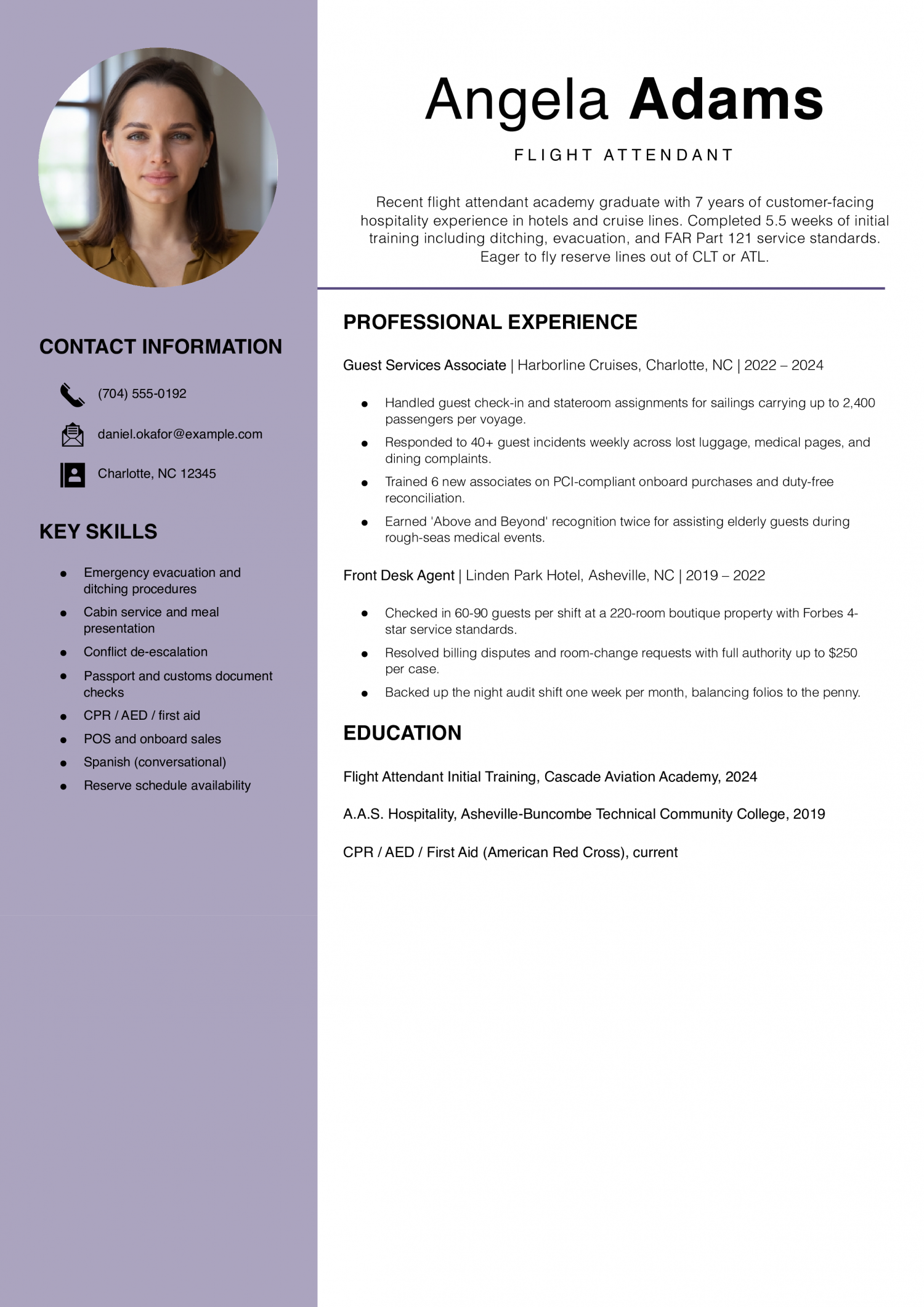
New-hire flight attendants are post-training reserve crew working their first 12 to 18 months on call out of a base. This resume needs to prove FAA certification, completion of initial training, and service experience that transfers from ground roles.
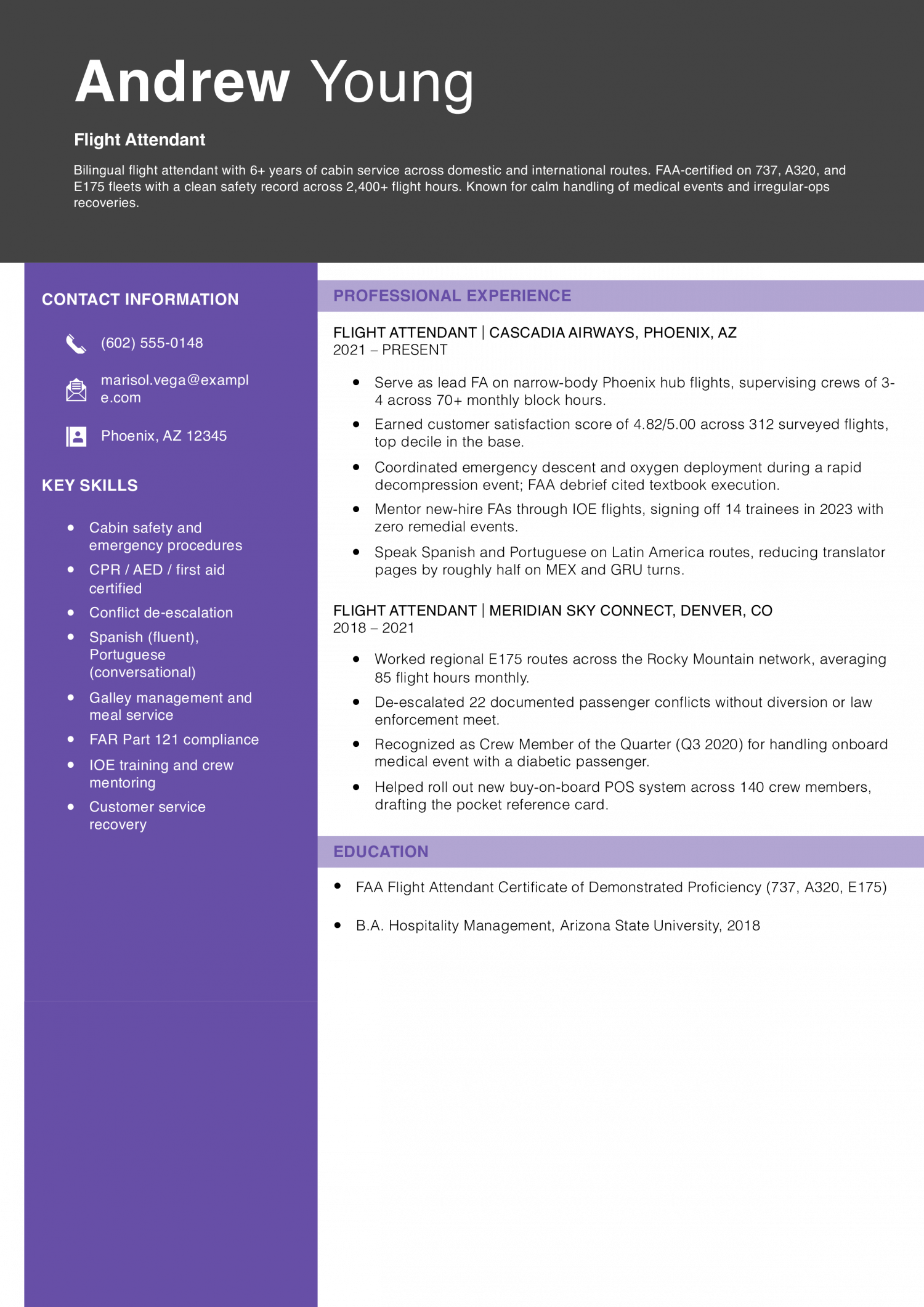
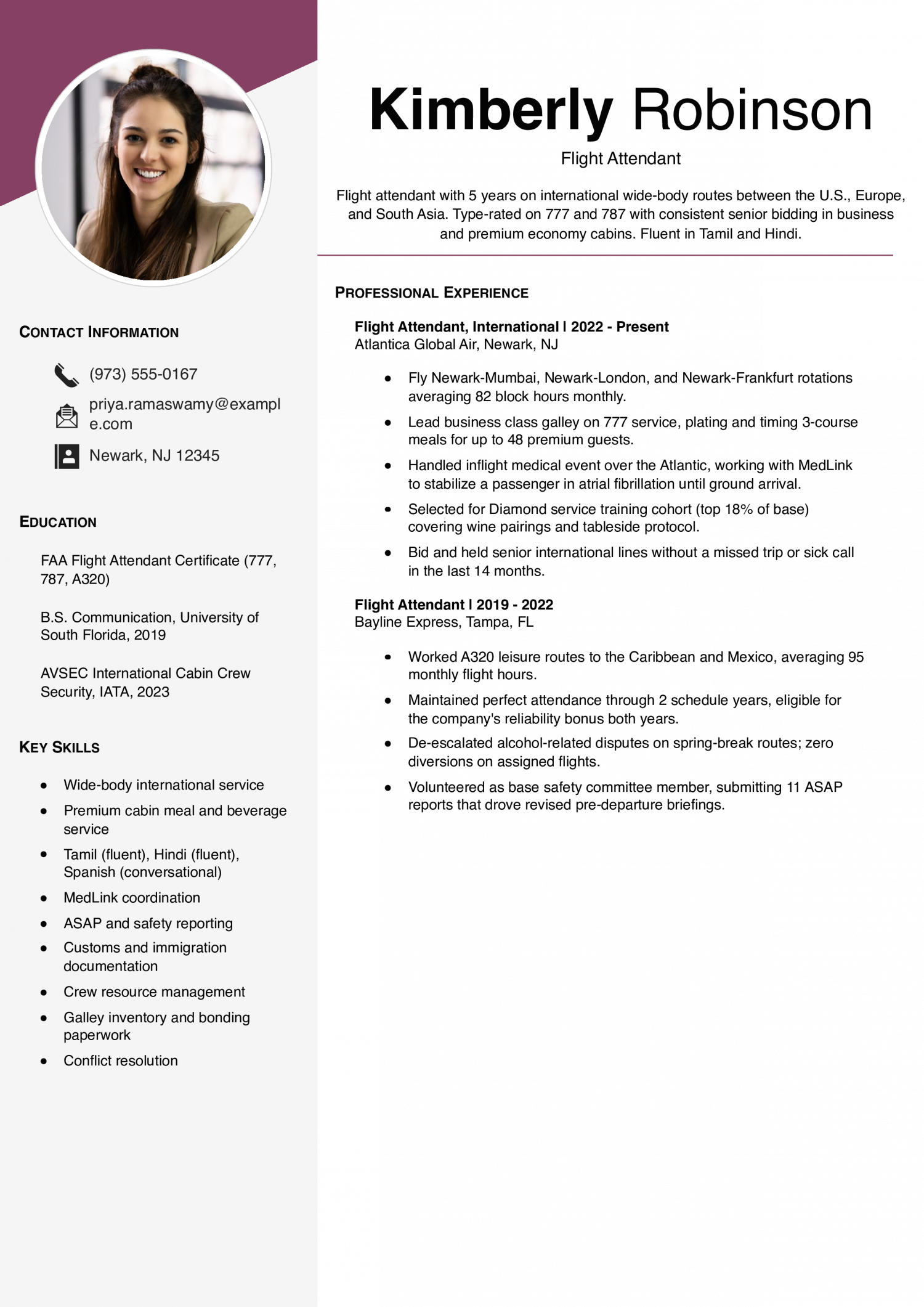
Experienced line holders bid their own schedules, fly multiple aircraft types, and hold seniority at a base. This resume needs to prove safety record, language qualifications, and steady performance across long-haul and international routes.
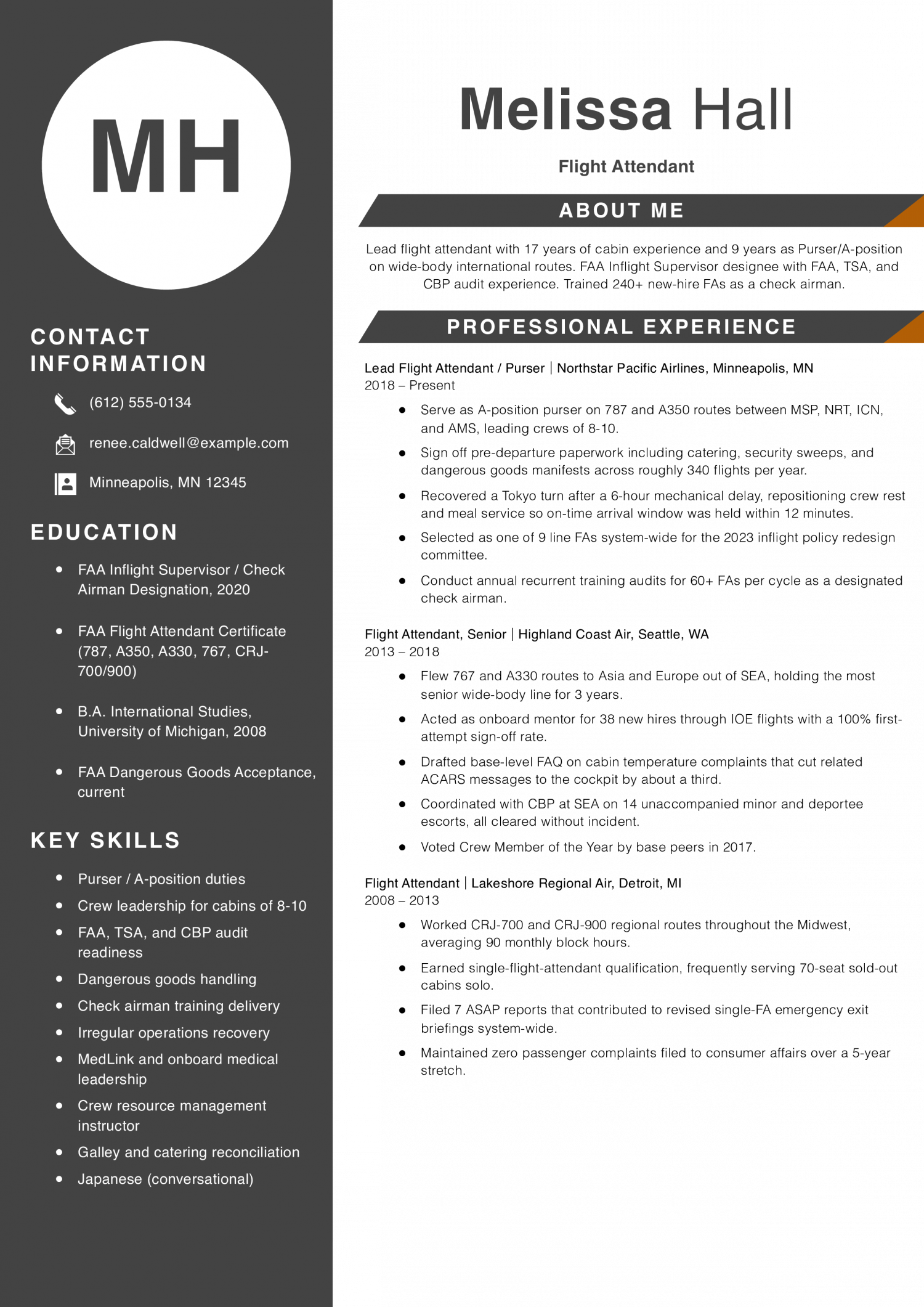
Lead flight attendants and pursers run the cabin crew, brief the team, and serve as the captain's point of contact on safety and service. This resume needs to prove crew leadership, irregular operations handling, and recurrent training currency.
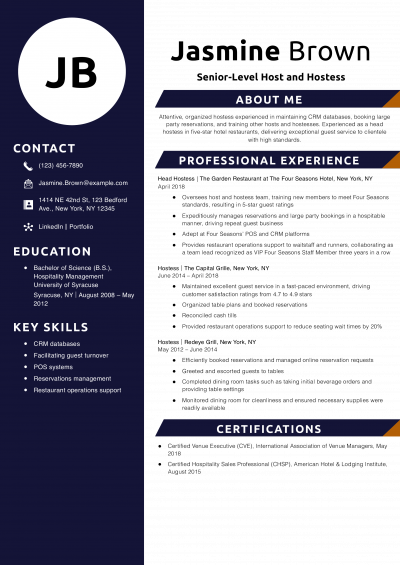
Flight attendant with 8 years of combined domestic and international cabin experience, including 3 years as a lead FA on narrow-body trans-con routes. FAA-certified on 737, A220, and A321 with active CPR/AED, advanced first aid, and dangerous goods qualifications. Bilingual in English and French, with regular bidding on Atlanta-Paris and Atlanta-Montreal rotations.
The first line of your summary should name your block hours flown, the aircraft types you’re qualified on, and your base. Base managers and in-flight services leaders read this as your readiness to hold a line on day one.
Skip the generic objective. A strong opener reads like: “Flight attendant with 4,200 block hours on the 737 and A320, based at DFW, current FAA Certificate of Demonstrated Proficiency, dual-language qualified on Spanish routes.” That tells a recruiter what you can be scheduled for before they finish the line.
Hospitality roles get scoped by volume, not dollars. Bullets without a number tend to read as duties rather than results, so reach for passenger counts, flight legs, route miles, and on-time service rates.
Strong patterns include: passengers served per month, average legs per duty period, languages used in cabin, and incident-free flight hours. Recruiters scan for scope first, so write “served 180 passengers per long-haul leg across 14 monthly trips” instead of “provided excellent customer service to international travelers on long flights.”
Split your bullets into three buckets the airline recognizes. Safety covers pre-flight checks, emergency equipment verification, evacuation drills, medical response, and turbulence protocols. Service covers boarding, meal and beverage, premium-cabin standards, and special-needs passenger handling.
Cabin operations covers crew coordination, irregular ops handling, gate-hold management, and turn times. Hiring teams want to see all three, not a wall of service bullets. If you’ve handled medical diversions, decompressions, or unruly passenger incidents, those go under safety with the outcome.
Base managers and airline recruiters pull resumes that show currency at a glance. Build a credentials block under your summary listing your FAA Certificate of Demonstrated Proficiency, aircraft type ratings, last recurrent training date, CPR and AED currency, and any FAA medical or DOT clearances.
Do not list certificate numbers on the resume. Write “FAA Certificate of Demonstrated Proficiency, current” and provide the number on the airline application. List recurrent training by month and year so a recruiter sees you are within the 12-month window.
End the resume with a tight education line, your language fluency levels, and your willingness to relocate to a base or hold reserve. Airlines weigh base flexibility heavily during class assignment.
Use the Interagency Language Roundtable or carrier-specific levels (qualified, conversational, fluent) rather than vague claims. A line like “Available for DFW, ORD, or LAX base assignment; open to reserve and international bidding” tells the scheduler you understand how the job works.
The skills below come from flight attendant resumes our users built on ResumeTemplates.com. Airline recruiters scan hundreds of resumes per base class window, and these are the terms that show up most often. Hard skills clear the credential filter (FAA certification, aircraft type, CPR currency).
Soft skills like de-escalation get weighed during the panel interview. Match the hard-skill list against the target carrier’s posting and use the soft skills as evidence anchors for your service bullets.
| Soft Skills | % of resumes with this skill |
|---|---|
| Customer service | 78% |
| Communication | 60% |
| Composure under pressure | 45% |
| Adaptability | 39% |
| Conflict resolution | 28% |
And here are the top hard skills showing up most often.
| Hard Skills | % of resumes with this skill |
|---|---|
| Emergency safety procedures | 67% |
| First aid and CPR | 61% |
| Aircraft evacuation procedures | 44% |
| In-flight service | 38% |
| Multilingual communication | 34% |
Based on data from thousands of flight attendants’ resumes built on ResumeTemplates.com, May 2026.
These are the must-haves hiring teams look for when scanning a flight attendant resume.
Mention the in-flight service and crew systems you’ve operated. Recruiters at major carriers recognize these names and weigh them during new-hire selection.
Onboard duty-free and credit card processing systems
Crew bidding and scheduling (CrewTrac, Sabre Crew, Jeppesen Crew Pairing)
Passenger manifest and special-service request platforms
Hospitality POS (Toast, Aloha, Micros) for career changers
Airlines bid language-qualified flight attendants onto specific international routes and pay a per-trip premium. Recruiters need to see the exact level, not a vague “speaks Spanish.”
Use a recognized scale so the recruiter can map you against the carrier’s language-qualified flying. The Interagency Language Roundtable scale and carrier-specific levels (qualified, conversational, fluent) both work.
If you have passed a carrier language assessment in the past, name the airline and the year. That signals you can pass the in-house test again without delay.
Airline recruiters verify credentials before they read service bullets. Put this block directly under your summary so a base manager can confirm currency in one scan.
Each line should name the credential, the issuing body, and the currency or expiration date. Do not list certificate numbers; provide those on the airline application.
If you hold qualifications across multiple fleets, group them together so the recruiter can match you against an open class fleet assignment.
Base managers assign new-hire classes by flexibility as much as by interview score. State your availability in a one-line block so the scheduler does not have to ask.
Name the bases you would accept, whether you can hold reserve, and whether you are open to international or red-eye flying. Honesty here matters because reserve life is hard and mismatched expectations drive early attrition.
If you have constraints (commuter status, family base preference), state them briefly. Recruiters appreciate the clarity more than they appreciate optimism that breaks in month three.
FAA certification and current CPR keep you eligible for any cabin crew role. The credentials below are what move a flight attendant resume from qualified-but-typical into a base manager’s shortlist. List the issuing body, level, and currency date on one line each.
FAA Certificate of Demonstrated Proficiency: The federal credential that proves you completed an FAA-approved initial training program; required for Part 121 carriers and verified before any class date.
CPR, AED, and First Aid (American Red Cross or AHA): Most carriers require current certification; listing it with the issuing body and expiration date saves a follow-up email from recruiting.
Aviation Medical First Responder or In-Flight Medical Training: Signals readiness for medical events and diversions; especially useful for long-haul and international bidders where ground response is hours away.
TWIC or SIDA Airport Security Credential: Speeds onboarding because the airline does not have to sponsor your initial badge; useful for corporate aviation and cargo carrier applications.
Flight attendant is a mid-sized occupation in BLS, and pay clusters tightly around seniority and carrier type rather than geography. Mainline carriers, regionals, and corporate flight departments sit in different bands, and the median pulls in newer hires still on the first-year pay scale. Top earners are senior line holders at legacy carriers flying international wide-body trips with per-diem.
To position above the median on your resume, lead with aircraft types, base seniority, and international or premium-cabin qualification.
| # | State | Avg. Annual |
|---|---|---|
| 1 | New York | $128,050 |
| 2 | Washington | $103,950 |
| 3 | Connecticut | $86,140 |
| 4 | California | $77,870 |
| 5 | Florida | $76,410 |
| 6 | Georgia | $76,340 |
| 7 | Massachusetts | $68,650 |
| 8 | North Carolina | $64,100 |
| 9 | Virginia | $62,280 |
| 10 | Illinois | $62,120 |
| # | State | Workers | Median |
|---|---|---|---|
| 1 | California | 15,760 | $77,870 |
| 2 | Texas | 13,180 | $57,170 |
| 3 | Florida | 11,880 | $76,410 |
| 4 | New York | 10,430 | $128,050 |
| 5 | Illinois | 9,230 | $62,120 |
Resume Templates offers HR approved resume templates to help you create a professional resume in minutes. Choose from several template options and even pre-populate a resume from your profile.
Translate your service work into the metrics an airline reads. Lead with covers served per shift, average check size, and multilingual service handled on the floor.
Then call out safety training, food handling certifications, and shift-flexibility patterns that read as transferable to a base. Bullets about handling 200 covers across a double shift map directly to long-haul cabin volume.
Add an "Aviation Training in Progress" line if you are enrolled in an FAA-approved program. Name the school and expected completion date.
One page for new hires and most line holders. Recruiters reading base class applications prefer scannable one-pagers over dense two-page resumes.
Move to two pages only if you have a decade of flying across multiple aircraft types, purser currency, and language qualifications worth detailing. Trim duty descriptions before you trim credentials.
No. List the credential with currency status and dates, but do not publish certificate numbers on a resume that lands on job boards.
Write "FAA Certificate of Demonstrated Proficiency, current" with your most recent recurrent training month and year. Provide the actual number on the airline application form when the system asks for it.
Add a short availability line at the bottom of your resume listing the bases you would accept and whether you can hold reserve.
Schedulers read this during class assignment and weight flexible candidates heavily. A line like "Open to DFW, ORD, LAX, or JFK base; available for reserve" tells the planner you understand the bidding system.
For a flight attendant, an ATS-friendly template is the safest pick, because it puts your certifications and experience where a hiring manager scans first. A basic template is a solid alternative. Whichever you choose, keep the formatting clean and easy to parse: clear section headings, a standard font, and no graphics a parser can choke on.
Executive Resume Writer and Career Coach
Andrew Stoner is an executive career coach and resume writer with 17 years of experience as a hiring manager and operations leader at two Fortune 500 Financial Services companies, and as the career services director at two major university business schools.
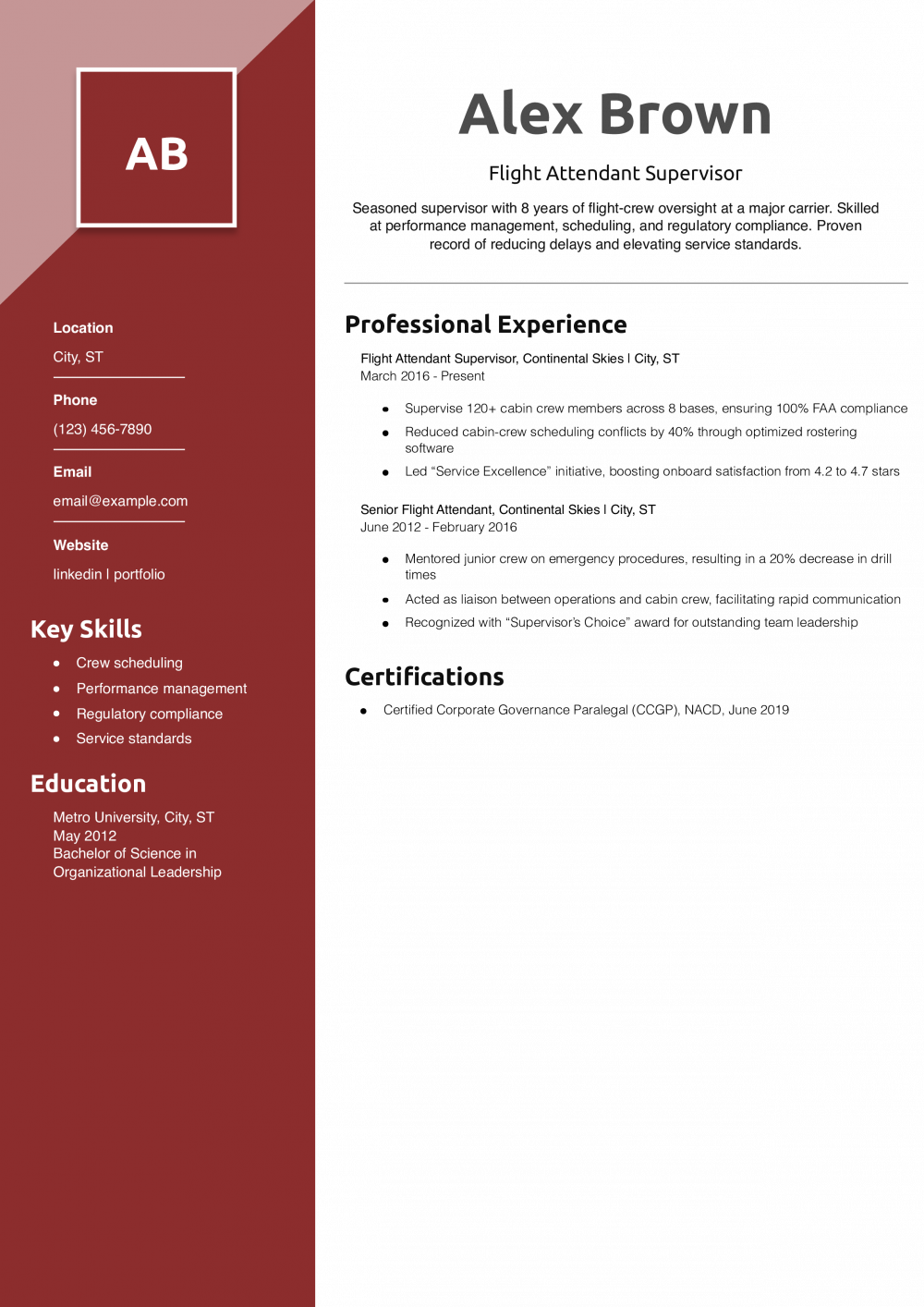
Customize this template in our builder in under 10 minutes.