Tip !

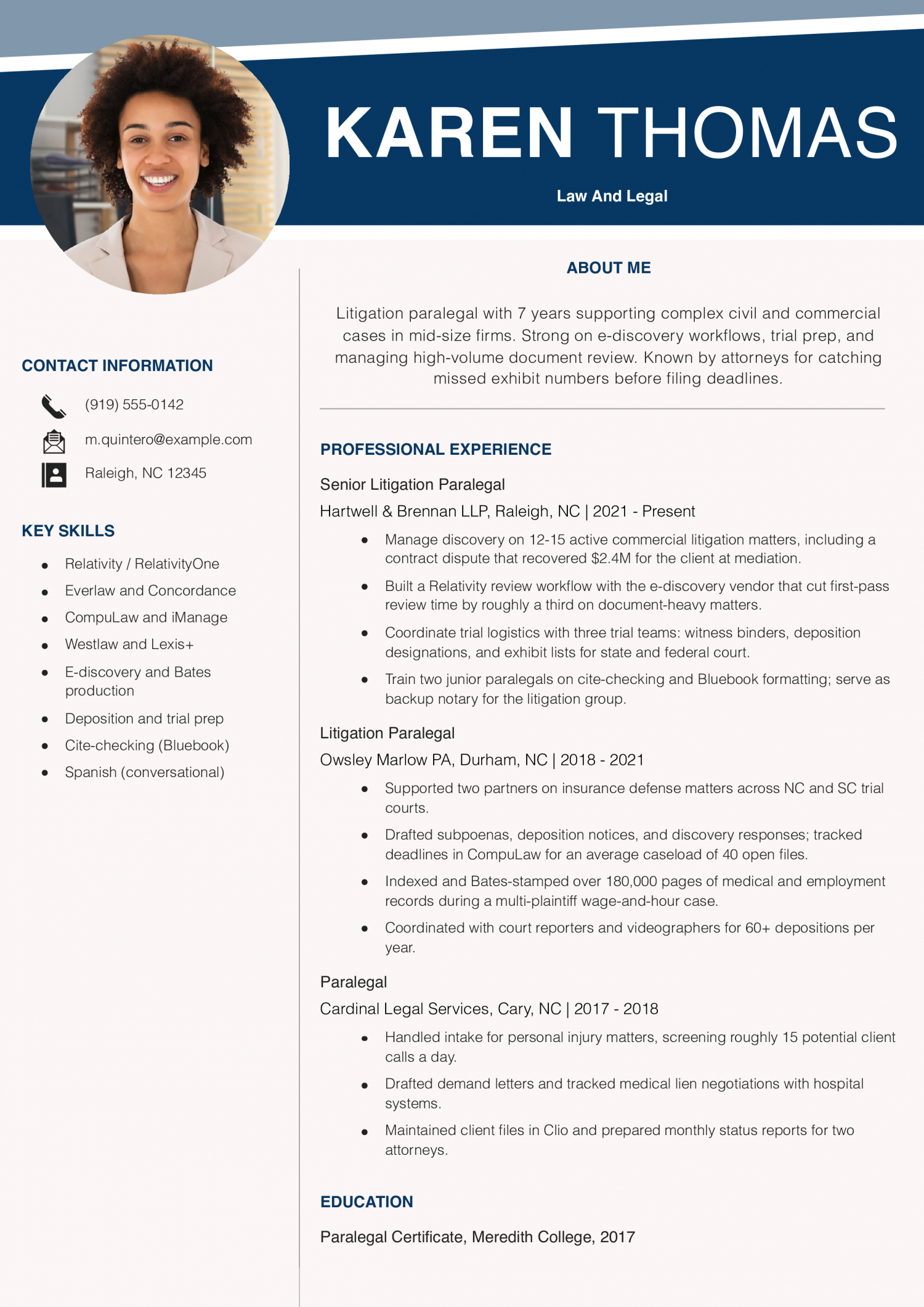
The law and legal resumes that advance past the first partner read share three things: a credentials block above experience with bar admissions by state, matter descriptions naming the practice area and your role, and citations to reported decisions or filed motions.

Andrew Stoner , Executive Resume Writer and Career Coach

Why this resume works

  • Dollar amount tied to client outcome: The $2.4M recovery on a discovery-heavy matter shows her work mattered to the case result, not just the filing.
  • Real workflow improvement: Cutting first-pass review time by a third is the kind of process win partners notice and ask about in interviews.
  • Clear caseload numbers: Concrete counts like 40 open files and 60+ depositions a year give hiring managers a real sense of capacity.

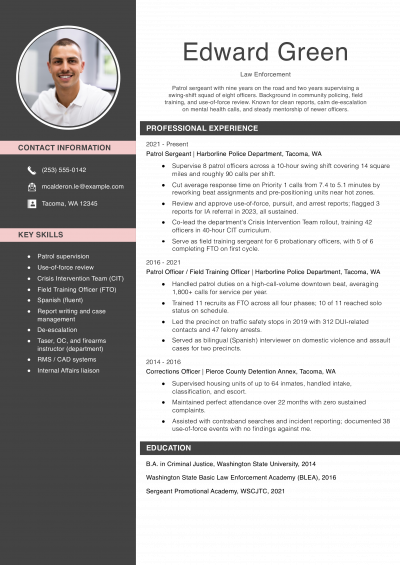
Entry Level Example

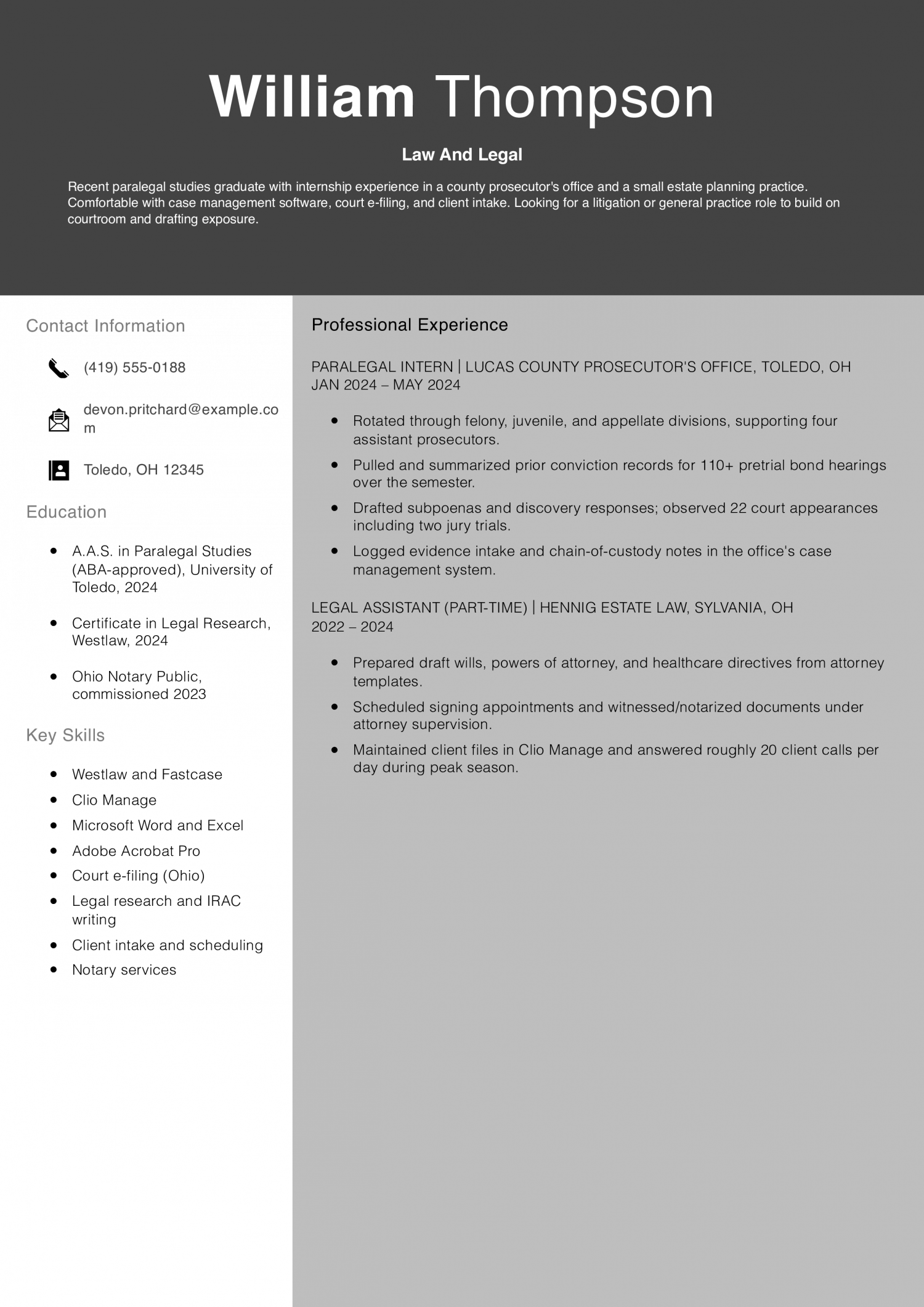
You are a first- or second-year paralegal, recent JD, or law clerk building a foundation. The entry-level resume needs to prove document-drafting accuracy, citation discipline, and the practice areas you supported during internships or clerkships.

Why this resume works

  • Specific count instead of a vague claim: 110+ pretrial bond hearings is concrete proof of volume, even from an internship.
  • Two real legal settings: Prosecutor’s office plus a small estate firm shows range without overstating experience.
  • Credentials placed up front: ABA-approved program, notary commission, and Westlaw certificate answer the first questions a hiring attorney asks.

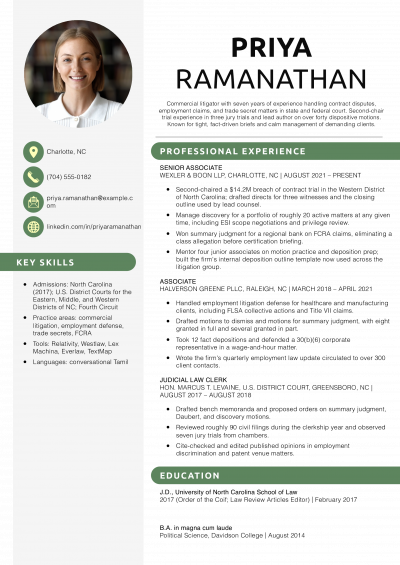
Mid Career Example

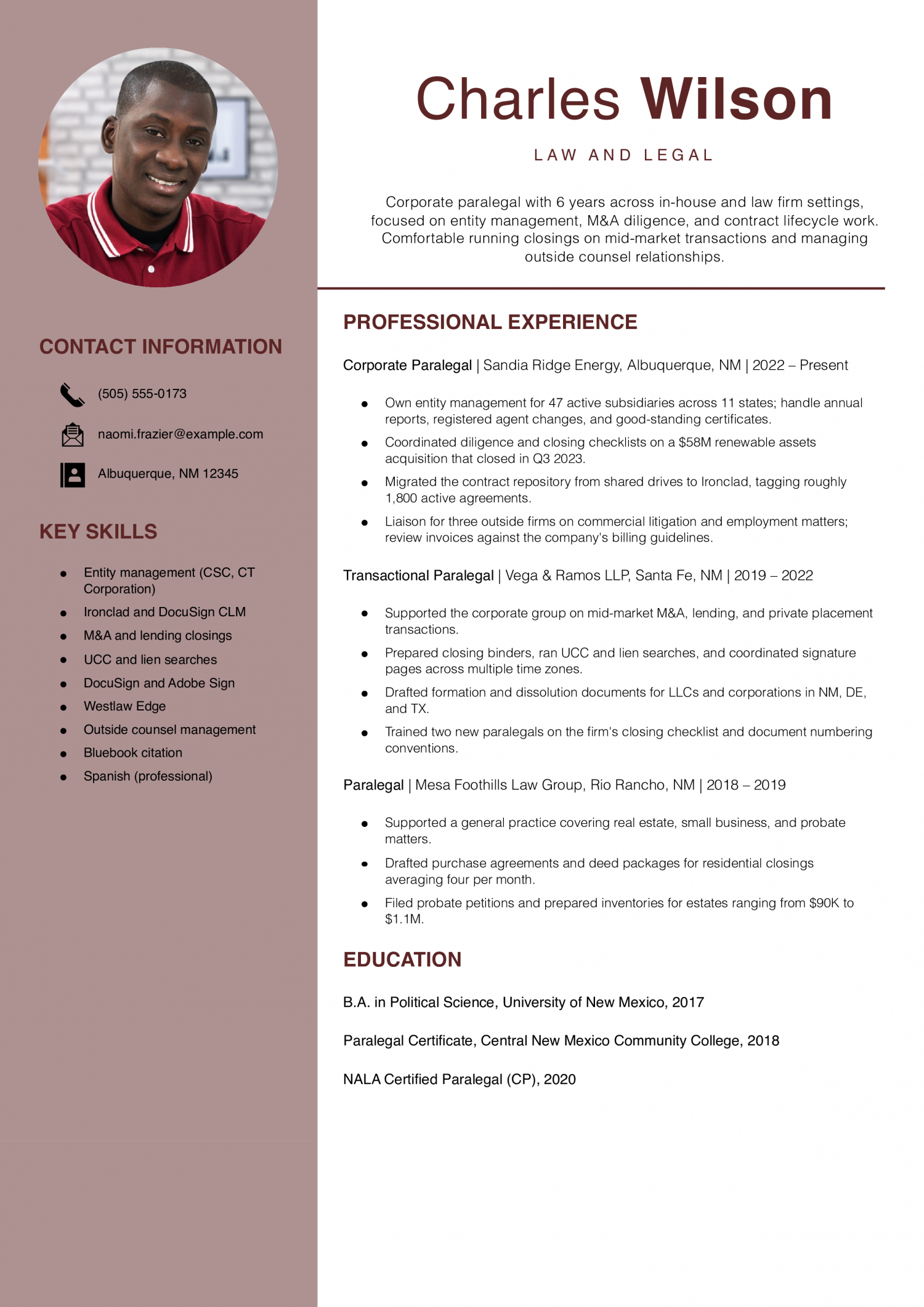
You are a fourth- to seventh-year associate or senior paralegal carrying matters with limited supervision. The mid-career resume needs to prove the matter types you've owned, your deposition and motion volume, and the partners or clients you've worked under.

Why this resume works

  • Deal size and clear role: Naming the $58M acquisition and her closing-checklist role gives recruiters a real picture of deal complexity.
  • Concrete portfolio numbers: 47 subsidiaries and 1,800 contracts show the scale of her day-to-day responsibility.
  • Bridges in-house and firm work: Two distinct settings tell the same corporate story without looking like job hopping.

Senior Example

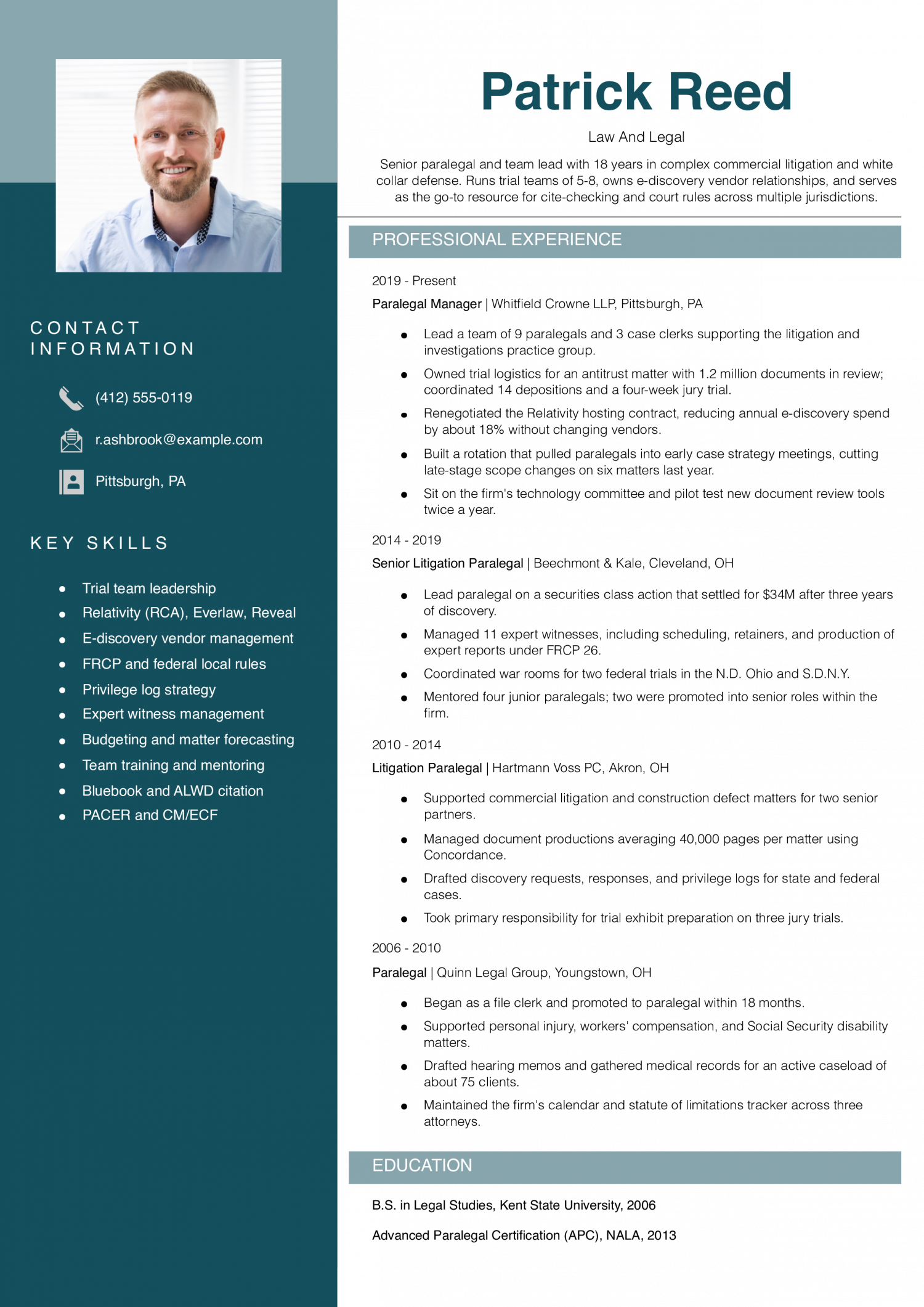
You are a senior associate, of counsel, or lead paralegal with a defined practice area and book of matters. The senior resume needs to prove case outcomes with citations or filings, supervision scope, and the client relationships that travel with you.

Why this resume works

  • Leads people and budgets: Nine paralegals reporting in and an 18% vendor savings show this is a management resume, not just a senior IC one.
  • Trial work at real scale: 1.2 million documents and a $34M settlement give hiring partners a clear read on the size of cases she can run.
  • Career arc that makes sense: File clerk to paralegal manager over 18 years tells a believable promotion story without padding.

01 Open with what a bar lookup cannot show

Add a line a managing partner cannot find on a state bar website. That might be a federal court admission, a second-chair trial credit, a published opinion you briefed, or a foreign-language deposition load.

Niche signal beats general polish. A paralegal certified in e-discovery review with Relativity hours logged reads stronger than a generic summary of legal support work.

02 Quantify matters, motions, and filings

Numbers separate strong legal resumes from duty lists. Name your matter count, motion volume, deposition hours, or document-review scope by gigabyte or document count.

Bullets without a number tend to read as duties. Lead with figures like 40 motions drafted, 12 depositions defended, or a 2.1 million-document review managed across three custodians.

03 Group your work by practice area

Cluster experience into 3 to 4 practice buckets the reader can scan. Common groupings are litigation and trial work, transactional drafting, regulatory and compliance, and e-discovery or case management.

Under each bucket, name the specific work: complaints drafted, due diligence memos, SEC filings, Rule 26 disclosures, or settlement agreements. Practice-area vocabulary is what legal recruiters search for.

04 Place bar admissions and tools up top

Put a credentials block on page one, above experience. List bar admissions by state with the year of admission and standing, plus federal court admissions and any specialty certifications.

Name the platforms you use: Westlaw, LexisNexis, Relativity, Clio, iManage, or NetDocuments. Managing partners and legal recruiters scan for tool fluency early because billable ramp-up depends on it.

05 Close with education and clerkships

End with your JD, law school honors, journal membership, and any moot court or clinic work. Note class rank or honors only if they help your case.

Federal or state clerkships belong here with the judge’s name and court. For paralegals, list the ABA-approved program or your bachelor’s plus paralegal certificate.

ATS filters catch more law and legal resumes than ever in 2026. The skills below come from our user-built legal resumes. Practice-area terms and platform names clear the first cut, and client-handling language decides whether the resume advances.

Managing partners and legal recruiters weigh hard skills as gating signals, then read soft skills as evidence behind your matter bullets. A claim like “client communication” only lands when a bullet shows you ran a deposition prep call. Match the lists below against your target posting, then rewrite bullets so each soft skill has a matter or filing behind it.

Soft Skills % of resumes with this skill
Attention to detail 66%
Written communication 56%
Organization 42%
Time management 36%
Confidentiality and discretion 30%

And here are the top hard skills showing up most often.

Hard Skills % of resumes with this skill
Legal research 78%
Legal document drafting 67%
Case management 50%
Court filing and e-filing 40%
Document review and discovery 30%

Based on data from thousands of legal professionals’ resumes built on ResumeTemplates.com, May 2026.

Before a law and legal resume gets a closer read, hiring teams check for a short list of essentials.

Niche Keywords for ATS Checkers

Managing partners and legal recruiters expect a niche section that mirrors the practice areas they staff. Use the rows below to pull the exact terms searchers and ATS filters look for.

Niche Keywords ATS scans for
Attorney roles attorney resume, lawyer resume, associate attorney resume, of counsel resume
Litigation litigation associate resume, trial attorney resume, motion drafting, deposition preparation
Corporate and transactional corporate associate resume, M&A due diligence, contract drafting, SEC filings
Paralegal and legal support paralegal resume, legal assistant resume, e-discovery paralegal, litigation paralegal
Law student and entry level law student resume, summer associate resume, law clerk resume, judicial clerkship resume

AI Skills to Add

Firms are split between partners adopting Harvey, CoCounsel, and Westlaw AI for research and drafting, and partners restricting generative tools over confidentiality and Rule 1.1 competence concerns. Name the tools you use, describe the review workflow, and avoid claims that you “draft with AI” if your real practice is checking citations and edits.

What AI is actually changing for this role
Legal research

AI research tools surface cases and statutes faster, but cite-checking against Westlaw or Lexis is still the lawyer's job.

Document review

Relativity aiR and similar tools prioritize documents for review, shifting paralegal time toward QC and privilege calls.

Drafting

First-pass motions, NDAs, and discovery responses come out of AI tools; associates edit for accuracy, tone, and jurisdiction.

Client intake

Intake summaries and conflict checks pull from AI assistants, so paralegals spend more time verifying entities and dates.

AI tools to name
  • Harvey or Thomson Reuters CoCounsel: Used for first-pass research memos, contract review, and deposition summary drafts that lawyers verify.
  • Relativity aiR for Review: Used to prioritize document review batches and flag privileged or responsive material in large productions.
How to phrase AI on your resume
Do
  • Used CoCounsel to draft first-pass research memos on 30 matters, then verified citations in Westlaw before partner review.
  • Ran Relativity aiR on a 1.8 million-document production, cutting first-pass review hours by a defined margin while preserving privilege QC.
Skip
  • Leveraged AI to revolutionize legal research workflows.
  • AI-powered contract drafting expert.

Law Credentials That Get You the Job

Managing partners and legal recruiters read this list as a map of where your work is heading. The certifications below tell them which practice track or support specialty you’ve invested in, beyond the bar admissions that gate the role. List the issuing body and the year of completion under a Certifications heading.

  • NALA Certified Paralegal (CP): The most-recognized paralegal credential in the U.S.; signals procedural competence and is searched by firms hiring litigation support staff.
  • Relativity Certified Administrator (RCA): Tells e-discovery hiring leads you can run a review workspace, not just tag documents; pairs with document-volume bullets.
  • Certified Information Privacy Professional (CIPP/US): Signals you can advise on privacy and data protection matters; valued at firms with regulatory, tech, or healthcare practices.
  • Registered Paralegal (RP) through NFPA: Useful for paralegals in jurisdictions that recognize NFPA credentials and for in-house roles seeking documented ethics training.

The 90th-percentile law and legal earner out-earns the median by a wide margin, which tells you the market rewards practice-area specialization and matter complexity more than years on a resume. A senior IP litigator with reported decisions reads differently than a generalist with the same tenure. Geographic concentration also matters: top-paying states cluster around financial centers and federal court hubs, where transactional and regulatory work is densest.

Lead your resume with the practice areas and matter types the higher band actually bills for, not your year-of-admission count.

$61,010 National median annual
$66,510 National mean annual
$39,710 Entry-tier floor (10th percentile)
$98,990 Top-decile ceiling (90th percentile)
367,220 Legal Professionals in the U.S.
Where you stand

Entry tier

$39,710 to $61,010 At the entry tier, your resume needs to show ABA-approved coursework or JD, Bluebook fluency, and the practice areas you supported in internships or clinics.

Mid band

$61,010 to $98,990 At the mid band, lead with the matter types you've owned, your motion and deposition volume, and the partners or clients you've worked under directly.

Top decile

$98,990+ At the top decile, your resume needs to show reported decisions, lead-counsel matters, supervision scope, and the client relationships or book that travel with you.

Top-paying states

# State Avg. Annual
1 District of Columbia $99,300
2 Washington $78,010
3 Massachusetts $74,990
4 Colorado $73,380
5 California $72,960
6 Minnesota $67,320
7 New York $66,390
8 Oregon $63,970
9 Maryland $63,560
10 Connecticut $63,260

Highest-employment states

# State Workers Median
1 California 45,740 $72,960
2 Florida 37,410 $60,280
3 Texas 28,770 $59,700
4 New York 28,510 $66,390
5 Georgia 14,480 $55,120
Source: U.S. Bureau of Labor Statistics, OEWS 2024 release (SOC 23-2011).
Written by professional resume writers and loved by hiring managers

Resume Templates offers HR approved resume templates to help you create a professional resume in minutes. Choose from several template options and even pre-populate a resume from your profile.

Frequently Asked Questions

Should I list my bar license number on a legal resume?

No. List the state and year of admission with a note that you are in good standing.

Provide the actual license number on the firm's application form or conflicts intake. State bars generally discourage publishing the number on public-facing documents.

How do I handle a bar admission in a state I'm not job searching in?

Keep the admission listed even if you are not licensed in the target state. It signals you've passed a bar and clears a credential check.

Add a one-line note about UBE score transfer, reciprocity, or a planned exam date. Hiring partners want a timeline, not a gap.

How should I describe matters that are sealed or confidential?

Describe the matter type, your role, and the scope without naming the client or sealed docket.

Use phrases like "represented a Fortune 500 manufacturer in patent infringement litigation" or "defended a healthcare provider in a False Claims Act matter." That gives a partner enough signal to assess fit.

I'm a paralegal applying for associate roles after passing the bar. How do I reframe my resume?

Lead with your JD, bar admission, and federal court admissions in the credentials block.

In experience, surface work that previewed associate output: motions a partner signed, deposition prep you led, and discovery you ran on named matters.

Move the paralegal title under the substantive work so the partner sees the legal product first.

What resume template should a legal professional use?

For a legal professional, a professional template is the safest pick, because it signals the polish hiring managers in this field expect. An ATS-friendly template is a solid alternative. Whichever you choose, keep the formatting clean and easy to parse: clear section headings, a standard font, and no graphics a parser can choke on.

Rate this article

Law and Legal Resume

Average Rating

4.2/5 stars with 184 reviews

You have given 0 Star(s)
4.2/5 stars with 184 reviews
Andrew Stoner

Executive Resume Writer and Career Coach

Andrew Stoner is an executive career coach and resume writer with 17 years of experience as a hiring manager and operations leader at two Fortune 500 Financial Services companies, and as the career services director at two major university business schools.