Licensed Vocational Nurse Resume Examples and Templates for 2026



Directors of nursing decide whether to call within the first scan of the credentials block; if active LPN licensure, NCLEX-PN, and BLS aren't visible by line six, the resume drops out of the stack.
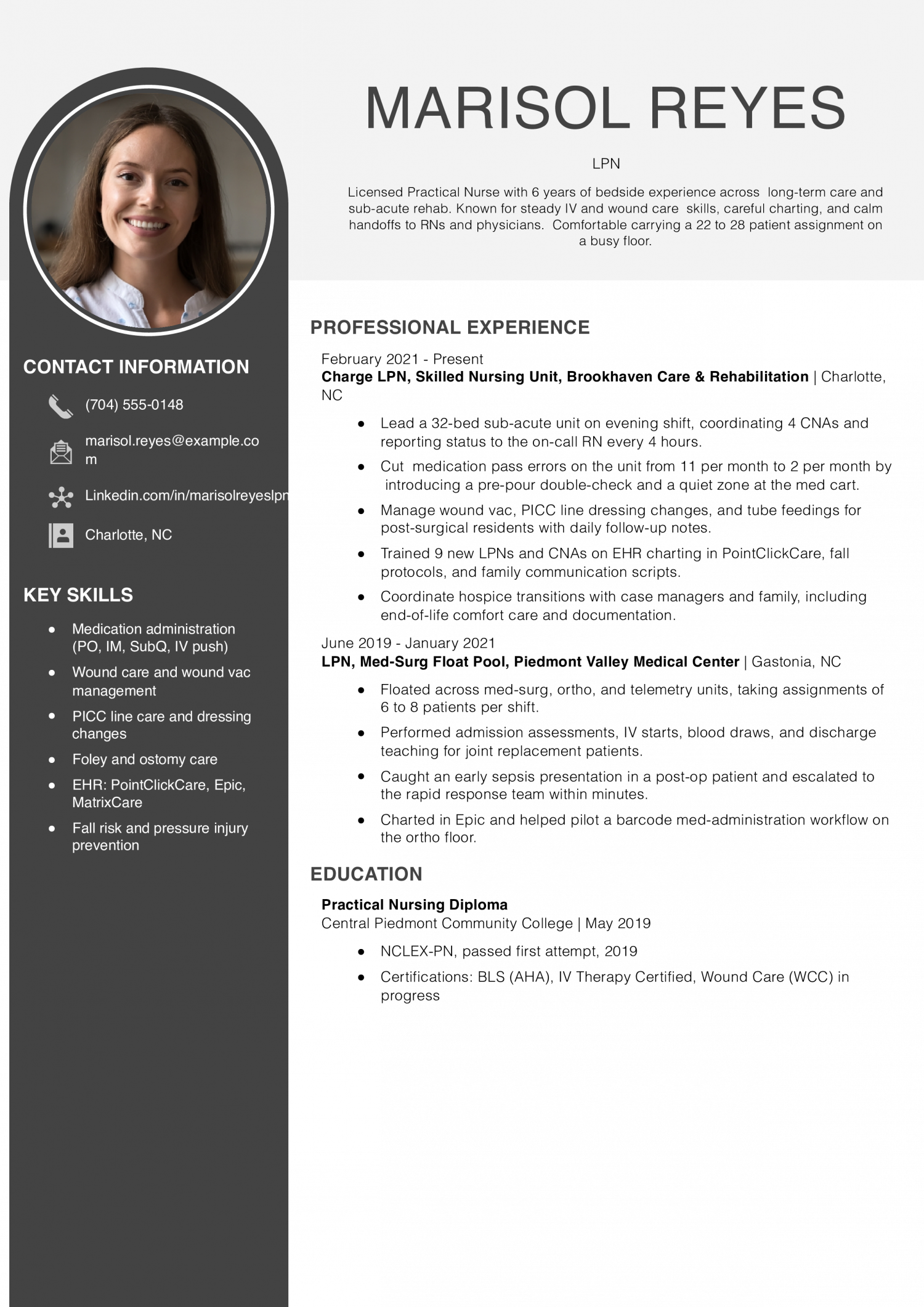
The new LPN archetype just passed NCLEX-PN and holds an active state license with limited paid bedside hours. This resume needs to prove clinical rotation depth, med-pass competence, and the EMR systems you charted in during school.
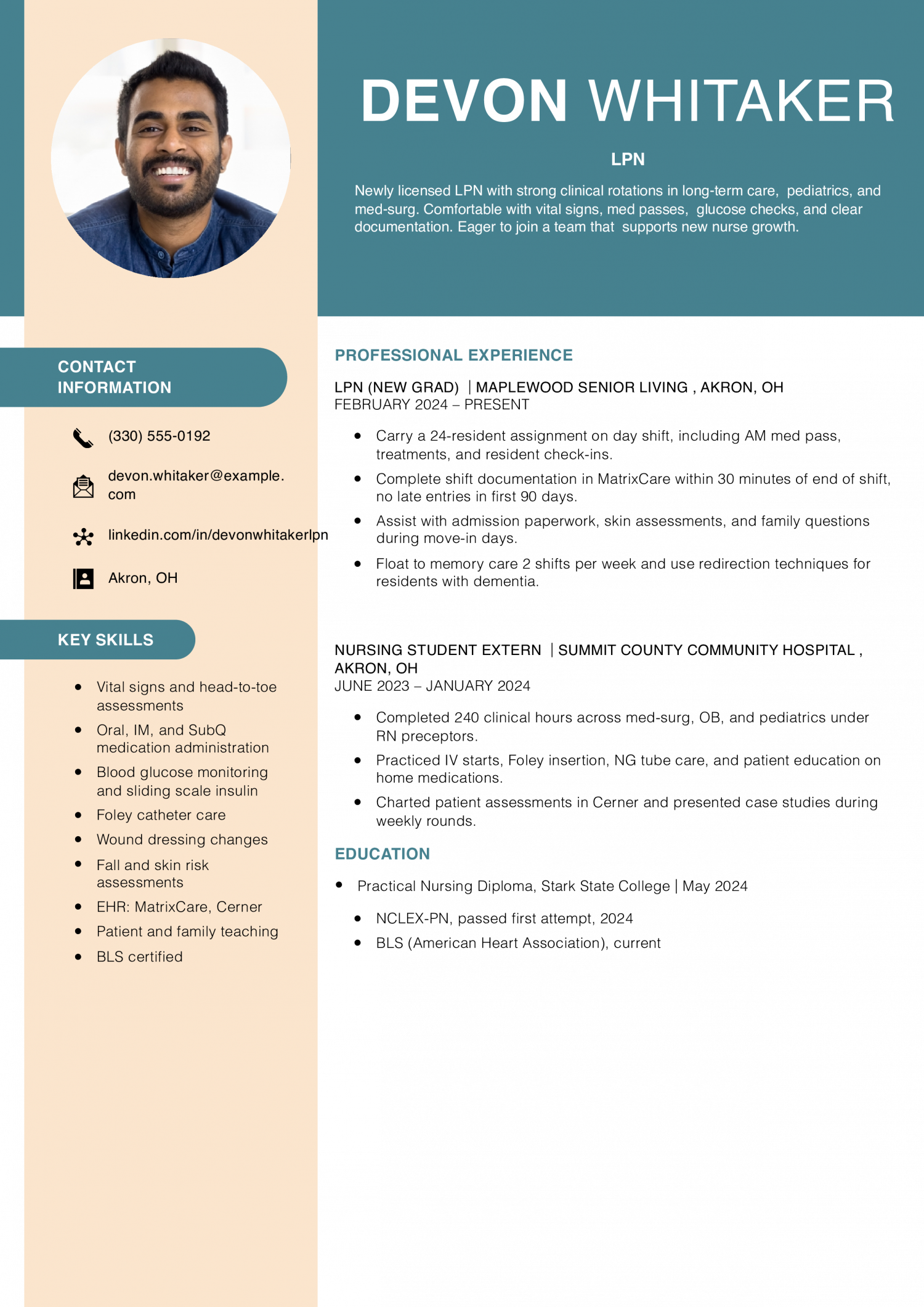
The experienced LPN archetype has two-plus years on the floor, a steady patient load, and a track record across at least one specialty setting. This resume needs to prove acuity, charting volume, IV and wound care scope, and the RN and physician teams you've supported.
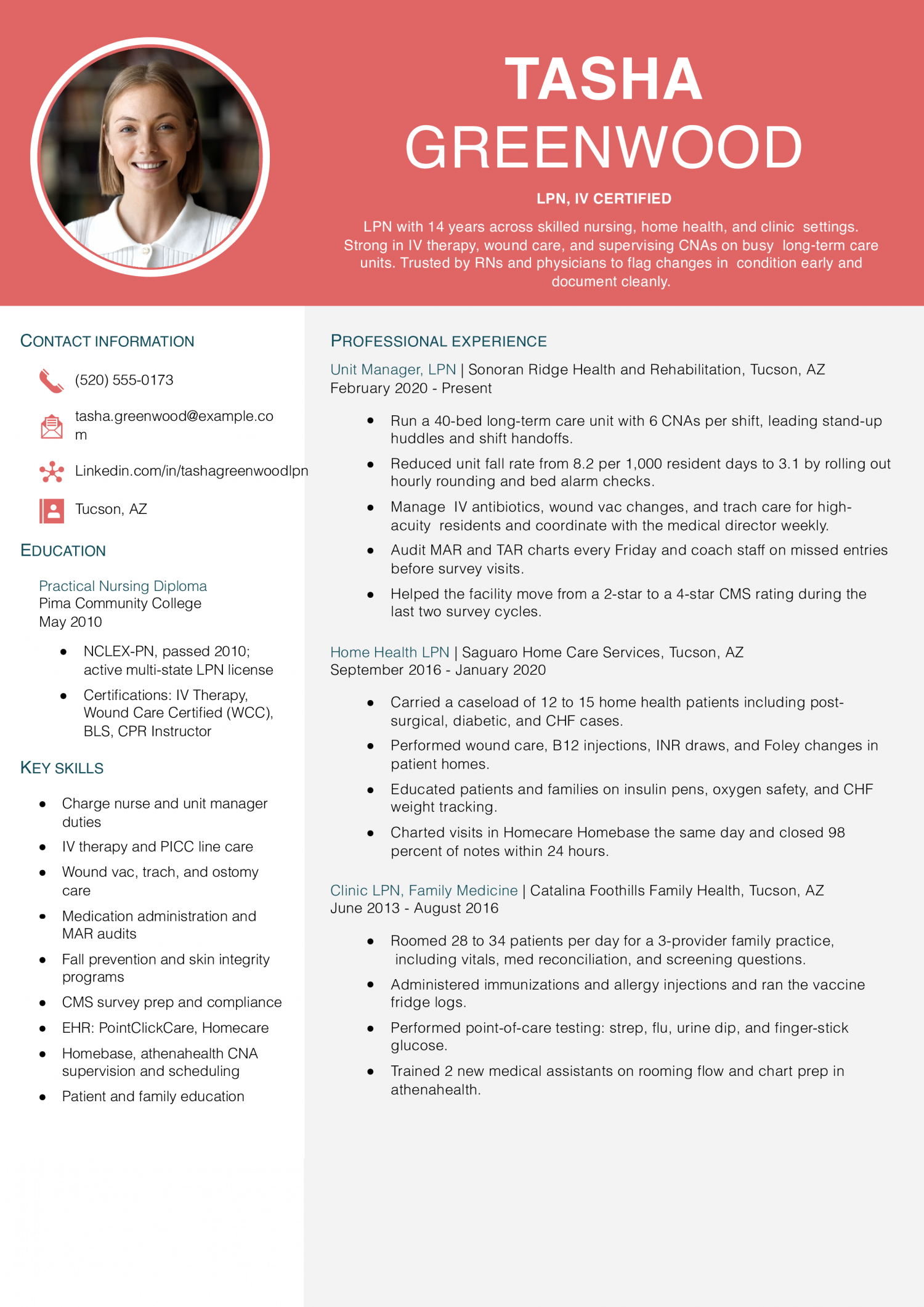
Priya Ramaswamy, LPN
Saint Paul, MN | (651) 555-0136 | [email protected] | linkedin.com/in/priyaramaswamylpn
LPN with 9 years across skilled nursing, sub-acute rehab, and outpatient infusion. Skilled at IV therapy, wound care, and steady documentation on high-acuity floors. Calm under pressure and trusted by RNs to triage changes in condition.
Charge LPN, Sub-Acute Rehab
Birchwood Transitional Care | Saint Paul, MN | 2022-Present
Infusion LPN
Riverbend Outpatient Infusion Center | Minneapolis, MN | 2019-2022
LPN, Long-Term Care
Lakeside Manor Skilled Nursing | Bloomington, MN | 2017-2019
LPN, Group Home
Northern Lights Disability Services | Saint Paul, MN | 2015-2017
Lead your summary with the patient load and setting a nurse manager uses to gauge readiness. Name your typical census, the acuity, and the shift length.
A line like “LPN with 3 years in a 120-bed SNF, carrying a 25-resident assignment on day shift” tells a director of nursing more than any adjective. Add your active state license, NCLEX-PN year, and BLS status in the same block.
Nurse managers read this opener to size your fit before they read a single bullet. Skip the objective; lead with the numbers that map to their floor.
Bullets without a number tend to read as duties. Strong LPN bullets name patient load, med-pass volume, charting frequency, and the supervising RN or physician context.
Pick two or three metrics nurse managers scan for: residents per shift (18 to 30 in LTC, 5 to 8 in med-surg), medications passed per shift, wound care cases, or fall-prevention rounds. Add the EMR you charted in, such as Epic, PointClickCare, or MatrixCare.
Pair each metric with the outcome it drove, like reduced rehospitalization rates or zero medication errors over a defined window.
Organize bullets into the categories Directors of nursing actually screen for. Four clusters cover most LPN roles: medication administration, assessment and monitoring, treatments and procedures, and documentation.
Under medication administration, name routes (PO, IM, SQ, IV when your state scope allows) and high-alert categories like insulin or anticoagulants. Under assessment, name vitals frequency, neuro checks, and the escalation pattern to the RN.
Treatments cover wound care, catheter care, trach and G-tube management, and specimen collection. Documentation covers your EMR, charting cadence, and care plan updates.
Build a credentials block directly under your summary so the nurse manager sees it in the first scan. List state of licensure with “in good standing,” NCLEX-PN year, BLS through the AHA, and IV certification if your state requires it.
Do not list your license number on the resume; you’ll supply it on the application. Add EMR systems on the same page-one block, since charting fluency is a hiring filter.
If you hold IV therapy certification, wound care credentials, or gerontology training, place them here too. This is where credential verification at larger hospital systems actually checks.
End with your practical nursing program, graduation year, and the clinical rotations that map to the job you want. Name the facility type, the unit, and the hours.
A new-grad LPN should list rotations in long-term care, med-surg, pediatrics, and OB, with hours per rotation. Add any preceptorship and the patient load you carried by the final weeks.
Experienced LPNs can shorten this section to program name, year, and any post-grad CE in IV therapy, wound care, or dementia care.
ATS filters catch more LPN resumes than ever in 2026. The skills below come from our user-built LPN resumes. Clinical procedures and EMR names clear the first cut, and patient-care language decides whether the resume advances.
Nurse managers weigh hard skills as the credential and competency check, then read soft skills as evidence backing your bullets. A bullet that says “de-escalated combative dementia patient” proves “patient advocacy” better than the label itself. Match this list against the target posting; mirror the EMR and procedure terms verbatim, and use soft skills only where a bullet proves them.
| Soft Skills | % of resumes with this skill |
|---|---|
| Communication | 67% |
| Empathy | 61% |
| Attention to detail | 43% |
| Teamwork | 38% |
| Time management | 28% |
And here are the top hard skills showing up most often.
| Hard Skills | % of resumes with this skill |
|---|---|
| Medication administration | 71% |
| Vital signs monitoring | 60% |
| Patient care | 44% |
| Wound care | 35% |
| Electronic health records | 31% |
Based on data from thousands of LPNs’ resumes built on ResumeTemplates.com, May 2026.
These are the must-haves hiring teams look for when scanning an lpn resume.
Every state board of nursing licenses LPNs (LVNs in California and Texas) after the NCLEX-PN. Show licensure in a page-one credentials block so director of nursing and credential-verification tools find it first.
List your state, “active, in good standing,” and the NCLEX-PN year. If you hold a multistate license through the Nurse Licensure Compact, write “multistate” so the reader sees portability at a glance.
Do not list the license number itself; employers verify through Nursys or the state board portal, and the number goes on the application. Add BLS through the AHA with the expiration date, and IV certification where your state requires it.
State boards of nursing require LPNs to complete continuing education hours per renewal cycle, and the courses you choose signal where your practice is heading. List CE by topic, certifying provider, and year.
Pick CE that maps to the roles you’re targeting. IV therapy, wound care, and dementia care courses signal LTC and home health readiness.
Pharmacology updates, diabetes management, and infection control signal med-surg and clinic readiness. Keep CE entries to the last three years and group them under a “Continuing Education” heading below certifications.
EMR fluency is a hiring filter for LPN roles. Name the systems you’ve charted in, the setting where you used them, and the modules you worked in.
Never name a patient, room number, or detail that could identify a person you cared for. HIPAA violations on resumes are a fast disqualifier at hospital systems with compliance review.
Write bullets in aggregate. “Managed daily care for a 25-resident assignment” is safe; “cared for Mr. R in room 214” is not.
If you ran a notable case, describe the clinical scenario without identifiers: “supported end-of-life care for a hospice patient with complex pain management.” List HIPAA training as a CE line if completed within the last two years.
Beyond your state LPN license and BLS, the certifications below tell Directors of nursing which patient populations you can take and which procedures you can run without RN oversight. List each one with the certifying body and current expiration date.
The LPN pay spread between the 10th-percentile floor and the 90th-percentile ceiling tells you that setting and specialty move pay more than tenure does. The floor reflects entry rates at smaller LTC facilities in low-cost regions, while the ceiling reflects hospital, correctional, and government LPN roles with night and weekend differentials. The top employment states cluster where SNF and home health demand is highest.
Position your resume around the setting and specialty that map to the band you want, and lead with the acuity and patient load that prove it.
| # | State | Avg. Annual |
|---|---|---|
| 1 | Washington | $79,700 |
| 2 | Rhode Island | $77,940 |
| 3 | Alaska | $77,670 |
| 4 | California | $77,170 |
| 5 | Oregon | $76,570 |
| 6 | Massachusetts | $76,560 |
| 7 | New Hampshire | $74,660 |
| 8 | Arizona | $74,020 |
| 9 | Nevada | $73,820 |
| 10 | New Jersey | $71,180 |
| # | State | Workers | Median |
|---|---|---|---|
| 1 | California | 79,610 | $77,170 |
| 2 | Texas | 59,060 | $60,150 |
| 3 | New York | 40,720 | $64,030 |
| 4 | Florida | 36,470 | $60,080 |
| 5 | Ohio | 36,440 | $60,990 |
Resume Templates offers HR approved resume templates to help you create a professional resume in minutes. Choose from several template options and even pre-populate a resume from your profile.
No. List your state of licensure and "active, in good standing" with the NCLEX-PN year.
State boards of nursing publish license numbers in public verification portals, and most employers run a primary-source verification through Nursys. Supply the number on the application form, not the resume.
If your state is part of the Nurse Licensure Compact, list your license as "multistate" so the director of nursing sees you can practice in their state immediately.
If you're moving from a non-compact state, name the state you hold and add "endorsement application in progress with [target state] Board of Nursing" with the date submitted.
Lead with your clinical rotations as if they were jobs. Name the facility, the unit, the hours you carried, and the patient load by the final weeks.
Add the EMR you charted in and any preceptorship cases you ran with minimal oversight. CNA or medical assistant work before nursing school goes below the rotations, with patient-care duties translated into LPN-relevant terms.
Place LPN-to-RN bridge program enrollment in your education section with the expected graduation date, not at the top of the resume.
Nurse managers read top-of-resume RN-track language as short tenure risk. In the summary, frame yourself as an LPN seeking the role you're applying for, and let the education section show the trajectory.
For an LPN, an ATS-friendly template is the safest pick, because it puts your certifications and experience where a hiring manager scans first. A basic template is a solid alternative. Whichever you choose, keep the formatting clean and easy to parse: clear section headings, a standard font, and no graphics a parser can choke on.
Executive Resume Writer and Career Coach
Andrew Stoner is an executive career coach and resume writer with 17 years of experience as a hiring manager and operations leader at two Fortune 500 Financial Services companies, and as the career services director at two major university business schools.