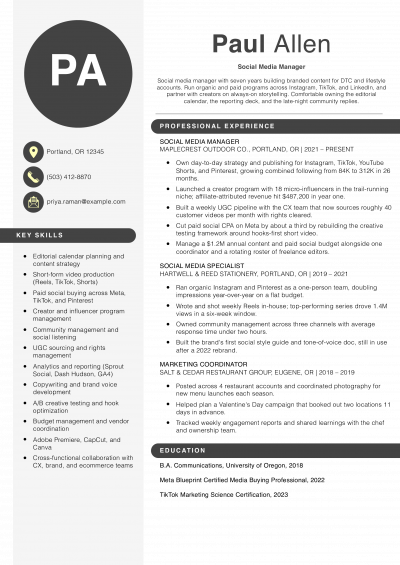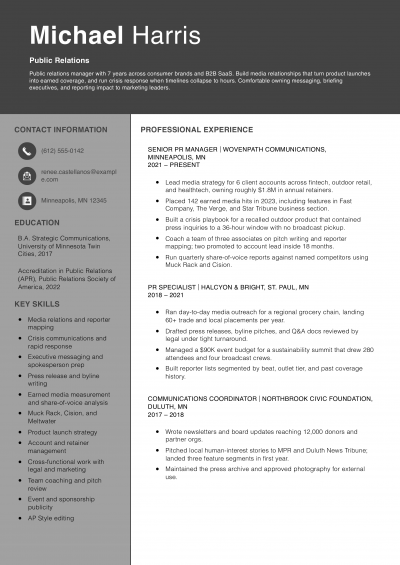
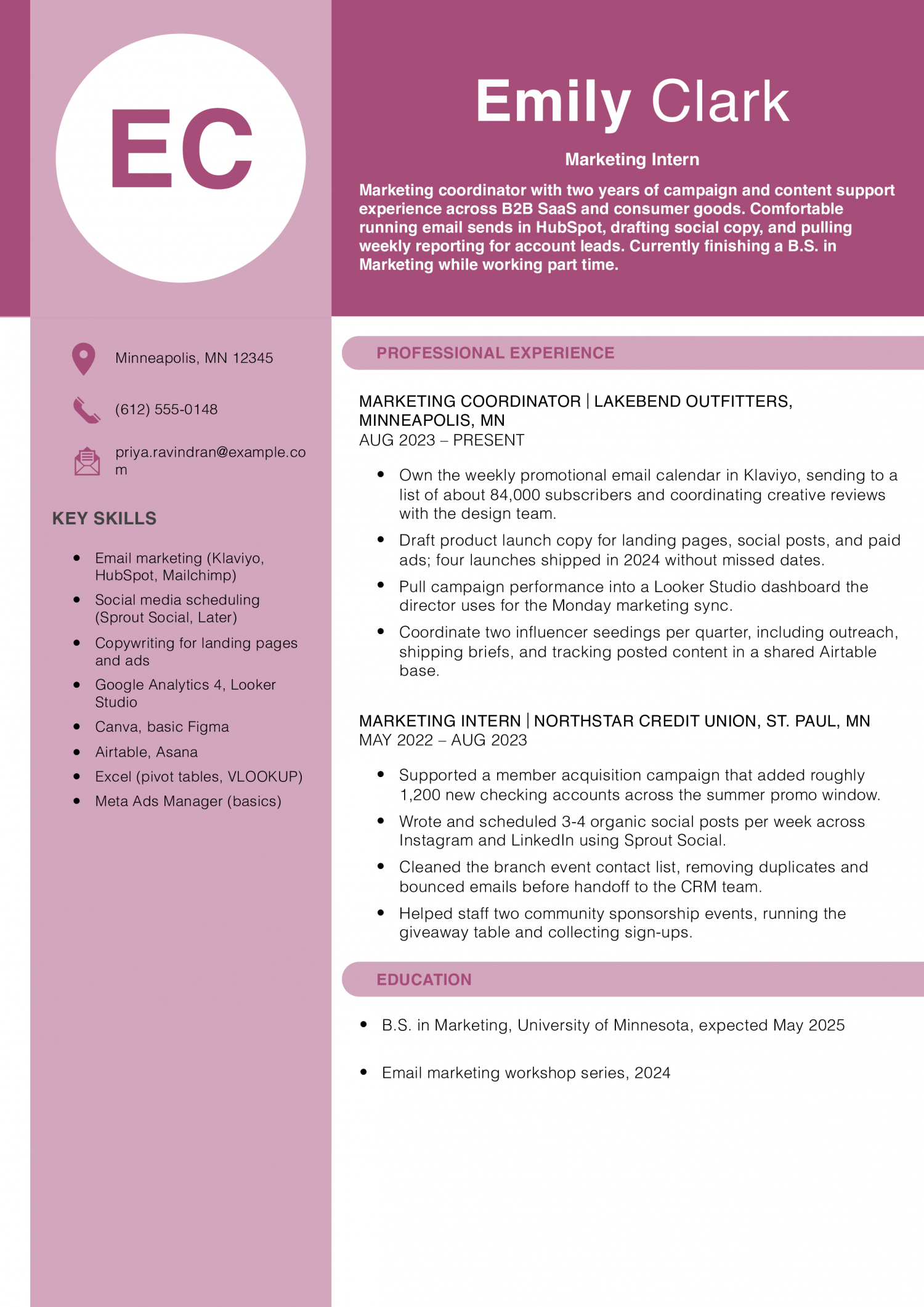
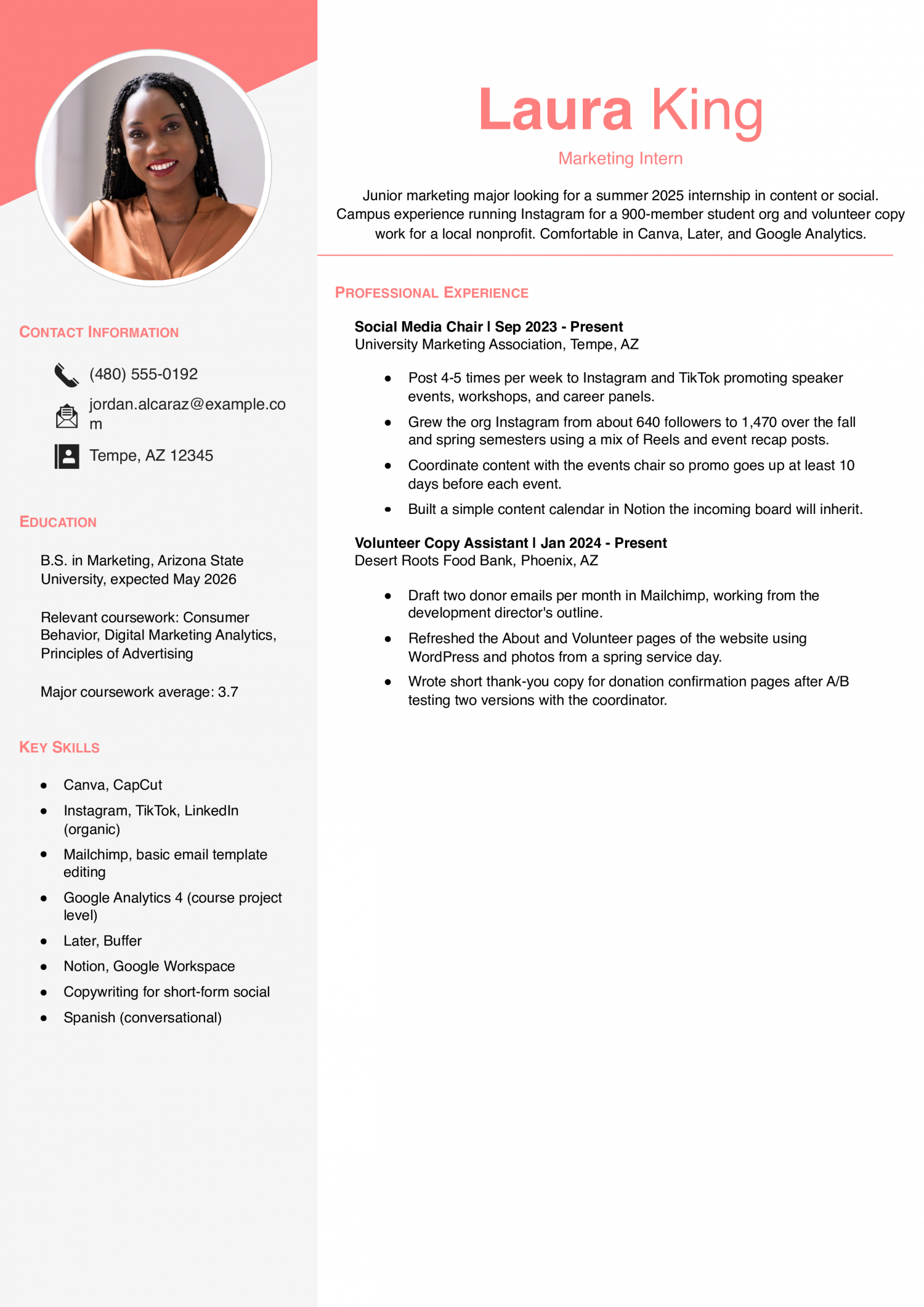
Marketing Assistant Resume Examples and Templates for 2026

Add a single line a marketing manager cannot pull from any other resume in the stack. That can be a paid social budget you managed, a HubSpot workflow you built, a TikTok account you grew,…
Every resume example is written and reviewed by our team of Certified Professional Resume Writers to ensure top-quality content and formatting.
Marketing internships now hinge on proof you can ship work, not just study it. A strong resume shows classroom projects, campus club campaigns, or freelance gigs where you touched real tools like Canva, HubSpot, Google Analytics, or Meta Ads Manager.
Marketing managers and internship coordinators screen for output they can point to: a social post that ran, an email you drafted, a landing page you tested. Name the tool, the audience, and what you produced, even at small scale.
The examples below show how to frame coursework, part-time roles, and side projects as marketing evidence a team can trust.
Coursework tied to the campaign type, a portfolio link that opens on the first click, and quantified results from student or freelance projects are what separate the Marketing Intern resumes that get callbacks from the rest.
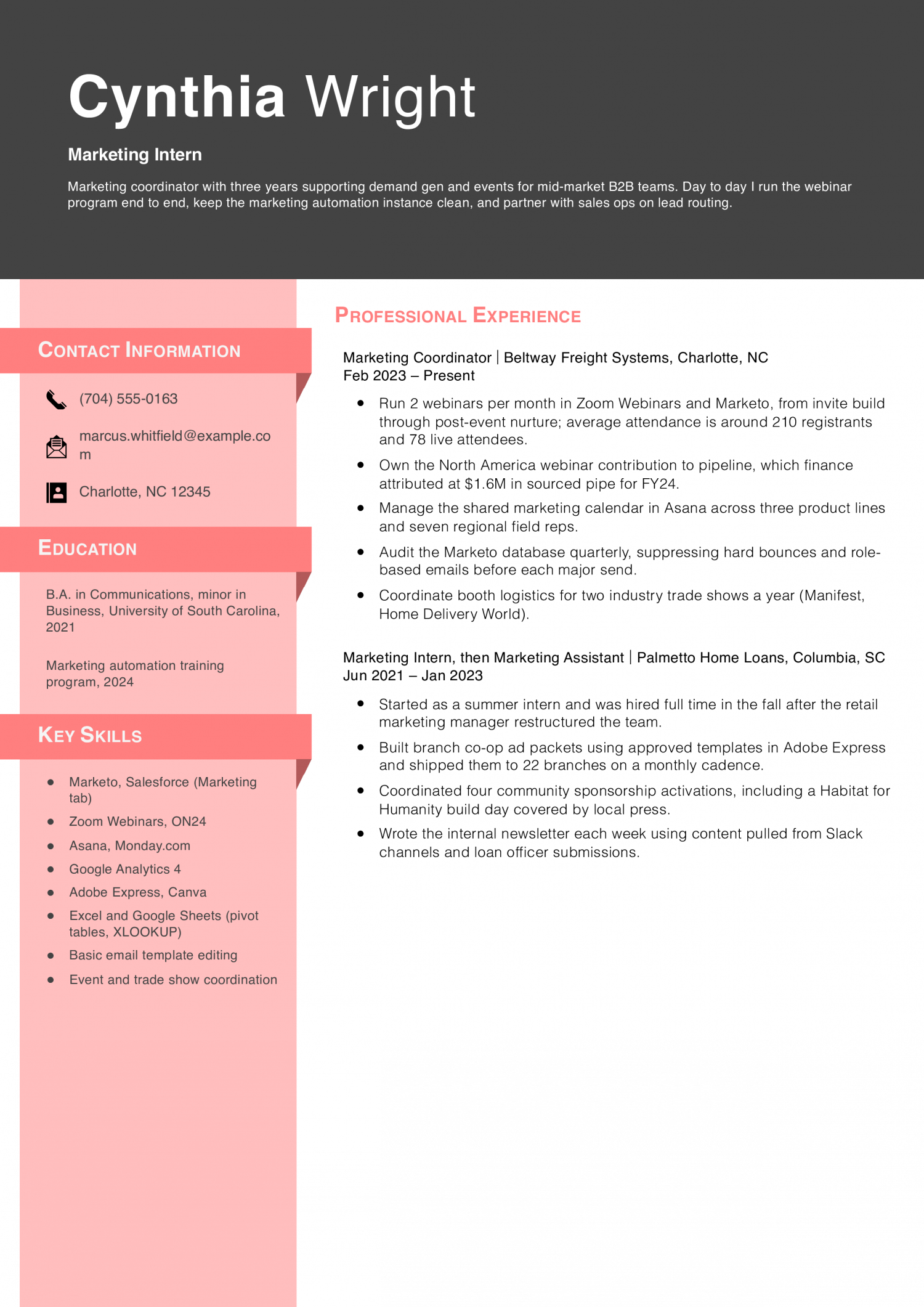
This resume is for a student or recent graduate stepping into a first marketing role. Show class projects, campus campaigns, and any hands-on work with social channels, content drafts, or basic analytics tools.
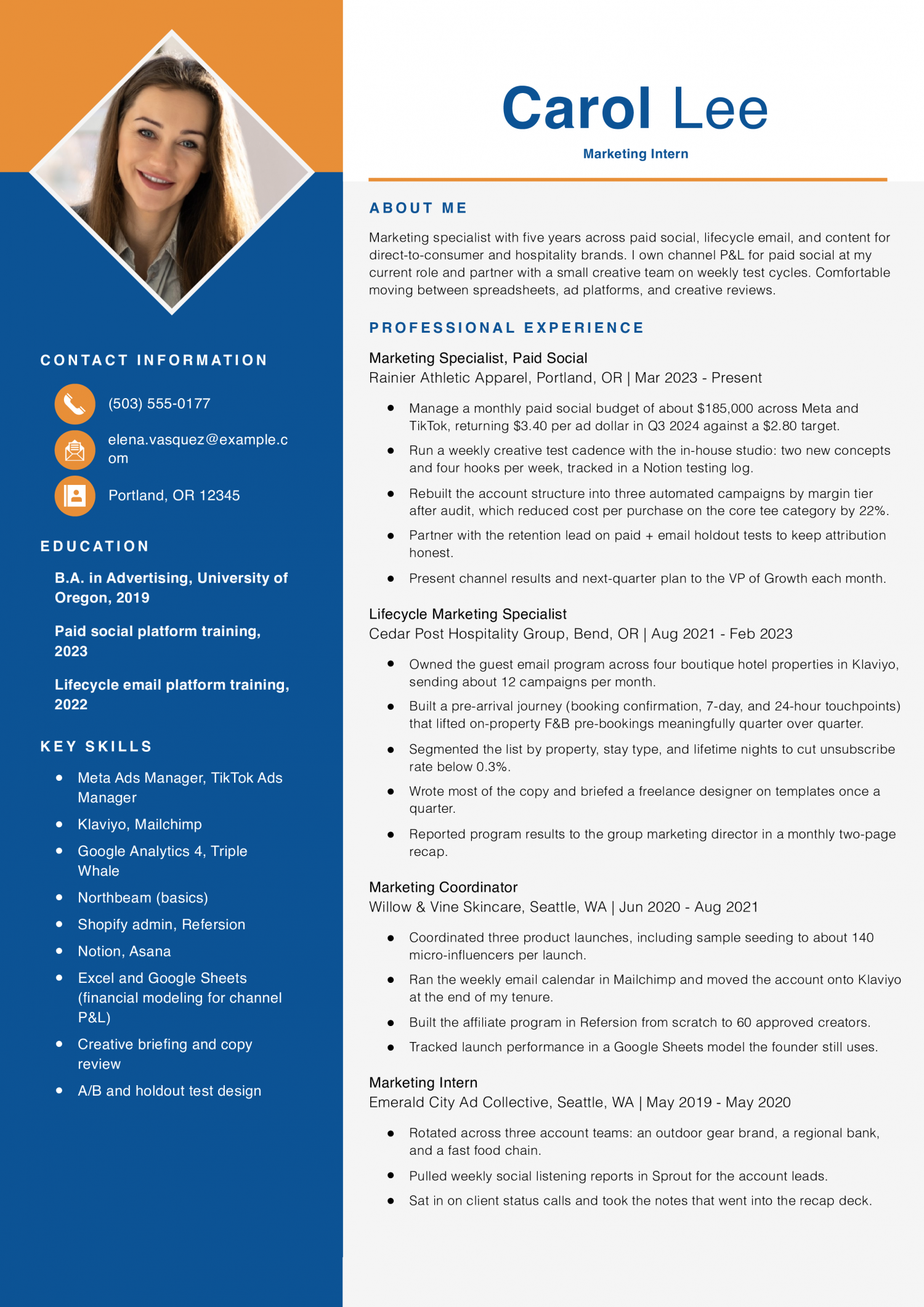
This resume is for someone with one or two years of marketing work moving into a coordinator seat. Show campaigns you helped run end to end, the channels you own, and the metrics you report on each week.
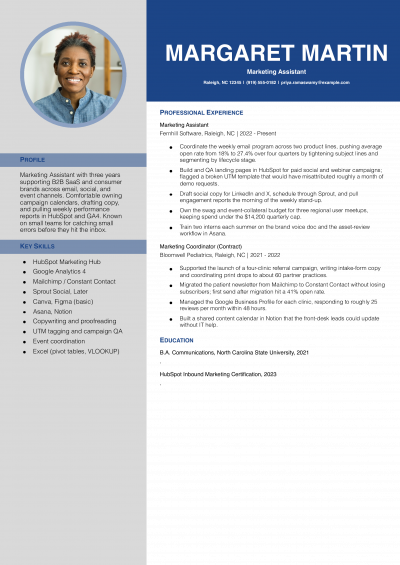
This resume is for a marketer with three or more years of channel or program experience. Show campaigns you led, budgets you managed, and the revenue, pipeline, or engagement lift you can tie to your work.
Sana Kohli
Denver, CO | (720) 555-0134 | [email protected] | linkedin.com/in/sanakohli
Marketing coordinator with four years of hands-on work across content, email, and events for B2B software and higher ed clients. I write the first draft of most things I send, keep campaign trackers current, and enjoy the operational side of marketing (list hygiene, link tagging conventions, calendar traffic). Looking to grow into a specialist role focused on lifecycle.
Marketing Coordinator
Fairhaven Analytics | Denver, CO | Apr 2023-Present
Marketing Assistant
Front Range Learning Partners | Boulder, CO | Aug 2021-Mar 2023
Marketing Intern
Alpine Peak Software | Denver, CO | May 2021-Aug 2021
Marketing Intern
Mile High Brewing Co. | Denver, CO | May 2020-Aug 2020
Your profile should sit at the top of page one. State your year in school, your major, and the marketing work you have already done. Name the channels you have touched, such as social, email, or event support.
Say whether you have worked on a campus club, a small business, or a class project for a real client. Marketing managers and internship coordinators read the first four lines to decide if you fit their team. Give them a plain scope line before any objective language.
Two sentences is enough. Add the software you know well, such as Canva or Google Analytics, so the reader sees your working tools right away.
Most strong intern resumes carry a few real numbers, even from class work or club roles. Name the size of the audience you wrote for, the follower count you grew, or the open rate on an email you sent. A bullet like grew a club Instagram from 300 to 900 followers over one semester reads far better than managed social media.
If you ran an event, give the attendance and the ticket or signup total. If you supported a paid campaign, name the budget you tracked, even if it was small. A bullet with no number in it reads as a chore, not a result.
Recruiters scan for a metric first, then read the verb. Pick two or three metrics per role.
Sort your bullets so the reader sees range without a wall of tasks. Four categories cover most intern work. Content and social covers posts, captions, short video, and basic graphic design in Canva or Figma.
Email and CRM covers drafting sends, list segmentation, and light work in Mailchimp or HubSpot. Analytics and reporting covers Google Analytics pulls, social dashboards, and weekly recap decks. Events and field covers campus activations, trade show support, and sponsor outreach.
Under each role, lead with the category that took the most hours. Marketing managers and internship coordinators want to see where you actually spent your week. Keep each bullet to one line so the pattern reads at a glance.
Interns rarely hold full certifications, so your tools list carries the weight a license would in other fields. Put a short skills block on page one, right under the profile. Name the platforms you have used in class or on the job, such as Google Analytics, Meta Business Suite, HubSpot, Mailchimp, Canva, and Adobe Express.
If you finished a free Google or HubSpot Academy course, list it under a short certifications line with the year. Marketing managers and internship coordinators screen for tool fit before they read bullets. They want to know you can log in on day one.
Keep the list to items you could open and use in a working interview. Do not pad.
Education belongs on page one for interns, right after skills. List your school, expected graduation month and year, major, and minor if it fits marketing. Name two or three courses that map to the posting, such as consumer behavior, digital marketing, or market research.
Under a projects header, add one or two class or club campaigns with a one-line brief and a result. A campus food drive that pulled 1,200 pounds of donations reads as marketing work. A mock brand book for a local coffee shop shows craft.
Marketing managers and internship coordinators use this section to judge fit when work history is thin. Keep it honest and specific.
Marketing managers and internship coordinators scan hundreds of intern resumes a term. The ones they shortlist name the tools used and the campaigns supported. The rest read as coursework with no proof of applied work.
Weight sits on the hard skills column at the intern stage. Managers want to see that you have touched Canva, Google Analytics, or a scheduler before day one. Soft skills like copywriting and collaboration carry weight once the hard skills clear the scan.
Treat the soft skills as claims you back up in your bullet points, not standalone traits. A line reading team player with no supporting bullet gets skipped by both the scan and the reader. Pull the exact phrasing from your target job posting and mirror it in your skills block.
Add the tools you used in class projects, campus orgs, or freelance gigs. Drop any skill you cannot speak to in a 30 second answer during a screen call.
| Soft Skills | AI-estimated % |
|---|---|
| Cross-team collaboration | 66% |
| Detail-oriented mindset | 53% |
| Deadline management | 47% |
| Creative problem-solving | 40% |
| Stakeholder communication | 33% |
The hard skills below show up just as often.
| Hard Skills | AI-estimated % |
|---|---|
| Social media content | 68% |
| SEO optimization | 67% |
| Web analytics reporting | 40% |
| Campaign performance tracking | 36% |
| Market research support | 30% |
Skill names and rankings come from an AI model grounded in U.S. Department of Labor occupation data for marketing interns, not from a count of marketing interns’ resumes built on ResumeTemplates.com.
Before a marketing intern resume gets a closer read, hiring teams check for a short list of essentials.
Marketing managers and internship coordinators scan for tools you touched. They also look for the channels and tasks you worked on. Name the platforms by their real names. Say which part of a campaign you owned. List the analytics tools you pulled numbers from. Show the content formats you helped build. Call out the paid channels you tracked or supported. Note the email tool your team ran on. Include the SEO or research work you did. Keep each term short and written as the trade writes it. Group them by the type of work, not by soft skills. That helps the filter match you to the right sub-niche.
| Niche | Keywords ATS scans for |
|---|---|
| Social media | Instagram Reels, TikTok, LinkedIn scheduling |
| Content marketing | blog drafting, WordPress CMS, Canva design |
| Email and CRM | Mailchimp, HubSpot, list segmentation |
| Paid and analytics | Google Ads, Meta Ads Manager, Google Analytics |
| SEO and research | keyword research, SEMrush, competitor analysis |
Marketing teams are split on intern AI use right now. Some managers want you drafting captions and briefs in ChatGPT by week two. Others ban generative tools on brand copy and paid work. Name the tools you actually opened during coursework or past internships. Describe the workflow in plain terms: prompt, draft, edit, fact-check, route for approval. Do not claim you run AI campaigns if you wrote captions a manager later revised. Say who reviewed your output and what you changed after feedback. That framing reads honestly to marketing managers and internship coordinators reading dozens of resumes.
You draft captions, subject lines and blog outlines in ChatGPT, then a full-timer edits and approves before posting.
You use AI to summarize competitor sites and audience notes, then verify claims against the original source before citing them.
You turn one blog post into social, email and script variants, then adjust tone for each channel by hand.
You paste campaign numbers into an AI tool to draft plain-language summaries, then check the math against the platform export.
The Bureau of Labor Statistics does not publish a wage code for Marketing Intern specifically. The numbers below are a proxy: the closest published match is Market Research Analysts and Marketing Specialists (SOC 13-1161), so use them as an estimate for this role, not an exact figure.
The pay band for a Marketing Intern is wide at the top and tighter at the bottom. The top of the band pulls away from the middle far faster than the bottom drops. That shape points to a market that rewards named channel skills and campaign metrics over general coursework.
The pool is large, so the resume competes in a deep field. Lead with the paid channels you have touched, the tools you ran in a live account, and one campaign metric you can name. Move the classroom projects below the paid or client work, even if the class work is more recent.
| # | State | Median Annual |
|---|---|---|
| 1 | Massachusetts | $101,810 |
| 2 | Delaware | $101,270 |
| 3 | New York | $98,580 |
| 4 | District of Columbia | $98,090 |
| 5 | Washington | $95,120 |
| 6 | California | $94,700 |
| 7 | Colorado | $93,050 |
| 8 | New Jersey | $88,190 |
| 9 | Minnesota | $87,510 |
| 10 | Rhode Island | $86,240 |
| # | State | Workers | Median |
|---|---|---|---|
| 1 | California | 119,070 | $94,700 |
| 2 | New York | 80,500 | $98,580 |
| 3 | Texas | 63,350 | $72,520 |
| 4 | Florida | 60,770 | $75,450 |
| 5 | Illinois | 40,560 | $79,120 |
Resume Templates offers HR approved resume templates to help you create a professional resume in minutes. Choose from several template options and even pre-populate a resume from your profile.
Put the internship in the experience section with the company name, city, and dates.
Write the end date as "Present" and keep bullets in present tense until the role wraps. Marketing managers and internship coordinators expect this format, and it signals current work without confusion.
Mirror the posting, then add the tools you have actually used: Google Analytics, HubSpot, Canva, Meta Ads Manager, and Mailchimp.
Include task words the posting uses, such as content calendar, campaign, copywriting, SEO, and social media analytics. Skip a keyword you cannot back up in an interview.
Treat each project like a paid role, with a client name, your role, and the deliverable.
Lead with the action verb and end with a number: reach, click-through rate, followers gained, or emails sent. Marketing managers and internship coordinators read a class brand audit as real work when the numbers are honest.
List honors that a reviewer can weigh, such as dean's list, a named scholarship, or a case competition placement.
Put them under education with the term or year attached. Skip a vague award with no context, since it takes space from a project you can describe.
Keep the resume to one page.
Marketing managers and internship coordinators read fast during recruiting season, and a second page for a student rarely helps. Cut a high school job or an unrelated shift role before you cut a marketing project.
Send a cover letter whenever the posting allows one, even when the field is marked optional.
Use it to name the brand, the campaign you admire, and the skill you would bring to the team. Three short paragraphs beat a full page, since the reviewer is scanning many applications in one sitting.
List a handle only when the account shows marketing work you want reviewed, such as a content page or a portfolio Instagram.
Put it in the header next to LinkedIn, and confirm the feed reads as professional before you send. Leave personal accounts off the resume entirely.
For a marketing intern, an ATS-friendly template is the safest pick, because it puts your certifications and experience where a hiring manager scans first. A basic template is a solid alternative. Whichever you choose, keep the formatting clean and easy to parse: clear section headings, a standard font, and no graphics a parser can choke on.
Marketing Intern Resume
4.5/5 stars with 137 reviews

Executive Resume Writer and Career Coach
Andrew Stoner is an executive career coach and resume writer with 17 years of experience as a hiring manager and operations leader at two Fortune 500 Financial Services companies, and as the career services director at two major university business schools.
© 2026 Resumetemplates.com All rights reserved.