Consultant Resume Examples and Templates for 2026



PR directors decide whether to keep reading by the first three bullets under your most recent role; if a named outlet placement and a measurable reach number aren't visible there, the resume drops to the maybe stack.
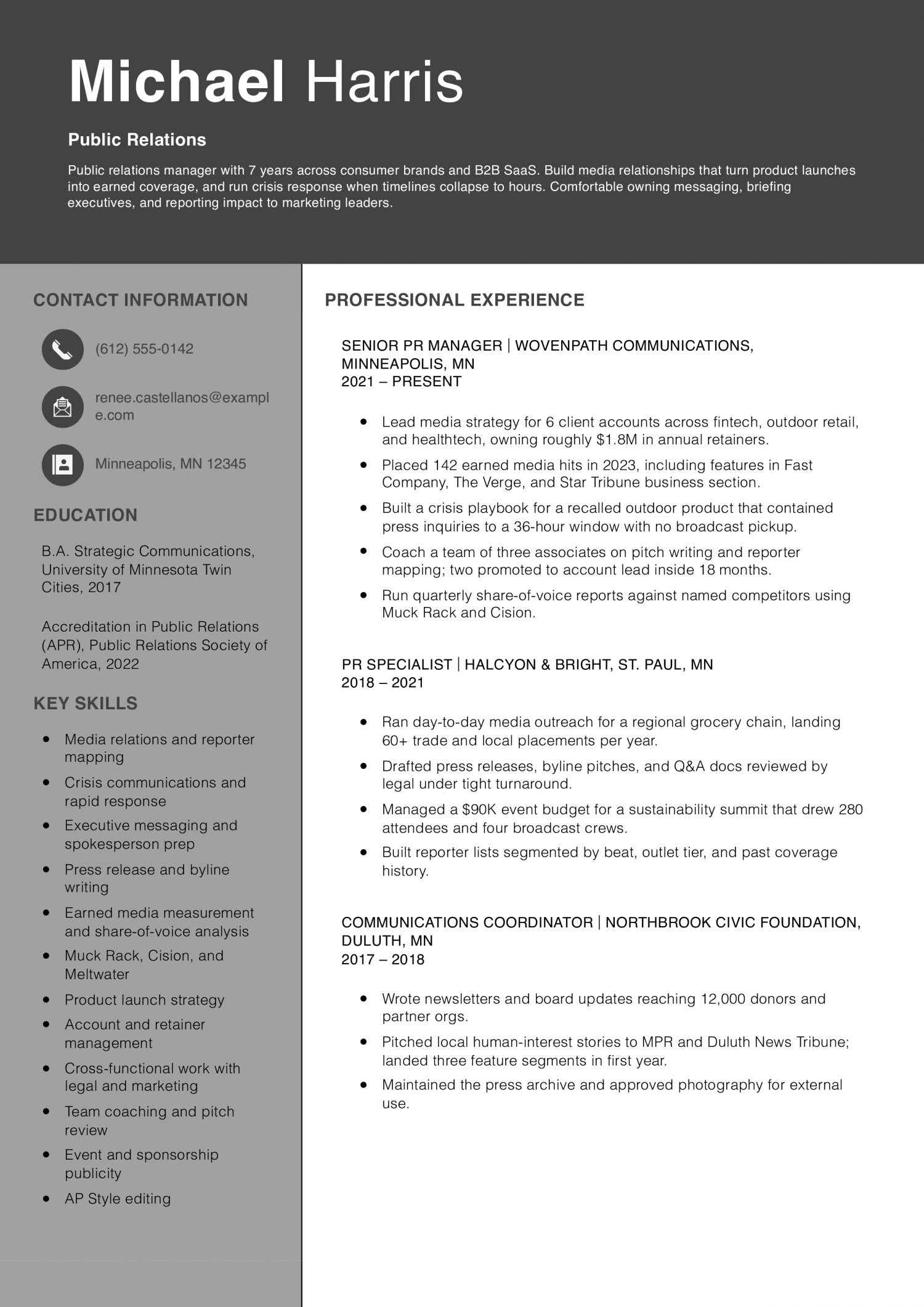
Entry-level PR specialists are early career, often one to two years in coordinator or intern roles. The resume needs to prove you can draft pitches, build media lists, and track placements without heavy oversight.
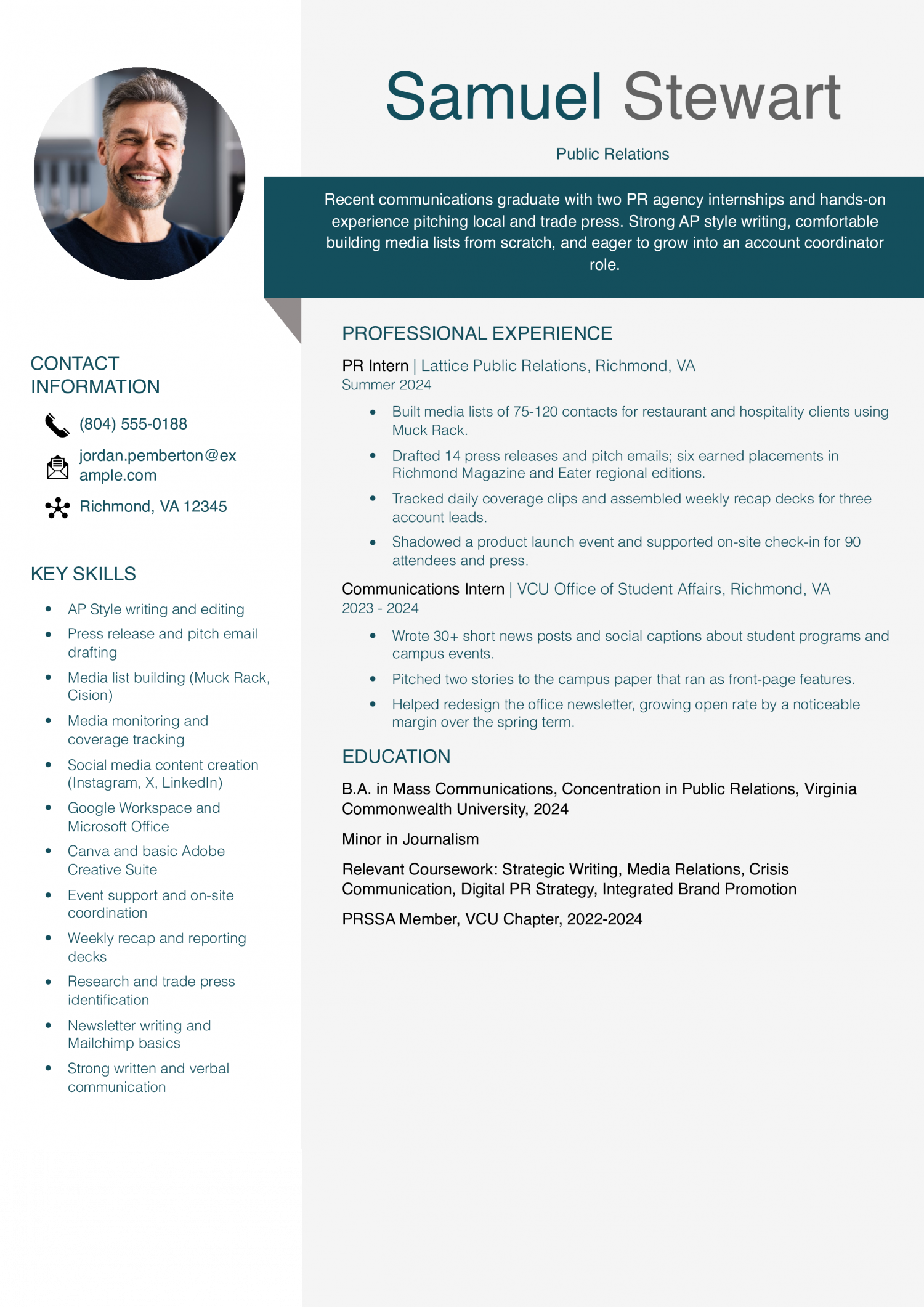
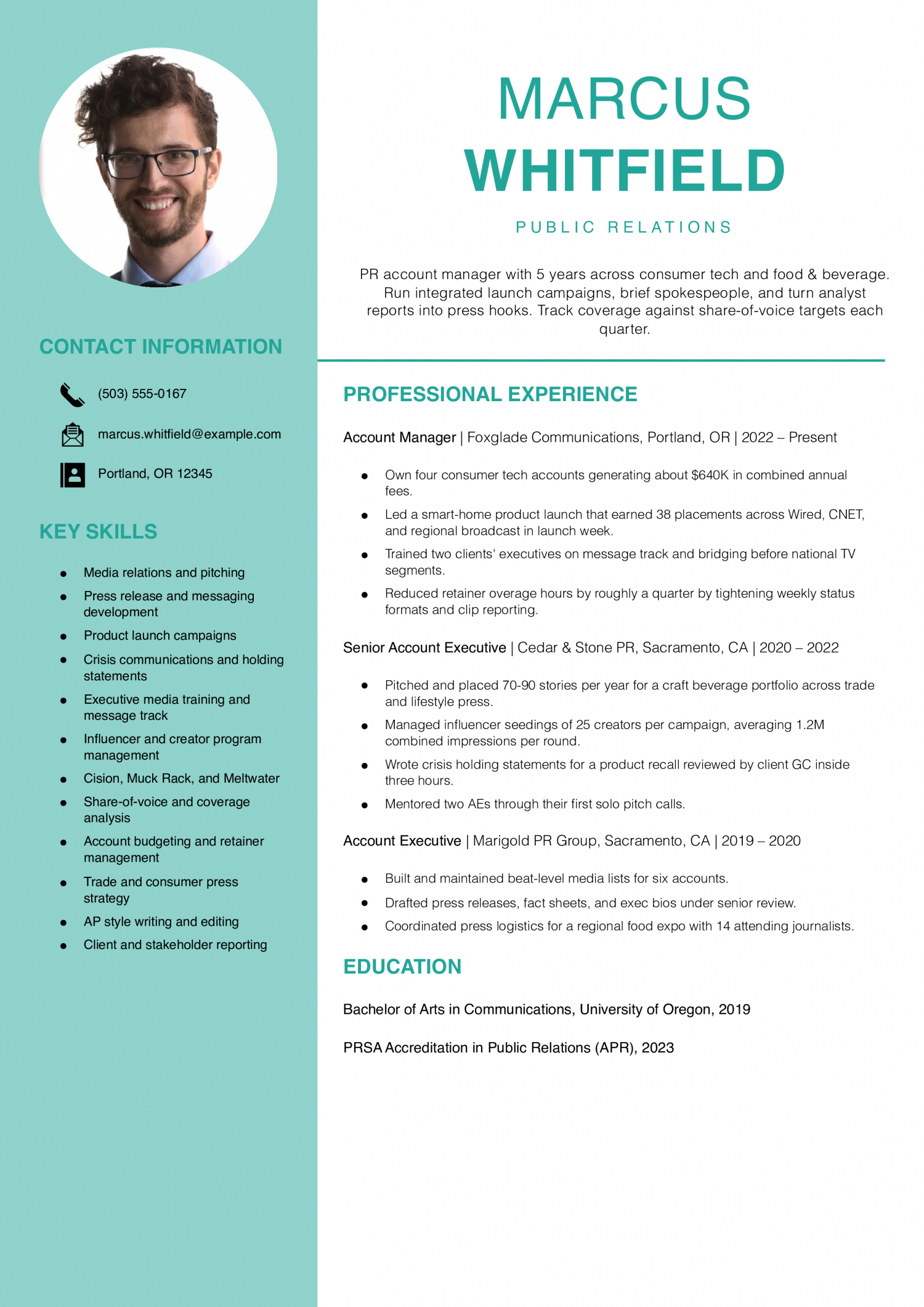
Mid-career PR pros run accounts or program areas with three to seven years behind them. The resume needs to prove you own campaigns end to end, brief executives, and report on earned media metrics.
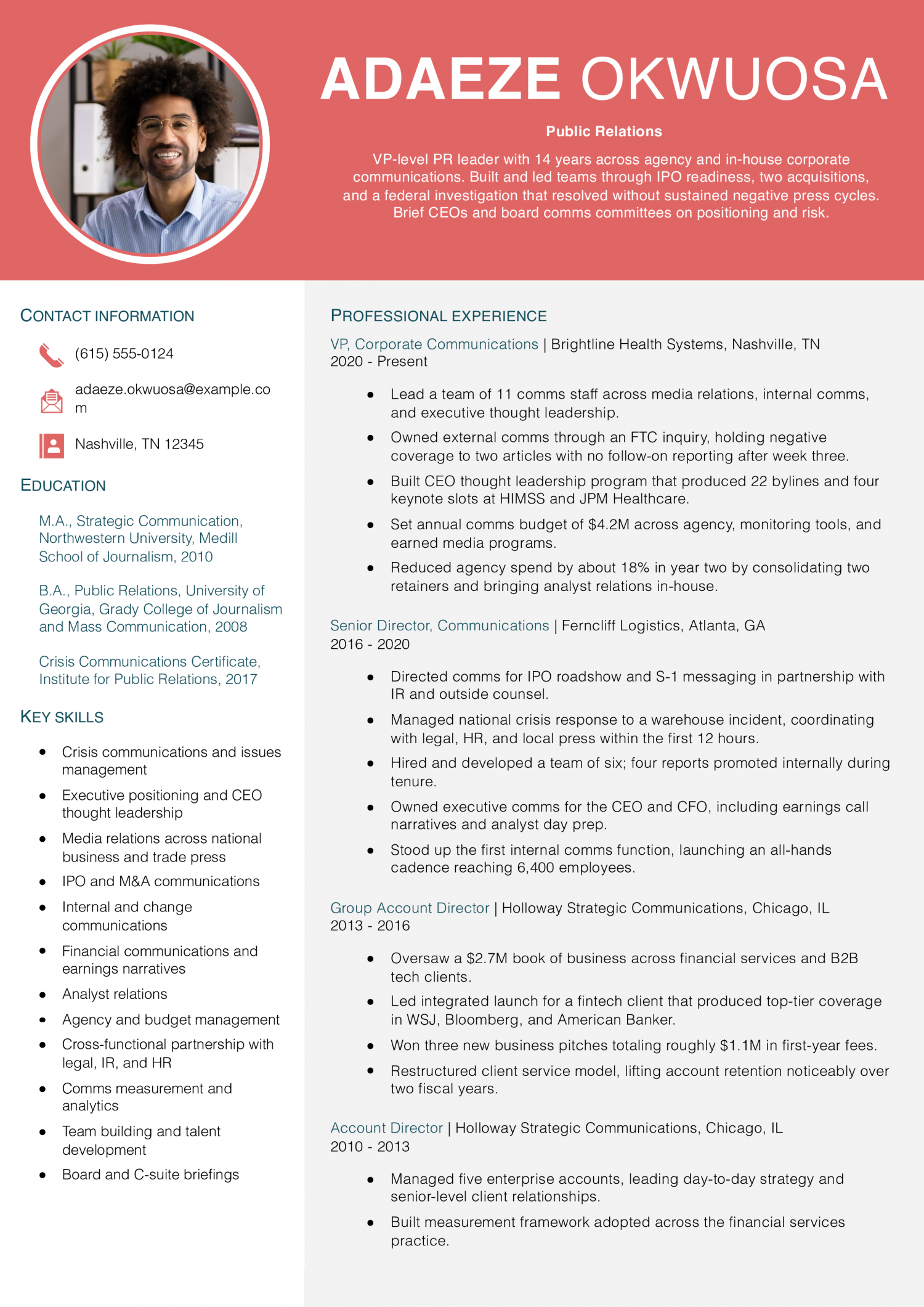
Senior PR leaders direct teams, set strategy, and own crisis response across business units. The resume needs to prove revenue or reputation impact, named-outlet wins at scale, and the executives you've coached on message.
Priya Achterberg
Denver, CO | (720) 555-0156 | [email protected] | linkedin.com/in/priyaachterberg
Public relations professional with 9 years across agency and in-house roles in clean energy, outdoor apparel, and B2B SaaS. Build media programs that pair earned coverage with analyst and executive visibility, and run measurement that ties back to pipeline. Comfortable as the comms lead in a crisis room and as the writer drafting the CEO’s first response.
Director of Communications
Solano Grid Technologies | Denver, CO | 2022-Present
Senior PR Manager
Ridgefoot Outfitters | Boulder, CO | 2019-2022
PR Manager
Kestrel Public Relations | Seattle, WA | 2017-2019
Account Executive
Kestrel Public Relations | Seattle, WA | 2015-2017
Communications Associate
Westwater Policy Institute | Tacoma, WA | 2014-2015
Your profile should state your years in PR, the sectors you’ve covered (tech, health, consumer, public affairs, nonprofit), and the channels you run weekly.
Name whether you work agency-side, in-house, or both. Call out the tier of outlets you’ve placed in (trade, regional daily, national, broadcast) and the executive levels you brief.
Three short lines beat a paragraph here. PR directors and communications VPs use this block to decide if your scope matches the open role before they read a single bullet.
PR work has real numbers behind it, and bullets without them tend to read as duties. Strong PR resumes name three kinds of metrics across the page.
Show placement counts and outlet tiers (for example, 42 placements including The Wall Street Journal and TechCrunch). Show reach or impressions on the campaigns you led. Show movement on share of voice or sentiment when you have the data.
If you worked nonprofit or government and the numbers aren’t public, lean on volume language: campaigns shipped, reporters in your active list, executives prepped for interviews, crisis statements drafted under deadline.
Cluster bullets so PR directors can scan your output type at a glance. Four categories cover most PR roles.
Media relations: pitches, briefings, desk-sides, media lists by beat. Content: press releases, bylines, op-eds, executive Q&As, social copy. Crisis and issues management: holding statements, message houses, reporter response under deadline.
Measurement and reporting: dashboards, monthly earned media reports, sentiment tracking.
Within each category, lead with the placement or outcome, then the tactic. Reporters and outlets named on the resume act as proof in a way generic verbs cannot.
Your APR, PRSA membership, or accreditations belong in a credentials line under your profile, not buried on page two. PR directors and communications VPs want to confirm the credential before they invest in the bullets.
List the PR tech you actually use: Cision, Muck Rack, Meltwater, Critical Mention, Sprout Social, Brandwatch. Add AI tools you’ve integrated into drafting and research workflows.
If you have a journalism degree or a beat reporting background, name it. That signals you understand the reporter’s inbox, which is the room PR works in. If you came up through reporting, see our journalist resume examples for ways to present that background.
End with your degree, any PR certificates, and a link to a clip portfolio or a recent campaign case study. A live link separates PR resumes that get callbacks from those that read as claims.
Keep the education block tight: degree, institution, year if within ten years. Add study-abroad or campus media only if you’re in your first three years.
If you’re transitioning from journalism, marketing, or corporate comms, a one-line transition note above the experience section helps PR directors place your prior bullets in context.
PR hiring is tight in 2026. Comms teams are running leaner, and the bar to clear a screen is higher. The skills below come from our user-built public relations resumes.
PR directors weight hard skills like Cision and crisis communications as scope proof, while soft skills like message discipline back up your bullets. Match the list against the job posting you’re targeting, and use the soft skills as evidence anchors inside your bullets rather than a standalone column.
| Soft Skills | % of resumes with this skill |
|---|---|
| Written and verbal communication | 73% |
| Relationship building | 64% |
| Adaptability | 50% |
| Creativity | 36% |
| Public speaking | 25% |
And here are the top hard skills showing up most often.
| Hard Skills | % of resumes with this skill |
|---|---|
| Media relations | 66% |
| Press release writing | 60% |
| Crisis communications | 45% |
| Social media management | 39% |
| Media monitoring tools | 27% |
Based on data from thousands of public relations professionals’ resumes built on ResumeTemplates.com, May 2026.
Before a public relations resume gets a closer read, hiring teams check for a short list of essentials.
PR directors and communications VPs expect to see niche terms that signal the corner of PR you actually work in. Group your keywords by sub-specialty so the ATS surfaces you for the right roles.
| Niche | Keywords ATS scans for |
|---|---|
| Media relations | media relations, press release writing, reporter pitching, media list building |
| Crisis and issues management | crisis communications, holding statements, message house, reputation management |
| Corporate and executive communications | executive communications, internal comms, leadership messaging, media training |
| Measurement and analytics | earned media measurement, share of voice, sentiment analysis, media monitoring |
| Digital and social PR | influencer relations, social listening, digital storytelling, brand advocacy |
What PR directors expect on a public relations resume has shifted. A clean “no AI” stance now reads as out of step on most corporate comms briefs; an honest workflow naming the tools, the human-edit steps, and where reporter relationships still drive the work reads as current. The list below names what to add.
PR pros draft pitches and releases against AI prompts, then rewrite for voice, news angle, and reporter fit before sending.
AI assistants speed up reporter-beat research and outlet mapping, but final list curation still depends on relationship knowledge.
AI summarizes coverage volume, sentiment, and share of voice; the analyst still writes the executive-facing narrative.
AI surfaces precedent language fast, but legal review and senior counsel still own the final approved statement.
PR directors and communications VPs read this list as a map of where your work is heading. The certifications below tell them which track you’ve invested in, whether accreditation, crisis response, analytics, or digital storytelling. List the issuing body and the year of completion under your credentials line.
The top-paying states for public relations specialists cluster in policy and corporate-headquarters markets, not the assumed creative-agency hubs. Federal affairs work, lobbying-adjacent PR, and concentrated Fortune 500 communications teams pull median pay up in those geographies. If you’re geographically flexible, the resume should foreground the sector tier you’ve worked in (federal, corporate, healthcare, financial services) and name the executives or agencies you’ve placed stories with.
Where you sit in the band tracks closely to the sector you list at the top of page one.
| # | State | Avg. Annual |
|---|---|---|
| 1 | District of Columbia | $97,800 |
| 2 | Washington | $85,500 |
| 3 | Connecticut | $83,620 |
| 4 | California | $81,490 |
| 5 | New York | $78,510 |
| 6 | Virginia | $77,800 |
| 7 | Colorado | $77,120 |
| 8 | Utah | $75,700 |
| 9 | New Jersey | $75,640 |
| 10 | Delaware | $75,540 |
| # | State | Workers | Median |
|---|---|---|---|
| 1 | California | 31,070 | $81,490 |
| 2 | New York | 25,780 | $78,510 |
| 3 | Texas | 25,270 | $61,100 |
| 4 | Florida | 18,500 | $60,210 |
| 5 | District of Columbia | 18,110 | $97,800 |
Resume Templates offers HR approved resume templates to help you create a professional resume in minutes. Choose from several template options and even pre-populate a resume from your profile.
Pull keywords directly from the job posting you're targeting. Most PR postings ask for media relations, crisis communications, press release writing, AP style, and a named PR tech stack.
Add sector keywords that match the role: B2B tech, healthcare, public affairs, consumer, financial services. Place them in your profile line and inside your experience bullets, not in a keyword dump.
Treat PR as a distinct deliverable category under your marketing experience, not a sub-bullet of brand work.
Name the press placements, the outlets, and the campaign results. A bullet like "Pitched and placed product launch in TechCrunch, The Verge, and three trade outlets" reads stronger than "Supported PR efforts."
Keep the design clean and ATS-friendly. Most PR resumes pass through a keyword parse before a human sees them, and heavy graphics, columns, or icons can break the scan.
Save the creative work for your portfolio link. A clip page or a campaign case study deck shows visual judgment without risking the resume parse.
Add a one-line transition note under your profile that names the move and the transferable skills you bring. Lead with beat depth, source networks, and deadline writing.
Translate reporting bullets into PR-readable language. "Covered the fintech beat for two years" becomes "Built a fintech reporter network of 80+ contacts across national and trade outlets." Reporters know the inbox PR is pitching into, and PR directors value that.
For a public relations professional, a professional template is the safest pick, because it signals the polish hiring managers in this field expect. An ATS-friendly template is a solid alternative. Whichever you choose, keep the formatting clean and easy to parse: clear section headings, a standard font, and no graphics a parser can choke on.
Executive Resume Writer and Career Coach
Andrew Stoner is an executive career coach and resume writer with 17 years of experience as a hiring manager and operations leader at two Fortune 500 Financial Services companies, and as the career services director at two major university business schools.