


Tip !

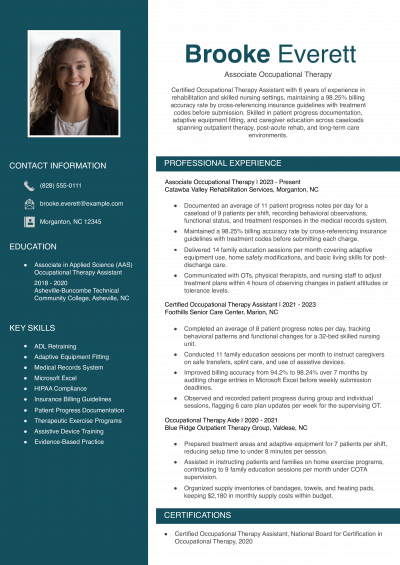
Hiring OT directors look for caseload size, productivity percentage, and the assessments you actually score on the first page, because that mix shows whether you can carry a full clinic load without supervision.

Andrew Stoner , Executive Resume Writer and Career Coach

Why this resume works

  • Shows real caseload size: Naming 52 patients per week tells hiring managers exactly what kind of workload she handles.
  • Mix of settings stands out: Inpatient rehab plus pediatrics plus home health signals flexibility for clinics with varied referrals.
  • Numbers tied to patient outcomes: Length of stay dropping from 18 to 13 days connects her work to results the hospital tracks.

Entry Level Example

Entry-level OTs are fresh out of an accredited MOT or OTD program, often with two Level II fieldwork rotations and a recent NBCOT pass. The resume needs to prove caseload exposure, EMR fluency, and supervised outcomes from fieldwork.

Why this resume works

  • License and exam date are clear: Listing NBCOT certification with the month right up top answers the first question any recruiter has for a new grad.
  • Fieldwork reads like a real job: Showing he handled 70% of a caseload by week 8 turns a school rotation into evidence of real clinical readiness.
  • PRN role bridges the gap: Weekend SNF work between graduation and full-time hiring keeps his skills active and his resume from looking thin.

Experienced Example

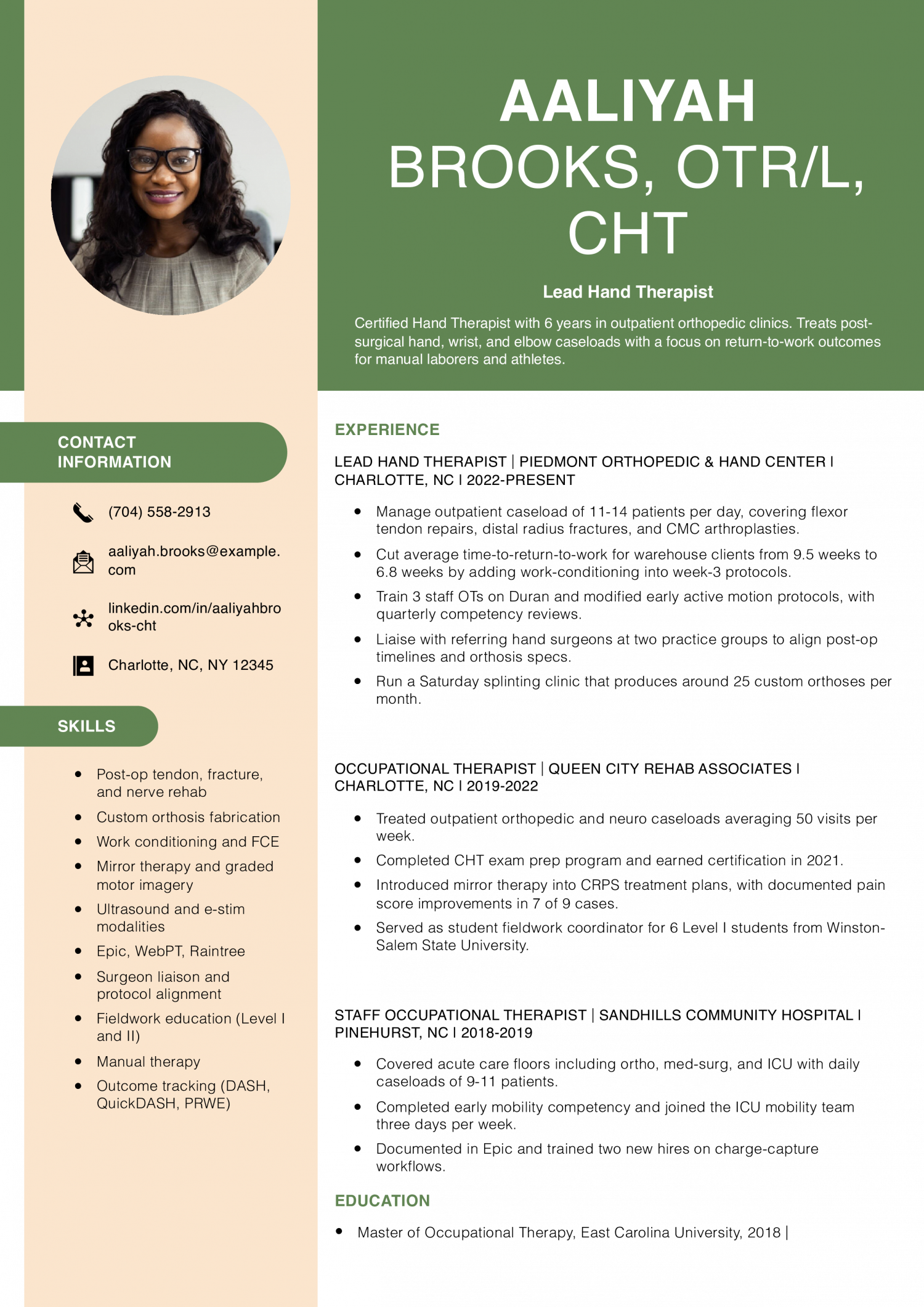
Experienced OTs carry three to seven years of caseload ownership across one or two practice settings. The resume needs to prove productivity targets met, standardized assessment fluency, and at least one specialty track like hand therapy, pediatrics, or neuro rehab.

Why this resume works

  • Specialty credential up front: Putting CHT in the name line tells hand-clinic recruiters in two seconds that she clears their bar.
  • Return-to-work numbers matter to payers: Cutting time-to-return-to-work from 9.5 to 6.8 weeks is the kind of metric workers’ comp clients care about.
  • Career arc is easy to follow: Staff OT, then certified, then lead role, the progression reads logically without needing explanation.

Senior Example

Senior OTs lead clinical programs, mentor staff, and own outcomes across multidisciplinary teams. The resume needs to prove program build-outs, supervision of OTAs and fieldwork students, and measurable gains in patient throughput or functional scores.

Why this resume works

  • Scope is unmistakable: Leading 42 clinicians and a $4.8M budget tells health systems immediately he can run a service line.
  • Numbers tied to revenue and quality: Saving $612,000 on contracted therapy and growing stroke admissions from 60 to 215 are the metrics CFOs and CMOs read first.
  • Still a clinician, not just a manager: Listing NDT, LSVT BIG, and CHT mentoring keeps him credible with the therapists he would lead.

How to Write an Occupational Therapy Resume

01 Open with what a license lookup won't show

Your state license and NBCOT number prove you can practice. They do not prove what you bring to a caseload.

Add one line under your name a clinical director cannot find on a credential check. Examples: certified hand therapist track, LSVT BIG certification, SIPT training, bilingual Spanish pediatric caseload, or splinting fabrication for upper-extremity post-op.

Put it in your summary line, not buried on page two. This is the line that earns the second read.

02 Quantify caseload, productivity, and outcomes

OT directors read for three numbers: caseload size, productivity percentage, and functional gains. Bullets without a number tend to read as duties, not results.

Name your daily caseload (10 to 14 patients), your productivity rate (85% to 92% is the common band), and a documented outcome.

Tie outcomes to standardized tools: FIM gains on inpatient rehab, COPM performance scores in outpatient, MMT changes in hand therapy. Specificity beats adjectives every time.

03 Group your work by clinical category

A wall of bullets reads as noise. Cluster your work into three or four buckets a clinical lead recognizes.

Useful categories: evaluation and treatment planning, ADL and IADL retraining, splinting and modalities, family and caregiver education, and documentation and billing.

Under each bucket, keep two or three bullets that name the population (pediatric sensory, post-stroke adult, post-op hand), the intervention, and the outcome.

04 Place credentials and EMR systems up top

Credential verification happens before the bullets are read. Put your state OT license, NBCOT registration, and BLS in a page-one credentials block under your contact line.

List the state and “license in good standing” rather than the license number. Add NBCOT certification with the issuing year, and BLS with current expiration.

Name the EMR systems you’ve documented in: Epic, WebPT, Cerner, Net Health, or Raintree. That line clears a real screening gate.

05 Close with education and fieldwork specifics

For new grads and early-career OTs, the education section carries weight a senior resume can compress. List your MOT or OTD program, the ACOTE accreditation, and graduation date.

Detail both Level II fieldwork rotations: setting, weeks completed, caseload focus, and supervising OT’s credentials. This is your clinical reasoning evidence.

Add capstone or research projects if they tie to the job’s population. Skip high school, GPA below 3.5, and unrelated coursework.

Five years ago, an occupational therapy resume read like a list of treatment techniques and settings. The skills below come from the resumes our users built in 2026. The mix has shifted toward EMR fluency, standardized assessment scoring, and specialty certifications like CHT or LSVT BIG.

OT directors weigh hard skills first because they map to billable services and caseload coverage. Soft skills like family education and interdisciplinary collaboration land second, as evidence backing your bullets. Match the lists against your target posting, then use the soft skills as the through-line in your work history bullets.

Soft Skills % of resumes with this skill
Communication 76%
Empathy 65%
Patience 44%
Problem solving 38%
Adaptability 34%

And here are the top hard skills showing up most often.

Hard Skills % of resumes with this skill
Patient assessment 75%
Treatment plan development 52%
Activities of daily living training 41%
Clinical documentation 38%
Assistive equipment fitting 34%

Based on data from thousands of occupational therapists’ resumes built on ResumeTemplates.com, May 2026.

Must Have on an Occupational Therapy Resume

These are the must-haves hiring teams look for when scanning an occupational therapy resume.

Licensure Requirements

Every occupational therapy posting screens for the same legal-minimum credentials before bullets are read. Get these on page one in a credentials block under your contact line.

List your state OT license as “License in good standing, [State name]” without the license number. If you hold licenses in more than one state, list each on its own line.

Add NBCOT certification with the year you passed the exam. Note any pending applications for additional state licensure with the expected issue date.

  • State OT license (status and state, not the number)
  • NBCOT certification (year certified)
  • BLS for Healthcare Providers (issuing body and expiration)
  • Additional state licenses or compact privilege (if applicable)
  • Pending state applications with expected issue date

Continuing Education That Reads on a Resume

Most states require CE hours per renewal cycle, and OT directors read your CE list as a map of where you’re sharpening. Include CE only when it ties to the role you’re applying for.

Group CE by topic, not by date. A cluster of pediatric sensory courses tells a school-based hiring lead something a chronological list does not.

Name the provider (AOTA, MedBridge, university-based programs) and the year. Skip generic ethics or HIPAA refreshers unless the posting calls them out.

  • Specialty-track courses (hand therapy, neuro rehab, pediatrics)
  • Standardized assessment training (SIPT, AMPS, Berg)
  • AOTA-approved provider courses with year completed
  • University-based certificate programs (LSVT, NDT, Kinesio Taping)
  • State CE hours logged per current renewal cycle

HIPAA and OSHA Compliance

Patient stories make strong bullets and weak compliance. Write outcomes that prove your clinical reasoning without identifying anyone.

Keep Patient Details Out of Your Bullets

Use population descriptors and aggregate numbers: “post-stroke adults,” “pediatric caseload of 30,” “average FIM gain of 18 points.” Avoid diagnoses paired with ages, locations, or any detail that could re-identify a patient.

Never name a specific patient, even by initials. If a case study or capstone project drove a measurable outcome, describe the intervention and result without the individual.

  • Use aggregate caseload numbers, not patient counts under five
  • Describe populations, not individuals
  • Avoid pairing diagnosis with age, gender, or location
  • Reference outcomes through standardized scores, not patient details
  • Cite published case studies by journal, not by patient identifier

Occupational Therapy Credentials That Get You the Job

Beyond your state OT license and NBCOT registration, the certifications below tell an OT director which patient populations you can take on without a ramp and which billing codes you can carry. List each item with the certifying body and the current expiration or issue date.

  • Certified Hand Therapist (CHT): Signals you can carry an outpatient hand therapy caseload independently, including post-op protocols and custom splinting.
  • LSVT BIG Certification: Tells neuro rehab and home health employers you can deliver the Parkinson's protocol, which expands the referrals they can accept.
  • Sensory Integration and Praxis Tests (SIPT) Certification: Marks you as qualified to assess and treat pediatric sensory processing, a billable specialty in school-based and clinic settings.
  • Assistive Technology Professional (ATP): Demonstrates competence in wheelchair seating, AAC devices, and home modifications for SCI, ALS, and complex pediatric clients.

Latest BLS Statistics for Occupational Therapists

The top-paying states for occupational therapists tend to cluster in markets with chronic clinician shortages and rural service areas, not the dense coastal metros most new grads target. Reimbursement structures and travel-therapy demand drive the spread more than cost of living. The employment leaders track population centers and large hospital systems, where caseload mix and productivity expectations shape the ceiling.

If you’re geographically flexible, your resume should foreground multi-state license eligibility and the settings (acute rehab, SNF, home health) where you’ve carried a full load.

$98,340 National median annual
$98,240 National mean annual
$67,090 Entry-tier floor (10th percentile)
$129,830 Top-decile ceiling (90th percentile)
152,280 Occupational Therapists in the U.S.
Where you stand

Entry tier

$67,090 to $98,340 At this tier, your resume needs to show both Level II fieldwork rotations with caseload detail and lead with NBCOT pass and state license.

Mid band

$98,340 to $129,830 At this tier, your resume needs to show productivity above 88%, a specialty track, and lead with measurable FIM or COPM outcomes.

Top decile

$129,830+ At this tier, your resume needs to show program leadership, OTA supervision, CHT or equivalent, and lead with throughput or quality-metric gains.

Top-paying states

# State Avg. Annual
1 California $119,470
2 Oregon $106,840
3 Nevada $104,770
4 Colorado $103,970
5 Oklahoma $103,510
6 New Jersey $103,340
7 Washington $102,360
8 Arizona $102,220
9 Connecticut $102,080
10 Maryland $101,880

Highest-employment states

# State Workers Median
1 California 12,020 $119,470
2 Texas 11,700 $101,760
3 New York 10,540 $95,370
4 Florida 9,230 $99,070
5 Illinois 7,410 $98,900
Source: U.S. Bureau of Labor Statistics, OEWS 2024 release (SOC 29-1122).
Written by professional resume writers and loved by hiring managers

Resume Templates offers HR approved resume templates to help you create a professional resume in minutes. Choose from several template options and even pre-populate a resume from your profile.

Frequently Asked Questions

How do I list fieldwork on an occupational therapy resume?

Treat Level II fieldwork like clinical experience, not coursework. Give each rotation its own block with setting, weeks completed, supervising OT's credentials, and caseload focus.

Add two or three bullets per rotation that name the populations you treated, the assessments you scored, and the interventions you ran.

Quantify where you can: average daily caseload, number of evaluations completed, productivity reached by the final week.

Should I list my NBCOT and state license numbers on the resume?

No. List NBCOT certification with the year you certified, and your state OT license as "license in good standing" with the state name.

The actual numbers belong on the application form, not on a document that may be shared widely.

This follows standard guidance from state boards and protects you from misuse of your credential numbers.

How do I write a personal statement for an occupational therapy resume?

Skip the "passionate OT seeking opportunity" opener. Write three lines: years of experience and primary setting, your strongest specialty or certification, and one outcome a director can verify.

For new grads, swap years for your fieldwork settings and a measurable result from each.

Anchor it to the posting's population, not a generic mission statement.

How do I show productivity without sounding like I'm gaming the metric?

State the productivity rate alongside an outcome metric, so the number reads as evidence of competence rather than corner-cutting.

For example: "Maintained 90% productivity while achieving average FIM gains of 18 points per inpatient rehab discharge."

Pair caseload size with quality data when you have it, like patient satisfaction scores or readmission rates.

Which resume template works best for an occupational therapist?

For an occupational therapist, an ATS-friendly template is the safest pick, because it puts your certifications and experience where a hiring manager scans first. A basic template is a solid alternative. Whichever you choose, keep the formatting clean and easy to parse: clear section headings, a standard font, and no graphics a parser can choke on.

Rate this article

Occupational Therapy Resume

Average Rating

4.5/5 stars with 184 reviews

You have given 0 Star(s)
4.5/5 stars with 184 reviews
Andrew Stoner

Executive Resume Writer and Career Coach

Andrew Stoner is an executive career coach and resume writer with 17 years of experience as a hiring manager and operations leader at two Fortune 500 Financial Services companies, and as the career services director at two major university business schools.