Tip !

The product owner resumes that advance past the first product-leader read share three things: a metric-led summary, prioritization trade-offs named with the constraint, and shipped features tied to a business outcome inside a stated quarter.

Andrew Stoner , Executive Resume Writer and Career Coach

Why this resume works

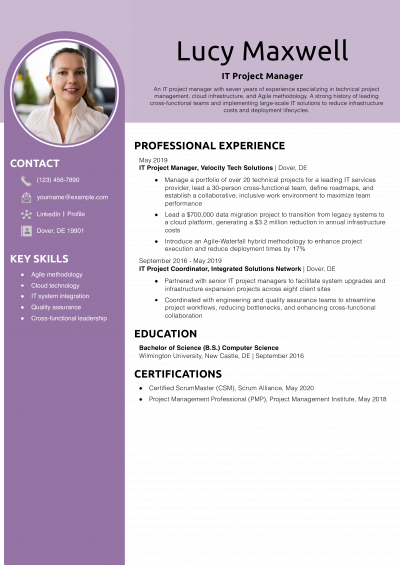
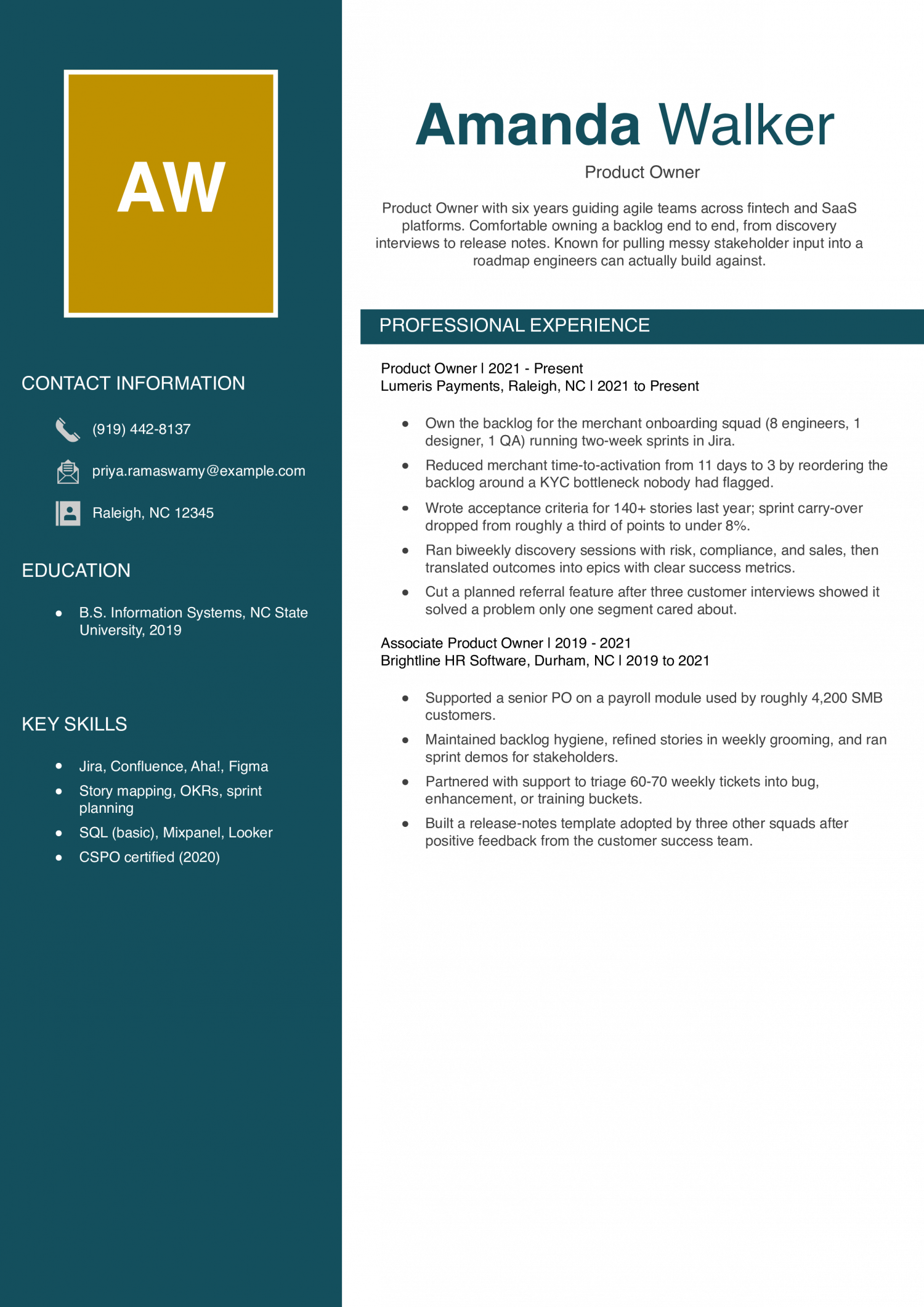
  • Real backlog ownership shown: She names the squad size and ceremonies, so a hiring manager sees she actually runs the work, not just attends meetings.
  • Numbers tied to user outcomes: The drop from 11 days to 3 for merchant activation connects her decisions to a result customers feel.
  • Willing to cut features: Pulling a referral feature after interviews shows she protects engineering time and listens to evidence.

Junior PO Example

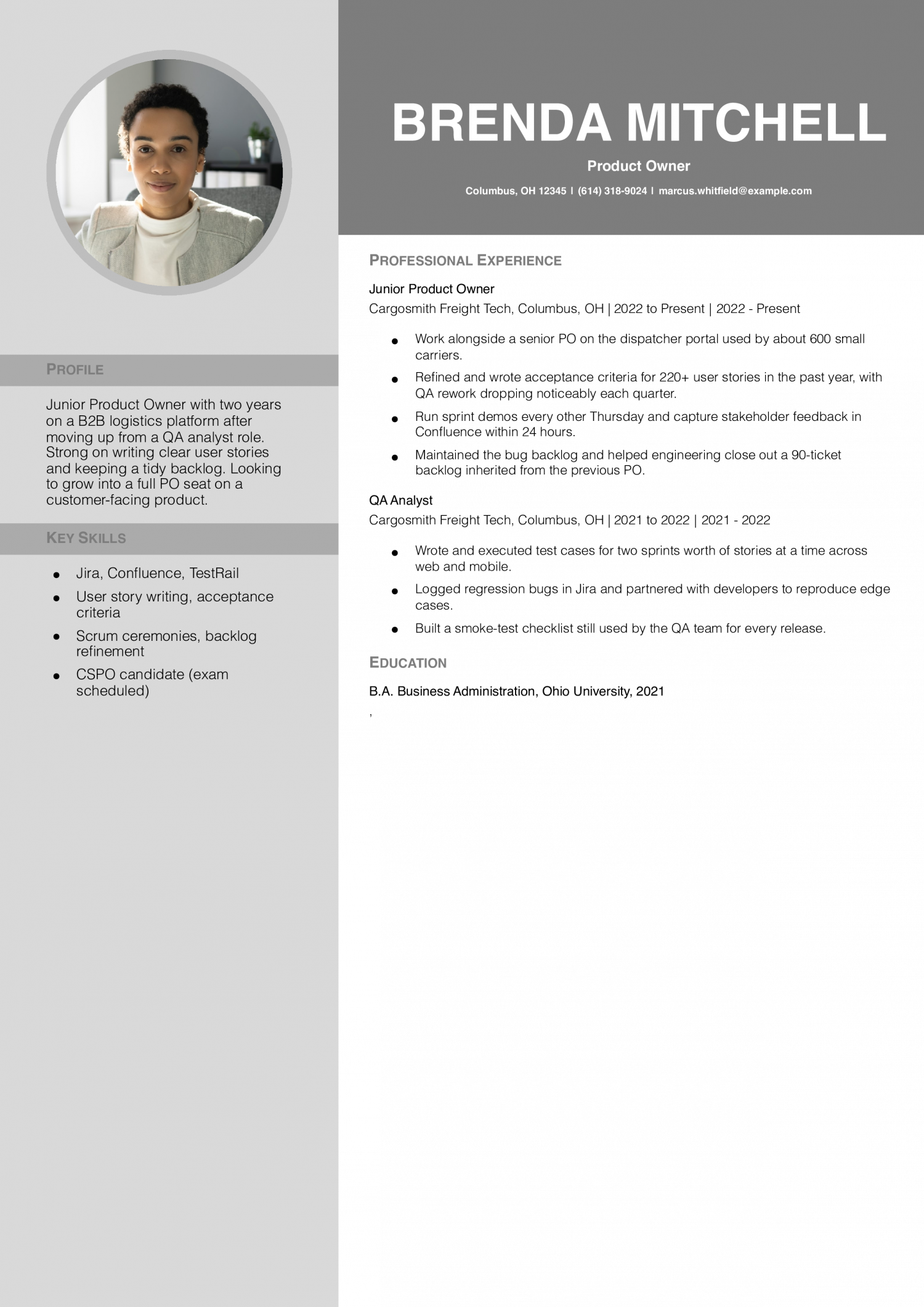
The junior product owner is one to two years in, often promoted from business analyst, QA, or associate PM work. This resume needs to prove backlog hygiene, story writing, and at least one shipped feature with a measurable user or sprint metric.

Why this resume works

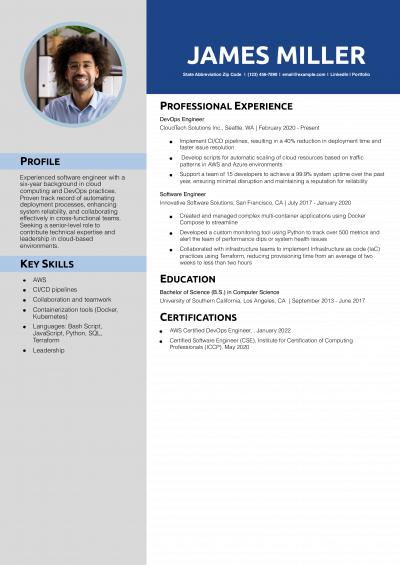
  • Shows a clear career step: Moving from QA into a Junior PO seat at the same company explains how he learned the product before owning stories.
  • One strong number stands out: 220+ stories with acceptance criteria gives a hiring manager a concrete sense of his output.
  • Honest about certification status: Listing CSPO as a candidate with an exam date is more trustworthy than padding the resume with claims he cannot back up.

Product Owner Example

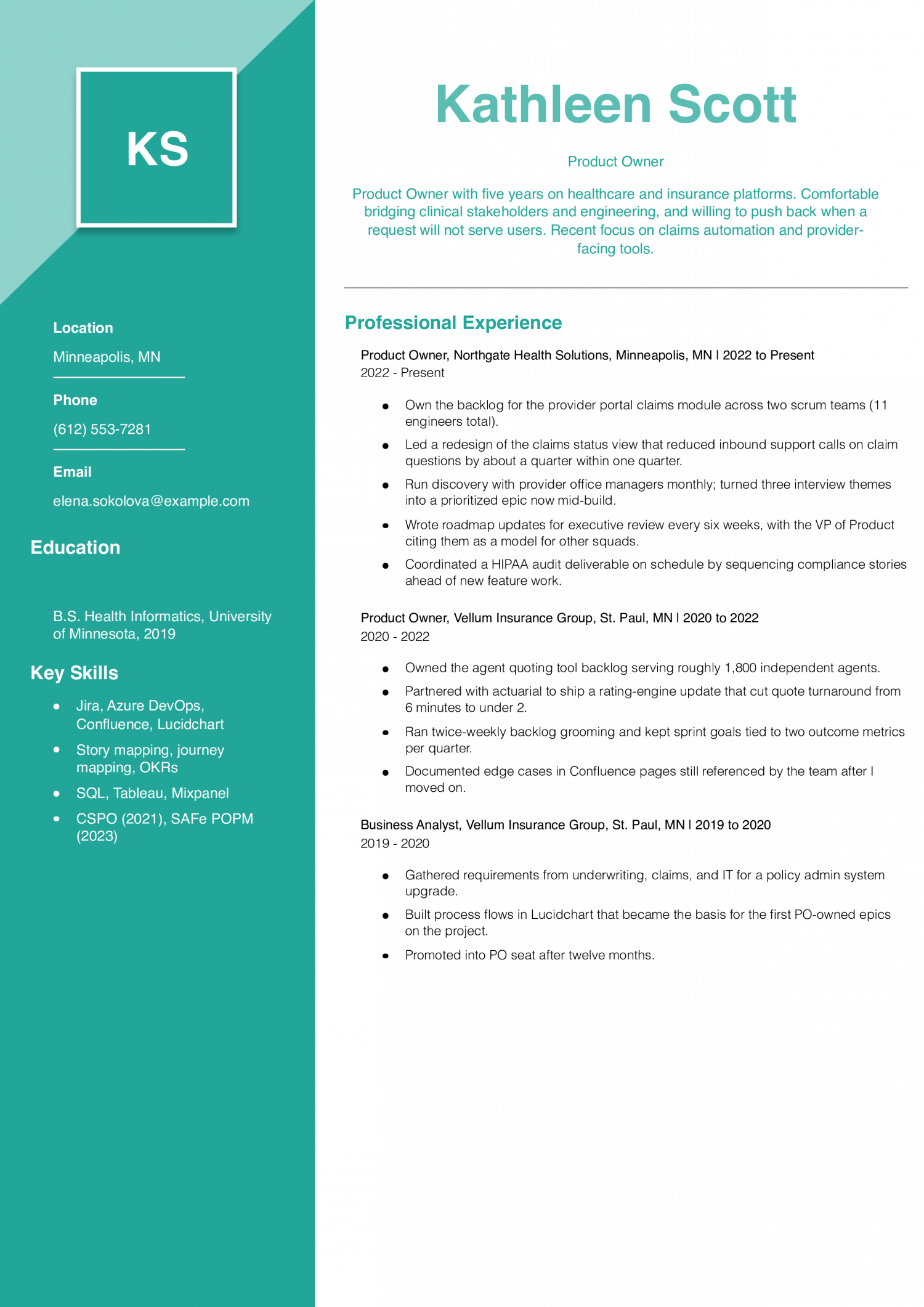
The mid-level product owner runs a full product area, owns prioritization calls, and partners daily with engineering and design. This resume needs to prove discovery-to-delivery ownership, stakeholder trade-off calls, and outcomes tied to revenue, retention, or activation.

Why this resume works

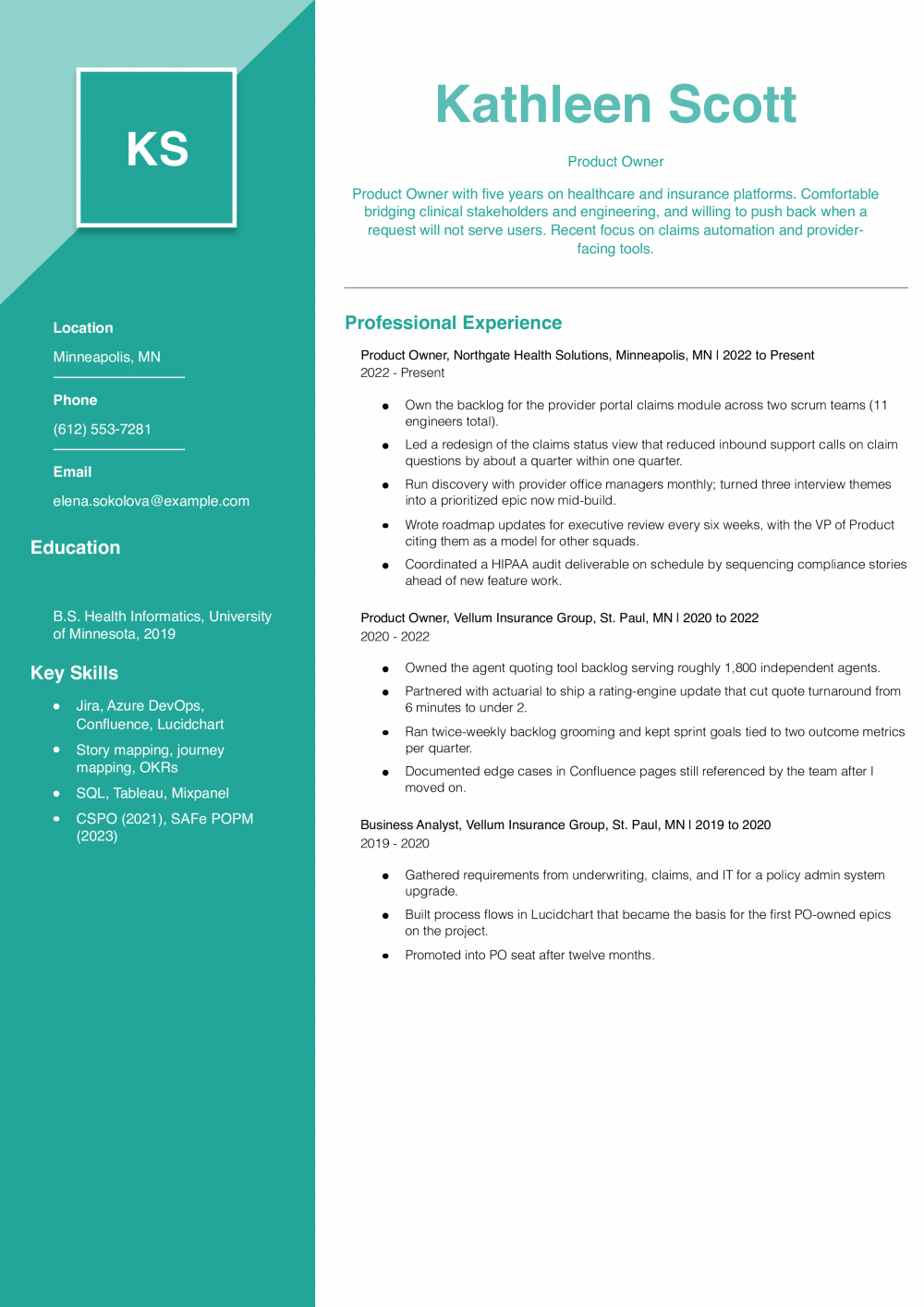
  • Numbers tied to user pain: Cutting quote turnaround from 6 minutes to under 2 makes the business value of her backlog choices clear.
  • Domain depth comes through: Healthcare and insurance specifics like HIPAA audits and rating engines show she can talk to regulated stakeholders.
  • Promotion shows growth: Moving from BA to PO at Vellum signals she earned more responsibility rather than job-hopping for the title.

Senior PO Example

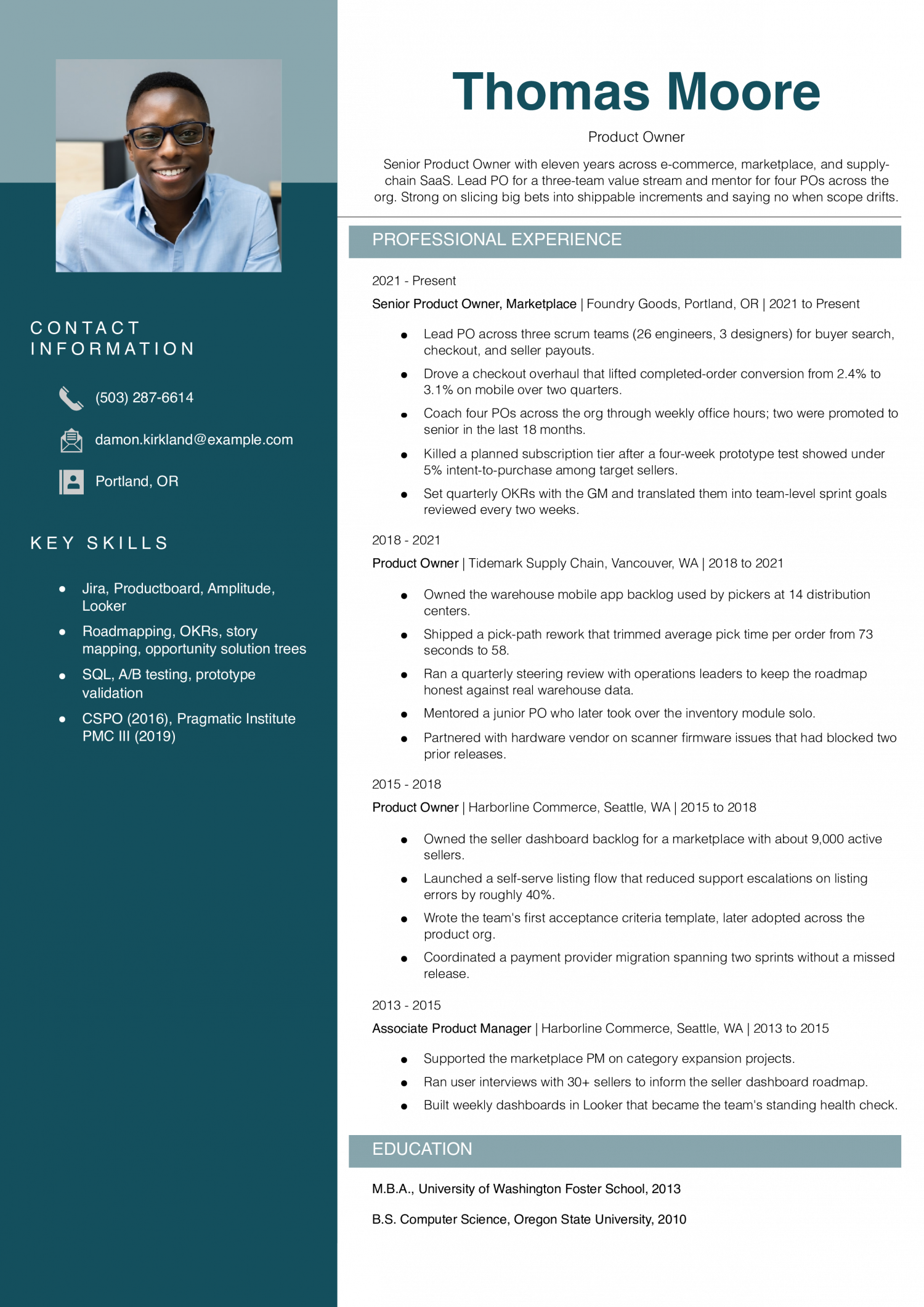
The senior product owner sets vision for a product line, mentors junior POs, and translates roadmap bets to executives. This resume needs to prove multi-team scope, OKR ownership, and bottom-line outcomes across multiple release cycles.

Why this resume works

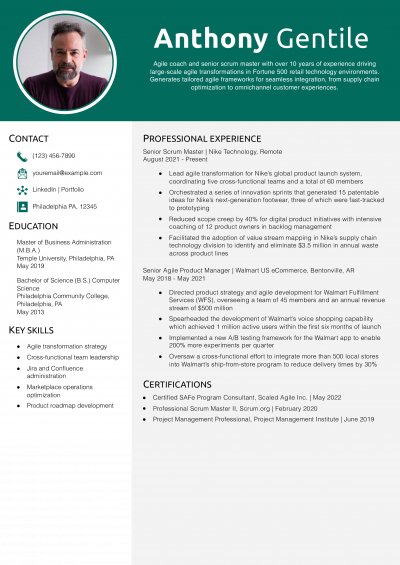
  • Leads across multiple teams: Naming the 26 engineers and three squads under his value stream shows the scope a senior PO is expected to handle.
  • Conversion lift you can verify: Going from 2.4% to 3.1% checkout conversion gives a precise, believable result tied to a specific bet.
  • Mentors other POs: Two mentees promoted in 18 months proves he develops people, not just product.

How to Write a Product Owner Resume

01 Open with the metric a product leader would use to size you up

The first line of your summary should name the business metric you moved, not your years in Agile.

Product leaders read for activation lift, retention gain, ARR contribution, or cycle-time cut inside a stated quarter. Lead with that number and the feature it came from.

Then add the product surface, team size, and user base. A line like “Product owner for a B2B billing platform serving 40,000 users, cut invoice errors 24% in Q3 2024” tells a head of product more than a paragraph of duties.

02 Quantify backlog work, not Agile vocabulary

Most strong product owner resumes name two or three metrics per role: outcome moved, scope owned, and delivery cadence.

Bullets without a number tend to read as duties. Replace “managed product backlog” with “prioritized a 180-item backlog across two squads, shipping 14 features in four quarters.”

Recruiters scan for activation rate, conversion, NPS, churn, sprint velocity, and time-to-release. Pick the two metrics your product leader actually tracked and repeat them across roles so the progression is visible.

03 Group your work into four delivery categories

Cluster bullets so the reader can locate your range fast. Use discovery, prioritization, delivery, and stakeholder work as your four buckets.

Under discovery, name the research method: user interviews, JTBD, A/B tests, or analytics dives in Amplitude or Mixpanel. Under prioritization, show the trade-off and the constraint, like “chose payments rebuild over loyalty rewrite given a six-engineer cap.”

Under delivery, name your cadence, your refinement rhythm, and one launch metric. Under stakeholder work, name the executive or partner team and the alignment artifact, like a quarterly roadmap review or a written PRD.

04 Place tools and frameworks where they get scanned

Heads of product and program managers scan for tool fluency in your skills block on page one, not buried in bullets.

List Jira, Confluence, Aha!, Productboard, Figma, Amplitude, Mixpanel, SQL, and Looker if you actually use them. Add the framework set you ran in: Scrum, SAFe, LeSS, or Kanban, with role names like CSPO or PSPO if you hold them.

Put certifications in a short credentials line near the top so the recruiter screen catches them. A line like “CSPO, PSPO II, SAFe POPM” reads faster than the same items scattered across the experience section.

05 What to cut from your product owner resume

Cut the methodology lecture. A head of product knows what Scrum is and does not need a bullet explaining sprint ceremonies.

Cut undated certifications, generic “cross-functional collaboration” lines, and any bullet that names a tool without an outcome. Cut roles older than 10 years to a one-line summary.

Keep the page focused on shipped products, the metric each one moved, and the trade-off calls you owned. If a bullet does not signal a business outcome or a scope dimension, it is using space that a sharper bullet could take.

Product hiring is tight in 2026. Product organizations are running leaner squads and the bar to clear a screen is higher. The skills below come from our user-built product owner resumes.

Heads of product weigh hard skills like backlog refinement and Jira fluency first, then read soft skills as evidence backing your delivery bullets. Match this list against the target posting and use the soft skills to frame what a feature launch actually demanded of you.

Soft Skills % of resumes with this skill
Communication 69%
Stakeholder management 59%
Leadership 48%
Cross-team collaboration 37%
Problem-solving 32%

And here are the top hard skills showing up most often.

Hard Skills % of resumes with this skill
Agile and Scrum methodology 69%
Product backlog management 50%
User story writing 47%
Product roadmapping 35%
Requirements gathering 31%

Based on data from thousands of product owners’ resumes built on ResumeTemplates.com, May 2026.

Must Have on a Product Owner Resume

Before a product owner resume gets a closer read, hiring teams verify a short list of licenses, tools, and compliance signals.

Niche Keywords for ATS Checkers

Heads of product expect to see the framework, tool, and industry vocabulary that matches your last role. Group these by sub-niche so the ATS catches each cluster cleanly.

Niche Keywords ATS scans for
Agile and Scrum delivery scrum product owner, sprint planning, backlog refinement, story point estimation
Scaled Agile (enterprise) SAFe POPM, PI planning, agile release train, feature decomposition
Discovery and research user interviews, jobs to be done, A/B testing, customer journey mapping
Product analytics amplitude, mixpanel, looker, SQL for product analytics
B2B SaaS product work saas product owner, API product owner, enterprise integrations, customer success collaboration

AI Skills to Add

Product orgs are split between teams running ChatGPT and Claude into discovery and PRD drafting, and teams that restrict AI use over data and IP concerns. Name the tools you use, describe the workflow honestly, and avoid claims that you “build AI products” if your actual practice is prompting and editing.

What AI is actually changing for this role
Discovery synthesis

User interview transcripts now run through Claude or ChatGPT for theme clustering, cutting synthesis time per round noticeably.

PRD and story drafting

First-draft PRDs and acceptance criteria are AI-generated, then edited against engineering constraints and product context.

Backlog grooming

AI summarizes Jira tickets and surfaces duplicate or stale stories, freeing PO time for prioritization calls.

AI features in the product

Postings increasingly ask for POs who have shipped LLM-backed features, including prompt design and evaluation rubrics.

AI tools to name
  • ChatGPT or Claude: Used for PRD drafting, user interview synthesis, and competitive teardown summaries against your own notes.
  • Notion AI or ProductBoard AI: Used for backlog summarization, release note drafting, and meeting recap distribution across stakeholders.
How to phrase AI on your resume
Do
  • Used Claude to synthesize 40 user interviews into five themes, cutting discovery cycle from three weeks to nine days.
  • Shipped an AI-assisted onboarding flow using GPT-4o, lifting day-seven activation 14% in Q1 2025.
Skip
  • AI-powered product visionary leveraging generative tools to revolutionize agile delivery.
  • Passionate about harnessing AI to drive next-generation product outcomes.

Portfolio Strategy

Product owners don’t need a Behance grid, but a one-page case study site changes the panel conversation. Build two or three writeups of shipped features showing the trade-off you made, the metric that moved, and what you’d do differently.

Best overall Personal site (Notion, Super.so, or Framer)

Lets you control the narrative and gate sensitive numbers behind a password.

Best for quick setup Notion public page

Free, fast, and lets you embed Figma, Loom, and screenshots inline.

Best for credibility Medium or Substack writeups

Long-form case studies that double as thought-leadership and ATS-discoverable text.

Structure each case study the same way so panel reviewers can compare them. Use four headers: the problem and constraint, the discovery you ran, the trade-off you made, and the outcome with a number.

If you’re under NDA, swap absolute numbers for relative ones (“lifted activation 18% quarter-over-quarter”) and name the product surface, not the employer. Most product leaders accept this framing as long as the trade-off logic is intact.

Tools and Tech Stack to List

Product owner postings filter on tool fluency before they read the bullets. List the tools you’ve used for more than three months in a dedicated skills block on page one.

  • Backlog and roadmapping: Jira, Confluence, Aha!, Productboard, Linear
  • Analytics: Amplitude, Mixpanel, Looker, Tableau, SQL
  • Experimentation: Optimizely, LaunchDarkly, Statsig, Split
  • Design and prototyping collaboration: Figma, FigJam, Miro
  • Communication and documentation: Slack, Notion, Loom

Product Methodologies to Name on Your Resume

Heads of product scan for the methodology vocabulary that matches their shop. Name what you’ve actually run, the team size, and the cadence so the experience reads as practiced, not classroom.

  • Scrum
  • SAFe
  • Kanban
  • Dual-track agile
  • Lean and JTBD

Product Ownership Credentials That Get You the Job

Heads of product read this list as a map of where your work is heading. The certifications below tell them which framework or scaling track you’ve invested in. List the issuing body and the year of completion on a single line near the top of the resume.

  • Certified Scrum Product Owner (CSPO): Scrum Alliance credential most product owner postings list as a baseline; cheapest signal that you've trained in the role.
  • Professional Scrum Product Owner (PSPO I and II): Scrum.org credential that carries more weight than CSPO at engineering-led shops; PSPO II signals depth beyond the entry tier.
  • SAFe Product Owner / Product Manager (POPM): Required at most enterprise SAFe shops; name it if you're targeting financial services, healthcare, or government roles.
  • Pragmatic Institute Certified (PMC): Signals discovery and market-facing work over pure backlog execution; useful if you're moving toward product manager scope.

Latest BLS Statistics for Product Owners

Top-paying states for product owners cluster in tech-dense markets with high cost of living, alongside a few finance and defense hubs where enterprise SAFe work pays a premium. Highest-employment states track where major tech employers concentrate their product orgs.

If you’re geographically flexible, the resume should foreground the industries you’ve shipped in and any enterprise framework experience, since those are the levers that travel across regions.

$111,569 National median annual
$80,000 Entry-tier floor (10th percentile)
$141,900 Top-decile ceiling (90th percentile)
1,006,160 Product Owners in the U.S.
Where you stand

Entry tier

$80,000–$111,569 At the entry tier, lead with your CSPO or PSPO, the squad size you supported, and one shipped feature with a measurable user metric.

Mid band

$111,569–$141,900 At the mid band, your resume needs to show full discovery-to-delivery ownership, named trade-off calls, and outcomes tied to retention or revenue.

Top decile

$141,900+ At the top decile, lead with multi-team scope, OKR ownership across a product line, and bottom-line outcomes named in dollars or ARR.

Top-paying states

# State Avg. Annual
1 Washington $117,030
2 Virginia $114,990
3 Delaware $114,310
4 New Jersey $113,320
5 California $111,300
6 New York $110,490
7 Massachusetts $108,630
8 Colorado $106,960
9 Alaska $105,360
10 Connecticut $104,990

Highest-employment states

# State Workers Median
1 Texas 116,240 $93,880
2 California 113,980 $111,300
3 New York 68,340 $110,490
4 Florida 65,890 $96,980
5 Virginia 46,960 $114,990
A note on these numbers. The Bureau of Labor Statistics groups product owners with IT project managers, so its standard figure can understate pay for product owners in technology. The title-specific number here is higher and draws on U.S. Department of Labor visa wage filings, which skew toward large technology employers, so treat it as the upper end. For product owners, pay swings most with the industry you land in, the size and stage of the employer, and whether you're scoped to a single squad or a product line. Use it as a guide, not a guarantee.

Primary data: U.S. Bureau of Labor Statistics. Title-specific base pay: U.S. Department of Labor (H-1B LCA disclosures). View on bls.gov
Written by professional resume writers and loved by hiring managers

Resume Templates offers HR approved resume templates to help you create a professional resume in minutes. Choose from several template options and even pre-populate a resume from your profile.

Frequently Asked Questions

How is a product owner resume different from a product manager resume?

Product owner resumes lead with backlog ownership, sprint outcomes, and engineering-team scope.

Product manager resumes lead with market discovery, roadmap strategy, and revenue ownership.

Name the squad size, framework, and shipped features for PO roles; name the segment, ARR, and roadmap bets for PM roles.

What should I write in the summary if I'm moving from business analyst or QA into product owner?

Lead with the product surface you already touched and the requirements or test work you owned that maps to PO scope.

Name the framework you ran in, the engineering team size you supported, and any backlog or story work you already did.

Add your CSPO or PSPO on the credentials line so the recruiter screen catches the formal training.

Do I need to list every Agile framework I've worked in?

No. List the frameworks named in the target job posting plus any you ran for more than six months.

Most product leaders read a long framework list as padding.

If you've run Scrum at one shop and SAFe at another, name both. If you sat through a SAFe class once, leave it off.

How do I show product impact when my features didn't move a clean business metric?

Pivot to scope and delivery metrics. Name the number of stories shipped, the team size you supported, sprint velocity trends, and time-to-release cuts. Add qualitative outcomes from user research, like "reduced support tickets in the billing flow per the CX team's Q2 review." The goal is to show evidence of ownership, not invent a metric that didn't exist.

What's the best resume template for a product owner?

For a product owner, a professional template is the safest pick, because it signals the polish hiring managers in this field expect. An ATS-friendly template is a solid alternative. Whichever you choose, keep the formatting clean and easy to parse: clear section headings, a standard font, and no graphics a parser can choke on.

Rate this article

Product Owner Resume

Average Rating

4.7/5 stars with 158 reviews

You have given 0 Star(s)
4.7/5 stars with 158 reviews
Andrew Stoner

Executive Resume Writer and Career Coach

Andrew Stoner is an executive career coach and resume writer with 17 years of experience as a hiring manager and operations leader at two Fortune 500 Financial Services companies, and as the career services director at two major university business schools.