Marketing Resume Examples and Templates for 2026



Launch metrics and named positioning frameworks are what get product marketing manager resumes past the recruiter screen; cross-functional context is what makes them readable enough to advance to the hiring panel.
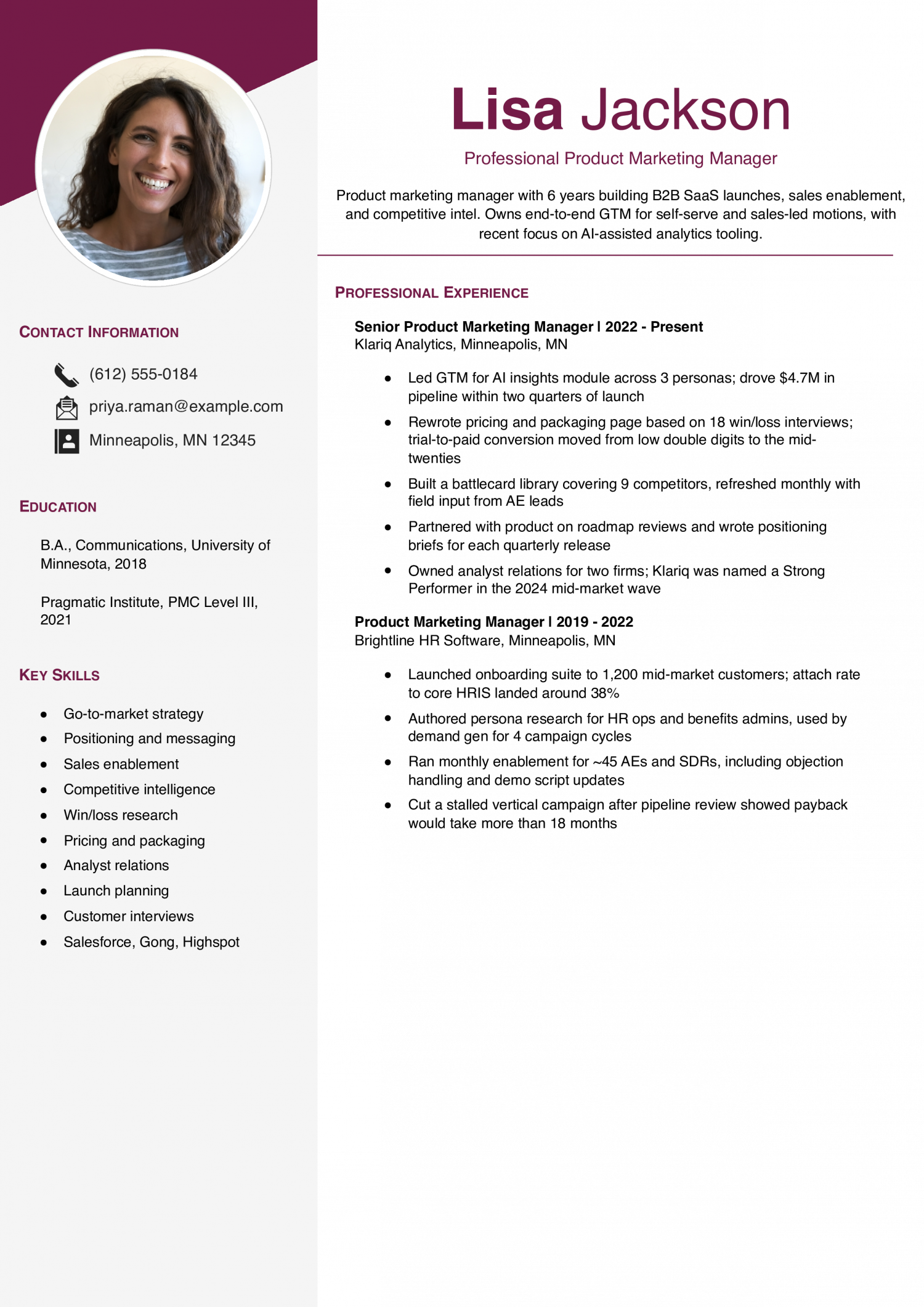
This product marketing manager resume fits an IC with two to five years owning launches or a product line. The file needs to prove you led a tier-one launch end to end, wrote the positioning, and moved a named metric.
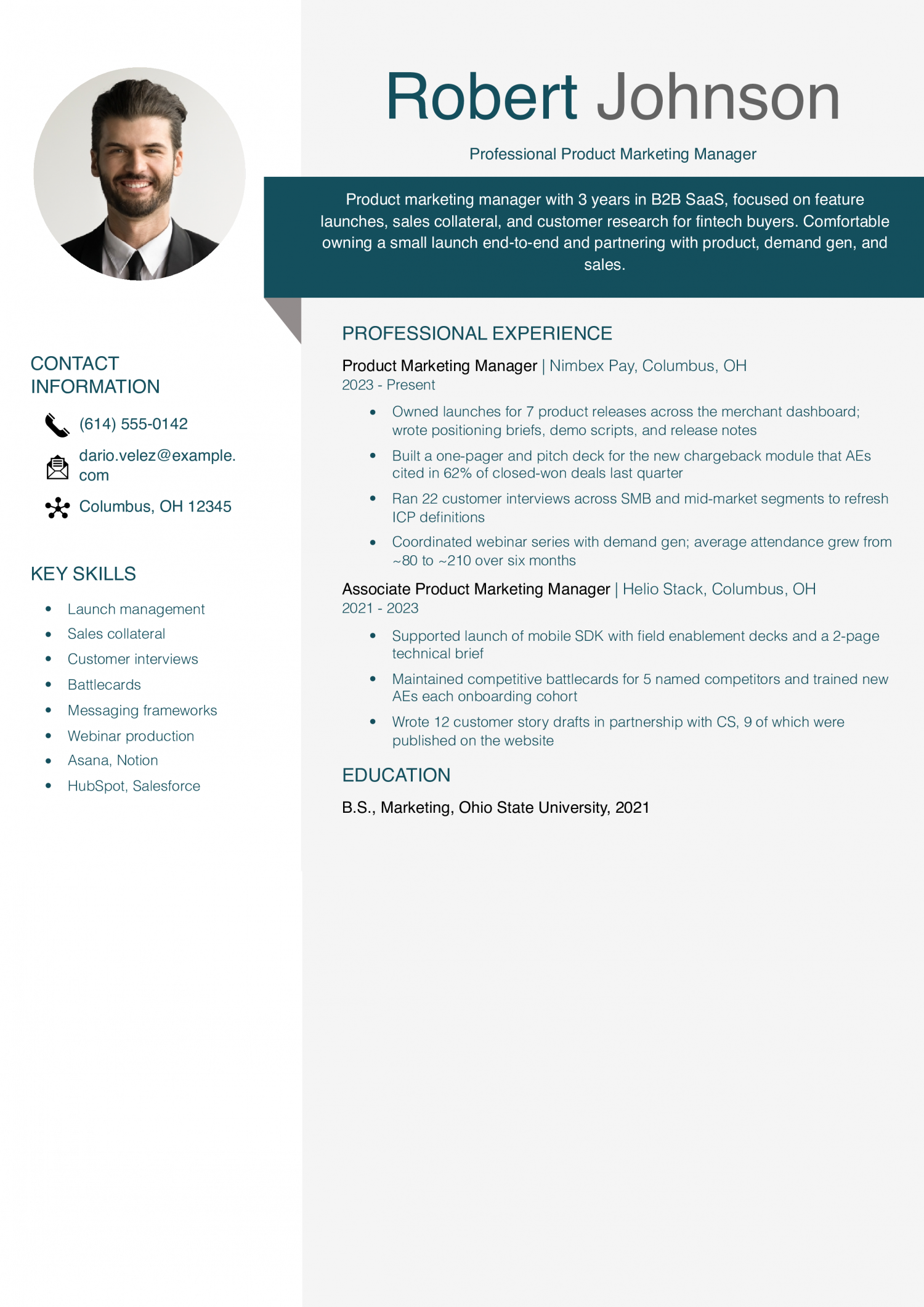
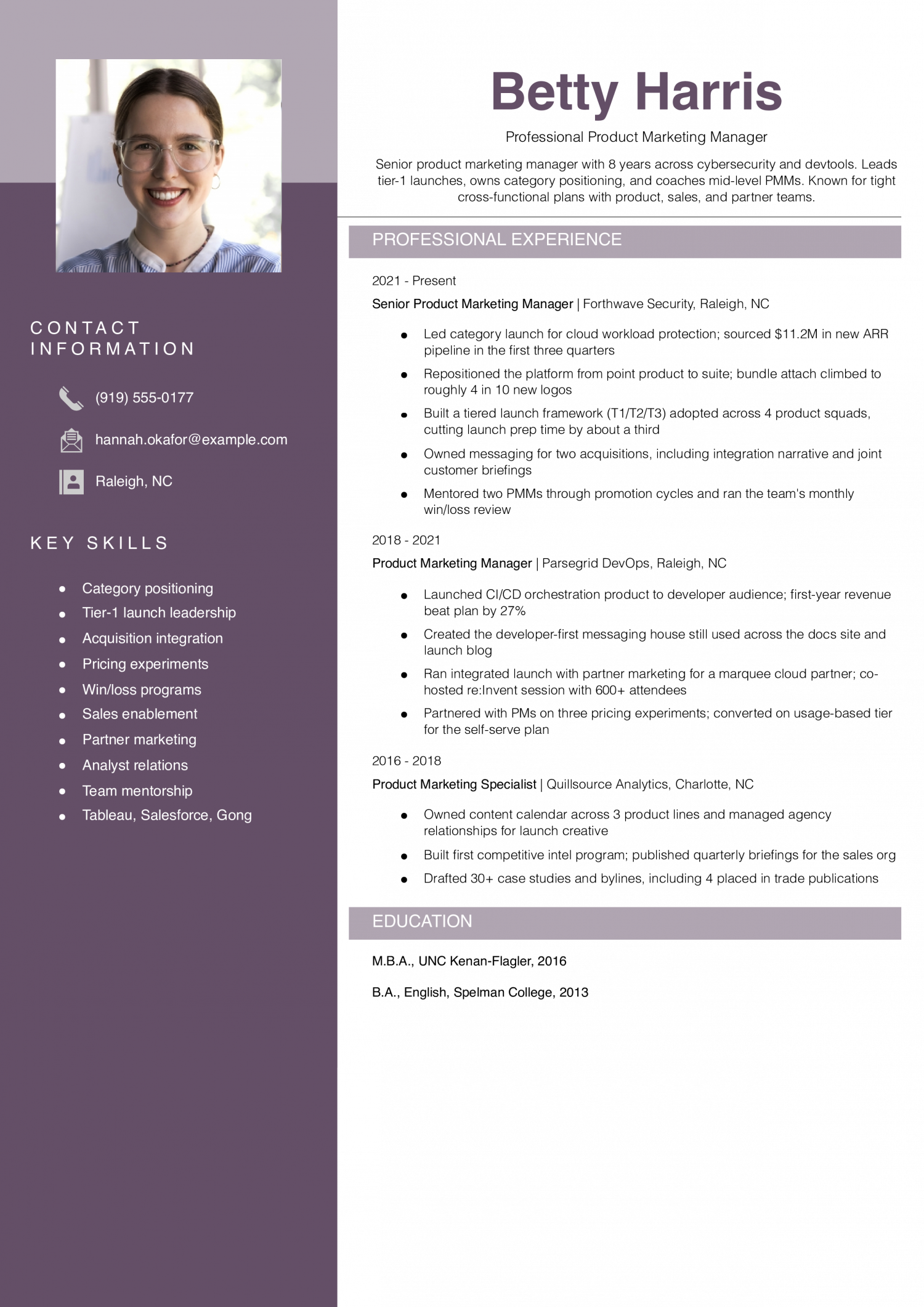
This senior product marketing manager resume fits a five-to-eight-year operator running multi-product launches or a strategic segment. The file needs to show messaging frameworks you built, sales enablement adoption, and pipeline or win-rate lift you can defend in interview.
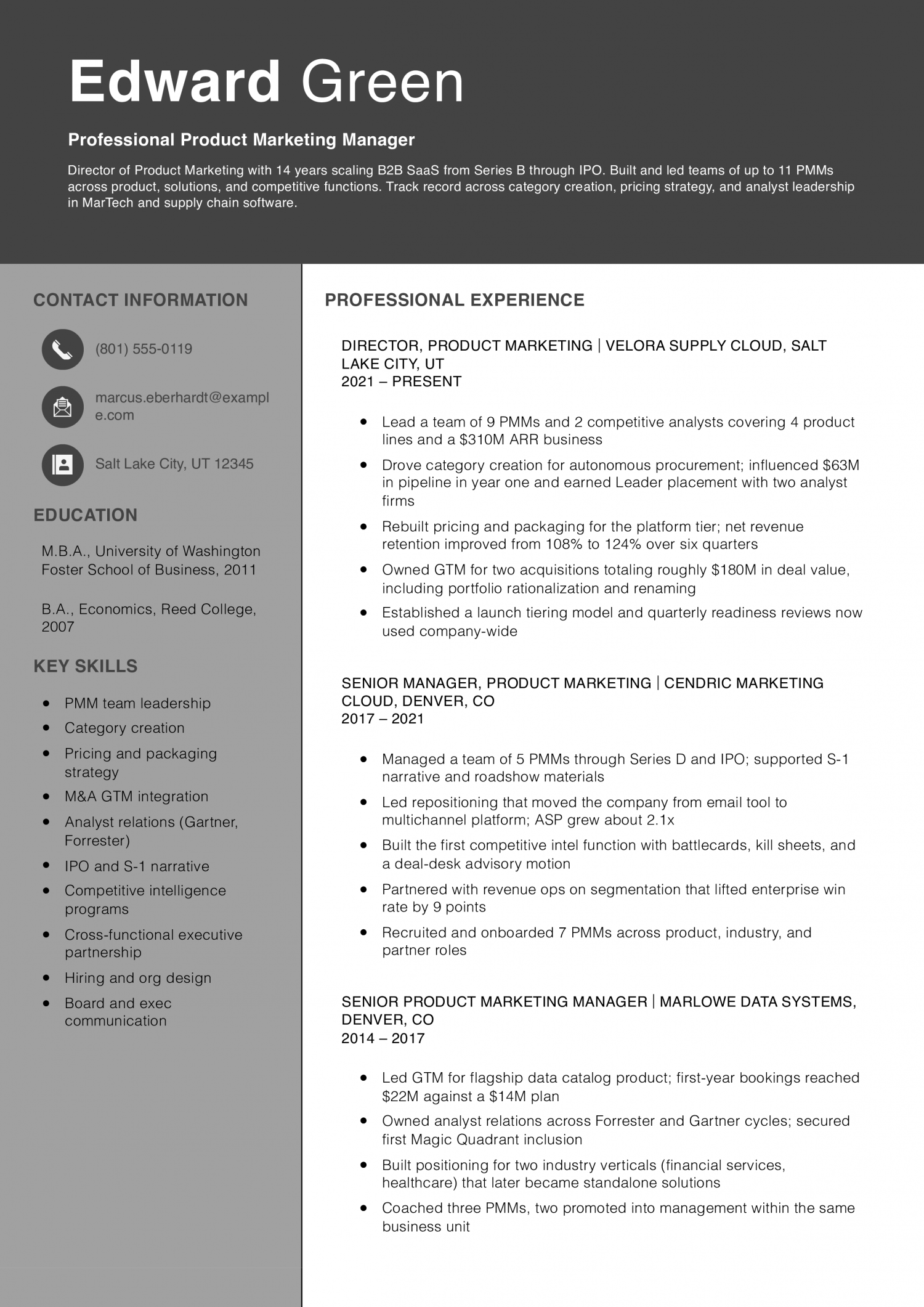
This director of product marketing resume fits a leader managing two or more PMMs across a product portfolio. The file needs to prove team scope, GTM strategy ownership, executive stakeholder reach, and revenue contribution at the segment or business-unit level.
Product marketing manager with 9 years in B2B SaaS spanning vertical software, payments, and AI tooling. Leads tier-1 launches, owns positioning and pricing, and partners closely with sales leadership on enablement and competitive deals. Comfortable presenting to executives, analysts, and customer advisory boards.
Your summary’s first line should name the launch tier you’ve led, the revenue or pipeline it generated, and the segment.
VPs of product marketing read this as your readiness to own their next release. A line like “Led the tier-one launch of a $12M ARR developer tool across mid-market and enterprise” sizes you up in one read.
Skip the “strategic storyteller” opener. Lead with launch scope, ARR or pipeline contribution, and the buyer segment. The rest of the summary then names your positioning craft (messaging frameworks, win-loss program ownership) and your cross-functional reach across product, sales, and demand gen.
Product marketing is a quantification-heavy role in 2026. Bullets without a number tend to read as duties, not impact.
Name three metric types across the resume: launch outcomes (ARR sourced, adoption rate, NPS at launch), positioning outcomes (win-rate lift, deal-size change, message-test results), and enablement outcomes (rep certification rates, time-to-first-deal, content usage in Highspot or Seismic).
Strong bullets pair the artifact with the lift: “Rewrote competitive battlecards for the top three competitors, contributing to a 9-point win-rate gain in contested deals over two quarters.” Recruiters scan for the number first, then the artifact that produced it.
Cluster bullets under categories VPs of product marketing recognize, so the panel can map you to their org chart.
Use four groupings: GTM and launch (launch tiers led, segments served, sequencing), positioning and messaging (JTBD interviews, value pyramids, naming, narrative frameworks), sales enablement (battlecards, certifications, MEDDIC or Command of the Message integration, Gong call review), and market intelligence (win-loss programs, analyst relations with Gartner or Forrester, competitive teardowns).
Customer marketing and pricing belong here too if you’ve owned them. The grouping makes scope legible at a glance and lets the reader confirm you cover the surface area their open role needs.
Put a tools line near the top of the resume, under the summary or in a dedicated block on page one. Recruiters search for stack names before they read bullets.
Name the real stack: Pendo or Amplitude for product analytics, Salesforce and HubSpot for funnel data, Highspot or Seismic for enablement, Klue or Crayon for competitive intel, Gong or Chorus for voice of customer, Figma for collateral review.
List Pragmatic Institute, Product Marketing Alliance, or Reforge certifications in a compact credentials block on page one. VPs of product marketing read these as shared vocabulary, not gatekeeping, so visibility matters more than ornamentation.
At the senior and director level, cut anything that reads as junior scope. Drop campaign-execution bullets that belong on a marketing coordinator resume.
Remove tactical content production lines (“wrote five blog posts”) unless they tie to a named launch metric. Compress early-career roles to two bullets each focused on the largest launch you owned.
Cut tool lists longer than nine items, generic “cross-functional collaboration” lines without a named team, and any soft-skill bullet that doesn’t end in a number. Replace them with one strong line on segment strategy, portfolio positioning, or team scope.
ATS filters catch more product marketing manager resumes than ever in 2026. The skills below come from our user-built product marketing manager resumes. Named frameworks like JTBD, MEDDIC, and win-loss programs clear the first cut.
Cross-functional language tied to product, sales, and demand gen decides whether the resume advances to the recruiter screen. Match the table against your target job posting, and treat the soft skills as evidence backing your bullets, not as standalone claims.
| Soft Skills | % of resumes with this skill |
|---|---|
| Cross-functional collaboration | 69% |
| Storytelling | 56% |
| Communication | 47% |
| Customer empathy | 36% |
| Prioritization | 27% |
And here are the top hard skills showing up most often.
| Hard Skills | % of resumes with this skill |
|---|---|
| Go-to-market strategy | 66% |
| Product positioning and messaging | 58% |
| Market and competitive research | 44% |
| Product launch management | 35% |
| Marketing data analysis | 26% |
Based on data from thousands of product marketing managers’ resumes built on ResumeTemplates.com, May 2026.
Before a professional product marketing manager resume gets a closer read, hiring teams check for a short list of essentials.
VPs of product marketing expect to see vocabulary that matches their GTM motion, not a generic marketing skills wall. Group your keywords around the sub-niche the posting describes.
| Niche | Keywords ATS scans for |
|---|---|
| Launch and GTM | go-to-market strategy, product launch, tier-one launch, launch tiering |
| Positioning and messaging | jobs-to-be-done, value proposition, messaging framework, narrative design |
| Sales enablement | battlecards, MEDDIC, command of the message, rep certification |
| Market intelligence | win-loss analysis, competitive intelligence, analyst relations, Gartner magic quadrant |
| Pricing and packaging | pricing strategy, packaging, tier design, monetization |
AI use on a product marketing manager resume can go three ways: lead with “AI-powered storyteller” (which VPs of product marketing screen out), leave it off entirely (which reads as evasive in 2026), or describe the workflow as it actually runs. The third is what hiring panels can validate.
Teams use LLMs to summarize earnings calls, G2 reviews, and analyst reports into draft battlecards a PMM then verifies and edits.
Synthetic persona testing and AI-assisted survey design are speeding up the early rounds before live customer interviews.
First-draft one-pagers, email templates, and call scripts are AI-generated, then refined against win-loss data and rep feedback.
Gong and Chorus AI summaries are shortening interview cycles, so PMMs spend more time on synthesis and less on transcription.
ChatGPT or Claude: First-draft positioning statements, competitive teardowns, and persona interview guides that you then edit against real data.
Gong or Chorus AI: Call summaries and deal-loss themes that feed win-loss programs and battlecard updates each quarter.
Beyond a marketing degree or MBA, the certifications below tell VPs of product marketing which frameworks you already speak and how you’ll plug into their GTM motion. List the certifying body and the year completed for each.
Pragmatic Institute (PMC-III or higher): The most recognized PMM credential in B2B; signals fluency in the Pragmatic Framework that many product orgs already run on.
Product Marketing Alliance Certified (PMMC): Increasingly common at SaaS companies; signals current vocabulary on positioning, launches, and sales enablement workflows.
Reforge Product Marketing or Growth Series: Reads as senior-track at growth-stage companies; pair it with a launch metric to prove you applied the framework.
Gartner or Forrester Analyst Relations Training: Worth listing if you've led an analyst briefing cycle; signals readiness to own MQ or Wave submissions at the senior level.
Top-paying states for product marketing managers cluster around enterprise software and cloud hubs where senior PMM supply runs thin, not the broad coastal metros most candidates assume pay best. The compression sits in mid-market SaaS markets where IC supply is deeper.
If you’re geographically flexible, the resume should foreground the segments you’ve launched into (developer tools, fintech, enterprise security) and the ARR tier of those launches, since that’s the signal hiring teams in concentrated markets use to justify above-band offers.
| # | State | Avg. Annual |
|---|---|---|
| 1 | Massachusetts | $192,480 |
| 2 | California | $178,160 |
| 3 | Virginia | $177,250 |
| 4 | Colorado | $173,390 |
| 5 | New Jersey | $173,310 |
| 6 | New York | $172,590 |
| 7 | Rhode Island | $171,250 |
| 8 | Washington | $168,800 |
| 9 | District of Columbia | $168,080 |
| 10 | Minnesota | $167,250 |
| # | State | Workers | Median |
|---|---|---|---|
| 1 | California | 56,300 | $178,160 |
| 2 | New York | 49,480 | $172,590 |
| 3 | Texas | 43,920 | $140,620 |
| 4 | Illinois | 21,670 | $154,480 |
| 5 | Florida | 20,630 | $130,490 |
Resume Templates offers HR approved resume templates to help you create a professional resume in minutes. Choose from several template options and even pre-populate a resume from your profile.
Use proxy metrics your former employer has already shared publicly or that don't expose the ARR figure directly.
Strong proxies include adoption rate at 30 or 90 days, win-rate change in contested deals, pipeline coverage ratio, NPS lift, and rep certification rates after enablement rollout.
Phrase the launch tier in relative terms ("tier-one launch across mid-market and enterprise") rather than naming the exact ARR. VPs of product marketing read this as discretion, not evasion.
Lead with the two or three launches where you owned positioning end to end and can name a metric.
Group smaller releases into a single line under each role, like "Supported 11 minor releases with refreshed messaging and enablement." That signals volume without burying your tier-one work.
Directors should cut launch lists entirely and replace them with portfolio scope: number of products, segments served, and team headcount.
Foreground the customer-facing and GTM-adjacent work you already did as a PM. Lead with launches you sequenced, beta programs you ran, and positioning input you gave to marketing.
Rewrite your summary around buyer outcomes and segments, not feature shipping cadence. Name any win-loss interviews, sales ride-alongs, or analyst briefings you contributed to.
List Pragmatic or Product Marketing Alliance coursework in the credentials block to signal you've done the vocabulary work for the switch.
Match the depth in the posting and the segment. Developer-tool and infrastructure PMM roles expect API fluency, architecture vocabulary, and the ability to read a product spec.
For those roles, name the technologies you positioned (Kubernetes, Snowflake, specific cloud services) and any developer programs you ran. Horizontal SaaS roles weight buyer-persona depth and segmentation craft more than stack vocabulary.
For a product marketing manager, a professional template is the safest pick, because it signals the polish hiring managers in this field expect. An ATS-friendly template is a solid alternative. Whichever you choose, keep the formatting clean and easy to parse: clear section headings, a standard font, and no graphics a parser can choke on.
Executive Resume Writer and Career Coach
Andrew Stoner is an executive career coach and resume writer with 17 years of experience as a hiring manager and operations leader at two Fortune 500 Financial Services companies, and as the career services director at two major university business schools.