College Resume Examples and Templates for 2026

Your profile should sit at the top of page one. Name your school, your major or intended major, and your expected graduation month and year. Add your GPA if it is 3.3 or higher. State…
Every resume example is written and reviewed by our team of Certified Professional Resume Writers to ensure top-quality content and formatting.
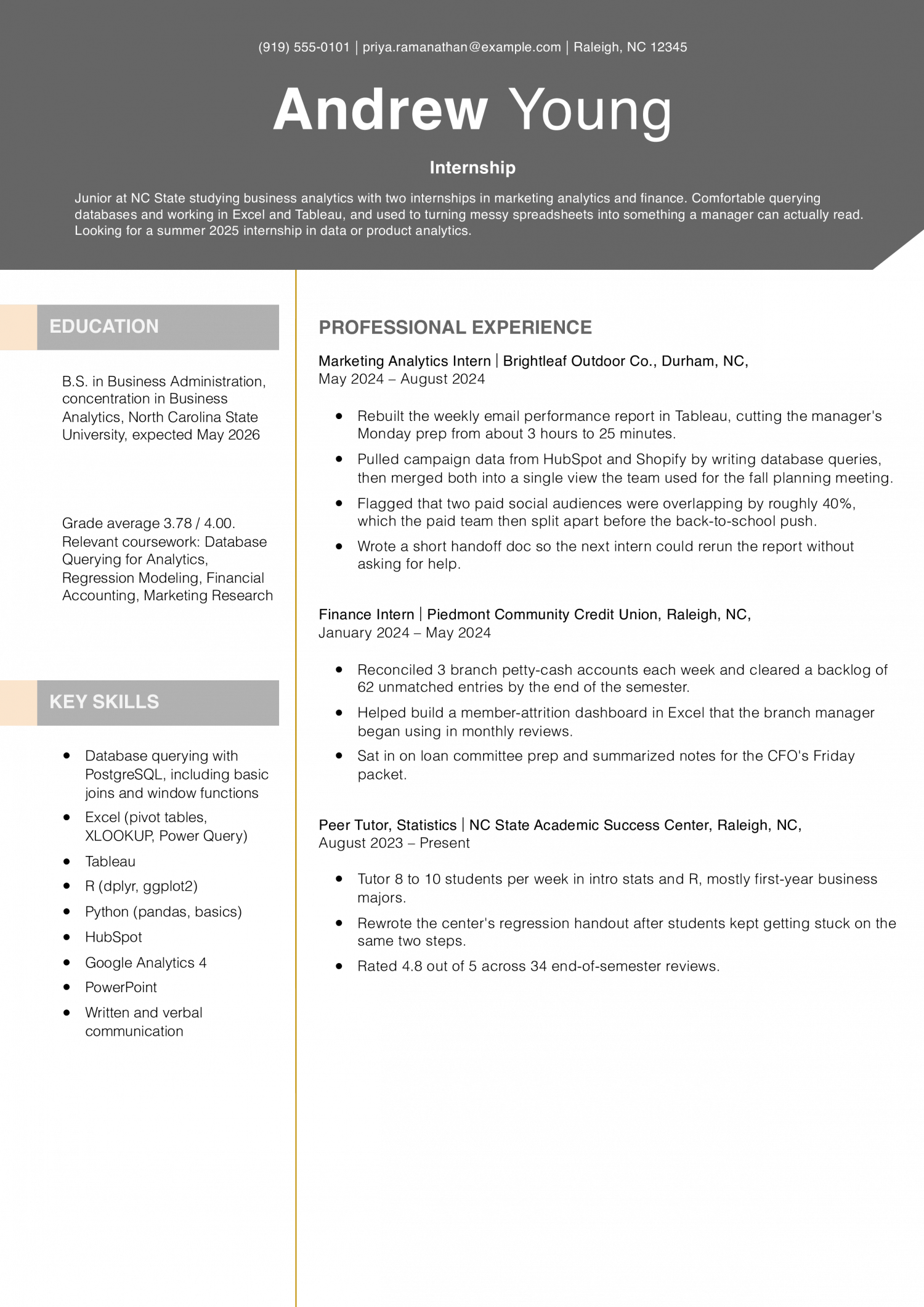
An internship resume is judged on coursework, projects, and part-time work, since you have not held the role yet. Your best proof is a class project or campus job where you used a real tool. Excel, Python, Figma, or QuickBooks all count if you shipped something a reader can picture.
Internship coordinators and team leads screen for signs you can learn fast and finish work on time. They want one or two projects with named tools, plus a short line on what you did with a team.
The accounting intern resume examples below show how to frame class projects, campus roles, and tool skills when your paid work history is still short.
Coursework tied to the posting, campus projects with measurable outputs, and one section showing tools actually used are what separate the internship resumes that get callbacks from the rest for coordinators screening a hundred applications a week.
As an intern, you are early in your career and often still in school. Your resume has to show classroom projects, campus roles and part-time work that prove you can learn on the job.
Elena Vasquez
Tempe, AZ | (480) 555-0187 | [email protected] | linkedin.com/in/elenavasquez
Junior at Arizona State studying computer science with a minor in Spanish. Two software internships and a research assistant role on campus. Comfortable in Python and JavaScript, and used to shipping small features into a real codebase with code review. Looking for a summer 2025 software engineering internship.
Software Engineering Intern
Saguaro Health Systems | Phoenix, AZ | May 2024 – August 2024
Undergraduate Research Assistant
Arizona State University School of Computing, language processing research lab | Tempe, AZ | January 2024 – Present
IT Help Desk Intern
Copper State Community College | Mesa, AZ | June 2023 – August 2023
Teaching Assistant, Intro to Programming
Arizona State University | Tempe, AZ | August 2023 – May 2024
Barista
Desert Bloom Coffee | Tempe, AZ | September 2022 – May 2023
Your profile should state your degree program, your school, and your expected graduation date. Name your major, your minor if you have one, and your year in school. Then name the two or three areas of work you want the internship to sit in.
For an accounting intern resume, that might be audit support, tax prep, or financial reporting. For a software or IT internship, name the languages and the stack. Keep the profile to three or four sentences at the top of page one.
Internship coordinators and team leads read this block first to route your file. A vague profile sends the resume to the wrong reviewer, so the scope has to be plain.
Most strong intern resumes carry numbers even when the work was unpaid. Recruiters scan for scope first, so give them a size to picture. Name the number of students in a group project, the size of a dataset you cleaned, or the dollar value of a budget you tracked for a club.
A bullet that says you led a team reads as a duty. A bullet that says you led a team of five on a 12-week case reads as work. Two or three numbers per role is a good target.
If the work was qualitative, use volume language: number of shifts, number of events, hours per week. Keep the units honest and easy to check.
Sort your bullets so each role shows a few clear kinds of work. For an accounting intern, that might be reconciliations, journal entries, and audit support. For an IT intern, group by ticket work, scripting, and documentation.
For a marketing intern, group by content, analytics, and campaign support. Three to five categories per role is enough. Lead each bullet with the verb, then the object, then the number.
Avoid stacking six technical terms in one line, since that reads as a word list rather than work. Coursework, class projects, and case competitions count as real experience for an intern. Label them clearly so a reviewer can tell paid work from academic work at a glance.
Put a short skills block on page one, under the profile. List the software you have used in class or on the job: Excel, Python, QuickBooks, Tableau, or Figma, whatever fits the posting. Name the two or three tools you use well, then a second line for tools you have touched.
Add a relevant coursework line under your education block with four to six course titles that match the role. Internship coordinators and team leads use these two blocks to confirm you can start on day one. Buried tool lists get missed in a six-second scan.
If the posting names a specific system, mirror that exact term, since applicant tracking systems match on the string.
Education sits near the top for an intern, right under the profile or the skills block. Include your school, degree, and expected graduation date. Add honors, scholarships, and Dean’s List terms on their own line.
Then build a projects section for class work, hackathons, and case competitions that show the skills the posting asks for. Two or three projects, each with a one-line scope and a result, tend to advance further than a longer list. Close with a short activities block for clubs, leadership roles, and volunteer work.
Keep the whole resume to one page. A second page for an intern reads as padding to most reviewers.
The internship resumes that get callbacks share a specific skill mix. Hold the two lists up against the internship posting you’re applying for, and keep the terms that match. Internship coordinators and team leads scan for these patterns first.
Generic eager-learner framing does not clear the first screen. Coordinators weight hard skills like Excel and bank reconciliations first. Those prove you can start work on day one.
Soft skills like attention to detail then explain how you got the numbers right. Both lists matter, but the hard column carries the ATS score. Pull the four or five terms that map to your target posting.
Put each one inside a bullet that shows the work you did. A skill named without a task looks like filler to a reviewer. A skill tied to a class project or a part-time role reads as real.
Refresh the picks for every posting you send out. Small wording swaps often move you past the keyword filter.
| Soft Skills | AI-estimated % |
|---|---|
| Communication | 77% |
| Teamwork | 66% |
| Time management | 43% |
| Problem-solving | 36% |
| Adaptability | 27% |
And here are the top hard skills showing up most often.
| Hard Skills | AI-estimated % |
|---|---|
| Microsoft Office Suite | 77% |
| Data analysis | 56% |
| Project management tools | 41% |
| Written communication | 37% |
| Research skills | 29% |
Skill names and rankings come from an AI model grounded in U.S. Department of Labor occupation data for interns, not from a count of interns’ resumes built on ResumeTemplates.com.
Resume Templates offers HR approved resume templates to help you create a professional resume in minutes. Choose from several template options and even pre-populate a resume from your profile.
Put an internship inside your experience section, not inside education, once you have completed at least one.
Use the same format you use for a job: role title, organization, city, and dates. Label it clearly as an internship so internship coordinators and team leads do not mistake it for a full staff role.
Yes, list an incoming internship under experience with the start date and the word "incoming" before the role.
Give the organization, the city, and the month and year the role begins. Move the entry into normal past tense once the first week of work is behind you.
Start each bullet with a past-tense verb and end it with a number the reader can picture.
Name the tool you used, the audience you served, or the deliverable you shipped in the same line. Three to five bullets per internship is enough, and the strongest one goes first.
Drop early internships once you have three to five years of full-time work in the same field.
Keep the internship that opened the door to your current specialty, even after that point. Everything else can move to a short line under education or come off the resume entirely.
List an unpaid internship the same way you list a paid one, with title, organization, city, and dates.
Do not write the word "unpaid" on the resume, because pay status is not what internship coordinators and team leads are scanning for. The work you did and the results you produced are what earn the interview.
Name the size of the thing you touched: the class you tutored, the campaign you supported, or the dataset you cleaned.
Numbers about scope count as results even when you cannot point to an outcome you owned. One line saying what the team shipped while you were there gives the reader the context they need.
No, keep the real title the organization gave you, because internship coordinators and team leads check that against the reference they call.
Group research, campus jobs, and internships together under a header called relevant experience if you want them read as one story. The bullets under each entry are where you show the work looked like an internship in practice.
An ATS-friendly template works best for an intern resume, since it puts your coursework and project work exactly where a hiring coordinator looks first. A basic template is a solid alternative. Whichever you choose, keep the formatting clean and easy to parse: clear section headings, a standard font, and no graphics a parser can choke on.
Internship Resume
4.8/5 stars with 211 reviews

Executive Resume Writer and Career Coach
Andrew Stoner is an executive career coach and resume writer with 17 years of experience as a hiring manager and operations leader at two Fortune 500 Financial Services companies, and as the career services director at two major university business schools.
© 2026 Resumetemplates.com All rights reserved.