Financial Analyst Resume Examples and Templates for 2026



Branch managers and managing partners decide whether to keep reading at the credentials block near the top; if Series 7, Series 66, and CFP status aren't visible there, the resume moves to the reject pile.
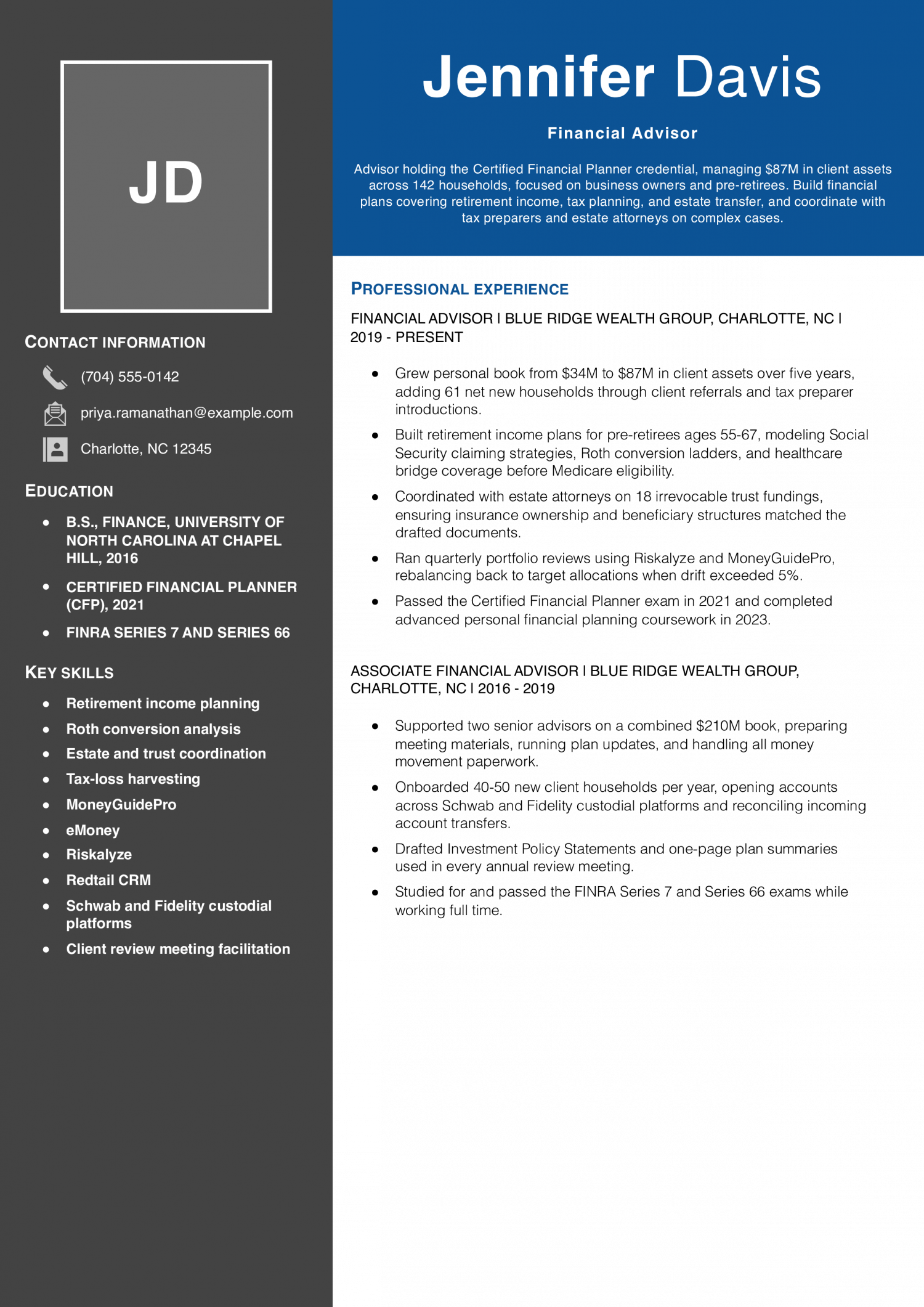
An associate financial advisor is new to the client track and often still working on Series 7, 65, or 66. Your resume must show you can support a book, prep reviews, and handle clients under a lead advisor.
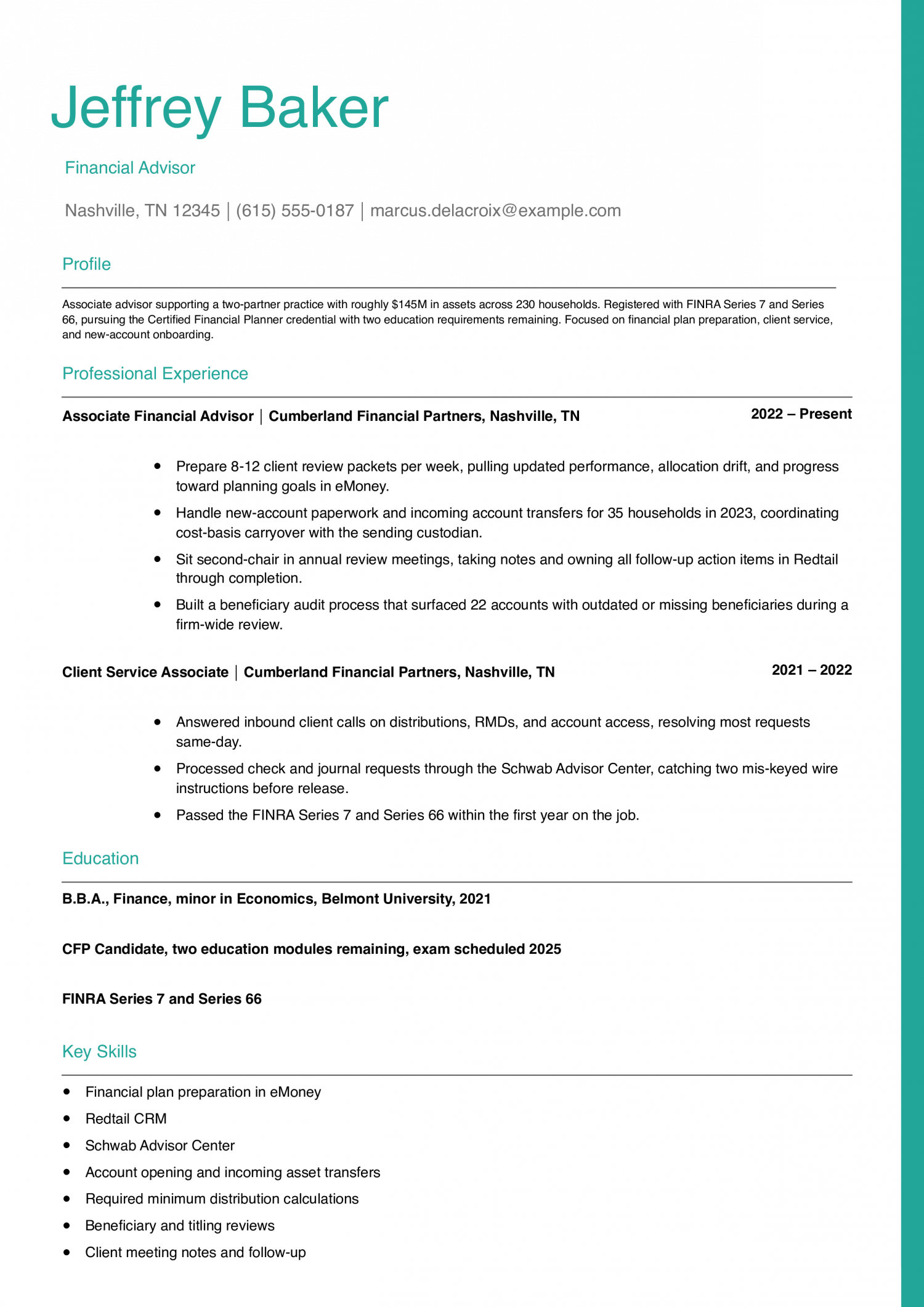
A financial advisor runs a book of clients and owns planning, portfolio reviews, and new business. This resume has to prove you can grow assets under management, deepen households, and hold retention through market and life events.
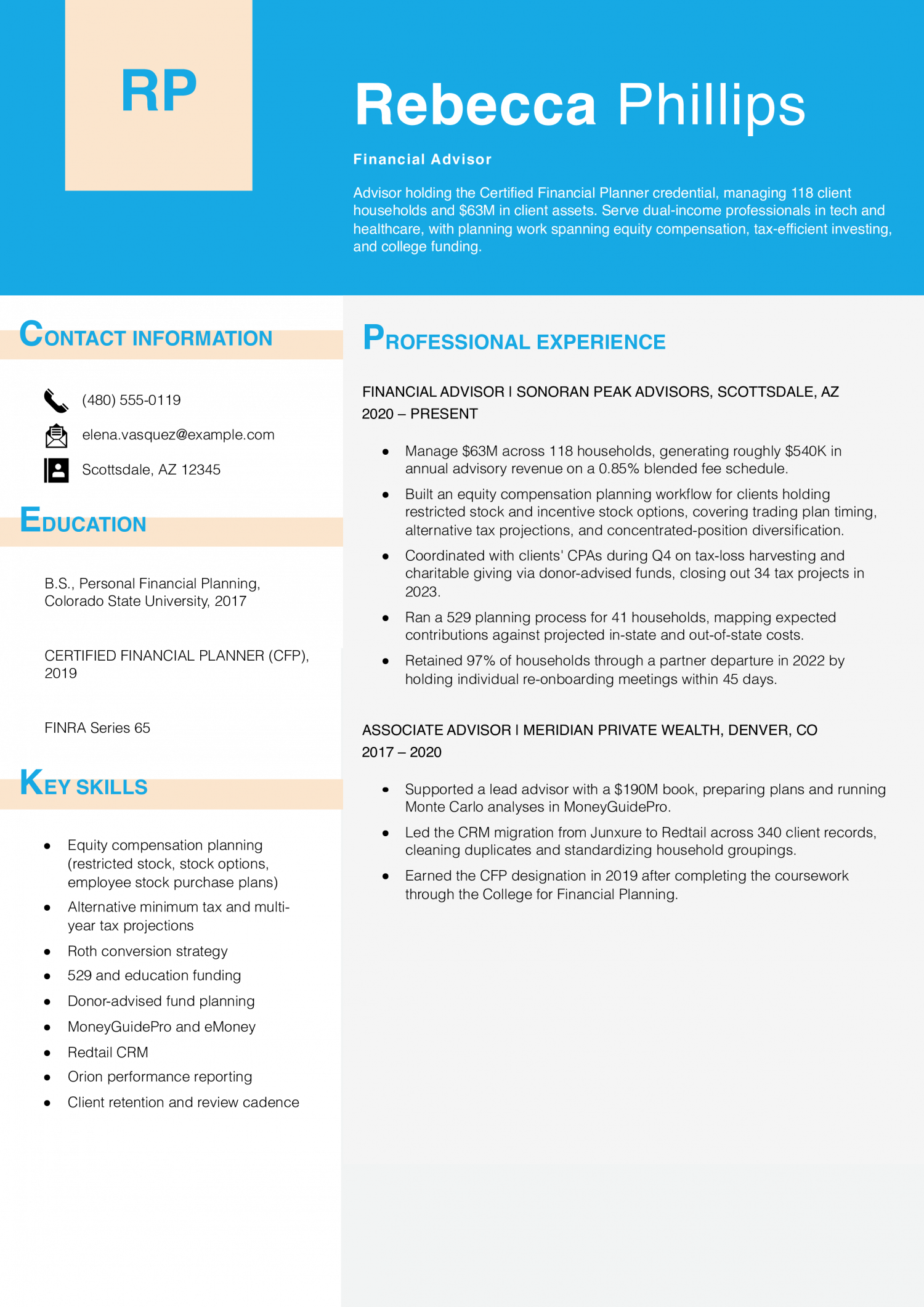
A senior advisor or partner leads complex households, mentors junior staff, and shares in firm equity. Your resume must show a steady book, team leadership, and credentials such as CFP or ChFC that back your planning depth.

Rebecca Hollingsworth, CFP
Portland, OR | (503) 555-0176 | [email protected] | linkedin.com/in/rebeccahollingsworth
CFP-certified financial advisor with 11 years managing planning-led relationships for professionals and small business owners. Currently managing $124M across 156 households, with a specialty in retirement transition planning, equity compensation, and tax-aware investing. Strong track record building referral relationships with CPAs and estate attorneys, and mentoring associate advisors through licensing and certification.
Senior Financial Advisor
Cascade Ridge Wealth Management | Portland, OR | 2019-Present
Financial Advisor
Willamette Financial Group | Eugene, OR | 2015-2019
Associate Financial Advisor
Willamette Financial Group | Eugene, OR | 2013-2015
Client Service Associate
Pacific Rim Investment Advisors | Salem, OR | 2012-2013
Branch managers and managing partners can pull your registration record in seconds. What they cannot see is the book you actually run. Put that in your first line.
Name the household count you serve, the assets you manage, and the niche you specialize in. A single opener like “CFP serving 180 households with $95M in managed assets, focused on business owners nearing exit” beats any generic summary. If you speak a second language your clients use, say so.
If you run fee-based planning rather than commission product sales, say that too. The one differentiator up top decides whether a reviewer keeps reading or moves to the next resume in the stack.
Bullets without numbers read as duties, not results. Strong advisor resumes lead with three figures a reviewer scans for first: total managed assets, household or client count, and year-over-year net new assets. Add production numbers where you have them, such as trailing twelve-month revenue or fee-based revenue mix.
Retention rate matters too, since a book that stays is worth more than a book that churns. Write “Grew managed assets from $42M to $78M over four years across 140 households” rather than “Managed client portfolios.” If you sit on a team book, say what portion you own or source. Rounded numbers are fine.
Vague ones are not, and reviewers treat them as padding.
Bucket your bullets so a reviewer sees the shape of your practice fast. Four categories tend to work. First, business development: prospecting, centers of influence, seminars, and referral sources.
Second, planning work: retirement income, tax-aware withdrawal, estate coordination, and insurance review. Third, investment management: portfolio construction, model usage, rebalancing cadence, and any discretionary authority. Fourth, service and operations: annual review cadence, CRM hygiene, and paraplanner or associate oversight.
Under each, write two or three bullets that name the deliverable and the number attached. This structure signals to Branch managers and managing partners that you can move past product sales into full-relationship planning. It also makes your resume easy to skim in under a minute.
Put your credentials block near the top, under your summary. Branch managers and managing partners screen for licenses before anything else, since an unlicensed hire cannot produce revenue on day one. List each active registration with the issuer: Series 7 and Series 66 through FINRA, or Series 7 and Series 65 if that is your path.
Add life and health insurance lines by state. If you hold the CFP from the CFP Board or the ChFC from American College, list the mark and the issuing body. Below that, name your planning and CRM stack: eMoney or MoneyGuide, Salesforce or Redtail, Morningstar, and your custodian platform.
State plus “in good standing” is the standard.
Senior advisor resumes get long because nothing gets removed. Fix that before you send. Cut early bank teller or call center roles once you have ten years in advisory.
Cut product-of-the-month sales bullets that read as commission chasing. Cut soft-skill lines like “strong communicator” and “client focused,” since every advisor claims them. Cut training courses that duplicate what your Series and CFP already imply.
Trim your education section to the degree and school, and drop the graduation year if it dates you. Keep continuing education only when it names a real specialty, such as behavioral finance or business owner planning. Two pages is the ceiling for most senior books.
A third page has to earn itself with numbers, not narrative.
Financial advisor hiring is tight in 2026. Branch managers and managing partners are running leaner books. The bar to clear a resume screen is higher than it was two years ago.
Line up your resume against the specific posting, since firms vary in which skills they weight most. Branch managers and managing partners read the hard skills first to confirm you can do the job. They weigh items like portfolio construction and Series 7 licensing against the book they need staffed.
Soft skills like client trust then decide who moves to a first call. Treat the hard skill list as your keyword bank and pull the exact wording the posting uses. Then use the soft skill list as evidence you back up with a bullet, not a bare claim.
Show client retention with a number, not the word itself. Read the posting twice before you edit your resume. Cut any skill the posting does not name and add ones it does.
| Soft Skills | AI-estimated % |
|---|---|
| Client trust-building | 76% |
| Active listening | 63% |
| Complex concept simplification | 43% |
| Calm under market volatility | 37% |
| Long-term relationship management | 29% |
And here are the top hard skills showing up most often.
| Hard Skills | AI-estimated % |
|---|---|
| Financial plan development | 66% |
| Portfolio risk assessment | 53% |
| Retirement income planning | 48% |
| Tax-efficient investing | 38% |
| Regulatory compliance | 34% |
Skill names and rankings come from an AI model grounded in U.S. Department of Labor occupation data for financial advisors, not from a count of financial advisors’ resumes built on ResumeTemplates.com.
The items below are what separate a financial advisor resume from one that gets put back in the pile.
Branch managers and managing partners scan for the work you actually do. Generic terms like planning or advising will not tell them much. Name the client segment you serve and the products you sell. Name the plan type you build and the review cadence you keep. Each row below groups three terms around one slice of the practice. Retirement work covers rollovers and income plans for near-retirees. Wealth work covers estate and trust cases for higher net worth. Investment work covers portfolio design and rebalancing across accounts. Insurance work covers annuity and life sales tied to a plan. Compliance work covers the FINRA and suitability record every book needs. Pick the rows that match your book, and drop the rest.
| Niche | Keywords ATS scans for |
|---|---|
| Retirement planning | 401(k) rollovers, Social Security timing, income planning |
| Wealth management | high net worth, estate planning, trust accounts |
| Investment advisory | portfolio construction, asset allocation, rebalancing strategy |
| Insurance and annuities | fixed annuities, variable annuities, life insurance |
| Compliance and licensing | Series 7, suitability review, FINRA reporting |
Clients are split on AI in advice work. Some want faster plan modeling and portfolio screens. Others worry about fiduciary risk and data privacy on client accounts. Branch managers and managing partners read your resume through both lenses. Name the tools your firm has approved and cleared. Describe the workflow honestly and say who reviews the output. Do not claim you build AI-driven portfolios if you use the tool for research prep. Compliance and your supervisor sign off on client-facing work. Show the tool, the task and the check you run. That framing reads as credible to a Series 7 or CFP holder.
AI summarizes statements and prior notes so you walk into review meetings with a tighter agenda.
Retirement and tax projections run faster, but you still validate assumptions before showing any figure to a client.
Tools cluster analyst notes and filings so you spend more time on client fit than on reading.
AI drafts follow-up emails and market recaps, and you edit for tone, accuracy and compliance review.
The Series 7 and a state law exam keep you eligible to sell and advise. The credentials below are what move a Financial Advisor resume from the qualified-but-typical stack onto a shortlist. Branch managers and managing partners read them as a signal of the book you can carry and the fee work you can bill. A CFP mark, for example, opens the door to planning fees, not just commissions. List each credential on its own line. Give the full name, the issuing body, the year you earned it, and the renewal date. Put the ones tied to your target seat at the top.
The top-paying states for Financial Advisors cluster in wealth-management hubs and smaller high-net-worth markets, not always the largest coastal metros most readers assume. Pay spread in this field is unusually wide. The gap from the tenth percentile to the ninetieth stretches far above what most large occupations show, and the national headcount is big.
That means the resume has to place you inside the spread, not just inside the field. If you are open to relocating, name the states where you hold Series 7, 65 or 66 registration. List the metros where you have built a book, and make your household or asset thresholds easy to find near the top.
| # | State | Median Annual |
|---|---|---|
| 1 | New York | $166,400 |
| 2 | New Jersey | $158,570 |
| 3 | California | $130,330 |
| 4 | Connecticut | $129,720 |
| 5 | South Dakota | $128,720 |
| 6 | Massachusetts | $125,670 |
| 7 | Delaware | $125,050 |
| 8 | Oregon | $122,830 |
| 9 | Illinois | $120,130 |
| 10 | Wisconsin | $119,430 |
| # | State | Workers | Median |
|---|---|---|---|
| 1 | California | 32,200 | $130,330 |
| 2 | New York | 21,550 | $166,400 |
| 3 | Florida | 21,490 | $100,970 |
| 4 | Texas | 18,200 | $99,160 |
| 5 | North Carolina | 12,340 | $96,880 |
Resume Templates offers HR approved resume templates to help you create a professional resume in minutes. Choose from several template options and even pre-populate a resume from your profile.
Keep it to one page for under ten years of work and two pages beyond that.
Put your Series licenses and CFP status in a bar under your name so a branch manager sees them in three seconds. Lead the experience section with assets under management and net new household growth, in dollars.
List it under experience with the advisor's firm, your dates, and the title "Financial Advisor Intern" if that fits.
Under it, name the client meetings you sat in on, the plans you helped draft in eMoney or MoneyGuidePro, and the prospecting calls you logged. Skip the word "shadowed" on its own, since it reads as watching rather than doing.
Yes, and you should name the one you actually hold rather than list both.
The Series 65 alone qualifies you as an investment adviser representative at a registered investment adviser. The Series 66 pairs with the Series 7 for dual registration at a broker-dealer, so a branch manager reads the two as different lanes.
Use aggregate figures a former employer already reports internally: total assets under management, household count, and net new assets for the year.
Never name a client, an account number, or a specific holding. If you signed a non-solicit, say "book retained by prior firm" so a managing partner does not have to ask.
Rewrite each bullet around the advising-adjacent work: referrals sent to the wealth desk, financial reviews you ran, and needs analyses you built.
Move product sales, teller metrics, or audit tasks to a shorter second block underneath. Then add a line naming your Series 7 and Series 66 exam window so the reader knows the license gap closes soon.
Name the planning software you use in client work, such as eMoney, MoneyGuidePro, or Orion, and the CRM, usually Salesforce Financial Services Cloud or Redtail.
Add the planning areas you actually deliver: retirement income, estate coordination, and tax-aware withdrawal. Skip soft-skill words like "communication" that every resume already claims.
Yes, list both under a Credentials heading, since the Chartered Financial Consultant covers estate and small business planning the CFP exam touches only lightly.
A managing partner scanning for a high-net-worth seat reads the pair as depth rather than duplication. Put the CFP first because clients ask for it by name.
For a financial advisor, an ATS-friendly template is the safest pick, because it puts your certifications and experience where a hiring manager scans first. A basic template is a solid alternative. Whichever you choose, keep the formatting clean and easy to parse: clear section headings, a standard font, and no graphics a parser can choke on.
Executive Resume Writer and Career Coach
Andrew Stoner is an executive career coach and resume writer with 17 years of experience as a hiring manager and operations leader at two Fortune 500 Financial Services companies, and as the career services director at two major university business schools.
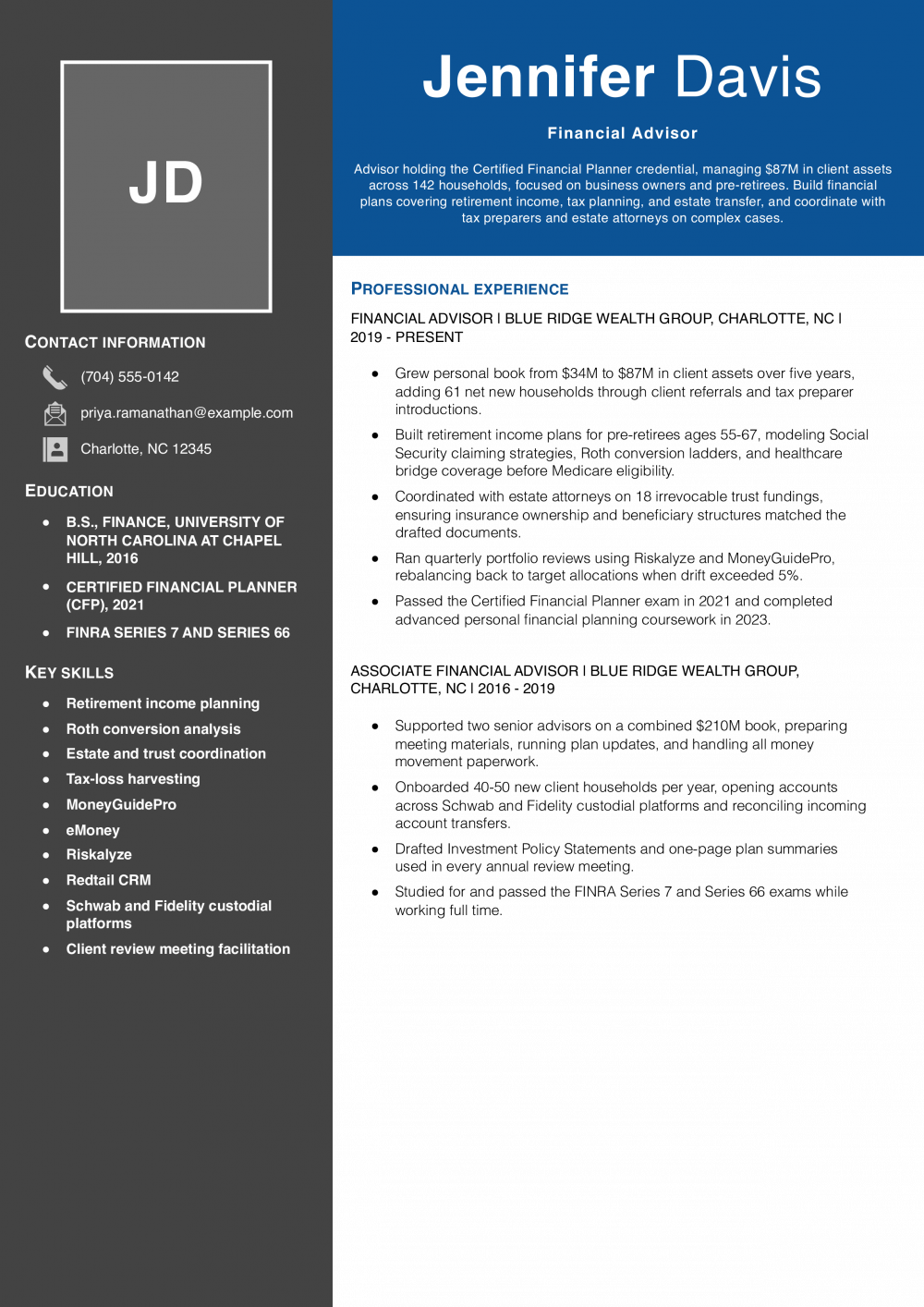
Customize this template in our builder in under 10 minutes.