
Bartender Resume Examples
The first line of your summary should name covers per shift, drinks per hour at peak, or weekly bar sales at your last spot. Bar managers and restaurant GMs read that number as your readiness…
Every resume example is written and reviewed by our team of Certified Professional Resume Writers to ensure top-quality content and formatting.
Most bar manager hires come down to proof you can run a P&L. General managers and restaurant owners look for cost controls on pour costs and labor. They want to see revenue growth tied to your menu changes or staff training.
Your resume should show inventory systems you managed and measurable bar sales results. Listing a ServSafe Alcohol or TIPS certification signals you take compliance seriously. The examples below show how to present these details in a clear format. To compare layouts before you start, browse our resume templates.
General managers and restaurant owners hiring bar managers look for pour-cost percentages and revenue growth on the first page, because those numbers show whether a candidate can protect margins while building a profitable bar program.
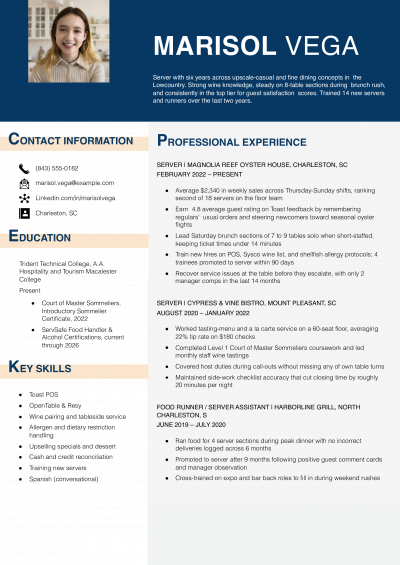
Pick this resume if you are a mid-level bar professional with about six years of experience moving from lead bartender into an assistant manager seat. Lead with your inventory control figures the way this document does, placing the SKU count and reorder method before any general duty line.
Most bar manager resumes mention inventory duties without showing the size of the program they ran. This resume pins it down with “setting par levels for 147 SKUs and scheduling twice-weekly vendor deliveries through BevSpot,” which tells a hiring manager the exact product count and reorder cadence behind the system. When you write your own inventory bullet, include the number of SKUs or products you tracked so a bar owner can compare your scope to theirs.
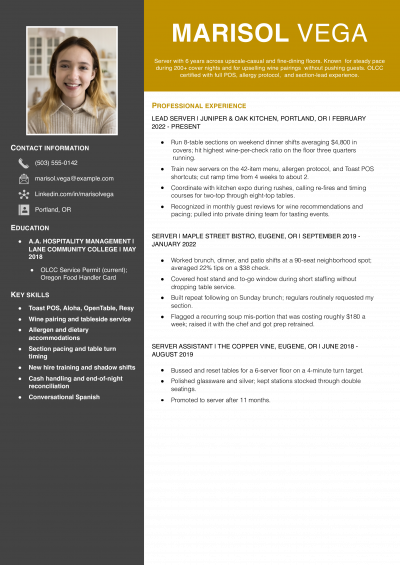
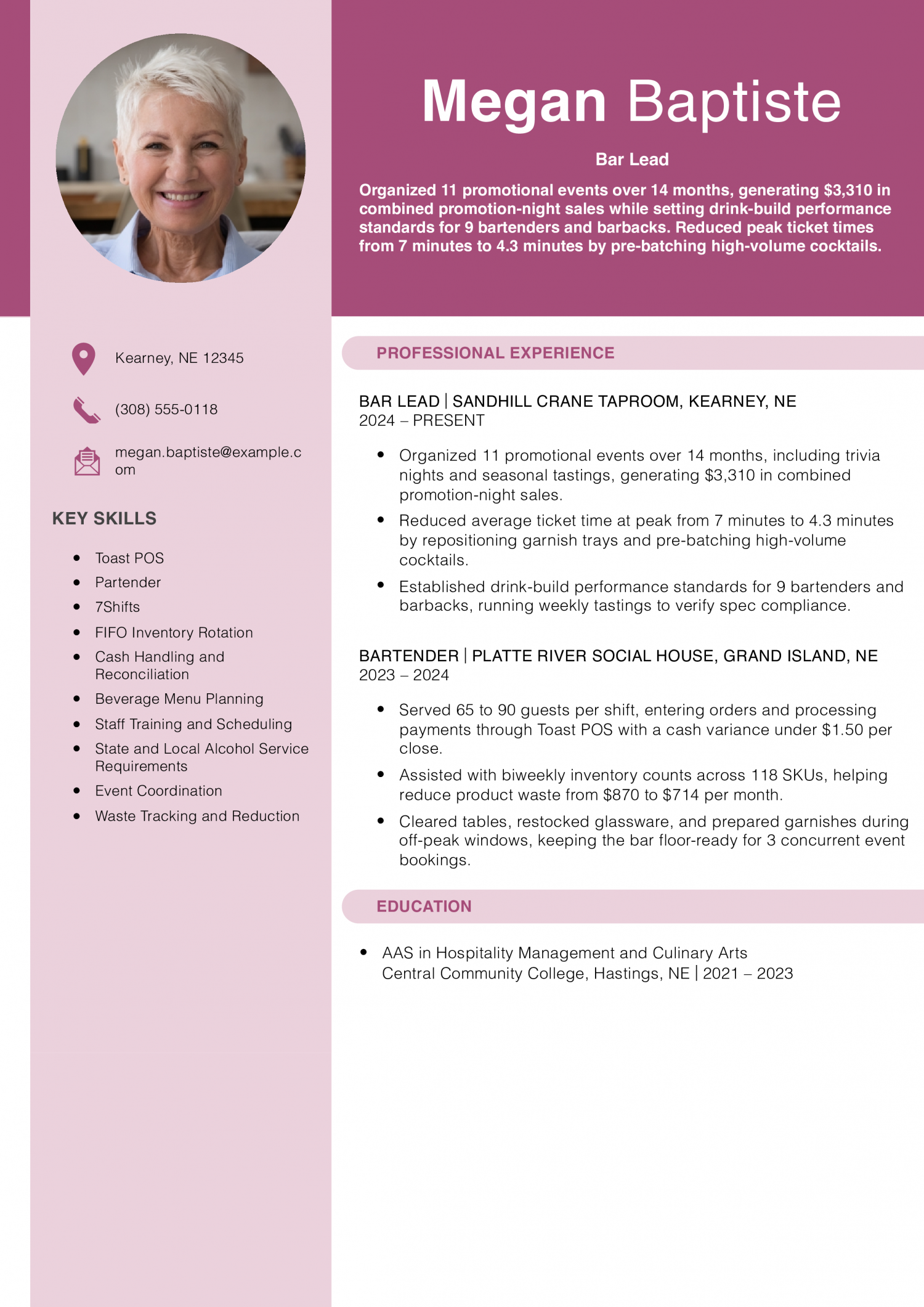
Start with this resume if you are an entry-level bar professional with about 3 years of experience stepping into your first lead role. Measure how it ties each waste-reduction figure to the specific tracking method that produced it.
Many bar manager resumes claim they reduced waste but leave out the dollar amounts that prove it. This resume tracks the actual change with “helping reduce product waste from $870 to $714 per month,” giving a hiring manager a clear before-and-after cost picture. When you write your own waste or cost-reduction bullet, pair the starting number with the ending number so your reader can calculate the monthly savings without guessing.
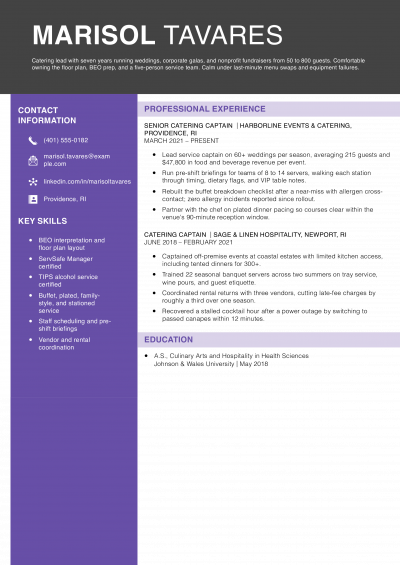
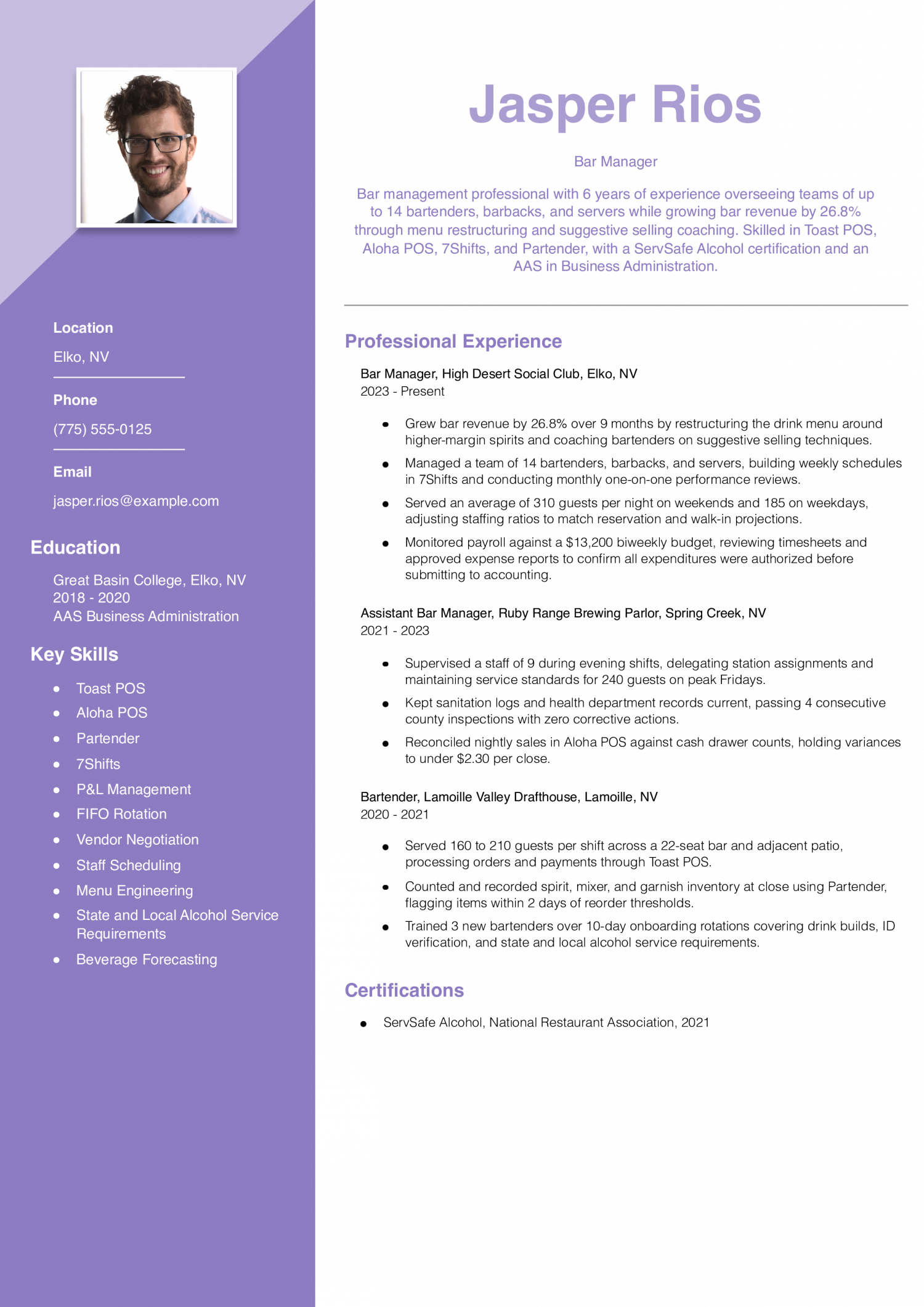
Try this resume if you are a mid-level bar manager with about six years of experience looking to move into a higher-volume venue. Order your cost-control bullets so the budget cap appears before the oversight method, giving readers the scale first.
Most bar manager resumes say they managed payroll without naming the budget they worked against. This resume anchors the claim with “monitored payroll against a $13,200 biweekly budget, reviewing timesheets and approved expense reports to confirm all expenditures were authorized before submitting to accounting.” That line tells a hiring manager you controlled a specific dollar figure and followed a verification step before money went out the door. On your own resume, state the actual payroll budget you oversaw so owners can gauge the financial responsibility you handled.
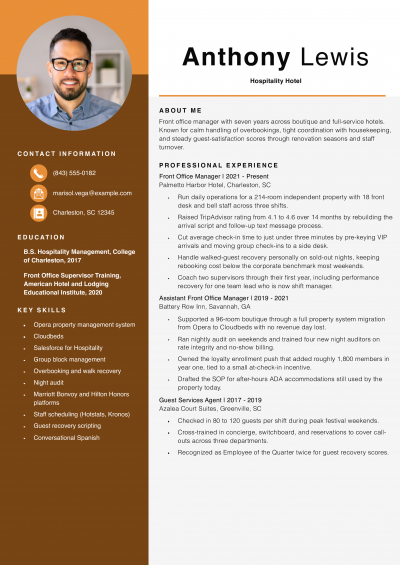
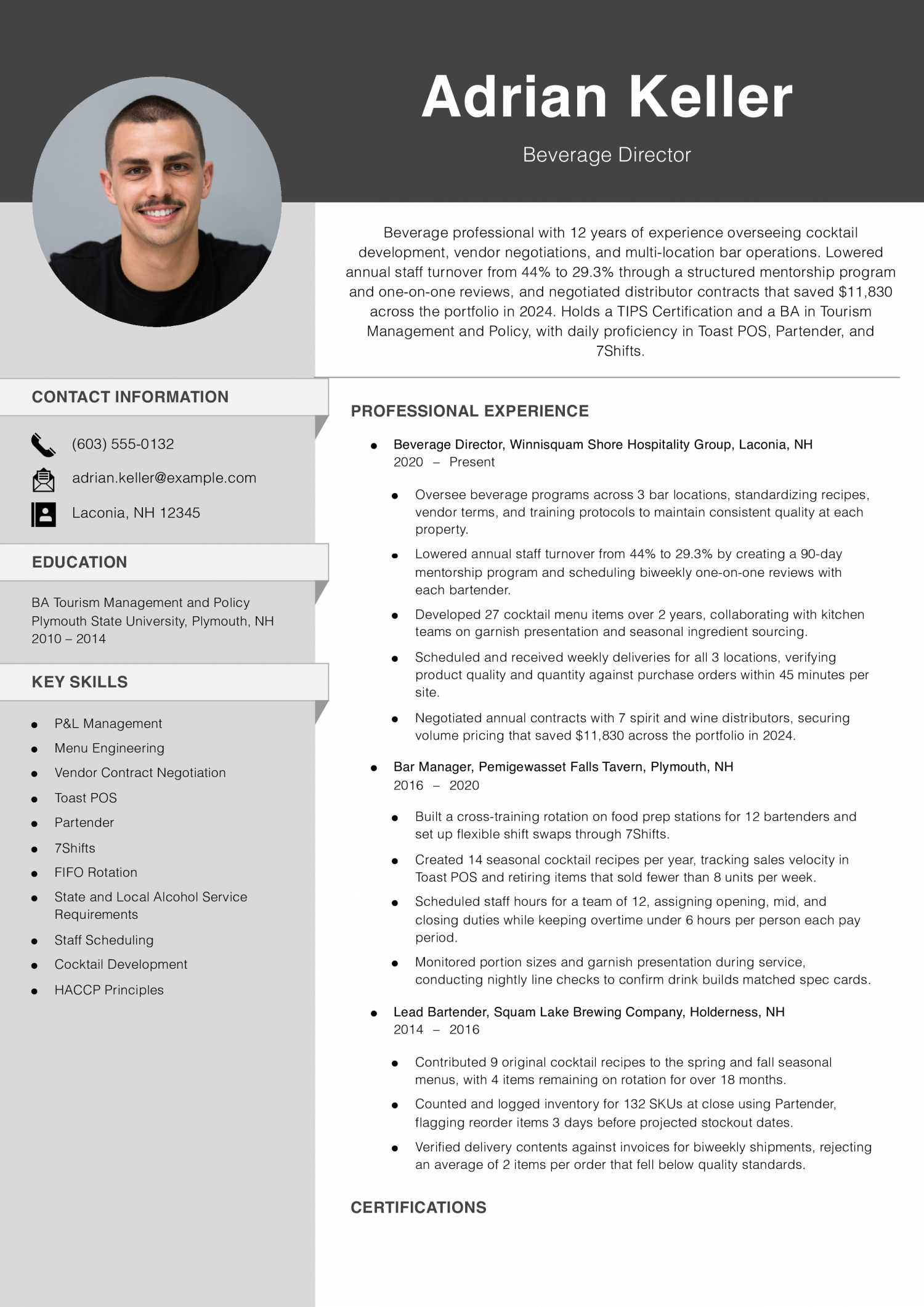
Rely on this resume if you are a senior beverage professional with roughly a decade of multi-site management experience seeking a director-level role. Pin down how each vendor negotiation bullet names the exact dollar savings and the number of distributors involved.
Many bar manager resumes describe receiving duties as a generic task without showing how long the work actually takes. This resume adds a time standard with “verifying product quality and quantity against purchase orders within 45 minutes per site,” which turns a routine chore into a measurable efficiency claim a hiring manager can evaluate. When you write your own receiving or operational bullet, attach a specific time frame or per-unit pace so your reader can see how you managed throughput across locations.
Pub management professional with 6 years of experience who cut pour cost from 24.3% to 19.1% by auditing free-pour accuracy weekly and switching high-volume wells to measured pourers. Raised customer satisfaction scores from 61 to 84 through rewritten escalation procedures and pre-shift briefings, while coordinating nightly labor allocation across kitchen and bar teams using 7Shifts, Toast POS, and Partender.
Hiring managers want quick evidence of your responsible alcohol service training and bar-program experience. They cannot verify your craft cocktail program or your bilingual front-of-house skills. Add one line near the top of your resume that sets you apart.
This could be a specialty like high-volume nightclub service. It could be a tiki or craft spirits menu you built from scratch. A niche like rooftop event programming also works well.
Pair that line with your strongest number, such as a revenue figure or a team size. Keep it to two short sentences right below your name and contact block.
Bar management is hands-on work, so hard metrics can be tough to pin down. Still, most strong resumes include volume and scope in each bullet. Name the weekly covers your bar handled or the size of your staff.
Mention the dollar value of your monthly inventory. Cite a pour cost percentage you maintained or reduced. You might write that you cut liquor waste by 12 percent over six months.
Or note that you trained a team of nine bartenders. Two numbers per bullet is a good target.
Sort your bullet points so each role covers the full scope of the job. Start with daily operations like opening and closing procedures. Include cash handling and POS reconciliation.
Next, cover beverage programming, such as menu design and vendor negotiations. Staff leadership is its own group and should note hiring and training. Compliance is another category covering ID checks and health code prep.
A final group can address guest experience, including conflict resolution and event hosting. This structure helps general managers and restaurant owners scan your resume fast.
List ServSafe Alcohol and TIPS on page one in a credentials block below your summary. ServSafe Food Protection Manager Certification belongs there too if you hold it. General managers and restaurant owners look for these before reading your work history.
List any responsible alcohol service training you completed, with the program, state, and completion or renewal date.
Software skills like Toast, Square, or BevSpot can sit in a tools line nearby. Keep the block tight, with one line per credential or tool category.
Place your education section at the bottom of the resume. A hospitality or business degree is helpful, but many bar managers advance without one. If your highest level is a high school diploma, list it and move on.
Pair it with any formal bartending school or mixology program you completed. Workshops on wine and spirits knowledge fit here as well. Volunteer event work, such as charity galas you staffed, can fill space for newer candidates.
Keep this section to four or five lines so it does not crowd your experience.
Five years ago, a Bar Manager resume read like a liquor order log. The mix has shifted toward cost control and staff training metrics. Listing pours and brands alone no longer fits what owners expect.
General managers and restaurant owners weigh hard skills like inventory management first. They then look for soft skills such as leadership. Both types must appear on your resume in plain keyword form.
Scan each table below against the posting you are targeting. Circle every term that appears in the job ad. Add those terms to your skills section word for word.
Turn soft skills into proof inside your bullet points. For example, pair “conflict resolution” with a short result. A number or outcome makes the claim real.
Drop any skill from the table that the posting does not mention. Replace it with a keyword the ad does use. This keeps your resume tight and on target.
| Soft Skills | AI-estimated % |
|---|---|
| Guest conflict resolution | 67% |
| Team leadership | 63% |
| Composure under pressure | 41% |
| Staff accountability | 38% |
| Shift communication | 27% |
And here are the top hard skills showing up most often.
| Hard Skills | AI-estimated % |
|---|---|
| Bar inventory management | 74% |
| Staff scheduling | 64% |
| Liquor cost control | 40% |
| Sanitation compliance | 39% |
| POS system operation | 33% |
Skill names and rankings come from an AI model grounded in U.S. Department of Labor occupation data for bar managers, not from a count of bar managers’ resumes built on ResumeTemplates.com.
Before a bar manager resume gets a closer read, hiring teams check for a short list of essentials.
Most bar manager postings ask for a food safety credential. General managers and restaurant owners check for these early. List each certification with its issuing body and expiration date.
Bar managers use POS systems every shift. General managers and restaurant owners want proof you know theirs. Name each system you have used by brand.
Bar hours run late nights, weekends, and holidays. General managers and restaurant owners need coverage clarity fast. A short availability note removes doubt right away.
Availability Tip
Place your availability near your contact details. Keep it to one line, such as open availability or specific nights. This saves the reader a follow-up question.
If you have managed closing shifts, state that clearly. Mention holiday or event coverage you have handled. These details show you fit the schedule they need.
General managers and restaurant owners read this list as a map of where your bar career is heading. The items below tell them which safety or service track you have put time into. These go past the basic permits your state may need.
They show you chose to build skill on your own. List each one with the issuing body and the year you earned it. Put the most recent credential first so a reader sees your latest training right away.
A strong certification section signals that you invest in your own growth between jobs. It also helps when a restaurant group screens resumes before the first interview round. Most owners look for at least one alcohol safety credential on a lead candidate’s resume.
Adding a food safety credential on top of that can set your resume apart from others in the stack.
About These Numbers
The Bureau of Labor Statistics does not publish a wage code for Bar Manager specifically. The numbers below are a proxy: the closest published match is Food Service Managers (SOC 11-9051), so use them as an estimate for this role, not an exact figure.
These BLS figures cover all Food Service Managers, a broader group that includes bar managers. For bar managers, the 10th-percentile floor sits about 34 percent below the median. The top-decile ceiling out-earns the median by roughly 55 percent.
That wide spread reflects how much venue type, geography, and scope of operations can vary across the field. Your resume should map to the tier you are targeting. Lead with the volume and revenue figures that place you in the right band.
Show your beverage program scope, staff size, and any cost controls you have run. Put those numbers near the top of each role so general managers and restaurant owners see them first.
| # | State | Median Annual |
|---|---|---|
| 1 | Washington | $95,190 |
| 2 | Massachusetts | $92,240 |
| 3 | Hawaii | $87,800 |
| 4 | New York | $84,200 |
| 5 | Rhode Island | $82,850 |
| 6 | Alaska | $82,030 |
| 7 | District of Columbia | $81,680 |
| 8 | Virgin Islands | $80,570 |
| 9 | Colorado | $79,870 |
| 10 | Minnesota | $79,820 |
| # | State | Workers | Median |
|---|---|---|---|
| 1 | California | 33,180 | $78,260 |
| 2 | Texas | 25,990 | $60,770 |
| 3 | Florida | 18,500 | $72,790 |
| 4 | Illinois | 11,270 | $63,930 |
| 5 | Pennsylvania | 10,530 | $64,750 |
Resume Templates offers HR approved resume templates to help you create a professional resume in minutes. Choose from several template options and even pre-populate a resume from your profile.
Lead each bullet with a strong verb and pair it with a number that shows your reach. Write "managed a team of 12 bartenders and barbacks across weekend shifts" rather than "responsible for staff." Numbers for revenue, covers, or team size tell general managers what scale you can handle.
A reverse-chronological format works well because it puts your latest venue first. General managers and restaurant owners want to see your most recent results at the top.
If you are switching from bartending into management, a combination format lets you lead with transferable skills before your work history.
Yes, bartending roles show that you understand the floor-level work your staff performs every shift. Keep older bartending entries brief, with one or two bullets each. Highlight any supervisory tasks you took on, such as training new hires or closing out registers.
List each role at the same venue under one company heading with separate job titles and date ranges. This layout shows a clear promotion path without repeating the venue name. Add a bullet to your bartender entry noting when you began handling ordering or scheduling.
Start with monthly or weekly revenue for the bar program you ran. Pour cost percentage is another strong figure because it shows you controlled waste. Team size and average covers per shift round out the picture for restaurant owners reviewing your results.
One page is enough if you have fewer than ten years of bar management experience. A second page makes sense when you have managed multiple venues or held regional oversight roles. Cut older bartending entries to one line each to save space on a single page.
Note any relevant activity during the gap, such as freelance event bartending or a food safety course you completed. Place the note in a brief line between the two jobs so the gap does not look unexplained. General managers care more about what you did with the time than about the gap itself.
For a bar manager, an ATS-friendly template is the safest pick, because it puts your certifications and experience where a hiring manager scans first. A basic template is a solid alternative. Whichever you choose, keep the formatting clean and easy to parse: clear section headings, a standard font, and no graphics a parser can choke on.
Bar Manager Resume
4.2/5 stars with 105 reviews

Executive Resume Writer and Career Coach
Andrew Stoner is an executive career coach and resume writer with 17 years of experience as a hiring manager and operations leader at two Fortune 500 Financial Services companies, and as the career services director at two major university business schools.
© 2026 Resumetemplates.com All rights reserved.