Recruiter Resume Examples
Add a line a TA director cannot pull from your LinkedIn: a niche function you staff (clinical RN, embedded SWE, GTM sales), the average req load you carry, or a sourcing specialty like passive executive…
Every resume example is written and reviewed by our team of Certified Professional Resume Writers to ensure top-quality content and formatting.
Your resume competes the same way you screen others: against a clear scorecard. Talent acquisition directors and HR directors look for proof you can cut time to fill, lift offer acceptance rates, and build sourcing pipelines. They want to see real metrics tied to those outcomes.
Show your work with ATS platforms like Greenhouse or Lever. Pair that with Boolean sourcing results and requisition volumes you have managed. The examples below show how to frame this proof so your resume reads as strong as the talent strategies you run. To compare layouts before you start, browse our resume templates.
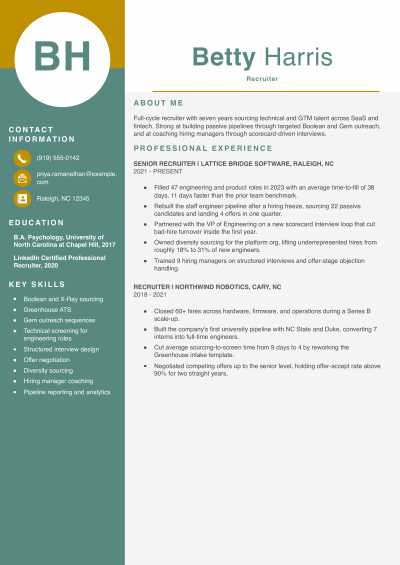
Talent acquisition directors scan the first page for sourcing metrics and time-to-fill numbers, because those figures show whether a specialist can actually move requisitions from open to closed at volume.
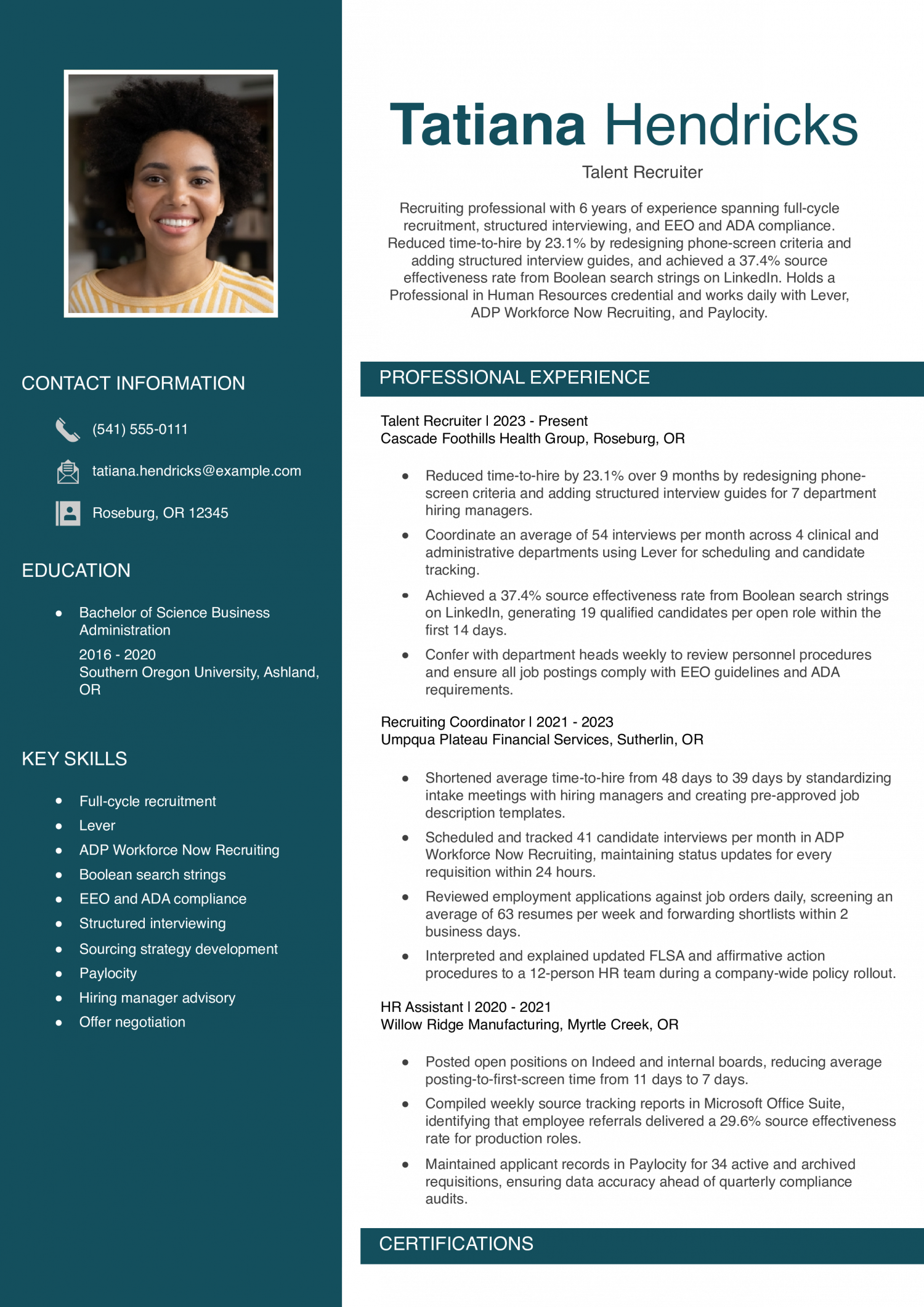
Pick this resume if you are a mid-level talent recruiter with around six years of sourcing and hiring coordination experience. Add a specific source effectiveness rate next to every sourcing channel you mention so reviewers can compare your methods.
Time-to-hire tracked across two different roles shows the improvement was a pattern, not a one-time win. An HR director reading both numbers can see the trend carried forward. If a recruiting measure appears in more than one of your jobs, show both so the pattern is clear.
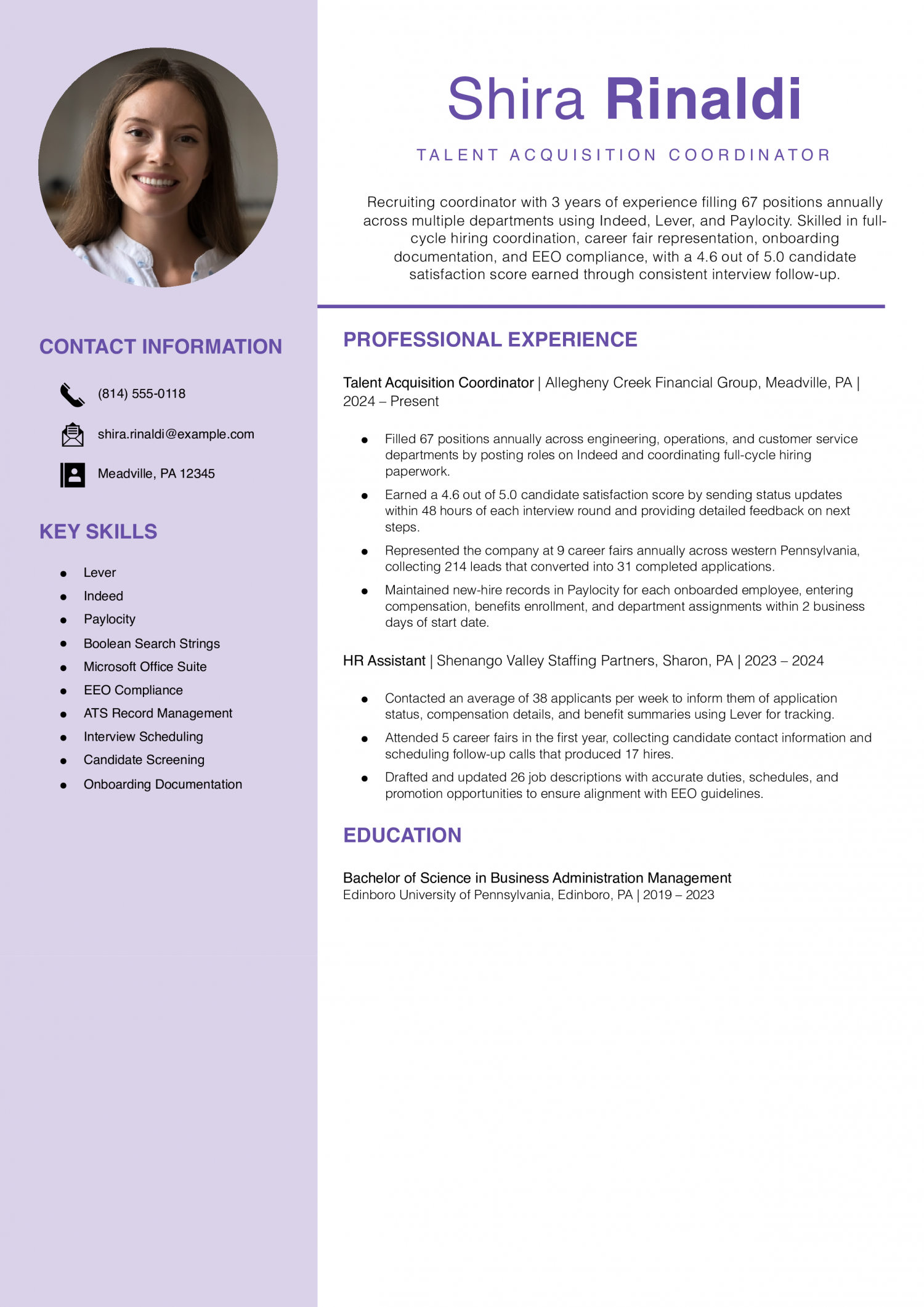
Start with this resume if you are an entry-level talent acquisition coordinator building your first two years of full-cycle recruiting experience. Lead with career fair lead counts and their conversion into completed applications, the way this resume traces sourcing to outcomes.
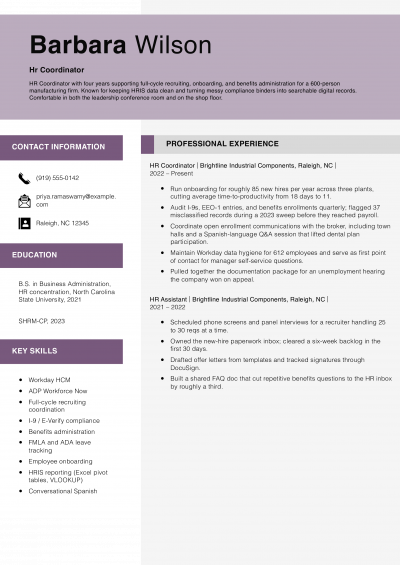
Compensation, benefits, and department assignments entered within days of a new hire’s start date show the onboarding moved fast. Attach a turnaround window to your own onboarding steps so the speed is on the page.
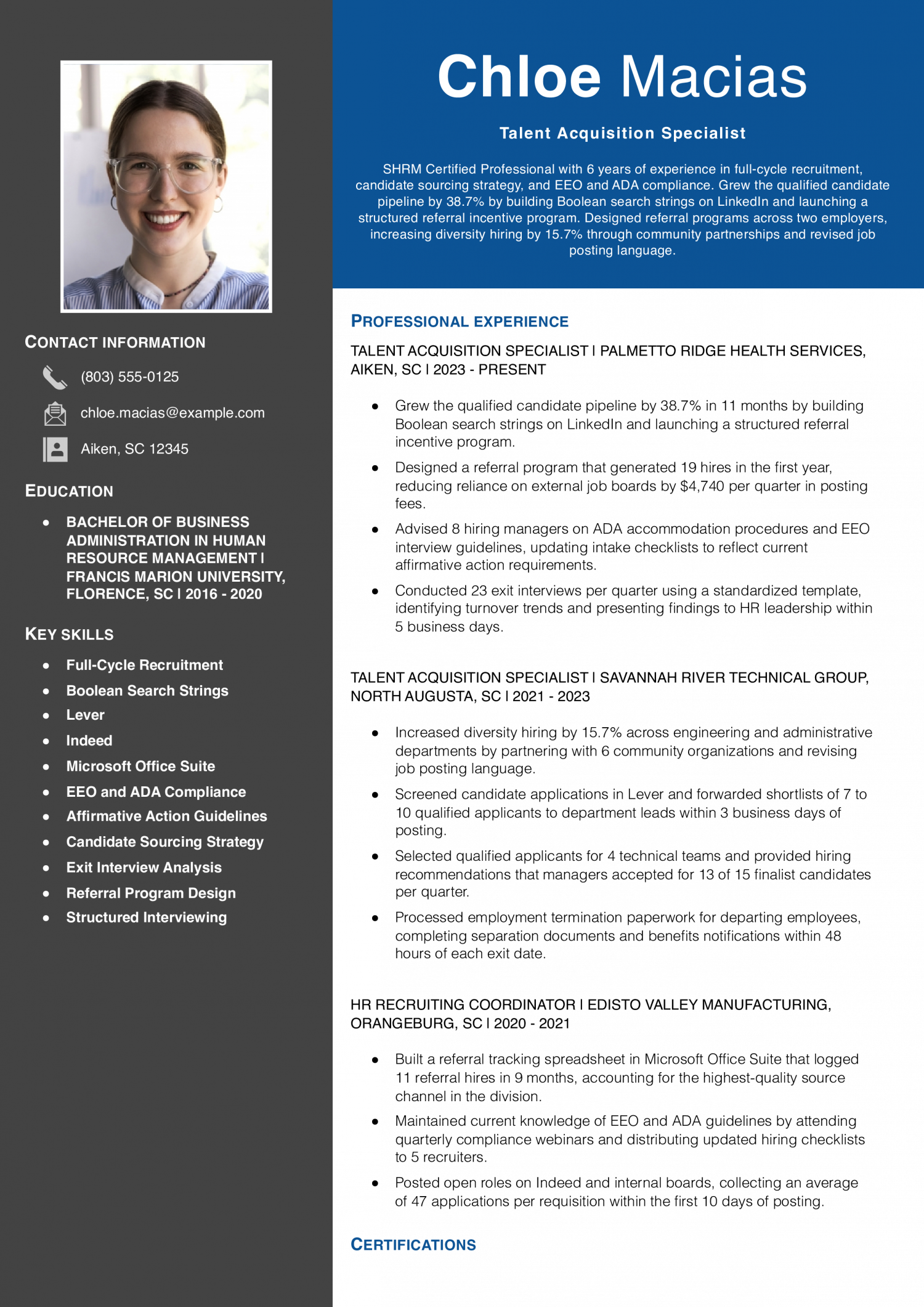
Try this resume if you are a mid-level talent acquisition specialist with about six years of recruiting experience and a SHRM-CP credential. Record your referral program results as both a hire count and a dollar saving so reviewers see two returns from one initiative.
Shortlists delivered to department leads within days of a job posting show a process that keeps up with urgent roles. A director of talent reading the candidate count and the delivery window together can judge throughput. State how many candidates you advance and the time it takes.
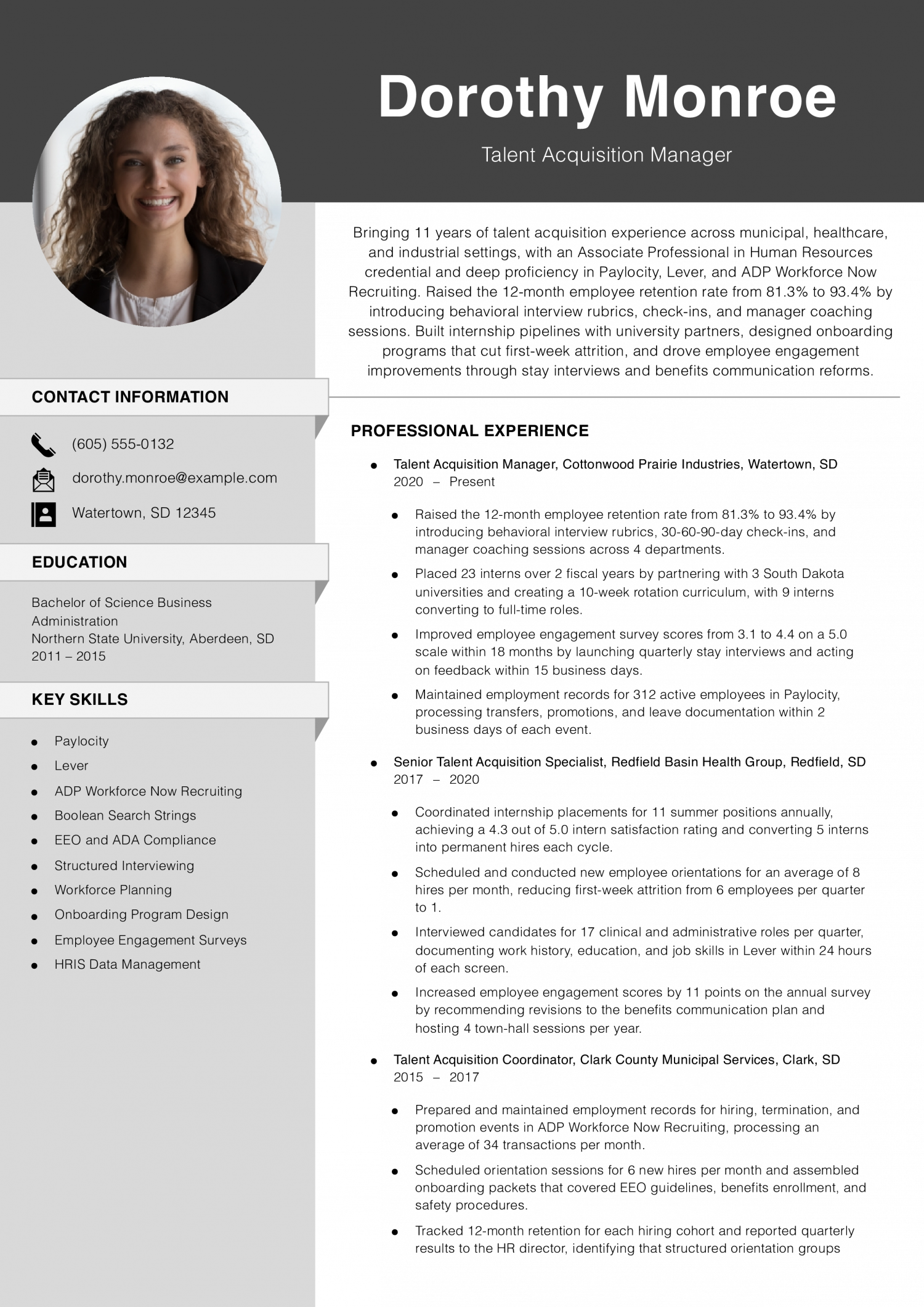
Lean on this resume if you are a senior talent acquisition manager with about 11 years of recruiting and retention experience. Run your retention figures across multiple roles to show a consistent measurement habit, the way this resume does.
Comparing retention in structured orientation against ad-hoc onboarding, with rates for each group, shows the difference the program made. A CHRO reading both numbers can weigh what the structure added. If you can split your results into two groups, show both rates side by side.
Experienced in full-cycle recruitment across healthcare, manufacturing, and corporate settings, with 6 years of managing concurrent requisitions in Lever and ADP Workforce Now Recruiting. Reduced cost per hire from $5,310 to $3,470 by shifting sourcing spend toward Boolean search strings on LinkedIn and away from third-party agency contracts. Skilled in EEO and ADA compliance, requisition management, and sourcing strategy development across multi-department organizations.
State how many hires you closed last year. Name the types of roles you filled most often.
Talent acquisition directors and HR directors read that figure first. It tells them your production speed and your scope in the organization. A line like “Filled 85 positions across engineering and finance in 2024” sets your scale fast.
Follow it with your average time to fill. Add your offer acceptance rate if it ran above 90 percent. These two data points frame every subsequent claim on the page.
Skip broad phrases like “experienced recruiter” or “passionate about people,” because numbers do more work than adjectives in a summary line.
Most strong resumes in this field tie every bullet to a result. Name your requisition load per quarter. State how much you cut time to fill or cost per hire.
Bullets without a number tend to read as routine duties, and talent acquisition directors along with HR directors want to see sourcing yield, too. That means the ratio of candidates screened to those who reached the final round. If you ran a referral program, state how many hires it produced.
Mention your pipeline conversion rate for hard-to-fill roles. You can also cite retention rates at 90 or 180 days. Each metric proves you track measurable outcomes rather than responsibilities, so place the number at the start of the bullet when you can.
Break your experience into the areas talent teams care about. Sourcing and outreach is one category. Cover Boolean searches and LinkedIn campaigns there.
Full-cycle recruiting is another, spanning intake calls through offer negotiation. Employer branding fits as a third group. Note career fair coordination and job posting content you wrote.
A fourth area is hiring process design. Include any interview scorecards or structured panels you built. Diversity hiring can stand on its own if you led a program.
State the applicant tracking systems you used under each group, such as Greenhouse or iCIMS. Grouping your bullets this way shows range without creating a wall of undifferentiated text on the page.
List the SHRM-CP or PHR right below your name. A page-one credentials block catches the eye before the summary does. The aPHR works well for early-career resumes in the same spot.
Talent acquisition directors and HR directors scan for these letters fast. They signal you understand employment law and established HR frameworks, so they carry substantial weight. Below your credentials, add your ATS tools.
Name the platforms you have used, such as Greenhouse or Workday Recruiting. Add any HRIS tools in the same line. Place compliance training or OFCCP knowledge in a skills section.
A short label per entry works best. Long descriptions in a credentials list slow readers down.
Note your degree, the school, and the year you finished. A degree in human resources or business administration is common for this role, and related fields like industrial-organizational psychology or communications also appear often. If you hold an aPHR and lack a four-year degree, place it higher on the page.
Add relevant coursework only if you graduated within the last three years. In a closing section, include volunteer recruiting, campus ambassador work, or pro bono advisory board participation. Mention any sourcing boot camps or training programs you finished.
Skip high school details once you hold a postsecondary degree. Keep this section to four or five lines total. Every line should add a fact that the rest of the resume did not cover.
The resumes that reach the interview round tend to pair sourcing tools with people skills. Talent acquisition directors and HR directors scan for these patterns first.
Hard skills like sourcing and ATS management prove you can fill roles. Soft skills like negotiation show you can close candidates. Directors weigh both, but hard skills pass the first filter.
Soft skills then back up the claims in your bullets. Add only the terms that appear in the posting you want.
Treat every soft skill as proof that supports a bullet point. Drop any skill you cannot back with a number or an outcome. Spell each term the way the posting spells it.
One word swap can cause the ATS to skip your resume. Review your final draft once more before you submit it.
| Soft Skills | AI-estimated % |
|---|---|
| Relationship building | 66% |
| Interviewing acumen | 61% |
| Stakeholder communication | 49% |
| Discretion with confidentiality | 36% |
| Organized under pressure | 31% |
And here are the top hard skills showing up most often.
| Hard Skills | AI-estimated % |
|---|---|
| Full-cycle recruiting | 71% |
| Applicant tracking systems | 52% |
| Employment records management | 46% |
| EEO compliance | 35% |
| Candidate sourcing strategies | 26% |
Skill names and rankings come from an AI model grounded in U.S. Department of Labor occupation data for talent acquisition specialists, not from a count of talent acquisition specialists’ resumes built on ResumeTemplates.com.
AI tools are up first.
Recruiters handle AI on their resumes in one of three ways. You could lead with vague claims like “AI-driven recruiter.” Talent acquisition directors will screen that out fast. You could leave AI off and wait for the interview.
Or you could show the real steps you take when you use a tool. Name the tool you use. State the task it handles.
Then note how you check its output. The third option is what talent acquisition directors and HR directors can validate. They want to see that you use AI to source faster.
They also want proof that you still own the hiring decision.
What AI is actually changing for this role
Candidate sourcing: AI tools scan resume databases and return ranked candidate lists, but you still verify fit and intent.
Screening volume: Automated filters can cut initial review time, though you must audit for bias in every batch.
Outreach drafting: Generative AI drafts personalized recruiting messages that you edit for tone and role accuracy.
Interview scheduling: AI assistants coordinate calendars across time zones and reduce back-and-forth email with candidates.
Pipeline reporting: AI dashboards flag bottlenecks in your funnel so you can act on drop-off points sooner.
AI tools to name
How to phrase AI on your resume
Do
Skip
Credentials signal that you know HR law and hiring best practices. Talent acquisition directors and HR directors scan for them early. Three credentials appear most often in this field.
Talent acquisition directors and HR directors scan your certifications as a quick map of where your recruiting career is heading. The items below tell them which areas of HR you have studied and tested in. They also show how far you have moved past entry-level sourcing work.
A strong credentials list signals that you keep your knowledge current across employment law and talent strategy. It can set you apart when two resumes show similar years of experience. Give each credential its own line. Add who issued it and the year you finished.
Place the section after your work history so it supports the results you already described. If a credential is in progress, note the expected completion date so that readers see forward motion.
About These Numbers
The Bureau of Labor Statistics does not publish a wage code for Talent Acquisition Specialist specifically. The numbers below are a proxy: the closest published match is Human Resources Specialists (SOC 13-1071), so use them as an estimate for this role, not an exact figure.
The top-paying states for talent acquisition specialists tend to cluster in smaller, high-cost markets rather than the large metro areas with the most job postings. That gap between where the roles are and where they pay best creates a real opening for remote or relocating candidates. These BLS figures cover all human resources specialists, a broader group that includes talent acquisition specialists.
The spread from the 10th percentile to the 90th is wide. Earners near the top make roughly 70 percent more than the median. Those near the bottom sit about 38 percent below it.
If you can work across state lines, list your remote hiring reach and the time zones you have covered on your resume.
| # | State | Median Annual |
|---|---|---|
| 1 | District of Columbia | $110,970 |
| 2 | Massachusetts | $85,630 |
| 3 | Washington | $84,550 |
| 4 | New York | $84,380 |
| 5 | Maryland | $83,910 |
| 6 | California | $83,500 |
| 7 | Connecticut | $82,890 |
| 8 | Virginia | $82,090 |
| 9 | Colorado | $80,840 |
| 10 | New Jersey | $80,690 |
| # | State | Workers | Median |
|---|---|---|---|
| 1 | California | 104,000 | $83,500 |
| 2 | Texas | 84,930 | $68,920 |
| 3 | Florida | 62,730 | $66,410 |
| 4 | New York | 54,610 | $84,380 |
| 5 | Pennsylvania | 36,960 | $70,450 |
Resume Templates offers HR approved resume templates to help you create a professional resume in minutes. Choose from several template options and even pre-populate a resume from your profile.
Start with an HR coordinator or recruiting coordinator role to build sourcing skills. Volunteer to own a full requisition cycle, even for an internal posting. That gives you at least one hire you can show on your resume.
An Associate Professional in Human Resources credential can strengthen your application when work history is thin.
Focus on skills you can tie to a result, such as Boolean sourcing and ATS administration. Add offer negotiation or pipeline forecasting as a third line.
Talent acquisition directors and HR directors want a mix that covers the full hiring cycle. Pair each hard skill with a soft skill like stakeholder management.
One page works for most specialists with fewer than ten years of recruiting experience. A second page is reasonable if you have led hiring programs across multiple regions.
Keep only the roles and metrics that relate to sourcing, screening, or closing candidates.
Yes, name every ATS you have used because many job postings filter for a specific platform. Write the full product name, such as Greenhouse or iCIMS, in your skills section.
If you configured workflows or built reports inside the system, describe that work in a bullet under the relevant role.
List the agency as your employer and note the industries you recruited for in each bullet. Talent acquisition directors and HR directors want to see how agency volume translates to corporate hiring.
Highlight metrics like submittals-to-interview ratio and time to fill for your top client accounts.
Yes, many companies include the talent acquisition specialist in at least one onsite round. You may assess culture fit or walk the candidate through compensation details.
Mention onsite interview coordination or panel facilitation on your resume if you played that role.
State the gap in your work history with a one-line note such as career break or contract transition. If you earned a credential like the Professional in Human Resources during that time, list it with dates.
Talent acquisition directors and HR directors care more about your recent hiring metrics than about a short pause.
Try an ATS-friendly template that separates your recruiting results from your credentials. A basic template works for this role too.
Talent Acquisition Specialist Resume
4.3/5 stars with 168 reviews

Executive Resume Writer and Career Coach
Andrew Stoner is an executive career coach and resume writer with 17 years of experience as a hiring manager and operations leader at two Fortune 500 Financial Services companies, and as the career services director at two major university business schools.
© 2026 Resumetemplates.com All rights reserved.