Tip !

What kills a police officer resume before it gets read is burying POST certification and academy graduation on page two; the fix is a credentials block under the name line so a recruiter can verify sworn status in the first scan.

Andrew Stoner , Executive Resume Writer and Career Coach

Why this resume works

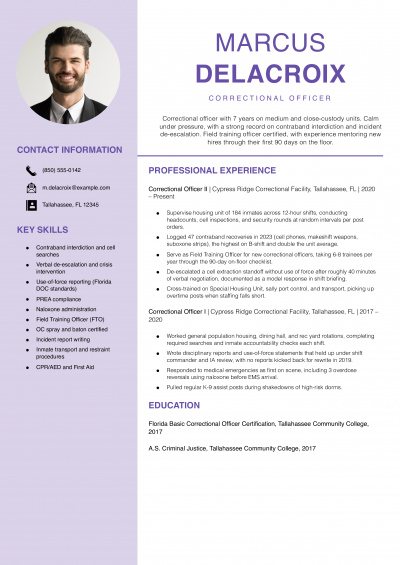
  • Quantified Squad Impact: The 22% burglary reduction and 7-officer span of control give a hiring board a clear picture of leadership scope.
  • Career Progression Visible: Two roles at the same agency show vertical movement from FTO to supervisor without job-hopping concerns.
  • Bilingual Credential Highlighted: Court-qualified Spanish interpretation is a differentiator most agencies actively recruit for.

Officer Example

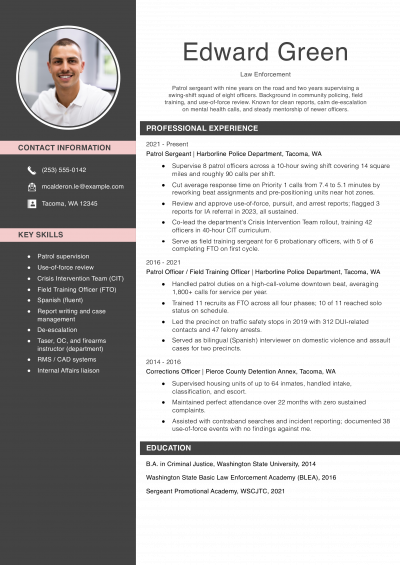
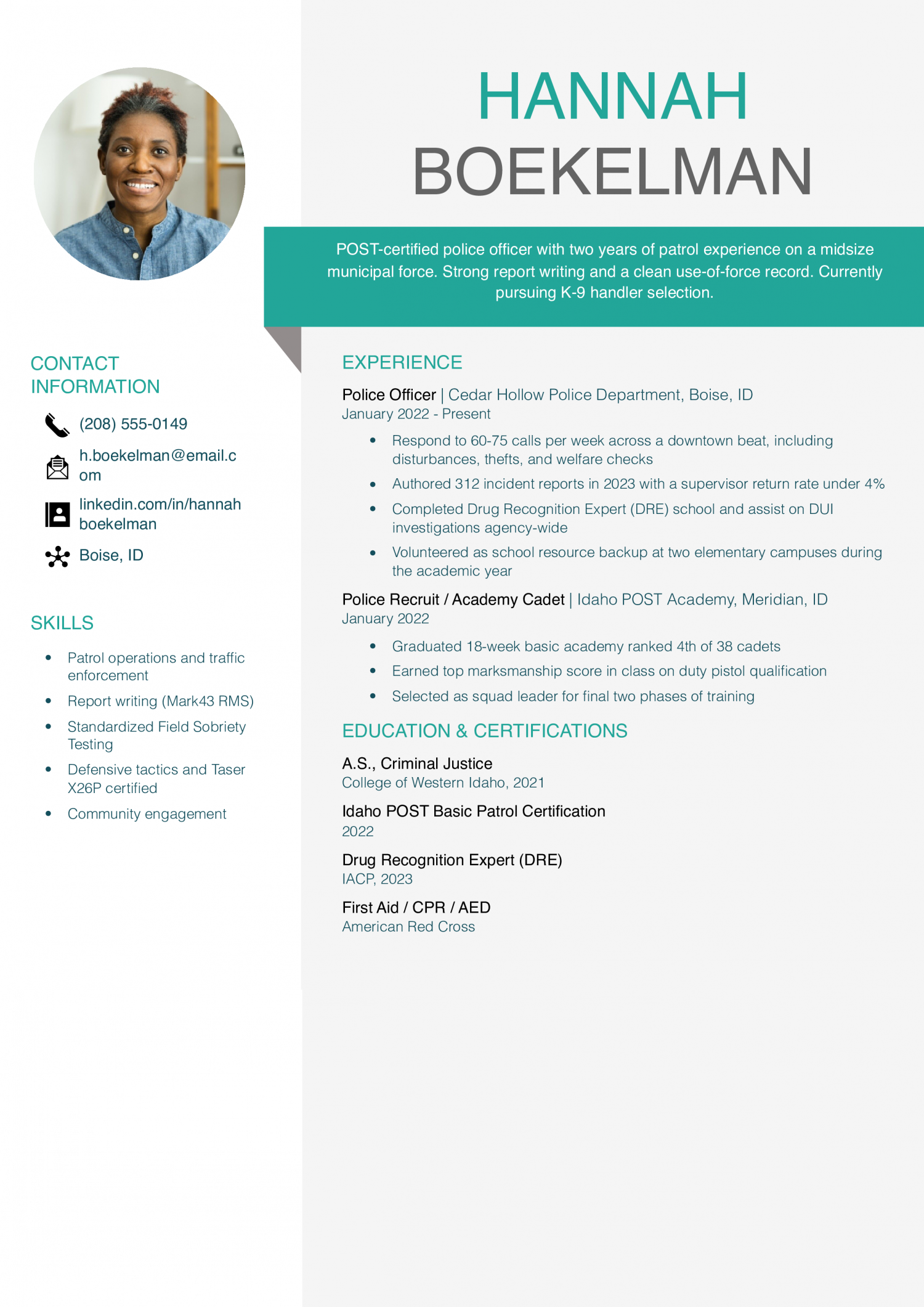
What changes between an academy recruit and a sworn officer resume is documented patrol output: call volumes, arrest reports written, and field training program completion under a senior officer.

Why this resume works

  • Academy Rank Disclosed: Listing class rank and marksmanship score gives concrete proof of capability before much patrol history exists.
  • Report Quality Metric: A sub-4% supervisor return rate signals strong writing, which sergeants prioritize when reviewing junior officers.
  • Specialty Pipeline Shown: DRE certification and K-9 interest tell command staff this officer is investing in long-term development.

Sergeant Example

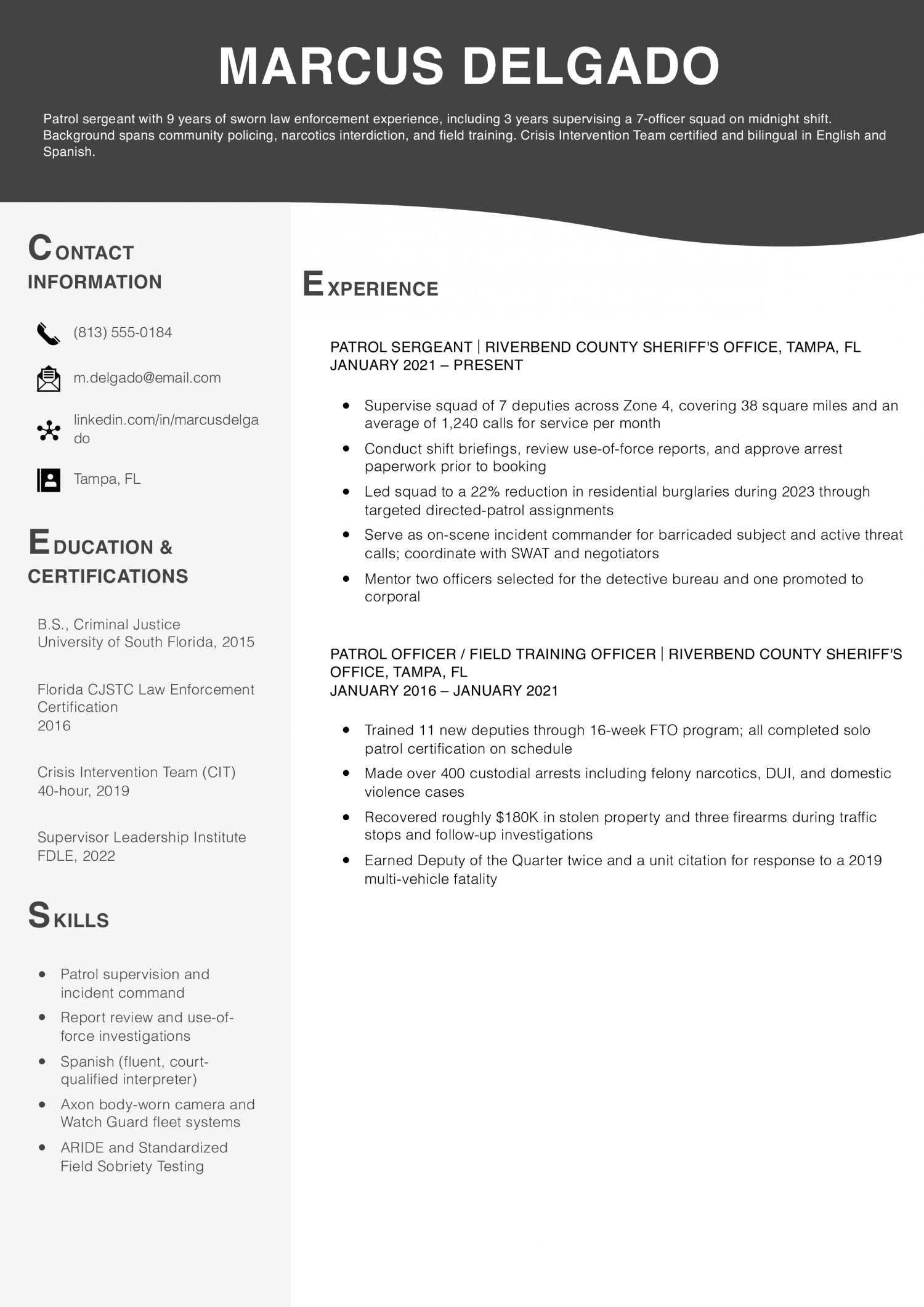
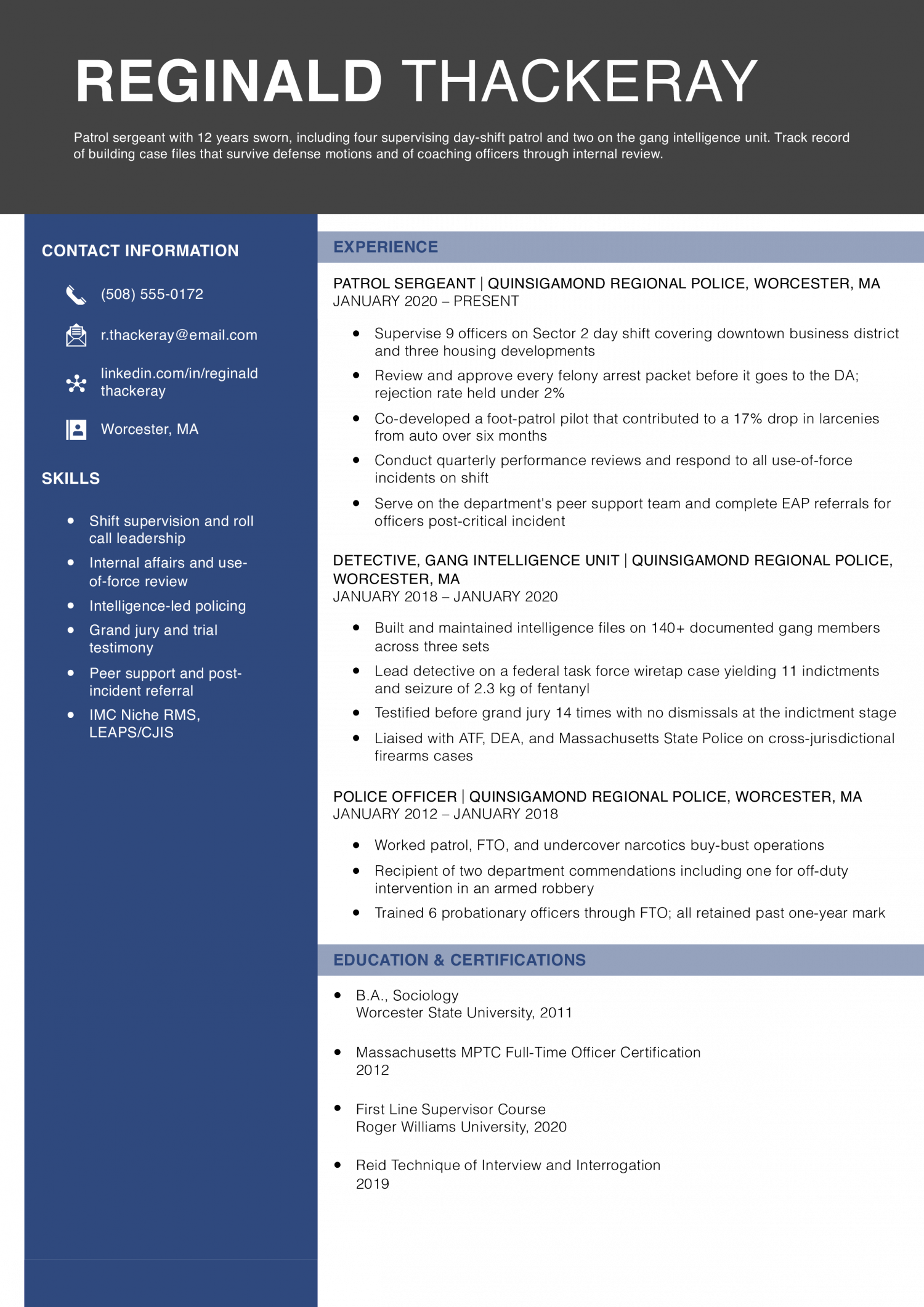
Sergeants are hired to run a squad on a shift and groomed toward watch commander roles that own staffing, incident command, and use-of-force review.

Why this resume works

  • Span of Control Stated: Naming nine officers and a specific sector tells promotion boards exactly how large a supervisory portfolio this is.
  • Court-Tested Credibility: 14 grand jury appearances with no dismissals is the kind of metric a DA’s office and command staff respect.
  • Wellness Lean-In: Peer support team involvement aligns with current officer-wellness mandates that many agencies are funding.

Lieutenant Example

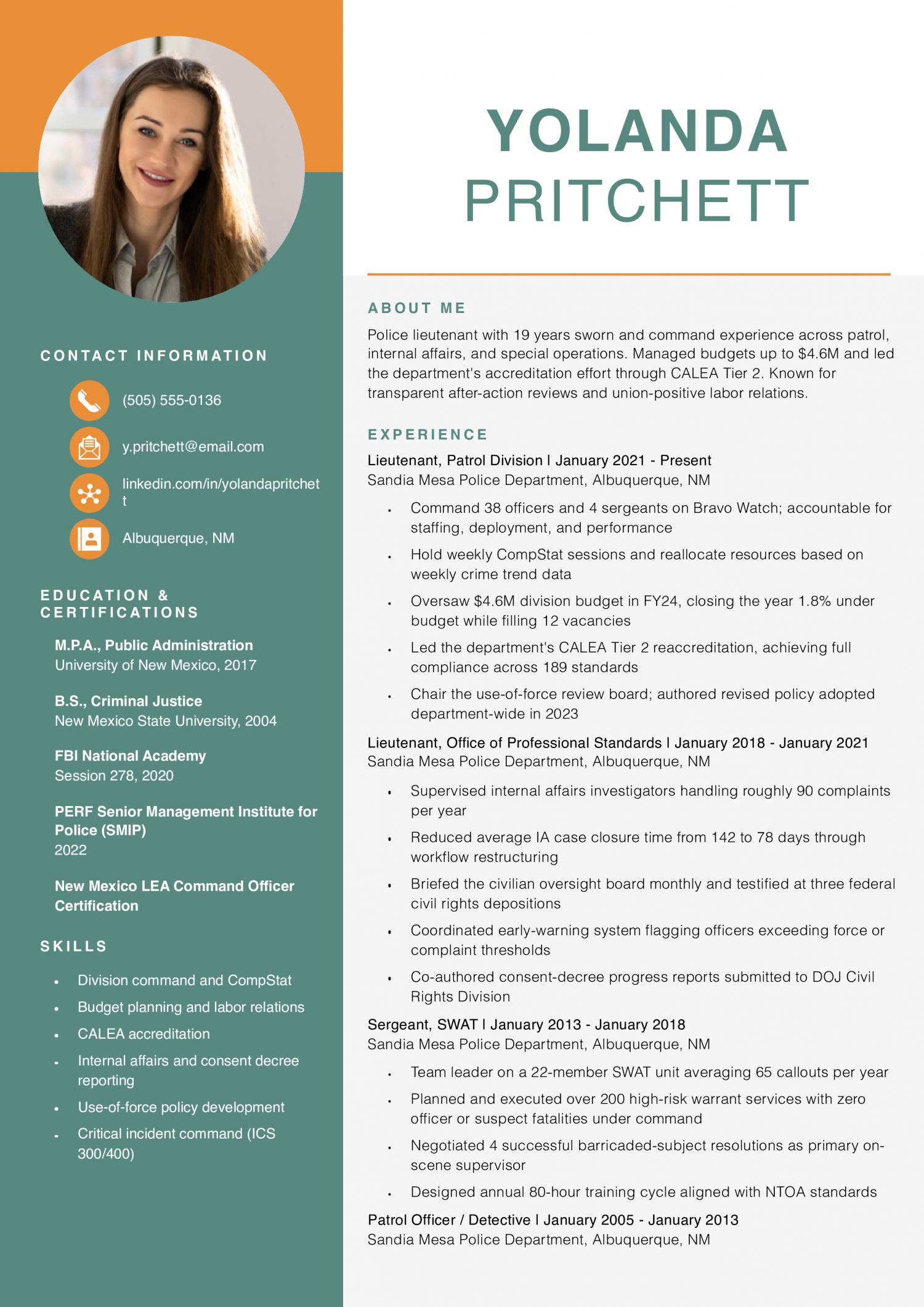
Police chiefs reading a lieutenant resume are answering one question: can this lieutenant own a bureau, manage sergeants, and brief command staff without escalation?

Why this resume works

  • Command Scope Documented: 38 officers, 4 sergeants, and a multi-million-dollar budget show readiness for captain or deputy chief consideration.
  • Reform Credibility: Consent decree work and IA closure-time reduction signal an officer who can lead a department through federal scrutiny.
  • Premier Schools Listed: FBI National Academy and PERF SMIP are recognized command-track credentials that immediately rank this candidate.

How to Write a Police Officer Resume

01 Open by stating the jurisdiction, shift, and beat you work

Police chiefs and department recruiters scan for three context anchors in the first two lines: jurisdiction type, shift assignment, and beat profile. Name the agency size (sworn headcount), the patrol environment (urban, suburban, rural, campus), and your current shift rotation.

Lead the summary with those anchors before any skill list. A line like “Patrol officer with 6 years on overnight shift covering a 14-square-mile urban beat for a 240-sworn municipal department” tells a hiring lieutenant more than a generic objective. Add your POST certification status on the next line so verification takes seconds, not a second read.

02 Quantify calls, reports, and case outcomes

Patrol work converts to numbers more readily than most officers realize. Most strong police resumes carry two or three concrete figures per role: calls responded to per shift, reports written per month, and clearance or arrest counts tied to specific case types.

Useful metrics include average response time, traffic stops conducted, DUI arrests, warrants served, and field interviews documented. Bullets without a number tend to read as duty lists. A bullet like “Cleared 78 property crime cases through follow-up investigation and suspect identification” beats “Investigated property crimes” every time a sergeant compares two resumes for the same opening.

03 Group your work into patrol, investigations, and community

Sort bullets into three to five categories that match how departments structure assignments. Common groupings: patrol response, traffic enforcement, investigations, community policing, and training or FTO duties.

Within patrol, name the call types you handle most: domestic disputes, mental health calls, narcotics, gang activity, crowd control. Under investigations, list the case types you carry through to prosecution and the evidence-handling tools you use, including body-worn camera review, Axon Evidence, and report systems like Mark43 or Niche RMS. Community policing bullets should name programs, school resource work, or citizen academy roles, with the population served.

04 Place credentials and tools in a page-one block

Police chiefs and department recruiters need sworn status visible before they reach your work history. Put POST or state-equivalent certification, academy name and graduation year, and any specialty certifications in a credentials block directly under the contact line.

List your state and “certification in good standing” without embedding any registration or badge number. Include firearms qualification status, EVOC, CIT, ICS 100 through 400, and instructor certifications. Tools and systems belong in the same block or a short technical line: NCIC, NLETS, CAD systems, Axon body cameras, LIDAR and RADAR units, and any RMS platforms your department uses.

Recruiters cross-check this block against the job posting before reading bullets.

05 Close with academy, military, and education detail

Entry and mid-career officer resumes close with academy details, military service, and degree work. Name the academy, graduating class rank if top quartile, and any awards (top shot, top defensive tactics, class leader).

Military veterans should list branch, rank at discharge, MOS or rating, and any military police, security forces, or master-at-arms experience. Degree holders in criminal justice, public administration, or psychology should list the institution and year. Add languages spoken at a working level, since bilingual officers move faster through hiring panels in most agencies.

Keep this section tight: three to five lines total below your work history.

The skills below come from police officer resumes our users built on ResumeTemplates.com. Police chiefs and department recruiters scan hundreds of resumes a hiring cycle, and these terms surface most often on the candidates who reach the oral board. Hard skills like POST certification and report writing pass the ATS filter on their own.

Soft skills like de-escalation and community engagement need a bullet behind them showing the call or program where you used the skill. Match your skill block to the job posting, then move any soft skill into a quantified bullet that proves it on the patrol record.

Soft Skills % of resumes with this skill
Situational awareness 57%
De-escalation under pressure 50%
Community engagement 42%
Split-second decision-making 24%
Composure in crisis 23%

And here are the top hard skills showing up most often.

Hard Skills % of resumes with this skill
Criminal law enforcement 56%
Suspect apprehension 32%
Incident report writing 27%
Crime scene investigation 25%
First aid response 23%

Based on data from thousands of police officers’ resumes built on ResumeTemplates.com, May 2026.

Policing Credentials That Get You the Job

The certifications below tell police chiefs and department recruiters you have not coasted since the academy. Recent completions carry more weight than ten-year-old credentials. List the issuing body, the year completed, and the training-hour count where it applies.

  • Crisis Intervention Training (CIT): A 40-hour CIT certification signals you can handle mental health calls, which now make up a growing share of patrol volume.
  • Field Training Officer (FTO) Certification: FTO status shows you can evaluate probationary officers and tells sergeants you are on the supervisory track.
  • ICS 300 and ICS 400: Advanced incident command coursework moves you toward watch commander and mutual-aid coordination roles.
  • ARIDE or DRE Certification: Advanced Roadside Impaired Driving Enforcement or Drug Recognition Expert credentials raise DUI clearance rates and prosecutor confidence.

Latest BLS Statistics for Police Officers

For police officers, the 10th-percentile floor and the top-decile ceiling tell you that jurisdiction, rank, and specialty assignments move pay more than years on patrol. Urban departments, federal agencies, and metropolitan transit and port authorities sit at the top of the band; rural municipal and small-town agencies anchor the floor.

Lead your resume with the agency type and sworn rank, then layer in specialty certifications and command experience that match the band you are targeting.

$76,290 National median annual
$79,320 National mean annual
$47,640 Entry-tier floor (10th percentile)
$115,280 Top-decile ceiling (90th percentile)
666,990 Police Officers in the U.S.
Where you stand

Entry tier

$47,640–$76,290 At the entry tier, your resume needs to show academy graduation and POST certification, and lead with FTO completion and call volume.

Mid band

$76,290–$115,280 At the mid band, lead with specialty assignments (FTO, CIT, detective rotation) and the case types you carry through to prosecution.

Top decile

$115,280+ At the top decile, your resume needs to show command rank, bureau ownership, and ICS 400 plus the budget or headcount you supervise.

Top-paying states

# State Avg. Annual
1 California $115,400
2 Washington $102,640
3 Illinois $101,530
4 Alaska $100,300
5 Colorado $96,100
6 New York $93,050
7 Hawaii $89,390
8 New Jersey $89,030
9 District of Columbia $88,330
10 Oregon $88,140

Highest-employment states

# State Workers Median
1 California 65,170 $115,400
2 Texas 62,230 $76,350
3 New York 54,360 $93,050
4 Florida 48,340 $76,190
5 Illinois 29,790 $101,530
Source: U.S. Bureau of Labor Statistics, OEWS 2024 release (SOC 33-3051).
Written by professional resume writers and loved by hiring managers

Resume Templates offers HR approved resume templates to help you create a professional resume in minutes. Choose from several template options and even pre-populate a resume from your profile.

Frequently Asked Questions

What should an entry-level police officer resume look like?

An entry-level officer resume opens with academy graduation and POST certification status under the contact line. Add military service or security experience next if you have it.

Bullets come from academy scenarios, ride-alongs, and internships. Cite specific class rankings, defensive tactics scores, or firearms qualification percentages.

Keep prior civilian work if it shows judgment under pressure: EMT shifts, dispatch, security, corrections, or retail loss prevention. Quantify with calls handled or incidents documented.

How do you describe police officer duties on a resume?

Skip the duty-list framing. "Responded to calls for service" reads as a job description and adds nothing.

Convert each duty into an outcome bullet with a number. Try "Responded to 25-plus calls per 12-hour shift on a high-volume urban beat, averaging 14 reports per week."

Group bullets by patrol, investigations, traffic, and community work. Name the call types and tools by name: domestic, mental health, NCIC, Axon, Mark43.

How should a retired officer write a resume for a second career?

Lead with your final rank, total years of service, and the bureaus you worked. Name the agency type and sworn headcount for context.

Translate sworn experience into the target field's language. Corporate security wants risk assessment and incident response; fraud roles want investigation and interview skills; school safety wants community policing and CIT.

Cap retirement-era bullets at the most recent 10 to 15 years. List instructor certifications, ICS coursework, and any degree work that supports the pivot.

Should I list my badge number or certification number on a police resume?

No. Never put badge, POST certification, driver's license, or social security numbers on a resume.

List the state and "certification in good standing" only. The background investigator will collect numbers on the formal application packet.

The same rule applies to home address and date of birth. Use city, state, and a phone number on the contact line.

Rate this article

Police Officer Resume

Average Rating

4.3/5 stars with 248 reviews

You have given 0 Star(s)
4.3/5 stars with 248 reviews
Andrew Stoner

Executive Resume Writer and Career Coach

Andrew Stoner is an executive career coach and resume writer with 17 years of experience as a hiring manager and operations leader at two Fortune 500 Financial Services companies, and as the career services director at two major university business schools.