Security Officer Resume Examples and Templates for 2026



A page-one credentials block with academy, PREA, and restraint currency is what clears corrections HR's first screen; specific post assignments and population sizes are what make a resume readable to the captain running the panel.

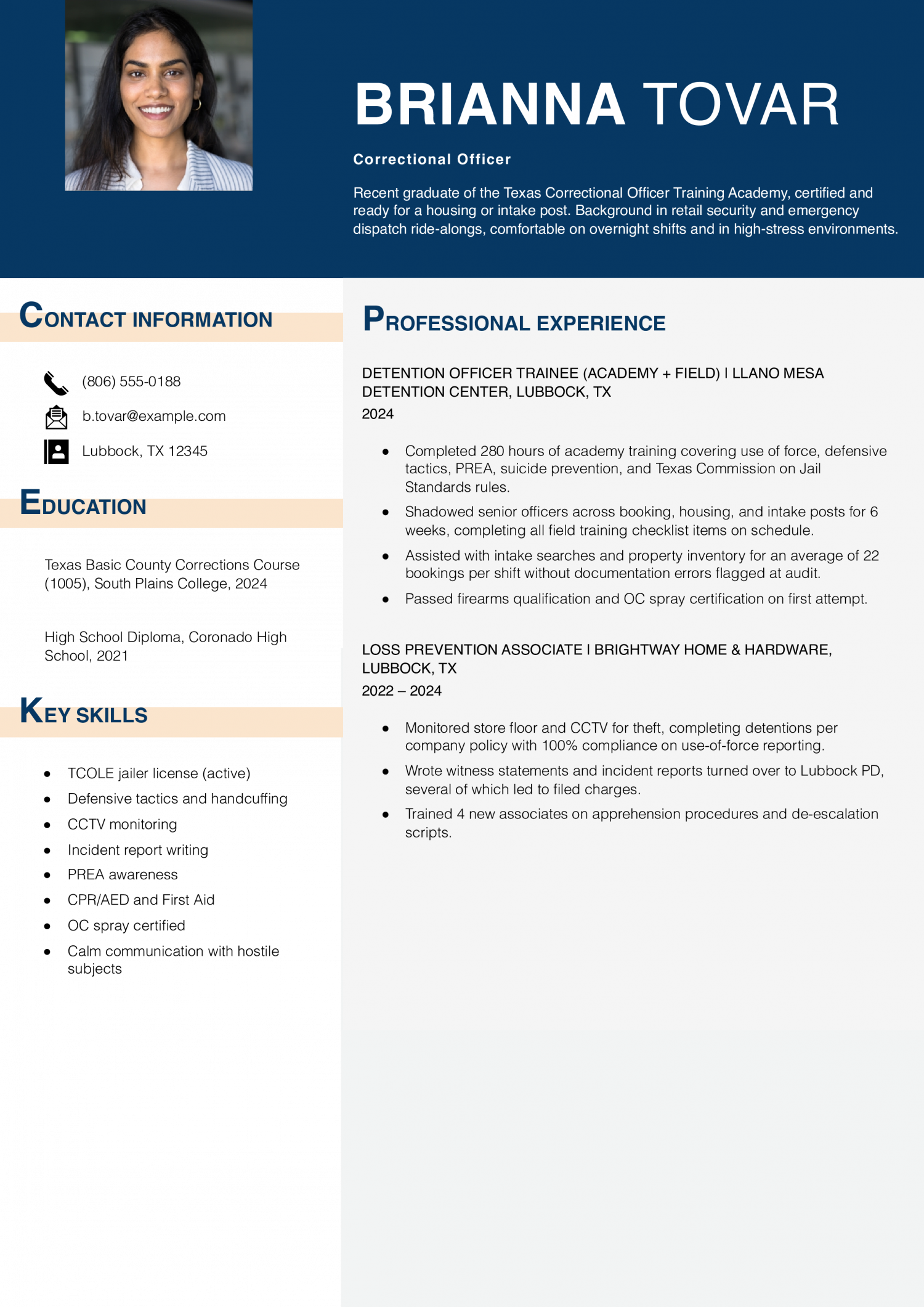
Entry-level officers are coming out of academy or transferring in from military, security, or county detention work. Your resume needs to prove academy completion, clean background, and the post assignments or ride-alongs that show you can hold a unit.
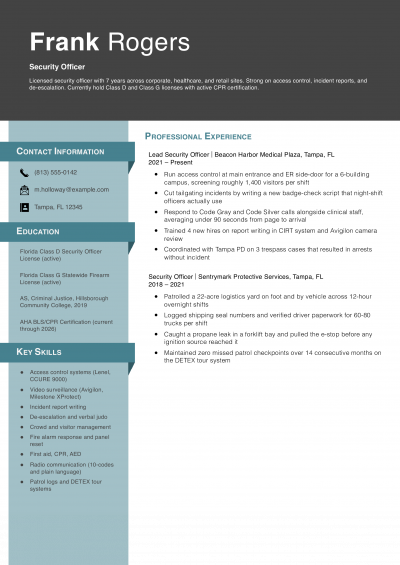
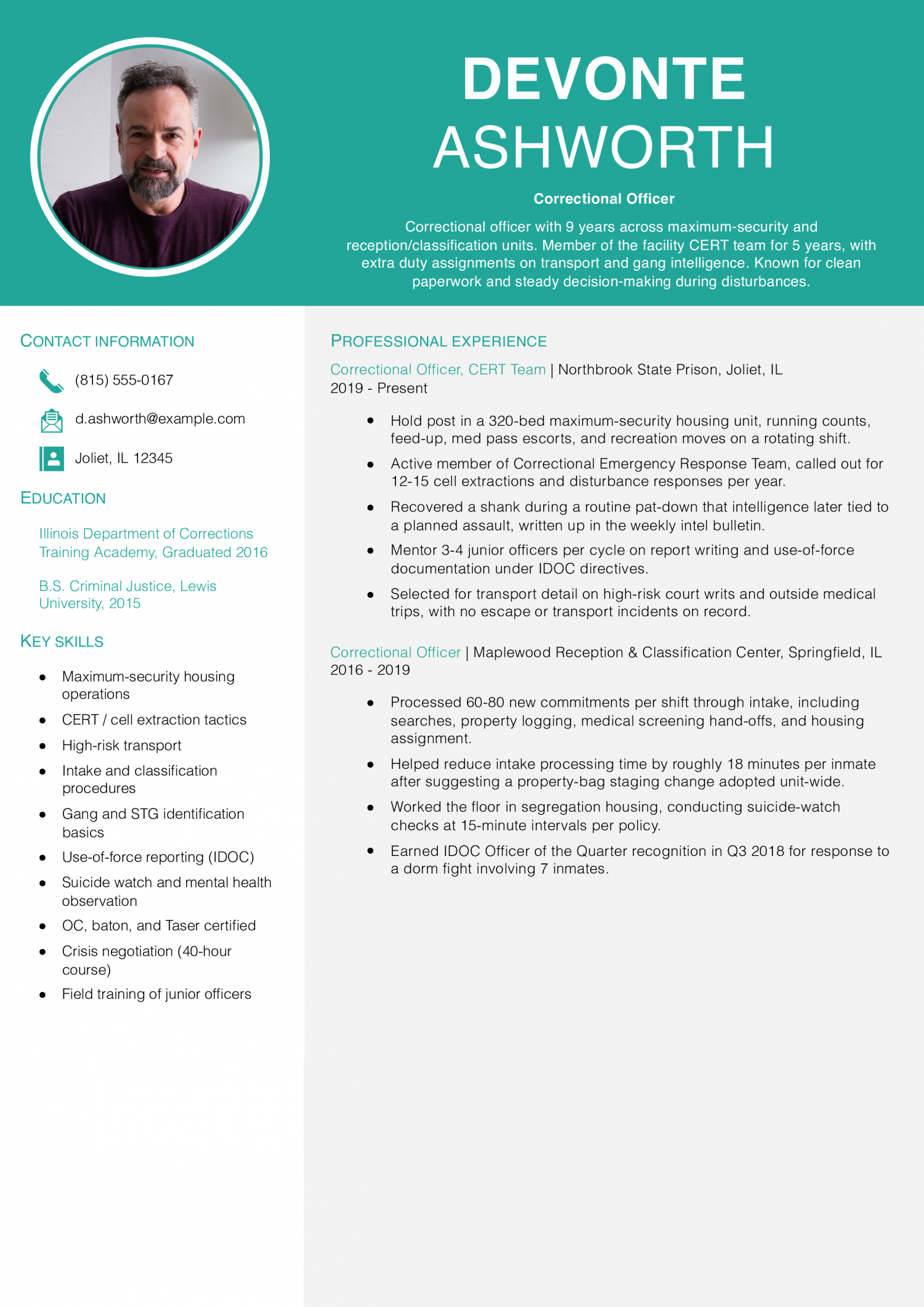
Experienced officers have two to seven years on housing units, intake, or transport with documented incident response. The resume needs to prove population size handled, contraband interdiction results, and PREA and use-of-force record without write-ups.
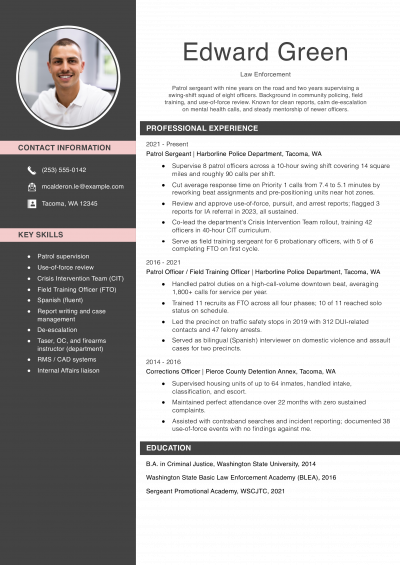
Sergeants supervise shifts of officers across housing units, intake, or special-management housing. The resume needs to prove span of control, post-order enforcement, incident-command roles during disturbances, and the training or FTO assignments you've carried.

Jamal Westerveld
Mobile, AL | (251) 555-0173 | [email protected] | linkedin.com/in/jamalwesterveld
Correctional officer with 11 years of state and county corrections experience, including 4 years on a Special Operations Response Team and 3 years as a field training officer. Strong record on contraband interdiction, mental health response, and report writing that holds up under IA and ACA review.
Senior Correctional Officer / SORT Member
Magnolia Bay Correctional Institution | Mobile, AL | 2020-Present
Correctional Officer
Riverbend State Prison | Montgomery, AL | 2016-2020
Correctional Officer
Pinecrest County Detention Center | Selma, AL | 2013-2016
Military Police Specialist (E-4)
U.S. Army | Various Duty Stations | 2009-2013
The first line of your summary should name the inmate population you’ve worked, your post type, and your years on the floor.
Facility wardens and corrections HR officers read that as your readiness to hold a post on day one. A line like “four years on a 480-bed medium-security housing unit, PREA and CPR current” carries more weight than any character claim.
Save the soft-skill language for the cover letter. The summary earns its space by telling the panel the floor you can walk into without a long ramp.
Bullets without a number tend to read as duties rather than performance. Name the population size of your unit, the headcount frequency, and the contraband or incident totals you logged.
Strong bullets cite three patterns: inmate population per shift, number of incident reports authored in a year, and contraband finds during shakedowns. “Authored 42 incident reports across 18 months on a 220-bed unit” reads cleaner than “responsible for documenting incidents.”
If your facility tracks use-of-force reviews or PREA audits, name your role in those reviews. Numbers do the work that adjectives can’t.
Cluster your bullets into three or four categories the panel already reads for: custody and control, search and contraband, escort and transport, and report writing.
Under custody and control, name headcount cadence, post orders followed, and any special-management housing experience. Under search and contraband, name the cell, vehicle, and visitor search protocols you ran.
Escort and transport bullets should name restraints used, distance, and any high-profile or medical transports. Report-writing bullets should name the incident types and the review chain your reports passed through.
Corrections HR screens credentials before reading narrative, so put academy, PREA training, restraint certification, CPR and first aid, OC spray, and any firearms qualification in a block under your name.
List academy name, graduation year, and state. List PREA, restraint, and CPR with the issuing body and currency date. Do not include certificate numbers or personal identifiers on the resume.
Facility wardens and corrections HR officers need this block visible because a missing currency date stalls an otherwise strong file at the screening desk.
End the resume with a short section covering academy specifics, in-service training hours per year, FTO or mentor assignments, and military service if applicable.
Name the academy, the state DOC or county sponsor, and the hours. If you’ve trained newer officers on post orders or use-of-force, name the count and the post type.
Military service with MOS and discharge type belongs here, not in the summary. This section answers the panel’s last question: what else have you been trusted to run.
The correctional officer resumes that get callbacks share a specific skill mix. The lists below come from our user-built correctional officer resumes. Facility wardens and corrections HR officers scan for these patterns first, not generic “protect and serve” language.
Hard skills carry the screen because corrections HR confirms academy, PREA, and restraint currency before any narrative is read. Soft skills only earn weight when a bullet shows the behavior under pressure. Match your list against the target posting’s post orders, then use the soft-skill terms as evidence labels for your incident and de-escalation bullets.
| Soft Skills | % of resumes with this skill |
|---|---|
| Conflict de-escalation | 69% |
| Clear communication | 60% |
| Composure under stress | 50% |
| Situational awareness | 36% |
| Sound judgment | 25% |
And here are the top hard skills showing up most often.
| Hard Skills | % of resumes with this skill |
|---|---|
| Inmate supervision and searches | 70% |
| Security surveillance monitoring | 60% |
| Incident report documentation | 42% |
| Restraint and defensive tactics | 37% |
| Emergency response and first aid | 30% |
Based on data from thousands of correctional officers’ resumes built on ResumeTemplates.com, May 2026.
Corrections HR runs a credentials check before a human reads your narrative, so the top of page one needs to answer their checklist on first scan. List the issuing body and the month and year of last renewal for each item.
Facility wardens and corrections HR officers read the certifications list as a map of where your work is heading. The list below tells them which custody, tactical, or supervisory track you’ve invested in beyond academy minimums. List the issuing body and the month and year of last renewal, not certificate numbers.
For correctional officers, the 10th-percentile floor reflects entry posts at county jails and private facilities, while the 90th-percentile ceiling reflects federal officers, senior state DOC posts, and high-cost-of-living regions. That spread tells you employer type and jurisdiction move pay more than tenure inside a single facility. The top-employment states cluster around large state DOC systems and federal facility regions.
Lead the resume with the jurisdiction you’re targeting, the security level you’ve worked, and the post type that maps to the ceiling.
| # | State | Avg. Annual |
|---|---|---|
| 1 | California | $95,840 |
| 2 | New Jersey | $90,150 |
| 3 | Oregon | $83,120 |
| 4 | Massachusetts | $78,830 |
| 5 | Illinois | $78,750 |
| 6 | Nevada | $76,800 |
| 7 | Washington | $76,400 |
| 8 | New York | $75,330 |
| 9 | Wisconsin | $74,490 |
| 10 | Alaska | $71,360 |
| # | State | Workers | Median |
|---|---|---|---|
| 1 | Texas | 39,150 | $51,020 |
| 2 | California | 37,760 | $95,840 |
| 3 | New York | 29,710 | $75,330 |
| 4 | Florida | 22,390 | $48,260 |
| 5 | Pennsylvania | 15,260 | $63,540 |
Resume Templates offers HR approved resume templates to help you create a professional resume in minutes. Choose from several template options and even pre-populate a resume from your profile.
Lead with custody and control, search and contraband interdiction, escort and transport, incident response and use-of-force, and report writing.
Each duty should carry a number. Name the bed count of your unit, the search cadence, the transport count, or the annual incident report total.
Panel interviewers read those five buckets first, so grouping your bullets that way maps cleanly to how they score files.
Create a short "Training and Certifications" section under your credentials block.
List the academy name, the sponsoring state DOC or county, graduation month and year, and total hours. Add in-service hours per year and any specialty schools like CERT, CIT, or FTO.
Do not list certificate numbers. Corrections HR will request those on the application form.
Lead with academy enrollment or completion status and a clean background statement.
Pull transferable experience from military police, armed or unarmed security, county detention, or dispatch work. Name post types held, population sized handled, and any restraint or de-escalation training completed.
Close with a short list of academy skills tested: defensive tactics, OC spray, firearms qualification, and report writing.
Yes. Lateral moves to police, parole, probation, court security, and federal investigator roles all weight corrections experience.
What transfers is your judgment under pressure, your report-writing volume, your clean use-of-force and PREA record, and your familiarity with chain of custody.
Reframe your bullets around those transferable signals when the target posting is outside corrections.
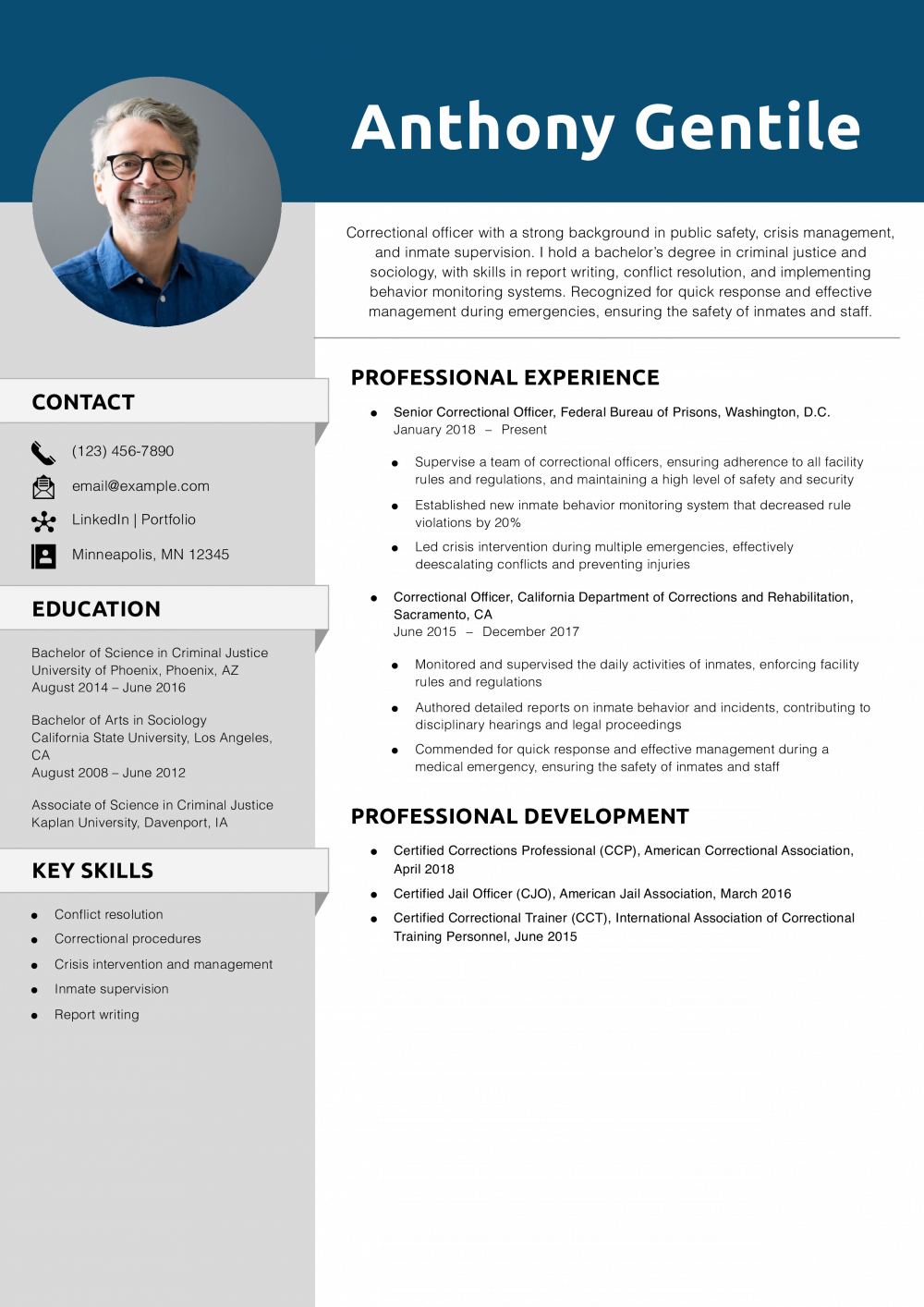
For a correctional officer, an ATS-friendly template is the safest pick, because it puts your certifications and experience where a hiring manager scans first. A basic template is a solid alternative. Whichever you choose, keep the formatting clean and easy to parse: clear section headings, a standard font, and no graphics a parser can choke on.
Executive Resume Writer and Career Coach
Andrew Stoner is an executive career coach and resume writer with 17 years of experience as a hiring manager and operations leader at two Fortune 500 Financial Services companies, and as the career services director at two major university business schools.
Customize this template in our builder in under 10 minutes.