Accountant Resume Examples
Lead the summary with one line stating the close outcome and the conditions that produced it. A pattern that works: ‘Closed a four-entity consolidation in six business days on NetSuite, $180M in annual revenue, clean…
Every resume example is written and reviewed by our team of Certified Professional Resume Writers to ensure top-quality content and formatting.
Most accounting intern roles draw dozens of applicants with the same coursework. What sets you apart is proof you can apply it. Show that you have used Excel, QuickBooks, or ERP tools to reconcile accounts or prepare reports.
Accounting managers and campus recruiters look for hands-on work with journal entries, bank statements, or month-end close tasks. Even a class project with real data counts if you name the output. The examples below show how to frame that proof on your resume. To compare layouts before you start, browse our resume templates.
Accounting managers and campus recruiters decide whether to keep reading by the education and skills block; if relevant coursework and software proficiency are not obvious there, the resume moves to the reject pile.
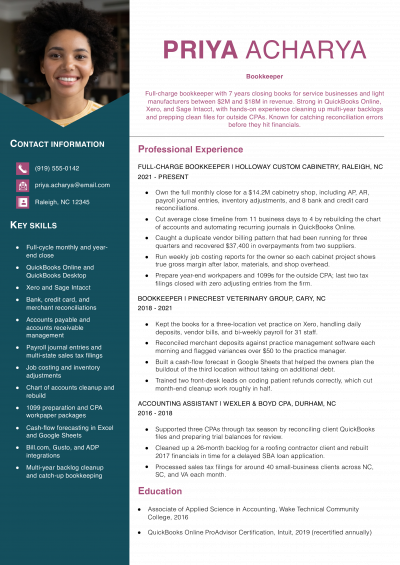
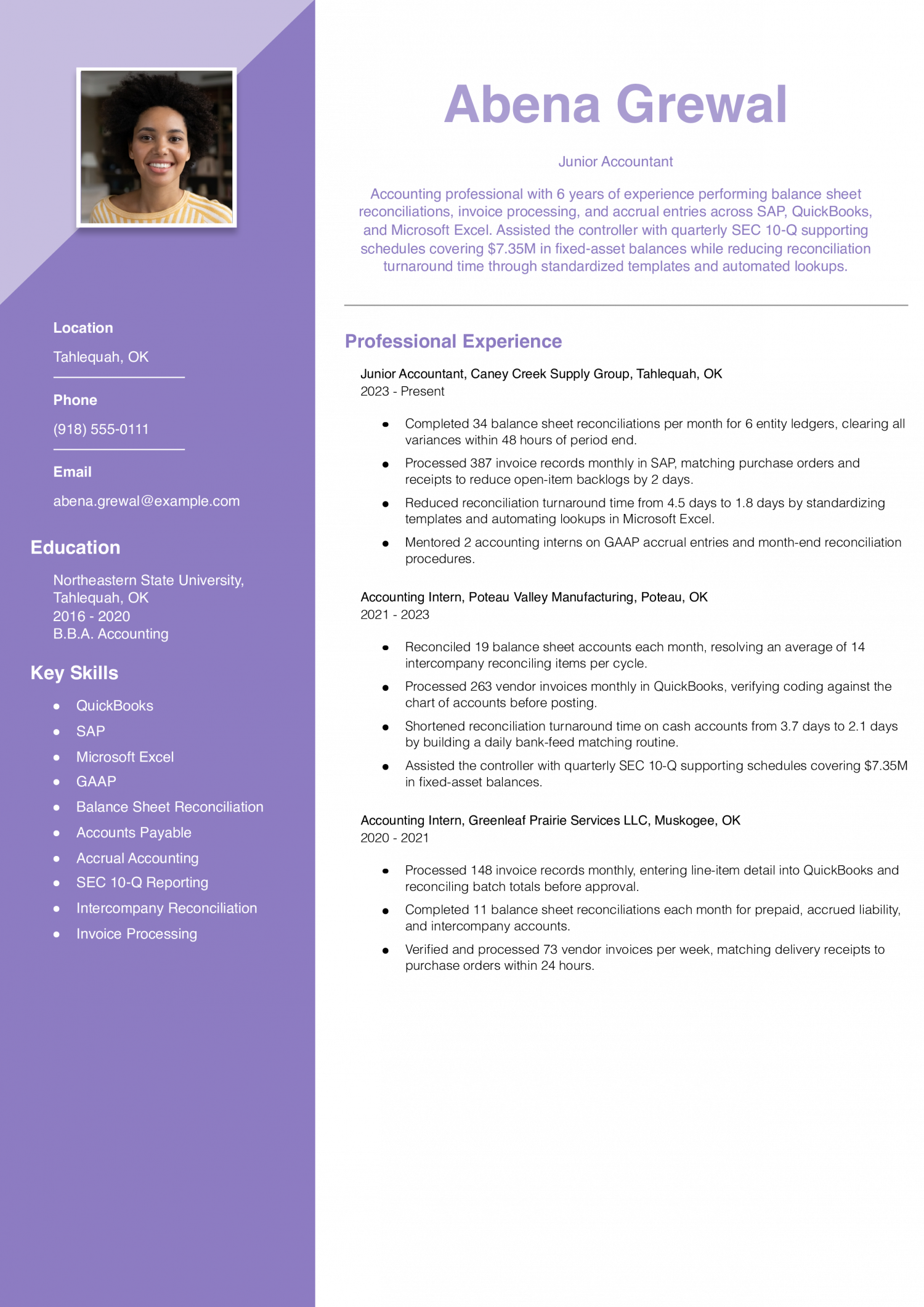
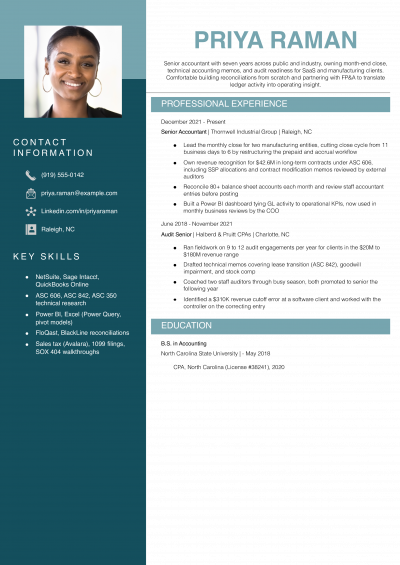
Pick this resume if you are a mid-level junior accountant with internship-to-staff progression and want to highlight growing volume across roles. Lead with reconciliation counts and turnaround improvements that climb from one position to the next.
Reconciliation turnaround went from slow to fast because of standardized templates and Excel automation. A supervisor can see the fix behind the speed gain, not the result alone. When you improve a routine process, name the change you made and the time difference it created.
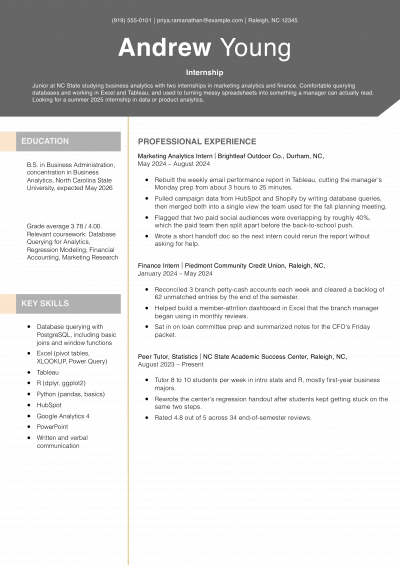
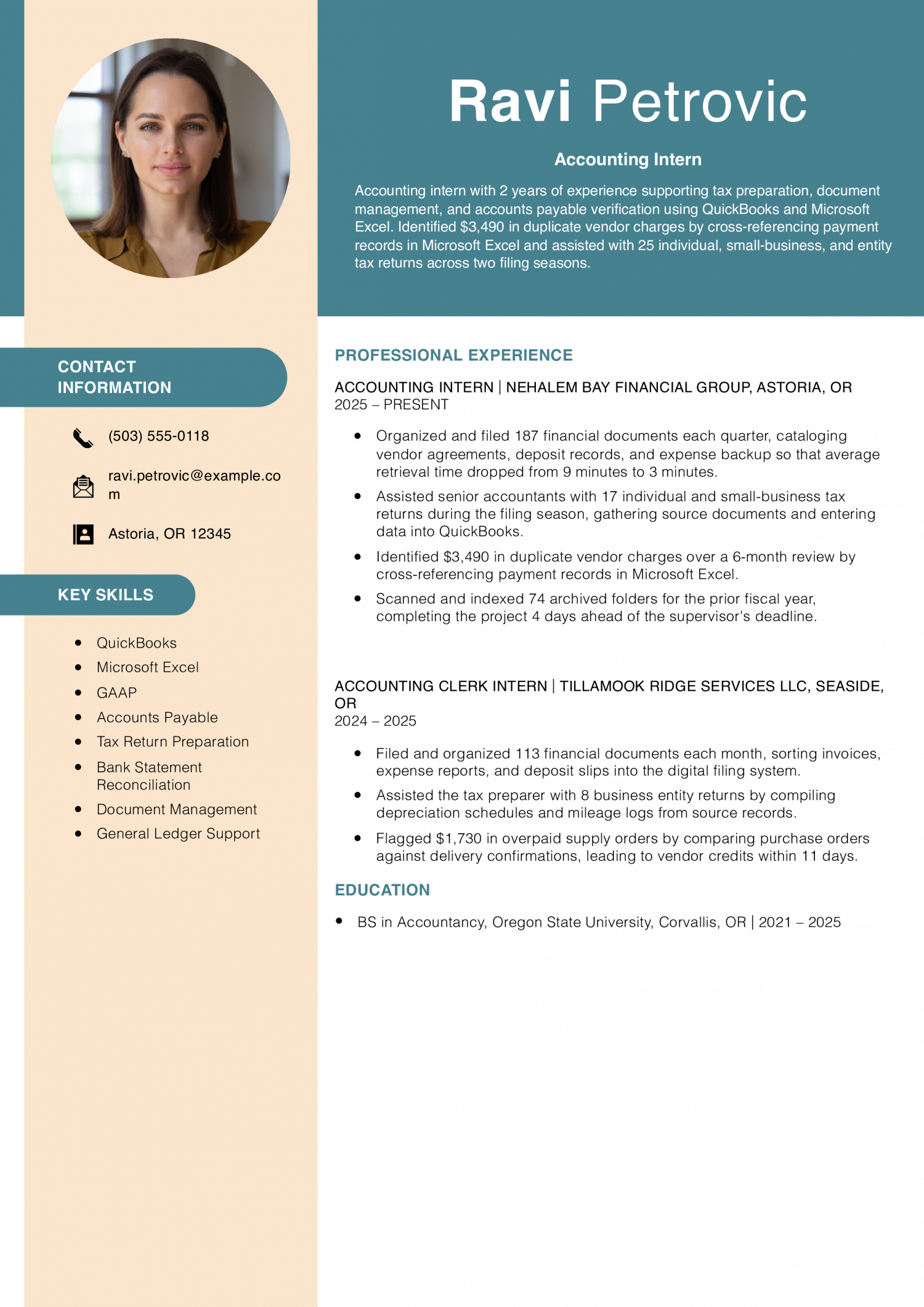
Start with this resume if you are an entry-level accounting intern building experience across two internship rotations. Top each bullet with a specific count or dollar figure tied to the task, the way every line here does.
Staff retrieved files faster after the filing change, shown with a before-and-after retrieval time. A senior accountant reading that can see the intern made things better, not kept them the same. Time a task you improved and put both the old and new numbers in the bullet.
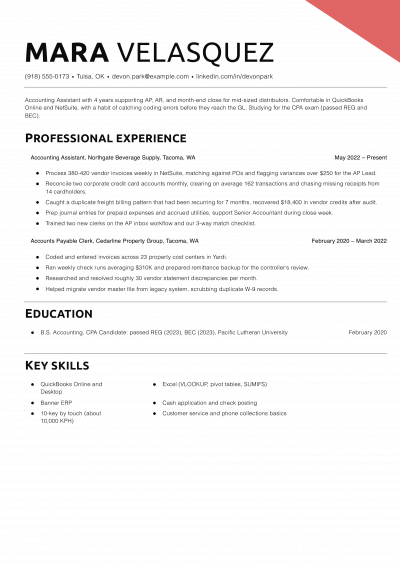
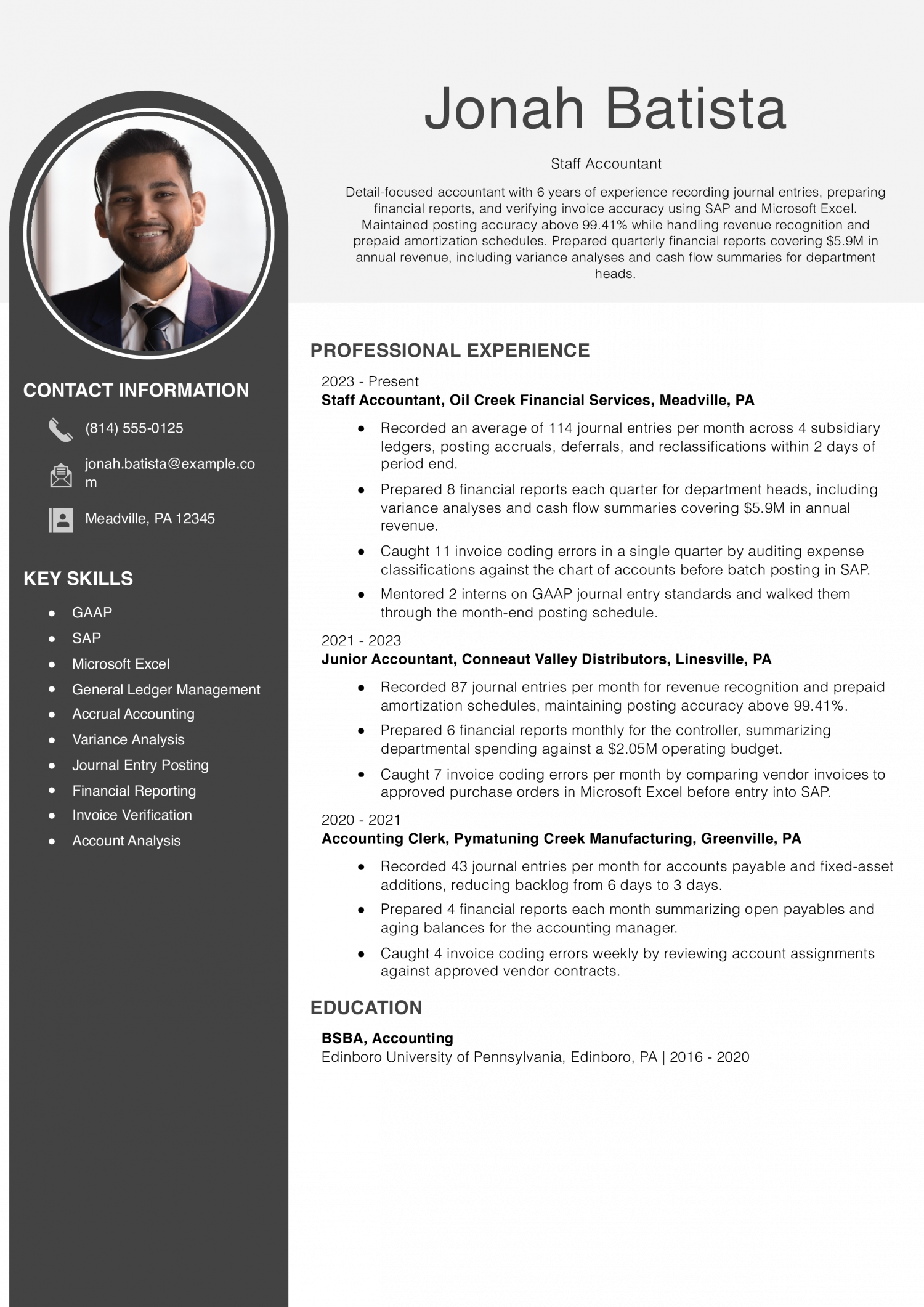
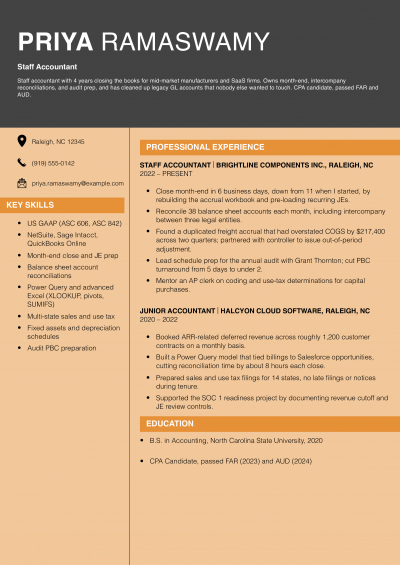
Try this resume if you are a mid-level staff accountant who has moved from clerk to junior to staff roles. Tuck an error-detection count into each position to show growing audit responsibility.
The invoice-review bullet names the verification step and the system where it runs, in that order. A controller can tell exactly where errors get caught in the process. For your own review work, say what you check, what you check it against, and where you post the result.
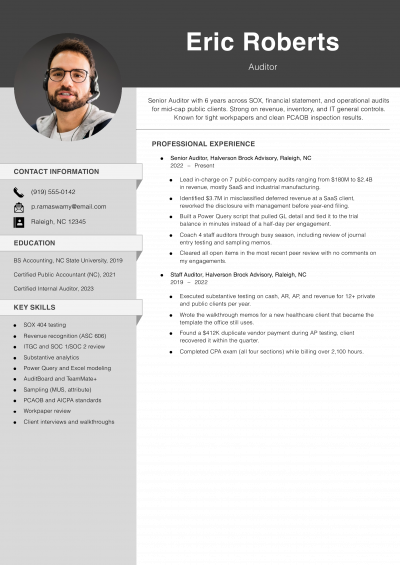
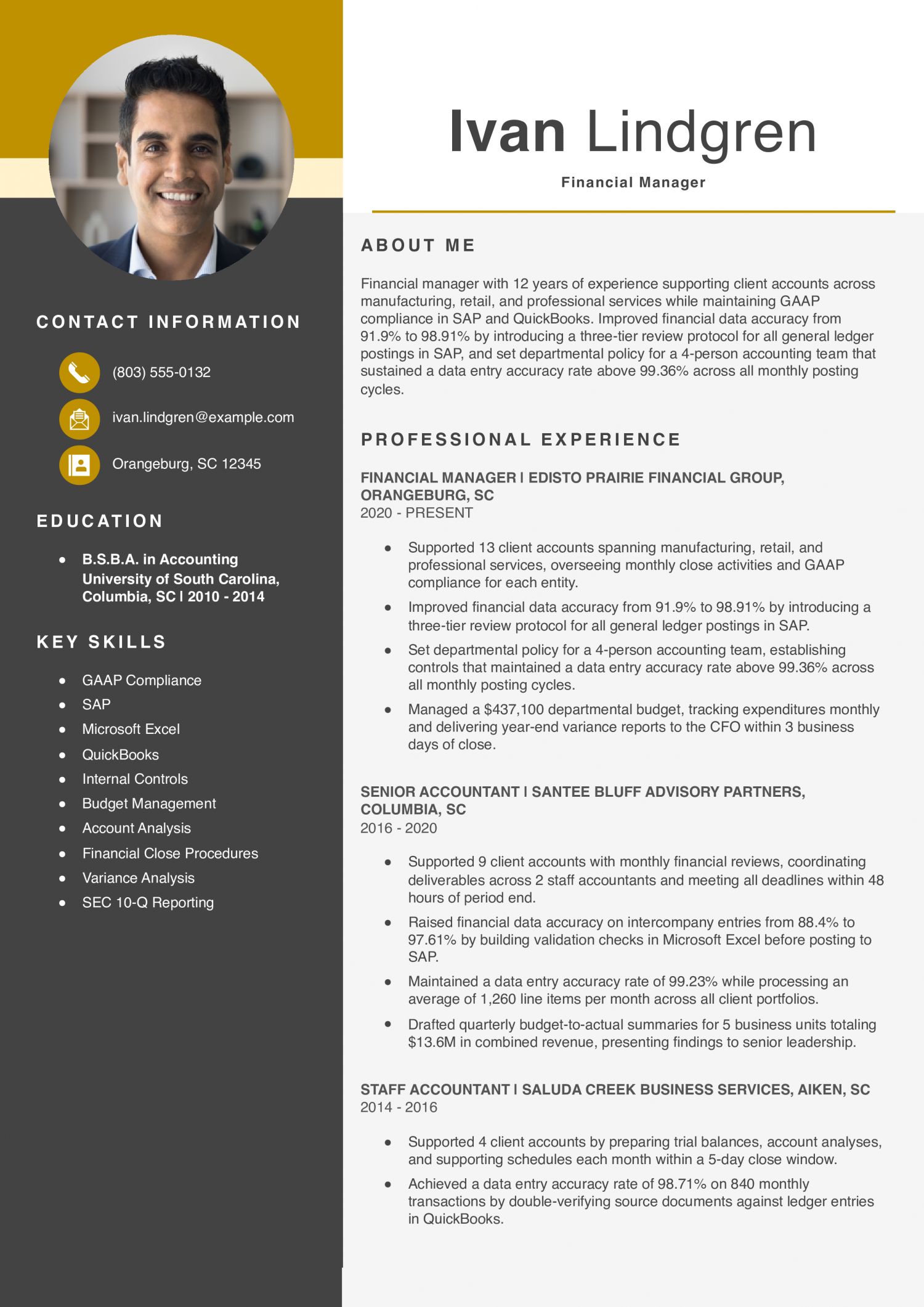
Lean on this resume if you are a senior-level financial manager overseeing multi-client portfolios and leading a small accounting team. Weigh how each role traces the same accuracy metric across three positions to show consistent improvement over time.
Budget reporting here includes a monthly schedule and a year-end delivery deadline to the CFO. A hiring manager sees both the rhythm and the audience for the work. Name your own reporting cadence and who receives the final numbers so a reviewer can picture the full cycle.
Experienced accountant with 6 years of progressive responsibility in transaction categorization, general ledger management, and month-end close optimization using SAP and Microsoft Excel. Prepared 19 audit working papers for the annual external audit covering $8.3M in assets and shortened the month-end close cycle from 9 days to 4 days by restructuring accrual schedules and automating recurring entries.
Name tax, audit, cost accounting, or another track. Mention your degree program and how far along you are.
Include the type of coursework that fits the posting. A profile like this tells accounting managers what seat you fill, because campus recruiters scan dozens of intern resumes each cycle. A clear, distinguishing focus line helps them sort yours into the appropriate pile.
Keep this introductory section to approximately three or four lines. State your GPA if it is 3.0 or higher. End with one relevant proficiency that ties directly to the job description.
Specificity demonstrates intentionality and helps differentiate your application from competing candidates.
Most strong intern resumes include at least one quantifiable number per role, and you may not have revenue figures, but you certainly have volume. State how many journal entries you posted each week. Note the number of accounts you helped reconcile.
If you worked a campus job, cite the dollar value you handled. A bullet with no number attached tends to blend in with the others, though even class projects offer data you can use. Name the size of a data set you cleaned.
Report how many transactions a spreadsheet tracked. Accounting managers look for proof you can work at scale. A single number turns a vague task into a clear, demonstrable result, and two or three per role is a solid target.
Sort your experience into clusters that match real work, where one cluster could cover bookkeeping tasks like journal entries and bank reconciliations. A second could list reporting work such as preparing trial balances. Name variance analysis or budget tracking as a third.
If you have tax exposure, give it its own line. A fourth cluster might cover data entry and filing. These groups show accounting managers you understand how the work breaks down, and they also help campus recruiters match you to open desks.
Use two to three bullets per cluster at most. Keep each bullet under one line on the page. Short, grouped bullets are faster to read than long paragraphs.
Create a dedicated skills block on page one near your profile, listing software you have used, such as Microsoft Excel and QuickBooks. Name any ERP system you touched in class or at a job. Accounting managers want to see these technical proficiencies before they read your bullets.
Put relevant coursework in your education section below. Name classes like intermediate accounting and cost accounting. If a posting asks for a specific tool, move that tool higher.
Campus recruiters often filter resumes by keyword, and a visible, well-organized skills block helps your resume pass that filter. Do not bury tools inside a bullet point midway down the page. Keep each item to one or two words so the block stays clean.
As an intern, your education section does heavy lifting, so list your degree, your school, and your expected graduation date. Add your GPA on the same line if it helps your case. Below that, name three to four courses that match the role.
Include honors, dean’s list terms, or academic awards on a short line. If you belong to a student accounting club, list it here. Note any volunteer tax prep work or case competitions.
Accounting managers read this section closely for intern roles. It tells them how academically prepared you are before day one, so keep the format tight and consistent with the rest of your resume. One page is the appropriate length for an intern resume.
Accounting managers and campus recruiters scan hundreds of intern resumes each cycle. The ones they shortlist name clear skills tied to real tasks. Start by reading the job posting word by word.
Hard skills like bank reconciliation prove you can do the daily work. Soft skills like attention to detail show you will catch errors early. Accounting managers and campus recruiters weigh both types when they compare interns.
The two tables below list terms that appear often in intern postings. Use them as a starting point, not a full list. Check each posting for terms that do not appear here.
Place hard skills near your bullet points so each one has context. Pair each soft skill with a short result or example. A claim without proof reads as filler to most reviewers. Match the exact phrasing in the ad so the ATS reads a direct hit.
| Soft Skills | AI-estimated % |
|---|---|
| Attention to detail | 76% |
| Professional communication | 70% |
| Deadline management | 50% |
| Team collaboration | 38% |
| Analytical thinking | 31% |
And here are the top hard skills showing up most often.
| Hard Skills | AI-estimated % |
|---|---|
| General ledger reconciliation | 78% |
| Financial statement preparation | 55% |
| GAAP compliance | 46% |
| Account variance analysis | 36% |
| Data entry accuracy | 26% |
Skill names and rankings come from an AI model grounded in U.S. Department of Labor occupation data for accounting interns, not from a count of accounting interns’ resumes built on ResumeTemplates.com.
Even as an intern, add every item below to your resume.
You can handle AI on an accounting intern resume in three ways. You could lead with vague claims like “AI-driven analyst.” Accounting managers screen that out. You could skip AI on the resume and bring it up later.
Or you could show how you actually use the tool on the job. The third is what accounting managers and campus recruiters can validate. Name the tool you used and the task it helped with.
Then note that a senior accountant reviewed the output. This framing shows you can use new tools responsibly. It also shows you understand that human review matters in accounting.
What AI is actually changing for this role
Data entry: AI tools can pre-classify transactions from bank feeds, but interns still verify each coding decision.
Reconciliation prep: Pattern-matching models flag mismatches faster, though a staff accountant must approve every cleared item.
Report drafting: AI can build first-draft variance commentary, but interns edit it against the actual general ledger.
Learning speed: Interns who prompt AI for explanations of GAAP entries can absorb context faster during busy season.
AI tools to name
How to phrase AI on your resume
Do
Skip
Most interns have not earned a CPA license yet. That is expected at the intern level. You can still show progress toward key credentials.
About These Numbers
The Bureau of Labor Statistics does not publish a wage code for Accounting Intern specifically. The numbers below are a proxy: the closest published match is Accountants and Auditors (SOC 13-2011), so use them as an estimate for this role, not an exact figure.
These BLS figures cover all accountants and auditors, a broader group that includes accounting interns. The 10th-percentile floor and the top-decile ceiling sit far apart. The top earners in this group out-earn the median by about 72 percent.
That wide spread reflects differences in geography, firm size, and industry sector. The bottom tenth sits roughly a third below the median. As an intern, you likely fall near the lower bands.
Your resume should close that gap by showing the tools and coursework that matter most to accounting managers. List your ERP exposure, tax or audit coursework, and any relevant software skills near the top of your resume.
| # | State | Median Annual |
|---|---|---|
| 1 | District of Columbia | $111,530 |
| 2 | New York | $102,640 |
| 3 | New Jersey | $100,830 |
| 4 | Massachusetts | $99,460 |
| 5 | Connecticut | $97,550 |
| 6 | California | $97,050 |
| 7 | Colorado | $97,030 |
| 8 | Washington | $96,550 |
| 9 | Rhode Island | $95,820 |
| 10 | Delaware | $95,020 |
| # | State | Workers | Median |
|---|---|---|---|
| 1 | California | 175,360 | $97,050 |
| 2 | Texas | 116,470 | $80,920 |
| 3 | New York | 109,830 | $102,640 |
| 4 | Florida | 91,000 | $79,250 |
| 5 | Illinois | 54,930 | $80,230 |
Resume Templates offers HR approved resume templates to help you create a professional resume in minutes. Choose from several template options and even pre-populate a resume from your profile.
Keep your accounting internship resume to one page. Accounting managers and campus recruiters spend only a few seconds on each resume. A single page with clear sections is the strongest format at the intern level.
List technical skills like Excel, QuickBooks, and general ledger posting near the top. Pair those with soft skills such as attention to detail and written communication. Match the exact phrasing from the job posting so your resume clears keyword filters.
Yes, relevant coursework strengthens your resume when you have limited work experience. List courses like financial accounting, cost accounting, or auditing under your education section. Those titles show accounting managers you have studied what the role requires.
Lead with class projects, volunteer bookkeeping, or campus organization budgets that show real accounting tasks. Describe each one with a bullet that names the task, the tool, and a number. Even a small figure like the dollar amount of a budget you tracked gives the reader proof.
Use a resume objective when you are applying for your first internship. State your degree program, your expected graduation date, and the area of accounting you want to explore. A summary works better after you have completed at least one prior internship.
Create a bullet under your experience section that names the audit procedure and your finding. For example, write that you reconciled vendor invoices against purchase orders for a stated dollar volume. Quantify the scope so the reader can judge the complexity of the work.
Yes, many accounting managers use GPA as an early filter for internship candidates. Include yours if it is 3.0 or above on a 4.0 scale, because that threshold appears in most campus recruiting guidelines. If your major GPA is higher than your overall GPA, list both.
An ATS-friendly template makes it easy for accounting managers to spot your coursework and software skills. A basic template is a good fit as well.
Accounting Intern Resume
4.1/5 stars with 137 reviews

Executive Resume Writer and Career Coach
Andrew Stoner is an executive career coach and resume writer with 17 years of experience as a hiring manager and operations leader at two Fortune 500 Financial Services companies, and as the career services director at two major university business schools.
© 2026 Resumetemplates.com All rights reserved.