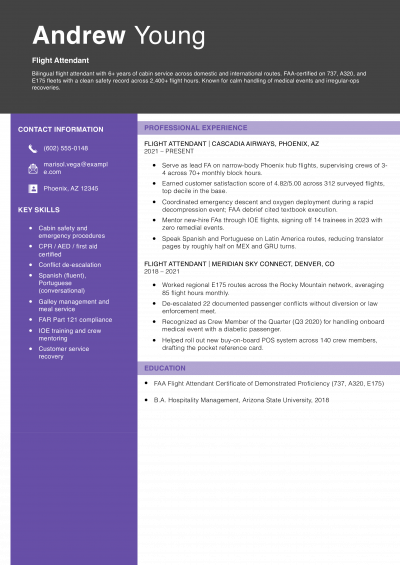
Flight Attendant Resume Examples
The first line of your summary should name your block hours flown, the aircraft types you’re qualified on, and your base. Base managers and in-flight services leaders read this as your readiness to hold a…
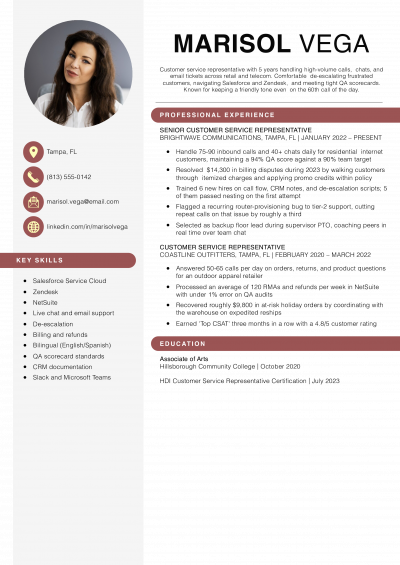
Every resume example is written and reviewed by our team of Certified Professional Resume Writers to ensure top-quality content and formatting.
Gate and ticket counter roles fill fast because airlines staff by season. Your resume needs to prove you can rebook flights, calm upset travelers, and hit on-time departure targets. Station managers and airline recruiters screen for hands-on work with Sabre, Amadeus, or similar reservation systems.
Show your boarding counts, bag-check volume, or complaint resolution rate in clear numbers. Mention any irregular operations experience, such as weather delays or cancellations you helped manage. The examples below show how to frame that proof on your own resume. To compare layouts before you start, browse our resume templates.
Station managers decide whether to keep reading by the summary section; if passenger-facing volume and familiarity with departure control systems are not obvious there, the resume moves to the bottom of the pile.
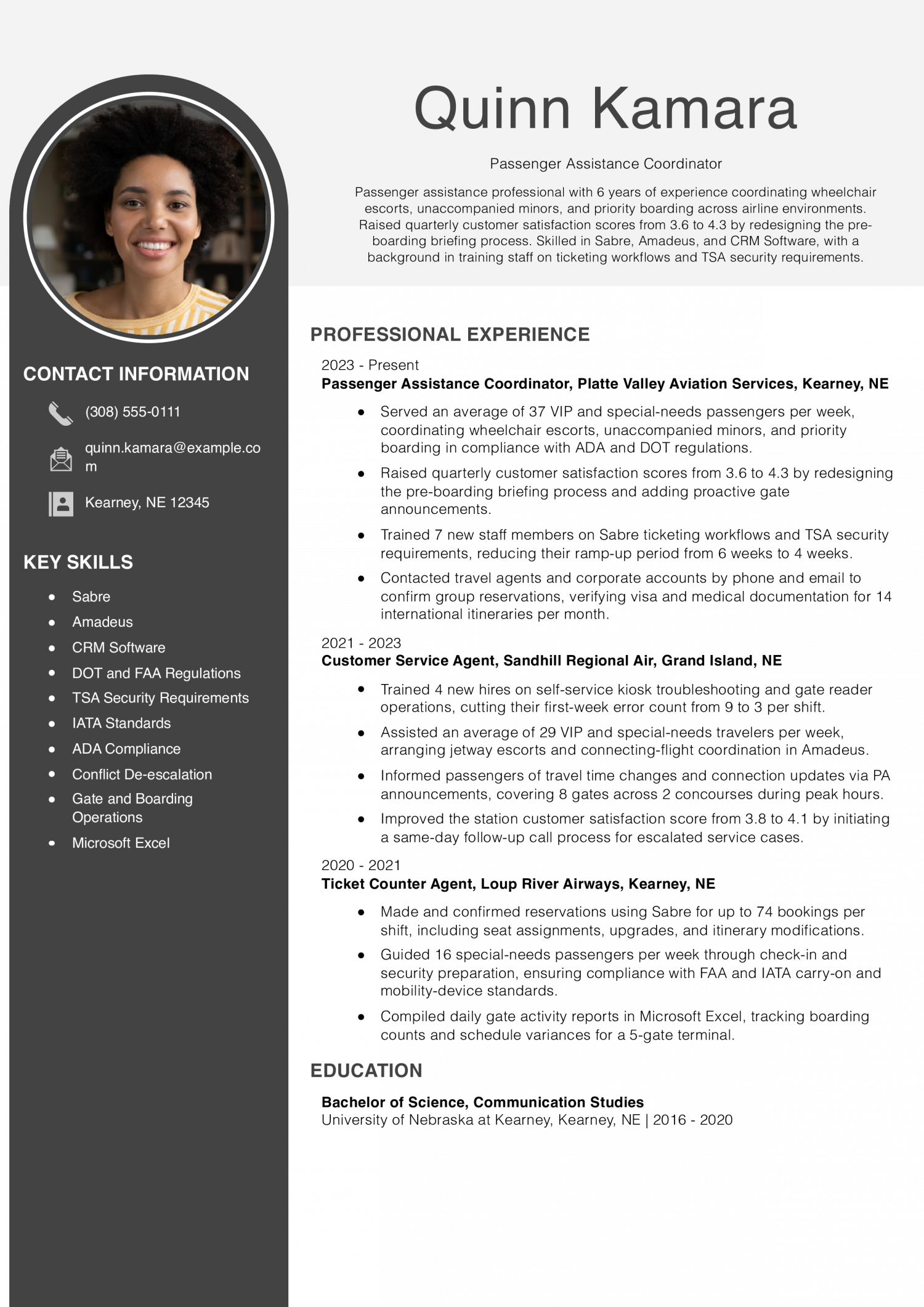
Consider this resume if you are a mid-level passenger assistance coordinator moving between regional carriers and growing your training responsibilities. Lead with satisfaction score gains tied to the specific process changes you introduced.
Onboarding new agents here ties a specific training approach to a shorter ramp-up period. The station manager reading it sees the method behind the result, not a vague claim. Spell out your training steps and how the learning curve changed for new hires.
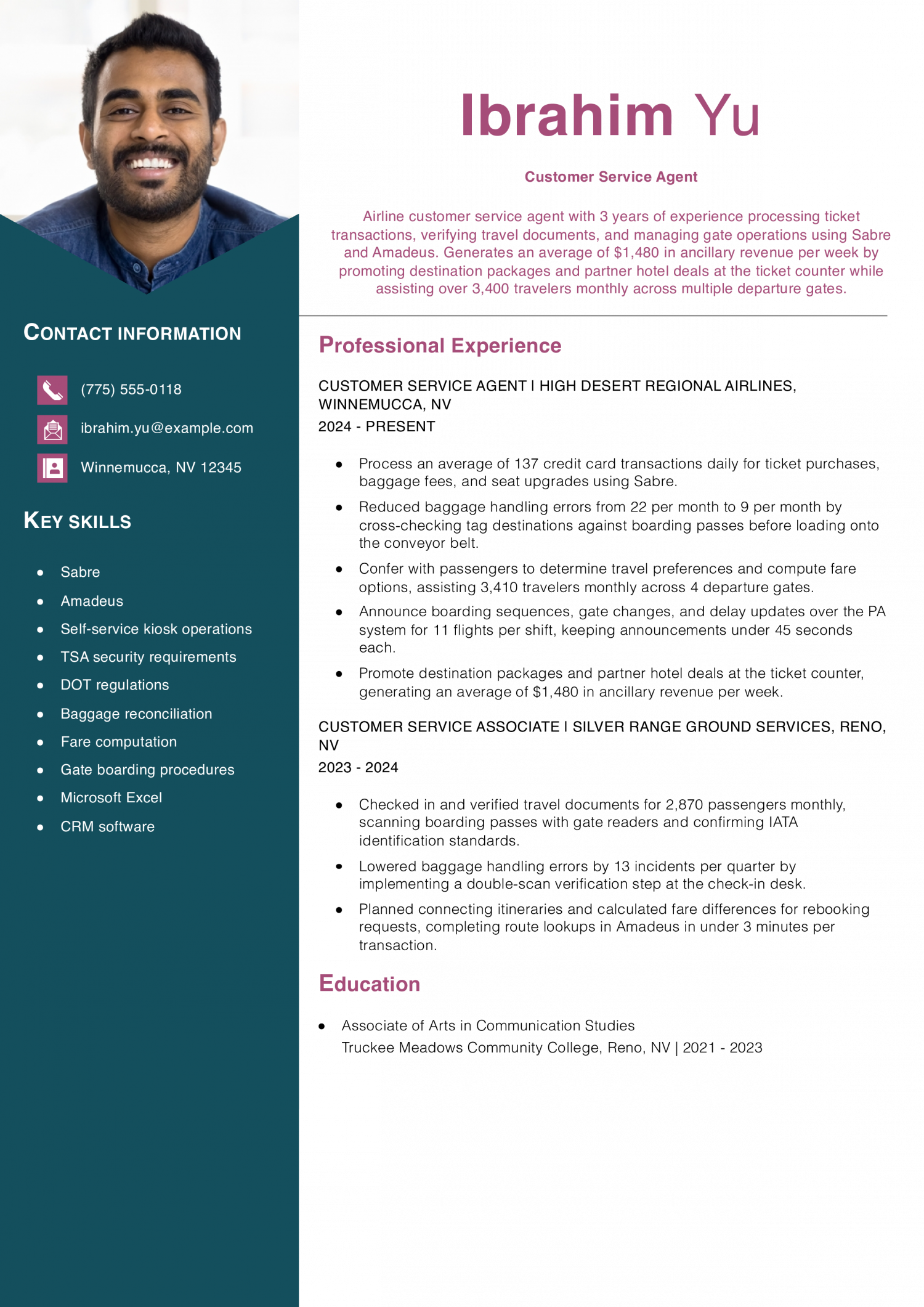
Start with this resume if you are an entry-level airline customer service agent building a career from ground services up. Lead with error-reduction figures that show you improved a measurable process, not only performed it.
Baggage handling errors dropped because of a specific verification step added to the loading process. That tells a supervisor what changed and by how much. Show the old error count next to the new one beside the step that fixed it.
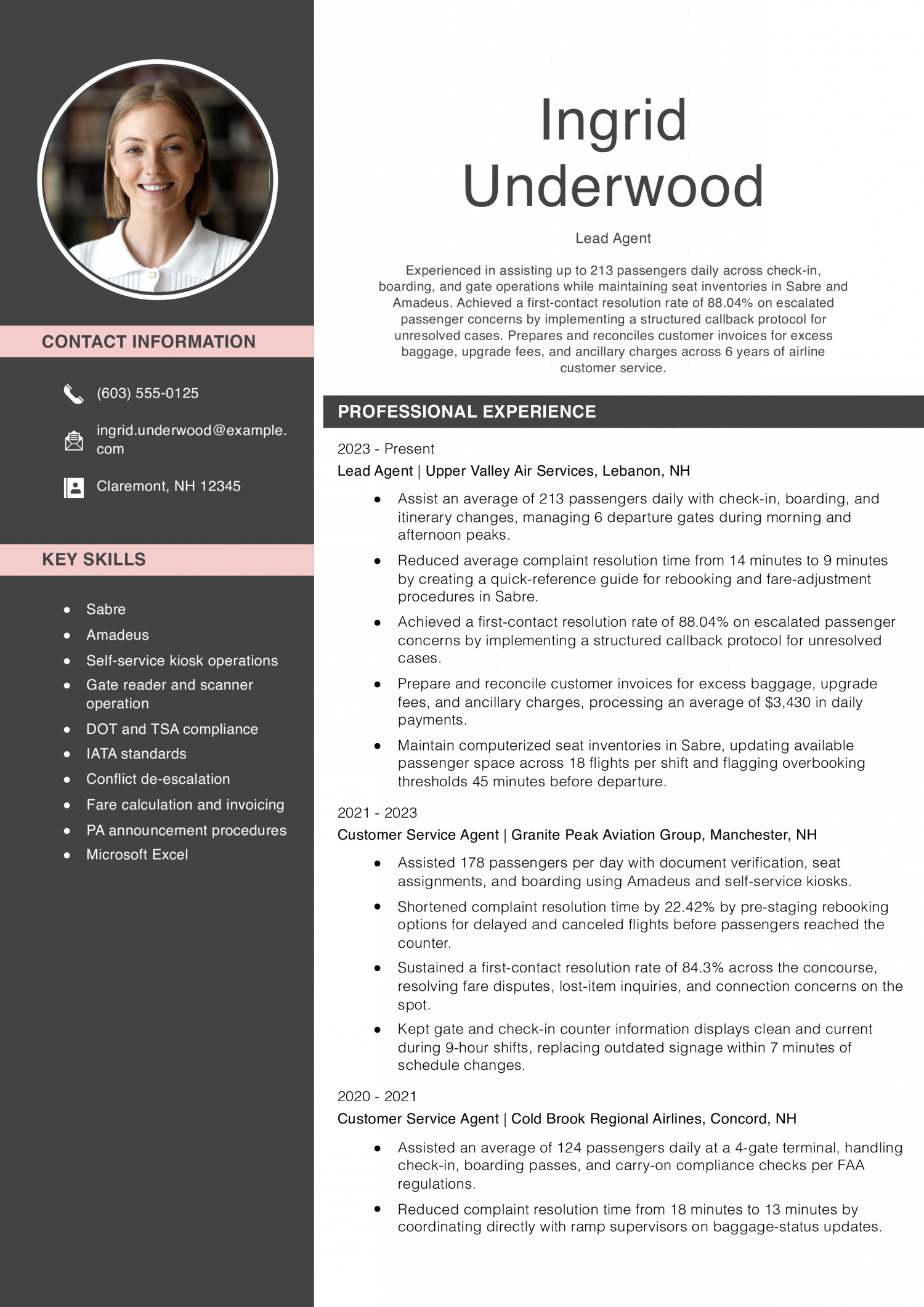
Try this resume if you are a mid-level airline agent moving into a lead role after several years of gate and counter work. Lead with resolution-rate gains tied to the specific protocol or procedure you introduced.
A quick-reference guide for rebooking and fare adjustments is the tool that shortened complaint times here. It shows a manager a resource the whole team can use, not one person working faster. Name any guide or template you built and the time it saved.
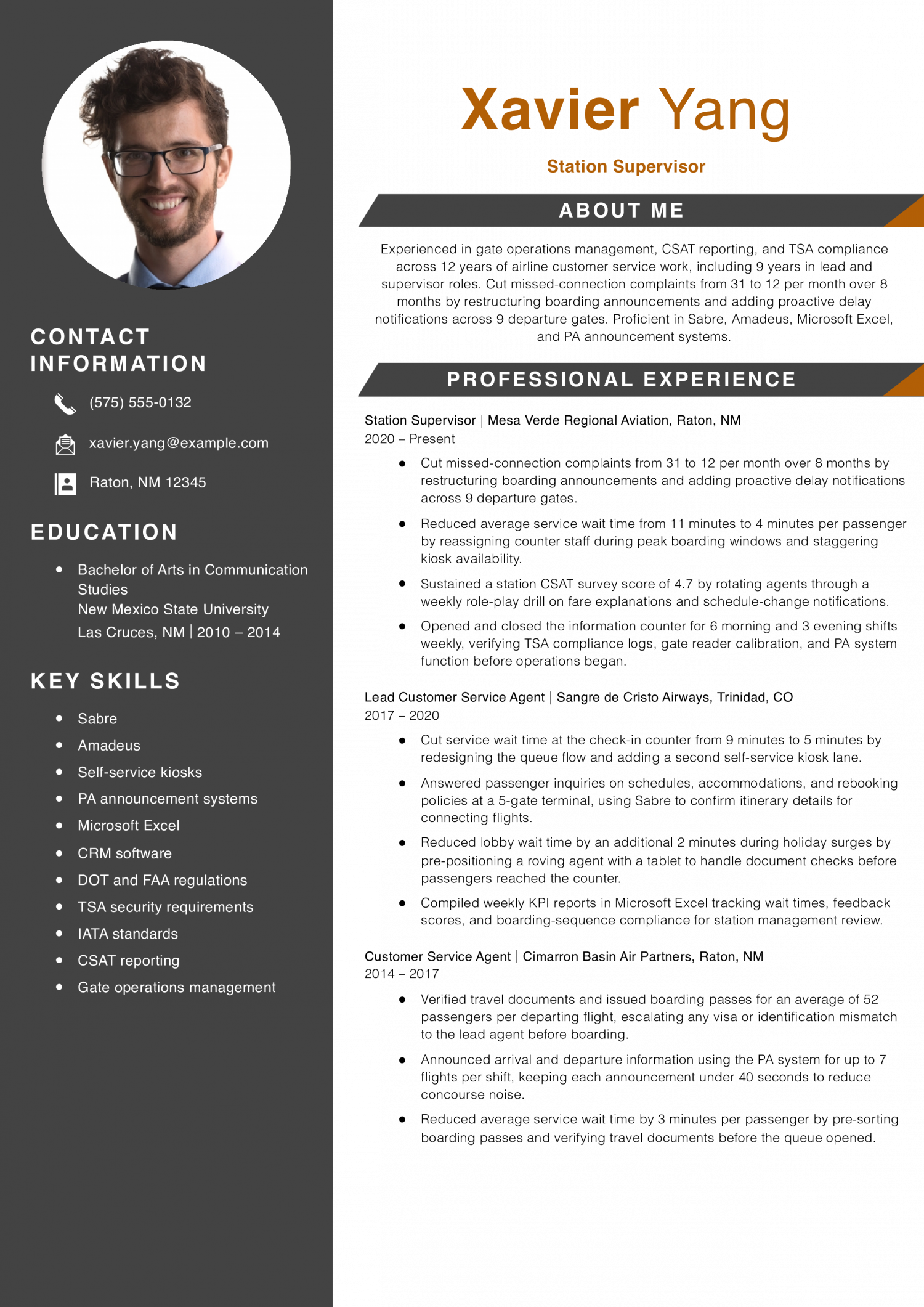
Lean on this resume if you are a senior station supervisor with over a decade of airline experience spanning frontline and leadership roles. Lead with wait-time reductions that name the staffing or queue change behind each improvement.
The satisfaction score stays steady because a recurring drill holds it in place. Regional managers see an ongoing habit, not a one-time push. If you keep a score stable, say which routine maintains it and how often you run it.
Experienced in airline customer service across gate, ticket counter, and lead positions over 6 years, with a focus on irregular operations rebooking, international departure documentation, and IATA compliance. Raised customer inquiry resolution rate from 86.2% to 94.4% by introducing a tiered escalation checklist and pre-built rebooking templates in Sabre. Skilled in Amadeus, CRM software, and ticket sales, generating $27,430 in quarterly revenue through seat-upgrade and travel-insurance recommendations at the gate counter during boarding windows.
Station managers and airline recruiters scan your summary for proof of volume. Lead with the number of passengers you process per shift or per day. A line like “checked in 200+ passengers per shift at a hub gate” tells a reader your pace right away.
Follow it with the size of the station you worked. Name the airline or ground handler too. Skip vague phrases like “team player with strong people skills.” A verifiable count shows you can handle peak boarding rushes.
Put the metric first, then add your years in the role.
Most strong resumes tie each bullet to a result. A line without data behind it tends to read as a task list. Think about on-time departure rates you helped maintain.
Note the percentage of rebookings you handled during delays.
You can also count bags tagged per hour or upgrades sold per month. Station managers want to see patterns of speed and accuracy. If you cut a queue wait time, state by how much.
Pair each metric with the action you took to reach it. One clear number per bullet is a solid floor.
Break your work into sections a recruiter can scan fast. Start with check-in and boarding, which covers ticket processing and gate calls. Next, list irregular operations work like rebookings and hotel vouchers.
A third group is baggage handling, such as tracing lost bags and filing claims. You can add a fourth for upselling, covering seat upgrades and lounge passes. Keep each group to three or four bullets.
Use the terms you see in the job listing so your resume reads like a fit.
Put a short credentials section near the top of page one. List your departure control systems here, such as Altéa or other platforms your airline used. Add any ground handling software you have used.
Station managers and airline recruiters look for these tools early. If you hold valid ramp access clearance, note it in this section. Airport security training belongs here as well.
Language skills matter at international stations, so list each language and your level. Do not bury them at the bottom of page two.
For entry and mid-level roles, close with your education section. A high school diploma or associate degree is typical for this role. List the school name, location, and graduation year.
If you hold a degree in hospitality or travel management, call it out.
Below education, add a short training section. Include any airline-specific onboarding courses you finished. Customer de-escalation training fits well here.
Keep each entry to one line so the section stays tight. Station managers and airline recruiters read the bottom of a resume for confirmation.
Station managers and airline recruiters scan for a clear mix of gate skills and composure under pressure.
Hard skills prove you can run the systems at the gate and ticket counter. Reservation systems and baggage tracing top the list. Soft skills like composure show you can handle delays and cancellations without losing control of the interaction.
Cross-check each table against your target job posting. Treat soft skills as proof points that back the bullets in your work history. Add the exact phrasing the posting uses so your resume clears each filter.
| Soft Skills | AI-estimated % |
|---|---|
| Customer de-escalation | 68% |
| Grace under pressure | 55% |
| Clear gate announcements | 42% |
| Team coordination | 37% |
| Passenger empathy | 29% |
And here are the top hard skills showing up most often.
| Hard Skills | AI-estimated % |
|---|---|
| Flight reservation booking | 72% |
| Ticket issuance processing | 59% |
| Baggage check-in handling | 41% |
| Fare calculation rules | 38% |
| Passenger itinerary management | 35% |
Skill names and rankings come from an AI model grounded in U.S. Department of Labor occupation data for airline customer service agents, not from a count of airline customer service agents’ resumes built on ResumeTemplates.com.
Name the booking systems you use.
Airline counters rely on point-of-sale terminals every shift. You process ticket changes, bag fees, and upgrades at speed. Station managers want to see the exact systems you know.
Airlines operate around the clock, every day of the year. Your open schedule can set you apart from other applicants. Make your shift range clear near the top of your resume.
Tip: State Your Shift Availability Early
Airline recruiters often screen for overnight or weekend coverage first. State the shifts you can work in a short line. Place it below your contact details or in a summary section.
This small detail saves reviewers time and flags your fit.
The top-paying states for airline customer service agents cluster in smaller, lower-supply markets. They are not the large hub cities most people expect. BLS figures here cover all reservation and transportation ticket agents and travel clerks, a broader group that includes airline customer service agents.
Pay varies widely in this field. Workers at the top of the range out-earn those at the median by a large margin. That gap signals real room to grow your pay over time.
If you are open to relocating, list that flexibility on your resume and name the regions where you can start.
| # | State | Median Annual |
|---|---|---|
| 1 | Michigan | $60,220 |
| 2 | Minnesota | $60,090 |
| 3 | California | $49,420 |
| 4 | Washington | $48,520 |
| 5 | Georgia | $47,860 |
| 6 | Illinois | $47,850 |
| 7 | New Mexico | $47,850 |
| 8 | Oklahoma | $47,340 |
| 9 | District of Columbia | $46,550 |
| 10 | Colorado | $45,960 |
| # | State | Workers | Median |
|---|---|---|---|
| 1 | Texas | 18,410 | $38,220 |
| 2 | Florida | 14,740 | $39,490 |
| 3 | California | 10,580 | $49,420 |
| 4 | Illinois | 7,080 | $47,850 |
| 5 | Georgia | 5,880 | $47,860 |
Resume Templates offers HR approved resume templates to help you create a professional resume in minutes. Choose from several template options and even pre-populate a resume from your profile.
Focus on skills you use at the gate or ticket counter every day. Strong choices include rebooking during irregular operations and boarding gate management. Baggage claim resolution is another skill station managers look for.
List six to ten skills that match the phrases in the job posting.
State the position you want, the airline you are applying to, and one strength you can measure. You might mention handling 200 passengers per shift or resolving complaints within a set target time.
Keep the objective to two or three lines so it reads fast.
No, a general resume often lacks the airline-specific terms that station managers scan for. Swap broad phrases like "assisted customers" for terms such as irregular operations recovery or gate announcements.
Tailoring your bullet points to airline vocabulary signals that you understand the work.
Highlight transferable tasks from hotel front desks, call centers, or retail roles. Stress situations where you managed high volumes under time pressure or calmed upset guests.
Airline recruiters value conflict resolution and fast problem-solving in any service setting.
Most airline customer service agent resumes fit on one page. If you have more than ten years of relevant work, a second page is acceptable.
Keep older roles to two or three bullet points so the page stays focused on recent results.
A summary works better when you already have airline or airport experience to reference. Lead with your years in the field, a key metric, and the type of operation you know best.
An objective fits better when you are entering the industry for the first time.
Note the gap on your timeline and mention any relevant activity you did during it. Volunteer work at an information desk or a language course shows applicable skills.
Station managers care more about what you did with the gap than how long it lasted.
An ATS-friendly template gives your certifications and work history separate headings on the page. A basic template is fine for this role.
Airline Customer Service Agent Resume
4.1/5 stars with 112 reviews

Executive Resume Writer and Career Coach
Andrew Stoner is an executive career coach and resume writer with 17 years of experience as a hiring manager and operations leader at two Fortune 500 Financial Services companies, and as the career services director at two major university business schools.
© 2026 Resumetemplates.com All rights reserved.