Loan Officer Resume Examples and Templates for 2026




Finance directors decide whether to keep reading by the second bullet of the first role; if the dollar size of the budget owned and the forecast accuracy aren't visible by then, the resume drops off the shortlist.
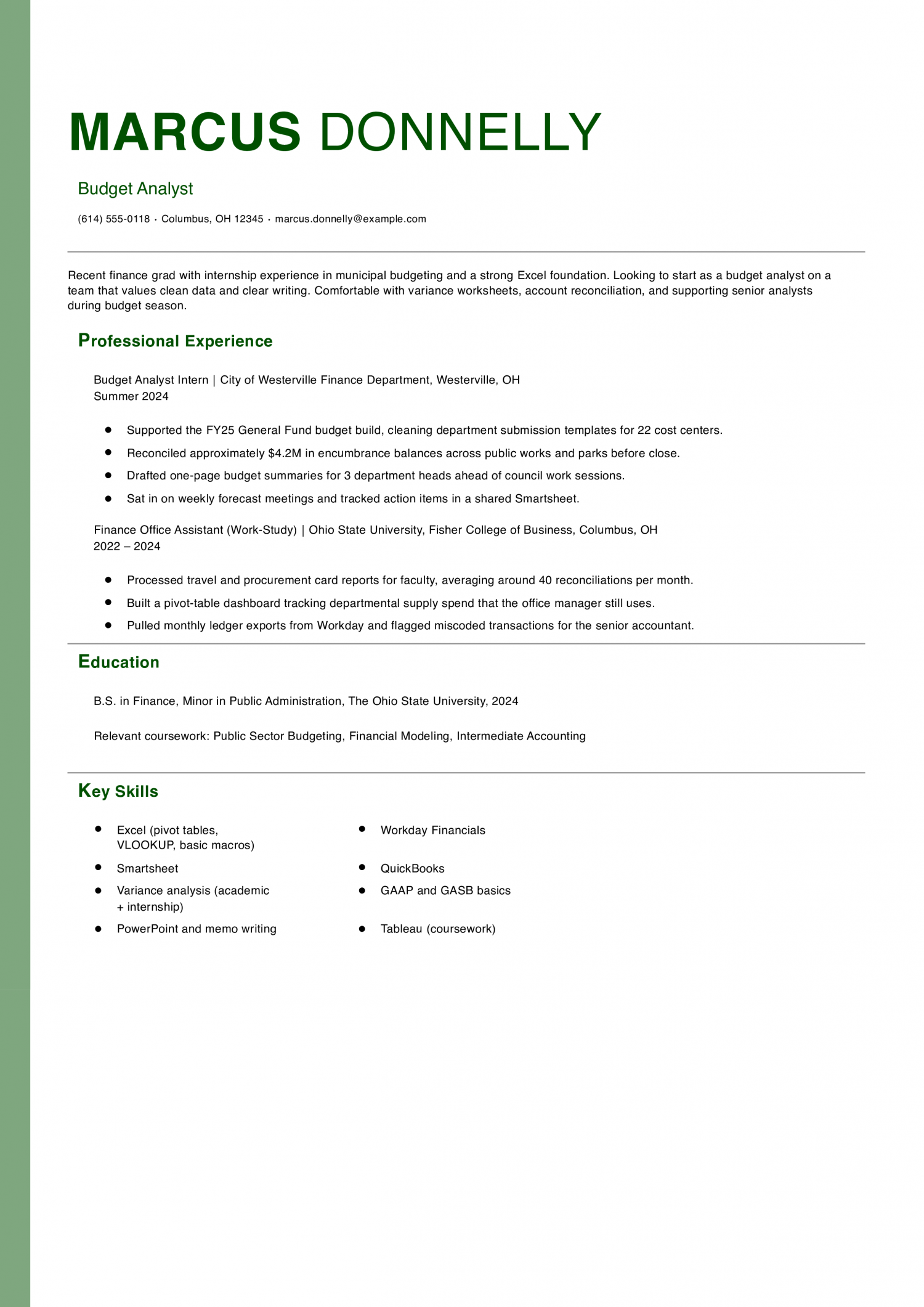
You finished a finance or accounting degree in the last two years and supported a budget cycle through an internship or analyst rotation. This resume needs to prove Excel modeling depth, variance work you touched, and the ERP you trained on.
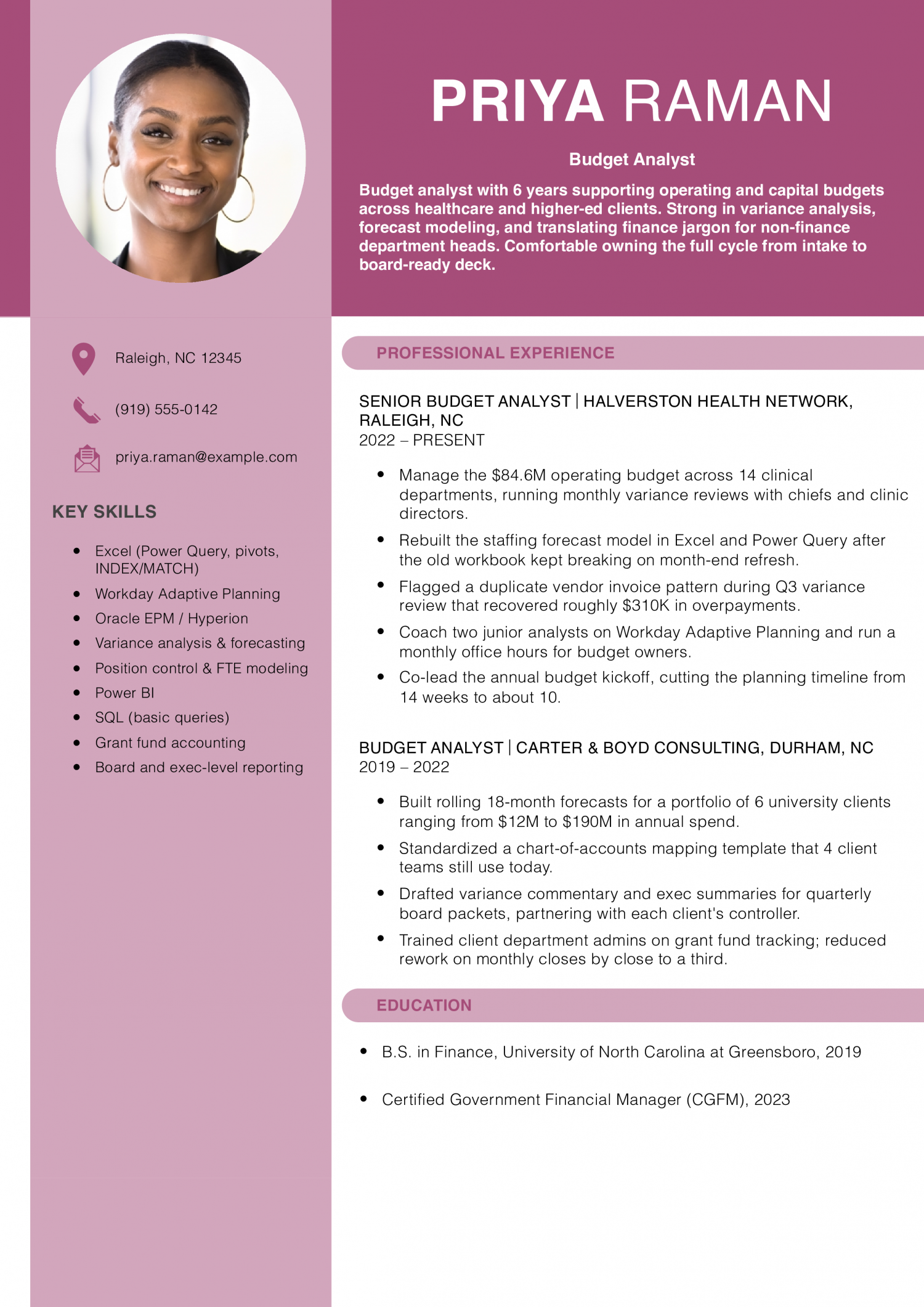
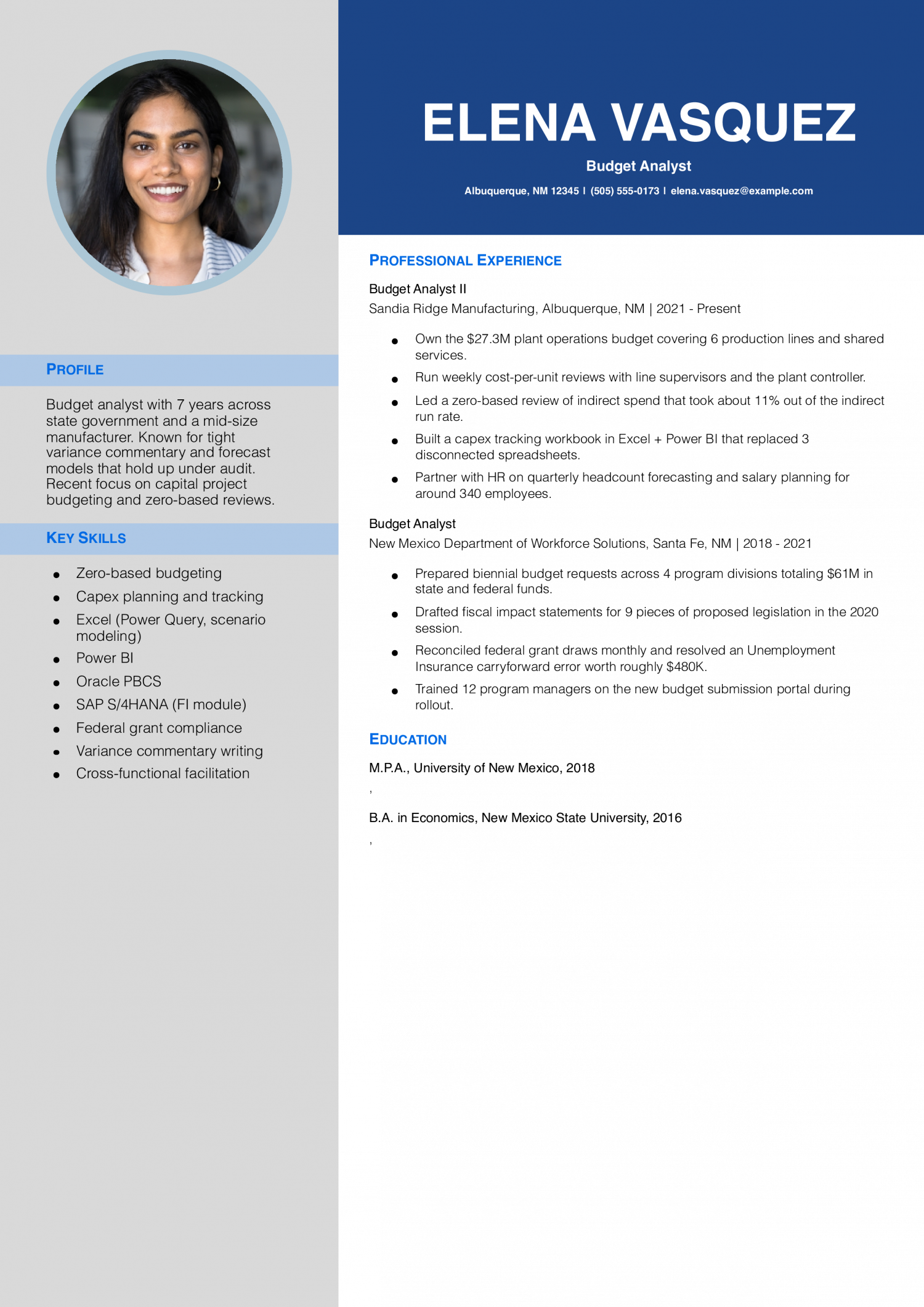
You own a department or program budget end-to-end and run the monthly variance review with operating leaders. This resume needs to prove forecast accuracy, the dollar size you manage, and the ERP and BI tools you drive.
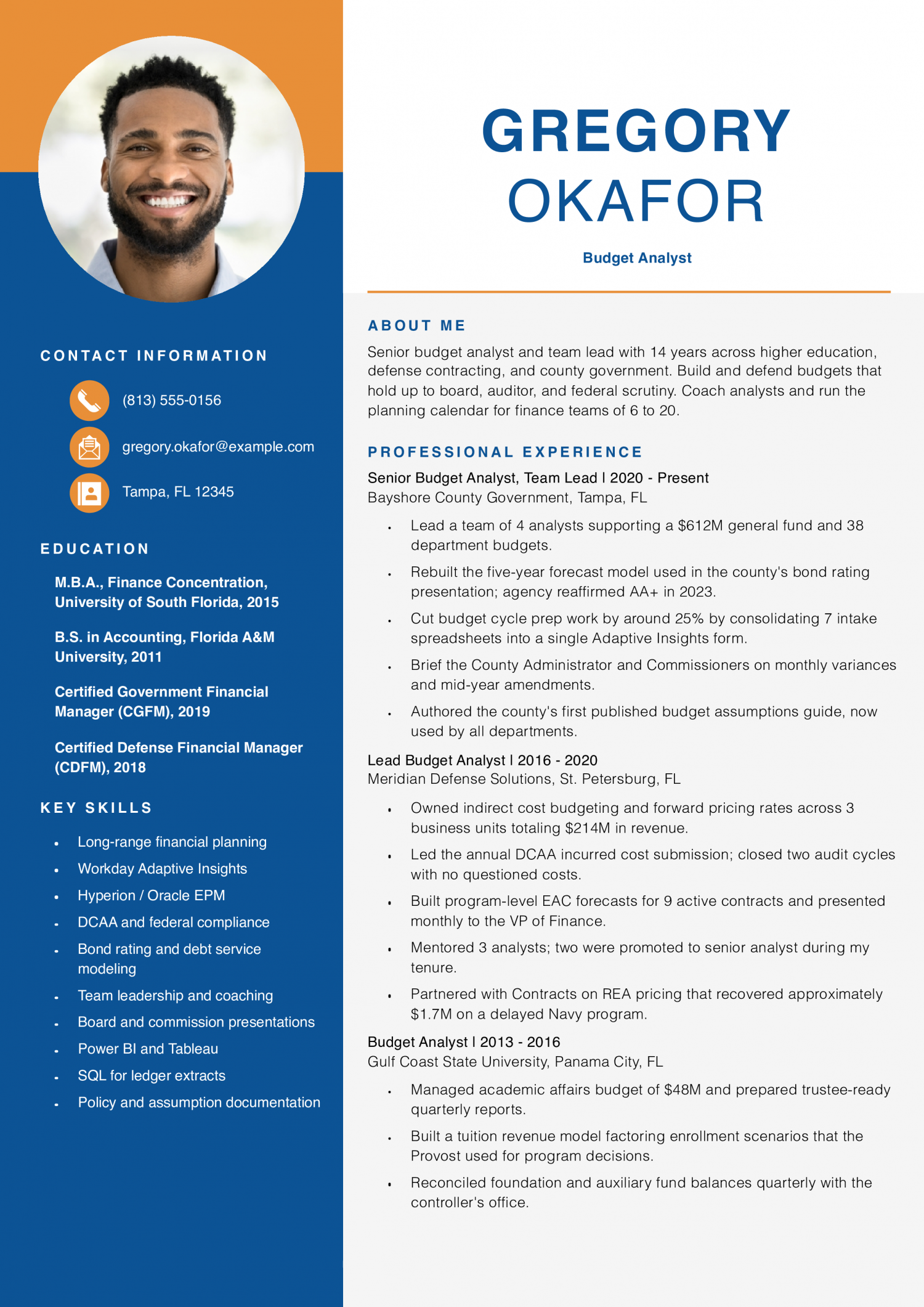
You lead a budget team or own a multi-program portfolio across an agency, hospital system, or business unit. This resume needs to prove cycle ownership, headcount you direct, and the policy or GAAP frameworks you set.
Hannah Lindqvist
Minneapolis, MN | (612) 555-0139 | [email protected] | linkedin.com/in/hannahlindqvist
Budget analyst with 9 years across nonprofit, health system, and city government settings. Strong on multi-fund accounting, grant budgeting, and forecast models that non-finance leaders can actually read. Comfortable owning the full cycle from intake through council or board approval and running variance reviews that change behavior.
Senior Budget Analyst
North Star Regional Health | Minneapolis, MN | 2022-Present
Budget Analyst
City of Bloomington Finance Department | Bloomington, MN | 2019-2022
Grants and Budget Analyst
Twin Cities Housing Coalition | St. Paul, MN | 2017-2019
Junior Financial Analyst
Lakeside Credit Union | Eagan, MN | 2015-2017
Lead your summary with the dollar size of the budget you own and your forecast accuracy, not your years in finance. Finance directors and budget officers read this as your readiness to run their cycle.
Name the cycle scope in one line: budget owned, departments or programs covered, forecast variance, and the ERP. A line like “Own $48M operating budget across 6 programs, forecast within 2.1% variance, Workday Adaptive” lands harder than “experienced budget analyst with strong analytical skills.” Save adjectives for the cover letter and put the size, accuracy, and tools on the first line of the resume.
Most strong budget analyst resumes pin three numbers to each bullet: dollar size, variance or accuracy, and a time window. Bullets without a number tend to read as duties, not results.
Name realistic metrics finance leaders track: budget owned in dollars, forecast variance percentage, cost savings captured, close-cycle days, and number of cost centers. A bullet like “Cut forecast variance from 6.4% to 2.8% across 14 cost centers over two cycles” gives a director something to compare. Pair the number with the lever you pulled (driver-based model, rolling forecast, zero-based review) so the reader sees the method behind the result.
Cluster your bullets under four buckets recruiters scan for: budget development, forecasting and variance analysis, financial reporting, and stakeholder partnership. This map mirrors the JD language and helps ATS parsers tag your skills.
Under budget development, name annual planning, capital requests, and zero-based exercises. Under forecasting, name rolling forecasts, driver-based models, and scenario planning. Under reporting, name month-end variance commentary, board decks, and OMB or GAAP filings.
Under partnership, name the operating leaders you brief and the cadence you run. Keep three to four bullets per cluster so the page stays scannable.
Finance directors and budget officers need your tool stack and credentials visible above the fold, not buried at the bottom. Put a credentials line directly under your summary listing the ERP, BI tools, and certifications you hold.
Name Hyperion, Workday Adaptive, SAP, Oracle EPM, Anaplan, Power BI, and Excel functions you actually use (XLOOKUP, Power Query, pivot tables). Add CGFM, CDFM, CMA, or CPA progress with current section status. For federal roles, name the OMB circulars you worked under (A-11, A-123) and any DoD PPBE exposure.
Keep the line tight so it parses cleanly through ATS.
Senior budget analysts often pad the resume with role descriptions and decade-old software. Cut anything that reads like a job description and prune tools you have not touched in three years.
Drop generic lines like “responsible for monthly close” and replace them with the headcount you direct, the portfolio you own, and the policy you wrote. Trim Lotus, legacy Hyperion versions, and pre-cloud SAP modules unless the JD asks for them. Keep your education to one line, move certifications up to the credentials block, and use the recovered space for cycle ownership and the operating leaders you brief at the executive level.
The skills below come from budget analyst resumes our users built on ResumeTemplates.com. Finance directors and budget officers scan dozens of resumes a week, and these are the skills that show up most often. Hard skills carry the ATS parse: ERP names, variance methods, and GAAP exposure are the gate.
Soft skills back the bullets, so treat partnership and communication as evidence behind a specific brief. Match this list against your target posting and keep only the items you can defend in an interview.
| Soft Skills | % of resumes with this skill |
|---|---|
| Analytical thinking | 76% |
| Attention to detail | 50% |
| Communication | 49% |
| Problem solving | 35% |
| Cross-functional collaboration | 32% |
And here are the top hard skills showing up most often.
| Hard Skills | % of resumes with this skill |
|---|---|
| Budget preparation | 68% |
| Variance analysis | 56% |
| Financial forecasting | 48% |
| Cost analysis | 39% |
| Advanced Excel modeling | 31% |
Based on data from thousands of budget analysts’ resumes built on ResumeTemplates.com, May 2026.
These are the must-haves hiring teams look for when scanning a budget analyst resume.
Finance directors and budget officers expect to see the niche language of your sector mirrored in your bullets. Use these clusters to match the JD vocabulary without keyword-stuffing.
| Niche | Keywords ATS scans for |
|---|---|
| Federal budget | OMB Circular A-11, appropriations law, PPBE, apportionment |
| Corporate FP&A | rolling forecast, driver-based model, monthly variance analysis, board reporting |
| Healthcare and nonprofit | fund accounting, grant budget management, cost center analysis, FTE planning |
| ERP and planning tools | Workday Adaptive Planning, Hyperion, Anaplan, SAP BPC |
| Capital and program budgeting | capital budgeting, zero-based budgeting, program budget execution, ROI analysis |
Finance teams are split between groups piloting AI for forecast automation and groups that bar generative tools from any data touching the GL. Name the tools you use, describe the workflow honestly, and avoid claims that you “forecast with AI” when your actual practice is prompt-assisted variance commentary and model review.
Analysts draft month-end variance write-ups with an LLM, then verify every driver against the actuals before sending.
Copilot in Excel flags formula breaks and unit inconsistencies in driver sheets, which speeds peer review of new models.
Workday Adaptive and Anaplan ship AI scenario tools that propose ranges; analysts vet the assumptions before publishing.
Federal analysts use enterprise LLMs to retrieve OMB and appropriations language, then cite the source section in the brief.
Finance directors read credentials as a sector signal, not a checklist. Where you put them on the page changes how fast the recruiter tags you for the right track.
Beyond a finance or accounting degree, the certifications below tell finance directors and budget officers which sector you trained for and how deep your technical bench goes. List the credential name, certifying body, and earned date or current section status for each item.
The 90th-percentile budget analyst out-earns the median by a wide band, which tells you the market rewards sector specialization and cycle ownership more than years on the resume. Federal, defense, and healthcare tracks pay above generalist corporate work once you carry a credential and own a multi-program portfolio. Lead your resume with the sector you trained in, the dollar size of the budget you own, and the ERP that sector runs on.
Years of experience belong in the dates column, not the summary.
| # | State | Avg. Annual |
|---|---|---|
| 1 | District of Columbia | $117,960 |
| 2 | Virginia | $108,740 |
| 3 | California | $103,900 |
| 4 | Maryland | $101,420 |
| 5 | New Mexico | $99,590 |
| 6 | Alabama | $98,080 |
| 7 | Colorado | $96,680 |
| 8 | Oregon | $94,640 |
| 9 | Connecticut | $93,070 |
| 10 | New Jersey | $92,980 |
| # | State | Workers | Median |
|---|---|---|---|
| 1 | Texas | 3,840 | $79,450 |
| 2 | California | 3,700 | $103,900 |
| 3 | Florida | 3,450 | $79,880 |
| 4 | Virginia | 2,940 | $108,740 |
| 5 | Maryland | 2,870 | $101,420 |
Resume Templates offers HR approved resume templates to help you create a professional resume in minutes. Choose from several template options and even pre-populate a resume from your profile.
A federal budget analyst resume needs explicit references to OMB Circulars (A-11, A-123), appropriations law exposure, and the PPBE cycle if you worked DoD.
List your security clearance level and current status on page one. Federal resumes run longer than corporate, often three to five pages, with month and year on every role and hours per week noted.
Use percentages and order-of-magnitude scale instead of exact dollar figures. "Reduced forecast variance from 6% to 2% on a mid-eight-figure operating budget" tells the story without breach.
Name the methodology (driver-based, rolling forecast, zero-based) so finance directors read the technical depth even when the dollar specifics stay general.
Yes, list it with the sections passed and your target completion date.
The CPA exam restructured under CPA Evolution in 2024, so name the core sections (AUD, FAR, REG) and your discipline (BAR, ISC, or TCP) if you picked one. Recruiters read in-progress credentials as commitment to the track.
Lead your summary with the forward-looking work you did inside accounting: forecasting, modeling, cost center analysis, and partnership with operating leaders.
Reframe close-cycle bullets as variance and accrual work, which budget analysts also own. Add the FP&A Certification or CMA to signal you trained for the planning side.
For a budget analyst, a professional template is the safest pick, because it signals the polish hiring managers in this field expect. An ATS-friendly template is a solid alternative. Whichever you choose, keep the formatting clean and easy to parse: clear section headings, a standard font, and no graphics a parser can choke on.

Certified Master Coach and Academy Certified Resume Writer
Carolyn Couch is a Certified Master Coach, Academy Certified Resume Writer, and Certified Etiquette Consultant. Over the past 20 years, she has helped thousands of professionals start, reinvent, and advance their careers with confidence.
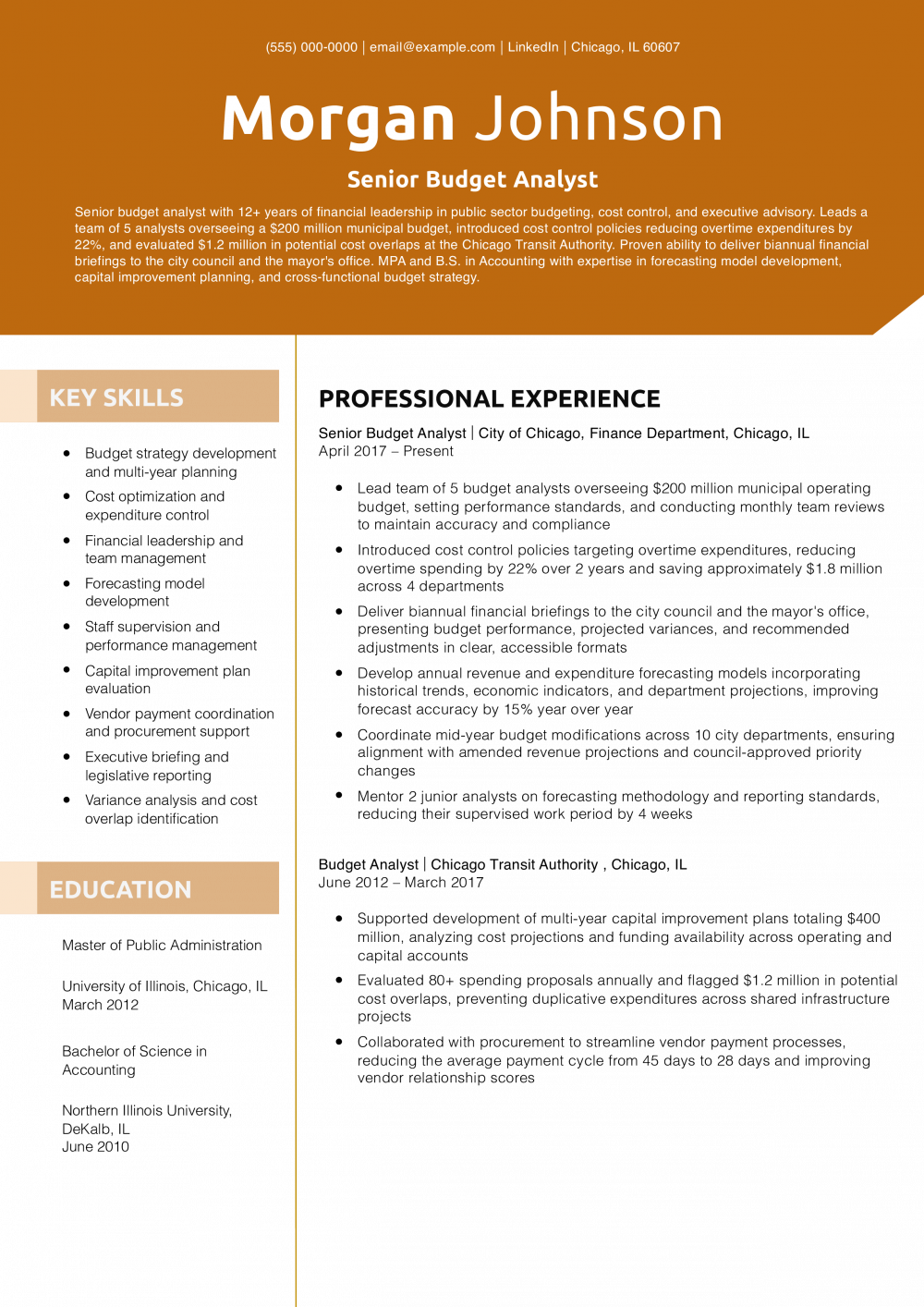
Customize this template in our builder in under 10 minutes.