Business Administration Resume Examples and Templates for 2026



Corporate recruiters decide whether to keep reading a business owner resume by the first three bullets under the company name; if revenue, headcount, and margin movement aren't visible there, the file gets passed over.
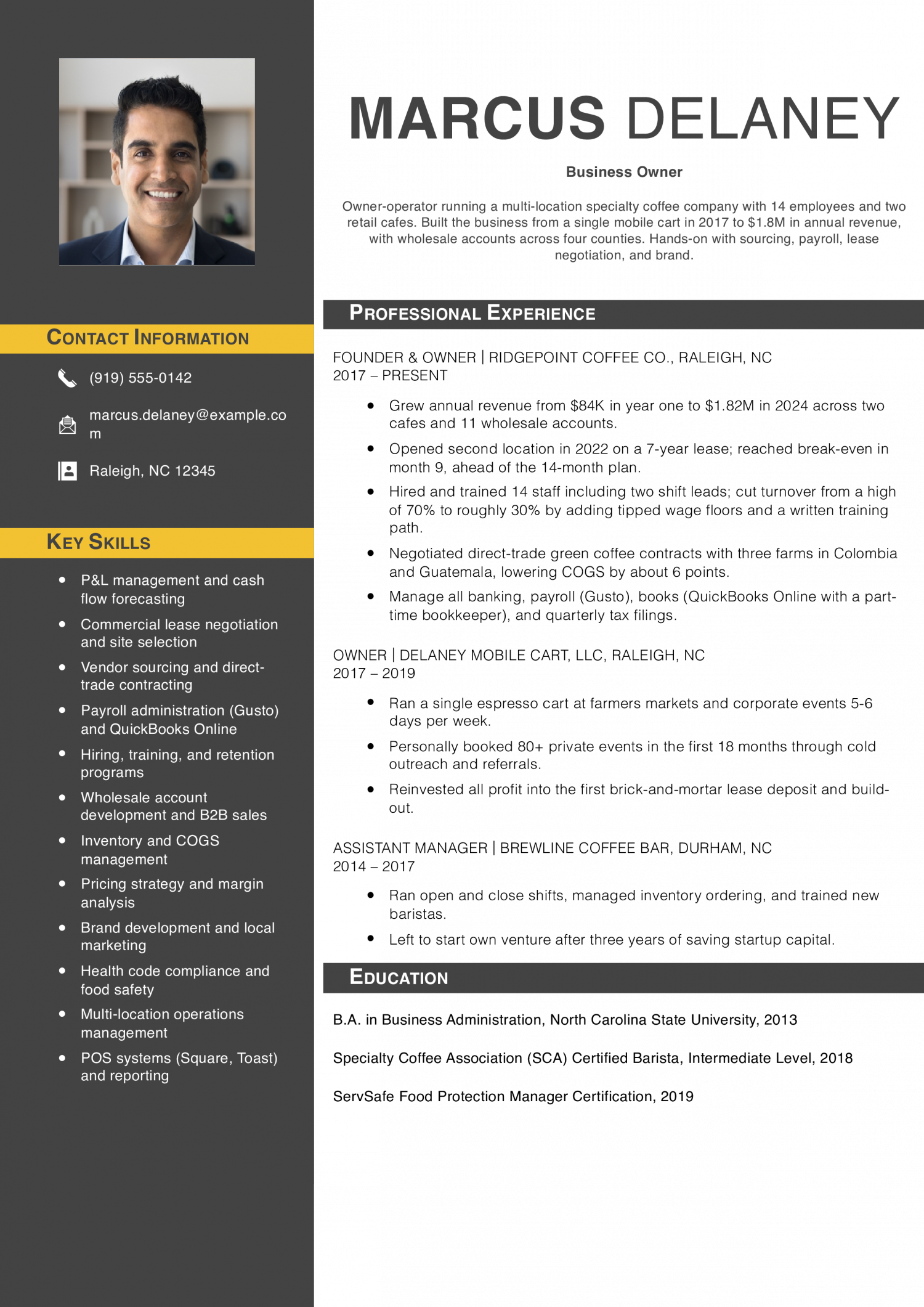
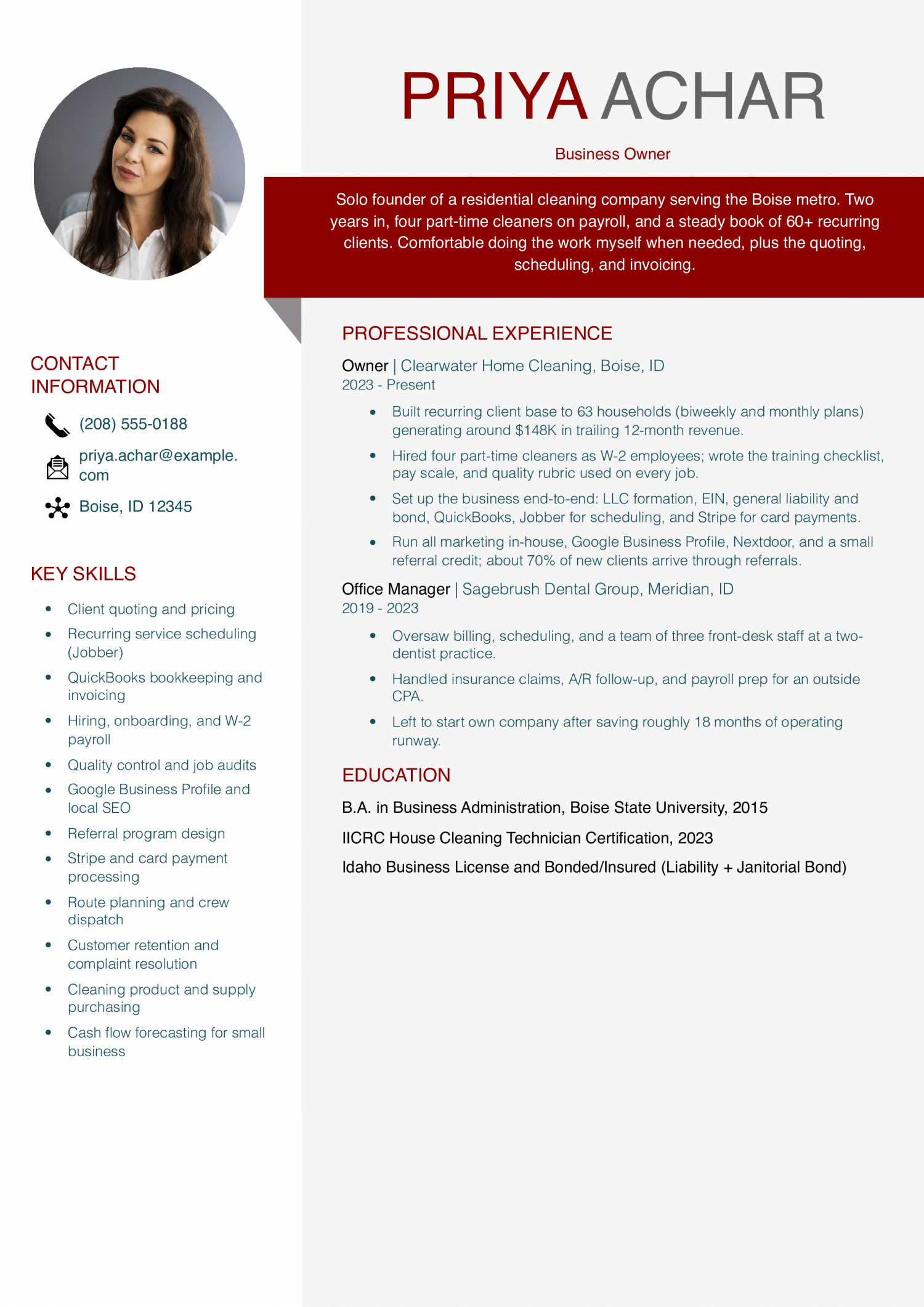
This profile fits owners running a single-location service, shop, or small e-commerce brand with one to ten employees. The resume needs to prove revenue growth, hands-on operations across sales and finance, and transferable skills for the next role.
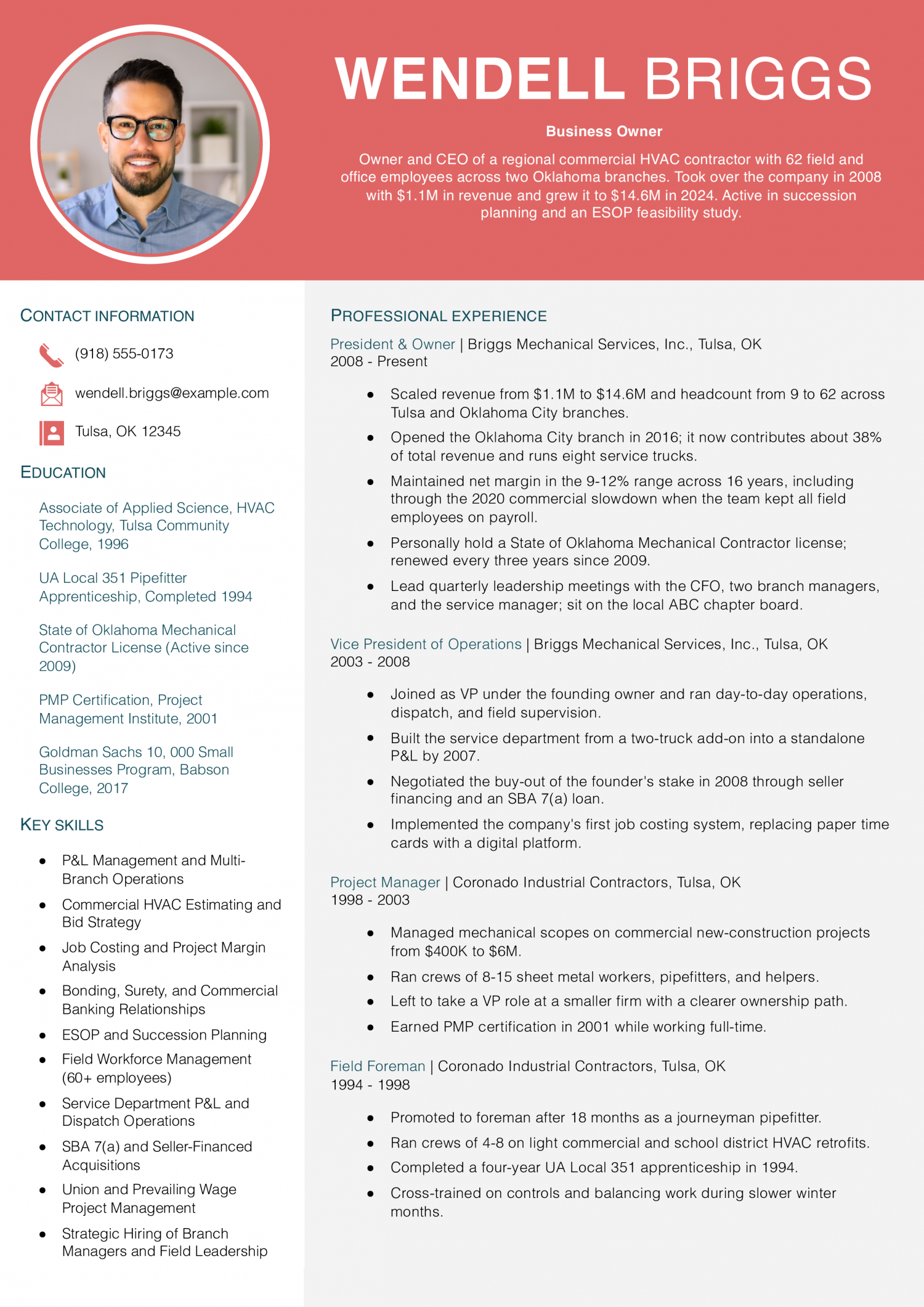
This profile fits owners with multiple locations, a seven-figure book, or a sale or recapitalization on the record. The resume needs to prove P&L scope, leadership of a management layer, and the strategic moves that grew enterprise value.
Renata Okafor
Asheville, NC | (828) 555-0167 | [email protected] | linkedin.com/in/renataokafor
Owner of a boutique branding and web studio serving small consumer brands across the Southeast. Founded the studio in 2015 and grew it to a team of six with $1.34M in 2024 billings. Run the studio as principal designer plus chief salesperson; comfortable across pitch, scope, contract, delivery, and collections.
Founder & Principal
Foxglove Studio, LLC | Asheville, NC | 2015-Present
Owner
Okafor Design (Sole Proprietor) | Asheville, NC | 2013-2015
Senior Designer
Marigold Creative Agency | Charlotte, NC | 2010-2013
Designer
Belltower Print & Web | Greensboro, NC | 2007-2010
Your profile should state the years you have owned the business, the revenue band you operate in, the industry, and the headcount you manage. A reader needs to know within two lines whether you ran a $400K services shop or a $6M multi-location operation.
Name the function you owned end-to-end (sales, ops, finance, hiring) and the next role you want. This frames ownership as a leadership job, not a gap. It also tells investors, lenders, or corporate recruiters which level of the org chart your experience maps to.
Owner resumes without numbers read like a hobby. Strong resumes name three to five hard metrics: annual revenue, year-over-year growth, gross margin, headcount, and customer or unit counts.
Pull figures from your tax returns, QuickBooks, Shopify, or Stripe dashboards so you can defend them in an interview. Bullets that pair a decision with an outcome (raised prices 12%, retained 94% of clients) tend to advance further than generic duty lists.
Cluster bullets under four to five functional categories so a corporate recruiter can map your scope to a job description. Useful groupings are growth and sales, operations and supply, finance and accounting, people and hiring, and product or service delivery.
Under each, name the systems and methods you ran: HubSpot, Salesforce, QuickBooks, NetSuite, Shopify, ADP, paid social, SEO, lean inventory, or KPI dashboards. This converts founder shorthand into the vocabulary hiring teams already screen for.
Add a page-one block that names the legal entity type (LLC, S-corp), years in operation, and any licenses your industry requires (contractor, food service, real estate, cosmetology). Note the state of licensure in good standing rather than the license number.
List certifications that signal corporate readiness: PMP, Six Sigma, SHRM-CP, Google Ads, HubSpot, or QuickBooks ProAdvisor. Investors and acquirers want to see the operating stack early; corporate recruiters want proof you speak their language.
Drop the self-employed disclaimers, the mission-statement paragraphs, and bullets that list daily tasks without an outcome. Trim early-career jobs older than 15 years to one line each unless they anchor your industry credibility.
Remove logos, headshots, and personal photos that founders often add to pitch decks. Keep the resume to two pages for most owners, three only if you have a sale, a board seat, or multi-entity scope worth a separate section.
Most owners lose interviews because the resume sounds like a pitch deck. The fix is to translate ownership scope into the function and level the target employer already hires for.
The business owner resumes that get callbacks share a specific skill mix. The lists below come from our user-built business owner resumes. Investors, lenders, and corporate recruiters scan for these patterns first, not founder-vision language.
Hard skills carry the weight when you pivot back into a corporate role, because they prove you ran the function in a system the new employer already uses. Soft skills back up specific bullets, not the summary. Match the lists against your target job posting and use soft skills as evidence labels under quantified wins.
| Soft Skills | % of resumes with this skill |
|---|---|
| Leadership | 78% |
| Communication | 62% |
| Problem-solving | 42% |
| Strategic thinking | 38% |
| Customer service | 26% |
And here are the top hard skills showing up most often.
| Hard Skills | % of resumes with this skill |
|---|---|
| Financial management | 66% |
| Project management | 60% |
| CRM software | 42% |
| Digital marketing | 39% |
| Operations management | 31% |
Based on data from thousands of business owners’ resumes built on ResumeTemplates.com, May 2026.
Corporate recruiters and acquirers read this list as a map of where your operator work is heading. The certifications below tell them which track (operations, finance, marketing, or people) you have invested in beyond running the day-to-day. List the issuing body and the year of completion under each entry.
Resume Templates offers HR approved resume templates to help you create a professional resume in minutes. Choose from several template options and even pre-populate a resume from your profile.
Treat it like any other job. List the legal business name, your title (Owner, Founder, or Managing Partner), the city, and the dates.
Under that, write bullets that quantify revenue, headcount, growth rate, and the functions you owned end-to-end. Skip the mission statement and the self-employed disclaimer.
Lead with the function you want next, not the founder label. Name the revenue band, the team size, and the systems you ran (QuickBooks, HubSpot, Shopify, NetSuite).
Then map your work to the target job's vocabulary: sales pipeline, P&L ownership, vendor management, hiring cycles. Add certifications like PMP or SHRM-CP if you have them.
Keep it on the resume and frame it by what you built, not by the wind-down. List the years, the revenue you reached at peak, and the specific operator skills you developed.
In the interview, explain the close briefly and pivot to the lessons applied since. Recruiters respect operators who can name what broke.
Yes, and use present tense for current responsibilities. State your plan for the business in the cover letter or screening call, not on the resume.
Common framings: selling the business, handing it to a partner, or running it as a side operation. Hiring teams want to know the role will not compete for your hours.
For a business owner, a professional template is the safest pick, because it signals the polish hiring managers in this field expect. An ATS-friendly template is a solid alternative. Whichever you choose, keep the formatting clean and easy to parse: clear section headings, a standard font, and no graphics a parser can choke on.
Executive Resume Writer and Career Coach
Andrew Stoner is an executive career coach and resume writer with 17 years of experience as a hiring manager and operations leader at two Fortune 500 Financial Services companies, and as the career services director at two major university business schools.