Project Manager Resume Examples
Lead the summary with a verifiable delivery number, not a scope statement. Name the budget you managed, the on-time rate across your portfolio, and the methodology you ran. PMO directors and program managers read the…
Every resume example is written and reviewed by our team of Certified Professional Resume Writers to ensure top-quality content and formatting.
Most change management roles are filled based on proof you moved people, not plans. Transformation directors and HR executives want to see adoption rates, training completion, and stakeholder readiness scores. A strong resume ties your work to the ADKAR model or a Prosci framework with real outcomes.
Your best proof is a project where resistance dropped and adoption held after launch. Pair that with tools like Prosci or a CCMP credential to stand out. The change management resume examples below show how to frame that proof on the page. To compare layouts before you start, browse our resume templates.
A visible Prosci or CCMP credential is what gets change management resumes past the first cut from transformation directors; quantified adoption and sustainment metrics are what make them readable enough to advance.
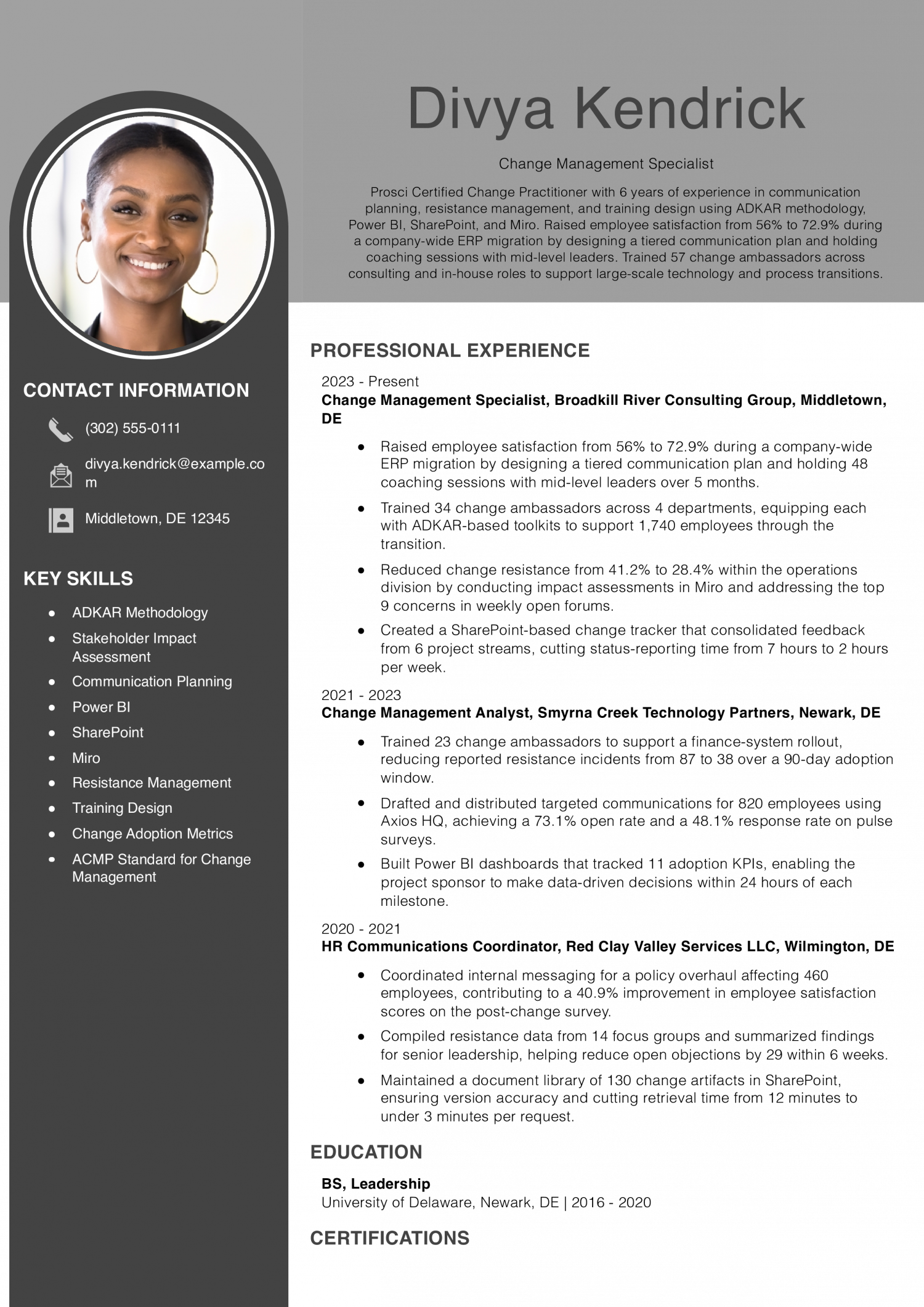
Pick this resume if you are a mid-level change management specialist with around six years of experience spanning consulting and corporate environments. Lead with resistance metrics and adoption outcomes tied to named frameworks like ADKAR rather than listing generic duties.
ADKAR toolkits given to a group of ambassadors who then supported thousands of employees show how far the training traveled. A sponsor sees reach, not a workshop attendance list. Name the framework your champions used and say roughly how many people their work touched.
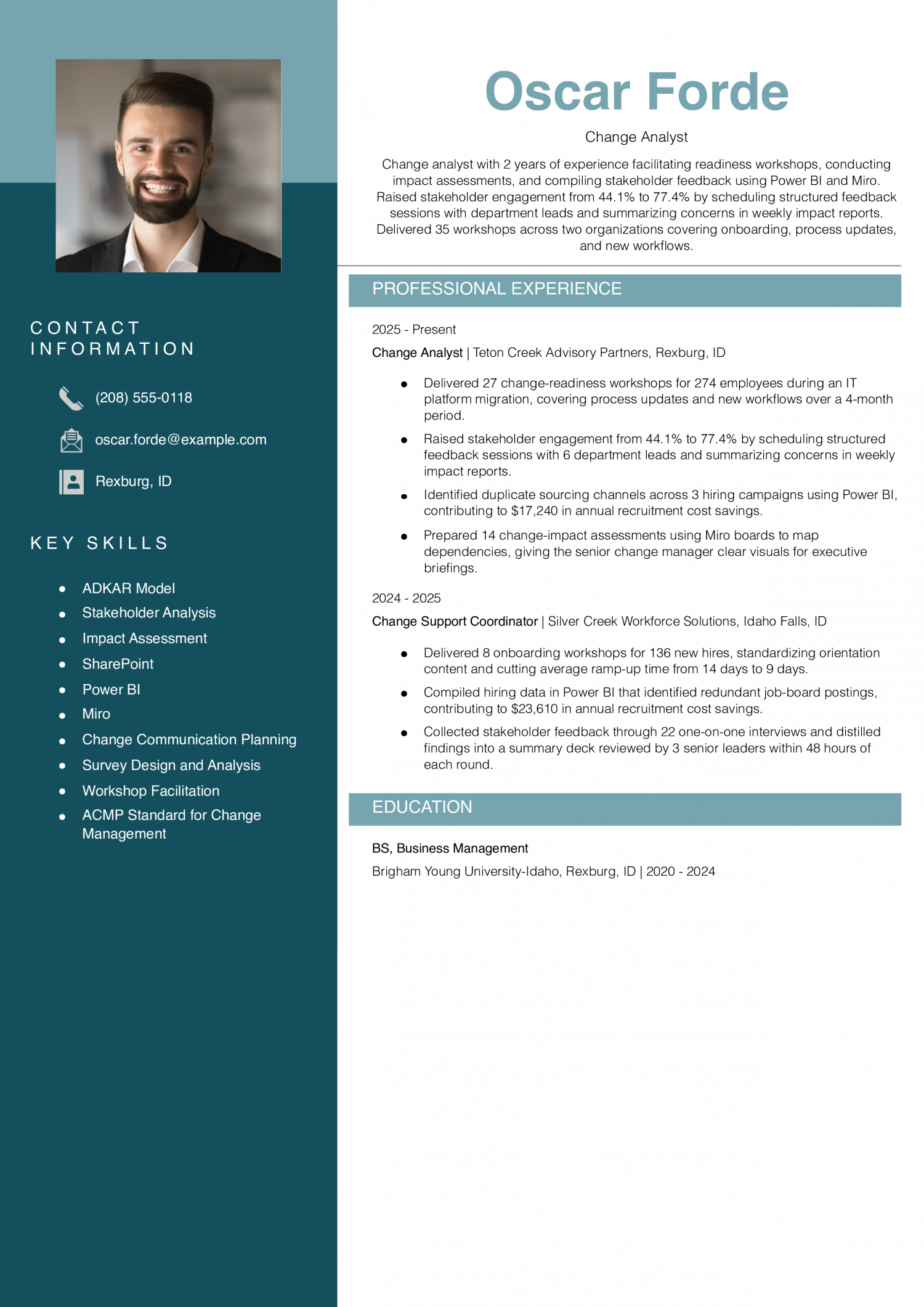
Start with this resume if you are an entry-level change analyst building a career from coordination into full change-readiness work. Lead with stakeholder engagement gains and workshop headcounts rather than listing change management theory.
Stakeholder engagement that rose after structured feedback sessions gives a sponsor a real before and after. A director sees which method moved the number. State where engagement started, where it ended, and what you did between those two points to change it.
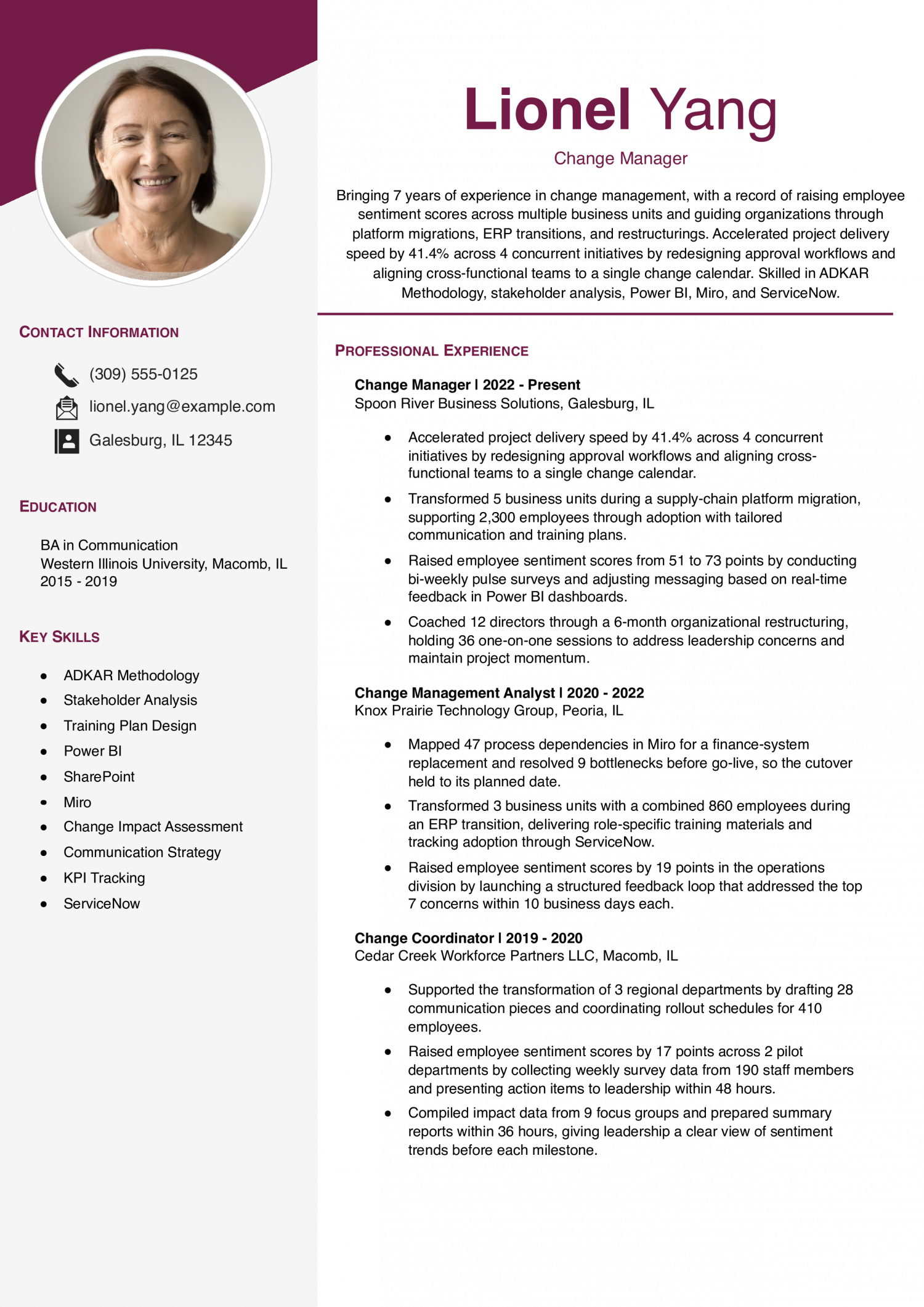
Try this resume if you are a mid-level change manager with about seven years of experience guiding employees through system migrations and organizational restructurings. Lead your bullets with sentiment score gains and the feedback methods that produced them.
Session counts and a fixed engagement length show a steady coaching rhythm over the full restructuring period. A CHRO reading those numbers sees how much time the directors received. When you describe coaching, say how many leaders, how many sessions, and how long the engagement ran.
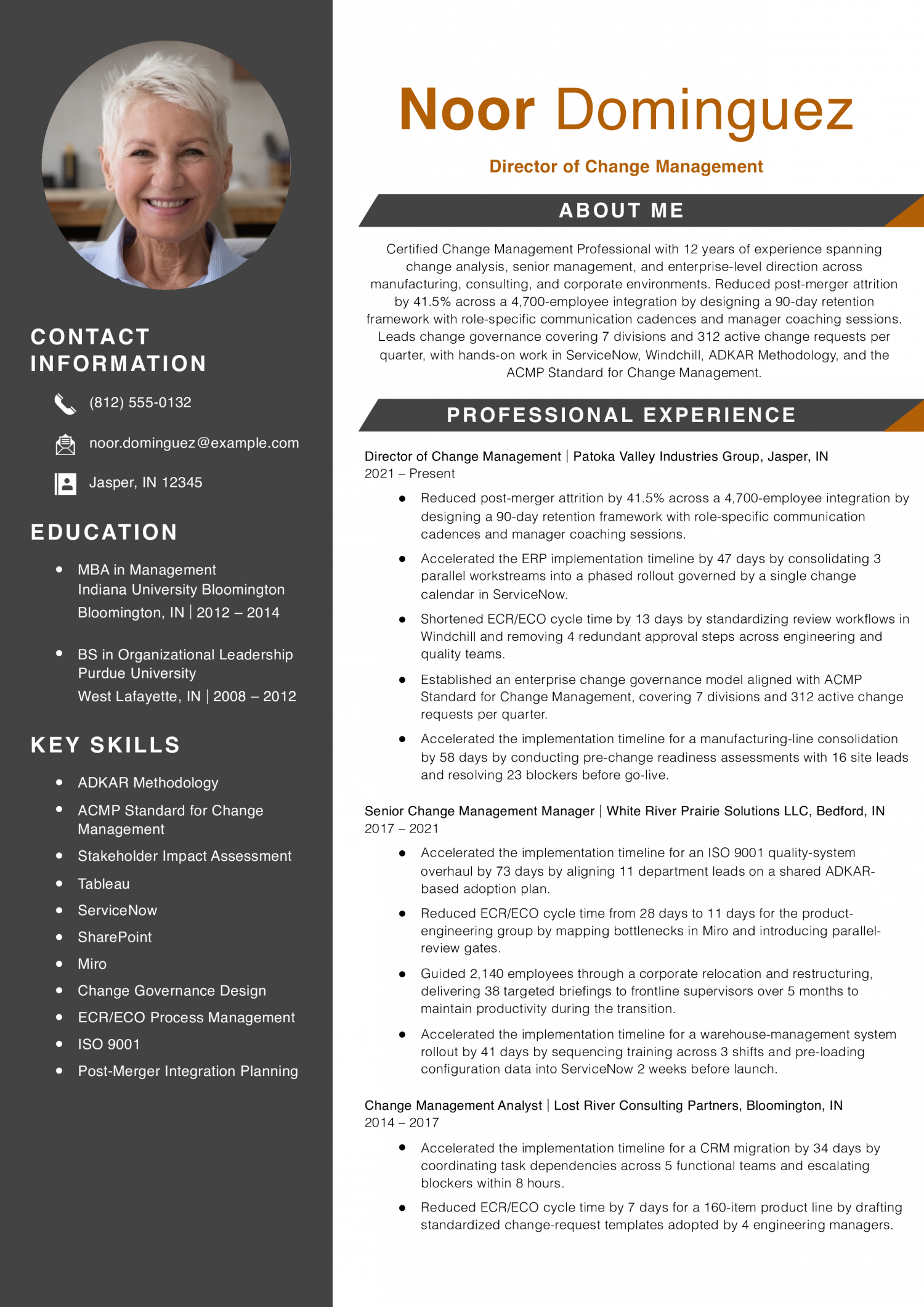
Lean on this resume if you are a senior change management director with about a decade of experience guiding large-scale integrations and system rollouts. Lead your bullets with timeline compression figures and blocker counts rather than describing oversight duties.
Readiness assessments and blocker counts name the groundwork that made the go-live date possible. A sponsor can see how the checks and fixes prepared the team for launch. If you led a rollout, list the checks you ran before launch and count the obstacles you cleared to stay on schedule.
Experienced in guiding organizations through system migrations, process restructurings, and workforce transitions using ADKAR methodology, SharePoint, and Miro across consulting and corporate settings. Reduced employee turnover from 42.3% to 31.6% by building a structured transition-support program for 480 warehouse and office staff, and contributed to revenue growth of 41.6% by guiding production and sales staff through a new order-management system.
Your profile should state your years of change work. Name the type of change you lead, such as ERP migrations or org restructuring. Add the scale of those efforts in headcount or revenue.
Transformation directors and HR executives scan this section in seconds. They want to see if your scope matches their initiative. A profile that reads like a generic summary gets passed over.
Specify the industries where you have driven adoption. Name the frameworks you follow, such as ADKAR or Kotter. Mention whether you partner with IT, operations, or HR sponsors.
State the largest number of impacted employees you have supported. This detail sets you apart from project managers with light change exposure.
Most strong change management resumes pair each bullet with a metric. Adoption rate is the one transformation directors and HR executives look for first. State the percentage of end users who adopted a new tool or process.
Training completion rates matter too. You can also cite the number of stakeholders you coached. Without those figures, the lines tend to blend into a task list.
Pull figures from surveys, LMS dashboards, or project status reports. Name the time you saved against a baseline go-live schedule. Show resistance reduction by citing support ticket drops.
If you cut rework or rollback incidents, state that count. These figures turn vague claims into proof of your impact.
Organize your bullets so each role covers distinct areas. Stakeholder analysis is one core group, and this includes sponsor alignment, readiness assessments, and impact analysis. Communication planning is another group.
Describe the channels and cadences you built for each audience. Training design forms a third category. Note whether you created instructor-led sessions or e-learning modules.
Resistance management is a fourth area worth calling out. Describe how you identified risk groups and built mitigation plans. Reinforcement and sustainment round out the set.
Detail the audits or checkpoints you ran after go-live. Each group should have two to four bullets so the section stays balanced. Grouping your work this way helps readers find relevant experience fast and compare your depth across areas.
List your certifications in a dedicated block near the top of page one. The Prosci Certified Change Practitioner credential signals structured methodology knowledge. The CCMP from ACMP carries weight at senior levels.
A PMP from PMI shows you can manage timelines and budgets. Transformation directors and HR executives often filter applicants by these credentials. Burying them on page two risks a missed match.
Below the credentials block, name the tools you use. Include platforms like ServiceNow, Jira, or WalkMe. Add LMS tools if you design training.
List survey tools like Qualtrics if you measure adoption. Keep this section scannable with short entries, not long descriptions.
Senior resumes grow long, so trim anything older than 15 years. Remove bullets that describe routine project tasks without a change angle. A line about scheduling meetings adds no value here.
Consolidate early-career roles into a single heading with title and dates. Drop outdated tools that no current initiative would use. Remove the objective statement if you still carry one.
Your profile replaces it with stronger detail. Transformation directors and HR executives care about your last three to four roles. Give those roles the most space and the freshest metrics.
Cut any skill that appears in every bullet, since repetition wastes room. Keep the resume at two pages or fewer for clarity.
Five years ago, a change management resume read like a list of frameworks studied. The mix has shifted toward adoption metrics and org readiness scores. Roles now ask for proof that you moved people through change.
Transformation directors and HR executives weigh hard skills and soft skills in different ways. They scan for tools like stakeholder analysis to confirm you can plan. Then they look for soft skills like empathy to judge how you lead through resistance.
Hard skills show you know the method. Soft skills show you can carry it out with real teams. Line up each table with the posting you plan to apply to.
Pull the terms that appear in both into your bullets. Pair each soft skill with a number or outcome from your work history. Add a hard skill only when you can back it up with a result.
| Soft Skills | AI-estimated % |
|---|---|
| Executive-level influence | 69% |
| Resistance navigation | 64% |
| Cross-functional collaboration | 50% |
| Empathy under uncertainty | 37% |
| Adaptive leadership | 27% |
And here are the top hard skills showing up most often.
| Hard Skills | AI-estimated % |
|---|---|
| Change impact assessment | 69% |
| Stakeholder engagement planning | 62% |
| Organizational readiness analysis | 43% |
| Change communication strategy | 39% |
| Training program development | 29% |
Skill names and rankings come from an AI model grounded in U.S. Department of Labor occupation data for change managers, not from a count of change managers’ resumes built on ResumeTemplates.com.
AI tools, project methods, and credentials are covered in the sections below.
Transformation directors and HR executives are split on AI in change work. Some want you to use AI to speed up stakeholder analysis. Others worry that AI-drafted communications feel impersonal to employees.
List only the tools you have used on real projects. Describe what you do with the output. Do not claim you built an AI-driven change strategy if you only used a chatbot for first drafts.
Reviewers will ask you to walk through your process in detail. Honest framing builds more trust than a long list of tools you tried once.
What AI is actually changing for this role
Stakeholder mapping: AI tools can cluster stakeholder sentiment data faster, but you still interpret priorities and risks.
Change readiness surveys: Natural language processing helps sort open-ended survey responses into themes for quicker analysis.
Communication drafting: Generative AI produces first drafts of change communications that you then tailor to each audience.
Training content: AI can outline role-based training modules, though subject matter experts must verify accuracy and tone.
Adoption tracking: AI dashboards flag adoption drop-offs across business units so you can intervene earlier in the rollout.
AI tools to name
How to phrase AI on your resume
Do
Skip
Change work lives inside project timelines. Your resume should name the methods you use. Transformation directors and HR executives scan for frameworks fast.
Beyond core project skills, the credentials below tell transformation directors and HR executives how deep your change work goes. They signal whether you can lead adoption at scale. They also show your grasp of proven change models.
Many job postings treat these as preferred, not required. Some senior roles do list one as a firm prerequisite. The weight each one carries varies by employer and industry.
Name the organization behind each credential and the year you completed it. Add the expiration date if the credential has a renewal cycle.
Resume Templates offers HR approved resume templates to help you create a professional resume in minutes. Choose from several template options and even pre-populate a resume from your profile.
Describe change management by naming the initiative, the number of people affected, and the outcome you measured. For example, write "Led organizational redesign for 1,200 employees, raising adoption to 94% within six months."
Transformation directors and HR executives look for scope and results, not vague claims about leading change.
List skills you have used in a real project, such as stakeholder analysis and impact assessment. Training design and readiness assessment tools belong there too.
Group technical skills apart from soft skills like coaching and executive communication. Limit the section to 10 or 12 entries so each one carries weight.
Open with your strongest transferable skill and the industry you are entering. Name a result from your previous role that maps to change work, such as rolling out a new process across multiple teams.
Close by stating the change management credential you hold or are pursuing.
A hybrid format works well because it leads with a skills section and follows with a brief work history. This lets you highlight relevant capabilities before your job titles tell a different story.
Keep the skills section tied to change management language so applicant tracking systems can parse it.
Yes, managers at consulting firms often reformat resumes to match a client template. However, you should review the final version to confirm no false claims were added.
If a credential or result was changed, ask for it to be corrected before it reaches the client.
Yes, contract roles show that you can enter an organization and deliver results under a deadline. List each engagement with the client's industry, the size of the affected group, and the outcome.
Mark them as contract so the short tenure reads as planned, not as job hopping.
Note the gap briefly in your work history with a one-line label like "Career Break" and the dates. If you completed relevant training or volunteer work during that time, list it there.
Transformation directors care more about what you delivered in your roles than about a gap of a year or less.
Use an ATS-friendly template that gives your certifications and work history their own sections. A basic template works too.
Change Management Resume
4.1/5 stars with 199 reviews

Executive Resume Writer and Career Coach
Andrew Stoner is an executive career coach and resume writer with 17 years of experience as a hiring manager and operations leader at two Fortune 500 Financial Services companies, and as the career services director at two major university business schools.
© 2026 Resumetemplates.com All rights reserved.