Registered Nurse Resume Examples
A state board lookup confirms you hold an active RN license. It does not show acuity, specialty, or the unit you actually staff. Lead the summary with the one signal that separates you from the…
Every resume example is written and reviewed by our team of Certified Professional Resume Writers to ensure top-quality content and formatting.
Most charge nurse roles fill through internal promotions. That means your resume has to prove you already lead a unit, not that you could learn to. Nurse managers and hospital recruiters look for shift oversight, patient acuity decisions, and staff assignment skills.
Show your RN license, Basic Life Support, and any ACLS training near the top. Pair those with real outcomes like lower fall rates or faster bed turnover on your unit. To compare layouts before you start, browse our resume templates.
Nurse managers hiring for charge nurse roles look for shift leadership scope and patient acuity levels on the first page, because those details show whether a candidate can coordinate unit operations under pressure.
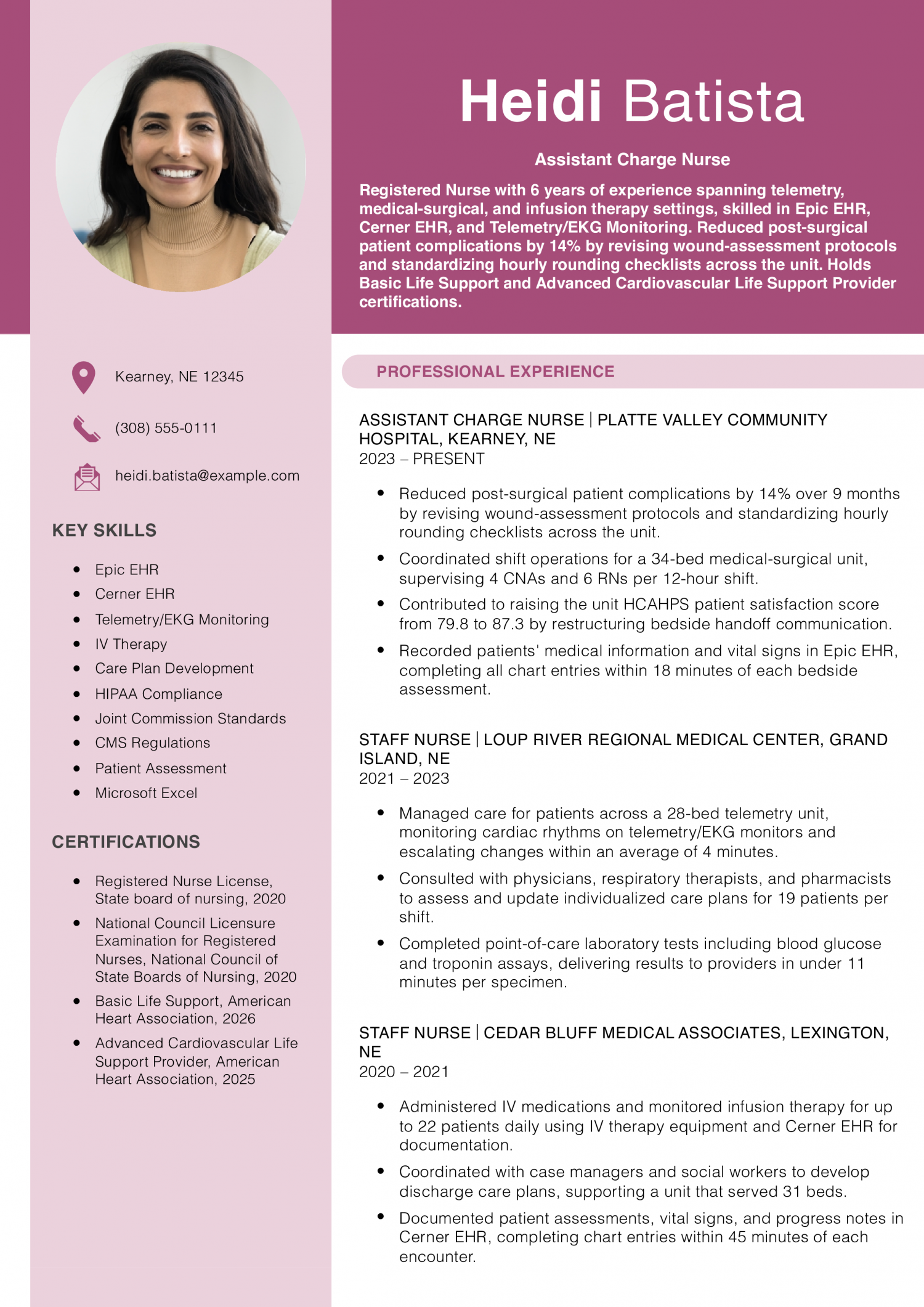
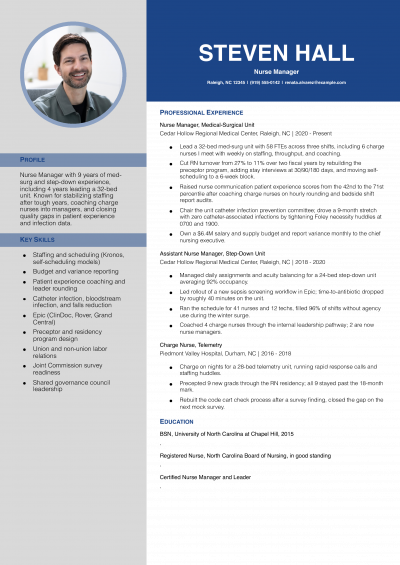
Consider this resume if you are a mid-level assistant charge nurse with about six years of bedside and supervisory nursing experience. Lead with protocol-driven complication reductions that name the exact clinical processes you changed.
Nurse managers hiring an assistant charge nurse look for someone who can run a shift: how many beds, how many staff, and how long the shift lasts. This resume gives the unit size and the number of aides and nurses on each shift. On your own resume, state the beds, the team you led, and the shift length.
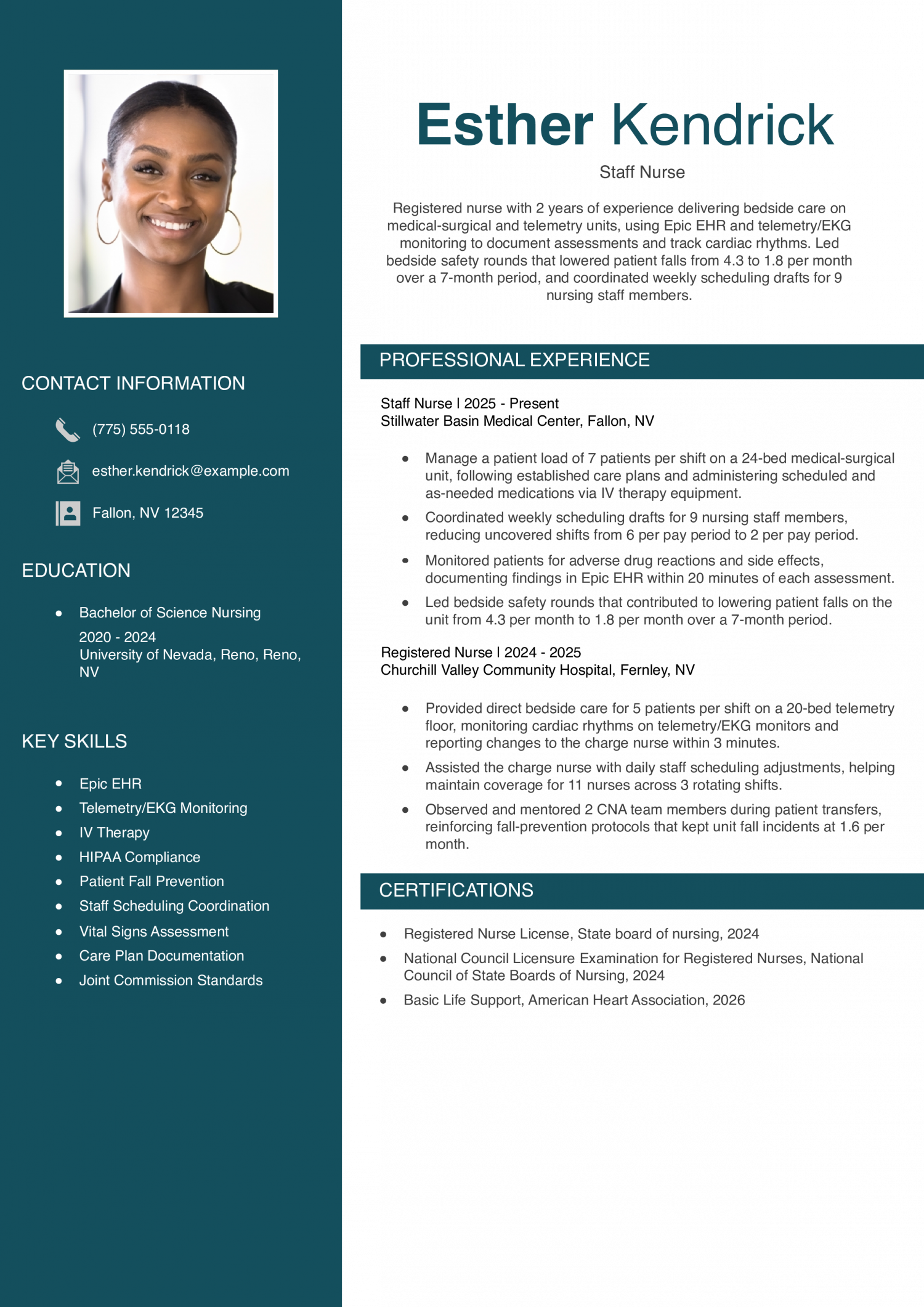
Use this resume if you are an entry-level staff nurse with about two years of bedside experience on medical-surgical or telemetry floors. Lead with fall-prevention or scheduling improvements that cite specific before-and-after numbers from your unit.
Hospital recruiters hiring a staff nurse want accurate charting and careful watch over patients. This resume names the time window for finishing notes after each assessment. When you describe your own charting, say how soon after care you finish your notes and what you chart, such as reactions to medicine.
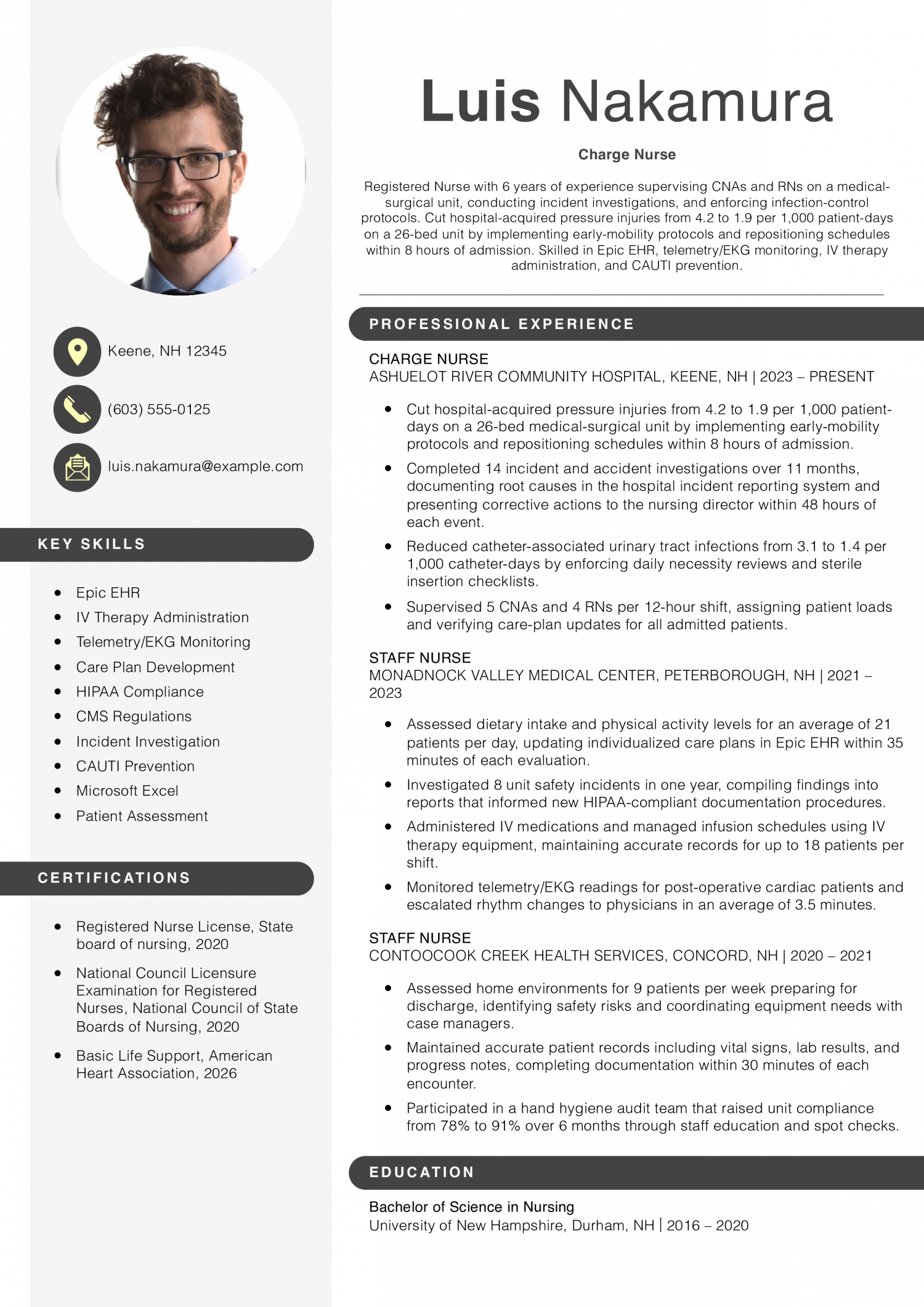
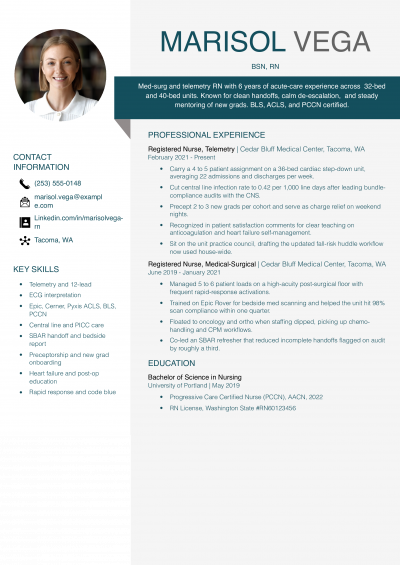
Try this resume if you are a mid-level charge nurse with around 6 years of bedside and supervisory experience seeking your next leadership role. Lead with infection-rate reductions that cite a named clinical metric and a specific before-and-after number.
Unit managers hiring a charge nurse look for someone who lowers harm on the unit and can show it. This resume gives the infection rate before and after, plus the checks that made the difference. If you ran a similar project, write the starting rate, the new rate, and the steps you enforced.
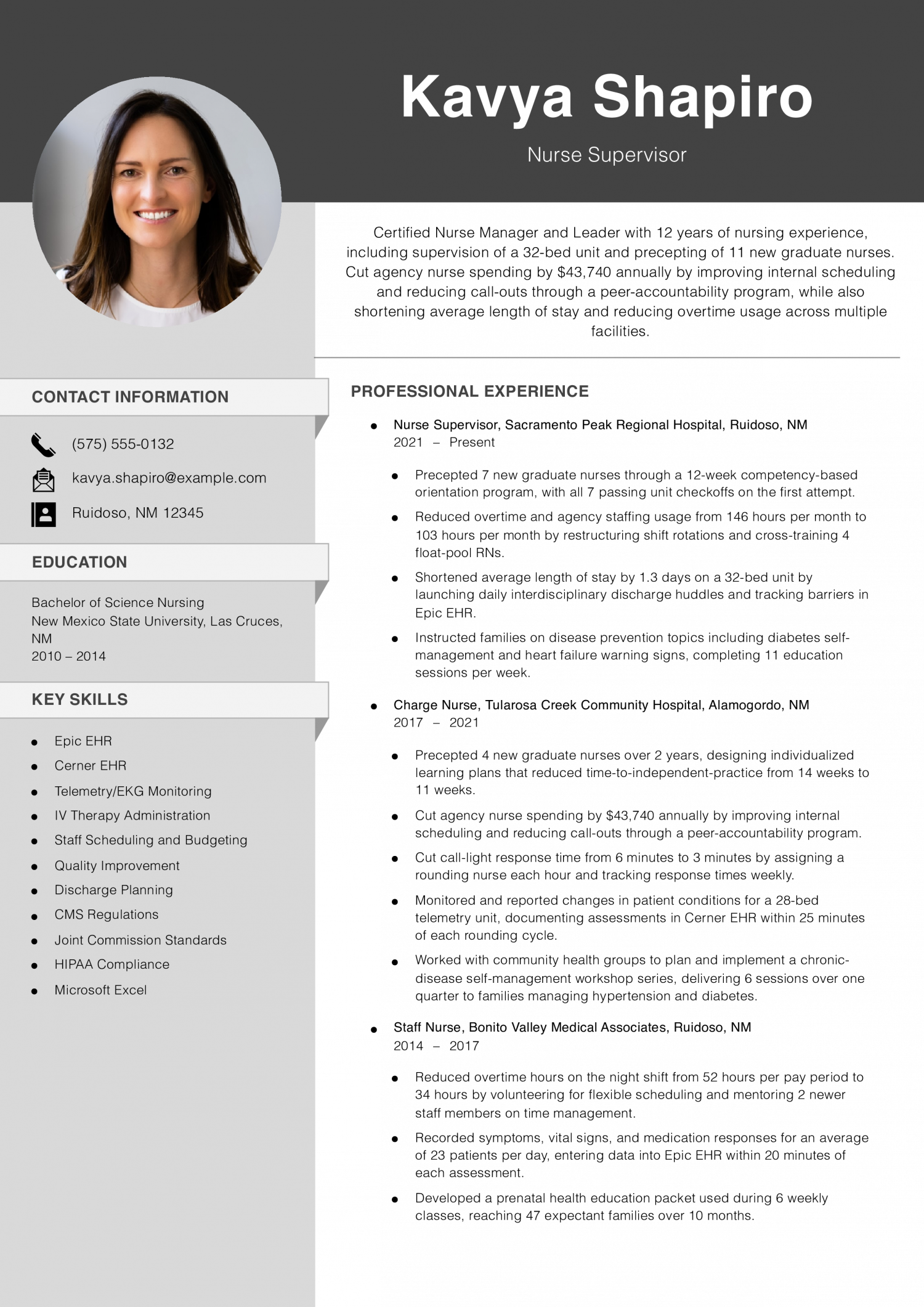
Lean on this resume if you are a senior nurse supervisor with about 12 years of bedside and leadership experience pursuing a supervisory role. Lead with staffing cost reductions that name the scheduling change and the dollar amount saved.
Directors hiring a nurse supervisor want leaders who bring new nurses up to speed and keep them. This resume says how many new graduates the nurse oriented and that every one passed the unit checkoffs. On your own resume, state how many nurses you trained, for how long, and how many passed.
Registered Nurse with 6 years of clinical experience spanning outpatient, step-down, and medical-surgical settings, skilled in Epic EHR, Cerner EHR, and staff supervision. Reduced patient wait times by 41% by restructuring triage intake workflows and reassigning nursing staff to high-volume periods across a 29-bed medical-surgical unit. Holds an active RN license and Basic Life Support certification.
Nurse managers and hospital recruiters scan your summary for one thing first: the unit size you run. Lead with your bed count along with your average daily census. A line like “Charge RN over a 36-bed med-surg unit with 12 direct reports” tells them your scope in seconds.
Follow it with your shift type and patient acuity level. Night shift on a step-down unit carries different weight than day shift on a general floor. Name both so the reader can place you in context right away.
Skip vague openers about being passionate or caring. The number does the work a paragraph of adjectives cannot do. Put your years of charge experience right after the unit data so the reviewer never has to search for it.
Charge nurse work produces measurable outcomes every single shift, so name your patient-to-nurse ratios and how you adjusted them during surges. State the percentage drop in falls or pressure injuries your unit logged under your watch. Medication error rates matter too.
If you cut them by a specific margin, write that figure into the bullet. Readmission rates show your discharge coordination skills. HCAHPS scores show patient satisfaction under your leadership.
Use both when you have them. Turnover data also carries weight. If your unit retained staff better than the hospital average, state the gap in percentage points.
Each bullet should pair an action verb with a clear result.
Sort your bullets under three to five clusters so the page reads fast for a busy nurse manager. Start with patient flow, covering bed assignments, admissions, and transfers. Next group staffing coordination, where you address call-outs and float pool requests.
Add a cluster for clinical oversight such as code response and rapid assessments. Quality improvement bullets fit their own heading too. Include rounding audits and infection control checks there.
A final group can cover staff development. Precepting new hires and running unit huddles belong in that set. These groupings mirror how a nurse manager thinks about the charge role.
They also prevent your resume from looking like one long task list with no structure.
Add a credentials block on page one, directly below your summary. List your RN license with your state.
Put Basic Life Support from the American Heart Association on its own line. If you hold ACLS from the American Heart Association, list it next. Nurse managers look for these before reading your work history.
A Certified Nurse Manager and Leader credential from AONL belongs here too, if you hold it.
Below the credentials block, list your EHR systems. Name the version of Epic or Cerner you chart in daily.
If you have more than ten years of nursing experience, you should cut detail from your earliest positions. Keep older staff nurse roles to one or two lines each. Remove bullet points that repeat skills you already show in your charge nurse entries.
Committee work from a previous hospital rarely adds value past five years. Delete it unless its scope was notably large. Condense any per diem or travel assignments into a single grouped entry.
Name the facilities and dates, then add one bullet for the strongest result. Your most recent two charge positions should hold three to five bullets each.
Everything else is context, not the main story.
A charge nurse resume works best when it reads as unit results and staff oversight, not a task list. Patient acuity and unit size belong near the top.
Nurse managers and hospital recruiters weigh hard skills first during screening. They want proof you can run a unit safely. Soft skills like conflict resolution then confirm you can lead under pressure.
From the tables, choose the skills that match your target posting.
Place hard skills in a sidebar or header block for quick scanning. List soft skills inside your work history bullets instead. A bullet with a named skill plus a number gives each term more weight.
Pair staff scheduling with a count of nurses you assigned per shift. Pair conflict resolution with a drop in incident reports you helped cause.
| Soft Skills | AI-estimated % |
|---|---|
| Bedside manner | 70% |
| Triage decision-making | 63% |
| Cross-team collaboration | 48% |
| Empathy under pressure | 40% |
| Clear clinical communication | 34% |
And here are the top hard skills showing up most often.
| Hard Skills | AI-estimated % |
|---|---|
| Patient assessment | 73% |
| Medication administration | 57% |
| Care plan coordination | 41% |
| Staff shift supervision | 35% |
| EHR documentation | 31% |
Skill names and rankings come from an AI model grounded in U.S. Department of Labor occupation data for charge nurses, not from a count of charge nurses’ resumes built on ResumeTemplates.com.
For a charge nurse resume, nurse managers and hospital recruiters look at patient assessment and medication administration first, so the items below back those up with detail.
An active RN license is the first thing recruiters check. List your license state and confirm it is in good standing.
Passing the NCLEX-RN is the gate to practice. Basic Life Support from the American Heart Association is expected. Many acute care units also ask for ACLS.
The Certified Nurse Manager and Leader credential from AONL signals leadership readiness. It is not required at every facility. Still, it sets you apart for senior charge roles.
Current training is what nurse managers look for. List recent courses that match your unit’s focus. Hours and completion dates make each entry credible.
Group entries by topic when you can. Infection control, wound care, and leadership are common themes. Place the most recent course first in each group.
State boards set renewal requirements that vary. Show you exceed the minimum when possible. This signals initiative to hospital recruiters.
Charge nurses use EMR systems every shift. Nurse managers often filter for specific software.
Show you understand HIPAA rules and enforce them. Nurse managers value staff who model privacy practices.
Describe how you trained your team on HIPAA. Note any audits you led or helped pass. Concrete actions matter more than vague claims.
Mention breach prevention steps you put in place. Include policy updates you wrote or revised.
Your RN license and a passing NCLEX-RN score keep you in the running. Nurse managers and hospital recruiters read this block to size up your clinical scope and leadership reach.
They also check whether you hold unit-specific cards the role needs. List each credential on a single line. Include the issuing body, the year you earned it, and the month it expires.
Group all items under one heading so nothing gets lost on the page.
The top-paying states are mostly on the West Coast and in the Northeast, and California leads by a wide margin. Pay for registered nurses differs a lot by state, so check the range where you plan to work.
Nurses at the 90th percentile earn about 41 percent more than the median, and the 10th percentile pays roughly 29 percent less. Note that BLS figures cover all registered nurses, a broader group that includes charge nurses.
Actual charge nurse pay may differ based on your shift leadership scope. If you are open to relocating, list multi-state RN licensure near the top of your resume so nurse managers see your flexibility right away.
| # | State | Median Annual |
|---|---|---|
| 1 | California | $140,270 |
| 2 | Hawaii | $136,320 |
| 3 | Oregon | $129,010 |
| 4 | Washington | $124,200 |
| 5 | Alaska | $109,480 |
| 6 | New York | $109,440 |
| 7 | New Jersey | $106,500 |
| 8 | Massachusetts | $104,550 |
| 9 | Nevada | $103,670 |
| 10 | Connecticut | $102,740 |
| # | State | Workers | Median |
|---|---|---|---|
| 1 | California | 338,940 | $140,270 |
| 2 | Texas | 271,380 | $95,970 |
| 3 | Florida | 229,940 | $84,190 |
| 4 | New York | 205,810 | $109,440 |
| 5 | Pennsylvania | 146,520 | $96,430 |
Resume Templates offers HR approved resume templates to help you create a professional resume in minutes. Choose from several template options and even pre-populate a resume from your profile.
List charge nurse as a separate role under the same employer entry. Give it its own date range and its own bullet points.
If you held both staff and charge duties on the same unit, create a stacked entry. Show the title change and the dates you served in each role. Each bullet should name a task such as shift assignments or patient acuity reviews.
Keep the charge nurse title in your work history under the dates you served. Past experience does not expire, so present it the same way you would any prior position. Use past tense verbs for those bullets to signal the role has ended.
Let the numbers speak for you instead of relying on adjectives about yourself. Write each bullet as a verb, a task, and a measured result. For example, state that you coordinated bed assignments for a 32-bed unit.
Follow that with the outcome, such as reducing patient wait times by 18 percent. Nurse managers and hospital recruiters read results as evidence, not as self-promotion.
Give each role its own entry with a clear unit label such as Medical ICU Charge Nurse. Under that heading, write bullets that blend clinical skill with leadership scope.
For example, state that you triaged admissions for a 20-bed ICU during overnight shifts. This format lets a nurse manager see your specialty depth and your supervisory range at once.
Focus on leadership scope, patient safety outcomes, and staff coordination history. Include your bed count and the size of the team you directed.
Add quality metrics you helped improve, such as fall rates or discharge turnaround times. Also list your state RN license and any relevant training such as ACLS.
Yes, a two to three line summary near the top can frame your unit type and charge experience before the reader reaches your work history. State the specialty, the bed count you oversaw, and one measurable outcome.
Nurse managers and hospital recruiters often scan the top third of a resume first, so this section sets the context for everything below it.
Yes, list each agency or travel assignment as its own entry with the facility name and unit type. Include the contract dates and note that you served as charge nurse during that assignment.
Use the same metrics you would for a permanent role, such as staff count per shift and patient volume. This shows nurse managers that your leadership held across different care settings.
If you are unsure, an ATS-friendly template is a good default for a charge nurse resume, and a basic template is a good second choice. Simple headings, one standard font, and graphics kept out keep either one readable.
Charge Nurse Resume
4.9/5 stars with 144 reviews

Executive Resume Writer and Career Coach
Andrew Stoner is an executive career coach and resume writer with 17 years of experience as a hiring manager and operations leader at two Fortune 500 Financial Services companies, and as the career services director at two major university business schools.
© 2026 Resumetemplates.com All rights reserved.