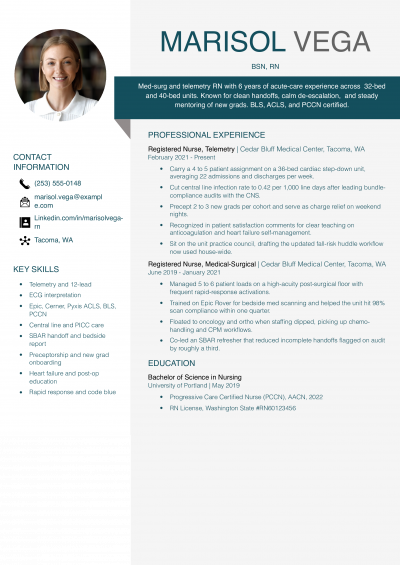
Registered Nurse Resume Examples
A state board lookup confirms you hold an active RN license. It does not show acuity, specialty, or the unit you actually staff. Lead the summary with the one signal that separates you from the…
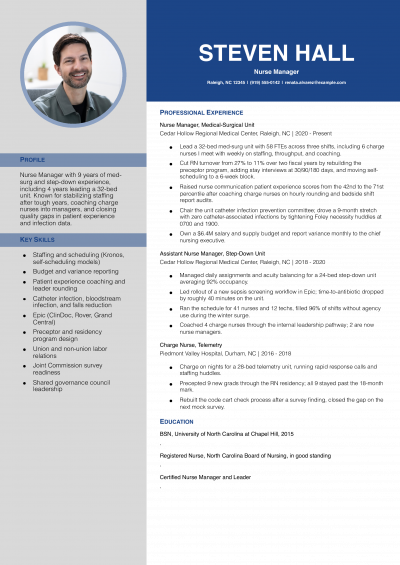
Every resume example is written and reviewed by our team of Certified Professional Resume Writers to ensure top-quality content and formatting.
Most nurse educator roles fill through a mix of clinical depth and teaching proof. Nursing deans and program directors want to see NCLEX pass rates you helped raise, courses you built, and sim lab hours you led. Your RN license and MSN form the baseline, but a CNE credential from the NLN sets you apart.
The strongest resumes pair clinical specialty areas with student outcome data. Show how many cohorts you guided or preceptors you trained. See how these details look on a finished page in the examples below. To compare layouts before you start, browse our resume templates.
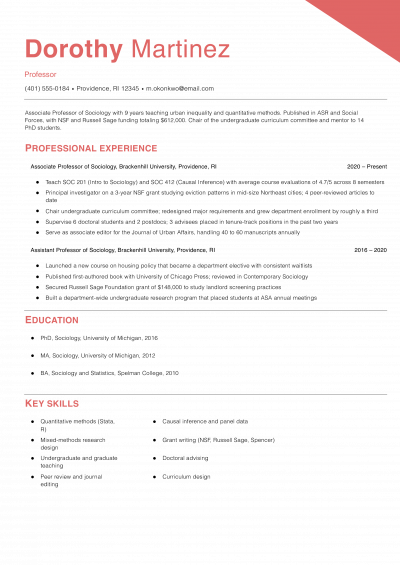
Nursing deans and program directors look for clinical specialties paired with measurable student outcomes on the first page, because it shows whether a candidate can bridge bedside practice and classroom instruction.
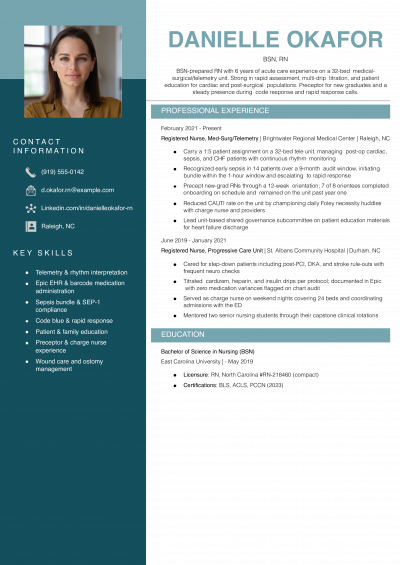
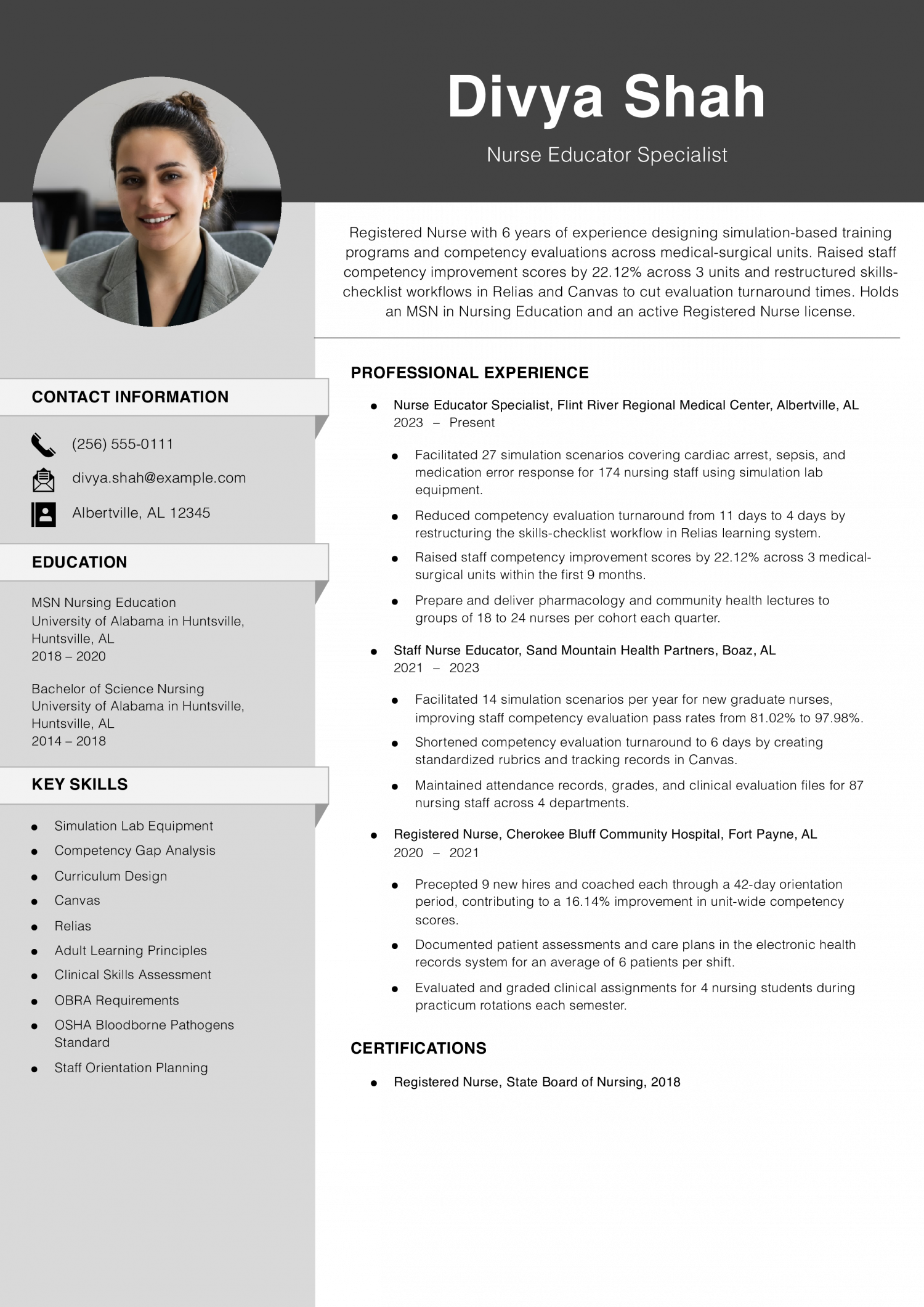
Pick this layout if you are a mid-level nurse educator building simulation and competency programs inside hospital systems. Lead with turnaround-time reductions tied to the specific learning platform workflow you restructured.
Simulation training stands out when you name both the scenario count and the number of staff who completed it. A nursing director can see the size of the program at a glance. State how many scenarios you delivered and how many nurses went through them.
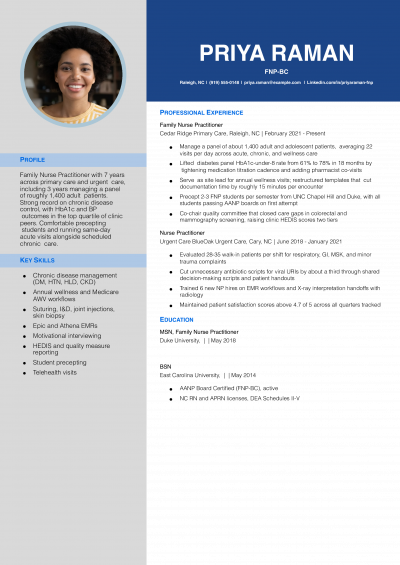
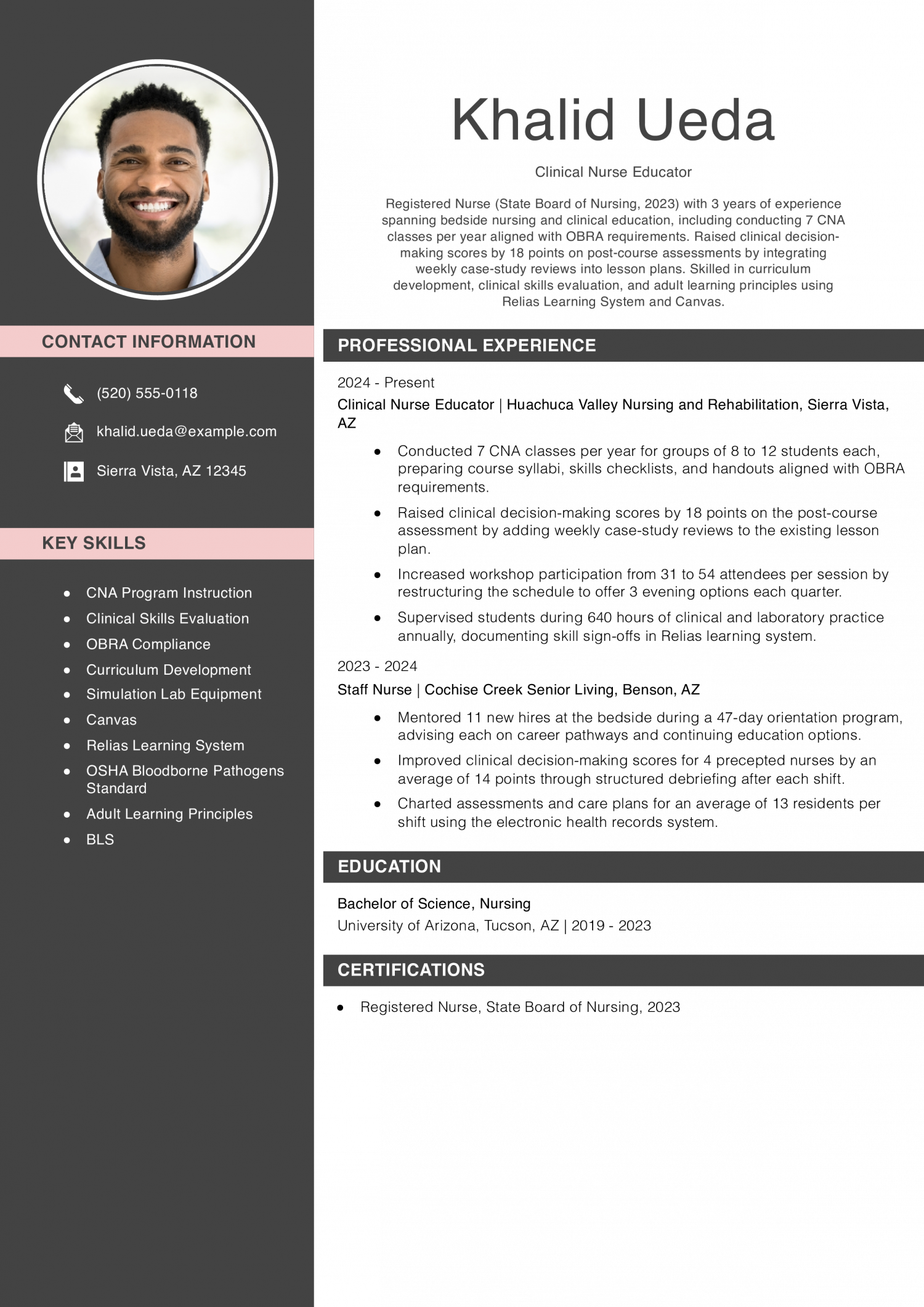
Use this resume if you are an entry-level clinical nurse educator moving from bedside nursing into formal teaching roles. Lead with attendance growth and assessment-score gains tied to the scheduling or curriculum changes you made.
Workshop attendance that climbed after a schedule change shows the fix worked. A clinical director sees the effect of the decision, not the topic list. If you redesigned a session, say how many people came before, how many came after, and what you changed.
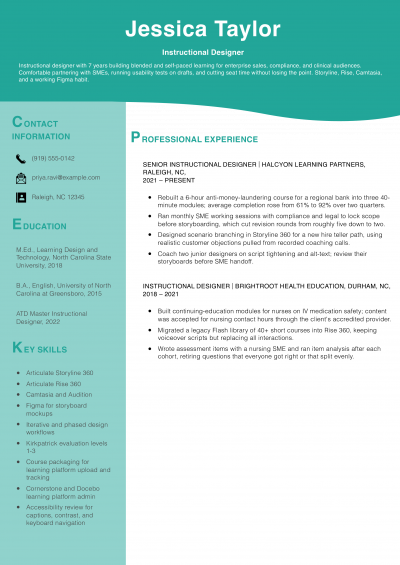
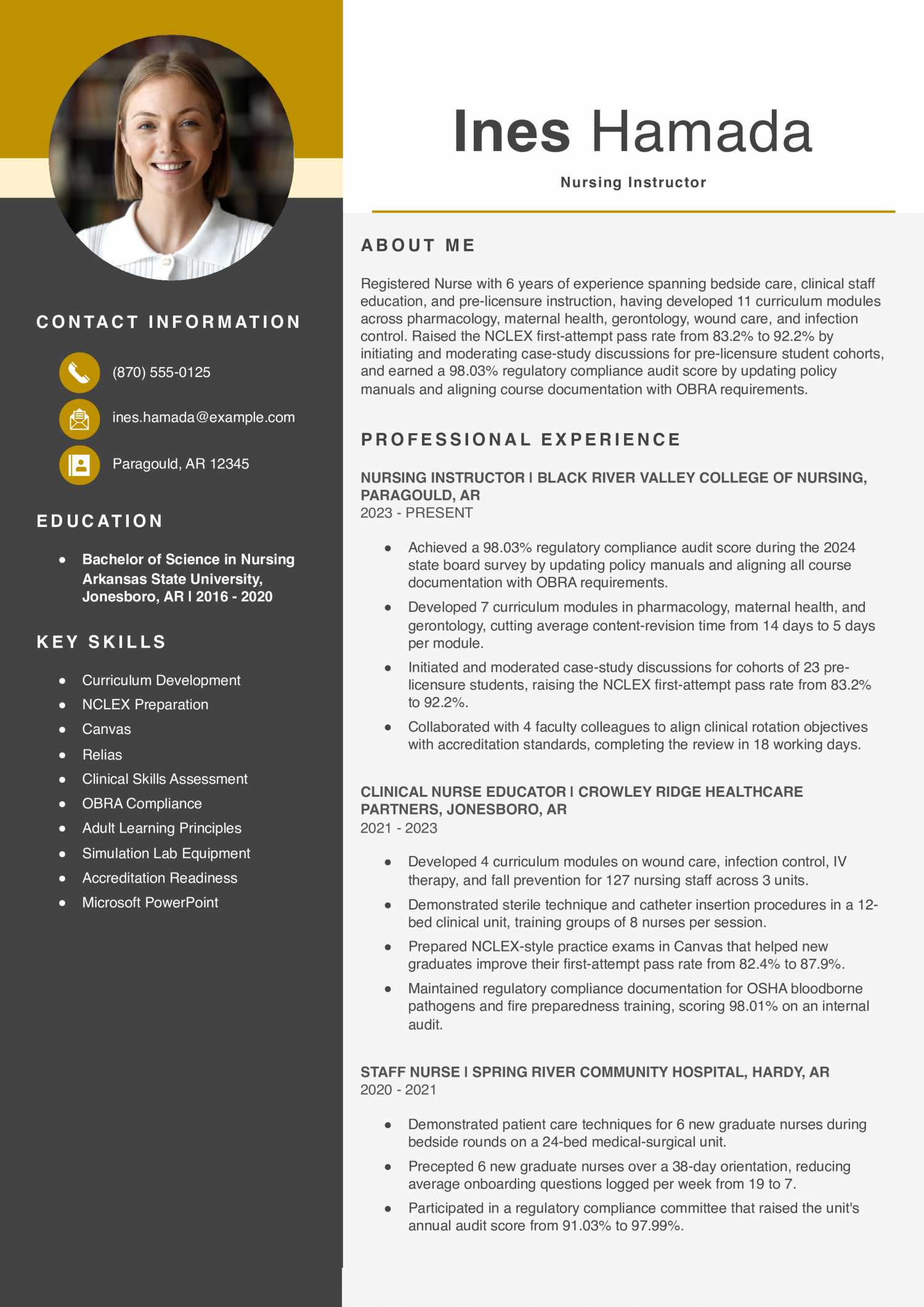
Try this resume if you are a mid-level nursing instructor balancing classroom teaching with clinical coordination and accreditation prep. Lead each bullet with the specific compliance score or pass-rate shift that resulted from your curriculum or policy work.
Modules were revised faster after extra steps were removed from the old process. A dean can see how much faster the work gets done now. If you sped up curriculum work, say what the turnaround was before, what it is now, and which steps you shortened.
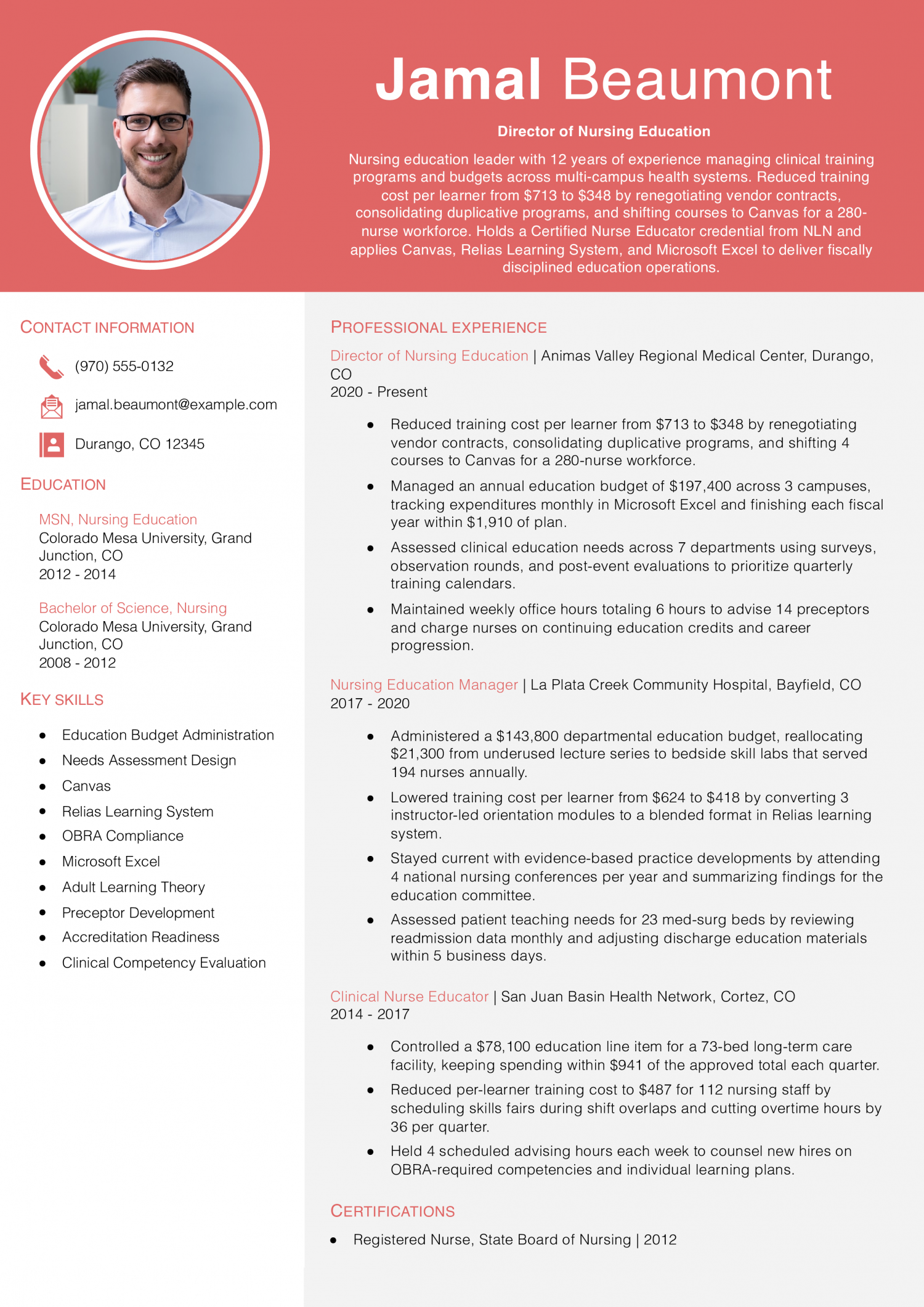
Lean on this resume if you are a senior-level director of nursing education overseeing budgets and curricula across multiple facilities. Lead each bullet with the dollar figure you controlled before naming the spending discipline or cost reduction you achieved.
Finishing a fiscal year within a tiny dollar gap of the approved budget is the result, but steady monthly tracking is the method behind it. A hospital administrator sees careful budgeting in that small variance. Calculate your year-end gap and state it next to your approved budget.
Registered Nurse with 6 years of experience in clinical education and competency assessment, skilled in curriculum development, examination design, and patient safety analysis using Relias Learning System and Canvas. Raised an annual course completion rate from 79.3% to 94.1% by restructuring due dates, adding automated reminders, and scheduling makeup sessions. Administered quarterly competency examinations and redesigned training programs across medical-surgical and rehabilitation units.
State how many students you taught per semester or year in your opening line. Nursing deans and program directors use that figure to gauge your workload capacity.
Follow it with your program type, such as BSN or ADN. Then name the NCLEX pass rate your cohorts earned. A line like “Nurse educator who prepared 120 BSN students per year with a 94% first-time NCLEX pass rate” gives a program director a clear picture in one read.
Avoid opening with vague phrases like “passionate educator” or “years of experience.” Those lines delay the facts that matter. Lead with the metric, then add your teaching focus area. This sets the tone for the rest of the resume and draws the reader in right away.
Most strong nurse educator resumes lean on scope more than raw output. Name the number of clinical sections you supervised each term. State how many credit hours you taught per semester.
You can also note the student-to-faculty ratio you managed. Specifics carry more weight. A phrase like “supervised 24 students across two med-surg clinical rotations” is stronger than “oversaw clinical rotations.” Where you led curriculum changes, note how many course units you revised.
If student outcomes improved, state the percentage shift. Program directors scan for volume first, then results. Even a rough figure beats a blank.
Organize your bullets under three to five areas that reflect the role. Classroom instruction covers lecture design, test writing, and grading. Clinical supervision covers bedside teaching and skills lab oversight.
Curriculum development covers course mapping and accreditation prep. A fourth area could be student advising and remediation. A fifth could be scholarly work or continuing education.
Splitting your experience this way helps a program director scan your resume fast. Aim for two to four bullets per group. Place the category most relevant to the posting first.
Mirror the language from the job listing when it fits. This structure prevents your resume from reading as one long block of tasks.
List your RN license and state right after your name at the top of page one. Add your MSN on the same line or in the education block, along with your degree focus area. If you hold the CNE from NLN, place it in the credentials line beside your RN.
Nursing deans and program directors often need to confirm licensure and degree level before they read further. A dedicated credentials block near the header keeps these visible. Do not bury your license in the education section at the bottom.
If the posting asks for a specific state RN, name that state. Tools like simulation software or learning platforms belong in a skills section below your experience.
At a senior level, your resume should run two pages at most. Remove bedside nursing roles from more than fifteen years ago. Keep them only if a posting asks for deep clinical background.
Trim committee memberships that produced no measurable outcome. Drop conference attendance unless you presented or published. Nursing deans and program directors care about recent teaching, curriculum work, and accreditation involvement.
Old clinical skills lists can go if they repeat what your job titles already show. Shorten early career entries to one or two lines each. Save the detailed bullets for your last two or three positions.
This approach keeps the focus on your current teaching capacity and scholarly contributions.
Nurse educator hiring is tight in 2026. Nursing programs run leaner, and the bar to clear a screen is higher.
Nursing deans and program directors weigh hard skills like curriculum design first. These show you can build and update a program. Soft skills such as mentoring then confirm you can guide students through clinical work.
Compare the tables below to your target posting, and work matching terms into your resume bullets. Use the exact phrase the posting uses, not a synonym.
Place hard skills in your work history and in a skills section. Tie each soft skill in your bullets to a teaching or student outcome.
Do not list every skill from these tables. Pick the five or six that appear in the posting. A tighter match raises your odds of passing the first screen.
| Soft Skills | AI-estimated % |
|---|---|
| Mentorship of students | 79% |
| Clear skills demonstration | 70% |
| Classroom facilitation | 40% |
| Constructive feedback delivery | 35% |
| Adaptability to learners | 33% |
And here are the top hard skills showing up most often.
| Hard Skills | AI-estimated % |
|---|---|
| Clinical supervision | 73% |
| Curriculum development | 57% |
| Nursing simulation instruction | 50% |
| Student clinical assessment | 40% |
| Pharmacology lecture delivery | 28% |
Skill names and rankings come from an AI model grounded in U.S. Department of Labor occupation data for nurse educators, not from a count of nurse educators’ resumes built on ResumeTemplates.com.
Your license comes first below. Continuing education and AI experience follow.
An active RN license is the baseline for this role. Your State Board of Nursing issues and renews it. List the state and confirm the license is in good standing.
Many programs also expect an MSN from an accredited university. Some states set their own rules for faculty credentials. Check the posting before you finalize your resume.
The CNE from NLN signals teaching expertise at the senior level. It is not required everywhere, but it strengthens your profile. Place all credentials near the top of the page.
Nursing deans and program directors look for ongoing learning. Your resume should show you stay current in pedagogy. It should also show clinical knowledge that is up to date.
List each course with the provider and year completed. Group entries under a clear heading on your resume. Place this section after your degrees and licenses.
If you hold the CNE from NLN, renewal requires contact hours. Show those hours to confirm your credential is active. Pick courses that tie to your teaching specialty.
There are three common approaches to listing AI on a nurse educator resume. You could claim to be an AI curriculum strategist. Nursing deans and program directors will doubt that title.
You could leave AI off and answer questions later. Or you could describe the actual workflow you use. The third is what Nursing deans and program directors can validate.
Name a tool you have used to build case studies or test items. State the clinical review step you apply after the tool runs. Keep the claim small and accurate.
A real workflow matters more than a broad label. Honest detail holds up in a teaching demo or interview.
What AI is actually changing for this role
Test item writing: AI drafts NCLEX-style questions faster, but you still review each item for clinical accuracy and bias.
Simulation design: Tools generate patient scenario outlines that you then adapt to match specific course objectives and skill levels.
Curriculum mapping: AI can flag gaps between program outcomes and course content, though faculty committees make final decisions.
Student feedback: Automated rubric assistants speed up formative comments on care plans and reflective journals you assign.
AI tools to name
How to phrase AI on your resume
Do
Skip
Beyond your RN license, the credentials below tell nursing deans and program directors how deep your teaching skill set runs. They signal whether you have formal training in course design and test writing. They also show your grasp of student assessment methods.
Most postings ask for at least one of these credentials. Some schools treat them as a rank or pay factor, so holding more than one can shape your standing. List the issuing body and your current expiration date for each credential you hold.
Place the most advanced credential first so reviewers see it at a glance. If a credential is pending, note the expected completion date beside it. Keep each entry to one line when you can.
The 90th-percentile nursing instructor out-earns the median by about 61 percent. BLS groups all postsecondary nursing instructors and teachers into one category, so this spread covers more than nurse educators alone. Still, the gap is wide enough to show that the market pays a clear premium at the top.
The 10th percentile sits roughly 39 percent below the median, which means the floor-to-ceiling range is large. Geographic location and institution type shape where you land in that range. On your resume, lead with the curriculum outcomes and clinical training programs you built, not years of teaching alone.
| # | State | Median Annual |
|---|---|---|
| 1 | Hawaii | $129,530 |
| 2 | District of Columbia | $107,770 |
| 3 | Delaware | $98,170 |
| 4 | Nevada | $96,500 |
| 5 | Connecticut | $95,500 |
| 6 | Idaho | $90,890 |
| 7 | Alaska | $85,650 |
| 8 | Massachusetts | $85,130 |
| 9 | Texas | $84,930 |
| 10 | Wisconsin | $84,700 |
| # | State | Workers | Median |
|---|---|---|---|
| 1 | Texas | 6,830 | $84,930 |
| 2 | New York | 6,340 | $82,950 |
| 3 | California | 5,610 | $81,960 |
| 4 | Illinois | 4,940 | $79,150 |
| 5 | Florida | 4,320 | $82,410 |
Resume Templates offers HR approved resume templates to help you create a professional resume in minutes. Choose from several template options and even pre-populate a resume from your profile.
Use a resume for clinical teaching roles at hospitals or community colleges. Use a CV for tenure-track faculty positions at universities instead.
A CV lists every publication, presentation, and grant you have earned. A resume stays at one or two pages. Check the job posting, because directors usually state which format they prefer.
Start with a header that shows your name, RN license state, and CNE credential. Use reverse chronological order so your most recent teaching role appears first.
Below experience, add sections for education, certifications, and scholarly work. Published research or conference posters belong in that final section.
Lead each clinical bullet with a teaching angle, such as precepting new graduates or running in-services. Quantify the learners you trained and the outcomes they reached.
Add any adjunct or guest lecturer work, even if it was unpaid. This shows nursing deans and program directors that you have classroom readiness.
List curriculum design, clinical simulation facilitation, and learning management systems you have used. Canvas and Blackboard are common ones worth naming.
Pair each skill with a result in your experience section, such as raising student pass rates. Program directors look for a blend of clinical expertise and instructional ability.
Create a section titled Publications and Presentations below your work history. List each entry in reverse chronological order with the title, journal or event name, and date.
If you have more than five, choose the ones most relevant to the role you are targeting.
Yes, include them when the posting asks for a minimum number of practice hours. State the unit type, the facility name, and the total hours completed.
This helps nursing deans verify that you meet accreditation standards for clinical instruction.
One to two pages works for most teaching roles at hospitals or community colleges. A two-page resume is reasonable if you hold a doctoral degree and have a long research record.
Academic faculty positions that call for a CV may run longer without a strict page limit.
An ATS-friendly template gives your teaching credentials and student outcomes their own space on the page. A basic template suits this role too.
Nurse Educator Resume
4.4/5 stars with 129 reviews

Executive Resume Writer and Career Coach
Andrew Stoner is an executive career coach and resume writer with 17 years of experience as a hiring manager and operations leader at two Fortune 500 Financial Services companies, and as the career services director at two major university business schools.
© 2026 Resumetemplates.com All rights reserved.