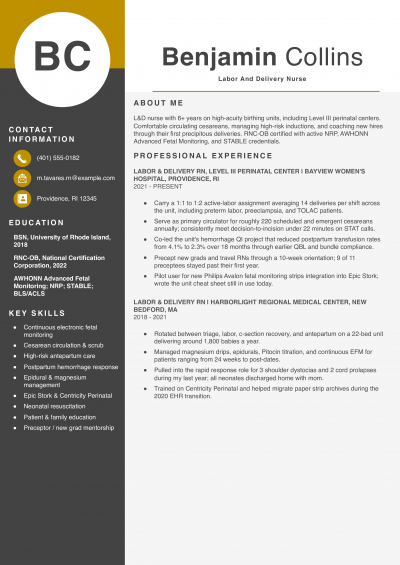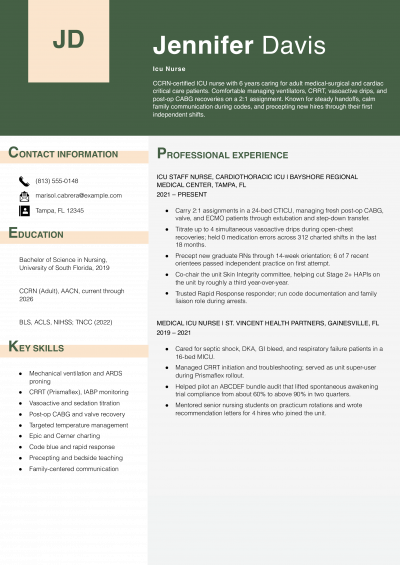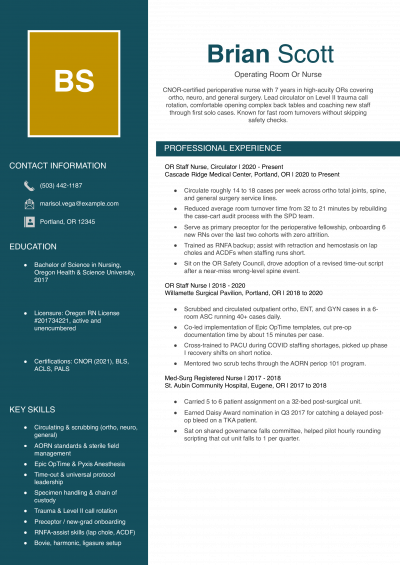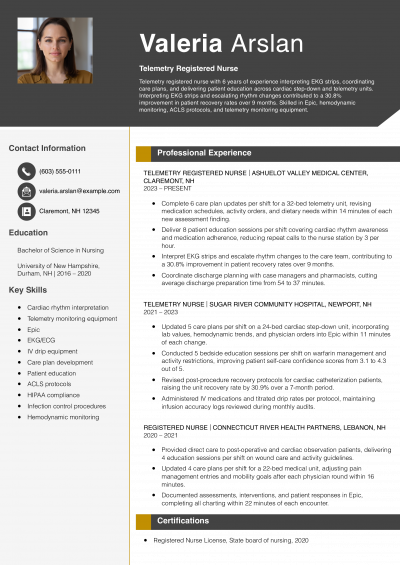

ICU Nurse Resume Examples and Templates
Your profile should state your years of bedside ICU experience and the unit type you have worked. Name MICU, SICU, CVICU, neuro ICU, or trauma ICU directly. Add the bed count and patient ratio you…
An active RN license plus BLS and ACLS is what gets med-surg resumes past the credentialing screen at most health systems; quantified patient-load and acuity detail is what makes them readable enough to advance to a nurse manager interview.
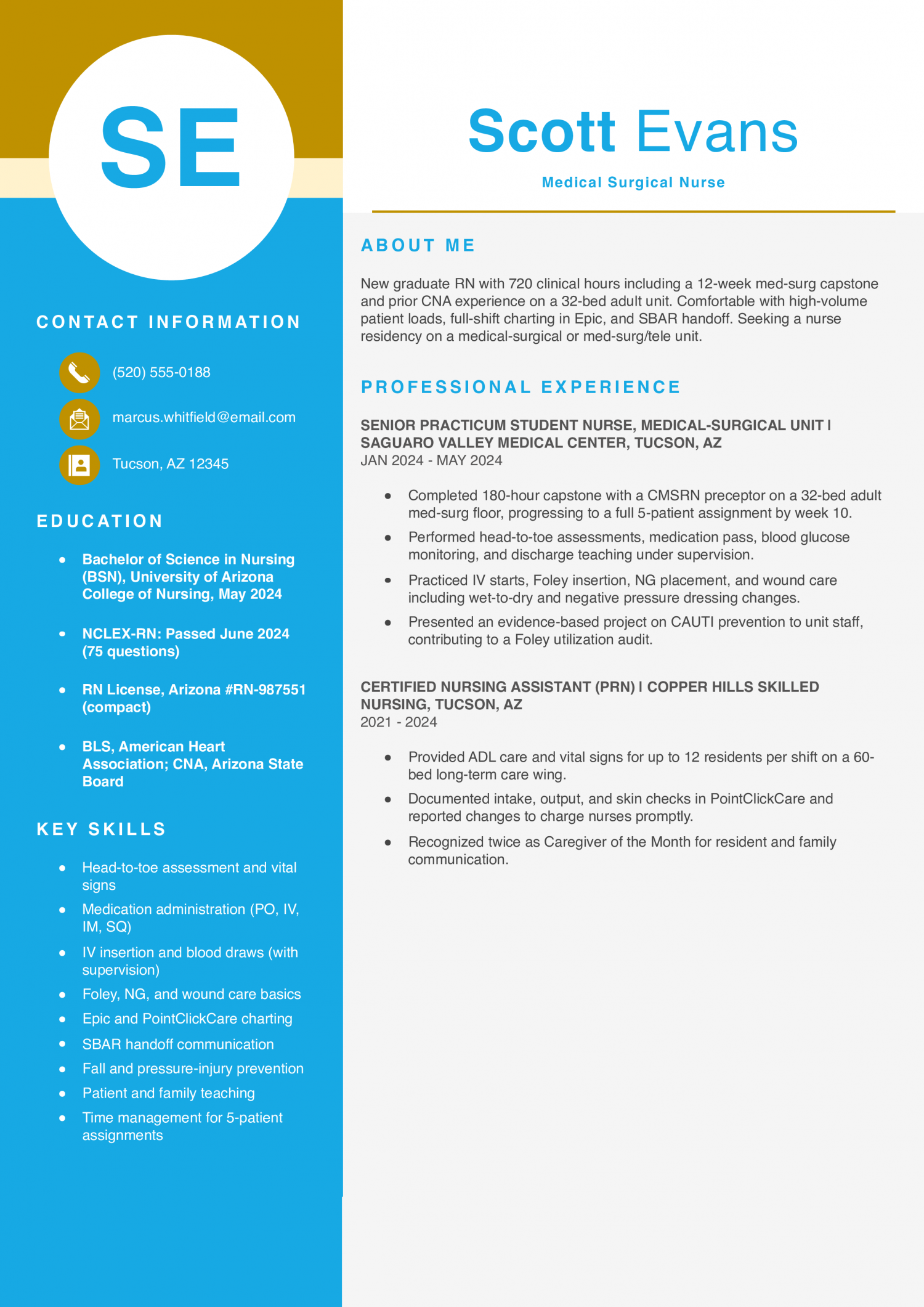
You finished an ADN or BSN program in the last year and want your first med-surg seat. This resume needs to prove clinical rotations, NCLEX pass, BLS, and the skills you practiced during preceptorship.
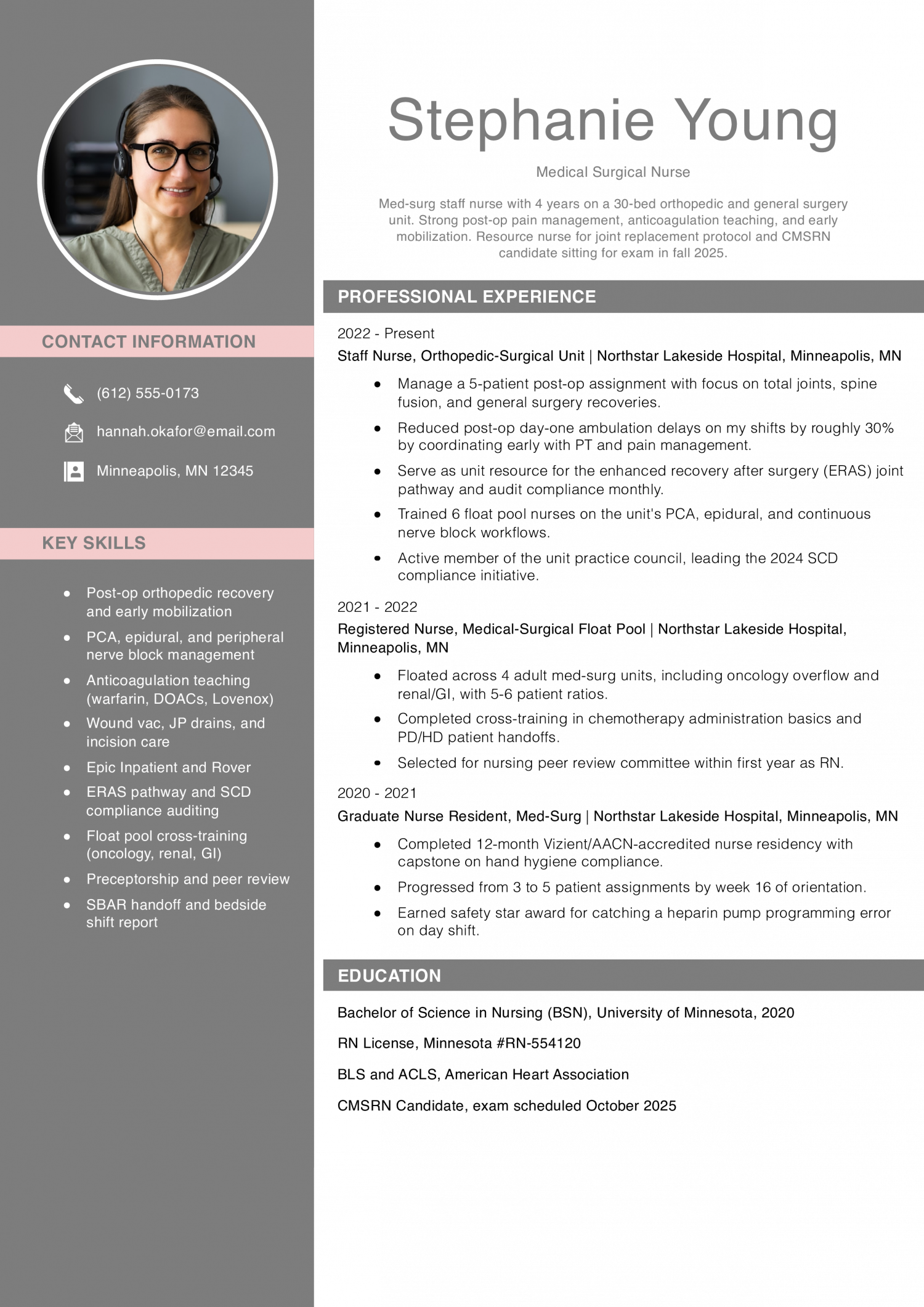
You have two to six years on a med-surg or telemetry floor and carry a full assignment without backup. This resume needs to prove patient-load range, EHR fluency, CMSRN progress, and outcome metrics like fall rates or HCAHPS pulls.
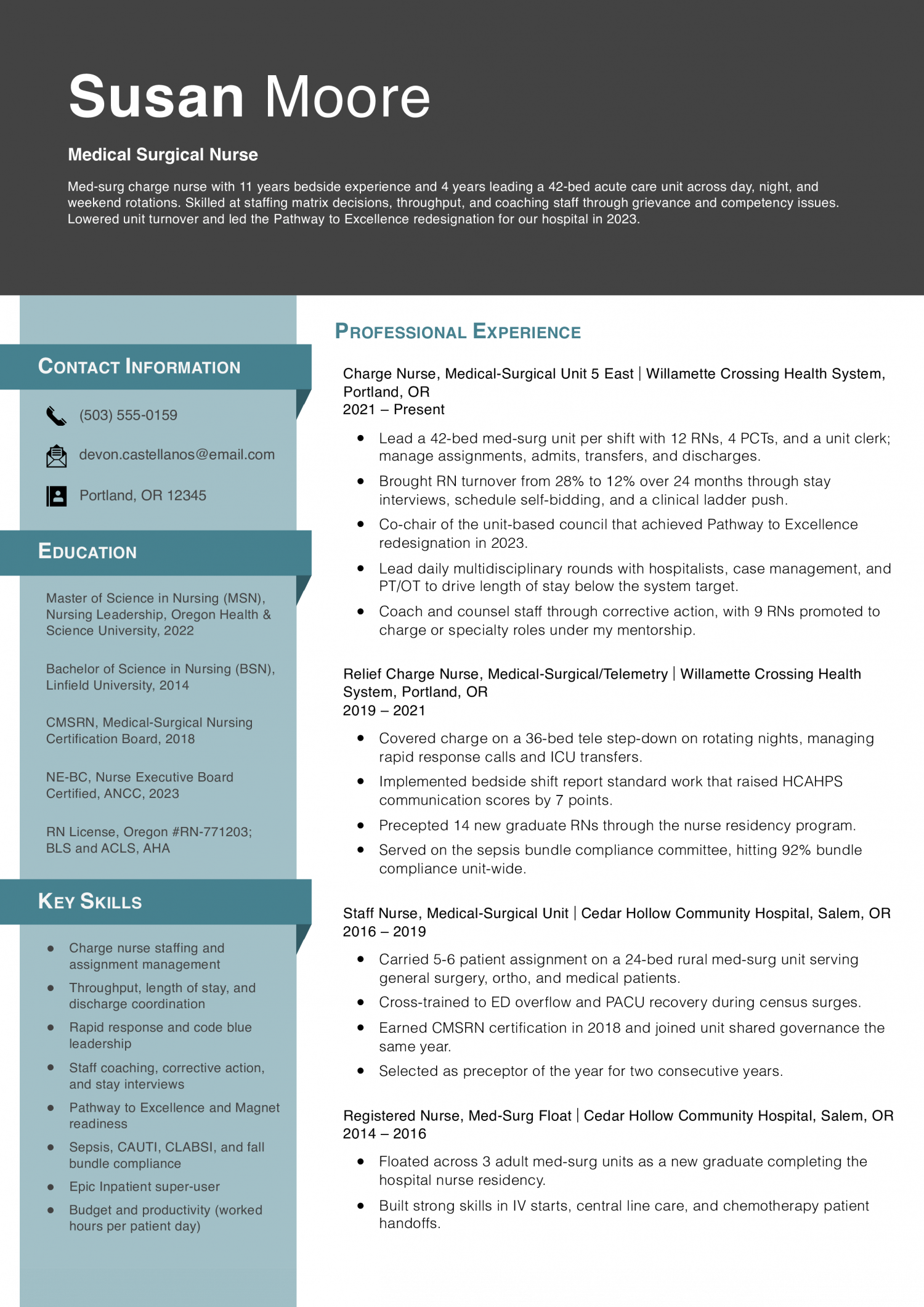
You run shifts as charge nurse or preceptor and own staffing, escalation, and float assignments. This resume needs to prove team size, throughput numbers, committee work, and the unit-level projects you led.
Priya Ramanathan, BSN, RN, CMSRN
Raleigh, NC | (919) 555-0142 | [email protected] | linkedin.com/in/priyaramanathan-rn
Medical-surgical RN with 6 years of acute care experience on 30+ bed adult units. CMSRN-certified, with deep skill in post-op recovery, telemetry monitoring, anticoagulation teaching, and complex discharge planning. Known for reducing fall-with-injury rates, precepting new graduates through residency, and serving as charge relief on night shift.
Medical-Surgical Nurse, Adult Surgical Unit
Cardinal Ridge Regional Hospital | Raleigh, NC | 2021-Present
Registered Nurse, Medical-Surgical/Telemetry
Brightline Memorial Hospital | Durham, NC | 2018-2021
Graduate Nurse Resident, Med-Surg
Brightline Memorial Hospital | Durham, NC | 2017-2018
Patient Care Technician (Student Worker)
UNC Health | Chapel Hill, NC | 2016-2017
Your profile belongs at the top of page one and should state your years on a med-surg unit, your license state, and the floor type you’ve worked.
Name the patient population and the typical assignment size. A telemetry RN with five years carrying six post-op patients reads differently than a float pool nurse covering ortho and oncology. Add one credential cue, like CMSRN-eligible or charge nurse trained, so nurse managers see the scope tier in under 10 seconds.
Strong med-surg bullets carry numbers. Name your typical assignment ratio, the acuity mix, and one outcome metric per role.
Pull from real artifacts: HCAHPS communication scores, fall rates per 1,000 patient days, CAUTI or CLABSI counts on your unit, or discharge throughput. Bullets without a number tend to read as duties, not contributions. Recruiters scan for assignment size first, then outcome shifts, then any project work you led.
Aim for three quantified bullets per role at minimum.
Cluster your work into four buckets so a reader can map it fast. Use Clinical Procedures, Patient Education, Care Coordination, and Charting and Compliance as working headers.
Under Clinical Procedures, name IV starts, central line care, NG tube management, wound vacs, and post-op assessments. Under Care Coordination, name handoffs to PT, case management, and discharge planning. This grouping helps managers see scope without reading every bullet.
Build a credentials block under your contact line. List your RN license state and status, BLS, ACLS, CMSRN or RN-BC if held, and any specialty add-ons like PCCN.
List your state and the words license in good standing. Do not print the license number on the resume; you’ll enter that on the application. Add an EHR line naming Epic, Cerner, Meditech, or Allscripts.
Credentialing teams check this block before the nurse manager sees the file.
Your education block lists your nursing degree, school, and graduation year. If you’re an ADN nurse in a BSN bridge program, name the program and your expected date.
Add a short continuing education block with hours completed in the current cycle and the topic areas. Magnet hospitals weigh BSN status and active CE when ranking applicants. Close with one short professional affiliation line, such as AMSN membership, if it applies.
The med-surg nurse resumes that get callbacks share a specific skill mix. The lists below come from our user-built med-surg nurse resumes. Nurse managers and hospital recruiters scan for these patterns first, not generic compassion language.
Hard skills carry the credential check and the EHR match. Soft skills back up the patient-load and handoff bullets you’ve written into your experience section. Match the hard skills against the target posting and use soft skills as evidence behind your outcome bullets, not as a standalone list.
| Soft Skills | % of resumes with this skill |
|---|---|
| Communication | 73% |
| Critical thinking | 66% |
| Teamwork | 46% |
| Time management | 36% |
| Patient advocacy | 31% |
And here are the top hard skills showing up most often.
| Hard Skills | % of resumes with this skill |
|---|---|
| Patient assessment | 68% |
| Medication administration | 59% |
| IV therapy | 49% |
| Wound care | 40% |
| Electronic health records | 34% |
Based on data from thousands of medical-surgical nurses’ resumes built on ResumeTemplates.com, May 2026.
Before a medical surgical nurse resume gets a closer read, hiring teams check for a short list of essentials.
Med-surg postings require an active RN license in the state of practice or a compact-state license that covers it. Credentialing teams verify this before a nurse manager reads your resume.
List your license under a Credentials header on page one. Name the state, the status, and the expiration month and year. Do not print the license number itself; that goes on the application.
If you hold a Nurse Licensure Compact (NLC) multistate license, write it that way: RN, multistate license issued by [Home State], compact privileges active. Recruiters at travel and float-pool employers search for compact RN as a keyword.
Most state boards require contact hours per renewal cycle. List your active CE in a short block under education, with topic and hours per course.
Group CE by topic area to show the direction of your clinical growth. Sepsis, stroke, telemetry rhythm interpretation, and end-of-life care are all common med-surg CE tracks.
Include your current cycle progress, such as 18 of 24 hours completed for the 2025 to 2027 renewal. Magnet hospitals weigh active CE during clinical ladder reviews and charge nurse selection.
Hospitals run resumes through ATS filters that search for EHR system names. Name the systems by brand, not by generic terms like electronic charting.
Med-surg resumes cross legal and recruiting desks. Never include patient names, medical record numbers, room numbers, or identifying case details in your bullets.
Write outcome bullets in aggregate. Say carried a six-patient post-surgical assignment, not described the case of an individual patient. Aggregate language passes HIPAA review and reads stronger to nurse managers anyway.
If a project required IRB approval or a data use agreement, you can name the study and your role without naming the patients. Cite the unit, the patient population in general terms, and the outcome measure.
Nurse managers read this list as a map of where your clinical interests are heading. The certifications below tell them which acuity tier, specialty floor, or leadership track you’ve invested in beyond your base RN license. List the issuing body and the year of completion under each item.
For med-surg nurses, the spread between the 10th-percentile floor and the top-decile ceiling tracks acuity level, shift differential, and geography more than years on the unit. Charge work, specialty certifications, and Magnet-hospital tenure move RNs from the middle band toward the top. Geographic concentration matters too: pay clusters in coastal metros and high cost-of-living states.
Lead your resume with the unit acuity, your CMSRN or PCCN status, and the patient-load range you carry per shift.
| # | State | Avg. Annual |
|---|---|---|
| 1 | California | $140,330 |
| 2 | Hawaii | $136,320 |
| 3 | Oregon | $123,990 |
| 4 | Washington | $112,180 |
| 5 | Alaska | $110,690 |
| 6 | New York | $105,600 |
| 7 | District of Columbia | $104,550 |
| 8 | New Jersey | $102,730 |
| 9 | Nevada | $101,990 |
| 10 | Massachusetts | $101,970 |
| # | State | Workers | Median |
|---|---|---|---|
| 1 | California | 326,720 | $140,330 |
| 2 | Texas | 261,050 | $90,010 |
| 3 | Florida | 218,100 | $82,850 |
| 4 | New York | 204,120 | $105,600 |
| 5 | Pennsylvania | 146,840 | $87,610 |
Resume Templates offers HR approved resume templates to help you create a professional resume in minutes. Choose from several template options and even pre-populate a resume from your profile.
Use the phrasing the posting uses. Most hospitals write Medical Surgical RN, Med-Surg RN, or Registered Nurse, Medical-Surgical Unit in their job titles.
Mirror that exact wording in your job title line so the ATS tags the match. In your summary, write both forms once: medical surgical and med-surg.
That covers recruiters who search either term.
Lead with patient assignment size and acuity. Then list assessment, IV therapy, wound care, post-op monitoring, medication administration, and discharge planning.
Add charting in your EHR by name. Close each role with two outcome bullets: HCAHPS pulls, fall rate, CAUTI count, or readmission numbers.
Skip generic duties like provides compassionate care; they read as filler.
Open with years of RN experience, your license state, and the unit type. Add patient load size, top two credentials, and EHR.
Keep it to three or four lines. A strong summary looks like: BSN-prepared RN with four years on a 32-bed med-surg telemetry unit at a Magnet hospital, carrying six-patient assignments.
Close with credentials: CMSRN-certified, ACLS, Epic.
No. List your state and the words license in good standing, with the expiration month and year.
State boards advise against publishing the full license number on documents you post online.
You'll enter the number on the formal application or credentialing packet when the employer asks for it.
For a medical-surgical nurse, an ATS-friendly template is the safest pick, because it puts your certifications and experience where a hiring manager scans first. A basic template is a solid alternative. Whichever you choose, keep the formatting clean and easy to parse: clear section headings, a standard font, and no graphics a parser can choke on.