Chief Executive Officer Resume Examples and Templates for 2026



Hiring CEOs and board technology committees look for IT budget size and a named transformation outcome on the first page, because it shows whether a CIO can run the function as a business, not a cost center.
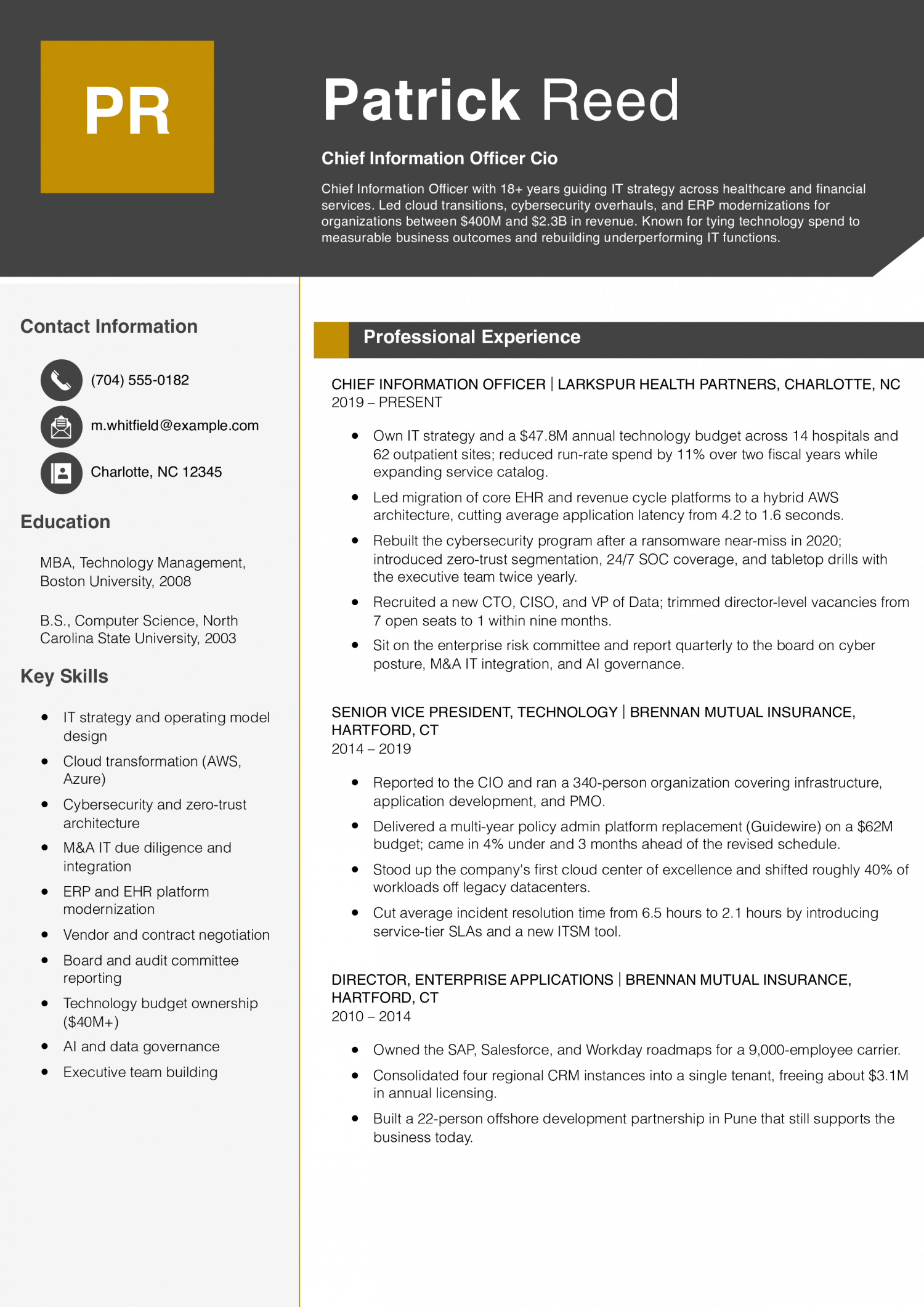
The CIO archetype is a senior technology executive with full IT P&L responsibility and a direct line to the CEO or board. This resume needs to prove enterprise transformation scope, budget authority, and a measurable cyber and uptime track record.
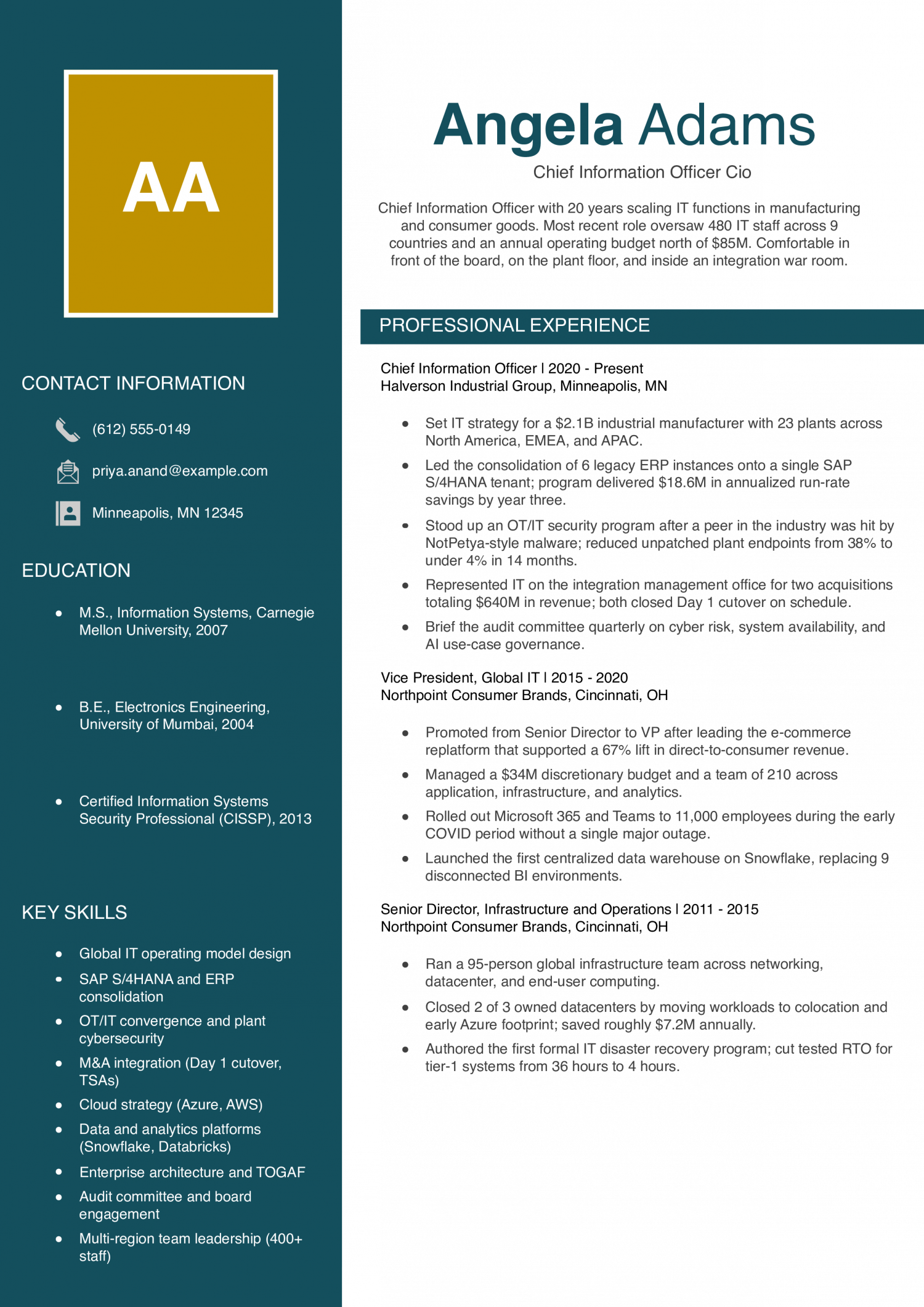
Chief Information Officer with 22 years across higher education, retail, and SaaS. Built IT functions from 30 people to 400+, led three ERP modernizations, and managed total technology spend approaching $110M annually at the senior-most level. Track record of arriving in underperforming IT shops and rebuilding leadership, vendor relationships, and the operating model within 18 to 24 months.
The first line of your summary should name your IT operating budget, the headcount you lead, and the revenue of the business you support.
Boards and CEOs read this combination as your operating scale. A line like “CIO leading a $90M IT budget and 320 staff across a $2.1B manufacturer” places you in a peer group instantly.
Follow it with one named transformation outcome: an ERP cutover, a cloud migration percentage, or a cyber posture lift tied to a board metric. Skip vague claims about driving innovation. Boards score CIO candidates on capital deployed, risk reduced, and revenue enabled.
Translate IT work into numbers a CFO and audit committee can verify.
Strong CIO bullets tend to name three things: scope (users, sites, revenue covered), delta (cost out, uptime gained, incident reduction), and timeline.
Useful metrics for this role include application portfolio rationalization percentage, cloud migration completion, mean time to recover, audit findings closed, and run-rate savings from vendor consolidation. Bullets without a number tend to read as duties. A line like “Cut application portfolio 40% over 18 months, freeing $6M in annual run-rate” outperforms “led rationalization efforts.” Recruiters scan for the dollar figure and the percent first.
Cluster your bullets so a board reader can size each pillar in seconds.
Use four categories: strategy and operating model, infrastructure and cloud, cybersecurity and risk, and business enablement.
Under strategy, name the IT operating model you built and the governance forums you chair. Under infrastructure, name the cloud platforms (AWS, Azure, GCP), the data center exits, and the SaaS consolidations. Under cybersecurity, name the framework (NIST CSF, ISO 27001), the SOC model, and the board reporting cadence.
Under business enablement, name the revenue or margin program you supported, such as a CPQ rollout or a data platform behind pricing.
CEOs and board technology committees expect a page-one credentials block, not a buried list.
Include your degree, any MBA, and executive programs (MIT Sloan, Harvard AMP, Stanford Executive). Name the frameworks you operate in: NIST CSF, COBIT, ITIL 4, TOGAF, and SAFe if you run agile at scale.
If you hold a CISM, CGEIT, or CISSP, list it next to your name. Boards weigh these because cybersecurity oversight is now a named board duty under SEC cyber disclosure rules. Naming the framework signals you can speak the audit committee’s language without translation.
Cut anything that reads as a staff IT manager’s resume.
Drop ticket counts, individual tool certifications below the architect tier, and bullets about “managing the helpdesk.” Cut early-career roles older than 15 years to a single line.
Remove buzzword strings like “visionary leader passionate about innovation.” Replace them with one board-facing artifact: a tech strategy you presented, a cyber tabletop you ran with the audit committee, or a capital plan you defended. Trim the resume to two pages. A third page signals you have not decided what your most important work is.
Executive IT hiring is tight in 2026. Search committees are running shorter slates and the bar to clear a recruiter screen is higher, with cloud economics and cyber governance the two filters that decide most cuts. CEOs and board technology committees weigh hard skills like AWS, Azure, NIST CSF, and ERP program ownership as table stakes, then read soft skills as the evidence backing your transformation bullets.
Match the skills below against your target posting, and keep each soft skill paired with a bullet that proves it.
| Soft Skills | % of resumes with this skill |
|---|---|
| Executive leadership | 72% |
| Strategic thinking | 58% |
| Stakeholder communication | 42% |
| Change management | 35% |
| Business acumen | 27% |
And here are the top hard skills showing up most often.
| Hard Skills | % of resumes with this skill |
|---|---|
| IT strategy and governance | 77% |
| Digital transformation | 61% |
| Cybersecurity risk management | 47% |
| Cloud computing | 36% |
| IT budget management | 27% |
Based on data from thousands of CIOs’ resumes built on ResumeTemplates.com, May 2026.
These are the must-haves hiring teams look for when scanning a chief information officer cio resume.
CEOs and board technology committees expect a niche keywords block that proves you operate in the specific IT sub-domain they are hiring for. Group keywords by sub-niche so the parser indexes each cluster cleanly.
| Niche | Keywords ATS scans for |
|---|---|
| Cybersecurity leadership | ciso resume, chief information security officer, nist csf, soc 2 |
| Cloud and infrastructure | aws migration, azure landing zone, data center exit, hybrid cloud |
| ERP and applications | sap s/4hana, oracle fusion, workday deployment, application rationalization |
| IT governance and risk | it governance, cobit, sox itgc, board reporting |
| Digital transformation | digital transformation, operating model, agile at scale, change management |
AI use on a CIO resume can go three ways: lead with “AI-first technology visionary” (which retained search firms screen out), leave it off entirely (which reads as evasive for a 2026 CIO), or describe the enterprise AI program you actually governed. The third is what boards and CEOs can validate in references.
CIOs now own enterprise AI policy, model risk reviews, and approval workflows that previously did not exist in the IT charter.
Every major SaaS vendor ships AI features, so renewal cycles now include data residency, training opt-outs, and shadow AI controls.
Boards ask for measurable AI productivity gains, so CIOs run pilots with named adoption rates and time-saved metrics.
Engineering and ops headcount mixes are shifting, and CIOs are expected to defend the new ratio to the CFO.
Microsoft Copilot for M365: Name your enterprise rollout scope, licensing tier, and the adoption or productivity metric you reported to the CEO.
ChatGPT Enterprise or Gemini for Workspace: Name the data governance controls and the use cases approved through your AI council.
Lead the summary with three numbers: IT operating budget, headcount, and revenue of the business you support. These three together place you in a peer group and tell a search consultant whether to advance you.
Show governance fluency by naming the committees you brief, the cadence, and the artifact you produce. “Quarterly cyber posture report to the audit committee” reads stronger than “reported to the board.”
Beyond a degree and a track record, the certifications below tell CEOs and board technology committees which governance language you speak and how prepared you are to brief the audit committee on cyber risk. List the certifying body and the year earned next to each item.
Certified Information Security Manager (CISM): Signals you can own cyber governance at the executive tier, which matters under current SEC cyber disclosure expectations.
Certified in the Governance of Enterprise IT (CGEIT): Built for CIO-level readers; tells boards you frame IT as portfolio risk and value, not project lists.
Certified Information Systems Security Professional (CISSP): Useful when the CISO reports to you and you need to defend security architecture decisions to the board.
TOGAF 9 or 10 Certified: Reads well when the role centers on enterprise architecture, ERP modernization, or a multi-year application rationalization mandate.
Chief executives (the BLS bucket that houses CIO) is a narrow occupation, which means supply matters and the spread between mid-band and top-decile pay is wide. Geographic concentration in financial centers and tech hubs pulls the top of the distribution up, while small-employer CIO roles anchor the floor.
To position above the median, lead the resume with IT operating budget, revenue of the business you supported, and one transformation outcome a CFO would underwrite.
| # | State | Avg. Annual |
|---|---|---|
| 1 | Connecticut | $239,200 |
| 2 | District of Columbia | $239,200 |
| 3 | Illinois | $239,200 |
| 4 | Maryland | $239,200 |
| 5 | Massachusetts | $239,200 |
| 6 | Nevada | $239,200 |
| 7 | New Jersey | $239,200 |
| 8 | North Carolina | $239,200 |
| 9 | Oregon | $239,200 |
| 10 | South Dakota | $239,200 |
| # | State | Workers | Median |
|---|---|---|---|
| 1 | California | 36,980 | $220,600 |
| 2 | Pennsylvania | 14,140 | $220,510 |
| 3 | New York | 7,830 | $219,320 |
| 4 | Massachusetts | 7,110 | $239,200 |
| 5 | Minnesota | 6,690 | $194,160 |
Resume Templates offers HR approved resume templates to help you create a professional resume in minutes. Choose from several template options and even pre-populate a resume from your profile.
Name the committee, the cadence, and the topic. "Briefed the audit committee quarterly on cyber posture against NIST CSF" tells a search committee you already operate at the level they are hiring for.
If you only briefed the executive team, say so honestly and name the topics. Boards check this in references, so accuracy matters more than scope inflation.
Two pages, with rare exceptions. Search firms and CEOs read CIO resumes for scope, transformation, and risk posture, not job history depth.
A third page usually means early-career roles are taking space that should belong to your current scope. Trim anything older than 15 years to a single line under "Earlier career."
Frame the smaller seat as a deliberate scope choice, not a step down. Lead the summary with the value thesis: "CIO targeting PE-backed mid-market companies where IT is a value-creation lever, not a cost center."
Then show what you did at the larger employer that maps to mid-market needs, like vendor consolidation or M&A integration. Search firms screen out CIOs who look like they are coasting downward.
Give cyber its own pillar in your experience, framed as governance and risk, not technical operations. Name the framework you adopted, the board reporting cadence, and the risk register you owned.
Avoid claiming hands-on SOC work if your CISO ran that. Boards can tell when a CIO overreaches into the CISO's lane, and it raises questions about how you delegate.
For a chief information officer, a professional template is the safest pick, because it signals the polish hiring managers in this field expect. An ATS-friendly template is a solid alternative. Whichever you choose, keep the formatting clean and easy to parse: clear section headings, a standard font, and no graphics a parser can choke on.
Executive Resume Writer and Career Coach
Andrew Stoner is an executive career coach and resume writer with 17 years of experience as a hiring manager and operations leader at two Fortune 500 Financial Services companies, and as the career services director at two major university business schools.
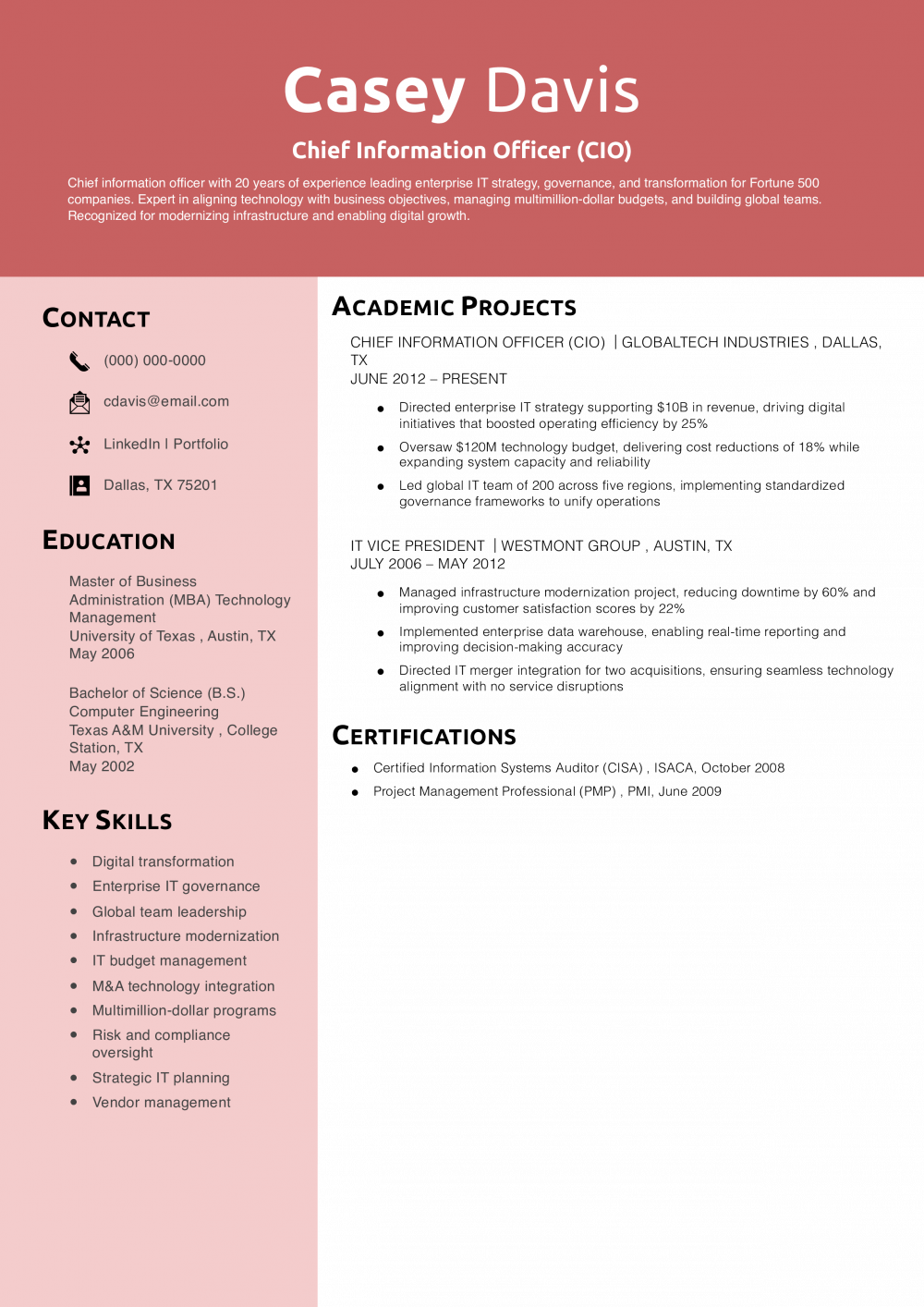
Customize this template in our builder in under 10 minutes.