IT Manager Resume Examples
Add one line a CIO or IT director cannot pull from your LinkedIn skills list. Examples include a multi-site ERP cutover, a SOC 2 Type II audit you owned, or a 24/7 NOC you stood…
Every resume example is written and reviewed by our team of Certified Professional Resume Writers to ensure top-quality content and formatting.
Most IT director roles draw dozens of senior applicants with strong technical depth. What sets your resume apart is proof you have led teams, cut costs, and shipped projects on time. CIOs and CTOs look for budget ownership, infrastructure migrations, and vendor strategy results.
Your resume should open with metrics tied to uptime, headcount managed, or dollars saved. Show that you align IT roadmaps with business goals. The IT director resume examples below show you how to structure that proof. To compare layouts before you start, browse our resume templates.
CIOs and CTOs decide whether to keep reading by the summary section; if budget scale, team size, and a clear infrastructure or security credential are not visible there, the resume moves to the reject pile.
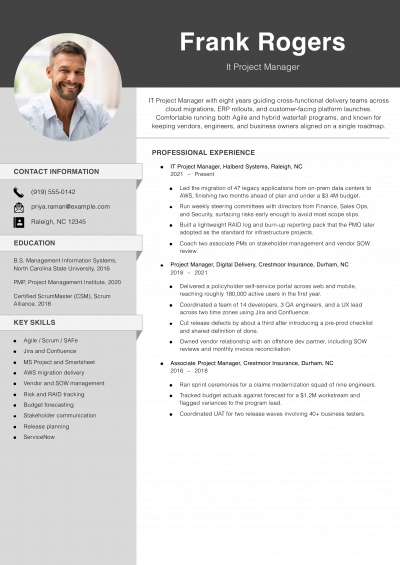
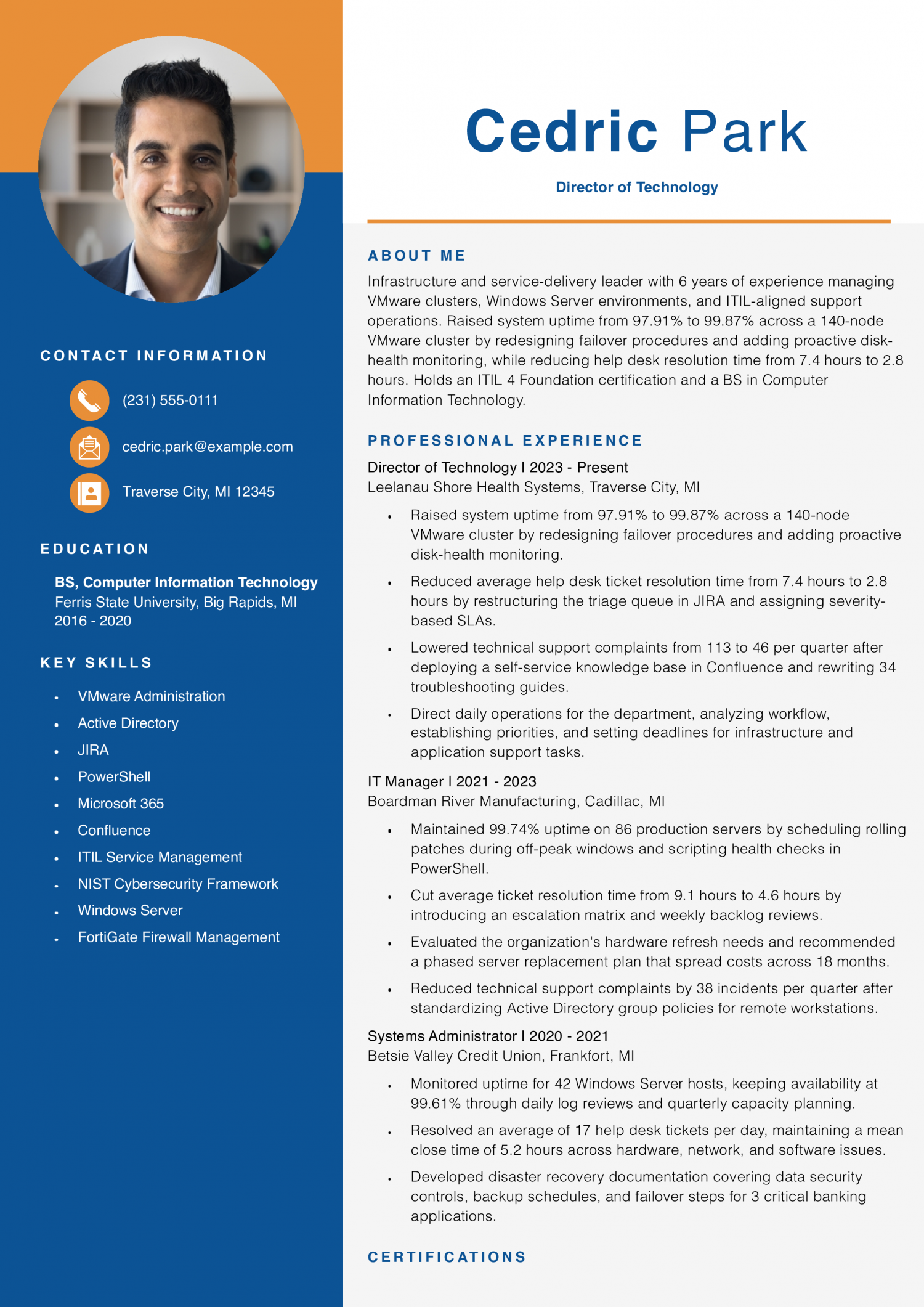
Pick this resume if you are a mid-level IT professional with about six years of experience moving into a director-level infrastructure role. Drop vague uptime claims and instead trace each availability gain to the specific monitoring or failover change behind it.
This resume shows the starting uptime and the ending uptime across a named cluster. A reader can see the exact improvement without guessing. For any availability number, put the old figure next to the new one and name the system.
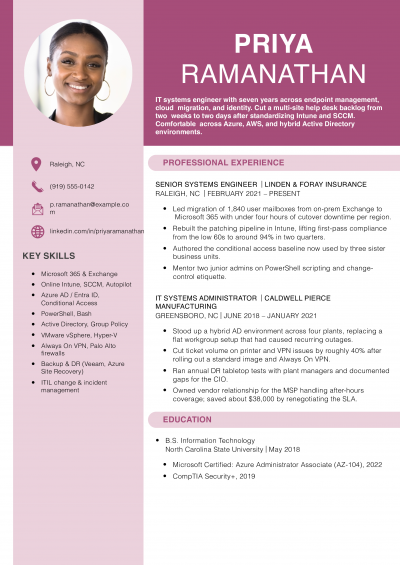
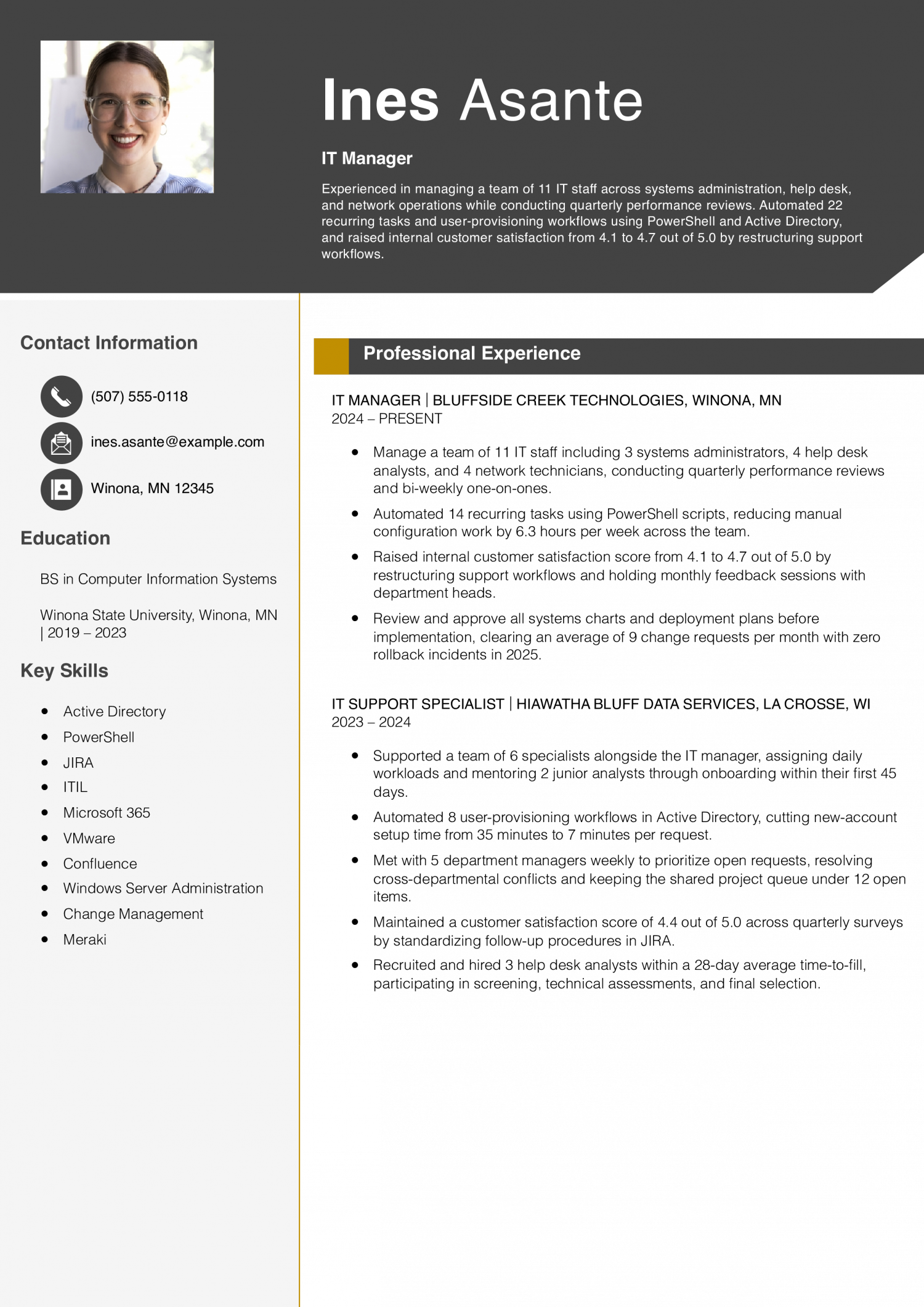
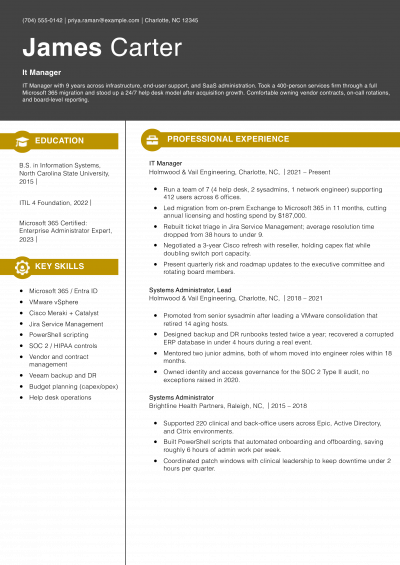
Use this resume if you are an entry-level IT professional with about three years of experience stepping into your first management role. Hold your automation wins and satisfaction scores side by side so readers see both technical depth and people leadership.
Notice how the IT Manager bullet pairs the PowerShell tasks with weekly hours saved. That lets a reader see the time returned to the team. In your own automation lines, include the number of tasks and the time saved.
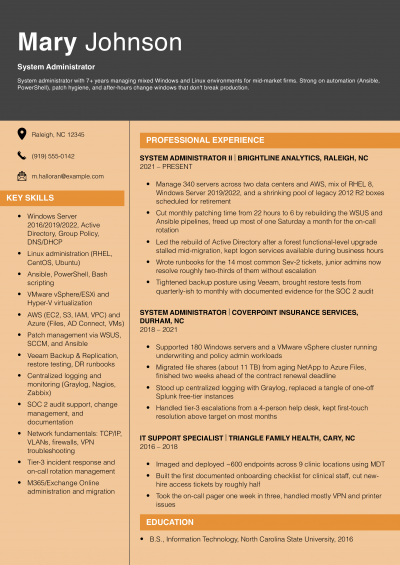
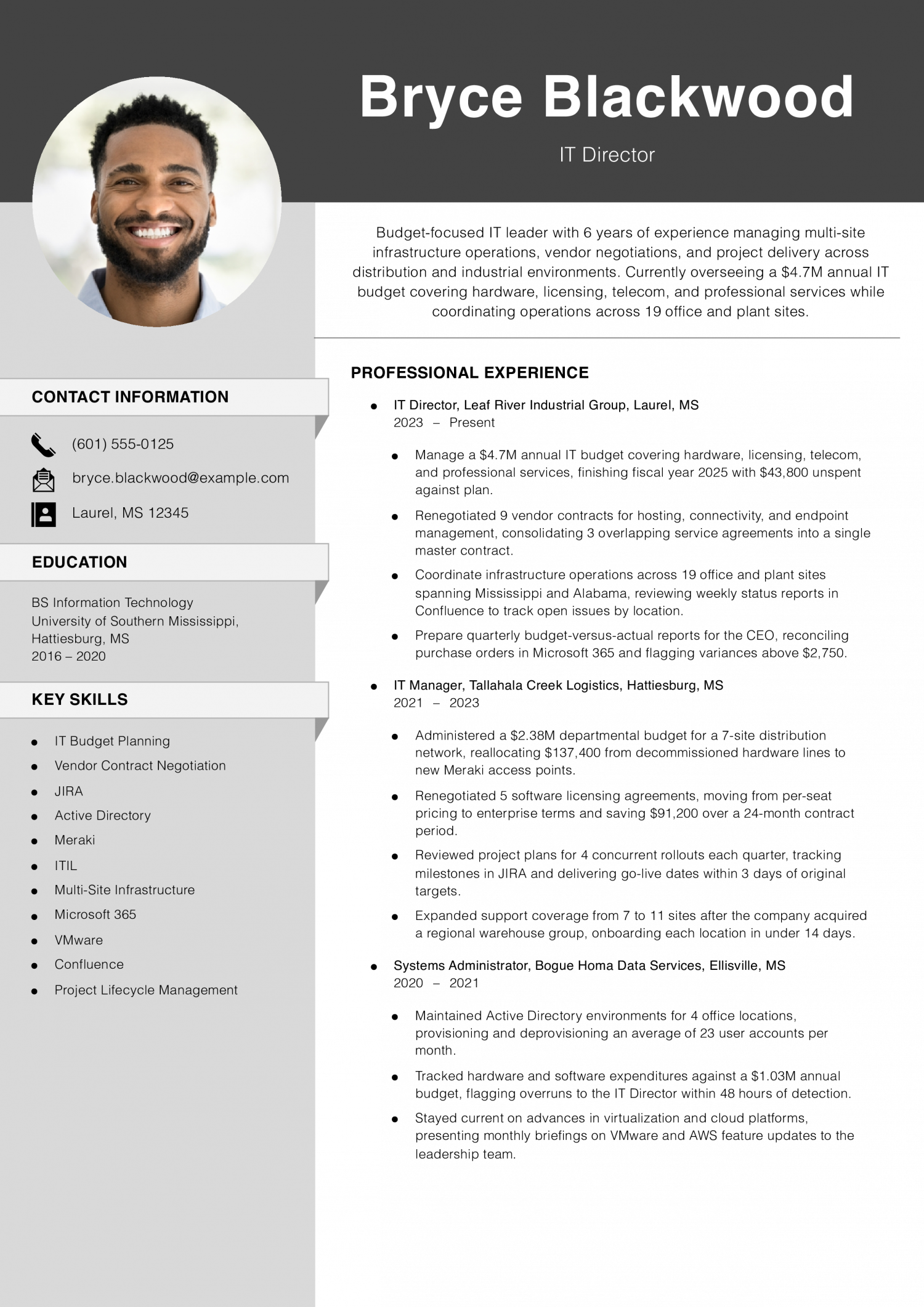
Try this resume if you are an IT manager with about six years of experience stepping into a director role overseeing multi-site infrastructure and vendor contracts. Lay out your budget discipline by showing the exact dollar amount you finished under plan, not a rounded percentage.
The budget bullet names the exact amount left over at the end of the fiscal year. That tells a hiring manager how closely actual spending matched the plan. State how far your spending was above or below plan.
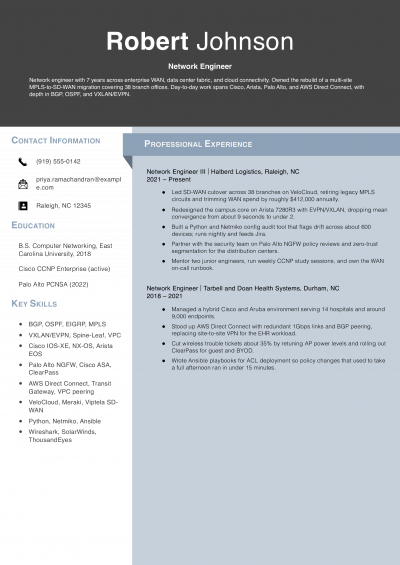
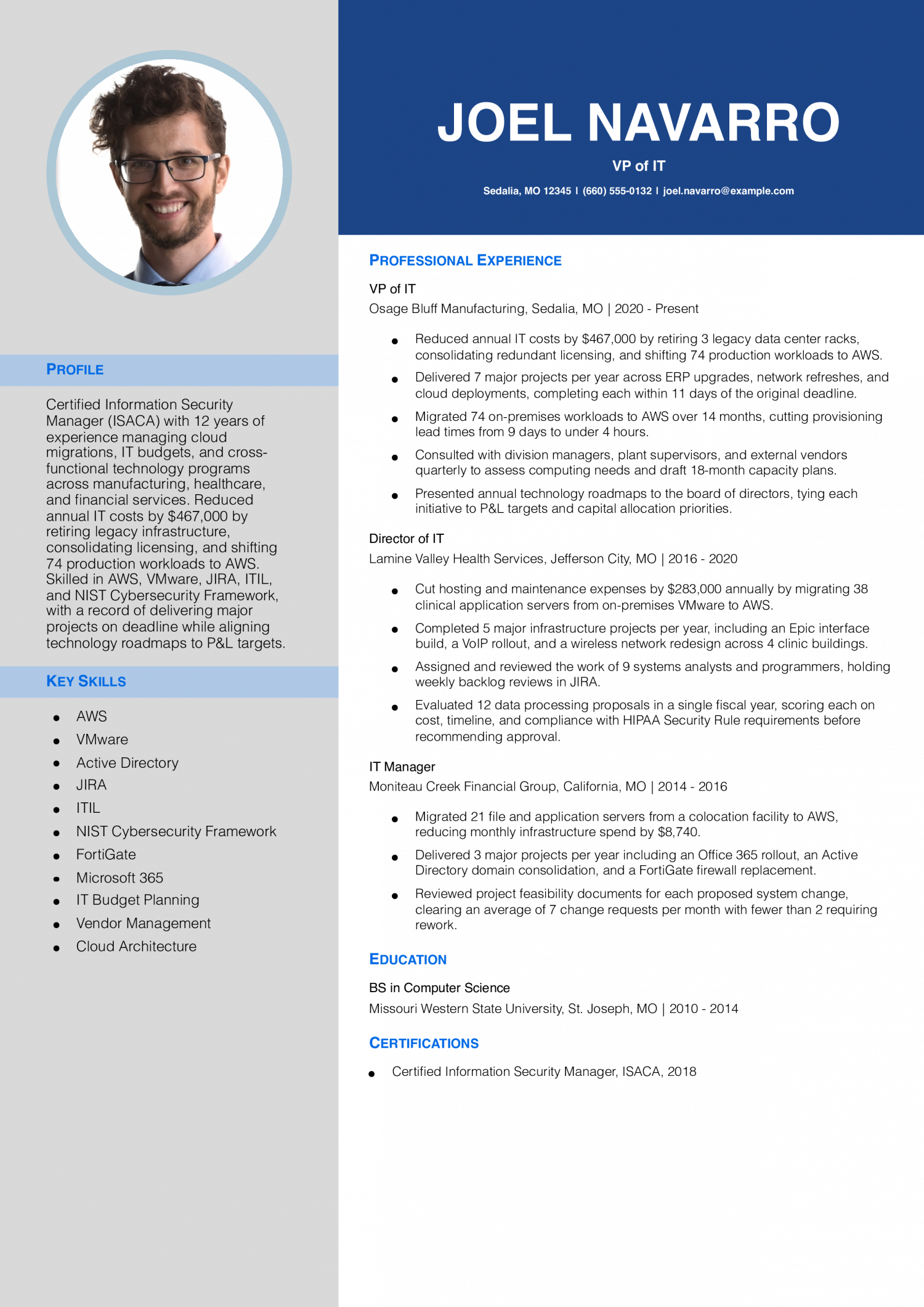
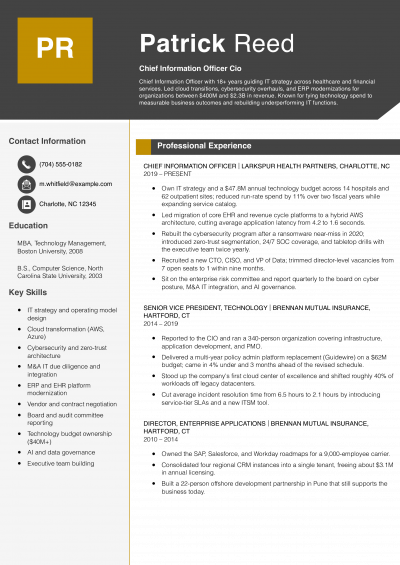
Lean on this resume if you are a senior IT leader ready to step into a VP-level position overseeing cloud strategy and enterprise infrastructure. Insert a capacity-planning narrative alongside migration counts to show you think beyond one-time projects.
Each project here shows the gap between its deadline and its finish date. A hiring manager can see how closely projects followed their schedule. When describing your projects, say how close each finish was to its target date.
Experienced in managing IT operations, security hardening, and disaster recovery across healthcare and agricultural environments over 7 years, including controlling a $1.45M operational budget for hardware, licensing, and telecom. Improved staff productivity by 26.4% after rolling out Microsoft 365 collaboration workflows and replacing manual approval chains with digital forms. Skilled in Active Directory, FortiGate, VMware, PowerShell, JIRA, and Confluence with deep knowledge of CIS Controls and the NIST Cybersecurity Framework.
Start with how many years you have led IT teams in enterprise settings. Name the size of the org you support.
State the budget band you manage, such as $2M or $15M. Mention whether you run on-prem data centers or cloud environments. Call out the verticals you know, like healthcare or financial services.
CIOs and CTOs scan this block first to see fit. A vague opener wastes that valuable chance to demonstrate your qualifications. Two to four lines is the right length here.
Each line should carry a concrete fact about your scope. Skip soft characterizations like “dynamic leader” or “passionate about tech.” Replace them with hard details about your department.
Most strong IT Director resumes lead with metrics. State the team size you direct, such as 25 engineers. Name the annual budget you control.
Show uptime gains as a percent, like 99.99% SLA. Include cost savings from vendor renegotiations or cloud migrations. Cite project counts, such as 12 concurrent deployments per quarter.
Bullets without a corresponding number tend to read as generic duty lists rather than accomplishments. CIOs and CTOs want proof of scale and impact. Pair each quantitative metric with the specific action you undertook.
For example, write “Cut infrastructure costs 18% by consolidating three data centers.” Time frames help too. Saying “in six months” adds urgency. Two quantifiable metrics per bullet is an appropriate target.
IT Directors cover a wide range of functions, so sort your bullets under three to five categorical headings so readers find relevant information fast. Infrastructure and operations is the first natural group. Include network architecture builds, server management, and disaster recovery planning here.
Next, list IT governance and security work, covering policy creation and compliance audits in that cluster. A third group handles vendor and budget management. Contract negotiations and SLA reviews fit there.
If you lead software projects, add an application delivery heading. Digital transformation efforts earn their own dedicated group too. Each categorical heading should hold approximately three to five bullets.
This organizational structure lets CIOs and CTOs jump to the particular area they care about most.
Place your certifications on page one, near your profile. List each cert with its issuing body. PMP from the Project Management Institute signals project rigor.
CISSP from ISC2 shows security depth. CISM from ISACA covers security management. CGEIT from ISACA signals governance expertise.
ITIL 4 Foundation from PeopleCert shows service management knowledge. Put the ones the job posting names first. CIOs and CTOs often filter resumes by cert match early.
Below credentials, add a tools row for platforms you run. Name your ITSM platform, cloud provider, and ERP system. Keep each entry to the product name and version.
Long tool lists lose clarity, so cap the row at approximately eight items.
At the director level, early career roles rarely add value. Remove job entries from before 2010 unless they show a rare skill. Trim bullet counts on mid-career roles to three or four.
Your most recent two positions deserve the most space. Delete outdated tools like Windows Server 2003 or Novell. Drop references to expired certifications you have not renewed.
If your education section lists coursework, cut it. A degree name, school, and year are enough. Hiring at the director level concentrates on the last decade of measurable impact.
CIOs and CTOs want to see what you run now. A two-page resume is the standard length here. Going to three pages signals poor editing, not deep experience.
CIOs and CTOs scan hundreds of IT director resumes each quarter. The ones they shortlist name clear skills tied to real results. Hard skills prove you can run the tech stack.
Think cloud migration, vendor management, and budget planning. CIOs and CTOs also want proof you can lead people. Soft skills like strategic thinking show up in how you frame your wins.
A bullet about cutting costs by 20% shows both budget control and problem solving. Pair each soft skill with a metric or outcome in your bullets. That turns a vague claim into a fact your reader can check.
Pull each term that appears in the posting from both tables. Use the same wording the ad uses.
| Soft Skills | AI-estimated % |
|---|---|
| Cross-functional leadership | 80% |
| Executive-level communication | 70% |
| Strategic decision-making | 42% |
| Team mentorship | 35% |
| Stakeholder alignment | 31% |
And here are the top hard skills showing up most often.
| Hard Skills | AI-estimated % |
|---|---|
| IT budget management | 79% |
| Infrastructure architecture planning | 65% |
| Cybersecurity policy development | 41% |
| Vendor contract negotiation | 35% |
| IT roadmap execution | 29% |
Skill names and rankings come from an AI model grounded in U.S. Department of Labor occupation data for IT directors, not from a count of IT directors’ resumes built on ResumeTemplates.com.
Put your tools, your project scope, and the credentials below on the page.
There are three common ways to show AI on an IT director resume. You could lead with vague claims like ‘AI transformation leader.’ You could leave AI off and answer questions later. Or you could describe the actual workflow your team runs today.
The third option is what CIOs and CTOs can validate. Name the tool, the task it handles, and the result. Keep each claim tied to a project you led.
A vendor you evaluated also works well here. That gives your counterpart something concrete to discuss. Specific details invite follow-up questions in a conversation.
What AI is actually changing for this role
Infrastructure monitoring: AIOps platforms now flag anomalies and suggest root causes before an engineer opens a ticket.
Budget forecasting: Machine learning models pull from usage data to project cloud and licensing costs per quarter.
Security operations: AI-driven tools correlate alerts across endpoints and reduce false positive volume for your SOC team.
Vendor evaluation: Natural language tools summarize contract terms and risk clauses across competing vendor proposals.
AI tools to name
How to phrase AI on your resume
Do
Skip
A clean tech stack list aids quick scanning. Group tools by category, not by alphabet. Keep each entry short and current.
List board work, advisory roles, or C-suite committees. Include any P&L ownership you have held. Name the revenue or headcount scale for each role.
CGEIT from ISACA signals governance fluency at this tier.
IT Directors run large, cross-team projects regularly. Name the frameworks you have used in practice. CIOs and CTOs value proof over buzzwords here.
CIOs and CTOs read this list as a map of where your work is heading. The items below tell them which domain you have invested in. Security, governance, and delivery each send a different signal.
Pick the ones that match the role you want next. A credential in governance says you think at the board level. One in security says you can own risk.
One in project delivery says you ship on time and on budget. List each credential with the issuing body and the year you earned it.
BLS wage data covers all Computer and Information Systems Managers, a broader group that includes IT directors. Workers at the 90th percentile earn about 70 percent more than the midpoint. Those at the 10th percentile sit about 39 percent below it.
That range reflects a field where geography, industry sector, and the size of the teams you run all vary widely. Employment across the category is large, so openings appear in most metro areas and across many industries. Position your resume around the scale of the infrastructure and budgets you have managed.
Show the number of staff, the annual IT spend, and the platforms you oversaw.
| # | State | Median Annual |
|---|---|---|
| 1 | California | $218,290 |
| 2 | Massachusetts | $214,960 |
| 3 | New York | $214,300 |
| 4 | Washington | $209,370 |
| 5 | New Jersey | $203,460 |
| 6 | Virginia | $201,490 |
| 7 | Colorado | $199,420 |
| 8 | District of Columbia | $195,190 |
| 9 | New Hampshire | $176,540 |
| 10 | Minnesota | $176,380 |
| # | State | Workers | Median |
|---|---|---|---|
| 1 | California | 94,720 | $218,290 |
| 2 | Texas | 73,060 | $171,530 |
| 3 | New York | 48,050 | $214,300 |
| 4 | Florida | 35,040 | $168,470 |
| 5 | New Jersey | 34,470 | $203,460 |
Resume Templates offers HR approved resume templates to help you create a professional resume in minutes. Choose from several template options and even pre-populate a resume from your profile.
A modern IT Director resume uses reverse-chronological format with a short profile at the top. Follow with work experience, a skills block, education, and certifications.
Keep the document to two pages at most. Lead each role with budget size, team headcount, or project outcomes.
Two pages is the standard length for an IT Director resume. You need enough space to show leadership scope, technical strategy, and measurable outcomes.
If your career spans more than fifteen years, include only the most recent positions.
Yes, list ITIL 4 Foundation in your certifications section if you hold it. CIOs and CTOs recognize it as proof you understand service management frameworks.
Place it alongside senior credentials like CISM from ISACA to show breadth across governance and operations.
Open your profile with the transferable skill that connects your past career to IT leadership. Managing cross-functional teams or overseeing enterprise budgets both translate well.
List IT certifications you have earned, like PMP from PMI, near the top. Reframe past accomplishments around technology decisions or infrastructure improvements you influenced.
Reverse-chronological format works best because CIOs and CTOs want to see your most recent scope first. Use clear section headings and consistent spacing for applicant tracking systems.
A single-column layout with standard fonts keeps parsing errors low across most platforms.
List the gap period honestly and note any relevant activity during that time. Consulting work or earning a certification both fill the space with useful detail.
A short line like "Sabbatical, completed ITIL 4 Foundation" turns dead space into a credential on the page.
Yes, name the specific platforms you have managed, such as AWS or Azure. ServiceNow and similar tools also belong if you directed them at scale.
CIOs and CTOs want to match your stack against their environment before scheduling an interview.
Use an ATS-friendly template so your certifications and tech tools each get their own section. A basic template is fine for this too.
IT Director Resume
4.5/5 stars with 150 reviews

Executive Resume Writer and Career Coach
Andrew Stoner is an executive career coach and resume writer with 17 years of experience as a hiring manager and operations leader at two Fortune 500 Financial Services companies, and as the career services director at two major university business schools.
© 2026 Resumetemplates.com All rights reserved.