Food Service Resume Examples
The first line of your summary should name the daily covers, transactions, or tickets you handled during peak rush. Food service directors and restaurant managers read that number as proof you can hold pace. Pair…
Every resume example is written and reviewed by our team of Certified Professional Resume Writers to ensure top-quality content and formatting.
Hiring for most dietary aide roles starts with proof you can prepare meals that follow modified diet orders. Food service directors and dietary managers scan for hands-on work with texture changes, allergen protocols, and tray accuracy rates. A ServSafe Food Handler card often sets you apart from other names in the stack.
Your resume should list the diets you have handled, such as renal or pureed. Include patient counts per shift and any food safety metrics you tracked. The examples below show you how to frame that experience on a clean, ready-to-use layout. To compare layouts before you start, browse our resume templates.
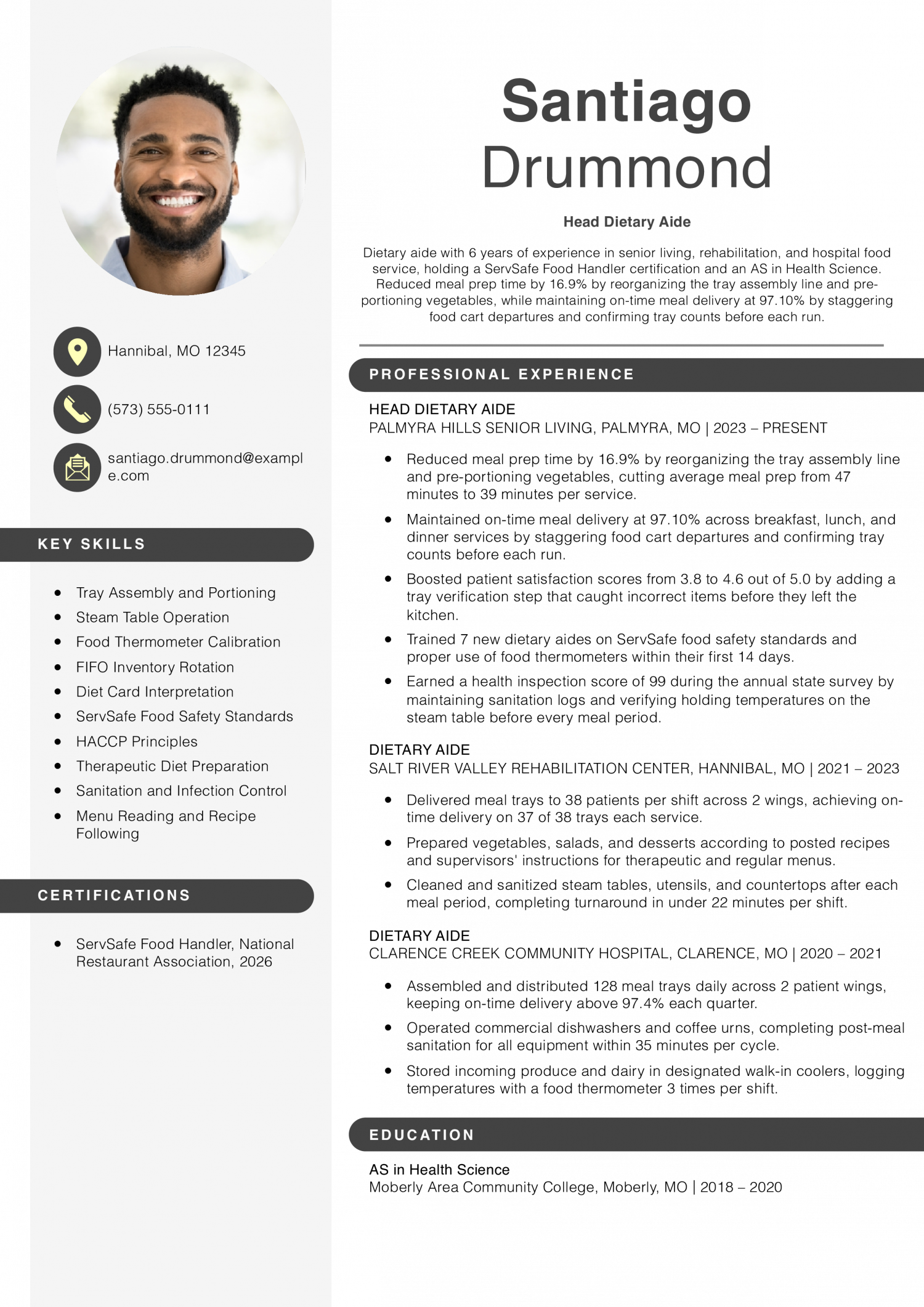
Food service directors screening dietary aide resumes filter first for a ServSafe credential and specific diet preparation experience, because those two details show whether a candidate can safely serve modified trays without extra training.
Pick this resume if you are a mid-level dietary aide with a few years of clinical food service experience stepping into a head aide role. Lead each bullet with a process change and close it with a timed or scored result.
Adding a tray check before trays leave the kitchen is the step that moved the satisfaction score. A patient care manager sees the cause, not the number alone. If you added a step that improved quality, name the check and say when in the process it happens.
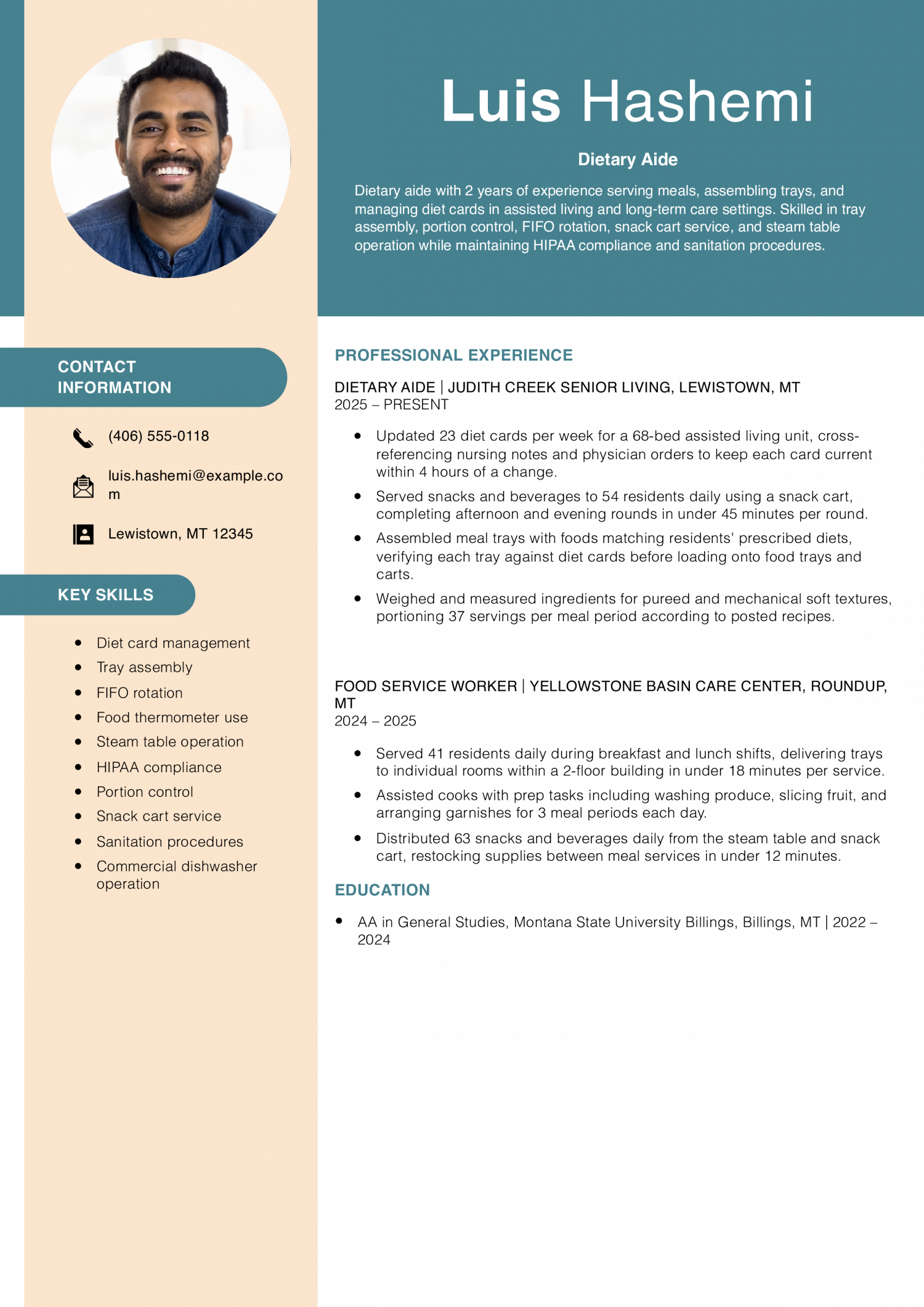
Start with this resume if you are entering dietary aide work with limited food service experience. Separate yourself by showing exact resident counts and timed service rounds in each bullet.
Cross-referencing nursing notes and physician orders is the method that keeps diet cards accurate. A dietitian reading that knows the aide follows clinical updates, not yesterday’s menu. Name the sources you check and the window in which you update each card.
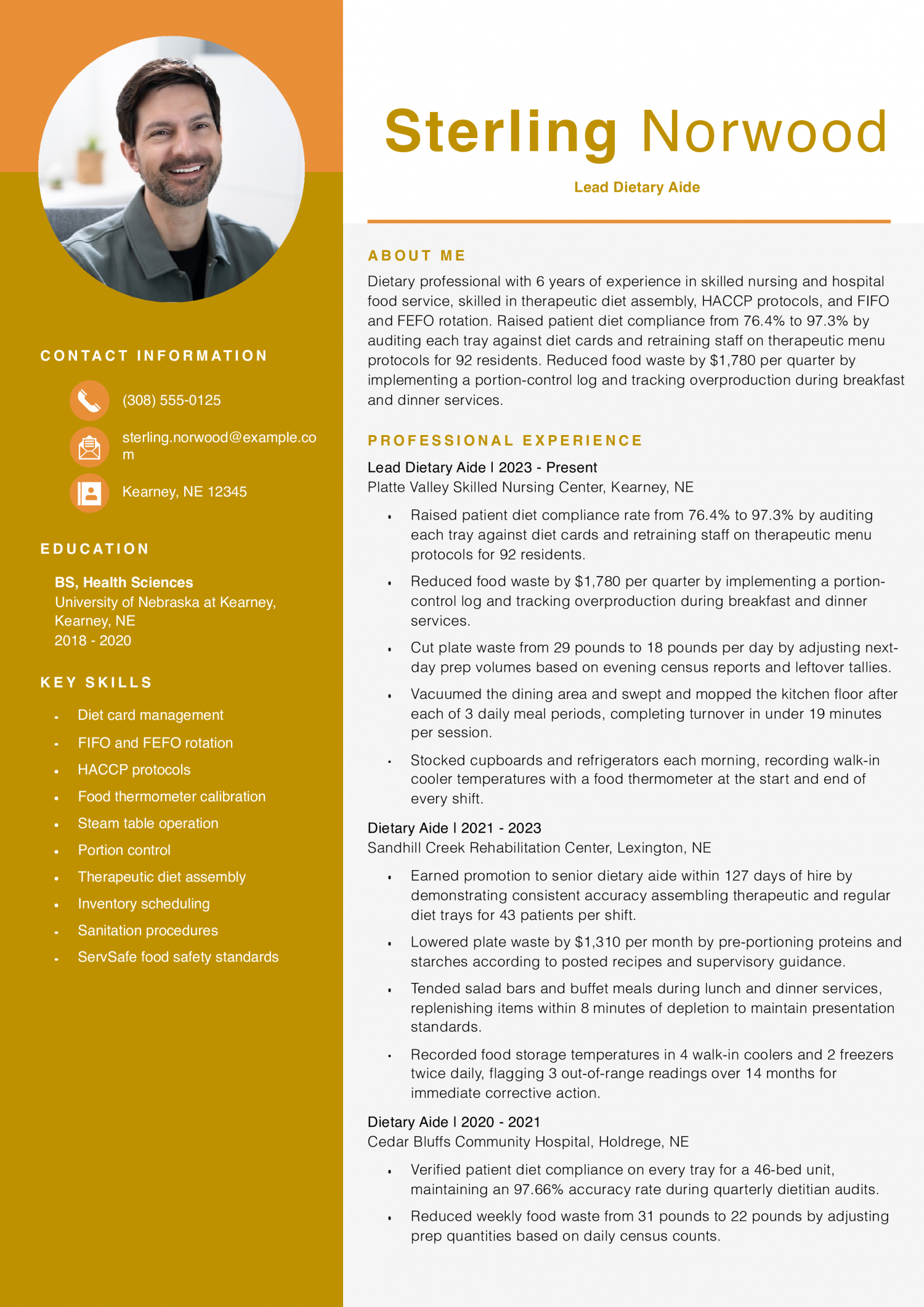
Try this resume if you are a mid-level lead dietary aide with several years of clinical food service work across nursing and rehabilitation settings. Lead each bullet with a before-and-after metric drawn from census reports, waste logs, or dietitian audits.
Temperature checks stand out when you say how many readings you took and how many fell outside the safe range. A food safety auditor can see the scope of the monitoring. State the total checks, the exceptions, and what you did when a reading was off.
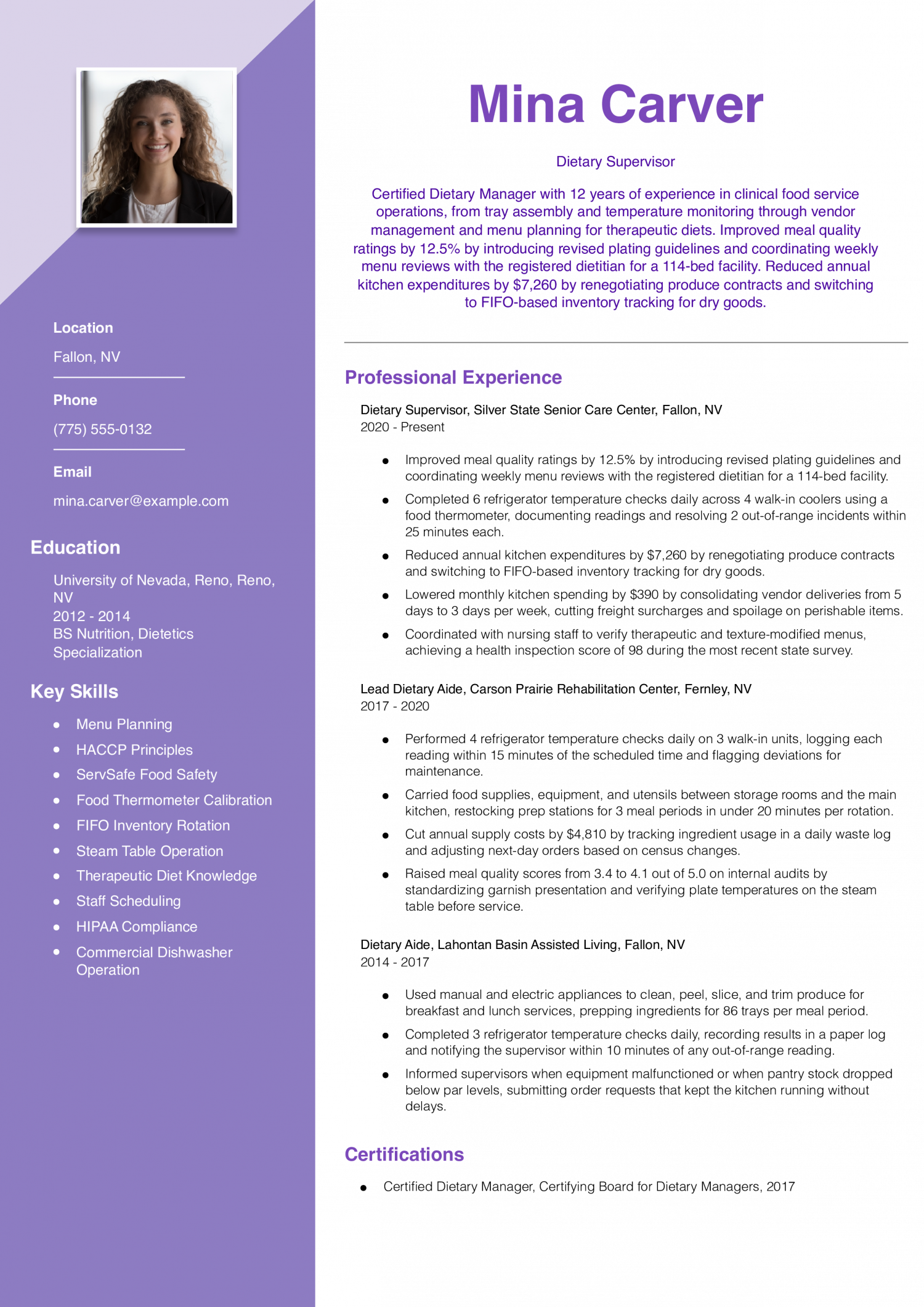
Lean on this resume if you are a senior dietary supervisor with years of progressive food service leadership in long-term care settings. Show readers how each cost reduction links to a named process change and a specific dollar figure.
Cutting delivery days from five to three removed the extra freight charges and reduced spoilage. A food service director sees a scheduling decision that saved real money. When you describe vendor changes, say what the old schedule was, what you changed it to, and which costs went down.
Experienced in preparing and portioning meals for therapeutic diets across skilled nursing and rehabilitation settings over 6 years of food service work. Maintained supply availability at 97.6% for a 72-bed facility by tracking par levels daily and submitting restock orders before shortages occurred. Skilled in FIFO inventory rotation, steam table operation, commercial dishwasher operation, and HACCP principles.
State how many meals you prepared or plated each shift. Food service directors and dietary managers use daily meal counts to gauge your speed.
A line like “prepared 120 texture-modified meals per shift” tells them your pace right away. Follow that number with the care setting you know best. Long-term care kitchens differ from hospital tray lines, so name the one you worked in most.
Then add one detail about diet types you handled, such as renal, pureed, or diabetic trays. This gives your reader three facts in three short lines. A vague opener about being a hard worker does not do that work for you.
Lead with data instead.
Most strong dietary aide resumes use volume language. State how many residents or patients you served per meal period. Note the number of special diets you tracked at once.
You can also name the ratio of aides to residents on your shift. Portion accuracy matters too, so mention tray accuracy rates if you tracked them.
Food service directors and dietary managers scan for signs that you handled real volume under time pressure. Even a phrase like “assembled 90 trays in 45 minutes” adds weight. Pair each task with a count or a timeframe.
That pattern turns a flat duty into a clear picture of your output.
Break your bullet points into clear categories. Meal prep and plating covers portioning, garnishing, and tray assembly. Diet compliance covers reading diet cards and matching trays to physician orders.
Sanitation covers dishwashing, surface cleaning, and temperature logging. Resident interaction covers delivering trays, collecting feedback, and reporting intake. Stock and inventory covers rotating supplies and labeling storage.
Organizing bullets this way helps food service directors and dietary managers find what they need fast. It also shows you understand each part of the kitchen workflow. Pick the categories that match the job posting most closely.
Move those groups higher on the page.
List your ServSafe Food Handler card near the top of page one. A credentials block right below your summary is a strong spot. Food service directors and dietary managers often check for food safety training before reading further.
If you hold the CDM, CFPP from the Certifying Board for Dietary Managers, place it on the same line. Include your state if you carry a state food handler permit. For software, name the diet management or point-of-sale systems you have used.
Even listing a kitchen display system or electronic menu platform helps. Keep each entry short with the credential name and issuing body. Do not bury these details at the bottom of page two.
Your education block belongs at the end of your resume. List your high school diploma or GED first. If you took any nutrition or food science courses, name them on a separate line.
Community college coursework in dietetics or hospitality stands out here. Add any on-the-job training programs your employer ran. Food service directors and dietary managers value hands-on training as much as classroom hours.
Volunteer work at food banks or senior centers also fits this section. Label it “Additional Training” or “Community Experience” to keep it clear. End with your CPR or first aid card if you hold one.
That final detail signals you are ready for a patient-facing role.
The Dietary Aide resumes that get callbacks share a specific skill mix. Food service directors and dietary managers scan for these patterns first, not generic compassion language.
Hard skills like food safety and portion control show you can do the daily work. Soft skills like teamwork tell a fuller story. Food service directors and dietary managers weigh both, but they check hard skills first.
A missing hard skill can filter your resume out before anyone reads it. Pull terms that match the posting into your bullet points.
Treat soft skills as proof that backs up your results.
| Soft Skills | AI-estimated % |
|---|---|
| Attention to detail | 66% |
| Resident compassion | 58% |
| Team collaboration | 47% |
| Time management | 37% |
| Adaptability under pressure | 33% |
And here are the top hard skills showing up most often.
| Hard Skills | AI-estimated % |
|---|---|
| Meal tray assembly | 77% |
| Dietary restriction compliance | 67% |
| Food portioning control | 41% |
| Sanitation and hygiene | 39% |
| Inventory restocking | 29% |
Skill names and rankings come from an AI model grounded in U.S. Department of Labor occupation data for dietary aides, not from a count of dietary aides’ resumes built on ResumeTemplates.com.
Start with your compliance training.
Dietary aides handle patient diet orders every shift. Those orders contain protected health information under HIPAA. Dietary managers look for awareness of privacy rules.
Never place patient data on your resume
Add a line about HIPAA training in your skills section. Do not list any patient names or medical details on your resume. Show that you follow proper handling of diet cards and tray tickets.
Food service directors expect proof of safe food handling. The ServSafe Food Handler card is the most common credential. It is issued by the National Restaurant Association.
Most healthcare facilities run background checks before hiring. Long-term care homes and hospitals screen every food service hire. State rules set which offenses may block you from work.
Your resume does not need to mention the check itself. Focus on showing reliable work history and strong references. Gaps in employment should be explained with brief, honest notes.
Healthcare kitchens run on early, split, and weekend shifts. Food service directors fill openings across all meal periods. Stating your availability gives you a clear edge in screening.
State your available shifts clearly
List the shifts you can work near the top of your resume. Be specific about weekends, holidays, and overtime willingness. Flexibility with rotating schedules is common in this field.
Food service directors and dietary managers read this list as a map of where your work is heading. The items below tell them which food safety or management track you have put time into. These go beyond the basic training most sites ask for at hire.
They signal that you want to grow in the field. They also show you can handle tasks with less oversight. List each credential with the body that issued it and the year you earned it.
Put the most recent one first.
The top-paying states for dietary aides tend to cluster in smaller, lower-supply markets. They are not the large metro areas most job seekers expect. These BLS figures cover all food preparation workers, a broader group that includes dietary aides.
The spread between the 10th percentile and the 90th is wide, with top earners outpacing the median by roughly 28 percent. The 10th percentile sits about 27 percent below that midpoint. That gap signals real room to grow your pay over time.
If you are open to working in less obvious regions, list that flexibility on your resume and note any prior work in similar care or food service settings.
| # | State | Median Annual |
|---|---|---|
| 1 | Washington | $40,910 |
| 2 | District of Columbia | $39,600 |
| 3 | California | $39,350 |
| 4 | Colorado | $38,960 |
| 5 | Massachusetts | $38,900 |
| 6 | Hawaii | $38,160 |
| 7 | Oregon | $37,450 |
| 8 | North Dakota | $36,800 |
| 9 | New Hampshire | $36,780 |
| 10 | Arizona | $36,750 |
| # | State | Workers | Median |
|---|---|---|---|
| 1 | California | 112,750 | $39,350 |
| 2 | Texas | 81,280 | $30,650 |
| 3 | Florida | 73,100 | $35,920 |
| 4 | New York | 62,380 | $35,610 |
| 5 | Illinois | 34,820 | $34,850 |
Resume Templates offers HR approved resume templates to help you create a professional resume in minutes. Choose from several template options and even pre-populate a resume from your profile.
Focus on duties that show patient contact and food safety practice. Strong picks include portioning meals to match therapeutic diet cards and recording patient intake. Sanitizing prep areas after each meal service also belongs on the list.
Choose duties that match the posting and add a number where you can.
Lead with any food service, caregiving, or volunteer work that involved meal prep or serving. Describe each task in the same words the posting uses, such as tray assembly or portion control.
A ServSafe Food Handler credential from the National Restaurant Association also fills space and shows readiness.
One page is enough for most dietary aide candidates. Food service directors and dietary managers review dozens of resumes at a time, so a single focused page keeps your strongest details visible.
Use a second page only if you have more than eight years of relevant experience.
Yes, a two-line summary at the top gives food service directors a fast read of your setting and strengths. Mention the type of facility you worked in, such as a long-term care home or hospital kitchen.
State the number of residents or patients you served per shift.
Name skills that food service directors and dietary managers check for in daily work. Tray accuracy, therapeutic diet knowledge, and allergen awareness are common picks.
Soft skills like patience with residents and clear communication with nursing staff also belong in your skills section.
Read the posting for the exact terms the facility uses, then mirror them in your bullets. If the posting says modified texture diets, use that phrase instead of a general term like special diets.
Matching the language helps your resume pass keyword filters before a person reads it.
Yes, restaurant and cafeteria experience transfers well when you reframe it for a healthcare kitchen. Highlight tasks like portioning, sanitation, and following standardized recipes under time pressure.
Note any work with allergy protocols or customer dietary requests to bridge the gap.
An ATS-friendly template puts your ServSafe card and diet experience under clear headings. A basic template also works well.
Dietary Aide Resume
4.4/5 stars with 136 reviews

Executive Resume Writer and Career Coach
Andrew Stoner is an executive career coach and resume writer with 17 years of experience as a hiring manager and operations leader at two Fortune 500 Financial Services companies, and as the career services director at two major university business schools.
© 2026 Resumetemplates.com All rights reserved.