Retail Manager Resume Examples and Templates for 2026



Same-store sales growth by location, shrink and labor variance held under plan, and a documented store-opening or turnaround record are what separate the District Manager resumes that advance with regional VPs from the rest.
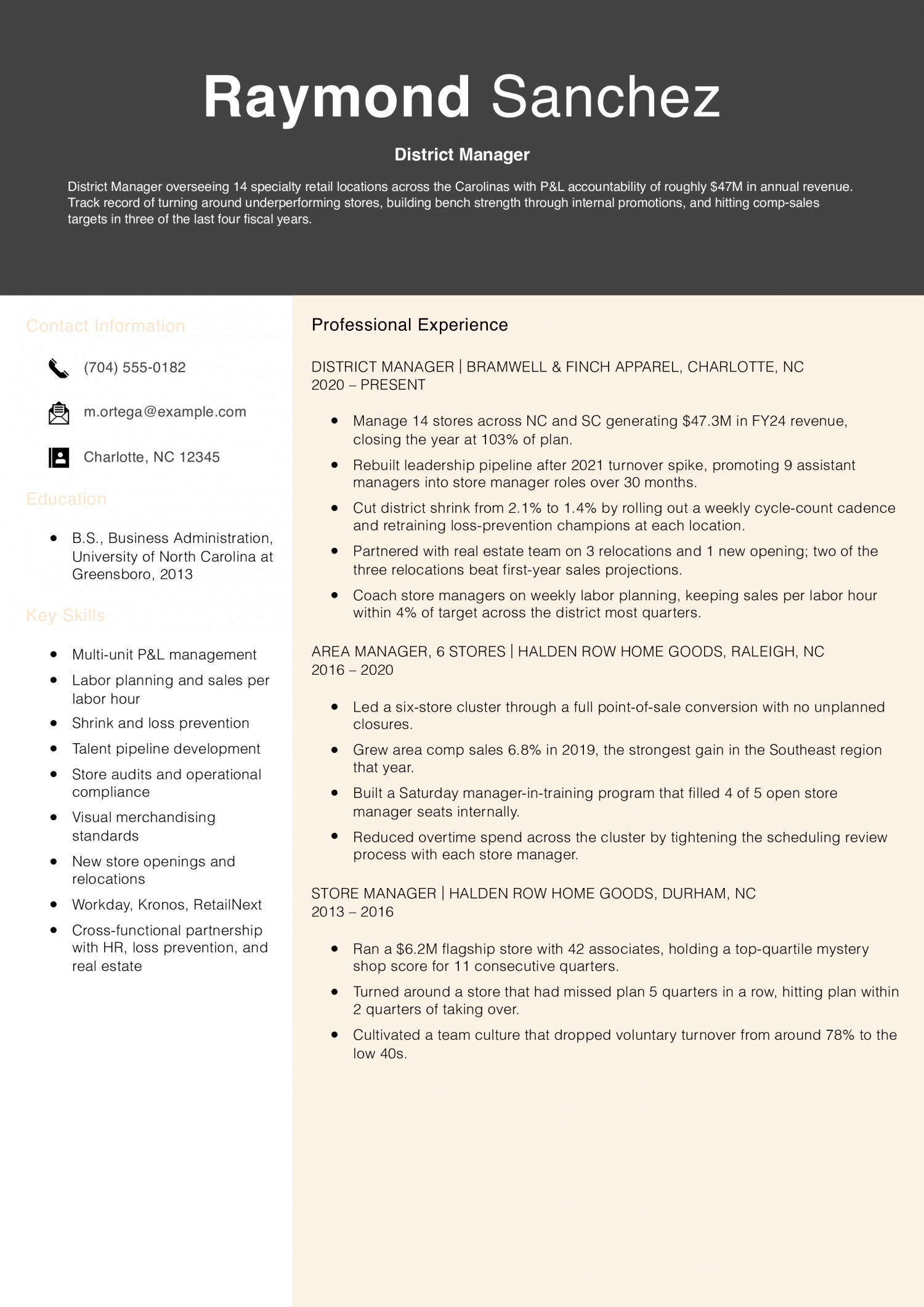
You run a single store and want the district seat, so your resume has to prove you moved sales, payroll and shrink numbers on your own floor. Show promotions of staff you trained and the volume tier of the store you led.
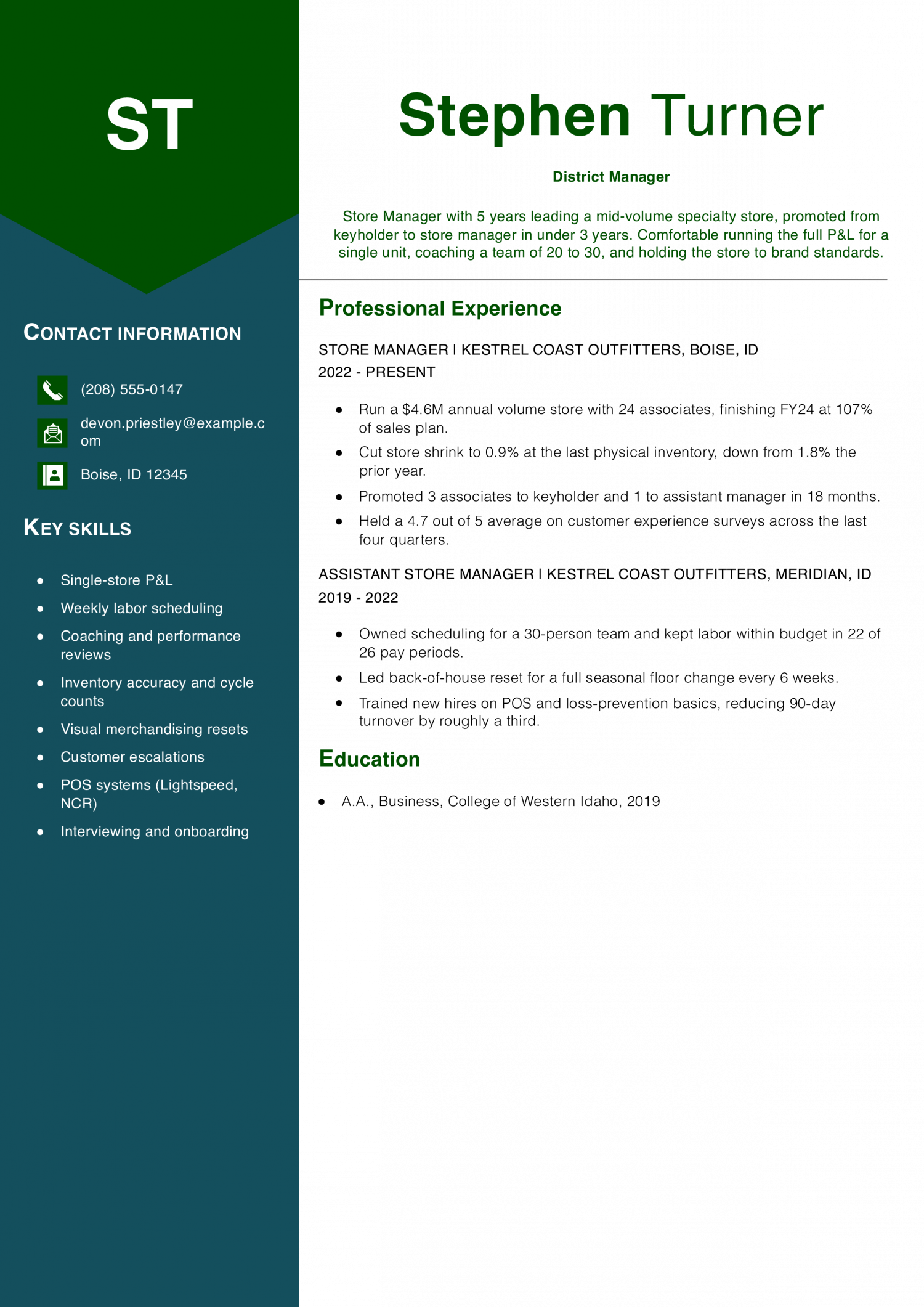
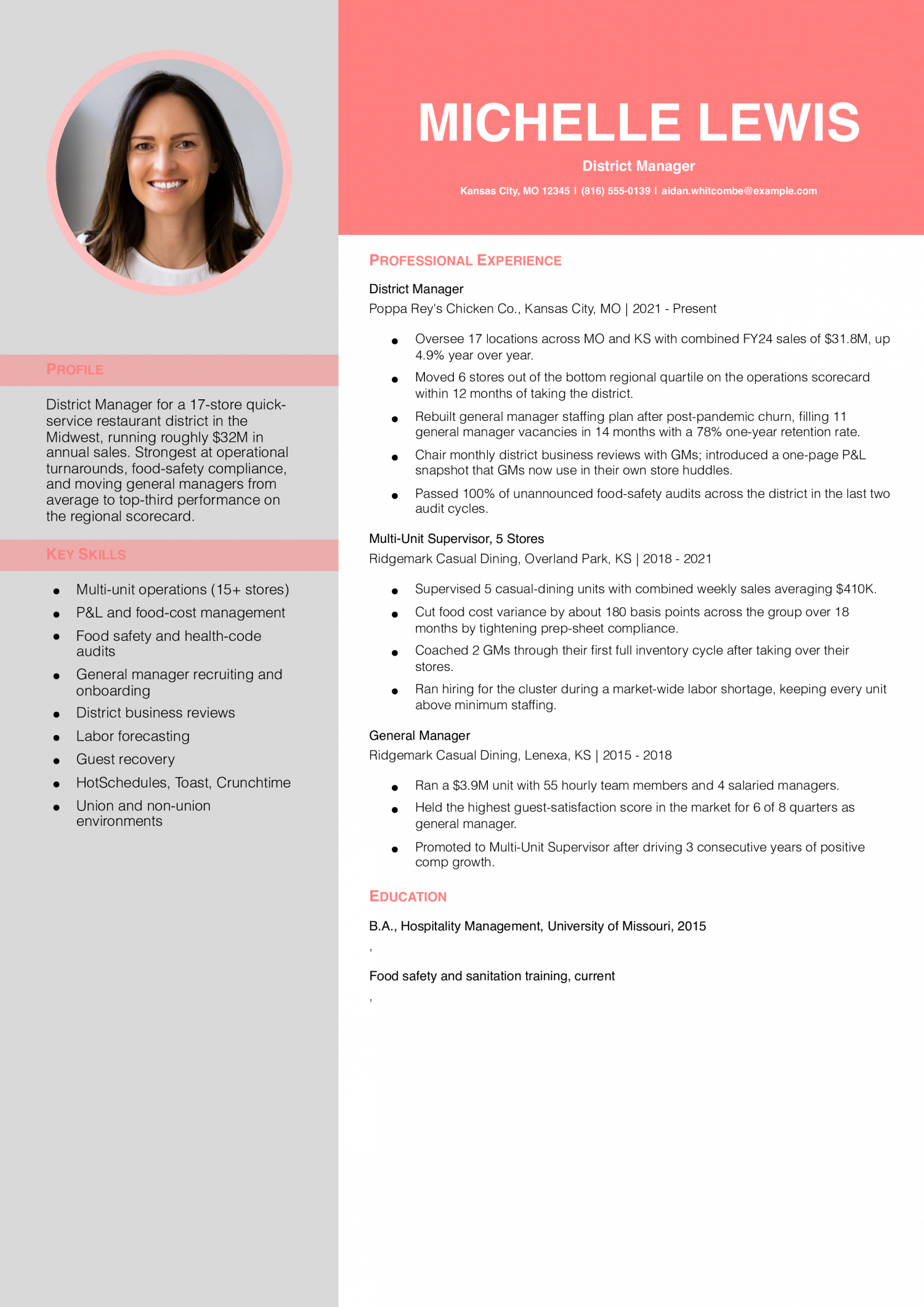
You already run a district and are moving to a bigger book or a stronger brand, so the resume has to prove year over year comp growth across the whole portfolio. Show store count, total revenue, and how you rank against peers.
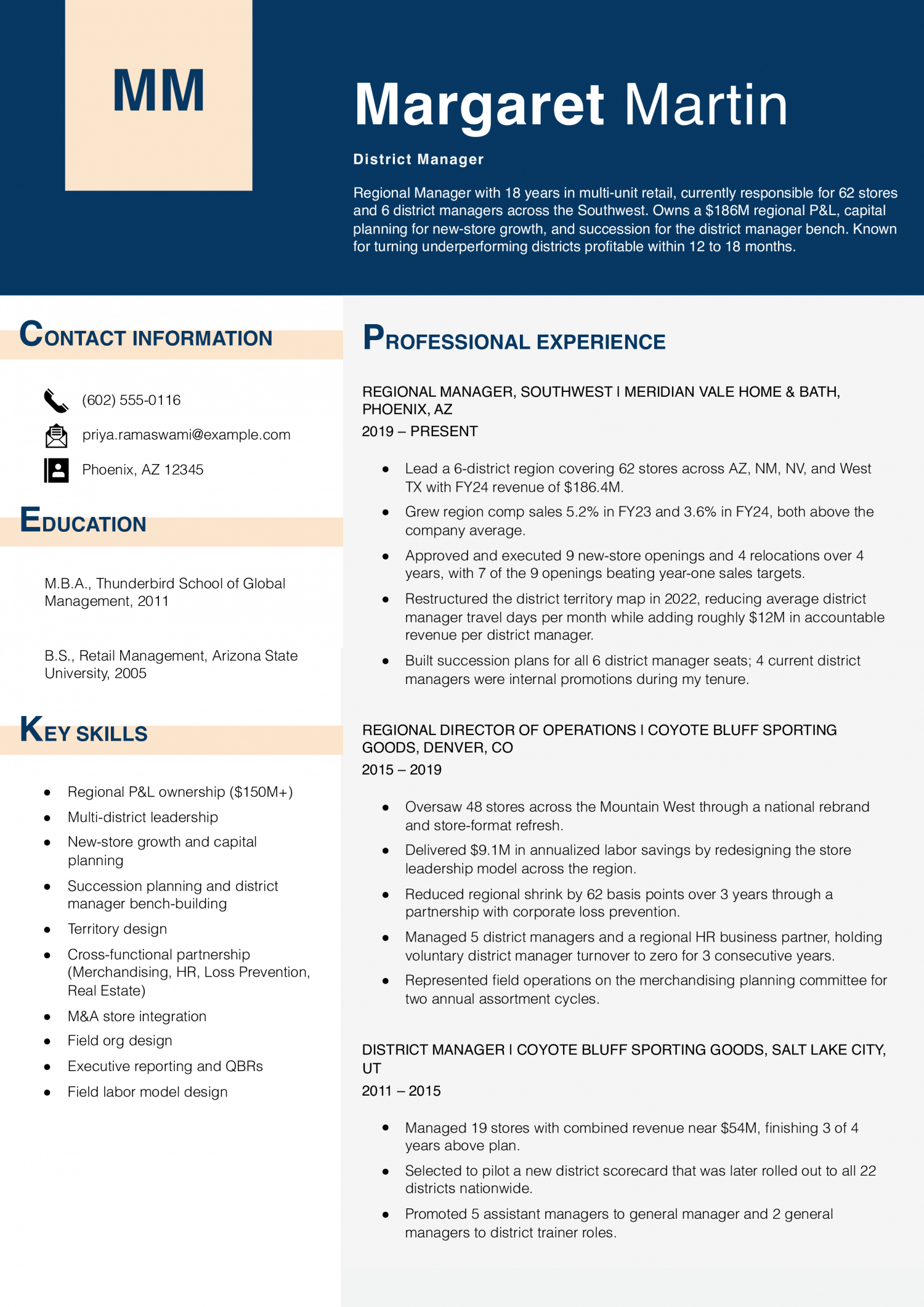
You are stepping up to regional manager and reporting to VPs of retail, so the resume has to prove you built district manager bench strength and hit plan across markets. Show P and L scope and turnaround wins.
Rowan Castellanos
Minneapolis, MN | (612) 555-0173 | [email protected] | linkedin.com/in/rowancastellanos
District Manager with 11 years of multi-unit retail and specialty grocery experience across the Upper Midwest. Currently accountable for 21 stores and roughly $63M in annual revenue, with a focus on operational consistency, store manager development, and shrink control. Promoted twice in the last five years after turning around districts that had missed plan for multiple consecutive quarters.
District Manager, Twin Cities and Western WI
Larkspur Market Co. | Minneapolis, MN | 2021-Present
Area Manager, 8 Stores
Larkspur Market Co. | Saint Paul, MN | 2018-2021
General Manager
Larkspur Market Co. | Bloomington, MN | 2015-2018
Assistant Store Manager
Northfield Grove Grocers | Eagan, MN | 2013-2015
Department Manager, Produce
Northfield Grove Grocers | Burnsville, MN | 2011-2013
Your profile should state your years managing multi-unit operations and the store count you oversee. Name the format you run: big-box retail, specialty apparel, quick-service restaurants, convenience, or grocery. Give the geographic footprint, whether that is a metro cluster or a multi-state region.
Add the annual revenue band your district carries, since this sets your seniority against similar postings. Regional managers and VPs of retail operations read the first four lines to place you on their org chart. A profile that says 22 stores across three states, 85 million in annual sales, tells them more than a paragraph of adjectives.
Put this at the very top of page one, above your experience block.
District manager bullets without a number tend to read as duties. Recruiters scan first for comp sales growth, labor as a percent of sales, and shrink numbers. Pick two or three metrics per role and hold them steady across bullets.
Strong lines pair a percent with a base, such as grew comp sales 6.2 percent on a 78 million base. Turnover, mystery shop scores, and audit pass rates also travel well across retail and restaurant brands. If your company treats sales figures as confidential, use percent change or index to plan.
Frame the win, then the mechanism: cut hourly turnover 18 points by rebuilding the assistant manager bench. Bullets that only list responsibilities move you down the stack.
Sort your bullets so Regional managers and VPs of retail operations can scan by function. Four categories cover most district roles. Sales and P&L: comp growth, gross margin, controllable expense, and four-wall profit.
People: hiring general managers, succession planning, and reducing turnover across the district. Operations and compliance: audit scores, food safety, loss prevention, and safety findings. Customer and brand: mystery shop scores, guest satisfaction, and new store openings or remodels.
Use three to five bullets per role and lead each category with your strongest number. Avoid stacking six similar sales bullets in a row. A reader who sees only sales wins will assume you cannot run the people or compliance side.
Regional managers and VPs of retail operations want to see your tool stack before they reach page two. Add a short credentials and systems block under your profile. List the POS and workforce systems you have run, such as NCR, Toast, Kronos, or Workday.
Name the reporting tools you use for district analysis, like Tableau or Power BI. Include ServSafe, food handler, or loss prevention certifications if your segment requires them. State the driver status and travel percent your district demands, since coverage models vary by employer.
Put state-specific liquor or tobacco permits here if they gate your candidacy. Keep this block to four or five lines so it does not crowd your experience section below.
At the district level, older store-level roles start to hurt more than they help. Cut assistant manager and shift lead jobs older than 15 years to a one-line entry. Drop the objective statement, references line, and any high school listing.
Remove generic phrases like proven leader or track record of success, since they take space from numbers. Trim your first multi-unit role to three bullets once you have two district roles above it. Keep education to the degree, school, and year if recent, or degree and school if older.
Two pages is the target for most district manager resumes. A third page is fine only if you carry P&L over 150 million or have led a turnaround worth detailing.
Multi-unit retail hiring is tight in 2026. Regional managers and VPs of retail operations are running leaner districts. Clearing the first screen takes more now than it did two years ago.
Check these two lists against the district manager posting you’re targeting. Hard skills like P&L management get weighed first. They map to the ledger you will own on day one.
Soft skills like coaching are read as proof behind your store-visit bullets. They also back the turnover numbers you report at the district level. Pull three or four items from each table that match the posting language.
Back each one with a bullet showing store count, sales lift, or shrink cut. Use the exact phrasing from the ad so the scanner finds a match. Repeat the top two skills once in your summary and once in a bullet.
| Soft Skills | AI-estimated % |
|---|---|
| Executive presence | 72% |
| Cross-location team building | 70% |
| Conflict de-escalation | 47% |
| Stakeholder accountability | 35% |
| Adaptive leadership | 29% |
And here are the top hard skills showing up most often.
| Hard Skills | AI-estimated % |
|---|---|
| Multi-unit operations oversight | 66% |
| P&L management | 50% |
| Staff performance evaluation | 43% |
| Budget forecasting | 38% |
| Compliance auditing | 25% |
Skill names and rankings come from an AI model grounded in U.S. Department of Labor occupation data for district managers, not from a count of district managers’ resumes built on ResumeTemplates.com.
The items below are what separate a district manager resume from one that gets put back in the pile.
Regional managers and VPs of retail operations scan for proof of range. They want to see multi-unit work, not one-store polish. Group your terms by the work each cluster covers. The first row below covers P&L and store-level financial control. The second row covers how you build and coach store teams. The third row covers day-to-day retail operations across sites. The fourth row covers loss prevention and audit readiness. The fifth row covers the customer and brand side of the job. Pull the terms from your own postings and your own results. Match the trade spelling, and keep credentials in their proper capitals. Drop any term you cannot back up in an interview.
| Niche | Keywords ATS scans for |
|---|---|
| Multi-Unit P&L | P&L ownership, labor cost control, sales forecasting |
| Team Development | store manager coaching, succession planning, performance reviews |
| Retail Operations | district rollouts, visual merchandising, inventory shrink |
| Loss Prevention | shrink reduction, internal audits, cash controls |
| Customer Experience | customer satisfaction, brand standards, mystery shop scores |
AI use on a District Manager resume can go three ways. You can lead with a hype line like ‘AI-driven multi-unit leader,’ which regional managers screen out on sight. You can leave it off and answer the question live in the interview loop. Or you can describe the workflow as it actually runs across your stores. The third is what regional managers and VPs of retail operations can validate. Multi-unit work leans on labor models, sales forecasts, and shrink reports, and AI now sits inside most of those systems. Name the tool, the store-level decision it informs, and the check you run before you act.
Forecast tools now draft store schedules, and you adjust for local events, callouts, and training needs before posting.
District rollups pull from AI demand models, so you own the assumptions behind each store's weekly target.
Vision and transaction tools flag exceptions, and you decide which stores need a visit or a coaching call.
You use AI summaries of KPIs, comments, and audits to shape the agenda before walking a location.
The Bureau of Labor Statistics does not publish a wage code for District Manager specifically. The numbers below are a proxy: the closest published match is General and Operations Managers (SOC 11-1021), so use them as an estimate for this role, not an exact figure.
For District Managers, the 10th-percentile floor sits well below the median, and the top-decile ceiling runs far above it. That spread is wide. The distance from floor to ceiling covers store count, revenue owned, and the industry footprint you carry.
National employment for the role is large, so postings exist across retail, food service, and specialty chains at very different pay bands. State pay varies too, and the top-paying states rarely match the states with the most jobs. Read the cards and tables below as two questions at once: what a District Manager earns at your tier, and where those jobs concentrate.
Position your resume to the tier you are targeting, not the title alone.
| # | State | Median Annual |
|---|---|---|
| 1 | New Jersey | $173,690 |
| 2 | District of Columbia | $168,000 |
| 3 | South Dakota | $137,400 |
| 4 | Connecticut | $137,220 |
| 5 | Delaware | $137,220 |
| 6 | Washington | $133,750 |
| 7 | Colorado | $131,840 |
| 8 | New York | $130,860 |
| 9 | Massachusetts | $127,220 |
| 10 | New Hampshire | $124,680 |
| # | State | Workers | Median |
|---|---|---|---|
| 1 | Texas | 431,310 | $103,230 |
| 2 | California | 300,840 | $124,390 |
| 3 | Florida | 236,290 | $101,580 |
| 4 | New York | 206,740 | $130,860 |
| 5 | Pennsylvania | 172,010 | $103,130 |
Resume Templates offers HR approved resume templates to help you create a professional resume in minutes. Choose from several template options and even pre-populate a resume from your profile.
It should open with a profile that names your district size, store count, and revenue.
Follow with a results section that quantifies sales lift, labor cost, and shrink reduction. Then group your work history into operating categories so regional managers can scan your scope fast.
Two pages is standard once you have run more than one district or led a rollout.
Keep page one focused on your current scope, top results, and systems you own. Move older store-level roles and training projects to page two in shorter bullets.
Put the totals in your profile line: store count, headcount, revenue, and states or metro areas covered.
Then in each role, name two or three flagship or turnaround locations by city. That gives regional managers the shape of the book without a two-column store list.
Comparable sales growth against district and company baselines is the first number they scan for.
Shrink as a percent of sales, labor as a percent of sales, and turnover come next. Include the baseline you inherited so the delta reads as your work, not the market.
Lead with the multi-unit work you already do: covering other stores, training new managers, or piloting a program chain-wide.
Reframe those lines as district-level outcomes, with the store count and revenue you touched. Then name the systems you used, such as Workday, Kronos, or a loss prevention platform.
List the parent company and the banners that a regional manager would recognize by name.
Skip banners that have since closed or rebranded unless the scope was large. Group short franchise stints under the franchisee name so the timeline stays clean.
Name the closure or consolidation in one line so the drop in store count reads as a company decision.
Then show what you protected: sales retention, staff redeployed, and shrink held flat during the wind-down. Regional managers know closures happen and read honest framing as a strength.
For a district manager, an ATS-friendly template is the safest pick, because it puts your certifications and experience where a hiring manager scans first. A basic template is a solid alternative. Whichever you choose, keep the formatting clean and easy to parse: clear section headings, a standard font, and no graphics a parser can choke on.
Executive Resume Writer and Career Coach
Andrew Stoner is an executive career coach and resume writer with 17 years of experience as a hiring manager and operations leader at two Fortune 500 Financial Services companies, and as the career services director at two major university business schools.
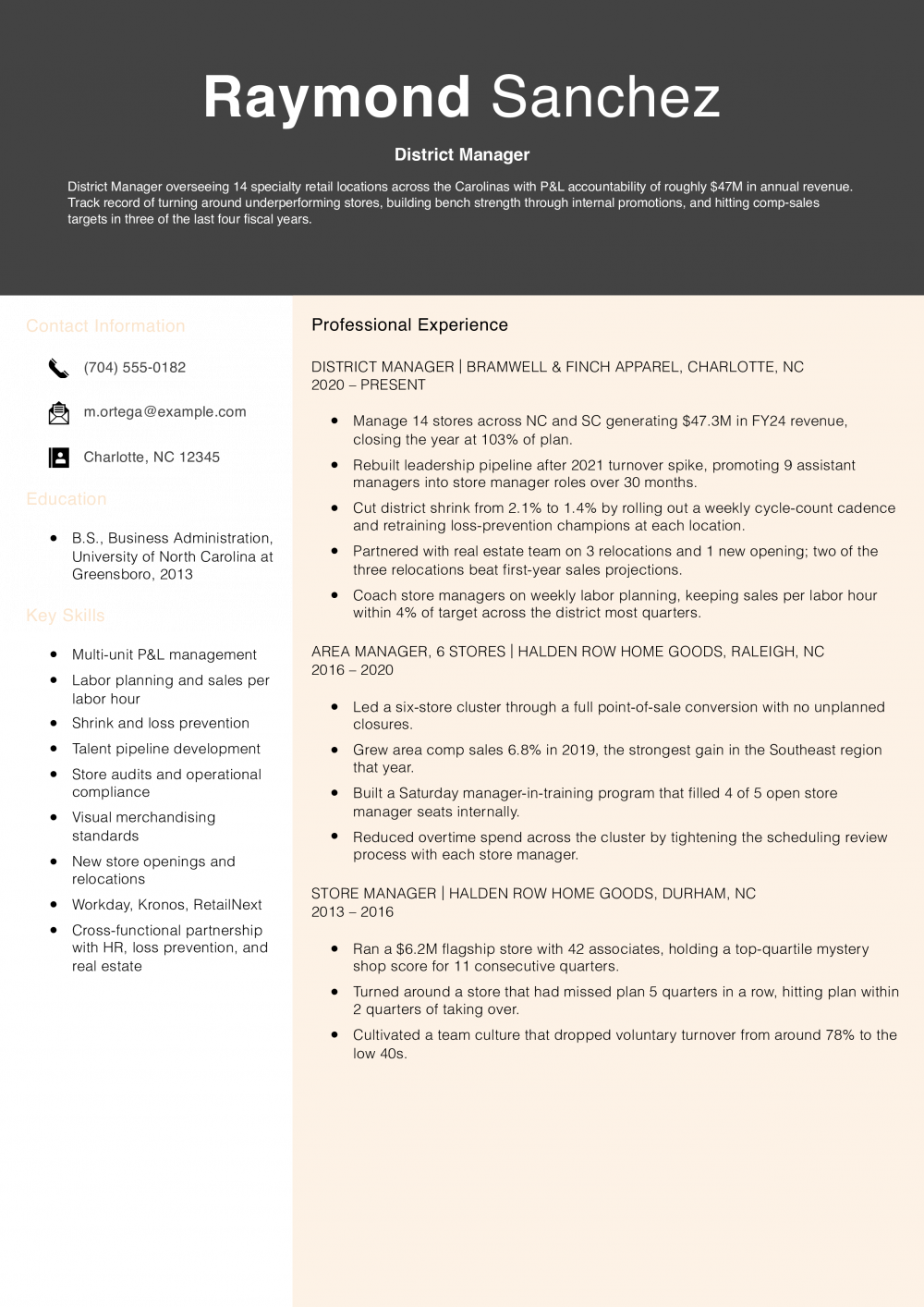
Customize this template in our builder in under 10 minutes.