Maintenance Resume Examples
Your profile should state your years on the tools, the building type or plant you worked in, and the systems you service weekly. Name the trades you cover: electrical up to a stated voltage, plumbing,…
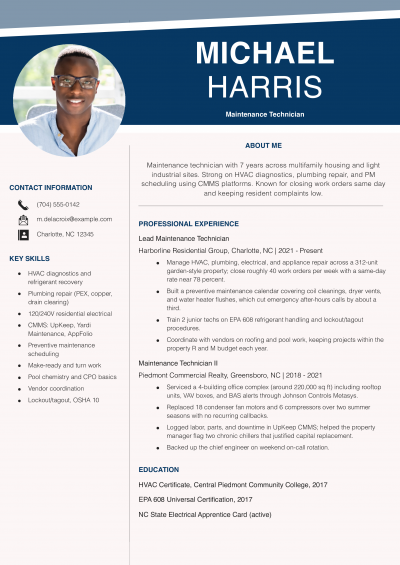
Every resume example is written and reviewed by our team of Certified Professional Resume Writers to ensure top-quality content and formatting.
Most facilities manager roles are filled based on proof you cut costs and kept buildings safe. Directors of operations and property owners want to see hard numbers. Show them your track record with operating budgets, preventive maintenance programs, and OSHA compliance.
Your resume should name the CMMS platforms you used, such as Corrigo or ServiceChannel. Tie each role to measurable gains like reduced work order backlogs or lower energy spend per square foot. The examples below show how to frame that proof for your next facilities manager resume. To compare layouts before you start, browse our resume templates.
Documented cost savings on building operations, an IFMA credential like the CFM or FMP, and preventive maintenance metrics tied to uptime are what set apart the facilities manager resumes that earn a closer look from directors of operations.
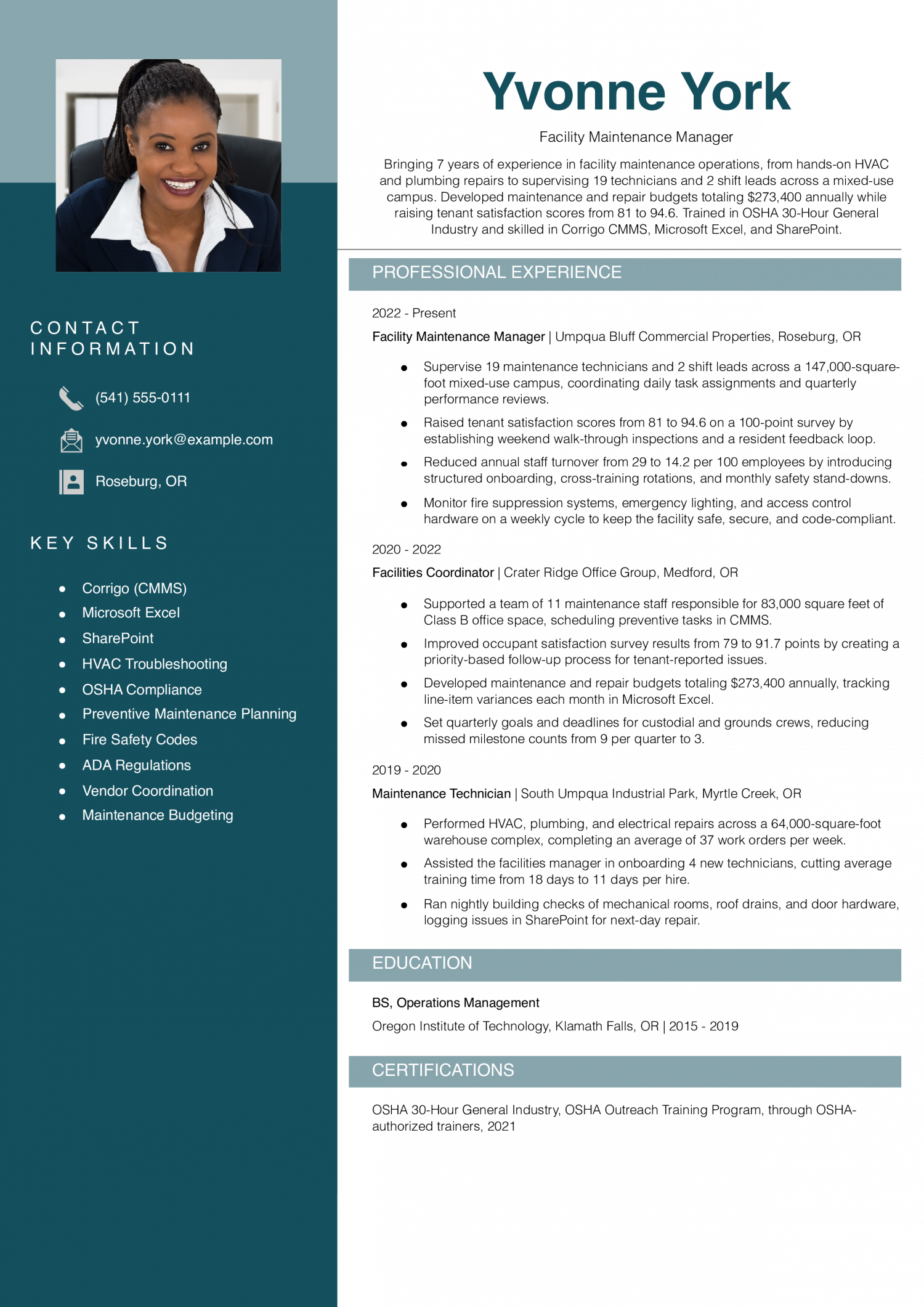
Pick this resume if you are a mid-level facility maintenance manager ready to show growth from technician work into campus-wide supervisory responsibility. Lead with your tenant satisfaction gains stated as before-and-after survey scores so each improvement reads as a concrete number.
Each compliance system is named beside its inspection schedule. A property owner reading fire suppression, emergency lighting, and access control on a weekly cycle can picture exactly how the building stays covered. List your own inspected systems with the schedule you follow for each.
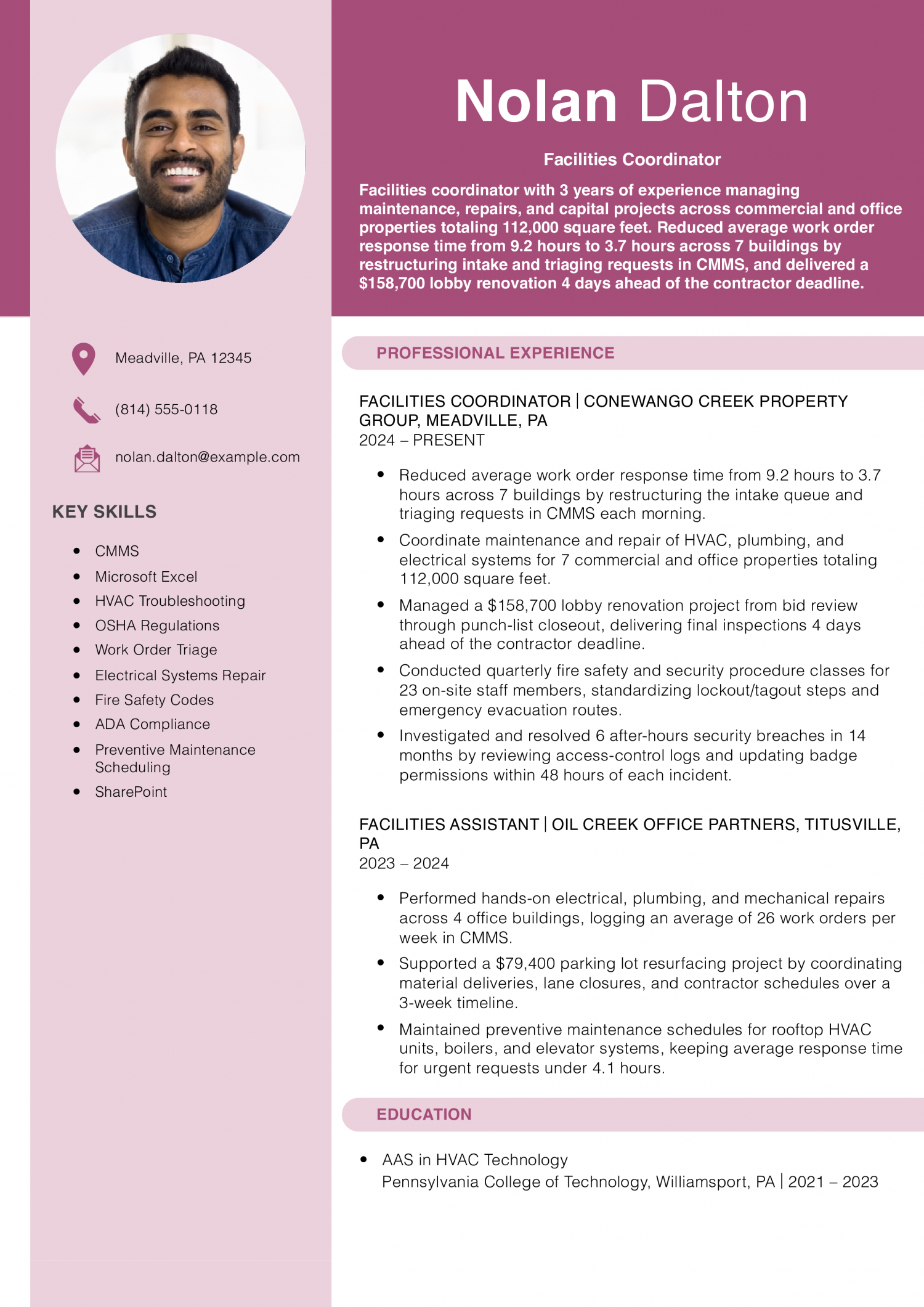
Start with this resume if you are an entry-level facilities coordinator moving from an assistant role into full building oversight. Limit your response-time metrics to a clear before-and-after pair so each improvement reads in one glance.
Finishing a renovation ahead of the contractor deadline tells a hiring manager something a completion date alone does not. The days gained, paired with the project cost, let the reader weigh both timing and scale. When you finish early, state the gap and the budget.
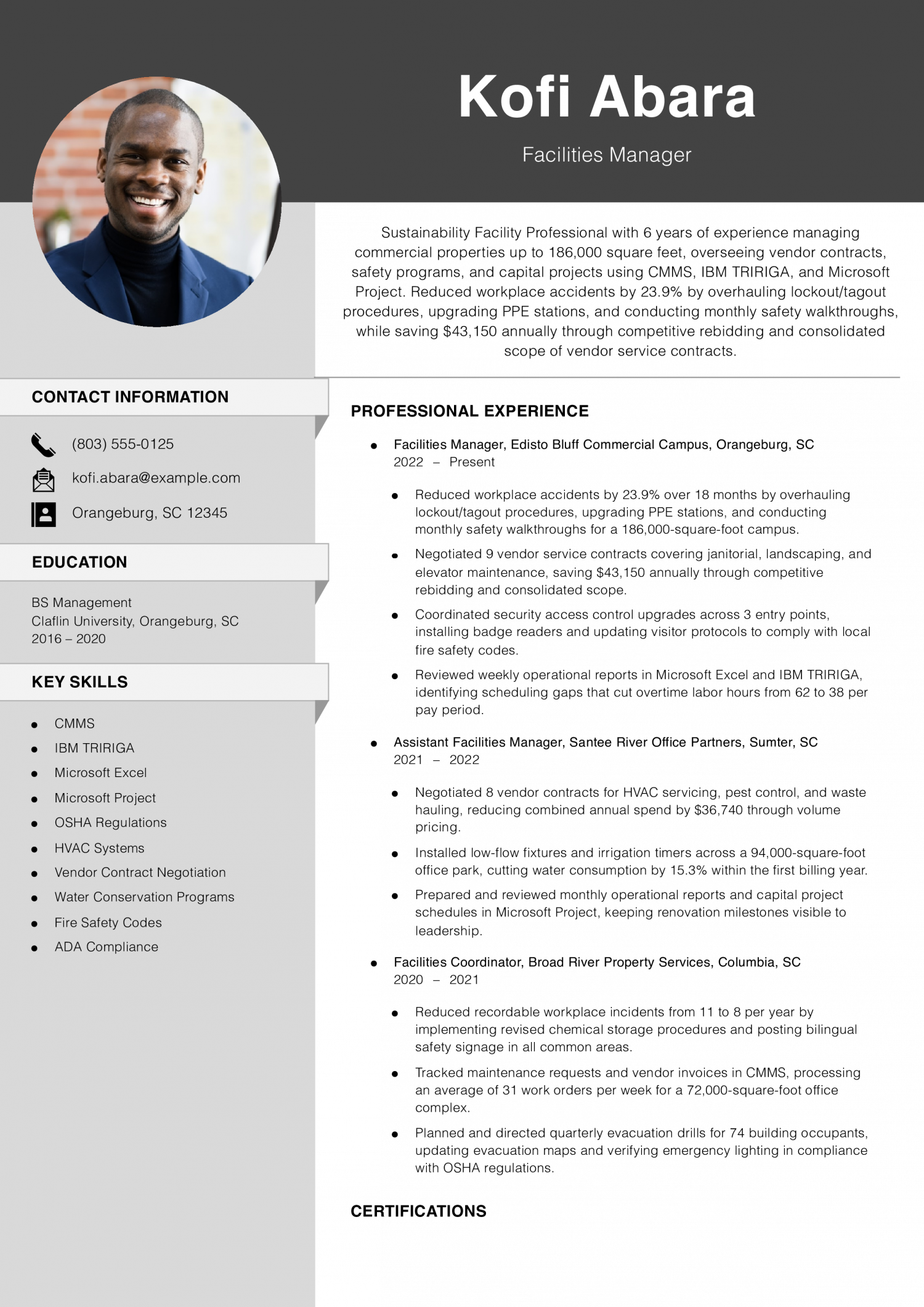
Try this resume if you are a mid-level facilities manager with about six years of experience spanning coordination through full campus oversight. Offer your reader the same pattern it uses: tying each safety or cost win to the specific tactic that produced it.
Three separate safety changes are listed together: updated lockout/tagout procedures, new PPE stations, and monthly walkthroughs across a large campus. A safety director can see which steps produced the improvement. Name each safety change and the improvement it led to.
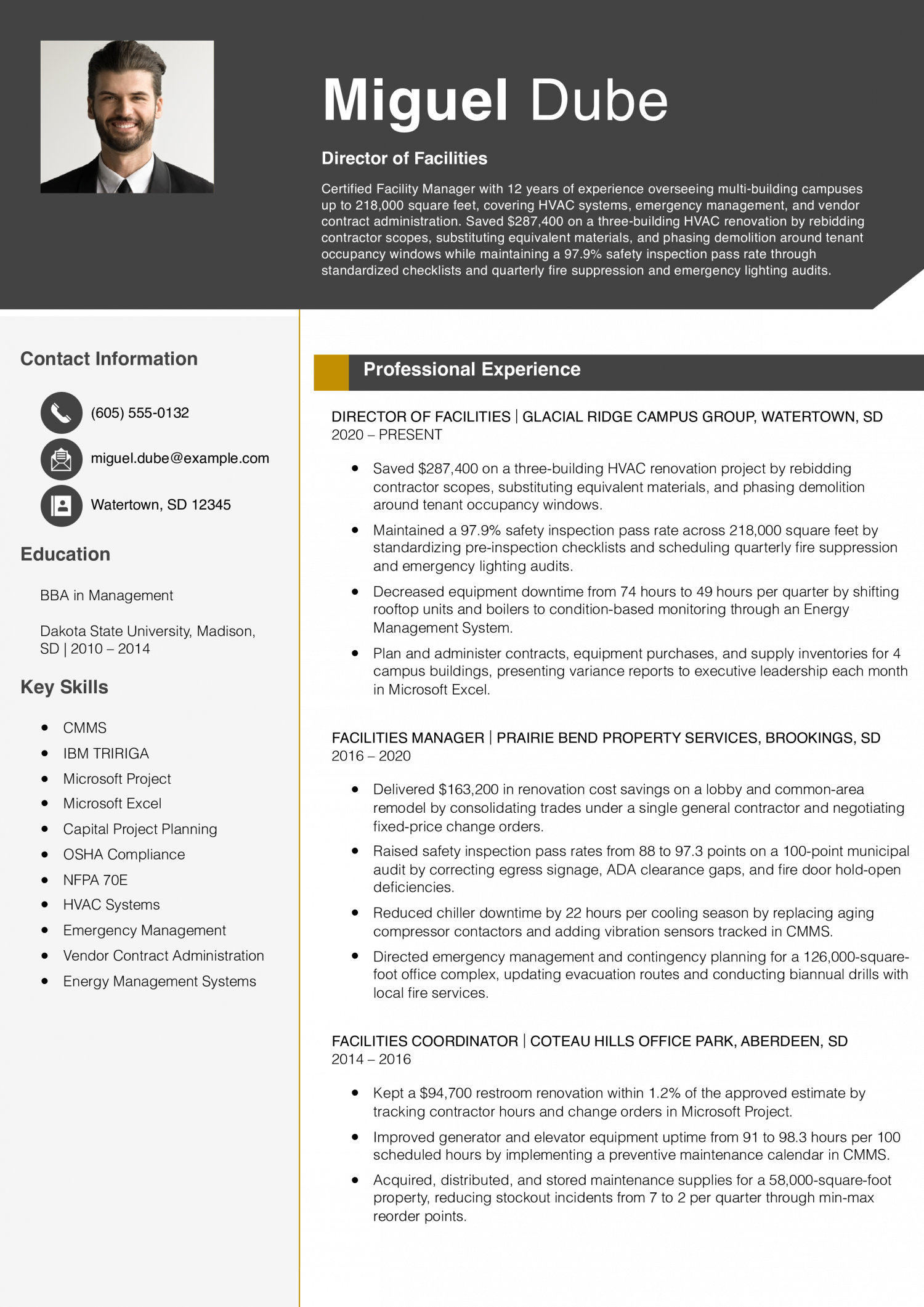
Turn to this resume if you are a senior-level director of facilities managing multiple campus buildings and multimillion-dollar capital budgets. Place a condition-based monitoring result beside every downtime reduction so your reader connects the method to the metric.
Cost savings read better when the tactics behind them are visible. Rebidding scopes, swapping materials, and phasing work around tenants show a vice president exactly where the money was saved. Break your own savings claims into the decisions that produced them.
Facility Management Professional with 7 years of experience managing preventive maintenance programs, HVAC systems, and building operations across campuses up to 139,000 square feet. Managed an annual maintenance budget of $1.37M while reallocating funds to cover $57,600 in unplanned capital requests. Skilled in CMMS, AutoCAD, Microsoft Excel, and emergency response coordination.
Directors of operations and property owners can verify your degree in minutes, but they cannot search for your specific edge. Add one line near your name that sets you apart. This could be a CFM credential from IFMA.
It could be fluency in a CMMS platform like Archibus. A niche focus on data-center cooling or LEED-rated buildings works too. Pick the trait that most of your peers lack.
Place it in a headline or branding line right below your contact details. This single line tells a reader why your resume is worth finishing. Keep it to ten words or fewer so it reads at a glance.
Everything else on the page supports this opener.
Strong facilities manager resumes lead with numbers. A line that skips the number tends to read as filler, not proof. Start each bullet with a result, then explain the action.
Square footage managed is a clear first metric. Annual operating budget is a strong second one. Energy cost reductions deserve their own bullet.
You might write that you cut utility spend by 18 percent across a 400,000-square-foot campus. Preventive maintenance completion rates also stand out. Vendor contract savings show financial impact fast.
Most strong resumes carry a number in at least half their bullets. Even rough figures help if exact data is not available. Round to the nearest 5 percent and move on.
Facilities management work spans many areas, so organize your accomplishment bullets by theme. Use three to five groupings that match the posting. Building operations is one natural group.
It covers HVAC, plumbing, electrical, and life-safety systems. Capital project oversight is a second group. It includes renovations, tenant build-outs, and equipment upgrades.
Vendor and contract management is a third. Space planning and moves form a fourth if your role included them. Sustainability efforts like waste diversion or energy audits can stand alone.
Label each group with a bold subheading when your resume document runs past one page. This structure lets a reader skip to the area they care about most.
Put your top professional credential next to your name. A CFM or FMP from IFMA belongs in the header. Listing it there means directors of operations and property owners see it before they scroll.
The SFP from IFMA fits the same spot if sustainability is core to the role. Create a separate credentials block on page one for safety training. OSHA 30-Hour General Industry cards go here.
Software tools like CMMS platforms, BAS interfaces, and work-order systems belong in a skills section nearby. Do not bury these items on page two. Many readers spend under ten seconds on a first pass.
Front-loading compliance certifications and tool proficiency keeps your resume in the consideration stack.
A senior facilities manager resume should trim early-career detail. Roles from more than 15 years ago can shrink to one line. Drop bullet points that describe tasks you no longer perform.
Entry-level maintenance duties add length without adding value at this stage. Remove objective statements and replace them with a concise two-line professional summary. A references line wastes space too, since reviewers will request them when needed.
Old software versions like outdated CMMS releases can go. Keep only the tools you would use on day one. If your resume exceeds two pages, cut the weakest bullets first.
Every line should point to budget authority, team leadership, or building performance. Anything else is filler at the senior level.
Many employers screen facilities manager resumes with ATS software before a person reads them. Building systems terms clear the first cut.
Soft signals like vendor negotiation decide whether the resume moves forward. Directors of operations and property owners weigh hard skills first. They want proof you can run HVAC and fire safety programs.
Space planning terms also rank high on their list. Soft skills then show how you lead teams and cut costs. Both types need to appear in your bullets.
Scan each table and circle terms that appear in the target job posting. Leave off any term the ad does not name. Add the hard skills to a core skills section near the top.
Show how each soft skill played out with a number from your work history. One clear metric per bullet is the pattern that works best.
| Soft Skills | AI-estimated % |
|---|---|
| Cross-department coordination | 69% |
| Vendor negotiation | 53% |
| Crisis decision-making | 44% |
| Team leadership | 40% |
| Budget accountability | 30% |
And here are the top hard skills showing up most often.
| Hard Skills | AI-estimated % |
|---|---|
| Preventive maintenance scheduling | 79% |
| Vendor contract management | 62% |
| Building code compliance | 45% |
| Space utilization planning | 36% |
| Safety inspection oversight | 25% |
Skill names and rankings come from an AI model grounded in U.S. Department of Labor occupation data for facilities managers, not from a count of facilities managers’ resumes built on ResumeTemplates.com.
The OSHA card and the AI section are covered below.
Safety credentials signal that you can protect staff and property. Directors of operations and property owners look for proof of training. OSHA 30-Hour General Industry is the most common card listed.
There are three approaches to putting AI on a facilities manager resume. You claim to be an AI-driven building optimizer, which directors of operations tend to distrust. You leave AI off and answer questions about it later.
Or you describe how AI fits into your real workflow. The third option is what directors of operations and property owners can validate. Name the tool, the task it handles, and the outcome you measured.
A building management platform that cut energy costs by 12% is a clear, checkable claim. Vague phrases like AI-powered facility solutions tell no one what you did. Stick to tools you have used on actual projects.
What AI is actually changing for this role
Energy use: AI platforms forecast HVAC and lighting loads so you can cut utility costs before overruns appear.
Work orders: Predictive models flag equipment likely to fail, letting you schedule repairs ahead of breakdowns.
Space planning: Occupancy sensors feed AI dashboards that show which floors or rooms are underused each week.
Vendor bids: AI tools compare service contracts across vendors and highlight line items that exceed market rates.
Compliance tracking: Automated checklists scan inspection dates and permit windows so nothing lapses without an alert.
AI tools to name
How to phrase AI on your resume
Do
Skip
Capital projects fill a large part of facilities work. You may run build-outs, HVAC replacements, or tenant improvements. Show the method you used to keep each one on track.
A solid work history keeps you in the mix for facilities manager roles. The credentials below can move your resume from the qualified stack into the shortlist. Directors of operations and property owners scan them to gauge your skill tier and safety knowledge.
They also signal that you stay current with codes and best practices. Name the issuing organization and the date for each one. Include the status of each credential so readers can confirm it is active.
Pairing even one of these with clear budget and maintenance results gives your resume a stronger profile. Most postings do not require all three, so lead with the one that fits the job best.
For Facilities Managers, the pay range from bottom to top is wide. The lowest-paid workers earn well under the middle mark, and the highest-paid group earns far above it. That spread tells you that this field rewards certain traits more than others.
Building type, total square footage, and the credential tier you hold all help sort who lands near the bottom from who lands near the top. Where you live matters too, since pay tends to be higher in areas with a lot of commercial property. Your resume should map to the pay band you want.
Lead with the total space you oversee, the building systems you run, and any IFMA credential you hold.
| # | State | Median Annual |
|---|---|---|
| 1 | Washington | $139,990 |
| 2 | New York | $131,350 |
| 3 | Delaware | $129,260 |
| 4 | New Jersey | $124,110 |
| 5 | Massachusetts | $124,100 |
| 6 | Colorado | $122,510 |
| 7 | Alabama | $121,010 |
| 8 | California | $118,620 |
| 9 | Kansas | $117,270 |
| 10 | Virginia | $116,540 |
| # | State | Workers | Median |
|---|---|---|---|
| 1 | California | 20,550 | $118,620 |
| 2 | Texas | 13,140 | $99,430 |
| 3 | New York | 9,580 | $131,350 |
| 4 | Illinois | 9,180 | $106,980 |
| 5 | Florida | 8,620 | $98,780 |
Resume Templates offers HR approved resume templates to help you create a professional resume in minutes. Choose from several template options and even pre-populate a resume from your profile.
Lead with your certifications, such as the FMP or SFP from IFMA, and years of hands-on experience. Many directors of operations weigh practical results over a degree.
List measurable wins like budget savings or uptime rates in your bullet points.
Yes, include it because square footage tells a property owner the scale you can handle. Add it to each role's opening line alongside the number of buildings or sites.
This context helps directors of operations compare your background to their own portfolio.
List the last 10 to 15 years of relevant work, which usually fills one to two pages. Older roles in maintenance or building trades can appear in a brief Earlier Experience line without dates.
This keeps your focus on recent results while still showing career depth.
Name the exact systems you have used, such as Archibus or Maximo. Directors of operations scan for their own platform first, so match the posting when your experience fits.
Adding a second system shows you can adapt to different toolsets.
State the number of vendor contracts you managed and the total annual spend you oversaw. Follow with a result, such as a percentage you cut from service costs.
This pair of numbers tells property owners you can control operating budgets.
Yes, and your hands-on knowledge is a strong foundation for the role. Reframe trade experience around building systems you maintained and budgets you tracked.
Earning the Facility Management Professional credential from IFMA can bridge the gap on paper.
One page works well if you have fewer than eight years of experience. Two pages are common for senior managers who oversee multiple sites or large capital projects.
Keep every line tied to a measurable outcome so the extra space earns its place.
An ATS-friendly template separates your IFMA credentials and building operations under clear headings. A basic template does well for this too.
Facilities Manager Resume
4.8/5 stars with 225 reviews

Executive Resume Writer and Career Coach
Andrew Stoner is an executive career coach and resume writer with 17 years of experience as a hiring manager and operations leader at two Fortune 500 Financial Services companies, and as the career services director at two major university business schools.
© 2026 Resumetemplates.com All rights reserved.