Tip !

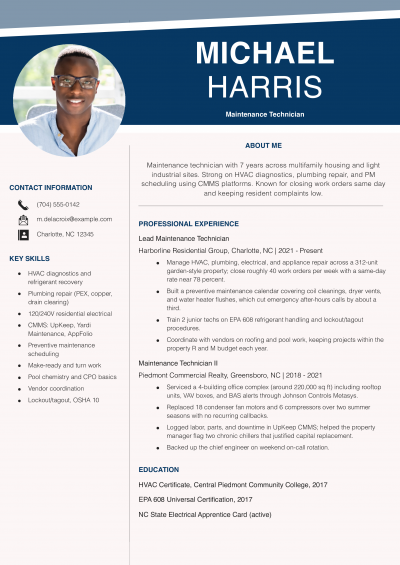
Facilities managers scan the top of a maintenance resume for EPA 608, OSHA cards, and the specific systems serviced, because those signals show whether the tech can pick up a work order without supervision.

Andrew Stoner , Executive Resume Writer and Career Coach

Why this resume works

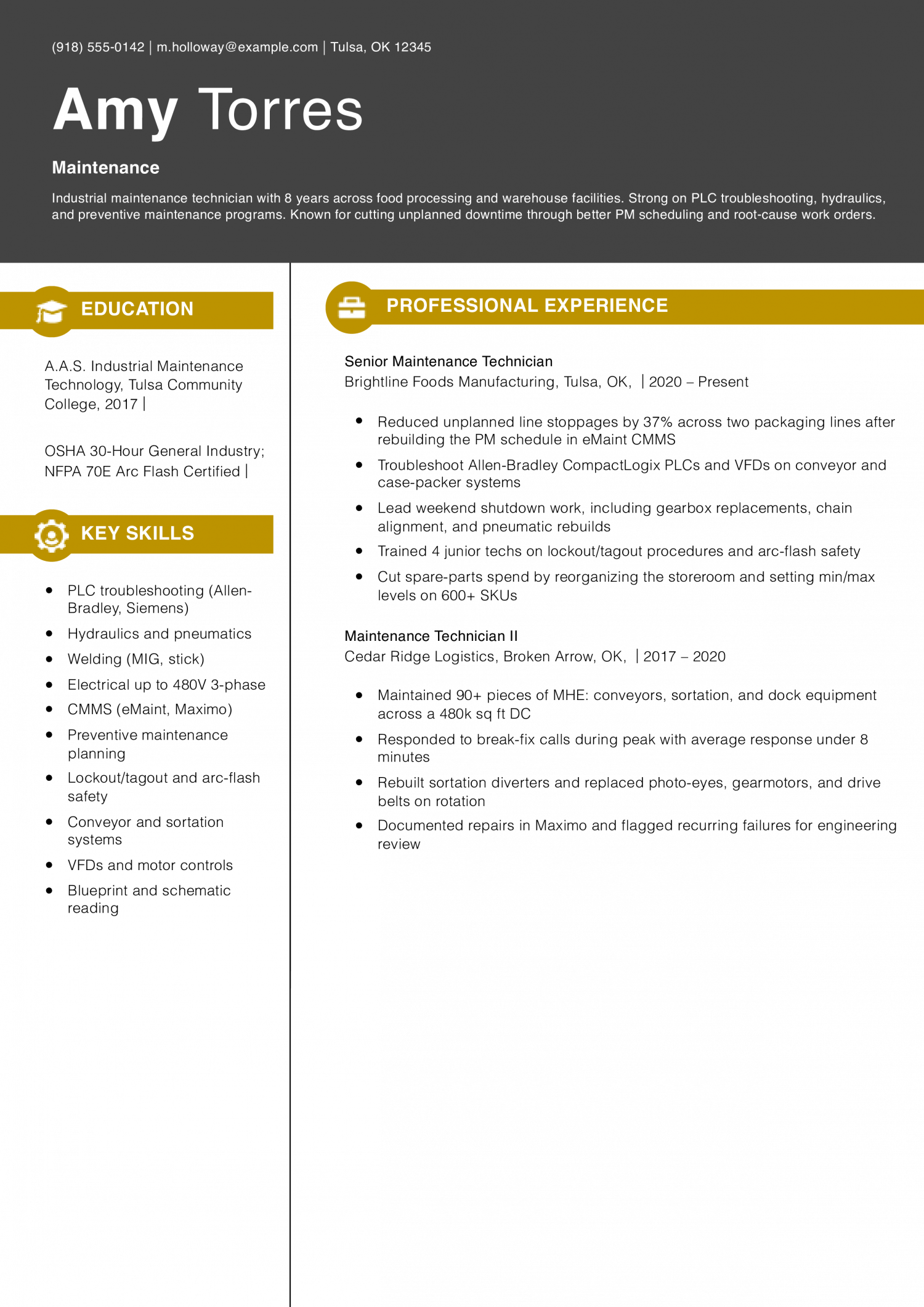
  • Downtime numbers tied to the fix: The 37% downtime reduction is paired with the actual change (rebuilt PM schedule in eMaint), so a hiring manager sees cause and effect.
  • Real equipment names, not buzzwords: Naming Allen-Bradley CompactLogix, VFDs, and case-packers signals this candidate has actually worked on the systems plants run.
  • Safety and training included: Lockout/tagout, arc-flash, and mentoring junior techs show readiness to move into a lead role beyond just turning wrenches.

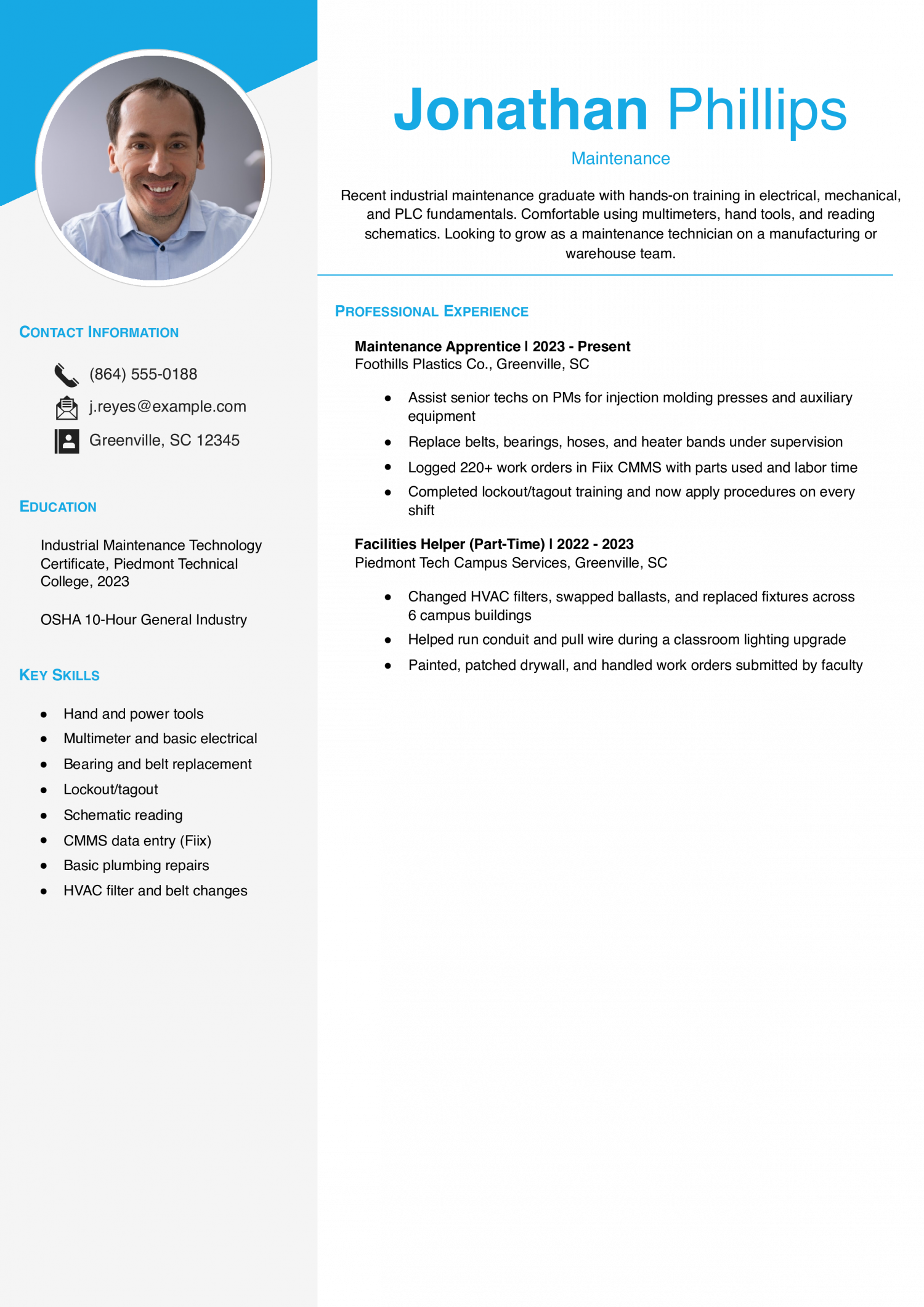
Entry Level Example

Entry-level maintenance workers usually come from trade school, the military, or a helper role under a journeyman. Your resume needs to prove safe tool use, basic system knowledge, and steady attendance through tickets, coursework, and any PM work you logged.

Why this resume works

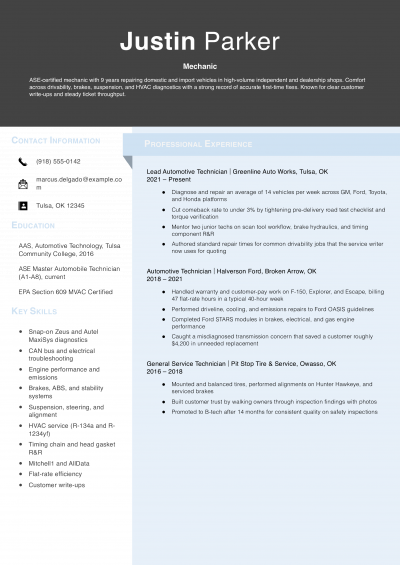
  • Names the tools and equipment: Mentioning injection molding presses, multimeters, and Fiix CMMS shows the candidate has touched real shop-floor gear, not just classroom demos.
  • A number even at entry level: Logging 220+ work orders gives concrete evidence of activity without overclaiming responsibility a new tech would not have.
  • Safety training is up front: Lockout/tagout and OSHA 10 reassure hiring managers this person will not get hurt on day one.

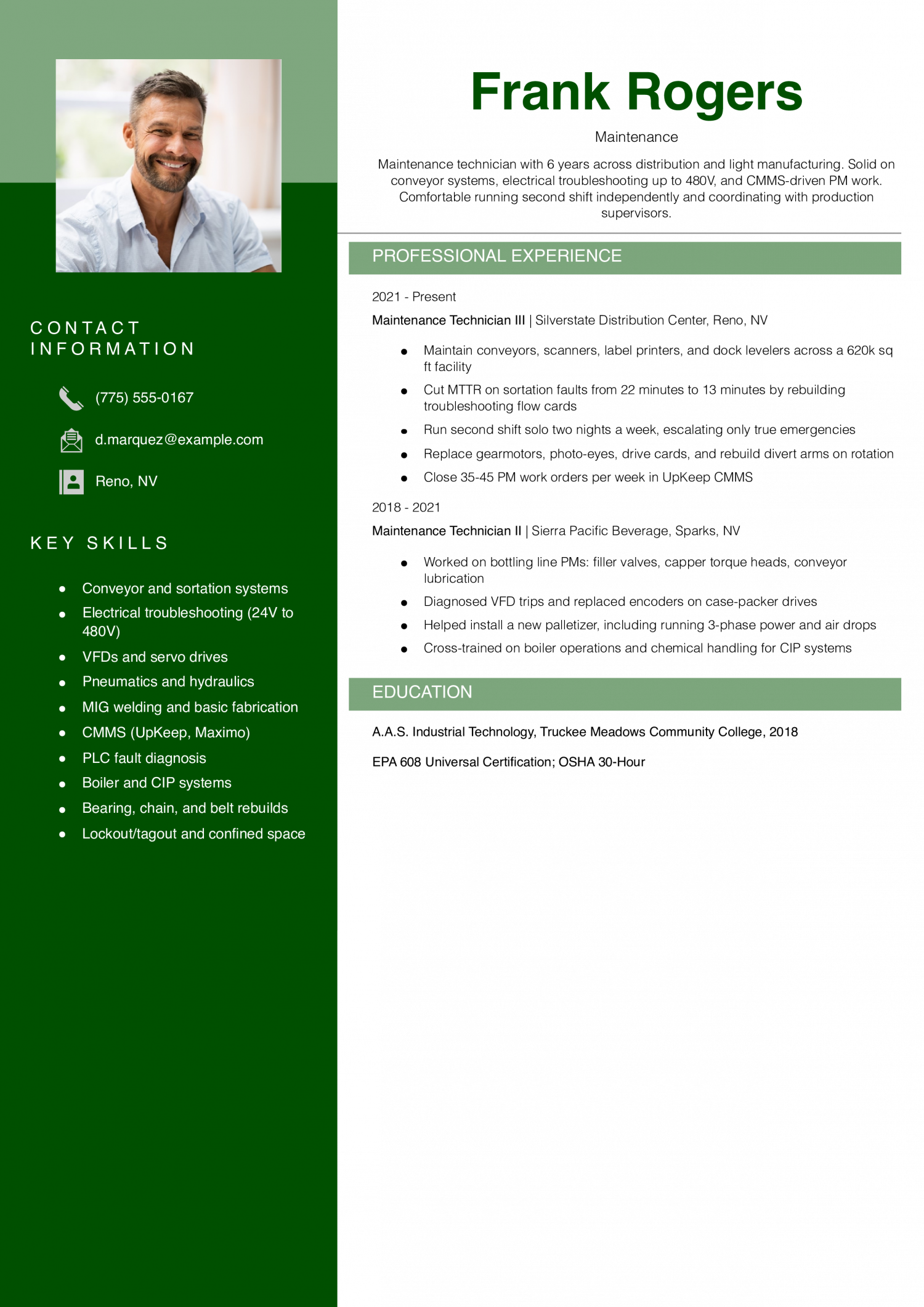
Experienced Example

Experienced maintenance technicians run their own work orders across HVAC, electrical, and plumbing without a foreman riding along. Your resume needs to prove independent troubleshooting, EPA 608 or comparable tickets, and PM completion rates on the systems you serviced.

Why this resume works

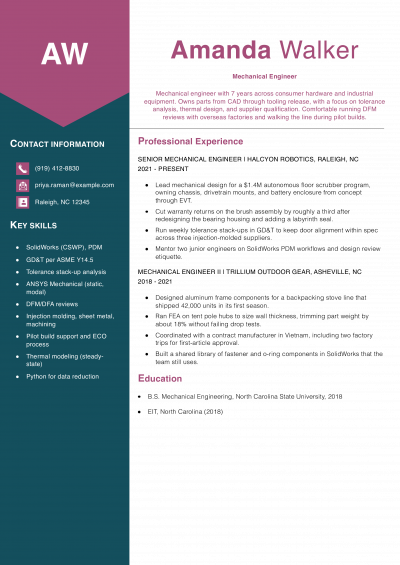
  • Improved a metric that matters: Cutting mean-time-to-repair from 22 to 13 minutes is the exact kind of number maintenance managers watch on weekly reports.
  • Shows ability to work alone: Running second shift solo signals trust and decision-making, which is what hiring managers look for at the mid-tier level.
  • Two related industries listed: DC plus beverage manufacturing shows transferable skills without scattering across unrelated jobs.

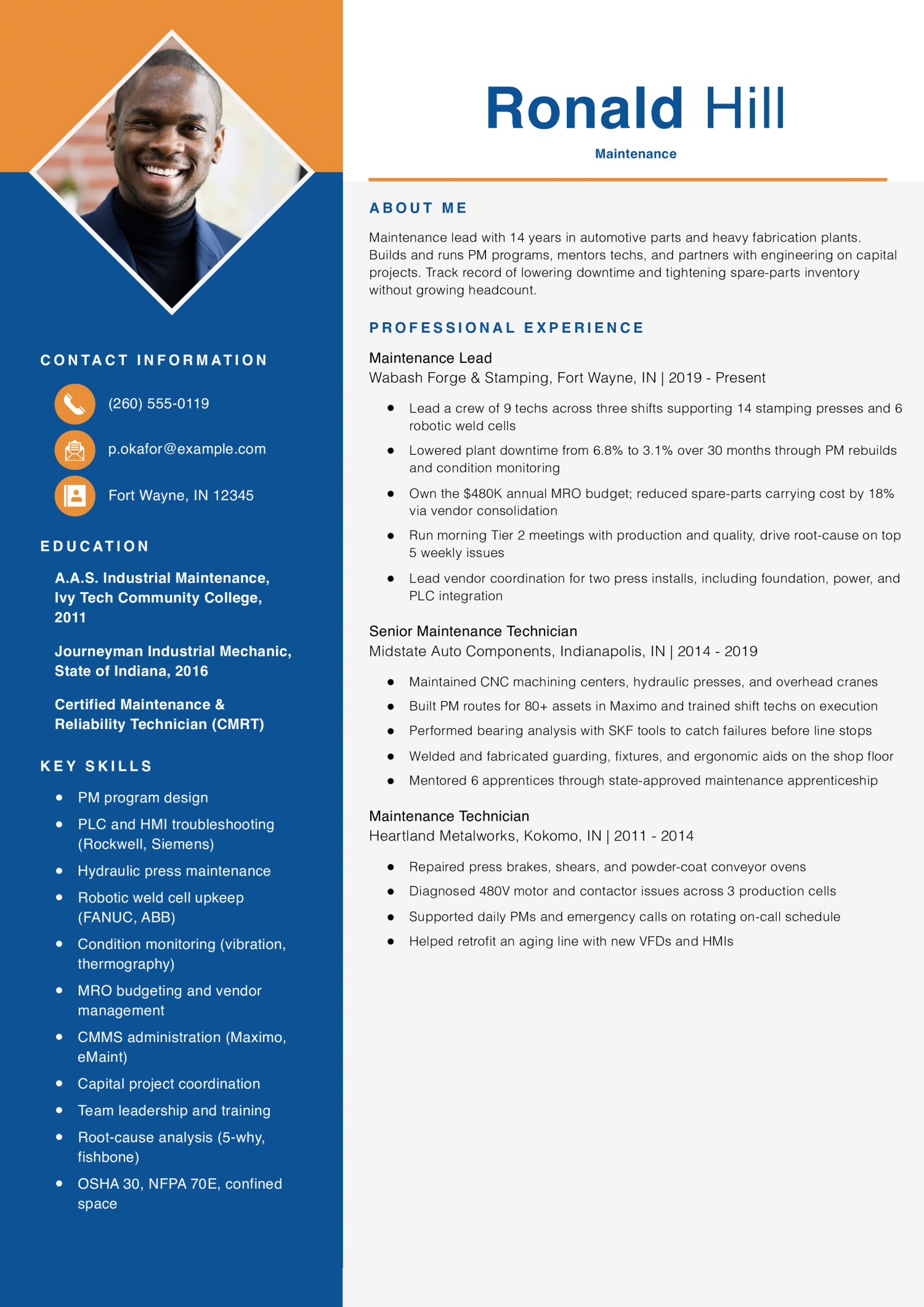
Lead Example

Lead maintenance technicians schedule crews, own the CMMS queue, and answer to plant engineers or facilities directors. Your resume needs to prove vendor management, capital project involvement, and downtime reduction across a building or production line you covered.

Why this resume works

  • Manages people, money, and uptime: Naming crew size, budget, and downtime percent in one job entry shows true lead scope, not just senior-tech work.
  • Career path tells a clean story: Tech to senior tech to lead inside one industry signals depth, which lead roles want over scattered experience.
  • Credentials match the title: CMRT plus journeyman license gives the technical authority a lead role needs when signing off on work and training others.

How to Write a Maintenance Resume

01 Open with a profile that names your repair scope

Your profile should state your years on the tools, the building type or plant you worked in, and the systems you service weekly.

Name the trades you cover: electrical up to a stated voltage, plumbing, HVAC with EPA 608 type, carpentry, and any boiler or chiller work. Add the CMMS you use, such as UpKeep, Fiix, or Maintenance Connection. A facilities manager should know, by line three, whether you can take a work order without a callback.

02 Quantify volume, response time, and PM rates

Maintenance work hides behind verbs like repaired and maintained, so the resume reads as duties instead of output.

Most strong bullets carry a number: work orders closed per week, average response time, PM completion rate, or downtime hours cut on a line. A bullet that reads “closed 35 to 45 work orders weekly with a 92 percent PM completion rate” tells a plant engineer what a shift with you looks like. Tickets without numbers tend to read flat next to candidates who show their volume.

03 Group your repairs by system category

Group your bullets so a reader can see range fast. Four buckets work for most maintenance resumes: HVAC and refrigeration, electrical and controls, plumbing and piping, and general building or grounds.

Under each, name the equipment by brand and size where it helps: Trane and Carrier rooftop units, Grundfos pumps, Square D panels, Bradley fixtures. Add carpentry, drywall, and painting if the role calls for it. Industrial techs should add conveyors, hydraulics, PLC troubleshooting, and the line speeds you supported.

This layout lets a foreman match your kit to the building in under a minute.

04 Put licenses and tickets on page one

Facilities managers and plant engineers screen for tickets before they read bullets, so a credentials block belongs above or beside the work history.

List EPA 608 with the type (I, II, III, or Universal), OSHA 10 or 30, any state journeyman or master electrician license by state with status, NFPA 70E, forklift, lockout/tagout, and confined space. Add boiler operator class where it applies. Note the state and that the license is in good standing; do not print the license number on the resume itself.

Save numbers for the application form.

05 Close with training, not filler

End on training that signals you keep up with code and equipment. List your trade school, technical college, or apprenticeship, plus any manufacturer schools you completed: Trane, Lennox, Carrier, Siemens, or Allen-Bradley.

Add union locals, military MOS, and any in-house leadership training if you are aiming at lead roles. Skip generic interests, references-available lines, and high school dates if you have more than five years on the tools. The closing third of the page should reinforce the same trades and systems you opened with, not introduce new ones.

ATS filters catch more maintenance resumes than ever in 2026. The skills below come from our user-built maintenance resumes. Specific systems and EPA 608 type clear the first cut, and reliability language decides whether the resume advances.

Facilities managers and plant engineers weigh hard skills first because a missing ticket ends the read. Soft skills back up bullets about on-call response, vendor handoffs, and tenant communication. Match the hard-skill list against the posting, then use the soft skills as the evidence layer inside your work-history bullets.

Soft Skills % of resumes with this skill
Problem solving 75%
Time management 50%
Attention to detail 49%
Communication 40%
Teamwork 31%

And here are the top hard skills showing up most often.

Hard Skills % of resumes with this skill
Preventive maintenance 69%
HVAC repair 50%
Electrical systems 48%
Plumbing repair 37%
OSHA safety compliance 27%

Based on data from thousands of maintenance workers’ resumes built on ResumeTemplates.com, May 2026.

Must Have on a Maintenance Resume

Before a maintenance resume gets a closer read, hiring teams check for a short list of essentials.

OSHA Certifications

Safety tickets are screened before bullets on most maintenance resumes. Facilities managers and plant engineers want to see you can step onto a job site without a safety officer walking you through every task.

  • OSHA 10-Hour or 30-Hour (General Industry or Construction)
  • NFPA 70E Arc Flash Safety
  • Lockout/Tagout (LOTO) certification
  • Confined Space Entry training
  • Forklift and aerial lift (powered industrial truck) certification
  • First Aid, CPR, and AED
  • HAZWOPER 24- or 40-Hour where applicable

Tools of the Trade

Generic phrases like hand tools and power tools do not move a maintenance resume. Name the brands and platforms a foreman recognizes from the shop floor.

  • Diagnostic: Fluke multimeters, clamp meters, megohmmeters, manifold gauges, combustion analyzers
  • HVAC: Trane, Carrier, Lennox, York rooftop units; recovery machines and vacuum pumps
  • Electrical: Square D, Siemens, Eaton panels; Greenlee benders and knockout sets
  • Controls: Allen-Bradley PLCs, Siemens S7, variable frequency drives (VFDs)
  • Building automation: Johnson Controls Metasys, Honeywell, Tridium Niagara
  • CMMS: UpKeep, Fiix, Maintenance Connection, IBM Maximo, eMaint
  • Plumbing: RIDGID press tools, drain machines, backflow test kits

Maintenance Credentials That Get You the Job

Facilities managers and plant engineers read this list as a map of where your work is heading. The credentials below tell them which track you have invested in: refrigerant, electrical safety, boiler, or industrial controls. List the issuing body and year of completion next to each one.

  • EPA Section 608 Universal: Required to buy and handle refrigerants on commercial HVAC; Universal beats Type I or II alone for most building roles.
  • OSHA 30-Hour General Industry: Signals you can work in plants and large facilities without a safety officer trailing you on every task.
  • NFPA 70E Arc Flash Safety: Industrial and data-center hiring teams flag this for techs working live or near energized 480V equipment.
  • Certified Maintenance and Reliability Technician (CMRT): SMRP credential that signals reliability-centered maintenance knowledge and moves you toward lead or planner roles.

Latest BLS Statistics for Maintenance Workers

The 90th-percentile maintenance technician out-earns the median by a meaningful margin, which tells you the market rewards specialty systems and industrial settings more than years on a residential ticket. Refrigerant-heavy, controls-heavy, and plant roles sit at the top of the band; apartment turn work sits closer to the floor.

Lead with the systems and settings that match the higher band: industrial HVAC, boilers, PLCs, and 480V electrical, not generic handyman language.

$48,620 National median annual
$52,430 National mean annual
$33,860 Entry-tier floor (10th percentile)
$76,110 Top-decile ceiling (90th percentile)
1,531,700 Maintenance Workers in the U.S.
Where you stand

Entry tier

$33,860 to $48,620 At the entry tier, lead with your trade school or apprenticeship, OSHA 10, and the tools and basic systems you handled solo.

Mid band

$48,620 to $76,110 At the mid band, show EPA 608 Universal, work-order volume, CMMS used, and the HVAC, electrical, and plumbing scope you own.

Top decile

$76,110+ At the top decile, lead with industrial systems, NFPA 70E, downtime reduction numbers, and any crew or capital project leadership.

Top-paying states

# State Avg. Annual
1 District of Columbia $60,600
2 Washington $57,910
3 Minnesota $57,750
4 Hawaii $57,480
5 New York $56,180
6 Massachusetts $56,040
7 California $56,030
8 Alaska $55,650
9 Illinois $54,220
10 Connecticut $53,570

Highest-employment states

# State Workers Median
1 Texas 139,310 $44,940
2 California 132,250 $56,030
3 New York 124,640 $56,180
4 Florida 112,590 $45,000
5 Illinois 71,100 $54,220
Source: U.S. Bureau of Labor Statistics, OEWS 2024 release (SOC 49-9071).
Written by professional resume writers and loved by hiring managers

Resume Templates offers HR approved resume templates to help you create a professional resume in minutes. Choose from several template options and even pre-populate a resume from your profile.

Frequently Asked Questions

How should you describe maintenance work on a resume?

Replace verbs like repaired and maintained with specific systems, brands, and outcomes.

Name the equipment by type and size, add the CMMS you used, and close with a number such as work orders per week or PM completion rate.

Should you list your license numbers on a maintenance resume?

No. List the credential, the state, and that the license is in good standing.

Save the actual journeyman or master electrician number for the application form, where employers can verify it through the state board.

What is the difference between a building maintenance and an industrial maintenance resume?

Building resumes lead with HVAC, plumbing, tenant work orders, and CMMS volume.

Industrial resumes lead with PLCs, motor controls, conveyors, hydraulics, and downtime numbers tied to a production line. Pick the version that matches the posting, not a single all-purpose resume.

How do you handle a gap or a non-trade job on a maintenance resume?

Keep the gap visible and short.

If you worked outside the trade during it, list the role in one line and pivot the bullets to transferable signals: safety, attendance, equipment care, or any side repair work you logged.

What's the best resume template for a maintenance worker?

For a maintenance worker, an ATS-friendly template is the safest pick, because it puts your certifications and experience where a hiring manager scans first. A basic template is a solid alternative. Whichever you choose, keep the formatting clean and easy to parse: clear section headings, a standard font, and no graphics a parser can choke on.

Rate this article

Maintenance Resume

Average Rating

4.7/5 stars with 245 reviews

You have given 0 Star(s)
4.7/5 stars with 245 reviews
Andrew Stoner

Executive Resume Writer and Career Coach

Andrew Stoner is an executive career coach and resume writer with 17 years of experience as a hiring manager and operations leader at two Fortune 500 Financial Services companies, and as the career services director at two major university business schools.