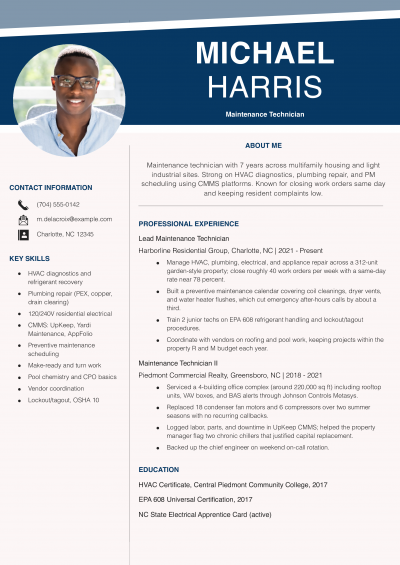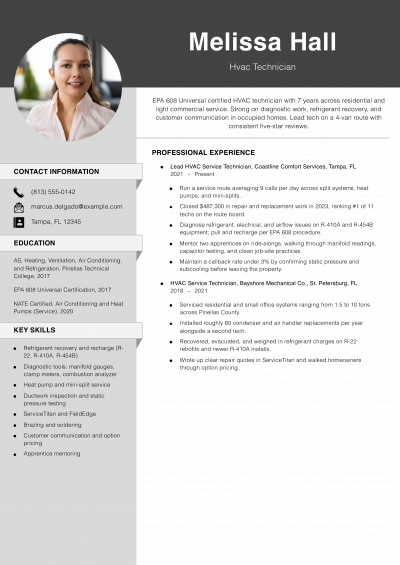
HVAC Technician Resume Examples and Templates for 2026



A tight license and equipment block is what gets HVAC installer resumes past the credentialing screen with installation managers; specific tonnage, system types and job counts are what make them readable enough to advance.
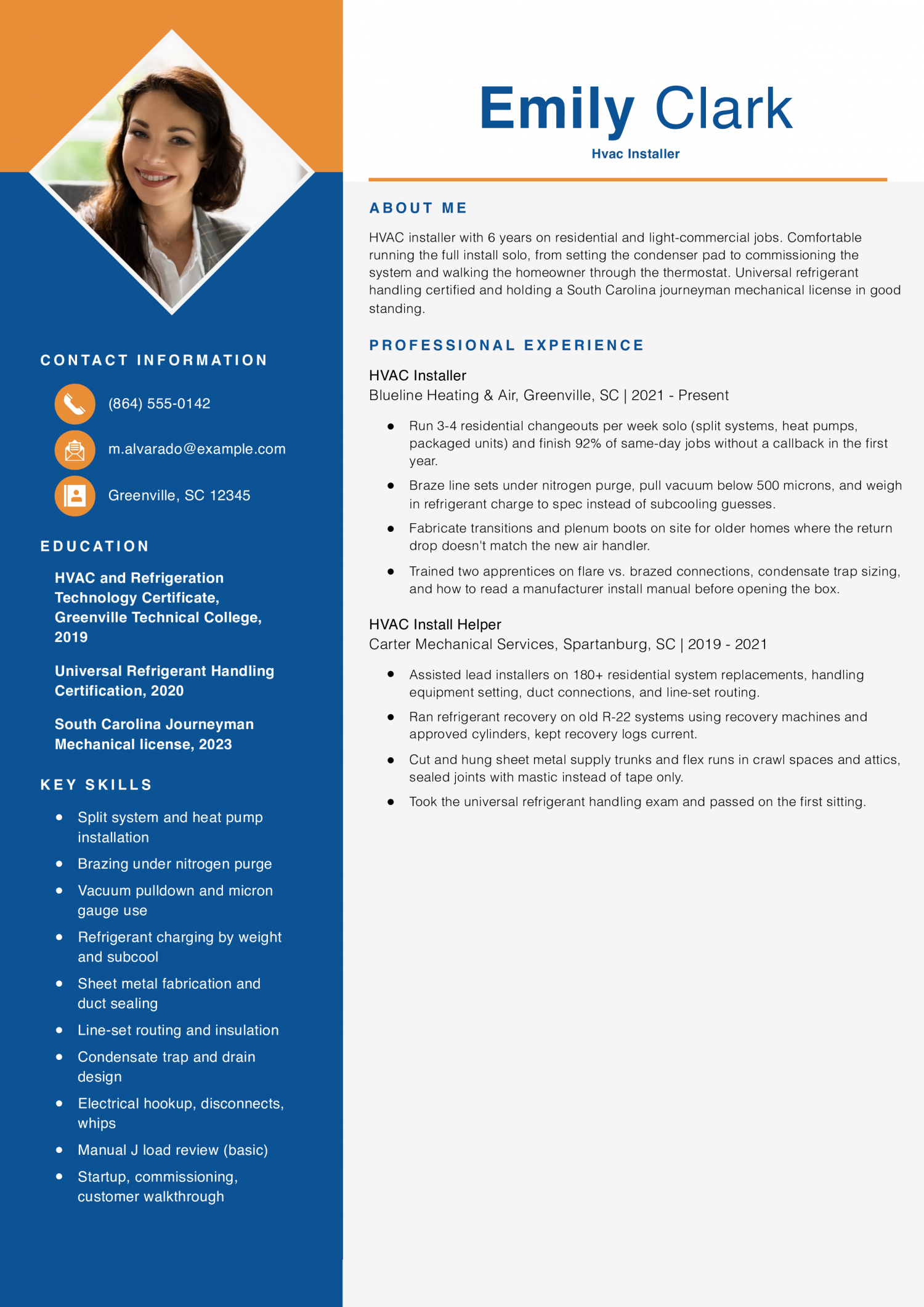
You are new to the trade and working under a licensed installer on residential or light commercial jobs. Your resume has to prove safe tool handling, jobsite reliability, and steady progress on brazing, ductwork, and startup tasks.

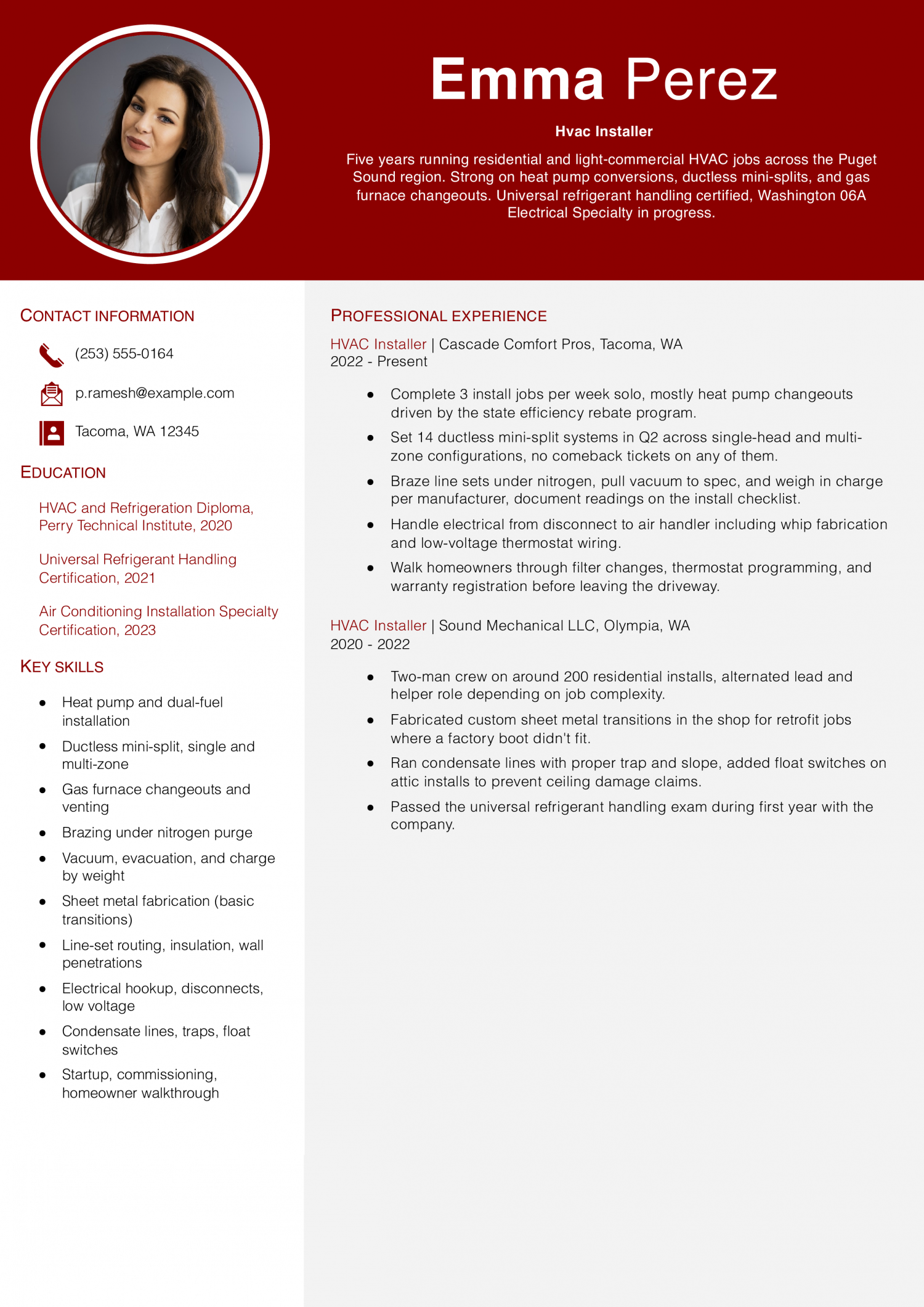
You run full installs of split systems, heat pumps, and ductwork with limited oversight from the lead. Your resume has to prove clean commissioning, code-compliant work, and callback rates low enough to keep the crew profitable.
You run the truck, lead the crew, and report to the install manager on quality and timing. Your resume has to show crew leadership, punch list closeout, and steady first-time inspection pass rates.

Marcus Alvarado
Greenville, SC | (864) 555-0142 | [email protected] | linkedin.com/in/marcusalvarado
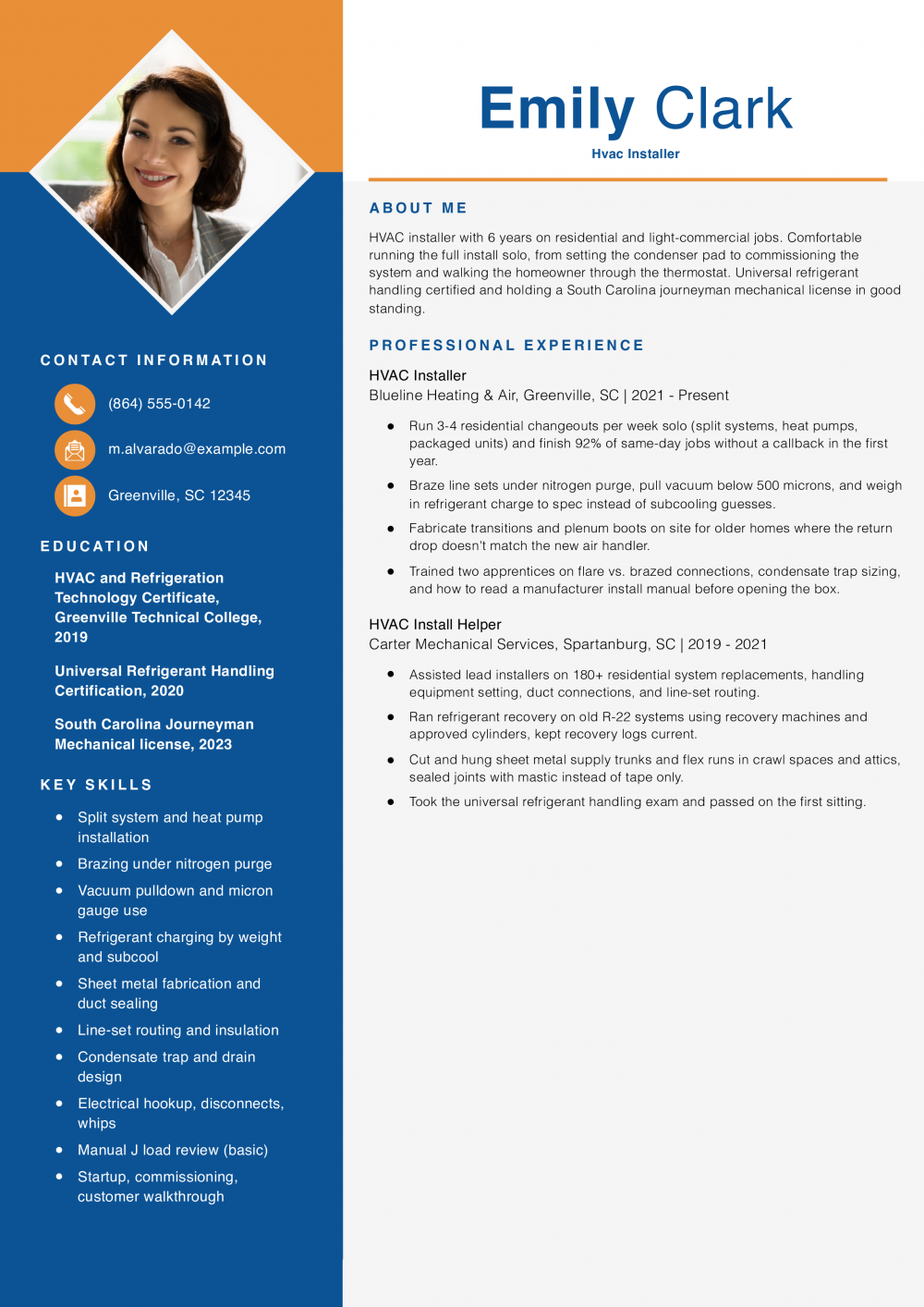
HVAC installer with 6 years of residential and light-commercial experience across the Upstate. Run full jobs solo including equipment set, line-set brazing under nitrogen, evacuation to spec, charge verification, electrical hookup, and homeowner commissioning walkthrough. Universal refrigerant handling certified and holding a South Carolina journeyman mechanical license in good standing. Comfortable coaching apprentices and stepping into a lead role on multi-day retrofits.
HVAC Installer
Blueline Heating & Air | Greenville, SC | 2021-Present
HVAC Install Helper
Carter Mechanical Services | Spartanburg, SC | 2019-2021
General Construction Laborer
Piedmont Home Renovations | Anderson, SC | 2018-2019
Your profile should sit at the top of page one and state your scope in plain terms. Name your years in the trade, the systems you install, and the settings you work in. Say whether you handle residential, light commercial, or new construction jobs.
Name the equipment you install most weeks: split systems, package units, heat pumps, mini-splits, or rooftop units. Add the tonnage range you work in, from residential three-ton units up through commercial rooftops. Installation managers and HVAC contractors read this block first to place you on a crew.
A vague profile that says only “experienced installer” makes them guess. A scoped profile tells them which trucks you can run and which permits you can pull.
Bullets without a number tend to read as generic duties. Give the reader volume you can defend when asked in an interview. Name installs completed per week, tonnage range, or square footage of the buildings you serviced.
Name the crew size you led or worked in, and the ratio of retrofit to new construction. If you ran change-outs, say how many per season and the typical turnaround from tear-out to startup. If you handled ductwork, name linear feet of sheet metal or flex you fabricated in a busy month.
Callback rate and QA pass rate on inspections are strong numbers when you have them. Recruiters scan for these first, then read the verbs around them.
Split your bullets into three or four buckets so the reader can find what they need. Equipment installation covers condensers, air handlers, furnaces, and mini-split heads. Ductwork and airflow covers sheet metal fabrication, flex duct runs, static pressure checks, and airflow balancing.
Refrigerant work covers line set brazing, evacuation, charging, and leak checks. Electrical and controls covers whip runs, thermostat wiring, low-voltage control boards, and startup diagnostics. Under each bucket, name the tools and gauges you use, from manifold sets and micron gauges to nitrogen kits and recovery machines.
This layout lets Installation managers and HVAC contractors match you to open work in seconds. It also keeps a long list of duties from reading as one blur.
Installation managers and HVAC contractors need to see your tickets before they read your bullets. Build a short credentials block under your profile on page one. List refrigerant handling certification with the type you hold, since requirements vary by state and employer.
Add state or city journeyman or contractor cards where required, with the state named and the status shown as current. Add manufacturer training from brands you install often, and any safety cards the job posting calls out. Name driver license class if the job runs service trucks or box trucks.
Put software last in the same block: dispatch platforms, load calculation tools like Manual J, and any invoicing app the shop uses. Keeping these visible early stops a recruiter from scrolling to check you can be scheduled.
End the resume with a short education and training section that backs up the credentials block. Name your trade school, technical college, or union apprenticeship, with the program title and completion year. If you came up through a registered apprenticeship, say the sponsor and the hours logged toward journeyman status.
List any employer-run training on specific equipment lines, such as variable-speed inverter systems or geothermal loops. Add safety courses like fall protection, confined space, or lift certifications if the work called for them. Keep this section tight: two or three lines is enough once the credentials block is doing its job.
Save the space above for install volume, equipment types, and the settings that show your daily scope.
Five years ago, an HVAC installer resume read like a list of unit types touched. The mix has shifted toward measured airflow, refrigerant work, and code compliance. Installation managers and HVAC contractors now scan for both trade proof and jobsite conduct.
Hard skills carry the first pass on the applicant tracking system. Terms like refrigerant charging and ductwork fabrication get your file in front of a human reader. Soft skills like customer communication then decide whether the callback comes.
Read the target job posting line by line and mirror its exact wording. Treat each soft skill as a claim you back up with a bullet, not a label you paste on top.
| Soft Skills | AI-estimated % |
|---|---|
| Customer site communication | 74% |
| Physical stamina | 53% |
| Troubleshooting under pressure | 42% |
| Detail-oriented workmanship | 40% |
| Team coordination | 31% |
And here are the top hard skills showing up most often.
| Hard Skills | AI-estimated % |
|---|---|
| HVAC system installation | 66% |
| Refrigerant handling certification | 64% |
| Ductwork fabrication | 43% |
| Electrical wiring connections | 36% |
| Preventive maintenance scheduling | 27% |
Skill names and rankings come from an AI model grounded in U.S. Department of Labor occupation data for HVAC installers, not from a count of HVAC installers’ resumes built on ResumeTemplates.com.
For HVAC Installers, the pay floor sits well below the middle, and the ceiling runs more than half above it. That spread is wide for a trade role. The floor reflects entry helpers and apprentices on residential change-outs.
The top of the band reflects journey-level installers on commercial and light industrial systems in costly metros with strong unions. National employment in the field is large, so the state tables below show real geographic pull, not thin samples. Read your own pay band against the cards.
Then build the resume around the tonnage, refrigerant classes, and system types that map to the tier you want next.
| # | State | Median Annual |
|---|---|---|
| 1 | District of Columbia | $84,390 |
| 2 | Alaska | $77,430 |
| 3 | Illinois | $77,410 |
| 4 | Massachusetts | $77,300 |
| 5 | Connecticut | $76,610 |
| 6 | Minnesota | $76,350 |
| 7 | Washington | $75,660 |
| 8 | North Dakota | $74,490 |
| 9 | New Jersey | $74,450 |
| 10 | New York | $74,430 |
| # | State | Workers | Median |
|---|---|---|---|
| 1 | Florida | 39,160 | $56,670 |
| 2 | California | 35,130 | $72,560 |
| 3 | Texas | 34,730 | $57,760 |
| 4 | New York | 24,430 | $74,430 |
| 5 | Pennsylvania | 15,880 | $62,400 |
Resume Templates offers HR approved resume templates to help you create a professional resume in minutes. Choose from several template options and even pre-populate a resume from your profile.
Yes, split them if you have done both, because installation managers staff crews by system class.
Residential split systems and commercial rooftop units call for different tools and different sizing math. Two subheads under your work history let a reader see the mix in one pass.
Name the refrigerant handling certification you hold and the type, such as Universal or Type II. Do not print the card number on the resume itself.
Bring the physical card to the interview, since HVAC contractors verify it before you touch refrigerant.
Reframe your service bullets around the install skills a crew lead cares about: brazing, line set routing, and startup.
Then add any change-outs, new construction rough-ins, or ductwork you ran on service calls. That shows you already carry install work, not only diagnostics and repair.
Name the gap in one line and say what you did during it, such as a family move or a training course.
Installation managers see winter slowdowns and layoffs often and read them as normal. What they will not read past is an unexplained blank between two install jobs.
License rules vary by state and by whether you pull permits or work under a contractor's license.
If your state issues an installer or journeyman license, list it with the state and the status. If you work under a contractor's license, say so instead of leaving the line blank.
Yes, name three or four brands you install often, such as Carrier, Trane, Lennox, or Mitsubishi ductless.
HVAC contractors are usually tied to one or two distributor lines and hire for that fit. A brand list also flags whether you have worked on inverter systems or only single-stage gear.
Write your role on the crew and the count for the crew, so the reader sees both.
A line like "lead installer on a two-person crew, 140 change-outs a year" answers the question. That is more honest than claiming crew totals as your own work.
For an HVAC installer, an ATS-friendly template is the safest pick, because it puts your certifications and experience where a hiring manager scans first. A basic template is a solid alternative. Whichever you choose, keep the formatting clean and easy to parse: clear section headings, a standard font, and no graphics a parser can choke on.
Executive Resume Writer and Career Coach
Andrew Stoner is an executive career coach and resume writer with 17 years of experience as a hiring manager and operations leader at two Fortune 500 Financial Services companies, and as the career services director at two major university business schools.
Customize this template in our builder in under 10 minutes.