4 Best Construction Worker Resume Examples and Templates for 2026



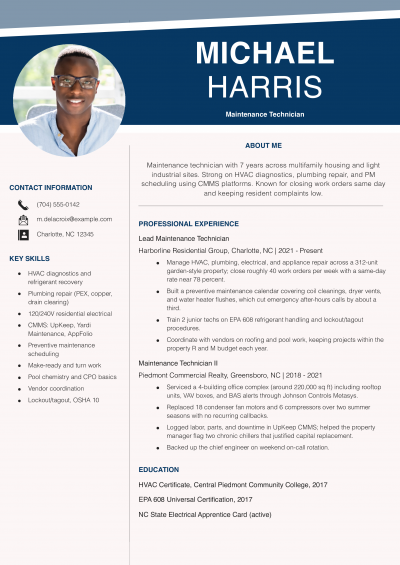
A clean EPA 608 and state license line is what gets HVAC technician resumes past the service manager's first read; first-time fix rate and the equipment list are what make them readable enough to book an interview.
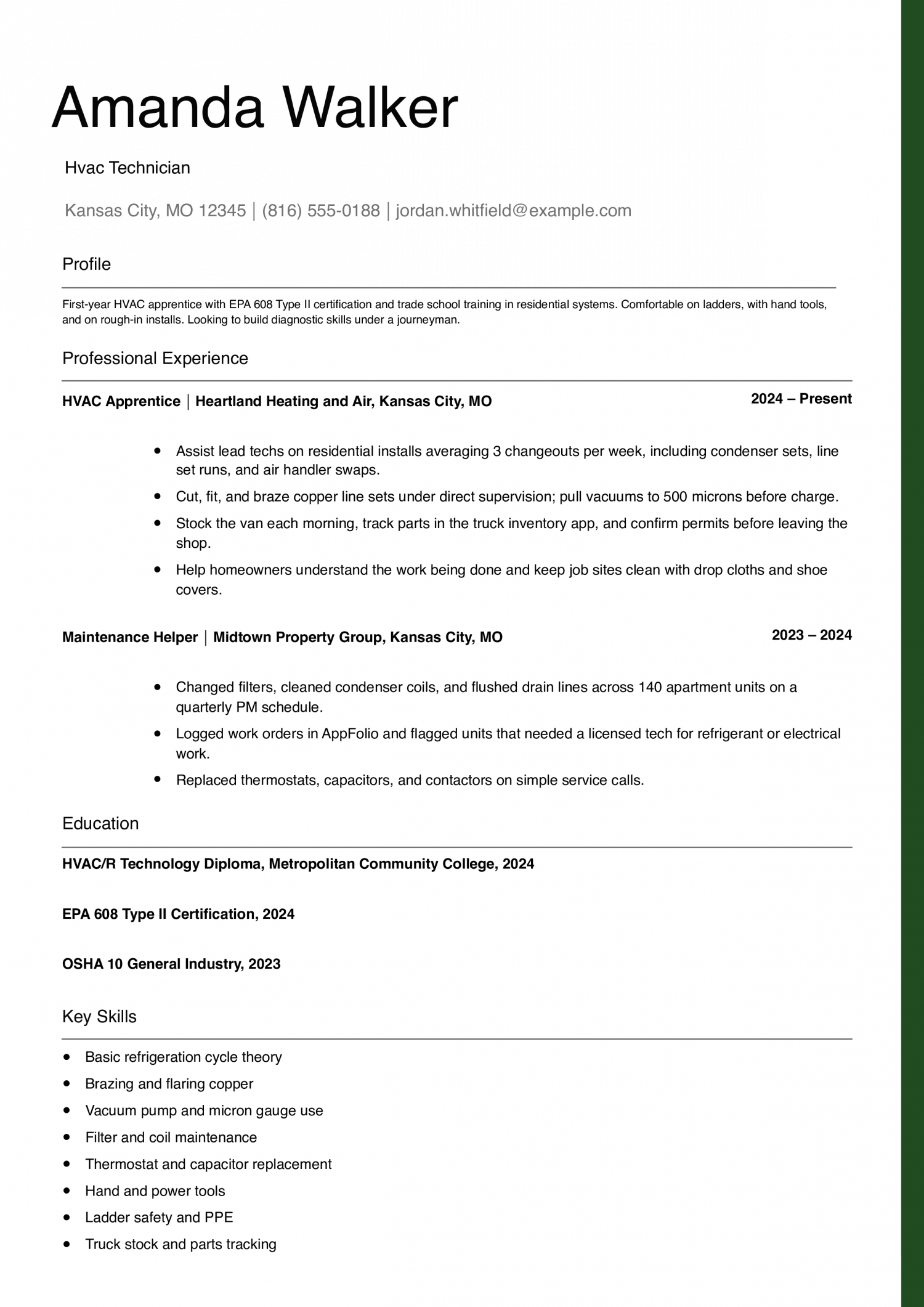
The apprentice profile fits techs in years one through three, often working under a licensed journeyman and finishing trade school or a registered apprenticeship. This resume needs to prove EPA 608 progress, ride-along hours, and the tools you can run without supervision.
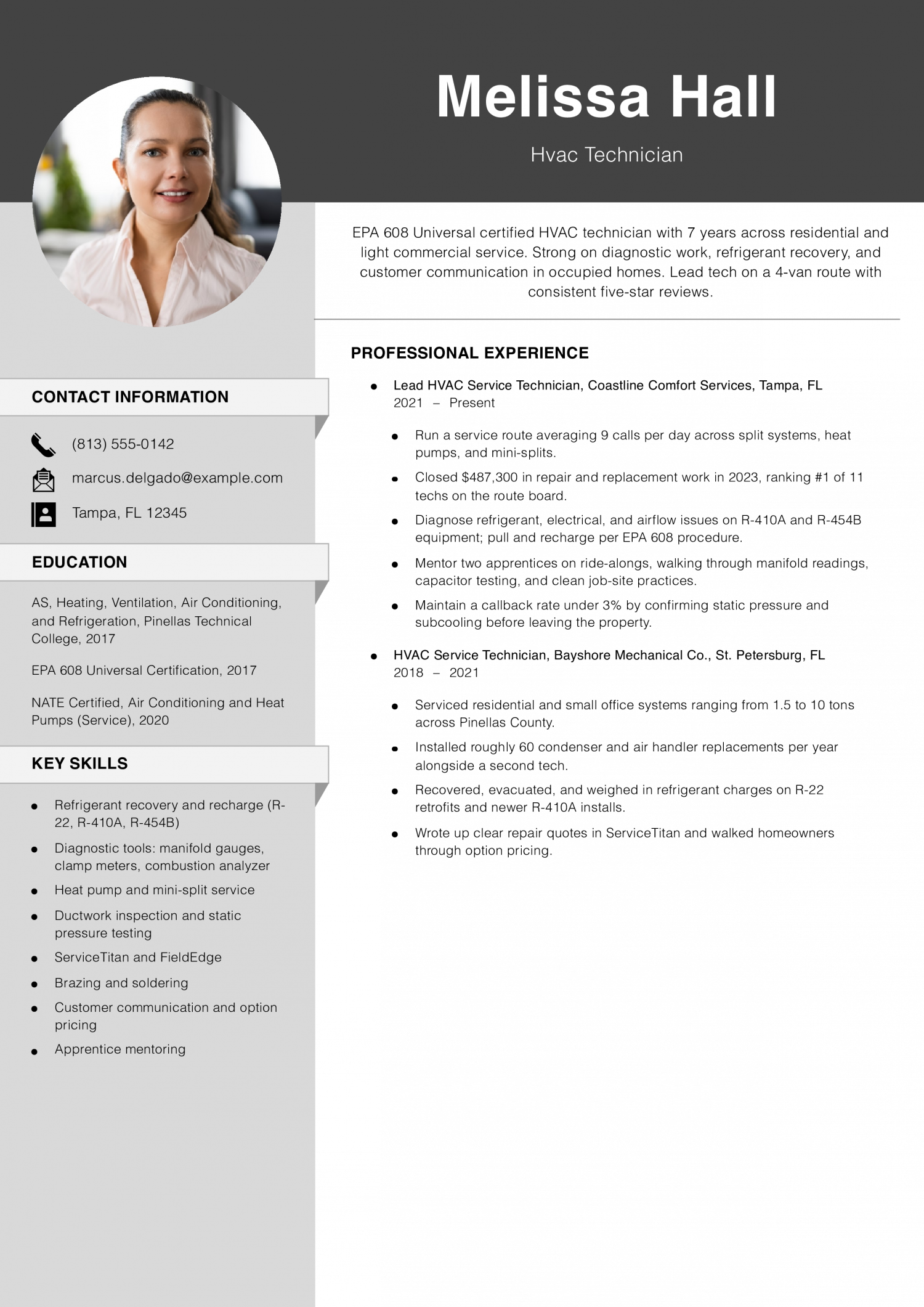
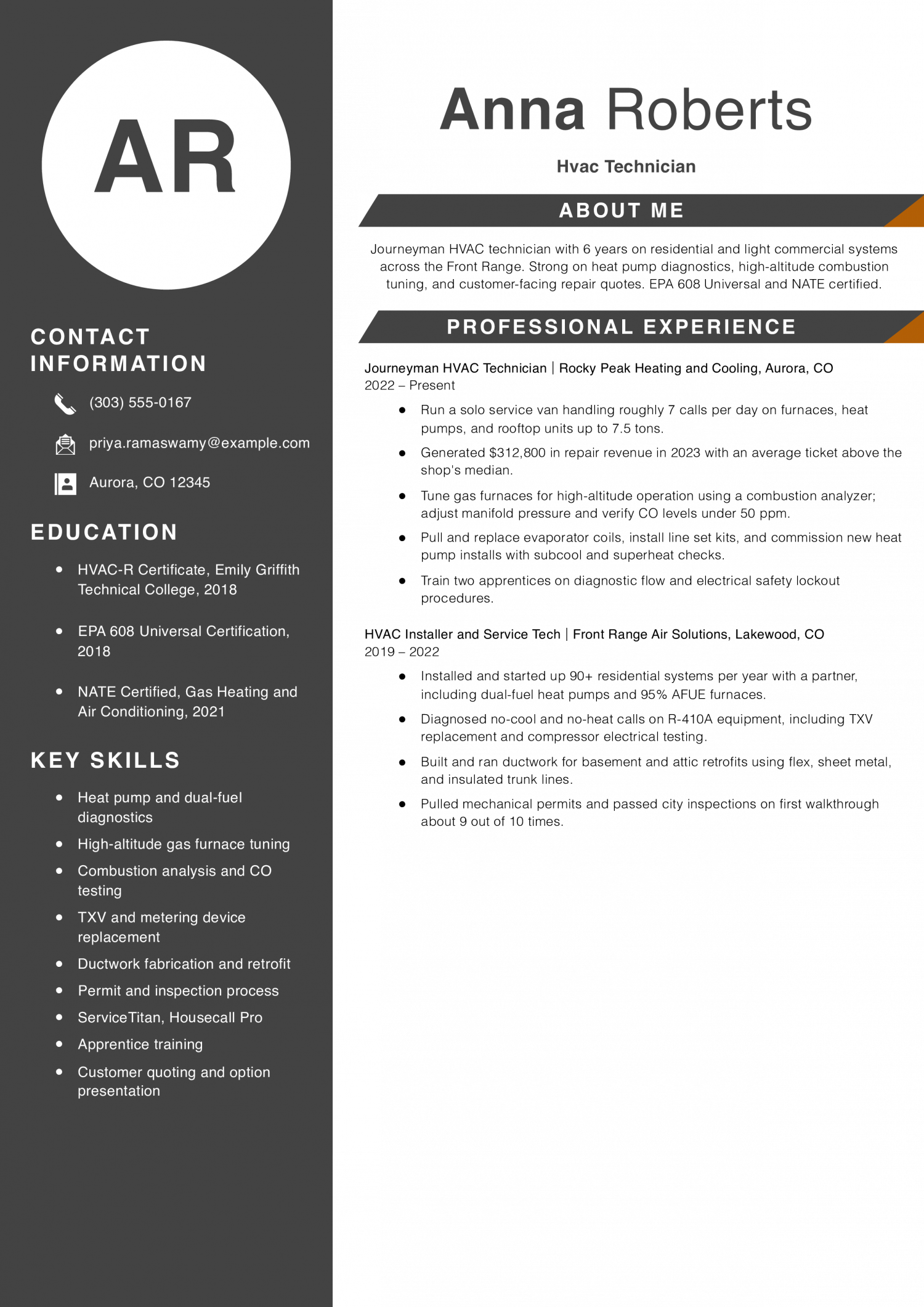
The journeyman profile fits licensed techs running their own truck on residential or light commercial calls. This resume needs to prove your first-time fix rate, the equipment lines you service, and the refrigerants you handle in the field.
The master profile fits lead techs, service supervisors, and licensed contractors running crews or commercial accounts. This resume needs to prove crew leadership, chiller or VRF scope, callback rate across the team, and revenue tied to service or install work.

HVAC technician with 9 years across residential service, new construction install, and light commercial PM work in the upper Midwest. EPA 608 Universal and NATE certified, with strong cold-climate heat pump and high-efficiency boiler experience. Known for clean job sites and clear customer communication.
Your profile should state your years in the trade and your license tier (apprentice, journeyman, master, or EPA 608 Universal).
Name the work setting you run in: residential service, light commercial, rooftop units, or refrigeration. Then list the equipment lines and refrigerants you handle.
A service manager reading the top of page one wants to know if you can roll on an R-410A heat pump call or a 20-ton RTU. Say it in plain words.
Service managers track three numbers on every tech: tickets closed per day, first-time fix rate, and callback rate. Put those on the resume.
Most strong HVAC resumes show 6 to 10 calls per day, an 85 to 95 percent first-time fix rate, and callbacks under 5 percent.
Bullets without a number tend to read as duties. A line like “averaged 8 service calls per day with a 92% first-time fix rate” tells the shop you bill hours, not burn them.
Sort your bullets by the systems you actually touched, not by employer. Service managers scan for system coverage first.
Use three or four buckets: cooling (split systems, mini-splits, heat pumps, RTUs), heating (gas furnaces, boilers, hydronics), refrigeration (walk-ins, reach-ins, ice machines), and controls (thermostats, BAS, VFDs).
Under each bucket, name the diagnostic work: superheat and subcooling readings, manifold gauge work, megohmmeter tests, combustion analysis, leak detection, and refrigerant recovery.
Build a credentials block in the top third of page one. List EPA 608 (Type I, II, III, or Universal), your state HVAC or journeyman license by state, NATE certifications, and any R-410A or R-32 training.
Add OSHA 10 or 30, forklift certification, and your driver’s license class. Service managers and HVAC contractors need to see license status before they read a single bullet.
List the state and “license in good standing”, do not print the license number on the resume.
End with your trade school, technical college, or registered apprenticeship hours. Name the program (ABC, NCCER, IEC, UA Local) and your year of completion.
Add a short tools or software line: ServiceTitan, FieldEdge, Housecall Pro, Fieldpiece or Testo instruments, and BAS platforms like Honeywell or Trane Tracer.
Skip a generic summary at the bottom. The credentials block already did that work on page one.
The HVAC technician resumes that get callbacks share a specific skill mix. The lists below come from our user-built HVAC technician resumes. Service managers and HVAC contractors scan for these patterns first, not generic “hard-working team player” framing.
Hard skills carry the screen; soft skills back up the bullets that follow. Match the list against the posting you are sending to and treat soft skills as evidence behind your tickets, fix rate, and customer-facing work.
| Soft Skills | % of resumes with this skill |
|---|---|
| Communication | 77% |
| Problem-solving | 52% |
| Customer service | 41% |
| Time management | 38% |
| Attention to detail | 35% |
And here are the top hard skills showing up most often.
| Hard Skills | % of resumes with this skill |
|---|---|
| HVAC system installation | 65% |
| Refrigerant handling | 57% |
| Electrical troubleshooting | 47% |
| Preventive maintenance | 35% |
| Blueprint reading | 27% |
Based on data from thousands of HVAC technicians’ resumes built on ResumeTemplates.com, May 2026.
Before an hvac technician resume gets a closer read, hiring teams check for a short list of essentials.
HVAC licensing is state by state, and a few states leave it to the county or city. List the state, the license tier, and “in good standing”, never the license number.
If you hold reciprocity in a neighboring state, name it on a separate line. Service managers hiring near state borders look for this first.
If you are working toward a higher tier (apprentice to journeyman, journeyman to master), say so under credentials with your test date or hours remaining.
A registered apprenticeship is the cleanest path into licensed HVAC work, and service managers read it as proof you have logged supervised hours under a journeyman.
List the sponsor (ABC, IEC, UA Local, SMART, or a state-registered employer), the program length, and the year you started or finished.
Add your classroom hours and on-the-job hours separately. A shop wants to see both.
Safety cards are a fast yes-or-no filter on commercial work. Group them under credentials on page one with the issue year.
OSHA 10 (Construction) with issue year
OSHA 30 (Construction) for lead techs and foremen
Forklift operator certification
Aerial work platform and scissor lift (ANSI A92)
Lockout-tagout and arc flash awareness
First Aid and CPR through American Red Cross or AHA
Naming the tools you actually run signals you can roll on a truck the day you are hired. Keep this list to the gear a shop expects a tech at your tier to own and operate.
Manifold gauge sets (Yellow Jacket, Fieldpiece, Testo)
Digital multimeter, clamp meter, and megohmmeter
Combustion analyzer (Testo 320, Bacharach Fyrite)
Refrigerant recovery machine and micron vacuum gauge
Brazing and soldering kit, tubing benders, swaging tools
Leak detector (electronic and UV)
ServiceTitan, FieldEdge, Housecall Pro, Jobber
BAS platforms (Honeywell, Trane Tracer, Johnson Metasys)
If you are applying to union contractors, list your local (UA, SMART, IBEW where it applies) and your book status under credentials.
If you are applying to non-union residential shops, you can leave it off without losing signal. Keep the training and hours from the apprenticeship either way.
Service managers and HVAC contractors read this list as a map of where your work is heading. The certifications below tell them which track you are investing in: refrigeration, commercial, controls, or specialty equipment. List the issuing body and the year earned, then the state where it applies.
NATE Certification (Service or Installation): The strongest post-license signal for residential and light commercial techs; name the specialty (Air Conditioning, Heat Pumps, Gas Furnaces).
R-410A and R-454B Safety Certification: Signals you can work the refrigerants currently shipping on new equipment, which matters more each season as R-22 work fades.
OSHA 10 or OSHA 30 (Construction): Required on most commercial job sites; OSHA 30 carries more weight for lead techs and anyone running a crew on new construction.
BPI Building Analyst or HERS Rater: Tells contractors you can do load calcs, blower door testing, and duct leakage work for rebate and weatherization programs.
The 90th-percentile HVAC technician out-earns the median by a wide margin, which tells you the market rewards commercial and refrigeration scope, NATE specialties, and license tier more than years on a residential truck.
Geography matters too: pay clusters in metros with heavy commercial construction and aging building stock. Lead your resume with the equipment classes the top band actually services (chillers, VRF, controls, refrigeration), not a generic “10 years of HVAC experience” line.
| # | State | Avg. Annual |
|---|---|---|
| 1 | Alaska | $83,660 |
| 2 | District of Columbia | $83,390 |
| 3 | New Jersey | $101,340 |
| 4 | Connecticut | $73,910 |
| 5 | Minnesota | $73,390 |
| 6 | Illinois | $71,620 |
| 7 | New Jersey | $69,800 |
| 8 | Washington | $67,630 |
| 9 | North Dakota | $66,770 |
| 10 | New York | $66,670 |
| # | State | Workers | Median |
|---|---|---|---|
| 1 | Florida | 38,290 | $50,580 |
| 2 | California | 34,020 | $65,290 |
| 3 | Texas | 32,070 | $54,050 |
| 4 | New York | 22,710 | $66,670 |
| 5 | Pennsylvania | 16,930 | $61,120 |
Resume Templates offers HR approved resume templates to help you create a professional resume in minutes. Choose from several template options and even pre-populate a resume from your profile.
No. List the state and "license in good standing," plus your tier (apprentice, journeyman, or master).
Give the actual number on the application form when the employer asks for it. Printing it on a resume that gets emailed around is a privacy risk.
Lead with your EPA 608 type, the refrigerants you have handled (R-410A, R-32, R-454B), and the system classes you service.
Then add diagnostic skills the shop tests for: superheat and subcooling, combustion analysis, leak detection, brazing, and BAS or thermostat programming.
Skip filler like "hard worker." Service managers want to see equipment and methods, not adjectives.
Lead with your trade school program, registered apprenticeship, or technical college and your EPA 608 status.
Name the ride-along hours, the tools you can run (manifold gauges, multimeter, vacuum pump, recovery machine), and any related work like construction or electrical helper roles.
A short "systems trained on" line under education helps a shop see what calls you can shadow on day one.
Yes. First-time fix rate and callback rate are the two numbers service managers track on every tech.
Pull them from your ServiceTitan, FieldEdge, or Housecall Pro reports before you leave a shop. If you do not have exact figures, use the daily ticket count and a tight range like "90%+ first-time fix."
For an HVAC technician, an ATS-friendly template is the safest pick, because it puts your certifications and experience where a hiring manager scans first. A basic template is a solid alternative. Whichever you choose, keep the formatting clean and easy to parse: clear section headings, a standard font, and no graphics a parser can choke on.