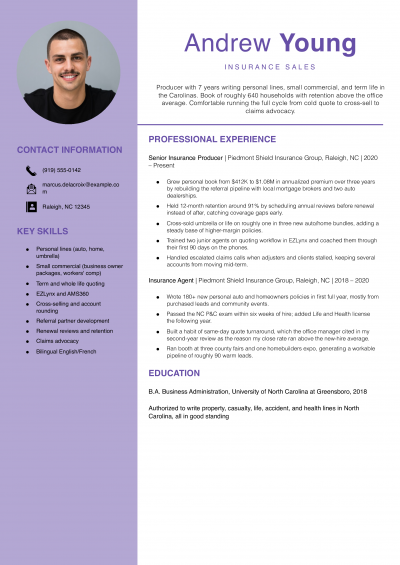
Insurance Sales Resume Examples
Name your years in insurance sales and the lines you write: personal auto, home, life, health, commercial, or a mix. State the channel you sell through, such as captive agency, independent brokerage, call center, or…
Every resume example is written and reviewed by our team of Certified Professional Resume Writers to ensure top-quality content and formatting.
Your book of business tells part of the story. Your resume tells the rest. Agency owners and sales managers look for proof you can write new policies, hit retention targets, and grow premium volume.
Lead with hard numbers: policies bound per month, renewal rate, or cross-sell ratio. List your active State Insurance Producer License and the lines you hold. The insurance agent resume examples below show you how to frame each of these details. To compare layouts before you start, browse our resume templates.
A clear state producer license and the lines you are authorized to sell help an insurance agent resume pass the first screen for agency owners. Retention rates and book-of-business growth help it move forward.
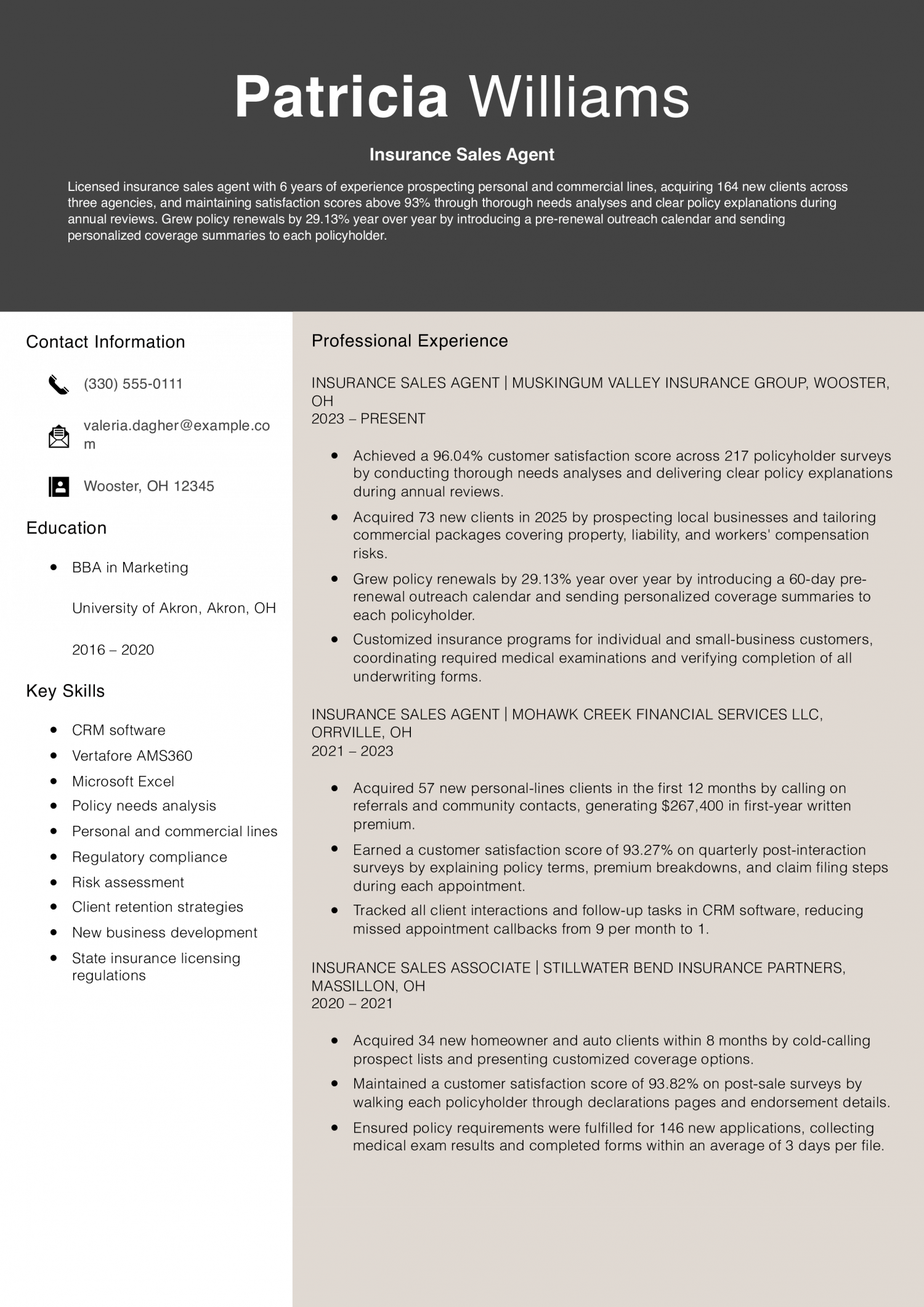
Consider this resume if you are a mid-level insurance sales agent with about six years of prospecting and retention work across personal and commercial lines. Lead with renewal growth percentages tied to the specific outreach system that produced them.
Agency owners want an agent who keeps appointments and does not lose leads. The CRM bullet works because it says how many callbacks were missed before the tracking and how many after. If you use CRM software, give the count of missed follow-ups before and after you started using it.
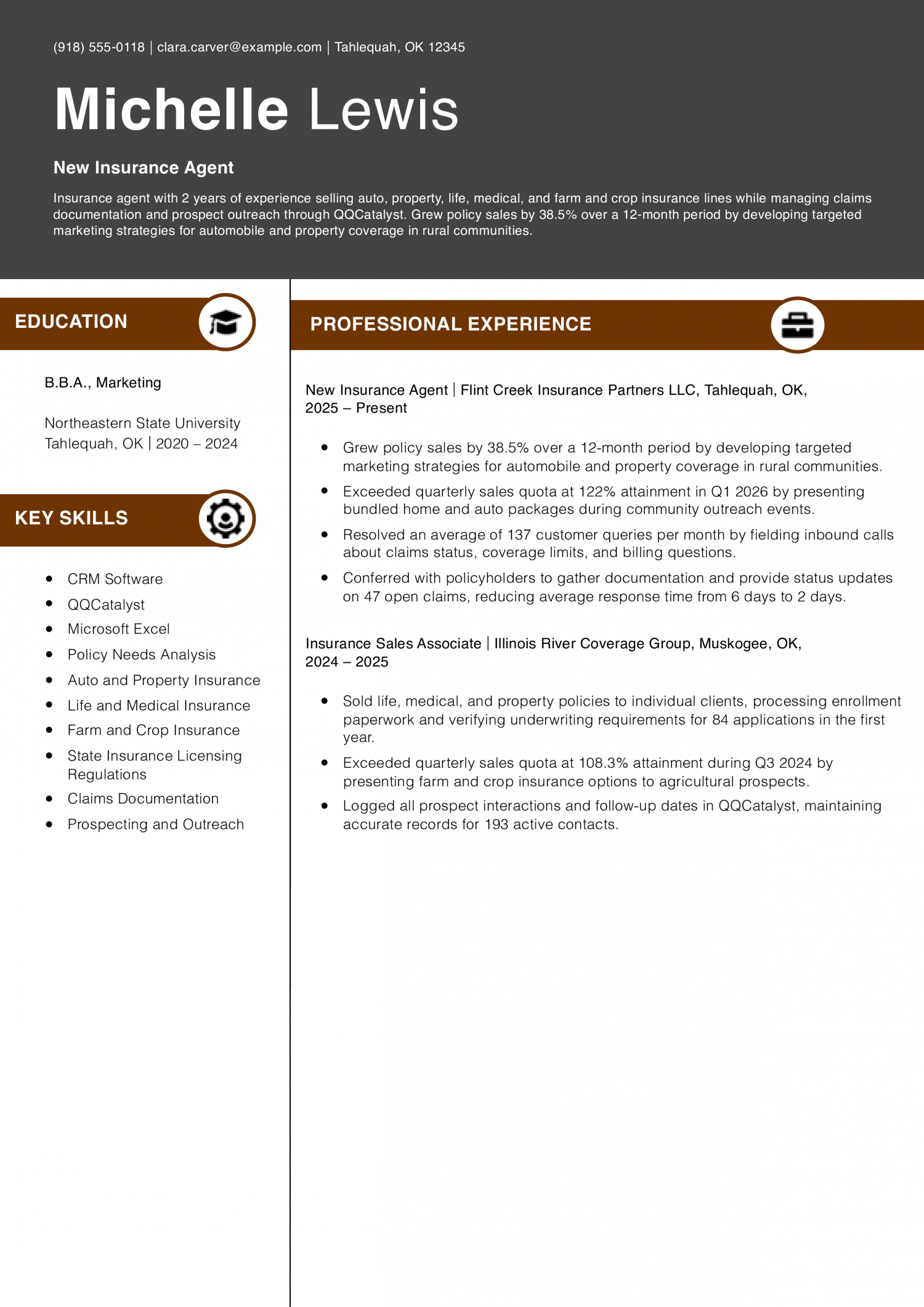
Start with this resume if you are an entry-level insurance agent building a record across multiple coverage lines. Show quota attainment for each product mix you sold, and name the outreach method behind it.
Hiring managers at agencies check whether a new agent can handle service work while selling. The claims bullet shows response time dropping from several days to fewer days, so a manager sees faster answers for policyholders. When you describe claims or service work, say how long clients waited before you stepped in and how long after.
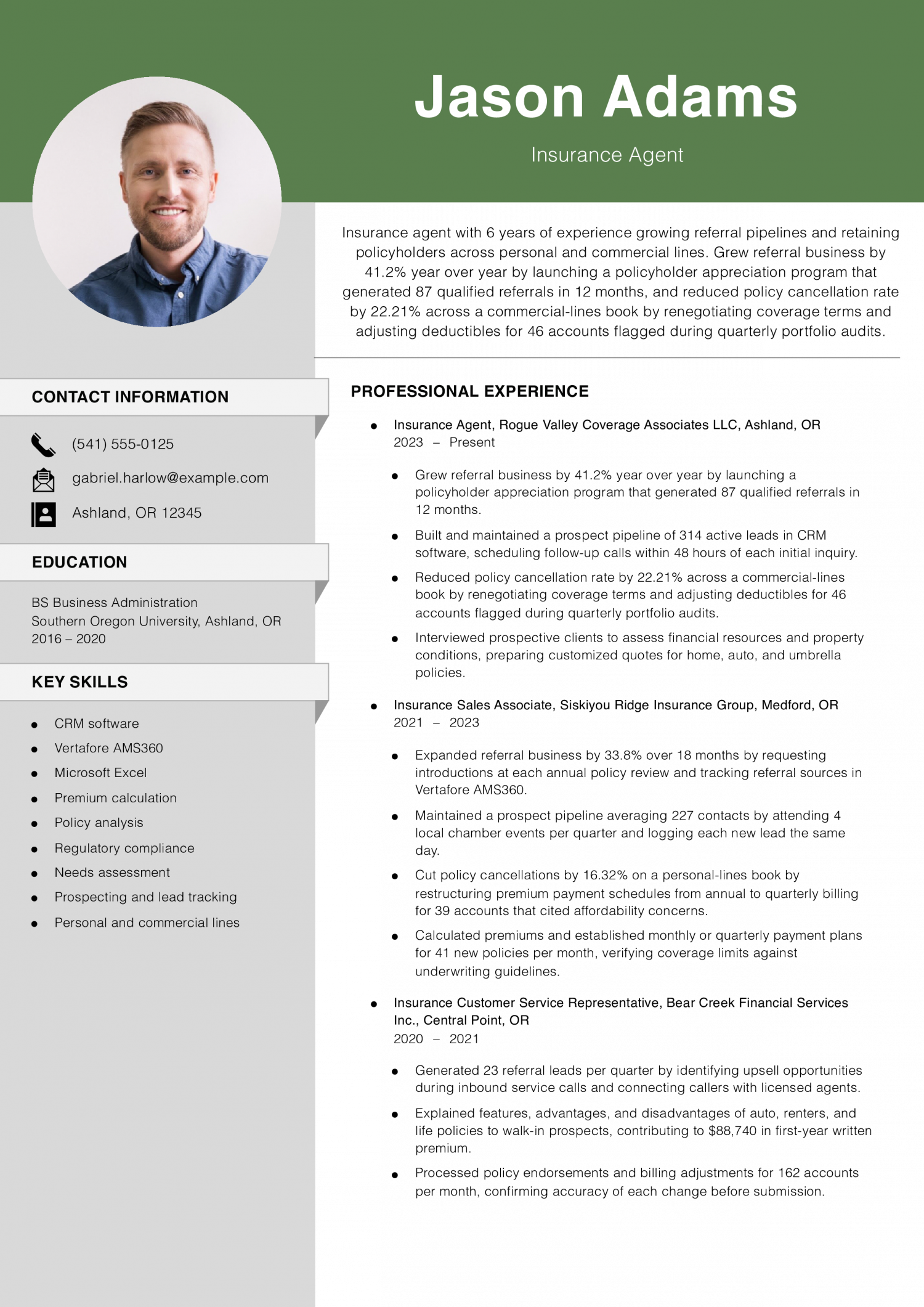
Try this resume if you are a mid-level insurance agent with about six years of referral growth and retention wins to present. Lead with cancellation-rate reductions and referral percentages so each bullet proves you protect and expand a book of business.
An agency owner wants to know what you did to retain clients. The accounts flagged during portfolio audits show this agent found at-risk clients early, then changed their coverage. If you kept clients from canceling, name the review you ran to find them and how many accounts you changed.
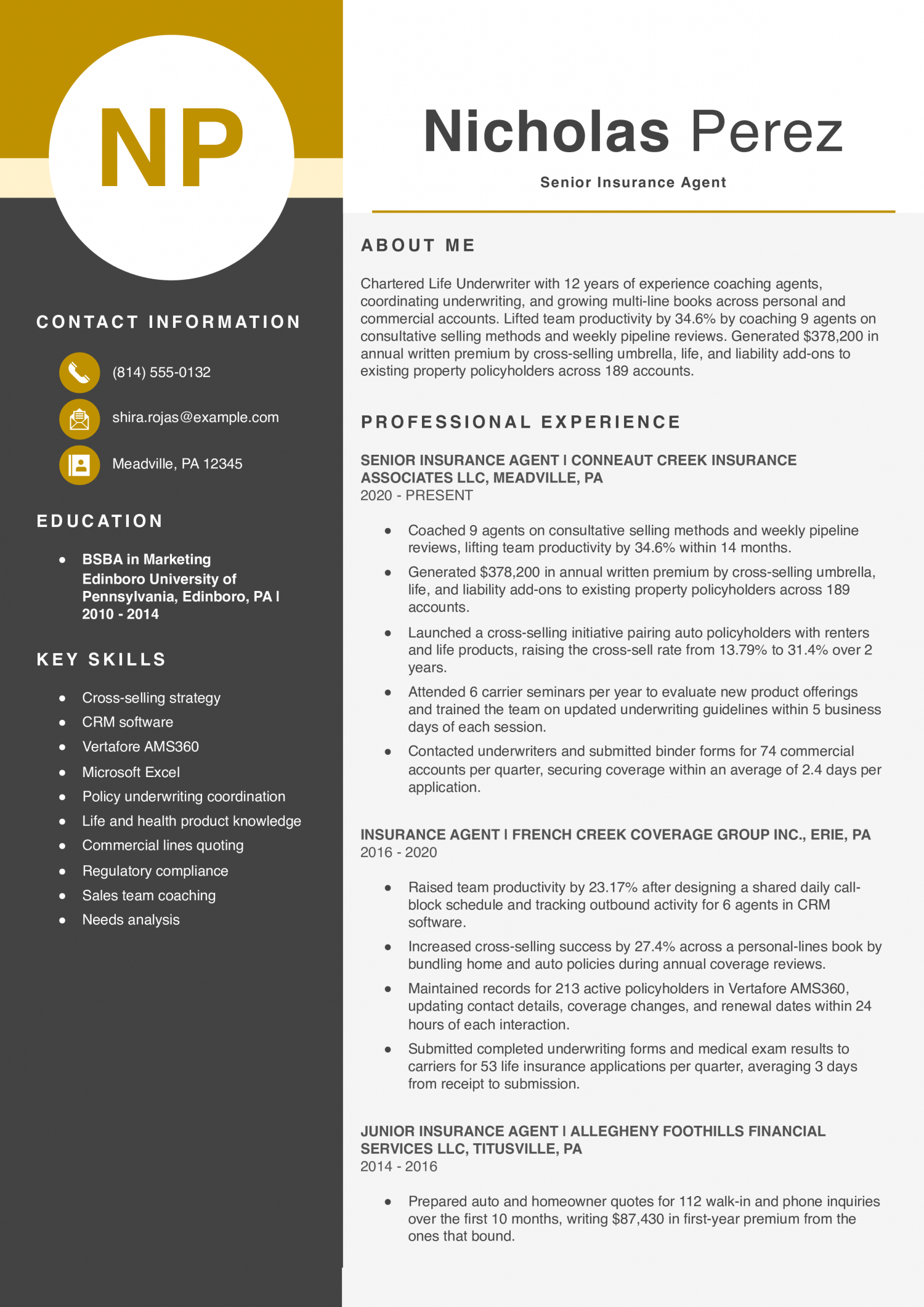
Rely on this resume if you are a senior insurance agent with over a decade of sales leadership and multi-line production results. Pair each cross-sell ratio or premium figure with the products that produced it.
For a senior agent, hiring managers look for production growth they can trust and a team that sold more. The cross-sell bullet gives a starting rate, an ending rate and a time span, so the gain can be checked. Do the same on your resume with the rate before, the rate after and how long it took.
Experienced in managing books of up to 187 client accounts across personal auto, homeowner, life, and commercial lines, with 6 years of policy analysis, carrier selection, and claims monitoring. Raised lead conversion rate from 14.07% to 28.41% by implementing a structured follow-up cadence of 3 touches within 72 hours of each inquiry. Skilled in Vertafore AMS360, CRM software, and needs-based selling across multiple partner insurers.
Your profile should state your years of licensed sales experience. Name the lines you write, such as personal auto and homeowners. Add commercial lines if you carry them.
State whether you work captive or independent. Note your book size or annual premium volume if you can share it. Agency owners and sales managers scan this section in about six seconds, so they want to know your product mix and your market right away.
Mention the client base you serve, such as small business or high-net-worth households. If you focus on life and health, say so here. Include any specialization in Medicare supplements or annuities if it applies.
This short block sets you apart from a generic sales profile.
Insurance sales is built on trackable results. Lead each bullet with an action verb and follow it with a metric. Strong metrics include new policies written per month and annual premium volume generated.
Retention rate is another number that stands out. You might note cross-sell ratio or average policy size. A bullet that says you “wrote 14 new auto policies per month” communicates far more than “sold auto policies.” Agency owners and sales managers often compare raw production numbers across resumes.
Quote your retention rate as a percentage. If you grew a book year over year, state the dollar change. Pair each number with the time frame so the reader can gauge pace.
Sort your bullets into three to five groups that reflect how the role runs. One group can cover prospecting, such as cold calls and referral follow-ups. A second can focus on quoting and binding coverage.
A third can address claims support and renewal retention. If you handle commercial accounts, give those their own heading.
Trim any bullet that restates what another one already shows. Every line should carry a distinct fact about your output or your client work.
Label each group with a subheading so the formatting stays consistent and scannable throughout your experience section.
List your State Insurance Producer License with the state name and the lines of authority it covers. Leave off the license number unless the posting asks for it. Put this entry right below your profile so it is visible at a glance.
If you hold the Chartered Life Underwriter designation from The American College of Financial Services, add it on the next line. The Chartered Property Casualty Underwriter designation from The Institutes belongs there too.
Below your credentials, name the agency management systems you use, such as Applied Epic or HawkSoft. Mention your comparative rater or quoting platforms as well. Agency owners and sales managers want to see these tools early because onboarding is faster when you already know the software.
Name your degree and school, then the year you finished. A degree in business, finance, or risk management fits well here. If your degree is in another field, that is fine because many agents enter the insurance industry from unrelated undergraduate majors.
Leave high school off if you hold a college degree.
End with any relevant professional development training, such as E&O loss prevention courses or continuing education seminars. If you completed carrier-specific product certification training, add a short list. A single page fits a career under ten years in licensed production.
Move to two pages only if you have enough distinct roles and quantifiable metrics to fill the second page at least halfway.
Policy quoting, claims handling, and renewal retention are the skill groups that earn callbacks. Compare the coverage lines below against those in the posting. Agency owners and sales managers scan for these patterns first, not generic sales platitudes.
Hard skills signal the products and systems you can sell on day one. Soft skills tell a reviewer how you build a book of business over time. A strong mix of both sets you apart from other applicants.
Agency owners weigh hard skills to gauge product knowledge and carrier familiarity. Sales managers look at soft skills to predict close rates and client loyalty. Negotiation and active listening matter as much as quoting speed.
Work the matching terms into your bullets and attach a measurable result to every soft skill. Swap out any term the posting does not list.
Mirror the posting’s exact phrasing where you can.
| Soft Skills | AI-estimated % |
|---|---|
| Client relationship building | 65% |
| Persuasive communication | 53% |
| Active listening | 50% |
| Self-motivated outreach | 37% |
| Consultative selling | 26% |
And here are the top hard skills showing up most often.
| Hard Skills | AI-estimated % |
|---|---|
| Policy customization | 77% |
| Coverage needs assessment | 67% |
| Client prospecting | 43% |
| Policy renewal management | 37% |
| Claims assistance coordination | 32% |
Skill names and rankings come from an AI model grounded in U.S. Department of Labor occupation data for insurance agents, not from a count of insurance agents’ resumes built on ResumeTemplates.com.
For an insurance agent resume, agency owners and sales managers look at policy customization and coverage needs assessment first, so the items below back those up with detail.
Agency owners and sales managers scan for terms tied to your book of business. They want proof you know their product lines and tools. Policy sales terms show your core production role. Carrier and quoting systems prove you can start on day one. Underwriting terms tell readers you understand risk selection. Retention words show you protect renewal revenue over time. Compliance terms confirm you follow state insurance regulations. Each group signals a distinct part of your value. Pick the rows that match your target role. Add the right terms to your skills or summary section.
| Niche | Keywords ATS scans for |
|---|---|
| Policy Production | new business premium, quote-to-bind ratio, cross-selling |
| Carrier Systems | Applied Epic, AMS360, comparative rater |
| Underwriting Support | risk assessment, loss ratio analysis, coverage review |
| Client Retention | policy renewal rate, book roll, claims advocacy |
| Regulatory Compliance | producer license status, E&O coverage, continuing education |
Agency owners now see AI tools in quoting workflows and lead scoring. You can overstate your use and call yourself an AI-driven agent. You can leave AI off and answer questions about it in the interview. Or you can name each tool and describe the human review steps you follow. The third is what agency owners and sales managers can validate. Describe how you checked the output before binding coverage. That honest detail matters more than a buzzword.
CRM platforms now rank prospects by likelihood to convert, so agents focus outreach on warmer leads.
Comparative raters pull pricing from multiple carriers in seconds, cutting the time per quote sharply.
AI flags coverage gaps in renewal documents, but agents still confirm accuracy before the client signs.
Chatbots handle routine questions after hours, freeing agents for complex coverage consultations during the day.
EZLynx Rating Engine: Runs comparative quotes across carriers and highlights the lowest-premium options.
HubSpot AI Lead Scoring: Ranks inbound leads by engagement data so you prioritize high-intent prospects.
Your state license gets you in the door. The credentials below tell agency owners and sales managers what you can sell and how deep your training runs. They signal whether you focus on life products, property lines, or both.
They also hint at your drive to grow past a captive book. A senior designation can set you apart when two agents show the same production numbers. List the year you earned each credential and the state or line of authority it covers.
If you hold a pending designation, note the expected completion date so reviewers see your timeline.
An agent at the 90th percentile clears the median by roughly 122 percent. That gap tells you the market pays very differently across product lines and book sizes. The floor is also far from the middle, since the 10th percentile sits about 40 percent below the median.
National employment is large, which means competition for the higher bands is real. Your resume should name the lines of coverage you write and the size of the book you manage. Lead with premium volume or policy count, not years of service alone.
Concrete production numbers let agency owners and sales managers place you in the right pay band before the first conversation.
| # | State | Median Annual |
|---|---|---|
| 1 | District of Columbia | $84,530 |
| 2 | New Jersey | $81,640 |
| 3 | Rhode Island | $79,930 |
| 4 | Wisconsin | $79,450 |
| 5 | Massachusetts | $79,300 |
| 6 | Minnesota | $78,640 |
| 7 | New York | $78,110 |
| 8 | California | $76,120 |
| 9 | Connecticut | $74,840 |
| 10 | New Hampshire | $74,370 |
| # | State | Workers | Median |
|---|---|---|---|
| 1 | Florida | 47,560 | $59,790 |
| 2 | Texas | 47,060 | $51,180 |
| 3 | California | 41,160 | $76,120 |
| 4 | New York | 22,420 | $78,110 |
| 5 | North Carolina | 20,540 | $58,710 |
Resume Templates offers HR approved resume templates to help you create a professional resume in minutes. Choose from several template options and even pre-populate a resume from your profile.
Lead each bullet with an action verb and a number that shows the result. Write "Grew a 200-household book of business by 18% in one year" instead of "Responsible for selling insurance." Pair the policy type with the outcome so agency owners can see your production at a glance.
Open with your years of experience, the lines you sell, and your strongest production figure. A summary like "P&C agent with six years of experience and a 92% retention rate" tells sales managers what you bring before they reach your work history. Keep the summary to three lines so it stays readable on screen.
Yes. Many agencies hire based on your State Insurance Producer License and your sales record. List your license, any lines of authority you hold, and your production numbers in the top third of the page.
A strong book of business and high retention rate carry more weight than a degree for most agency owners.
Focus on metrics that transfer across carriers, such as policies written per month and client retention rate. Add cross-sell ratio as a third metric. Agency owners want to see that your process works regardless of the product portfolio you carried before.
Place a one-line note in your work history that covers the gap period. If you kept your State Insurance Producer License active during that time, say so. Sales managers care most about whether your license is current and your selling skills are sharp.
State the model in your job title line, such as "Independent Agent" or "Captive Agent, Acme Insurance." Under each role, note how many carriers you quoted or the single carrier you represented. This distinction tells agency owners how much product training you will need.
Your resume usually fits on one page if you have fewer than ten years in the business. If you have held roles across several lines of authority, a second page is fine. Keep the strongest production numbers and your active license on page one so nothing critical sits below the fold.
Most insurance agent resumes need nothing fancy. Pick the ATS-friendly template or choose the basic template and then use headings that say what the section is, a common font, and no graphics.
Insurance Agent Resume
4.7/5 stars with 103 reviews

Executive Resume Writer and Career Coach
Andrew Stoner is an executive career coach and resume writer with 17 years of experience as a hiring manager and operations leader at two Fortune 500 Financial Services companies, and as the career services director at two major university business schools.
© 2026 Resumetemplates.com All rights reserved.