Real Estate Agent Resume Examples and Templates for 2026



Premium growth tied to specific quarters, a cross-sell ratio into life or umbrella coverage, and a state licensing line at the top are what separate the insurance sales resumes agency owners advance from the rest.
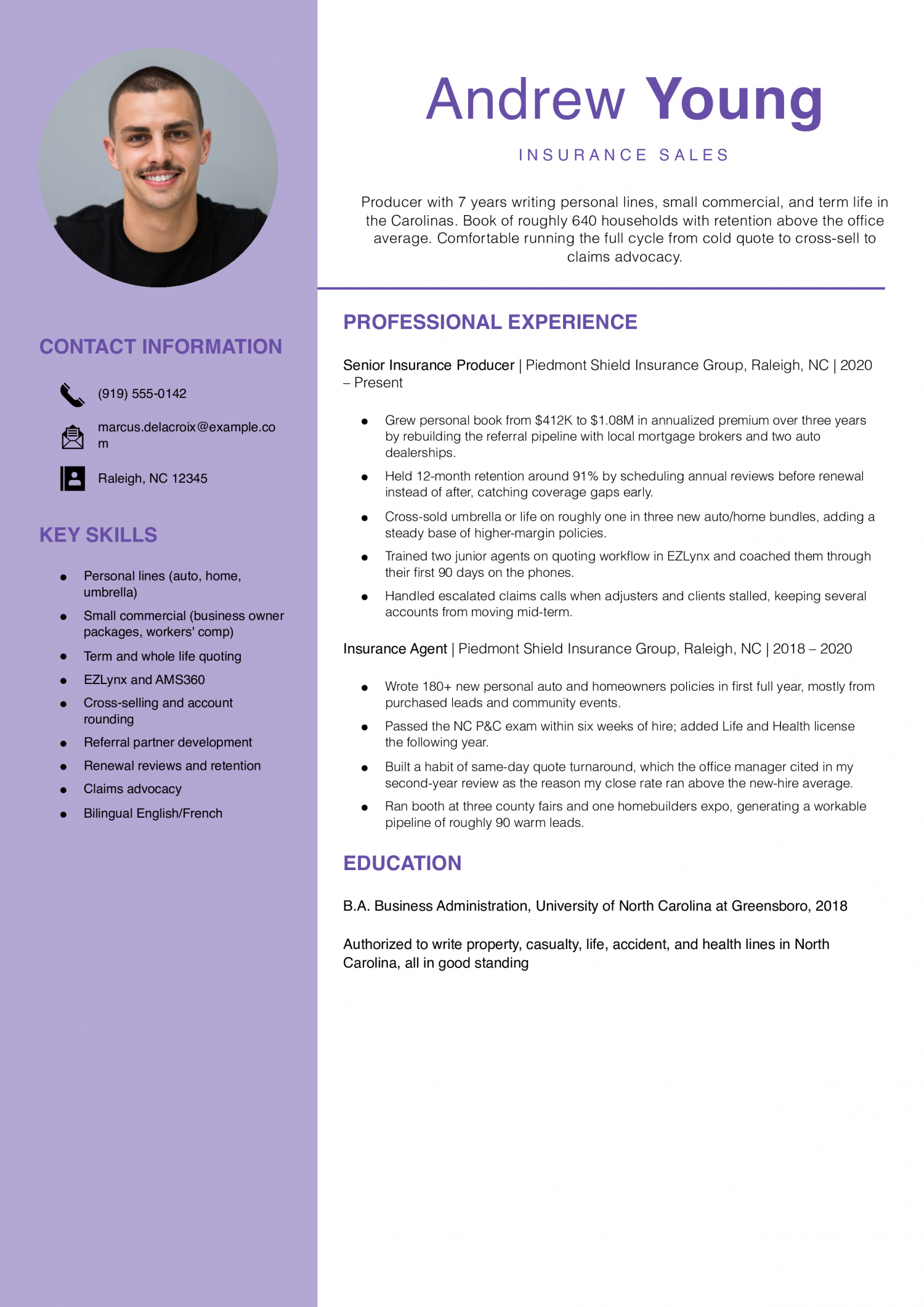
This resume fits a licensed agent in the first few years of writing auto, home, or life policies. It has to prove you can quote, bind, and cross-sell without heavy oversight from your agency owner.
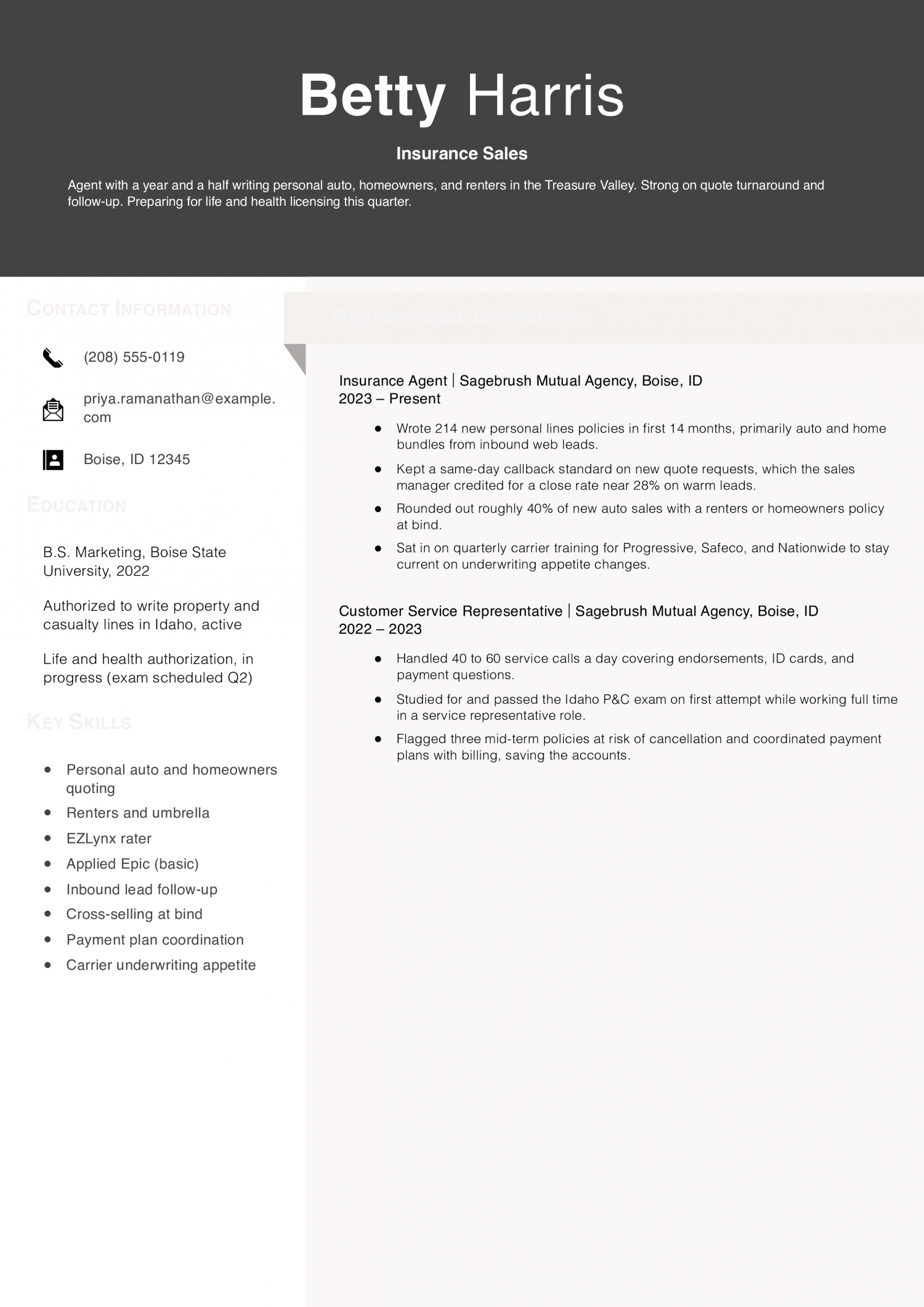
A senior producer runs a personal book worth serious annual premium and mentors newer agents on the floor. The resume has to show retention rates, cross-line ratios, and the size of the book you carry.
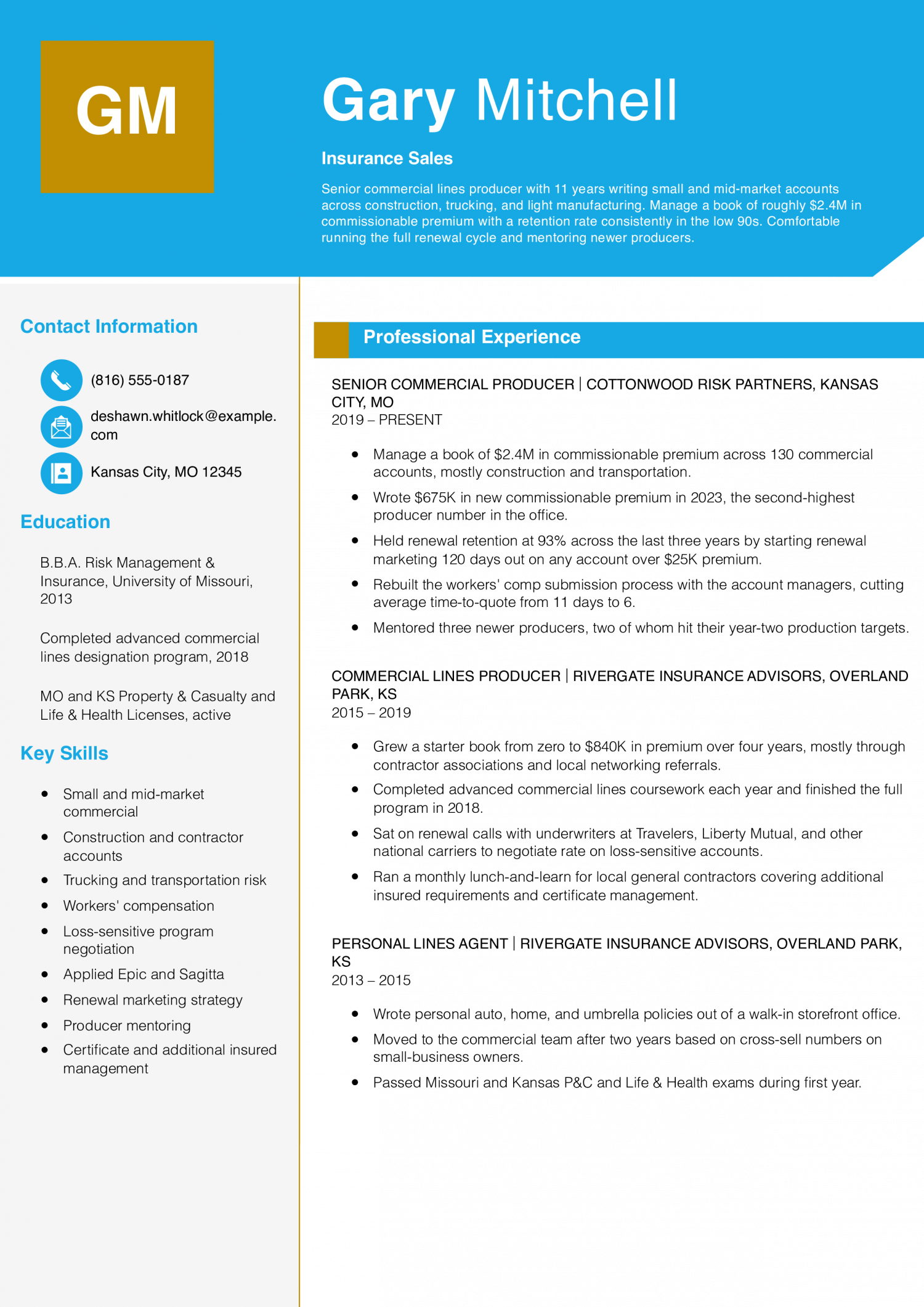
An agency owner runs a scratch or acquired office and answers to the carrier on growth, loss ratio, and staff. The resume has to show book value, agency profit, and how you built and kept a producing team.

Jordan Halloway
Charleston, SC | (843) 555-0174 | [email protected] | linkedin.com/in/jordanhalloway
Producer with 9 years in coastal personal lines and small commercial. Manage a personal book of roughly $1.6M in annualized premium with retention in the low 90s. Known in the office for handling hurricane-season claims volume without losing renewal accounts.
Lead Personal Lines Producer
Harborline Insurance Associates | Charleston, SC | 2020-Present
Personal Lines Producer
Harborline Insurance Associates | Charleston, SC | 2017-2020
Insurance Agent
Palmetto First Insurance Group | Mount Pleasant, SC | 2015-2017
Customer Service Representative
Palmetto First Insurance Group | Mount Pleasant, SC | 2014-2015
Your profile should sit at the top of page one and read as a scope statement. Name your years in insurance sales and the lines you write: personal auto, home, life, health, commercial, or a mix. State the channel you sell through, such as captive agency, independent brokerage, call center, or worksite.
Give the geography and the client type, whether that is individual households, small business owners, or mid-market accounts. Agency owners and district sales managers read this block first to place you against an open territory. Three or four tight lines do the work here.
A vague profile forces the reader to guess where you belong, and most will move on.
Insurance sales is a numbers role, and bullets without a number tend to read as duties. Agency owners and district sales managers scan for premium written, policies bound, and retention first. Pick two or three metrics per role and keep them honest.
Written premium per month or year, close rate on quoted policies, and cross-sell ratio per household all travel well. Retention percentage, book size in force, and average premium per policy show you can hold a book, not only open one. If you sold in a call center, add dials per day, contact rate, and quote-to-bind time.
Round to the nearest whole number, and give the timeframe so the reader can pace the figure.
Break the bullets under each role into three or four buckets so the page scans in seconds. Prospecting and lead work covers referrals, networking, outbound calls, and internet leads. Quoting and binding covers needs analysis, carrier selection, rating, and underwriting follow-up.
Account service covers renewals, endorsements, claims intake, and billing questions that keep a book on the books. Cross-sell and household rounding is its own bucket, since it shows you move a mono-line client into a full account. If you handle commercial, add a bucket for risk review and certificates of insurance.
Naming the buckets in your bullets, not only the tasks, helps the reader see the shape of your week.
A licensed credentials block belongs near the top, under the profile, not buried on page two. List the state or states where you hold a resident or non-resident license, and the lines of authority: property and casualty, life, health, or variable. Note that licenses are in good standing rather than printing numbers.
Agency owners and district sales managers need this visible early because an unlicensed hire cannot quote on day one. Add appointments with major carriers if you sold independent, since that signals a portable book. Below that, list the agency management and rating systems you have used, such as AMS360, EZLynx, Applied Epic, HawkSoft, Salesforce, or Guidewire.
Dialer and CRM fluency belongs here too.
Education sits at the bottom for most insurance sales roles, and one tight block does the job. Put your degree, the school name, and a recent graduation year on one line. If you did not finish a degree, name the coursework you did complete and move on.
Under education, add a short continuing education line for courses your state requires each renewal cycle. If you have started designation coursework through a recognized industry body, name the program and the modules passed so far. Agency owners and district sales managers read this section to gauge how you invest in the craft after hours.
A short, honest block reads better than a padded one, and it leaves room on page one for production numbers.
Five years ago, an insurance sales resume read like a product menu of lines quoted. The mix has shifted toward retention rates, cross-sell ratios, and named carrier appointments. Agency owners and district sales managers now scan for both sides of the ledger.
Hard skills prove you can quote, bind, and service a book without hand-holding. Terms like producer license, policy binding, and CRM pipelines tell them you can start on day one. Soft skills carry a different weight in this seat.
Consultative selling and objection handling back up the numbers you cite in your bullets. A closer who cannot hold a renewal call costs the agency more than they write. Read the target posting twice before you edit your skills block.
Pull the exact phrases the posting repeats, then check them against the two tables below. Keep hard skills at the top and let soft skills echo inside your bullet evidence.
| Soft Skills | AI-estimated % |
|---|---|
| Consultative selling | 75% |
| Active listening | 55% |
| Client relationship building | 40% |
| Persuasive communication | 35% |
| Self-motivated outreach | 32% |
And here are the top hard skills showing up most often.
| Hard Skills | AI-estimated % |
|---|---|
| Policy needs assessment | 65% |
| Insurance plan customization | 63% |
| Coverage explanation | 46% |
| Client prospecting | 37% |
| Policy renewal management | 25% |
Skill names and rankings come from an AI model grounded in U.S. Department of Labor occupation data for insurance sales agents, not from a count of insurance sales agents’ resumes built on ResumeTemplates.com.
These are the must-haves hiring teams look for when scanning an insurance sales resume.
Agency owners and district sales managers read for the lines you sell. They also read for the carriers you have appointments with. The rows below group terms by the work each one covers. Personal lines covers auto, home and umbrella policies for families. Commercial lines covers small business risk and workers comp. Life and health covers term, whole life and Medicare products. Property and casualty covers the P&C license work most agencies hire for. Sales operations covers the pipeline, the CRM and the book you carry. Pick the rows that match your desk. Drop terms you cannot back up in an interview. Match the exact wording a carrier or state uses.
| Niche | Keywords ATS scans for |
|---|---|
| Personal Lines | auto quoting, homeowners policies, umbrella coverage |
| Commercial Lines | small business quoting, workers comp, general liability |
| Life and Health | term life, Medicare Advantage, whole life |
| Property and Casualty | P&C license, carrier appointments, loss runs |
| Sales Operations | CRM pipeline, book of business, cross sell |
AI use on an insurance sales resume can go three ways: lead with a line like ‘AI-powered producer’ that agency owners screen out, leave it off and answer the question in the interview, or describe the workflow as it actually runs on your book. The third is what agency owners and district sales managers can validate. They want to know which tools touched a quote, a policy review or a renewal call. They also want to know who checked the output before it reached a client. Name the tool, name the task, and name your review step. That is the version a sales manager can trust and repeat on the floor.
Carrier and CRM scoring models now rank inbound leads, so your day starts with a queue you did not build.
Rater tools pre-fill applications from prior policies and public data, cutting keying time on auto and home submissions.
Generative tools draft renewal emails and review agendas, which you edit for tone, coverage facts and state rules.
Recorded call software transcribes and flags coverage disclosures, giving managers a written record of what you quoted.
Insurance Sales is one of the larger occupations tracked by BLS, and the pay spread is wide from bottom to top. The 10th percentile sits well below the median. The 90th percentile earns more than twice what a median seller takes home.
That shape shows a long entry tier of new producers. A much smaller group of high earners hold big books with renewals. Agency owners and district sales managers read a resume for signals that place you above that entry tier.
To place higher on the band, lead with the lines you sell, your book retention, and premium written last year.
| # | State | Median Annual |
|---|---|---|
| 1 | District of Columbia | $84,530 |
| 2 | New Jersey | $81,640 |
| 3 | Rhode Island | $79,930 |
| 4 | Wisconsin | $79,450 |
| 5 | Massachusetts | $79,300 |
| 6 | Minnesota | $78,640 |
| 7 | New York | $78,110 |
| 8 | California | $76,120 |
| 9 | Connecticut | $74,840 |
| 10 | New Hampshire | $74,370 |
| # | State | Workers | Median |
|---|---|---|---|
| 1 | Florida | 47,560 | $59,790 |
| 2 | Texas | 47,060 | $51,180 |
| 3 | California | 41,160 | $76,120 |
| 4 | New York | 22,420 | $78,110 |
| 5 | North Carolina | 20,540 | $58,710 |
Resume Templates offers HR approved resume templates to help you create a professional resume in minutes. Choose from several template options and even pre-populate a resume from your profile.
Yes, insurance sales gives you production numbers, retention rates, and license credentials that read well on a resume.
Agency owners and district sales managers want to see written premium, policy counts, and renewal rates by line of business. Those figures move you from generic sales prose into a career story a reader can price.
Yes, life insurance sales shows longer sales cycles, needs analysis, and steady persistency, which reads as senior work.
Put your 13-month persistency rate, your average face amount, and your mix of term and permanent policies. Those three lines tell a reader you sell past the first premium and hold the book.
Yes, health insurance sales is worth calling out because it carries its own enrollment windows, plan types, and compliance training.
Name the markets you have worked, whether that is individual under-65, Medicare Advantage, group health, or supplemental. Then show enrollment volume during open enrollment and retention through the plan year.
Lead with written premium, policy count, and retention or persistency for the last two full years.
Name the lines you sell, the states you are licensed in, and the carriers or agency systems you have used. Save appointment counts and quoting activity for bullets under each role, not the summary.
List the state, the lines of authority, and the phrase in good standing, on one line near the top of the resume.
Write it as "Texas resident producer, property and casualty, life and health, in good standing." Do not publish your license number on the resume itself; carriers verify it through the state department of insurance.
Say plainly that you hold a resident license in your current state and will apply for a nonresident license in the hiring state on offer.
Most states process a nonresident producer license in one to three weeks once the resident license is verified. Agency owners and district sales managers read that line as a working plan, not a gap.
Translate your carrier-specific metrics into figures an independent agency will recognize, such as items per household and retention by line.
Name the comparative rater or agency management system you have used, like EZLynx, Applied Epic, or HawkSoft. Show that you have quoted more than one carrier, even if the captive channel limited you to one.
For an insurance sales agent, an ATS-friendly template is the safest pick, because it puts your certifications and experience where a hiring manager scans first. A basic template is a solid alternative. Whichever you choose, keep the formatting clean and easy to parse: clear section headings, a standard font, and no graphics a parser can choke on.
Executive Resume Writer and Career Coach
Andrew Stoner is an executive career coach and resume writer with 17 years of experience as a hiring manager and operations leader at two Fortune 500 Financial Services companies, and as the career services director at two major university business schools.
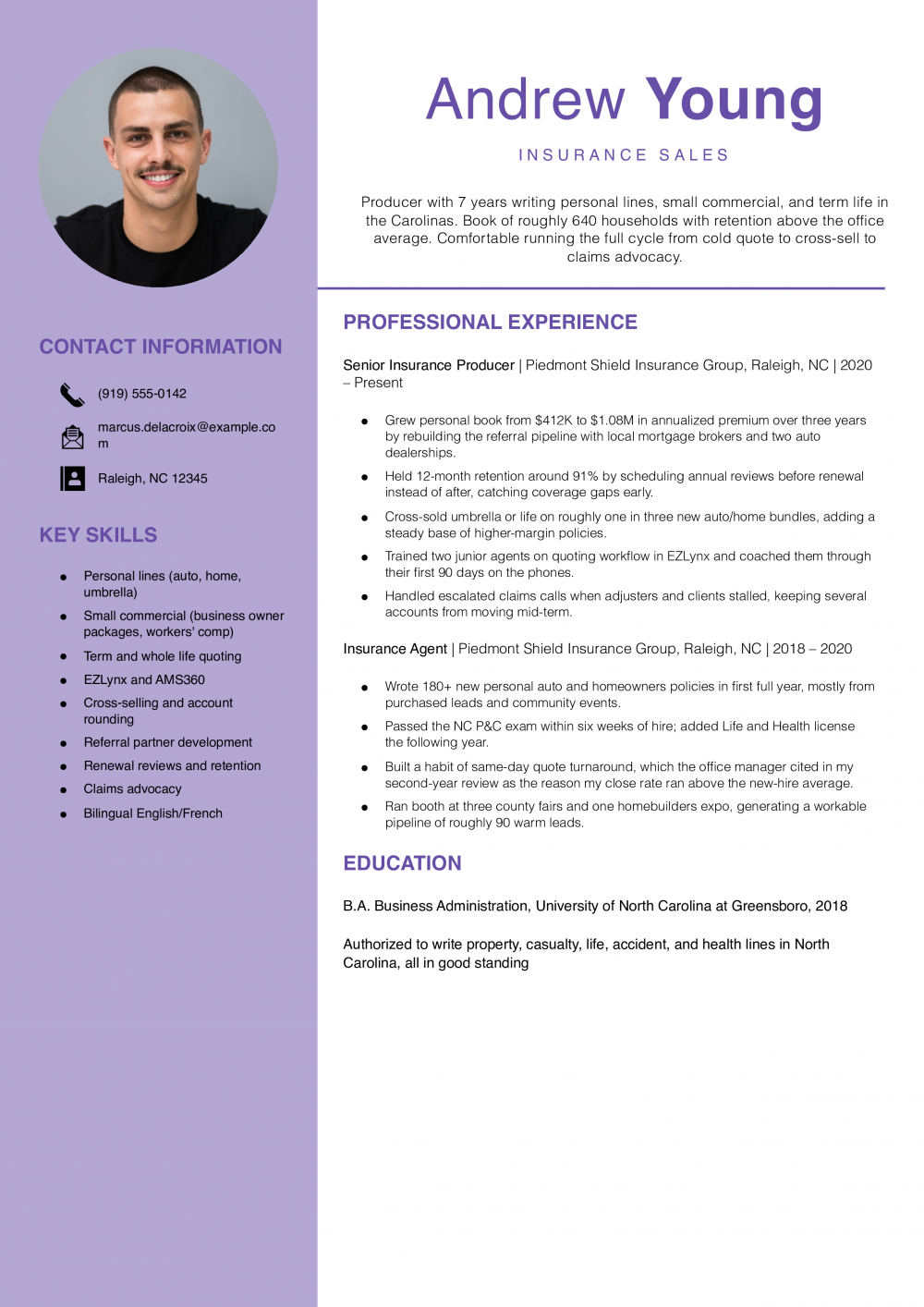
Customize this template in our builder in under 10 minutes.