Insurance Sales Resume Examples
Your profile should sit at the top of page one and read as a scope statement. Name your years in insurance sales and the lines you write: personal auto, home, life, health, commercial, or a…
Every resume example is written and reviewed by our team of Certified Professional Resume Writers to ensure top-quality content and formatting.
Your loss ratio track record carries more weight than any list of soft skills. Underwriting managers and chief underwriters want to see how you price risk, not that you "pay attention to detail." Show the lines of business you have bound and the premium volume you manage.
A strong underwriter resume leads with risk selection decisions and their outcomes. Name the rating tools and guidelines you apply, such as ISO classes or carrier-specific manuals. The examples below show you how to frame that experience on the page. To compare layouts before you start, browse our resume templates.
Underwriting managers decide whether to keep reading by the summary section; if risk appetite, line-of-business focus, and loss ratio results are not obvious there, the resume moves to the reject pile.
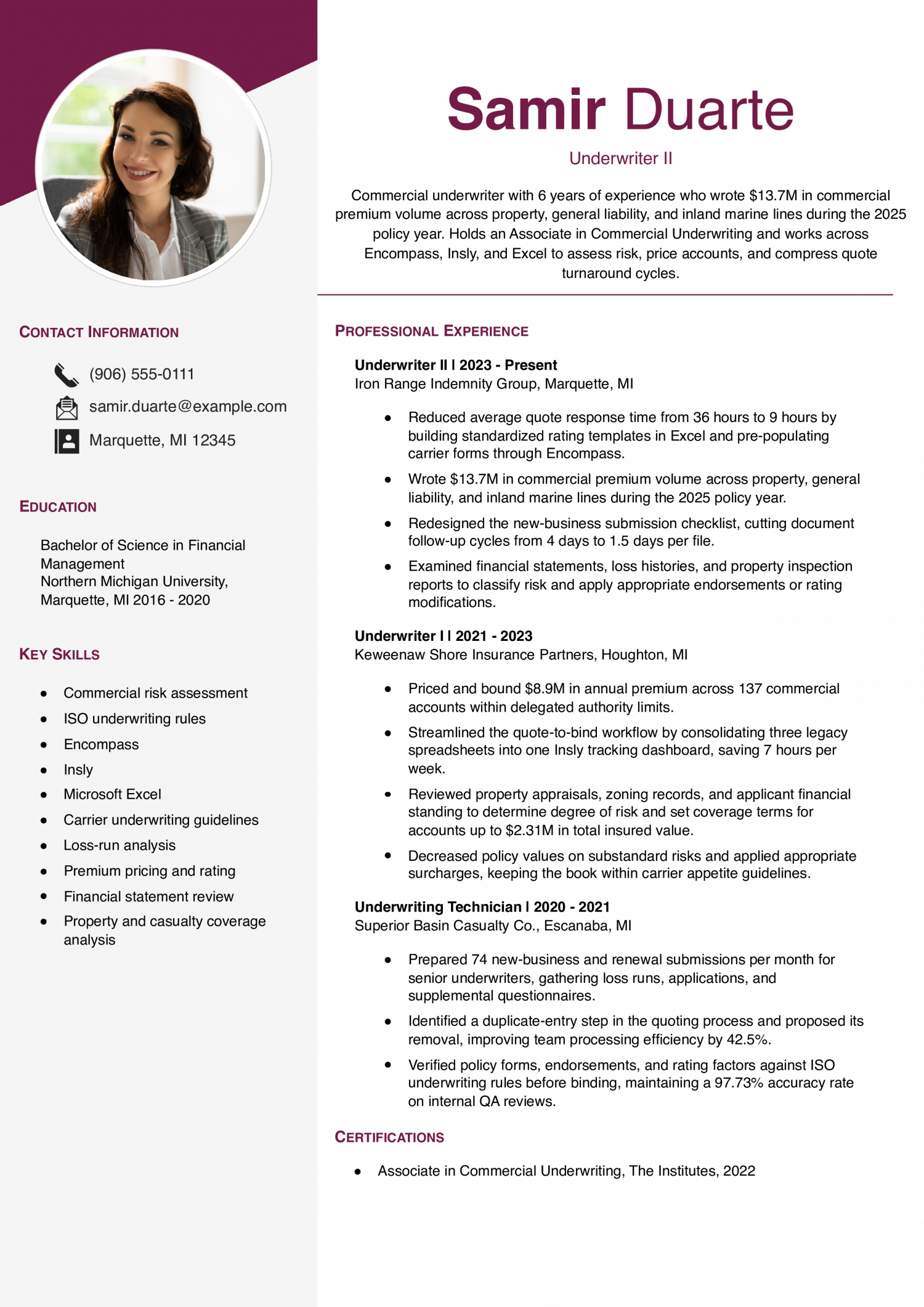
Pick this resume if you are a mid-level underwriter with about six years of commercial lines experience aiming for a larger book or a senior title. Lead with a before-and-after turnaround metric that proves you speed up the quote cycle, not only price risk.
Premium volume across named coverage lines shows both the dollar size and the range of authority. An underwriting manager sees the total premium and which coverage lines it includes. For your own book, state the total premium and list the lines it covered.
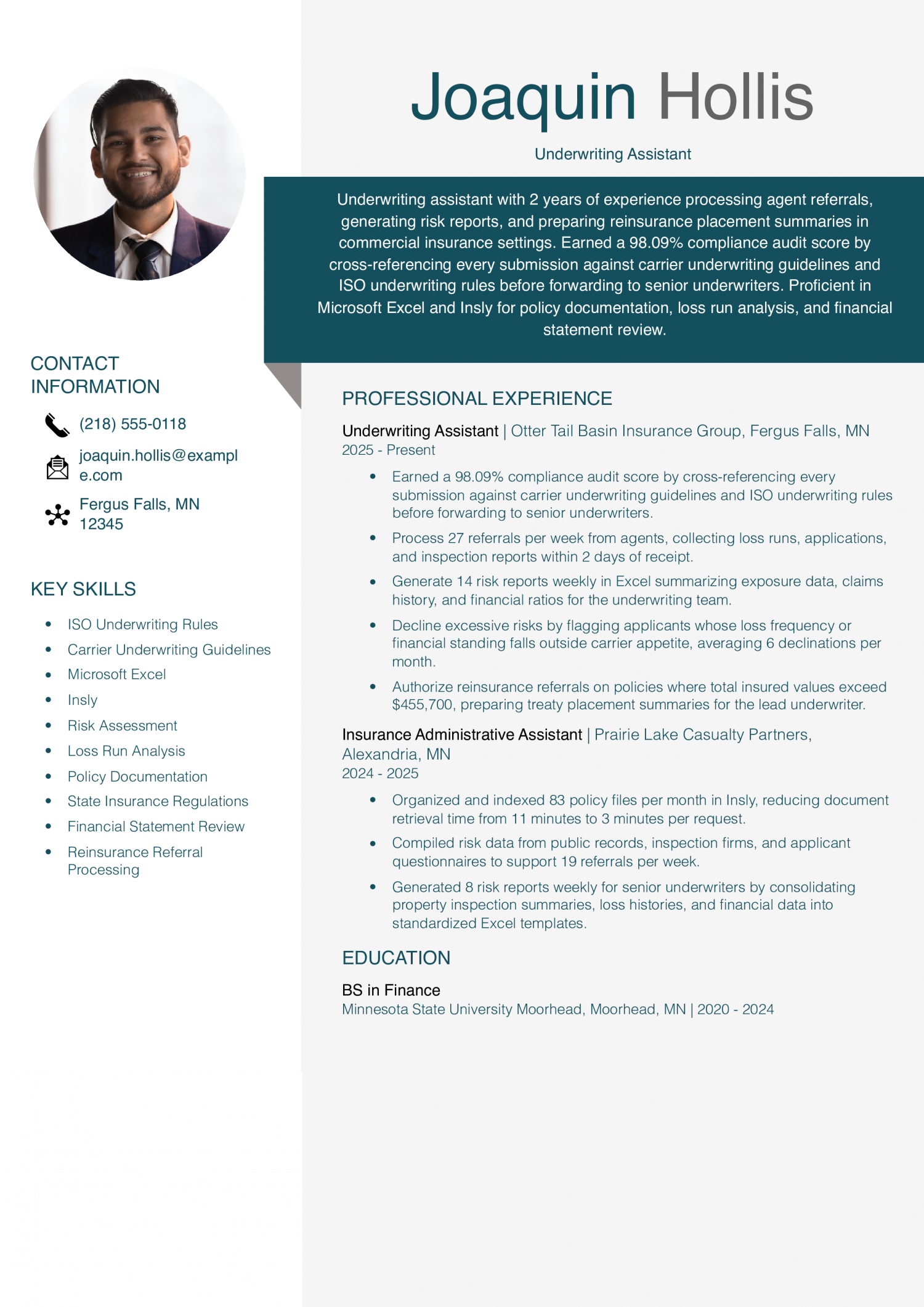
Start with this resume if you are an entry-level underwriting assistant building your first year or two of commercial insurance experience. Lead with a compliance audit score to prove you can follow carrier guidelines without constant supervision.
Declined applications are the outcome, but the screening criteria and the monthly count are what make the bullet useful. A carrier sees someone protecting the book from bad risk. State the reason you flag applications, the standard you check against, and how often the decision comes up.
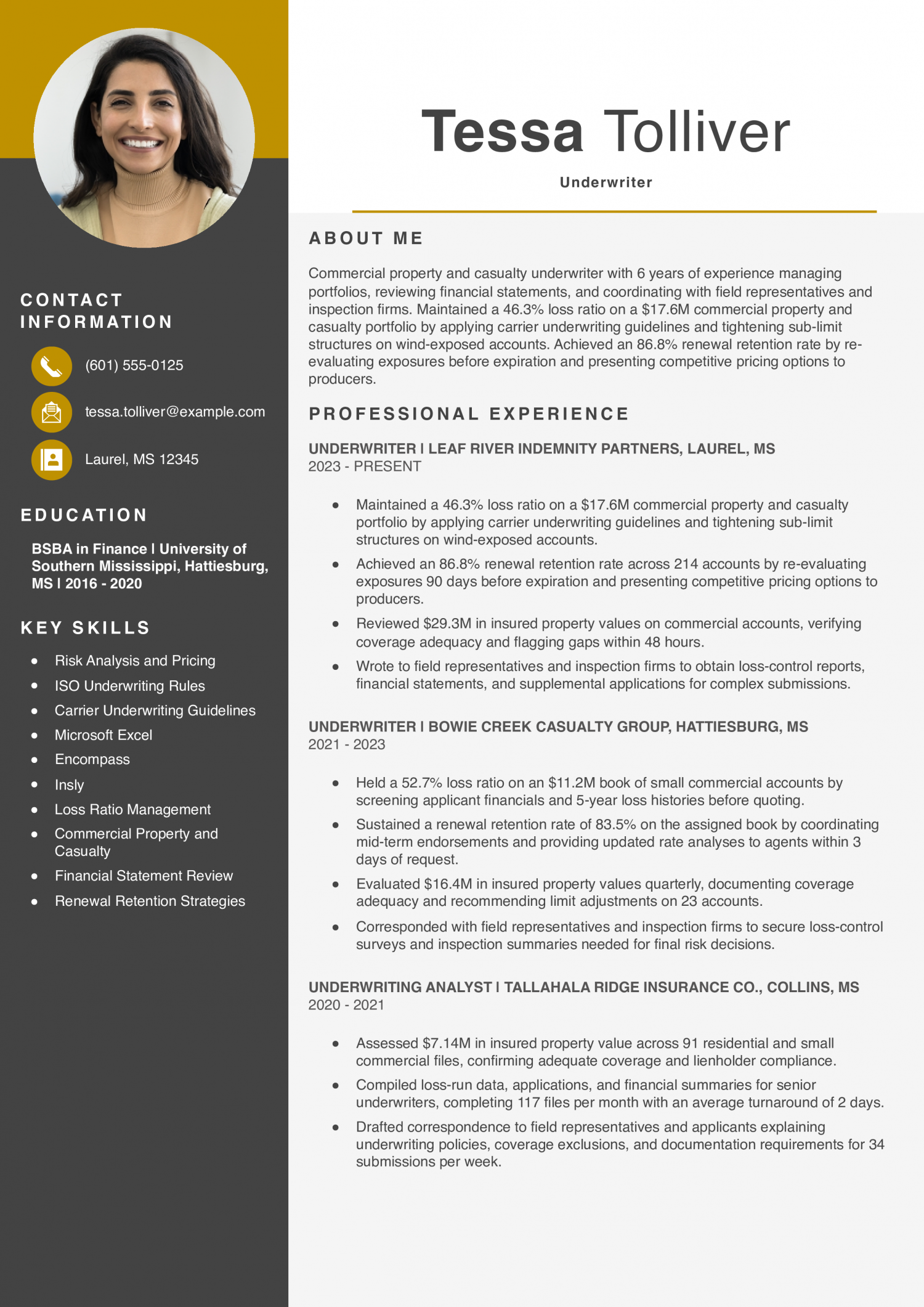
Try this resume if you are a mid-level underwriter with about six years in commercial lines and a record of managing retention alongside loss ratios. Lead with the specific sub-limit or screening method behind your best loss ratio rather than listing general underwriting duties.
Retention numbers only mean something when you explain the method. Reviewing exposures months before renewal and presenting pricing options to brokers is the work behind those renewals. When you describe your book, name the review steps you follow and say when in the policy cycle you take them.
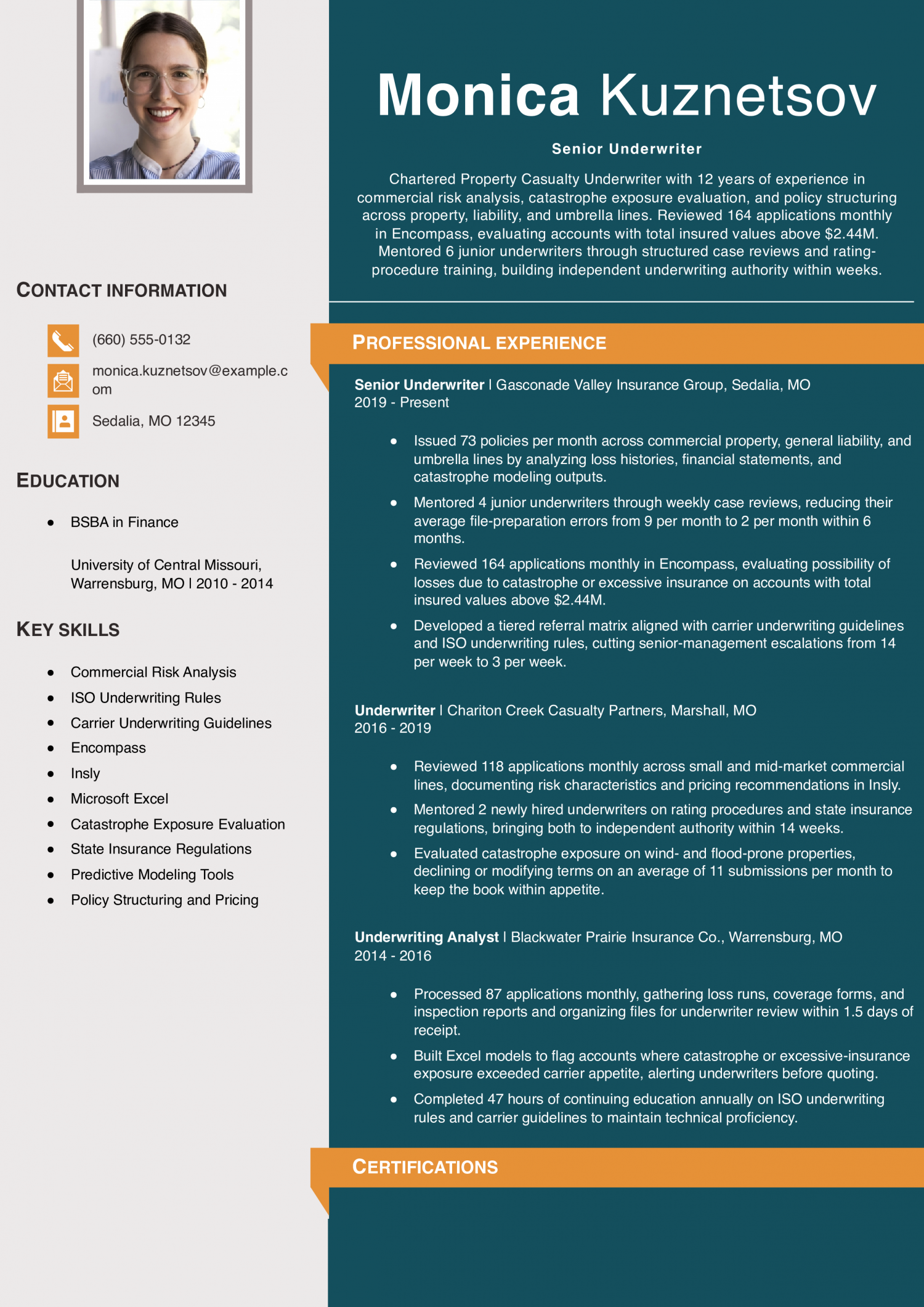
Lean on this resume if you are a senior underwriter with over a decade in commercial lines and a mentoring record. Lead with escalation-reduction metrics to prove you protect leadership bandwidth while keeping authority close to the risk.
Mentoring shows up on plenty of resumes, but a file-error count that dropped over several months shows it worked. A manager sees the trainee’s progress in those two numbers. State the error type you targeted, where the count started, and where it landed.
Commercial underwriter with 7 years of experience managing agent relationships, applying ISO underwriting rules and carrier underwriting guidelines, and pricing accounts in Encompass, Insly, and Microsoft Excel. Reduced the default rate by 42.6% on a $15.9M commercial book by adding cash-flow ratio thresholds and 3-year receivables trend analysis to the risk selection process. Maintained an application approval rate of 86.6% while servicing portfolios across independent agency networks in Montana.
Your profile sits at the top of page one. It should state your years of underwriting experience and the lines you handle. Name the coverage types you evaluate, such as commercial property and general liability.
Add a third line if you also write inland marine or professional liability. State the premium volume you manage per year. Mention whether you work in admitted or surplus lines markets.
If you focus on a specific industry vertical, say so here. A clear scope statement helps underwriting managers and chief underwriters place you in the right team fast. Keep this section to three or four lines.
Every word should narrow your fit to a real desk.
Most strong underwriter resumes lead with measurable results. State the annual premium volume you wrote or renewed. Include your loss ratio for the book you managed.
Note the number of submissions you reviewed each month. A bullet without a number tends to read as a duty, not a result. Cite the percentage of accounts you retained at renewal.
If you grew a book, state the dollar increase and the time frame. Underwriting managers and chief underwriters scan for these figures early. They want to see that you price risk well and protect profitability.
Pair each metric with a short phrase about how you reached it. Two strong numbers per role often carry more weight than five vague ones.
Break your experience into the types of work you perform. Risk selection and pricing is one natural group. Include how you analyze loss runs and financial statements.
A second group covers policy structuring, where you set terms, conditions, and endorsements. A third group is broker and agent relationship management. Note how you negotiate coverage and handle referrals.
If you perform portfolio monitoring, list that as its own category. Include audits, file reviews, or authority limit checks there. This structure keeps your resume from reading like a single wall of tasks.
It also helps underwriting managers and chief underwriters see which skills transfer to their open desk. Match your groups to the language in the job posting when you can.
Create a credentials block on page one, right below your profile. List your underwriting designations with their status. If you hold the Chartered Property Casualty Underwriter designation from The Institutes, place it here.
The Associate in Commercial Underwriting from The Institutes also belongs in this block. Underwriting managers and chief underwriters look for these early in a review. Name the rating and quoting platforms you use daily.
Include any policy administration systems you have worked in. Mention data tools you rely on for loss modeling or exposure analysis. Putting credentials and tools high on the page saves reviewers time.
It also signals that you meet baseline requirements before they read further. Keep each entry to one line so the block stays clean.
Your education section should list your degree, school, and graduation year. A degree in finance, risk management, or business is common for this role. If you completed coursework in insurance or actuarial science, note it.
Place education after your experience section on page one or two. In your closing section, add any professional memberships you hold. Industry groups can signal your commitment to the field.
You can also list relevant training, such as reinsurance workshops or catastrophe modeling courses. Keep this section brief so it does not crowd your experience bullets. Underwriting managers and chief underwriters rarely spend long on these details.
They matter most when two candidates have similar books and loss ratios.
Five years ago, an underwriter resume read like a list of policy types. The mix has shifted toward risk modeling tools and data skills. Pricing software now shows up more than coverage categories alone.
Underwriting managers and chief underwriters weigh hard skills first. They want proof you can price risk and run loss models. They then scan for soft skills tied to real results.
Read each table below before you open the job posting. Check which terms the posting repeats. Add those terms to your bullet points word for word.
Do not list a skill you cannot back up with a result. A bare claim scores no points with a reviewer. Pair each skill with a metric from a past role.
Treat soft skills as labels for outcomes you proved on the job. One strong example beats three vague claims.
| Soft Skills | AI-estimated % |
|---|---|
| Analytical decision-making | 73% |
| Broker relationship management | 53% |
| Attention to detail | 41% |
| Deadline management | 39% |
| Cross-functional collaboration | 25% |
And here are the top hard skills showing up most often.
| Hard Skills | AI-estimated % |
|---|---|
| Risk assessment | 75% |
| Policy coverage analysis | 53% |
| Premium calculation | 45% |
| Underwriting guidelines compliance | 40% |
| Loss ratio evaluation | 32% |
Skill names and rankings come from an AI model grounded in U.S. Department of Labor occupation data for underwriters, not from a count of underwriters’ resumes built on ResumeTemplates.com.
These are the must-haves hiring teams look for when scanning an underwriter resume.
Underwriting managers are split on AI right now. Some carriers want underwriters who use predictive models to speed risk selection. Others worry that over-reliance on algorithms creates blind spots in complex accounts.
Name the tools you actually use in your workflow. Describe how you check and adjust AI-generated risk scores. Do not claim you “built a model” if you only reviewed its output.
Underwriting managers and chief underwriters will ask you to walk through a real decision. They want to see that you apply judgment on top of the data. Honest framing beats inflated tool lists every time.
What AI is actually changing for this role
Risk scoring: Predictive models now flag high-risk applications before you open the file, cutting initial triage time.
Pricing accuracy: Machine learning tools analyze loss history across larger data sets than manual rate reviews can cover.
Portfolio monitoring: AI dashboards surface concentration risks in a book of business and alert you to emerging trends.
Document intake: Optical character recognition tools extract key data from submissions so you can focus on analysis.
AI tools to name
How to phrase AI on your resume
Do
Skip
Credentials signal technical depth to underwriting managers. They confirm you can price risk and read financials. The right designation separates you from generalist applicants.
Underwriting managers and chief underwriters read your certifications as a map of where your career is heading. The items below tell them which lines of business you have studied most. They also signal how far you plan to grow in the field.
A strong list helps set you apart from peers at the same career stage. It shows you put time and money into building real depth. List each credential on its own line with the issuing body and the year you earned it.
Place the most advanced designation first so the reader sees your highest level of study right away. If you are still working toward a credential, add the expected completion date. Drop any lapsed or expired items that you do not plan to renew.
Keep each entry to one line so the section stays clean and easy to scan. Short entries let the reader move through the list in seconds.
The top-paying states for underwriters tend to cluster in smaller, low-supply markets rather than the large coastal metros you might expect. Regions with fewer underwriters often pay more to attract and keep talent. The gap between the 90th percentile and the median is wide, close to 78 percent.
Meanwhile, the 10th percentile sits roughly a third below the median. That spread tells you the field rewards specialization and tenure in measurable ways. If you are open to relocating, list geographic flexibility on your resume and note any multi-state regulatory experience you carry.
Underwriting managers scanning resumes in those high-pay regions look for candidates who can start writing policies on day one.
| # | State | Median Annual |
|---|---|---|
| 1 | Massachusetts | $106,640 |
| 2 | New Hampshire | $103,940 |
| 3 | Nevada | $101,440 |
| 4 | Connecticut | $100,690 |
| 5 | Colorado | $100,640 |
| 6 | Washington | $99,400 |
| 7 | New York | $97,450 |
| 8 | Wisconsin | $97,370 |
| 9 | New Jersey | $96,220 |
| 10 | Maine | $95,510 |
| # | State | Workers | Median |
|---|---|---|---|
| 1 | Texas | 9,980 | $78,890 |
| 2 | Florida | 7,300 | $78,720 |
| 3 | Georgia | 7,160 | $85,980 |
| 4 | New York | 6,900 | $97,450 |
| 5 | California | 6,580 | $95,320 |
Resume Templates offers HR approved resume templates to help you create a professional resume in minutes. Choose from several template options and even pre-populate a resume from your profile.
Lead each bullet with a verb that names the decision you made, such as "evaluated" or "approved." Follow it with the line of business and a measurable outcome. For example, state the number of policies you reviewed per month or the loss ratio your book held.
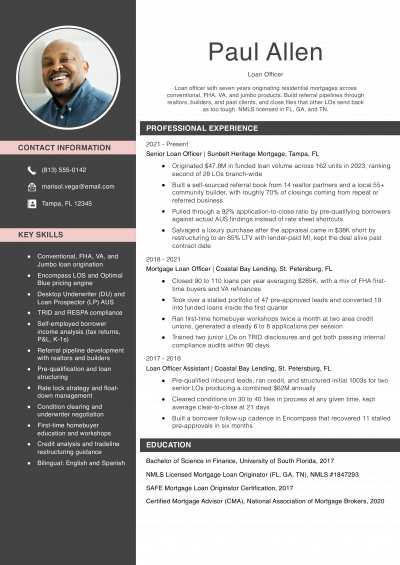
Call out the loan programs you have cleared, such as conventional, FHA, or VA. Note your delegated authority status if you hold it, because that signals you can sign off on loans independently. Include your average pipeline volume and your turn time per file to show speed alongside accuracy.
Frame each bullet around the risk tasks you supported, not the admin work alone. Mention the types of applications you screened and the number of files you prepared each week. If you drafted coverage analyses for a senior underwriter, state that clearly so the role reads as risk work.
Direct Endorsement (DE) underwriters work for FHA-approved lenders, which register eligible underwriters with HUD. If you hold DE status, list it with your mortgage-underwriting qualifications. Many mortgage lenders treat DE status as a core requirement for senior loan underwriter openings.
Yes, state your authority level with a dollar figure whenever your employer allows disclosure. A line like "individual binding authority up to $2M per risk" tells the reader what decisions you can own. Without that figure, underwriting managers have to guess your seniority from job titles alone.
Place a one-line entry in your work history that names the gap period and what you did. If you kept up with continuing education during that time, list the courses under that entry. Underwriting managers care more about current guideline knowledge than an unbroken timeline.
Yes, highlight risk analysis skills that cross both lines, such as financial statement review and loss-trend evaluation. Rewrite your bullets to stress transferable outcomes like approval accuracy rates. Then note any personal lines training or coursework in your education section to bridge the gap.
For an underwriter, an ATS-friendly template is the safest pick, because it puts your certifications and experience where a hiring manager scans first. A basic template is a solid alternative. Whichever you choose, keep the formatting clean and easy to parse: clear section headings, a standard font, and no graphics a parser can choke on.
Underwriter Resume
4.1/5 stars with 132 reviews

Executive Resume Writer and Career Coach
Andrew Stoner is an executive career coach and resume writer with 17 years of experience as a hiring manager and operations leader at two Fortune 500 Financial Services companies, and as the career services director at two major university business schools.
© 2026 Resumetemplates.com All rights reserved.