Tip !

Claims managers scan the summary for claim volume handled and line of business first. Where your state requires an adjuster license, list it in the credentials block to stay competitive.

Andrew Stoner , Executive Resume Writer and Career Coach

Claims Adjuster Resume Examples

Featured Example

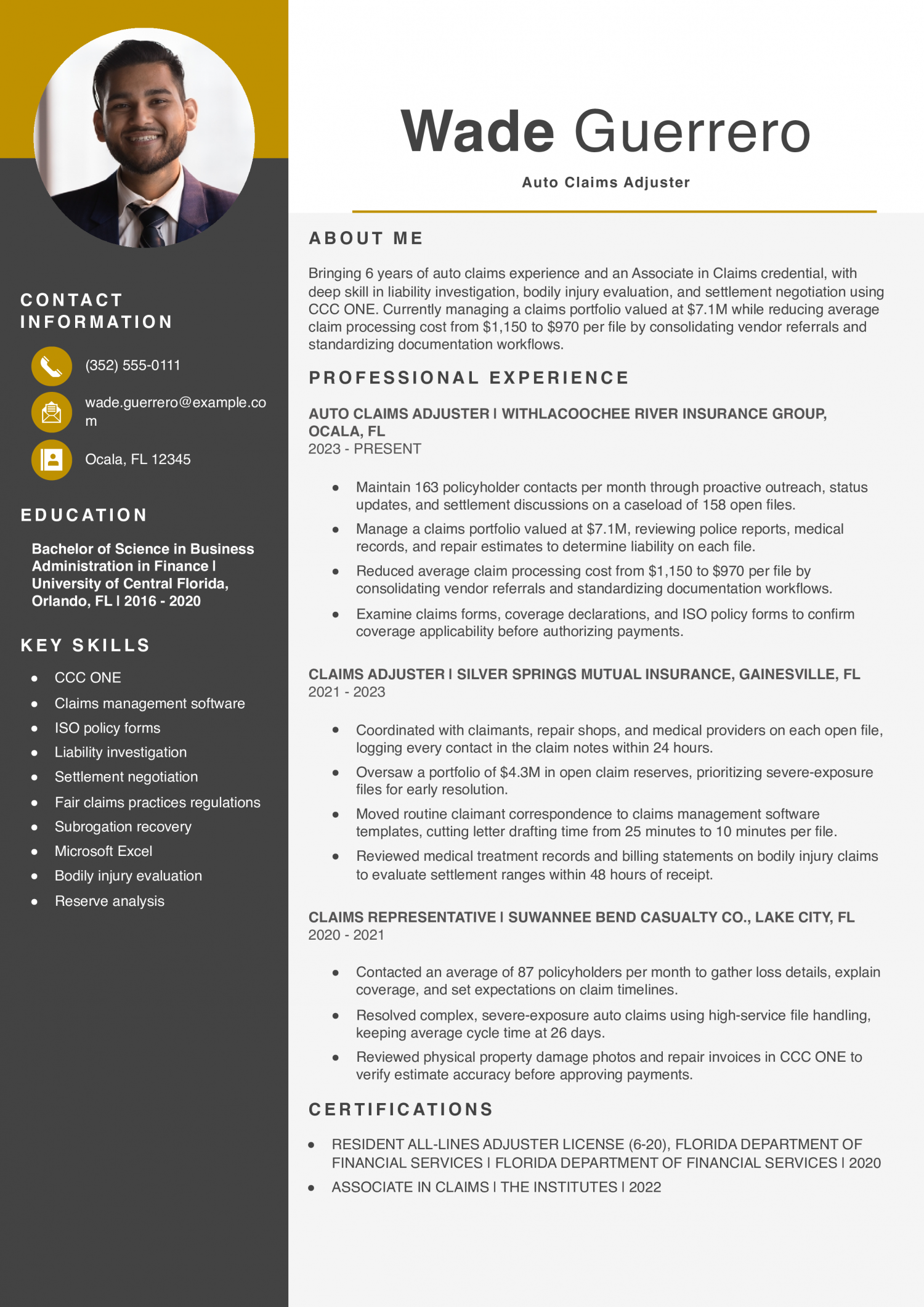
Pick this resume if you are a mid-level auto claims adjuster with about six years of experience and a Resident All-Lines Adjuster License. Copy the way it traces per-file cost reductions across roles to demonstrate growing efficiency.

What to take from this resume example

Many claims adjuster resumes mention cutting costs but leave out the actual dollar figures, forcing the reader to guess how much the improvement mattered. This resume avoids that by writing “Reduced average claim processing cost from $1,150 to $970 per file by consolidating vendor referrals and standardizing documentation workflows.” If you have driven down a per-file cost, cycle time, or expense ratio, place the before number right next to the after number so a claims manager can see the gap without calculating anything.

Claims Trainee Example

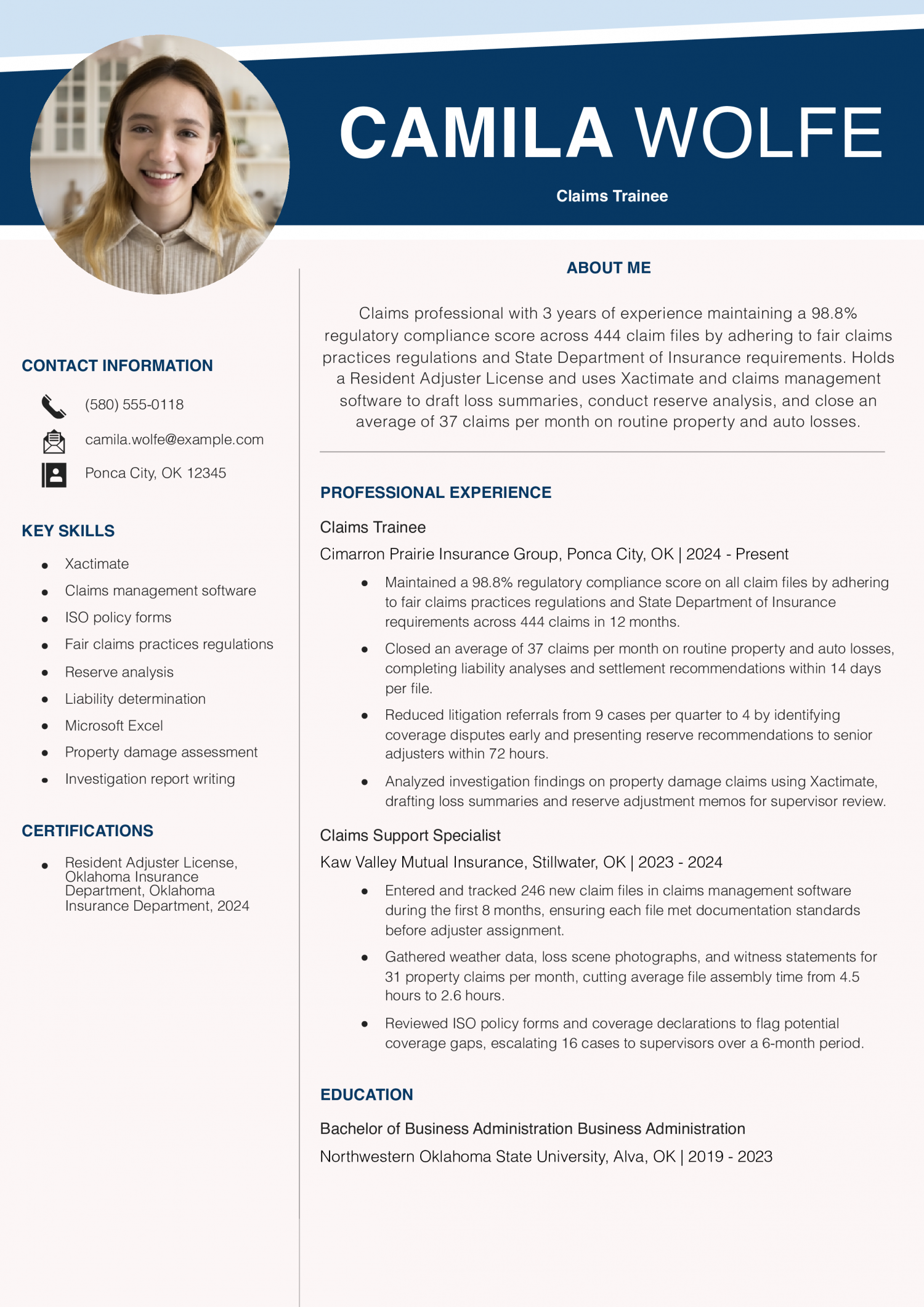
Start with this resume if you are an entry-level claims trainee building your first year of adjuster experience after a support role. Follow how it tracks litigation referral reductions to show early dispute-resolution instinct.

What to take from this resume example

Many claims adjuster resumes describe their workload without telling the reader how fast each file moved from open to closed. This resume pins down a per-file timeline by writing “completing liability analyses and settlement recommendations within 14 days per file.” If you handle a regular volume of claims, attach a specific cycle time to your closing average so a hiring manager can judge your throughput and turnaround together in one line.

Claims Adjuster Example

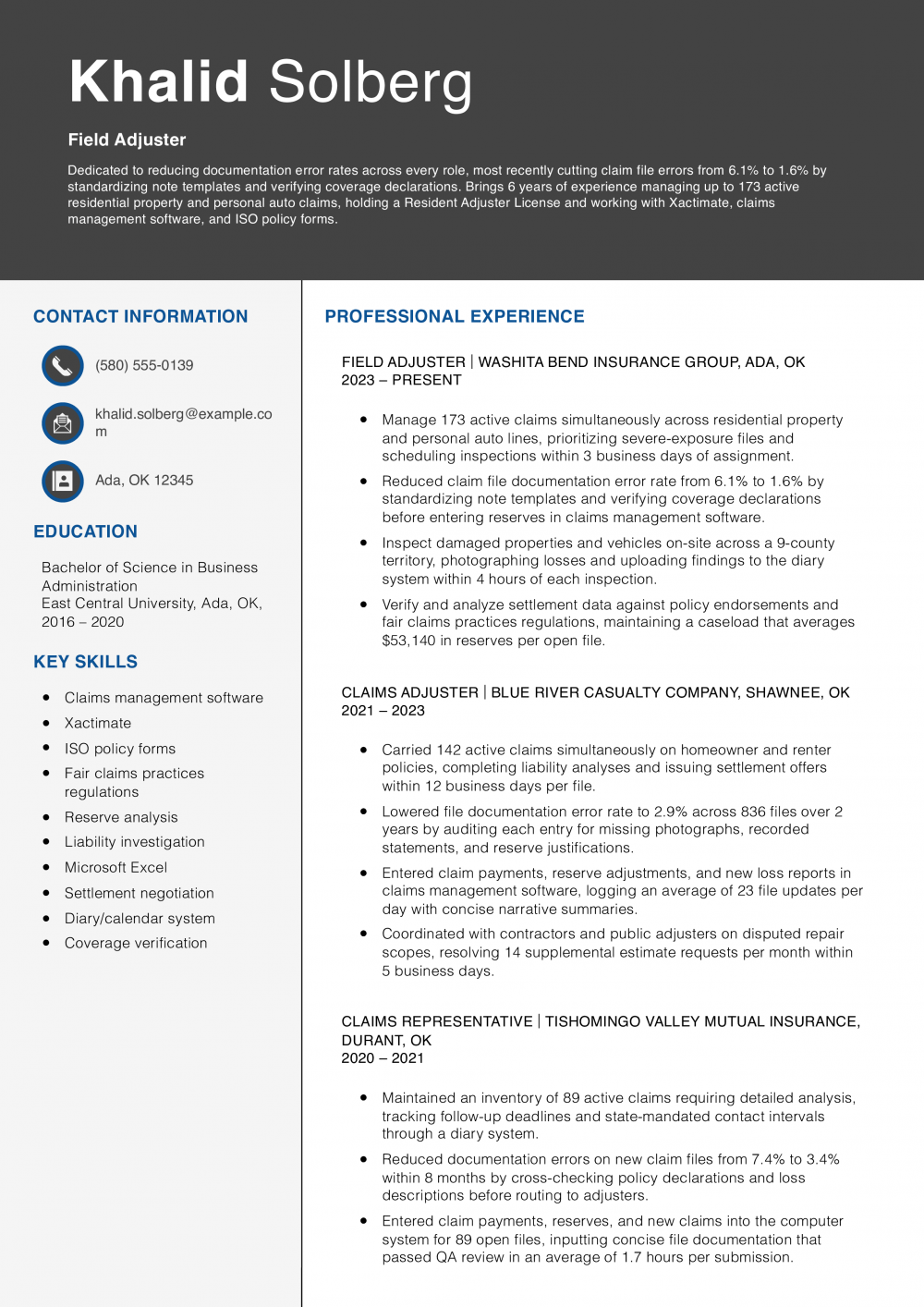
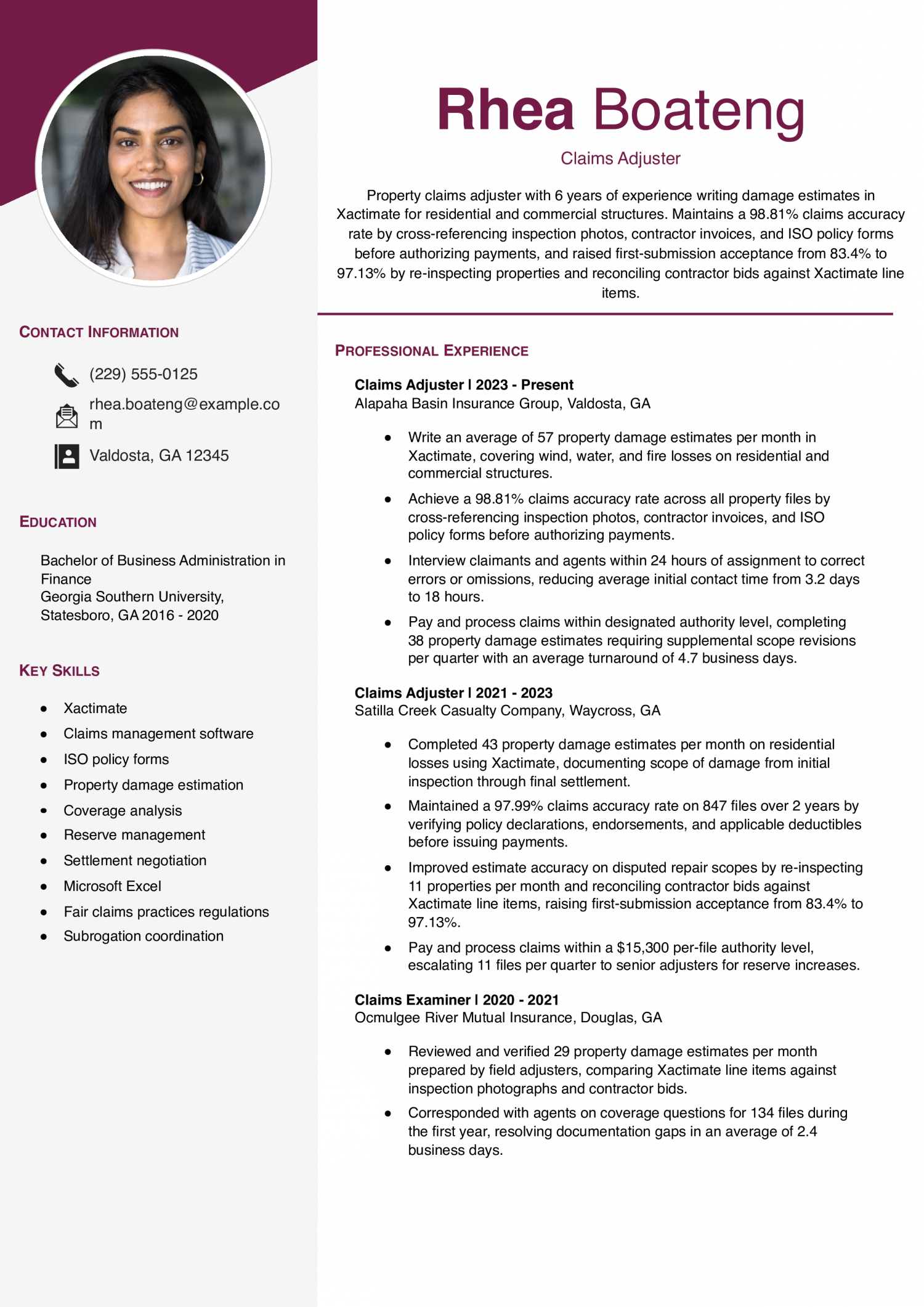
Try this resume if you are a mid-level property claims adjuster with about six years of experience handling wind, water, and fire losses. Raise your accuracy narrative by showing a climbing claims accuracy rate from one employer to the next.

What to take from this resume example

Many claims adjuster resumes mention dispute resolution or re-inspections without showing whether those efforts actually changed outcomes. This resume ties the activity directly to a measurable result by writing “raising first-submission acceptance from 83.4% to 97.13%.” If you have a process you refined or a recurring problem you reduced, pair the starting percentage with the ending percentage so the reader can see the size of the shift without doing any math on their own.

Senior Claims Adjuster Example

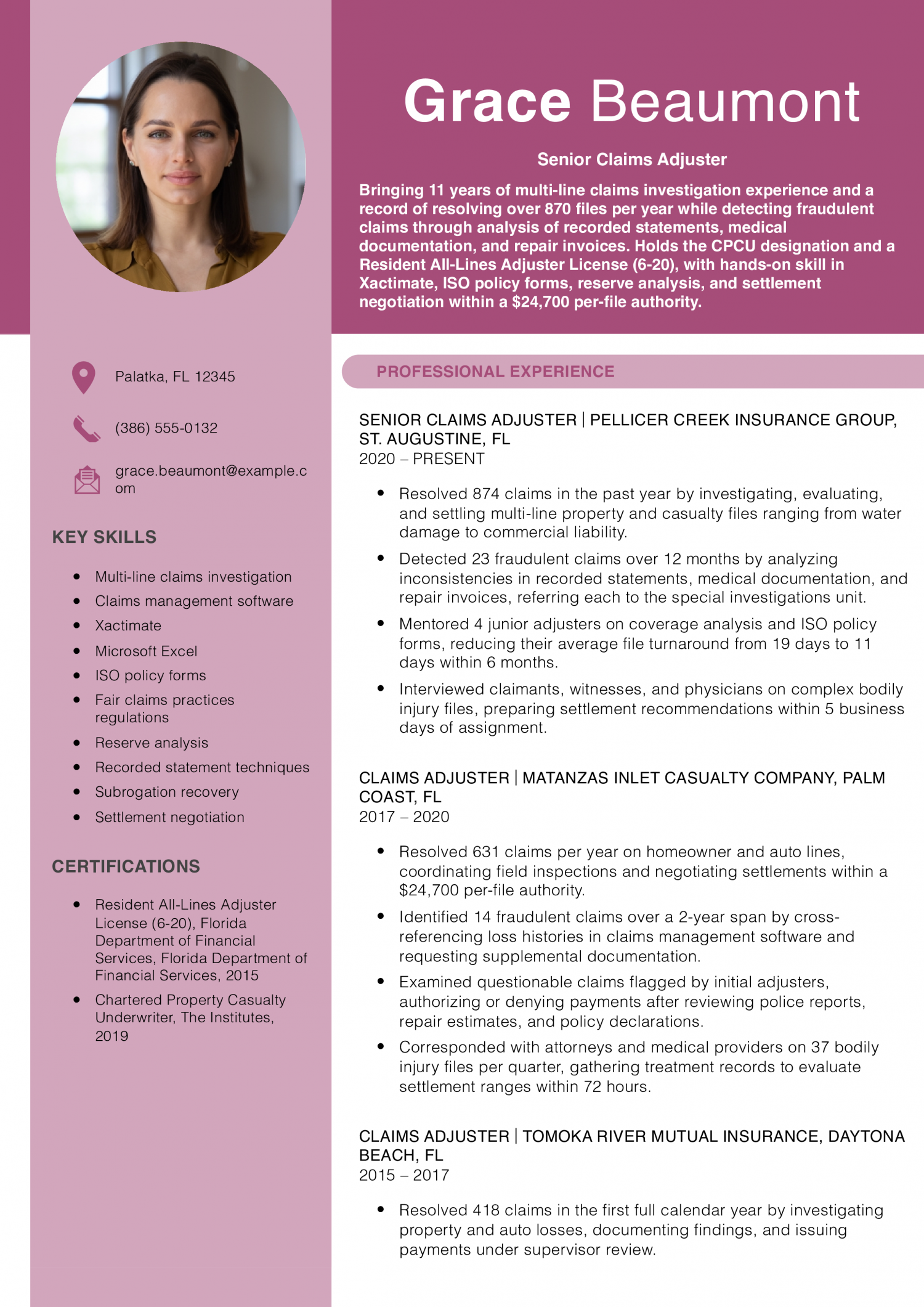
Lean on this resume if you are a senior claims adjuster with roughly a decade of property and casualty experience and a CPCU credential. Quantify fraud detection totals at each employer to show investigative instinct growing alongside your caseload.

What to take from this resume example

Many claims adjuster resumes describe bodily injury work without specifying how fast they delivered their analysis to the file owner or supervisor. This resume sets a clear deadline by writing “preparing settlement recommendations within 5 business days of assignment.” If your role involves evaluating injury claims, attaching a specific number of days between assignment and deliverable lets a hiring manager measure your responsiveness without having to ask about it in an interview.

How to Write a Claims Adjuster Resume

01 Open with a profile naming your claim scope

Your profile sits at the top of page one. It should state your years of adjusting experience and the lines you handle. Name the claim types you work most often, such as auto physical damage and homeowner property.

Then name your typical coverage territory or region. Claims managers and insurance carrier recruiters scan this section in seconds. A profile that names your scope tells them whether your background fits the book they need covered.

State your average caseload size here too. If you handle field inspections, say so. If you work a desk queue, make that clear.

02 Add numbers to every claim outcome

Strong adjuster resumes attach a number to each bullet. Start with your open caseload count per month. Include your average cycle time from first notice to closure.

Name the dollar range of reserves you managed.

If you reduced claim severity, state the percentage drop. A bullet without a number tends to read as a duty, not a result. Pair each metric with the action you took.

For example, write that you cut cycle time from 30 days to 22 by triaging new losses within four hours.

03 Group your work by claim category

Sort your bullet points into the types of work you perform. Coverage analysis is one group. Include tasks like reading policy language and issuing reservation of rights letters.

Damage evaluation is another group.

List field inspections, photo documentation, and vendor estimates. Negotiation and settlement form a third category. Note recorded statements and subrogation recoveries there.

If you handle litigation files, add a group for coordinating with defense counsel. A fifth group could cover fraud detection, such as referring suspicious claims to your internal fraud team.

04 Place credentials and tools on page one

Create a credentials block near your profile section. If your state requires an adjuster license, list it with your state name and active status. Florida and Oklahoma are among the states that license staff adjusters.

Georgia registers staff adjusters through the employer instead.

Rules differ, so list the license where your state requires one. The Associate in Claims from The Institutes signals mid-career depth. The Chartered Property Casualty Underwriter signals senior expertise.

Name the claims platforms you use, such as Guidewire ClaimCenter or Xactimate.

05 End with education and continuing study

List your degree, school name, and graduation year. A bachelor’s degree in insurance, business, or finance is common in this field. If you hold an associate degree, list it the same way.

Below your degree, add any relevant coursework or training hours. If you are pursuing the AIC or CPCU designation, list it as in progress with your expected date. This closing section can also hold volunteer work or industry memberships.

Keep it brief, no more than five or six lines.

Five years ago, a Claims Adjuster resume read like a policy glossary. The mix has shifted toward data points and cycle time results. Software names now matter as much as coverage knowledge.

Claims managers and insurance carrier recruiters weigh hard skills first. They scan for tools and methods that cut claim cycle time. Soft skills like negotiation then confirm you can settle files on your own. Both types need to appear in your bullet points.

Match each table against the posting you target. Turn soft skills into proof by pairing them with numbered results. Add a hard skill only when your work history backs it up. Drop any term the posting does not mention. A tight list beats a long one every time.

Soft Skills AI-estimated %
Investigative judgment 65%
Claimant communication 63%
Detail orientation 44%
Negotiation under pressure 40%
Empathy with claimants 29%

And here are the top hard skills showing up most often.

Hard Skills AI-estimated %
Coverage determination 72%
Liability assessment 66%
Property damage estimation 48%
Claims settlement processing 37%
Medical record review 33%

Skill names and rankings come from an AI model grounded in U.S. Department of Labor occupation data for claims adjusters, not from a count of claims adjusters’ resumes built on ResumeTemplates.com.

Must Have on a Claims Adjuster Resume

The items below are what separate a claims adjuster resume from one that gets put back in the pile.

Niche Keywords for ATS Checkers

Claims managers and insurance carrier recruiters scan for specific terms. Group your keywords by the type of claims you handle. Coverage analysis terms show you can read a policy. Investigation terms prove you verify facts before paying. Negotiation terms cover how you settle with claimants. Compliance terms signal you follow state rules and carrier guidelines. Credentials like AIC or CPCU belong in their own section. Each group below maps to a real adjuster task. Pick the rows that match your daily work. Then mirror those words in your bullet points.

AI Skills to Add

Insurance carriers are split on AI in claims work. Some want adjusters who use AI tools to speed up estimates. Others worry about bias in automated decisions.

Name the tools you use on your resume. Describe how you check AI output before it reaches a claimant. Do not claim AI runs your workflow if you only use it for drafts.

Claims managers and insurance carrier recruiters want to see that you verify every AI result. Honest framing matters more than a long list of tools. Show what you do with the output, not what the model does alone.

Computer vision tools scan photos and flag damage, but adjusters still confirm scope and pricing on site.

Machine learning models score claims for fraud risk, and adjusters review flagged files before any denial.

Predictive models suggest initial reserves based on claim features, though adjusters adjust them as facts change.

AI extracts data from police reports and medical records, reducing manual entry time per claim file.

Chatbots handle status updates and simple questions, freeing adjusters to focus on coverage and liability decisions.

  • Tractable: Scores vehicle damage from photos to help set repair or total-loss estimates.
  • CCC Intelligent Solutions: Uses AI to generate repair cost projections from submitted claim images.
  • Name the AI tool and your review step
  • State how you verified AI-generated estimates
  • Leveraged AI to revolutionize claims processing
  • AI-powered adjuster with cutting-edge expertise

Claims Adjusting Credentials Worth Listing

Claims managers and insurance carrier recruiters look for credentials that prove you can handle loss files beyond a basic level. A state adjuster license is the starting point where your state requires one. Not every state does.

Florida and Oklahoma license staff adjusters, while Georgia registers them through the insurer instead. Beyond licensing, designations from The Institutes show deeper technical knowledge. They tell reviewers whether you can evaluate complex property losses or lead a high-severity claims team.

List the issuing body and your current status for each credential. Add the year you earned it so reviewers can gauge your experience level. Place these entries in a dedicated section near the top of your resume.

  • Associate in Claims: The Institutes issues this designation, and claims managers often expect it for mid-level adjuster roles.
  • Chartered Property Casualty Underwriter: The Institutes awards the CPCU, and senior claims leaders tend to list it when seeking supervisory posts.
  • State Adjuster License: Your state department of insurance issues this where required, so list it if your state mandates one.

Latest BLS Statistics for Claims Adjusters

For Claims Adjusters, the 10th-percentile floor sits about 37 percent below the median. The top-decile ceiling runs roughly 50 percent above it. That gap is wide enough to reward line-of-business depth, geographic choice, and credential stacking over a career.

National employment is large, so the field absorbs new adjusters steadily. Still, where you land in the range depends on the claims you handle and the territory you cover. Position your resume around the claim types you have closed and the volume you carry.

Show your state adjuster license where your state requires one. Add the Associate in Claims or CPCU designation if you hold either.

$78,000 National median annual
$80,470 National mean annual
$48,850 10th percentile
$117,040 90th percentile
324,230 Claims Adjusters in the U.S.
Where you stand

Below median

$48,850 to $78,000 Lead with the claim types you have settled and your total file count.

Above median

$78,000 to $117,040 Show the average reserve value you manage and your subrogation recovery record.

Top 10%

$117,040+ Lead with complex or specialty lines you adjust, such as commercial property or liability.

Top-paying states

# State Median Annual
1 District of Columbia $101,150
2 New Jersey $95,690
3 Maryland $95,560
4 California $91,790
5 Connecticut $88,330
6 Alaska $87,670
7 New York $87,130
8 Rhode Island $86,520
9 Vermont $83,970
10 New Hampshire $83,890

Highest-employment states

# State Workers Median
1 Texas 29,220 $78,800
2 Florida 28,100 $76,920
3 California 24,290 $91,790
4 New York 17,330 $87,130
5 Illinois 14,210 $77,010
-5.5% projected growthJob outlook, 2025-2035

Source: U.S. Bureau of Labor Statistics, Employment Projections, 2025-2035. View on bls.gov
Source: U.S. Bureau of Labor Statistics, OEWS May 2025 release (SOC 13-1031). View on bls.gov
Written by professional resume writers and loved by hiring managers

Resume Templates offers HR approved resume templates to help you create a professional resume in minutes. Choose from several template options and even pre-populate a resume from your profile.

Frequently Asked Questions

How do I become a claims adjuster with no experience?

Apply for trainee roles at insurance carriers. A business or finance degree can help, but a high school diploma or equivalent is typically sufficient for entry-level claims adjuster roles. Highlight transferable skills such as investigation, negotiation, and customer service from prior jobs.

In states like Florida or Oklahoma, you will also need to obtain the required adjuster license before you begin.

Does claims adjuster experience look good on a resume?

Yes. Claims adjuster experience signals strong analytical and negotiation skills that transfer well into risk management or underwriting roles. Quantify your results with settlement volumes or claim closure rates so the experience carries measurable weight.

What keywords should I include on a claims adjuster resume?

Pull keywords from the job posting first. Common terms include liability determination, subrogation, and reserve setting. Also list the claims software you have used, such as Xactimate or Guidewire ClaimCenter.

These terms help your resume pass through applicant tracking systems before a recruiter reads it.

How should a property adjuster resume differ from an auto adjuster resume?

A property adjuster resume should stress roof inspections, structural estimates, and tools like Xactimate. An auto adjuster resume should focus on vehicle appraisals and total loss valuations.

Tailor every bullet to the claim type the posting describes so claims managers see an exact match.

Should I list my state adjuster license on my resume?

Yes, if your state requires one. Florida and Oklahoma both require licensed adjusters, so listing your active license shows you meet a legal prerequisite. In Georgia, staff adjusters are registered by their employer, so note that registration status instead.

Place the license or registration near the top of the first page for quick review.

How do I handle an employment gap on a claims adjuster resume?

Note any relevant activity during the gap, such as coursework or earning the Associate in Claims designation. If the gap was personal, a one-line note is enough.

Focus the rest of the resume on measurable claim outcomes so the gap does not dominate the page.

Can I use a two-page resume as a claims adjuster?

A second page is reasonable if you have more than 10 years of experience across multiple carriers or claim types. Keep the strongest results and most recent roles on the first page.

Claims managers often scan page one in under 30 seconds, so front-load your best numbers there.

What's the best resume template for a claims adjuster?

For a claims adjuster, an ATS-friendly template is the safest pick, because it puts your certifications and experience where a hiring manager scans first. A basic template is a solid alternative. Whichever you choose, keep the formatting clean and easy to parse: clear section headings, a standard font, and no graphics a parser can choke on.

Rate this article

Claims Adjuster Resume

Average Rating

4.1/5 stars with 191 reviews

You have given 0 Star(s)
4.1/5 stars with 191 reviews
Andrew Stoner

Executive Resume Writer and Career Coach

Andrew Stoner is an executive career coach and resume writer with 17 years of experience as a hiring manager and operations leader at two Fortune 500 Financial Services companies, and as the career services director at two major university business schools.