Chef Resume Examples
Your profile should state your years on the line, the venue type you’ve cooked in (fine dining, hotel, banquet, country club, fast-casual), and the cuisine or station you’re known for. Name covers per service and…
Every resume example is written and reviewed by our team of Certified Professional Resume Writers to ensure top-quality content and formatting.
A strong kitchen manager resume leads with food cost control and labor numbers. General managers and restaurant owners scan for proof you kept costs in a target range. They want to see how you ran inventory, cut waste, and held ticket times.
Your resume should name the systems you used, like POS platforms or prep tracking tools. List any ServSafe or ACF credentials you hold. The kitchen manager resume examples below show how to turn your back-of-house results into a clear, hire-ready format. To compare layouts before you start, browse our resume templates.
Documented food cost reductions, team retention rates and a current ServSafe certification listed near the top are what separate the Kitchen Manager resumes that general managers and restaurant owners schedule for interviews from the rest.
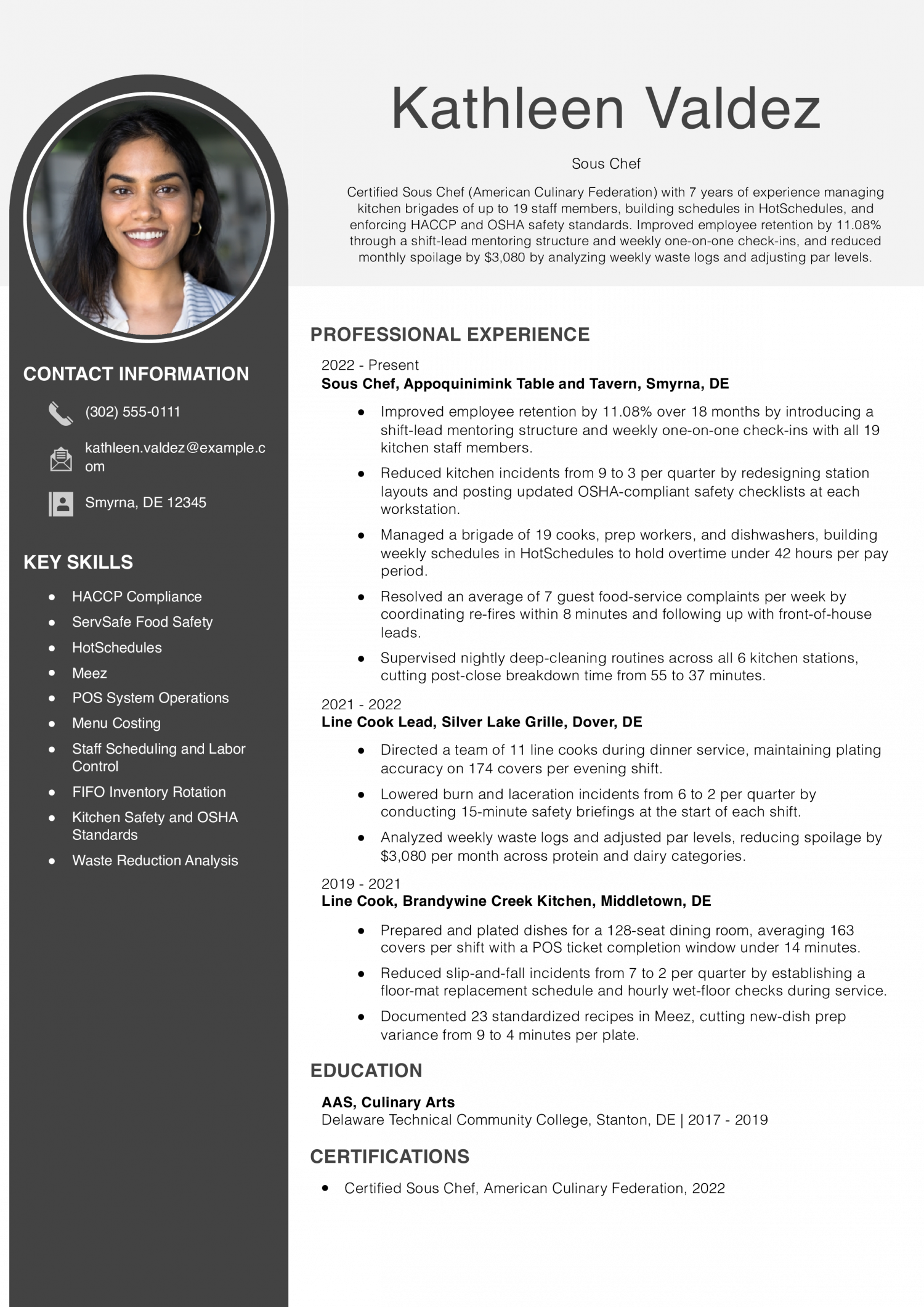
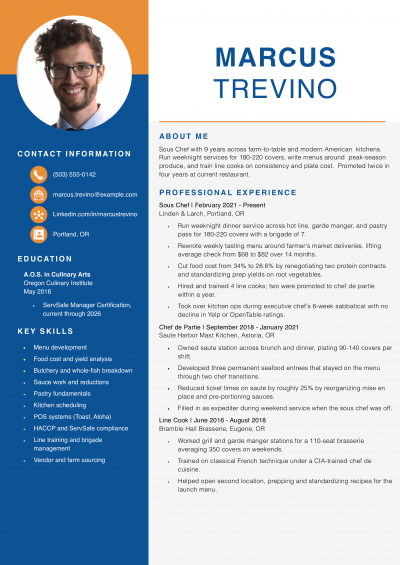
Consider this resume if you are a mid-level sous chef with about 7 years of experience ready to run a full kitchen operation. Lead with retention and safety incident reductions stated as before-and-after counts per quarter.
Kitchen incidents dropped from one count to another after station layouts and safety checklists changed. Restaurant owners see both the problem and the fix in one bullet. State the old and new incident counts and name the change behind the drop.
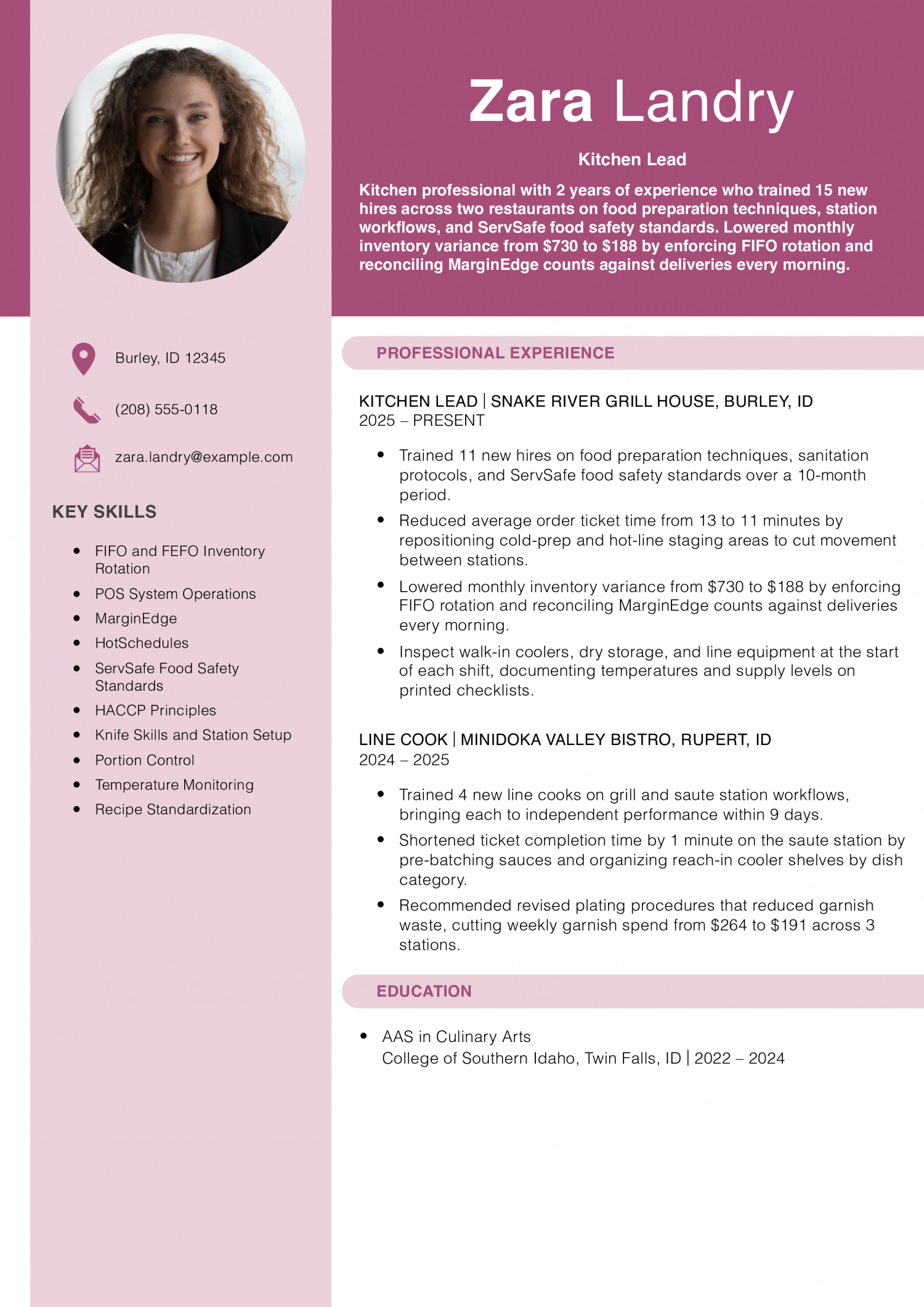
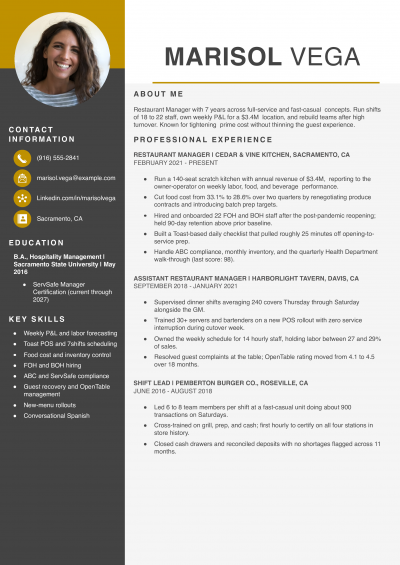
Use this resume if you are an entry-level kitchen lead with about 2 years of cooking and supervisory experience moving into a formal lead role. Lead with inventory and ticket-time improvements that attach before-and-after numbers to each operational change.
Training work names the headcount, the topics covered, and the time it took. General managers can picture the full effort, not a vague mention of teaching. Say how many people you trained, what you covered, and how long it lasted.
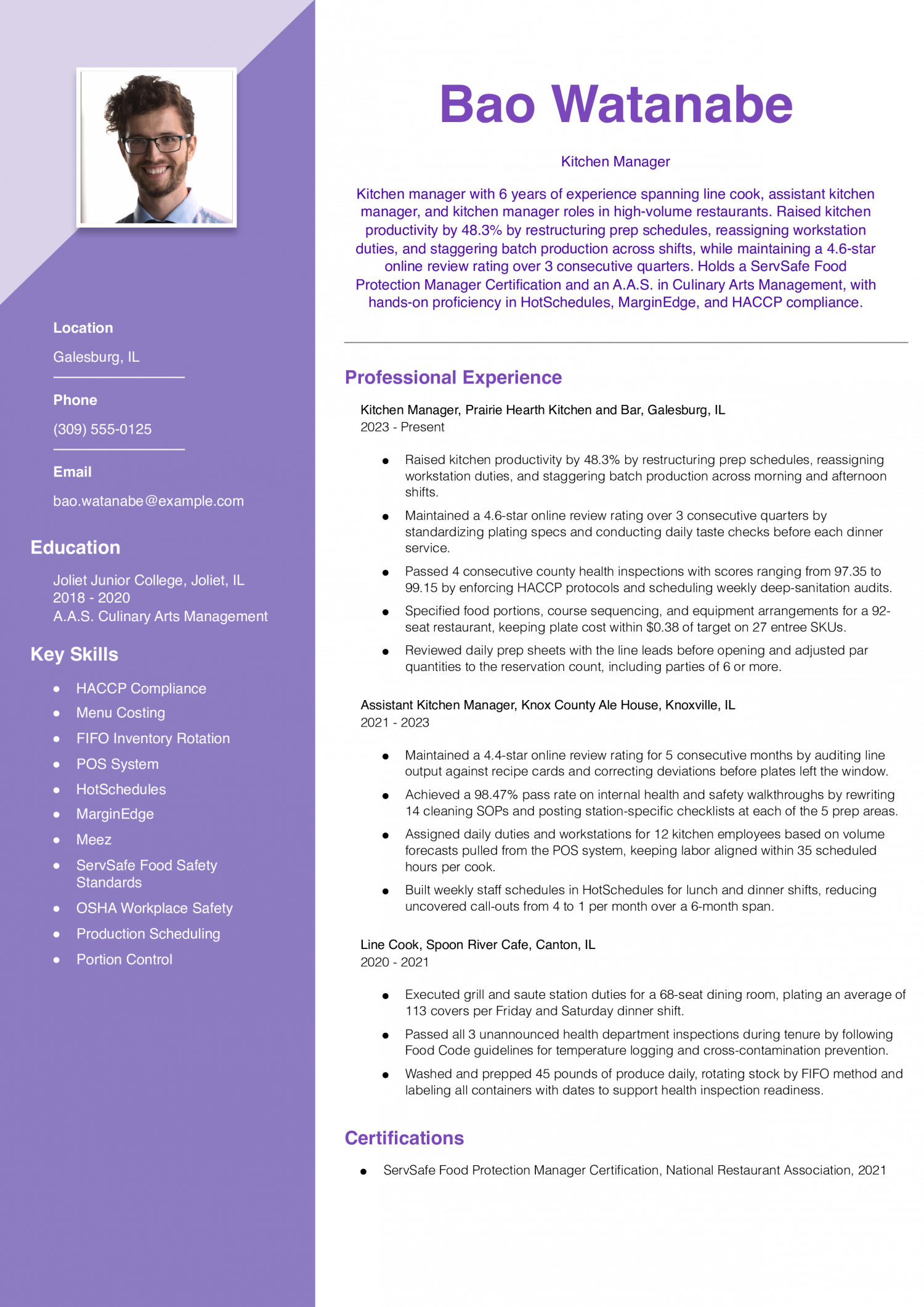
Try this resume if you are a mid-level kitchen manager with around 6 years of experience moving from line work into full kitchen oversight. Lead with health inspection scores and productivity gains tied to the specific scheduling or sanitation methods you used.
Plate cost held within a tight dollar range across a named number of menu items. Food-and-beverage directors see cost control at the dish level, not a round number. State how close your actual cost landed to the target and how many items you tracked.
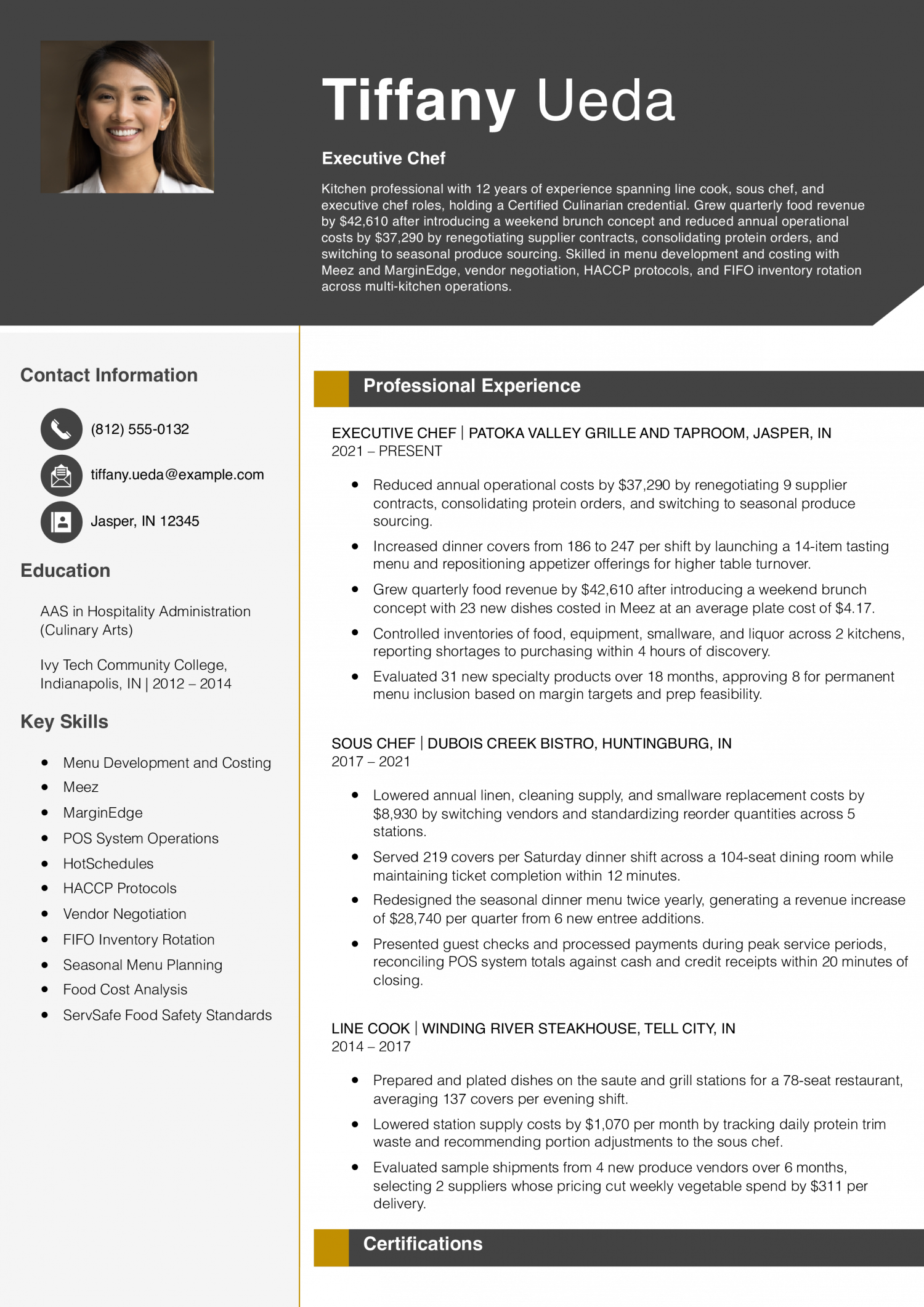
Lean on this resume if you are a senior executive chef with over a decade of progressive kitchen experience aiming for a high-volume or multi-unit role. Lead each bullet with a dollar figure tied to the sourcing, menu, or vendor decision that produced it.
Product evaluation names how many items were tested, how many made the cut, and the criteria for each decision. A restaurant group sees a screening process, not a tasting. Say how many products you reviewed, how many you approved, and what ruled each one in or out.
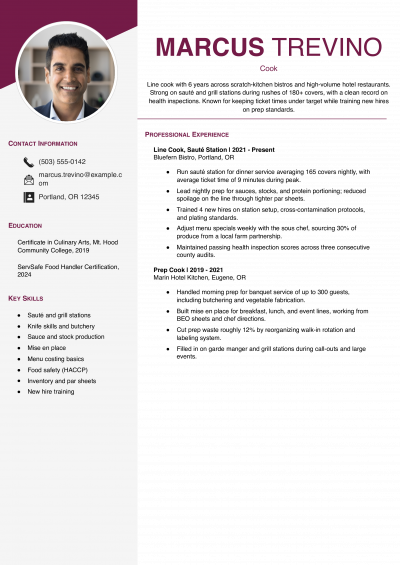
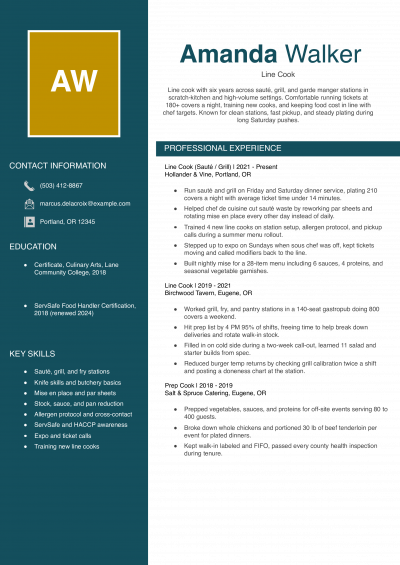
Kitchen supervisor and line cook lead with 6 years of experience, a ServSafe Food Handler certification, and an A.A.S. in Culinary Arts. Cut mis-fired tickets from 9 to 4 per week by training 6 line cooks on a new prep-list format and walking the line before each service. Skilled in POS System Operations, HotSchedules, FIFO Stock Rotation, HACCP Protocols, and end-of-shift cash handling.
General managers and restaurant owners can verify your food safety card in seconds. They cannot search for the trait that sets you apart from other candidates in the hiring pool. Lead your summary with one detail no database holds, something that speaks to your culinary leadership style.
That might be a Certified Sous Chef credential from the American Culinary Federation. It could be fluency in Spanish for a bilingual line crew. Maybe you built a scratch kitchen program from a heat-and-serve model.
Pick the single fact that makes you distinct. Place it in the first line of your summary so it reads before anything else. This detail frames the rest of your resume around a clear identity.
Without that detail, your resume looks like every other applicant with a food safety card.
Most strong kitchen manager resumes tie each bullet to a measurable outcome that proves your impact. Start with food cost percentage, since owners watch it daily. Note the dollar value of inventory you controlled each month.
Crew size matters too, so state how many cooks you scheduled per shift. Tickets per hour during peak service show your pace under pressure.
Write “Cut food waste 18% over six months” instead of “Reduced food waste.” Even rough figures give your claims weight, because hiring managers trust concrete data over broad language. Two or three metrics per role keep the section sharp. Avoid vague words like “improved” or “managed” on their own.
Your bullets should fall into a few visible groups. Food cost and purchasing is the first group. Cover ordering, vendor talks, and waste tracking here.
The second group is crew leadership. Include hiring, training, scheduling, and shift coverage in this set. Health and safety is the third group.
Add HACCP logs, temp checks, and inspection prep. The fourth group is menu and production. Cover recipe builds, prep lists, and plate standards there.
Sorting work this way helps restaurant owners scan your resume fast, and they can find the area they care about most in seconds. Aim for two to three bullets in each group so that every category carries enough weight to show real depth. If one group has only a single bullet, fold it into the closest related category instead of leaving it alone.
List your ServSafe Food Protection Manager Certification near the top of page one. Put it in a credentials block right below your summary. Restaurant owners scan for it before they read your work history, so its placement matters a great deal.
If you also hold a ServSafe Food Handler card, add it on the same line. The Certified Culinarian credential from the American Culinary Federation fits here too. Name each issuing body beside the credential so nothing looks vague.
Include any POS systems you know, such as Toast or Aloha. Add inventory tools like MarketMan or BlueCart on the same line. Placing these items above your experience section saves the reader from hunting.
Owners often reject resumes where safety credentials appear only at the bottom.
For entry-level and mid-level kitchen managers, education belongs at the end. List your culinary arts degree or associate program with the school name. Add the year you finished.
If you hold no degree, list any formal apprenticeship or training program instead. Relevant coursework in nutrition, hospitality management, or food science can strengthen a thin section and show continued professional development. Keep this block to three or four lines at most.
Do not repeat credentials you already placed at the top of the page. If you earned your Certified Sous Chef credential through the American Culinary Federation, it stays in the credentials block. Close with any current coursework or a food safety renewal date.
This gives general managers a clear, complete final impression of your background.
Check both tables below against the posting you want. Pull every skill that appears in the ad. Place hard skills in your bullet points with a number or result attached. Food cost control paired with a dollar figure works well. Inventory management tied to waste reduction does the same.
General managers and restaurant owners weigh hard skills first. They want proof you can run a safe kitchen on budget. Soft skills then show how you lead a line crew under pressure.
Treat each soft skill as a label for a result. Conflict resolution means nothing on its own. Pair it with a story about turnover or team retention instead. Add the skill phrase, then prove it with data in your bullets.
| Soft Skills | AI-estimated % |
|---|---|
| Team leadership | 78% |
| Customer complaint resolution | 68% |
| Composure under pressure | 46% |
| Clear delegation | 39% |
| Cross-shift communication | 34% |
And here are the top hard skills showing up most often.
| Hard Skills | AI-estimated % |
|---|---|
| Food safety compliance | 70% |
| Staff scheduling | 62% |
| Kitchen inventory management | 44% |
| Food cost control | 38% |
| Sanitation procedure enforcement | 29% |
Skill names and rankings come from an AI model grounded in U.S. Department of Labor occupation data for kitchen managers, not from a count of kitchen managers’ resumes built on ResumeTemplates.com.
Start with the food handler certifications section.
Food safety credentials signal trust to general managers. They also meet local health code rules. List each one with its issuing body and expiry date.
Kitchen managers interact with POS platforms every shift. Naming the exact systems you know saves review time. General managers want proof you can start fast.
Restaurant owners staff around peak meal periods. Stating your open availability removes a common concern. A brief line near your header works well.
Tip: Place Availability Near Your Contact Header
Write your availability in plain terms. Use day parts such as morning, evening, or weekend. Avoid vague phrases like “flexible schedule” with no detail.
If you can cover holidays or double shifts, say so. This kind of detail matters for high-volume kitchens. It shows you understand real scheduling demands.
Beyond any local food safety card your county or state requires, the certifications below tell general managers and restaurant owners how deep your training goes. They signal your skill in food safety systems and culinary technique. They also show your readiness to lead a kitchen team under pressure.
List the issuing body and your current expiration date for each one. If a credential has no expiration, note the year you earned it instead. Not every employer asks for the same set, so check the posting before you apply.
Some states treat a food protection manager credential as a legal requirement for the person in charge of a kitchen. Others leave it up to the operator. Adding one or more of these credentials to your resume helps you stand out in either case.
Kitchen manager falls under a broad BLS group that includes all first-line supervisors of food prep and serving workers. That larger group is one of the bigger occupations tracked by BLS. The median pulls in a long tail of entry-tier and lower-credentialed roles.
The spread from the 10th percentile to the 90th is wide. Workers near the bottom earn roughly a third less than the median. Those near the top earn about half more.
That gap tells you that scope and credentials matter on the page. Lead your resume with the size of the kitchen operation you run, the team count you manage, and your food-cost percentage.
| # | State | Median Annual |
|---|---|---|
| 1 | Washington | $59,400 |
| 2 | District of Columbia | $57,170 |
| 3 | Connecticut | $52,940 |
| 4 | Colorado | $50,550 |
| 5 | Vermont | $49,820 |
| 6 | New Hampshire | $49,710 |
| 7 | Hawaii | $48,880 |
| 8 | New Jersey | $48,420 |
| 9 | Rhode Island | $48,400 |
| 10 | Delaware | $48,120 |
| # | State | Workers | Median |
|---|---|---|---|
| 1 | Texas | 137,930 | $36,480 |
| 2 | California | 130,190 | $46,980 |
| 3 | Florida | 91,500 | $44,470 |
| 4 | New York | 65,580 | $47,190 |
| 5 | Ohio | 51,990 | $37,340 |
Resume Templates offers HR approved resume templates to help you create a professional resume in minutes. Choose from several template options and even pre-populate a resume from your profile.
Lead each bullet with an action verb and a measurable result tied to that duty. For example, write "Reduced weekly food waste by 18% through revised prep schedules" instead of "Responsible for food waste." Framing duties as outcomes shows general managers you improved the operation.
Yes, the reverse-chronological format works for both roles. Shift the focus from front-of-house metrics to back-of-house results like food cost percentage and ticket times. Restaurant owners expect to see kitchen-specific inventory and labor data near the top of each entry.
One page is the standard unless you have more than ten years of progressive kitchen leadership. A second page is fine when you need space for multiple locations or high-volume concepts. Keep each job entry to four or five strong bullets so the page stays focused.
A two-sentence summary works better than an objective for most kitchen manager candidates. State your years of back-of-house leadership and one standout metric, such as a food cost target you held. Restaurant owners often scan this section before reading your work history.
List each promotion as its own entry under the same employer, with separate dates and bullets. Highlight the shift from executing recipes to managing labor schedules and vendor relationships. This progression signals to general managers that you earned leadership through performance.
Address the gap with a brief note if you used the time for training or personal reasons. A line reading "Career break, completed ServSafe Food Handler certification" turns downtime into proof of initiative. Leaving a gap without context invites questions that a short explanation would prevent.
No, many postings accept equivalent work experience in place of a culinary degree. If you studied but did not finish, list the school name and credits completed. Pair that entry with relevant certifications from the American Culinary Federation to strengthen the education section.
An ATS-friendly template gives your food safety credentials and work history their own sections. A basic template works well for kitchen roles.
Kitchen Manager Resume
4.5/5 stars with 209 reviews

Executive Resume Writer and Career Coach
Andrew Stoner is an executive career coach and resume writer with 17 years of experience as a hiring manager and operations leader at two Fortune 500 Financial Services companies, and as the career services director at two major university business schools.
© 2026 Resumetemplates.com All rights reserved.